Cheek dimples develop primarily from variations in facial musculature, particularly the zygomaticus major muscle. While natural dimples typically appear during facial movement, a created dimple behaves differently at first, as explained in why a new dimple shows at rest before it shows only on smiling.
Differences between static and dynamic indentations involve muscle attachments and skin tethering. Examining these structural traits clarifies how dimples behave naturally, why they occasionally alter over time, and what patients can expect regarding postoperative settling and facial contours.
What Causes a Cheek Dimple
A natural cheek dimple occurs due to an anatomical variation in the facial muscles. In most individuals, the zygomaticus major muscle extends from the cheekbone down to the corner of the mouth to lift the lips during a smile.
Key points
- Cheek dimples result from a bifid zygomaticus major muscle that tethers the skin.
- Inheritance is debated, possibly autosomal dominant with variable penetrance or irregular dominant.
- Dimples may appear or fade between childhood and adulthood.
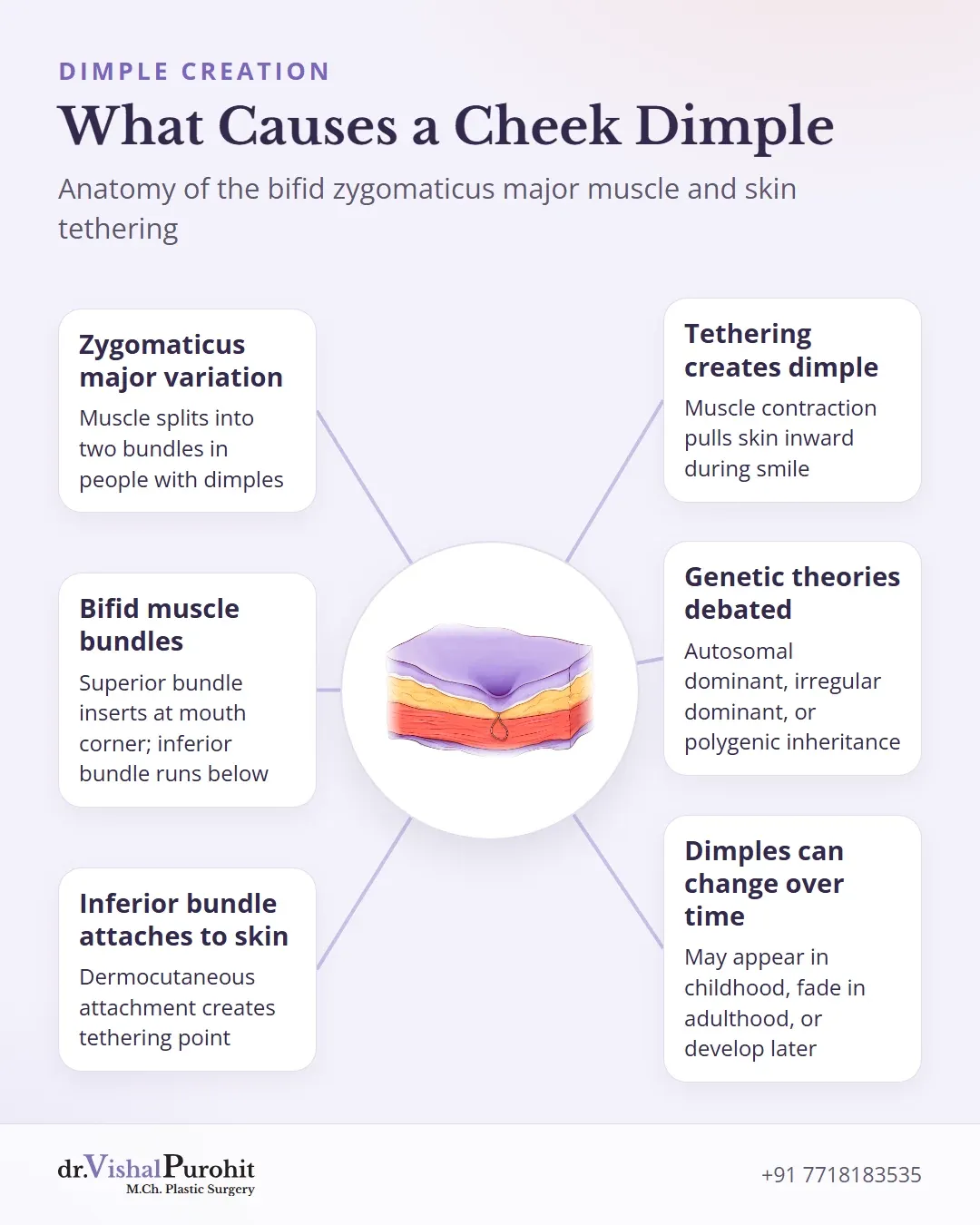
In people with cheek dimples, this structure often splits into two separate muscle bundles, forming a double or bifid zygomaticus major muscle. The superior bundle inserts at the corner of the mouth, while the inferior bundle travels below it and attaches directly into the overlying skin. This dermocutaneous attachment creates a tethering effect, pulling the facial skin inward when the muscle contracts during a smile. Fibrous bands and neighboring muscle variations may also contribute to the indent.
The genetic basis of cheek dimples remains under debate:
- Some studies describe them as an autosomal dominant trait on chromosome 16 with variable penetrance.
- Other researchers consider them an irregular dominant trait because two parents with dimples may not have a child with dimples.
- Inheritance may involve multiple genes rather than a single set of alleles.
Dimples can also change over time, occasionally appearing or fading between childhood and adulthood.
Dynamic Dimples
A dynamic dimple is a facial indentation that appears only during facial animation, such as smiling or talking, and disappears when the face is at rest. Natural cheek dimples typically behave as dynamic indentations that show on smiling.
Anatomical Basis
Anatomically, cheek dimples are primarily caused by the insertion of fibers from a double or bifid zygomaticus major muscle into the dermis. When this mimic muscle contracts during a smile, dermal tethering draws the skin inward, creating the visible depression.
The depth of a dynamic dimple varies with different facial expressions:
- It can appear deeper when smiling with the mouth closed and the corners of the mouth tightened.
- It may appear less pronounced during a wide smile with exposed teeth.
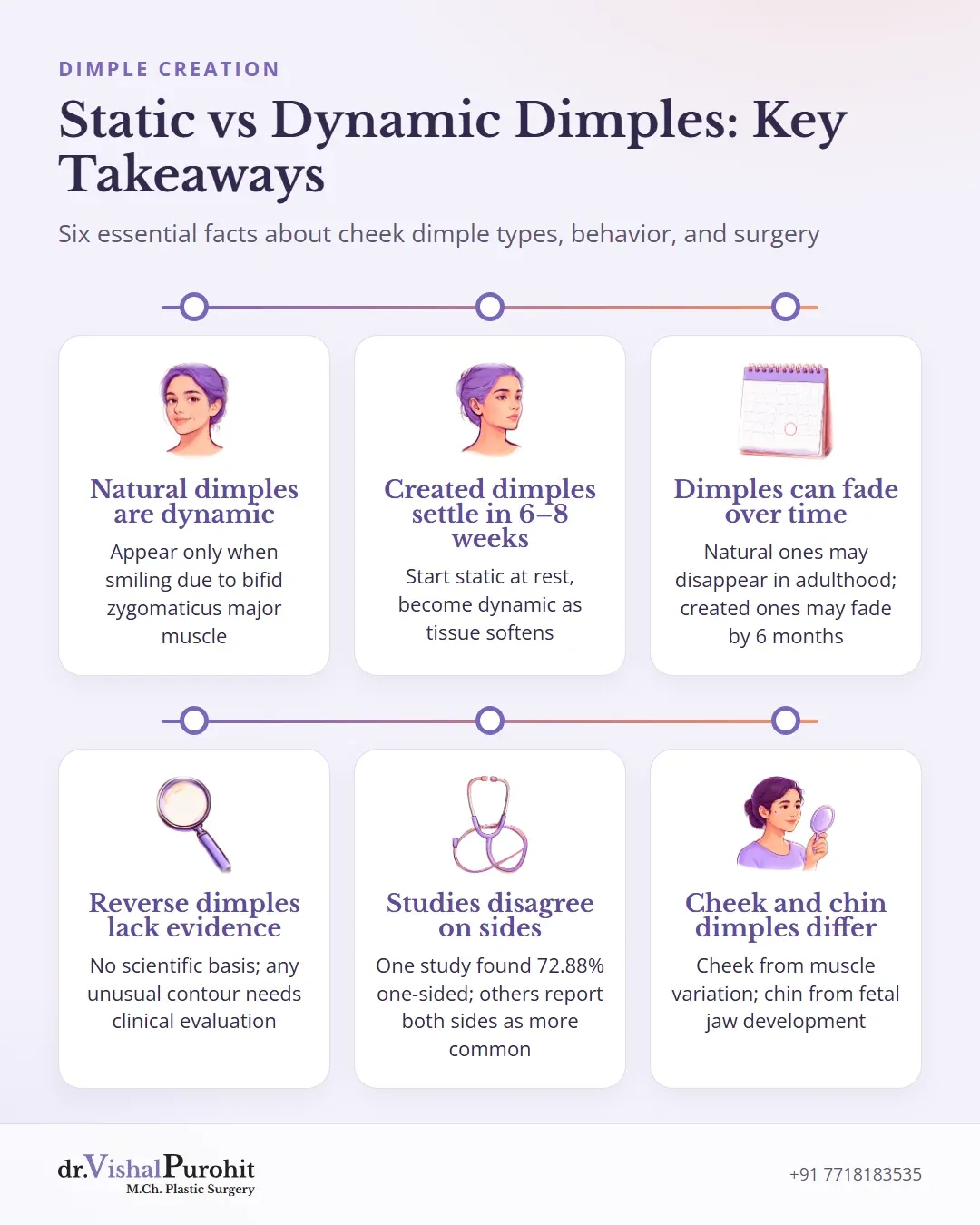
A created dimple starts out static and settles over several weeks into this dynamic pattern.
Static Dimples
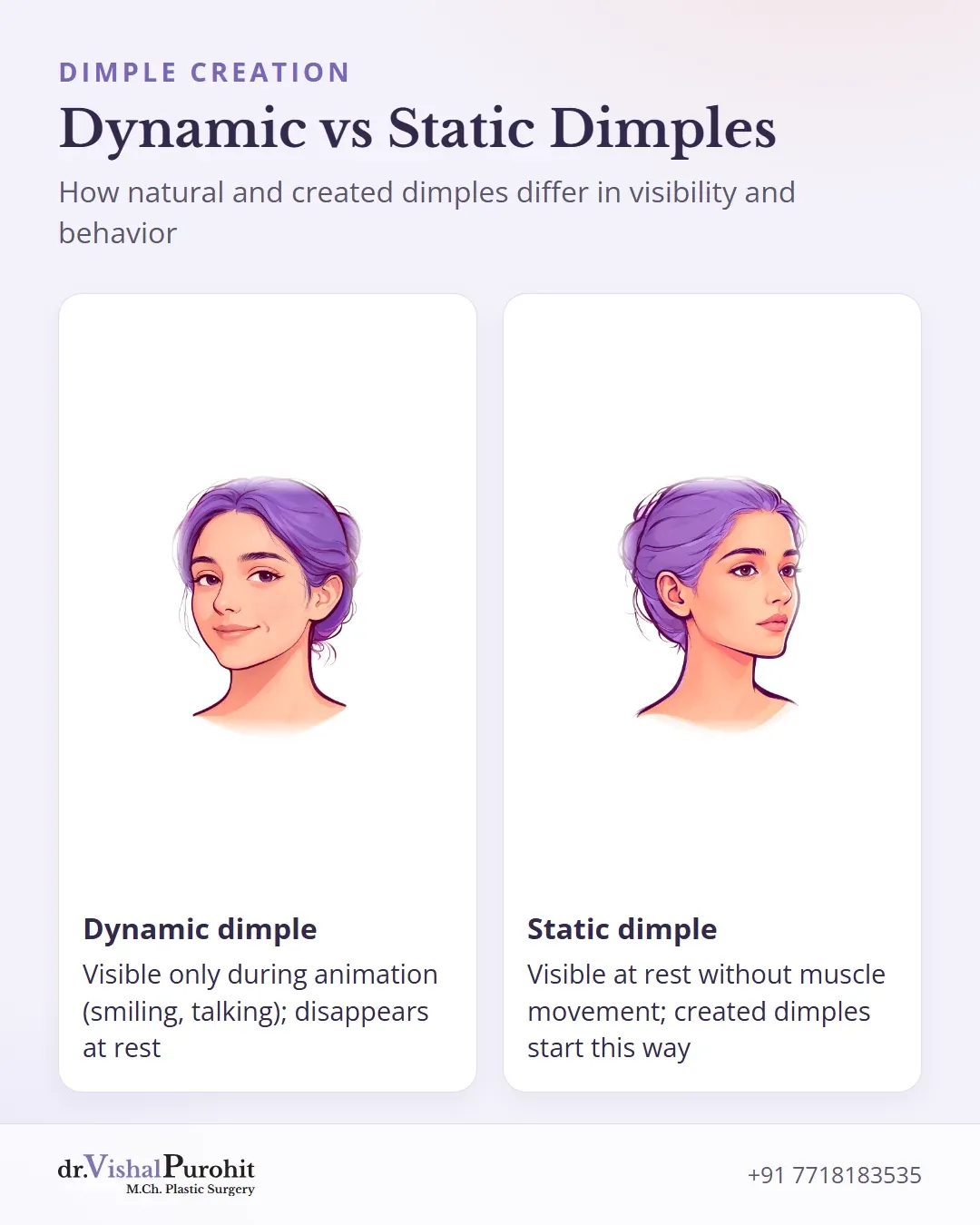
A static dimple is an indentation visible on the cheek even when facial muscles are completely at rest.
In nature, static dimples are less common, as facial indentations typically act as dynamic features that accentuate during facial animation. Literature reports that naturally occurring dimples present as longitudinal depressions measuring 0.5 to 1.5 cm.
Postoperative Presentation and Settling
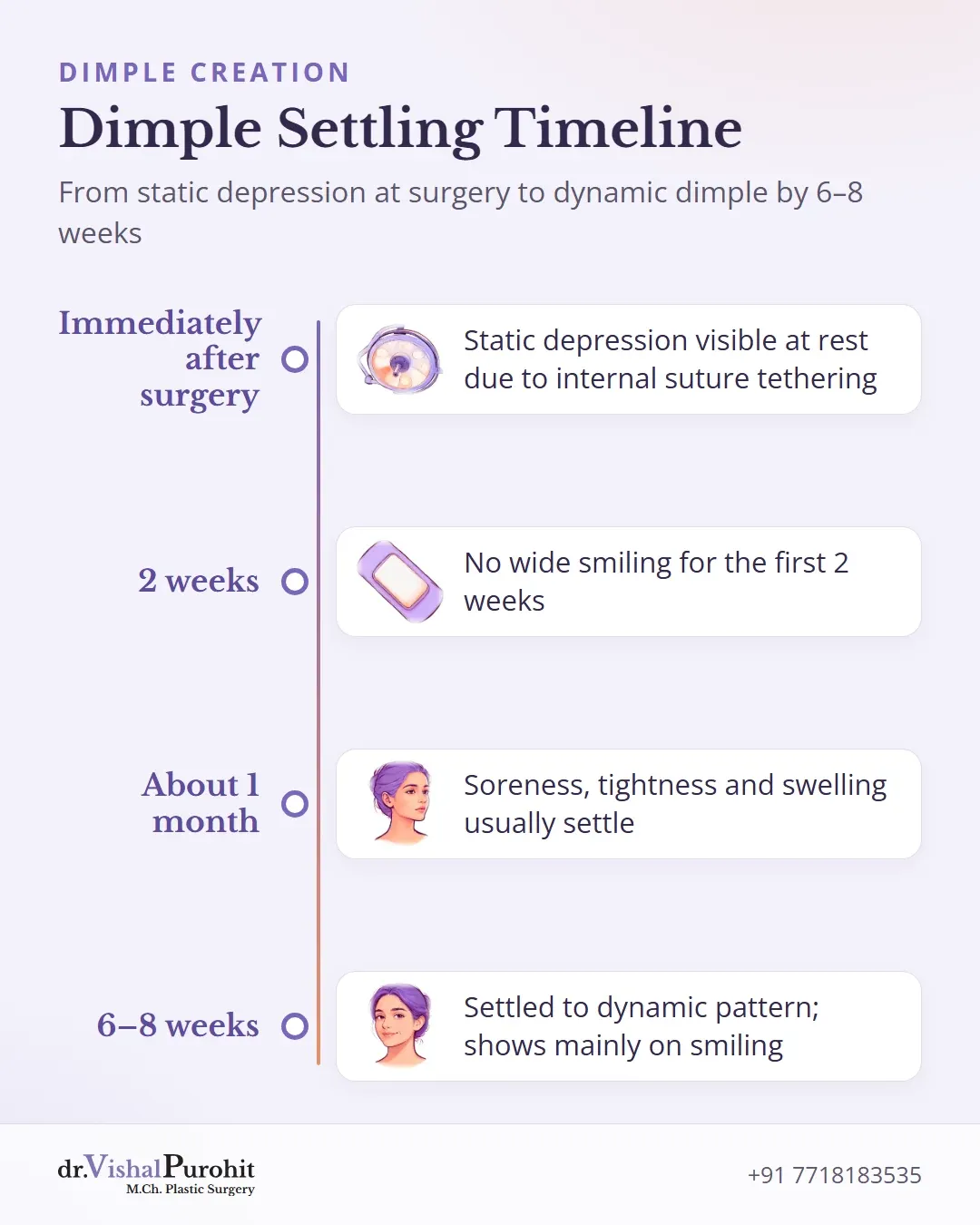
Unlike typical natural dimples that appear primarily during laughter or movement, a newly created surgical dimple presents as a static depression immediately following the procedure. In published surgical series, this initial static appearance gradually softens over time, leaving only a subtle trace at rest while deepening on animation.
Dr. Purohit’s note: In the surgical practice of Dr. Vishal Purohit in Jaipur, a created dimple shows at rest at first and settles by about 6 to 8 weeks to show mainly on smiling.
Faded Dimples
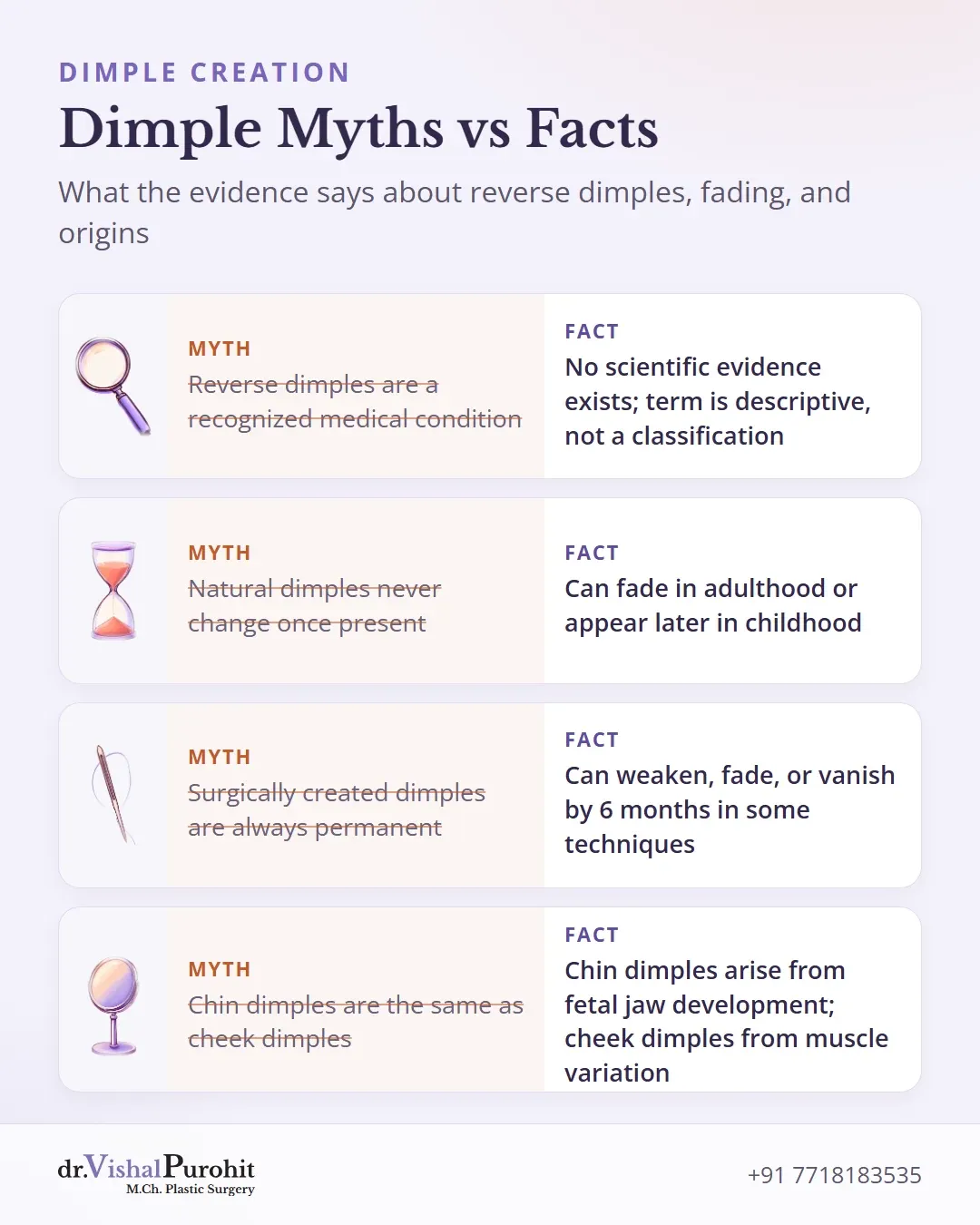
Natural cheek dimples do not always remain unchanged throughout life. While some individuals keep their dimples permanently, in other people dimples can alter over time. An individual who displays cheek dimples during childhood may find they disappear in adulthood. Conversely, a child born without dimples can also develop them later during childhood.
Dimple Fading After Surgery
In surgical dimpleplasty, late changes can also occur. Literature notes that created dimples can weaken, fade, or disappear over time. In certain suture-based techniques, dimples have been reported to fade or vanish by the end of six months.
In Dr. Vishal Purohit’s practice, a created dimple lasts for most patients but can fade in some; how long a created dimple lasts is covered separately.
Reverse or Inverted Dimples
Some people use the term reverse or inverted dimple to describe a small outward bump or bulge on the cheek that appears in place of an inward depression when smiling.
In clinical literature, however, there is little to no documented scientific evidence regarding this presentation. The term is a popular descriptive phrase rather than a recognized medical classification or an established anatomical variation. Standard medical texts define a natural cheek dimple as a depression in the cheek that forms during facial expression, typically associated with underlying muscle action such as the contraction of the zygomaticus major.
Because medical literature does not define an anatomical mechanism for an inverted or reverse dimple, no confirmed surgical or structural explanation exists for it.
Any unusual facial swelling, asymmetry, or unexpected contour change during expression should be evaluated in person by a qualified surgeon to understand the true tissue structure involved.
Other Dimple Variations
Natural dimples vary from person to person in side, site and shape. Round or linear shapes and the choice of one or two dimples are discussed in cheek dimple types, and placement in the ideal cheek dimple position.
Key points
- Natural dimples vary in side (unilateral or bilateral), site (cheek or chin), and shape (round or linear).
- One study found 72.88% of cheek dimples were unilateral, though other sources report bilateral dimples as more common.
- Chin dimples arise from fetal developmental variations, and Dr. Purohit performs cheek dimple creation only.
Unilateral and Bilateral Distribution
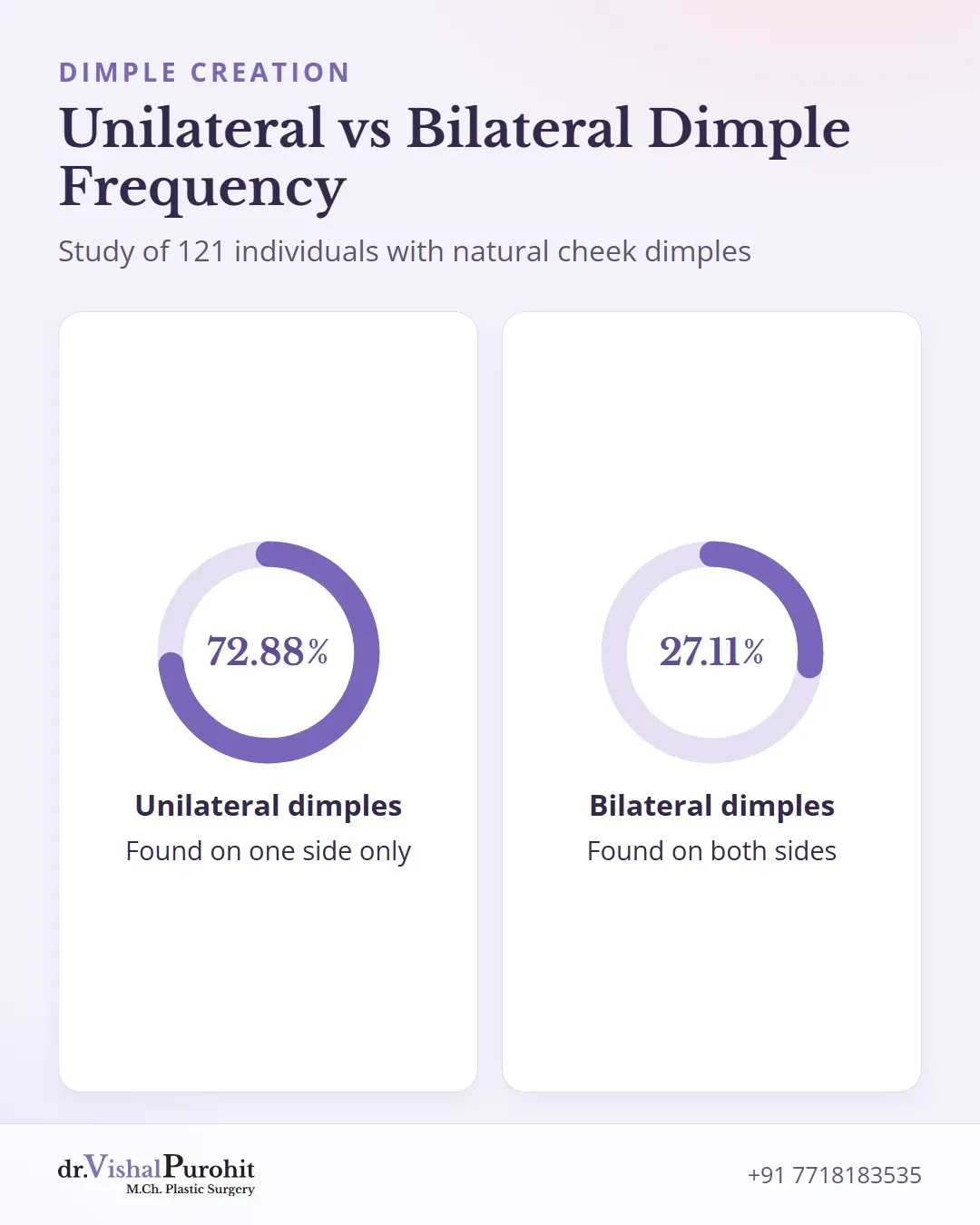
Cheek dimples can express on both sides of the face or on only one side. In a study of 121 individuals with natural dimples, unilateral cheek dimples were identified in 72.88% and bilateral dimples in 27.11%. However, other medical literature reports that bilateral cheek dimples are more common than unilateral ones.
Anatomical Site and Morphology
While cheek dimples relate to underlying facial musculature, a chin dimple results from foetal developmental variations, such as incomplete fusion of the jaw halves forming a notch in the mandibular symphysis or failure of the paired mentalis muscle to unite.
Dr. Vishal Purohit creates cheek dimples only, not chin dimples.
Cheek Dimple Consultation in Jaipur
The operation is described on the page for dimple creation surgery in Jaipur. Dr. Vishal Purohit creates dimples on one side or both, for adults aged 18 and above; who is suited is covered in the dimpleplasty candidate guide. The procedure uses an absorbable internal suture through a small incision inside the cheek, with no skin incision. It is performed as daycare, usually under local anaesthesia (₹20,000 for one side, ₹35,000 for two) or general anaesthesia on request (₹55,000). For further details on candidacy and placement, review the dimple creation FAQs or contact +91 7718183535.
This is educational information, not medical advice.