
TUE - SUN: 11:00 AM – 07:00 PM

Aesthetic & Reconstructive Surgery

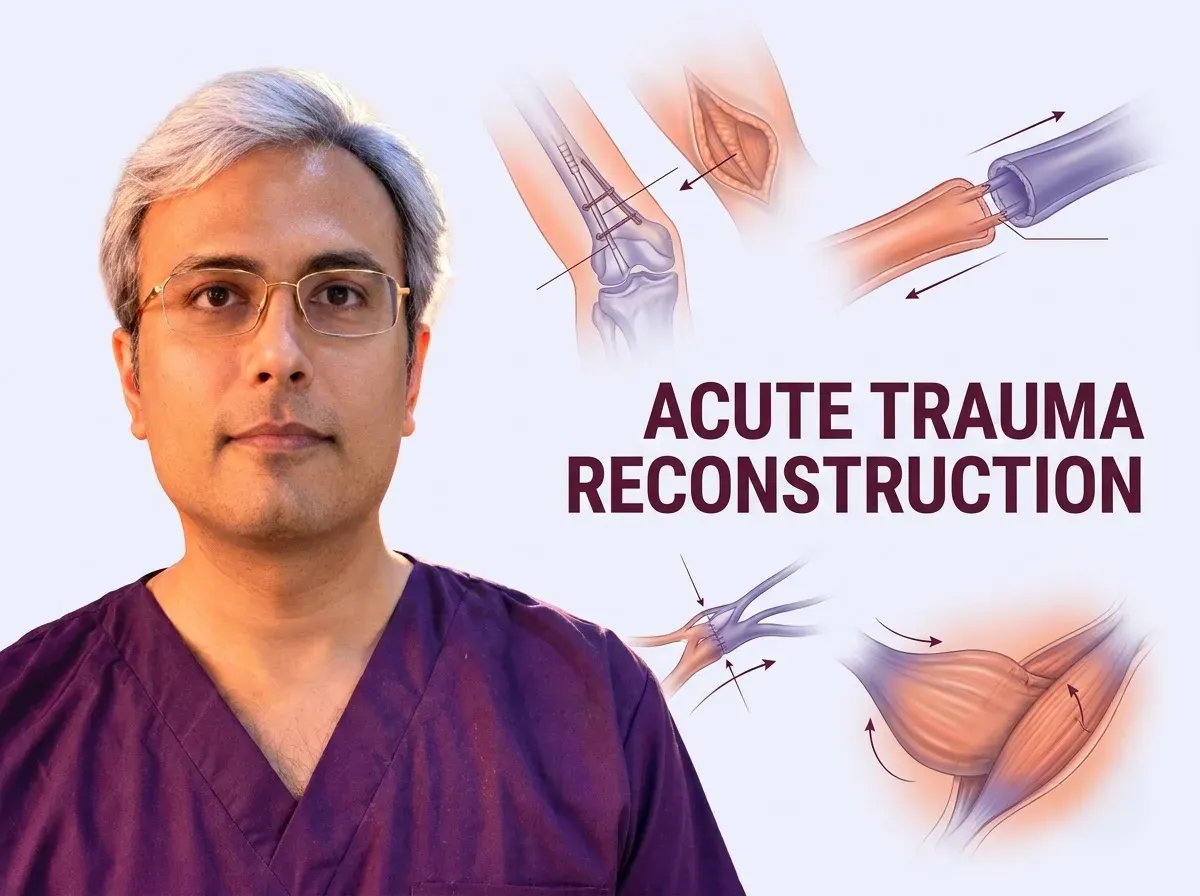
Ear Trauma & Auricular Reconstruction in Jaipur

Ear Trauma & Auricular Reconstruction in Jaipur - Dr. Vishal Purohit Plastic Surgeon Jaipur11+ Years of Surgical Experience

Cartilage framework re-approximation and skin preservation to restore normal ear projection and contour.

Urgent and elective auricular reconstructive surgery repairing torn earlobes, severed helix cartilage, and subtotal ear avulsions.

  • M.Ch Plastic Surgeon · RMC Reg. 28041/14185
  • Day-care / short-stay procedure
  • Tonk Road, Jaipur
  • Jump to FAQs (10)

Procedure Time

1–3 hours

Anesthesia

Local Anesthesia with sedation or General Anesthesia

Hospital Stay

Daycare or 1 overnight stay

Recovery Time

Protective ear splint: 2 weeks; Framework stabilization: 6–8 weeks

Indications

Auricular lacerations, subtotal/total ear avulsion, cauliflower ear hematomas, severe split earlobe deformities

Techniques

Chondrocutaneous composite re-attachment, pocket technique, postauricular skin flaps, cartilage carving and realignment

Injured or Torn Ear

Will my ear ever look and function normally again?

Traumatic ear injuries from road accidents, bites, or sharp lacerations can sever cartilage and skin, threatening permanent deformity if not reconstructed promptly.

Torn or Avulsed Ear Segment

Partial or total ear avulsions from trauma leave exposed cartilage vulnerable to infection and irreversible structural collapse.

Exposed Cartilage After Laceration

Bare helix or conchal bowl cartilage rapidly desiccates, risking suppurative chondritis that melts the entire ear framework.

Auricular Haematoma and Cauliflower Ear

Unevacuated auricular haematomas destroy natural convolutions, leading to permanent cauliflower deformity of the ear.

Why Ear Cartilage Cannot Wait

The auricle's cartilaginous framework is covered by remarkably thin, adherent skin with minimal subcutaneous fat. Once cartilage is exposed, it lacks its own blood supply and desiccates rapidly, inviting suppurative chondritis that chemically dissolves the framework — making early surgical intervention essential to prevent permanent structural loss.

Dr. Vishal Purohit - M.Ch Plastic & Cosmetic Surgeon Jaipur

Dr. Vishal Purohit

M.Ch Plastic & Cosmetic Surgeon

✓

Credential Level

M.Ch Super-Specialty

RMC Reg. 28041/14185

Your Surgical Guide

Artistic Proportion & Advanced Surgical Safety

"Our priority is to salvage and restore the ear's cartilaginous architecture — realigning fractured segments, achieving tension-free skin coverage, and preserving framework integrity so the auricle heals with normal projection and contour."

— Dr. Vishal Purohit

1

M.Ch Plastic & Reconstructive Surgery, SMS Medical College, Jaipur

The highest super-specialty surgical qualification in India, ensuring total anatomical mastery of neurovascular planes and soft tissues.

2

11+ Years as a Plastic Surgeon

Hundreds of procedures performed, with a focus on natural, proportionate results.

3

Accredited Operating Suites

Dr. Vishal Purohit operates in sterile hospital operating theatres, with certified cardiac anaesthesiologists and ICU support.

Simple & Transparent

Your 3-Step Surgical Journey

We remove anxiety and uncertainty with a structured, transparent pathway designed for absolute safety and peace of mind.

1

Confidential Assessment

Dr. Purohit evaluates your anatomical baseline, skin elasticity, and health history. You receive an honest feasibility blueprint, personalized surgical plan, and transparent cost with zero pressure.

Step 1: Planning
2

Precision Operating Suite Procedure

Performed by Dr. Vishal Purohit in a sterile hospital operating theatre under gentle anaesthesia. Using advanced minimally invasive techniques, target areas are treated with microscopic care.

Step 2: Procedure
3

Monitored Recovery & Transformation

Supported with tailored recovery guidelines and post-operative follow-up visits. As tissue heals and settling occurs over the coming weeks, your refined results emerge.

Step 3: Recovery
Clinical Guide & In-Depth Information

Comprehensive Medical Overview

Detailed procedural analysis, anatomical considerations, and patient guidelines by Dr. Vishal Purohit.

Aesthetic Reconstruction for Traumatic Ear Lacerations & Cartilage Loss

The human ear (auricle) possesses an intricate, delicate cartilaginous framework covered by remarkably thin, adherent skin with minimal subcutaneous fat. Traumatic injuries from road traffic collisions, dog bites, human bites, or sharp lacerations pose serious reconstructive challenges because exposed cartilage rapidly desilicates and develops suppurative chondritis, which can melt the ear framework and cause permanent cauliflower deformity.

Reconstructive Principles in Ear Trauma

Dr. Vishal Purohit applies specialized plastic surgical techniques to salvage and restore ear architecture:

  • Cartilage Preservation & Alignment: Precision realignment of fractured helix, antihelix, and conchal bowl cartilage using fine, non-absorbable or slow-absorbing 5-0 monofilament sutures placed through perichondrium.
  • Tension-Free Skin Resurfacing: Utilizing adjacent retroauricular (behind the ear) skin flaps or preauricular advancement to completely cover bare cartilage and avoid ischemic necrosis.
  • Subtotal Avulsion Salvage: For amputated or partially avulsed ear segments, microvascular replantation, composite chondrocutaneous grafting, or the Mladick pocket technique (dermabrading skin and burying cartilage in retroauricular skin) is performed to preserve framework integrity.

Cauliflower Ear and Hematoma Evacuation

Auricular hematomas are urgently evacuated with through-and-through bolster compression dressing to prevent cartilage necrosis and restore natural convolutions.

Your Safety Comes First

Why Your Surgeon’s Training Matters

Ear Trauma & Auricular Reconstruction in Jaipur involves delicate anatomy, blood supply and tissue handling. Choosing on price alone, or an operator without plastic-surgery training, raises the risk of contour irregularities and complications.

With Dr. Vishal Purohit, your safety is backed by intensive-care support, certified cardiac anaesthesiologists and hospital-grade theatre protocols.

What to watch out for

  • Operators without plastic-surgery training
  • Rushed or imprecise tissue handling
  • Clinic rooms without emergency backup
  • Higher chance of visible scars or revision surgery

With Dr. Vishal Purohit

  • M.Ch super-specialist plastic surgeon
  • Careful, tissue-preserving technique
  • Hospital-grade operating theatre
  • Personal follow-up through recovery
Ear Architecture Restored

Rebuilt ear with natural projection and contour

Auricular reconstruction aims to re-establish the ear's structural framework and skin cover, allowing the helix, antihelix, and conchal bowl to resume their normal form and relationship.

Cartilage Framework Realigned

Precision suturing of helix, antihelix, and conchal cartilage through perichondrium restores the ear's natural three-dimensional architecture.

Cartilage Protected from Necrosis

Retroauricular skin flaps and preauricular advancement completely cover bare cartilage, preventing ischaemic necrosis and chondritis.

Avulsed Segment Salvaged

Composite chondrocutaneous grafting or the Mladick pocket technique offers a pathway to preserve and reintegrate amputated ear segments.

Got Questions?

Frequently Asked Questions

Honest, clinically precise answers from Dr. Vishal Purohit regarding Ear Trauma & Auricular Reconstruction in Jaipur.

What is ear trauma and auricular reconstruction in Jaipur?

Ear trauma means injury or loss of ear tissue; auricular reconstruction rebuilds the ear's shape and support. It may follow bites, cuts or other accidents, and reconstruction aims to restore appearance and function. Dr. Vishal Purohit, M.Ch. plastic surgeon in Jaipur, can explain options based on damage extent and available tissue.

Reconstruction must recreate both the ear's cartilage framework and its skin cover. The approach varies with how much ear is missing, whether nearby skin is healthy, and whether the injury is fresh or scarred. Small defects may use local cartilage and skin flaps, while larger or total loss may need rib cartilage or, when skin and soft tissue are badly damaged, a bone-anchored prosthesis. BAPRAS notes trauma often follows bites or sharp cuts and replantation attempts may fare poorly, so the area is often tidied and rebuilt later. Complications may occur in 3–8% of operations, more often after severe trauma or secondary reconstruction.

After surgery, a protective dressing is usually kept for 3 to 5 days, and you should avoid pressure on the ear. A soft headband at night for 4 to 6 weeks can protect the new position. Rib cartilage use may leave chest donor-site effects to discuss. If ear injury or deformity concerns you, you may consult Dr. Vishal Purohit in Jaipur to discuss realistic reconstruction options and recovery.

When might an amputated ear segment be suitable for microsurgical reattachment after ear trauma?

An amputated ear segment may be suitable for microsurgical reattachment only after a clean, sharp cut when usable artery and vein are available; very small defects under 1.5 cm may survive as a composite graft. M.Ch. plastic surgeon Dr. Vishal Purohit in Jaipur can explain whether your injury pattern allows this option.

Microsurgical replantation depends on vessel quality, and a sharp amputation usually leaves better candidate vessels than an avulsion, where vessels may be irreversibly injured. Even when an artery is found, veins are often small or damaged, so venous outflow can be difficult. Microvascular replantation is technically demanding because vessels are tiny, and leeches may be used if no vein is found; necrosis can occur and require removal, and even partial necrosis can deform cartilage. If reattachment is unsuitable, the wound is cleaned, debrided and closed primarily; banking auricular cartilage or using it under a flap is not useful because it deforms. Later reconstruction commonly uses costal cartilage.

After surgery, a protective dressing is usually kept for 3 to 5 days, pressure on the ear should be avoided, and a soft headband is often recommended at night for 4 to 6 weeks. If reattachment is not possible, the area is left to heal and reconstructed later. If ear trauma has occurred, you may consult Dr. Vishal Purohit in Jaipur to discuss reattachment possibilities and later reconstruction.

What is an auricular hematoma and why must it be drained urgently?

An auricular hematoma is blood collecting between ear cartilage and its covering perichondrium after blunt or shearing trauma. It must be drained urgently because delay can cause cartilage damage, fibrosis and cauliflower ear. M.Ch. plastic surgeon Dr. Vishal Purohit in Jaipur can explain how prompt drainage and compression protect ear shape.

The ear’s cartilage gets support from the perichondrium. Blunt trauma can shear this layer away, letting blood accumulate in the space. That collection can separate cartilage from its blood supply, leading to cartilage necrosis, infection and disorganized scarring that blunts normal ear architecture. Drainage is therefore time-sensitive; evacuation within the first 12 to 24 hours after injury helps prevent cauliflower ear. Early liquefied collections may be aspirated, while mature clots may need an incision, often on the lateral ear where scars are usually inconspicuous. After drainage, a bolster or compressive dressing is commonly used for about 5 to 7 days to stop reaccumulation.

Because the ear has rich blood supply, treatment aims to restore cartilage-perichondrium contact and preserve fine detail. Pain after treatment can signal reaccumulation or infection, so new or worsening pain should be assessed promptly. If you have had ear trauma or notice swelling, you may consult Dr. Vishal Purohit in Jaipur to discuss timely drainage, dressing care and protection of ear shape. He can also explain warning signs and follow-up.

How long does recovery take after surgery for a traumatic ear injury in Jaipur?

Recovery after surgery for a traumatic ear injury varies with the damage and whether reconstruction is staged. BAPRAS notes that after a surgical tidy-up, the damaged area is left to heal, then reconstructed using methods used for microtia. M.Ch. plastic surgeon Dr. Vishal Purohit in Jaipur can explain your likely stages and care.

Ear trauma is often caused by bites or sharp cuts, and emergency replantation attempts often yield poor results. Reconstruction depends on how much cartilage, skin and soft tissue are lost; partial defects may use conchal cartilage, while larger or total defects may need costal cartilage, staged surgery or, when skin is badly affected, a prosthesis. The approach varies with tissue quality and defect size. Because each patient has peculiar deformities, surgical planning is mandatory before any plastic surgery; the new framework and skin cover must be created. Dr. Vishal Purohit in Jaipur can explain relevant options, benefits and limitations during consultation.

After surgery, a protective dressing is typically kept for 3 to 5 days, and patients should avoid pressure on the ears. A soft headband is often recommended at night for 4 to 6 weeks to protect the new position. Staged reconstruction may require further operations, so timelines vary. If you are recovering from an ear injury, you may consult Dr. Vishal Purohit in Jaipur to discuss expected stages and care.

Can split earlobes from heavy earrings or trauma be repaired permanently?

A split earlobe from heavy earrings or trauma can usually be repaired, but no repair can promise it will never split again. M.Ch. plastic surgeon Dr. Vishal Purohit in Jaipur can explain how the defect is closed and what habits reduce repeat tearing for your earlobe after careful assessment and realistic expectations.

The tear happens when an earring pulls through the lobe, leaving skin-lined edges that will not join unless they are freshly cut and sutured. A partial tear may be repaired by removing the lining of the enlarged hole; a complete split may need edge excision and two-layer closure, sometimes with a Z-plasty to break the scar line. Recurrence remains a concern, especially with heavy earrings or early re-piercing, because scarred tissue can weaken. If left untreated, a torn lobe can heal into an unsightly V-shaped defect. The best approach depends on tear size, tissue quality, and your wish to wear earrings again.

Sutures are often removed after about 5 to 7 days, and re-piercing should wait several weeks; some patients are asked whether they can avoid earrings for 3 to 4 months. Avoiding heavy earrings and piercing away from the scar may lower repeat tearing. Follow-up timing is individualized. Do not rush re-piercing. If a torn earlobe bothers you, you may consult Dr. Vishal Purohit in Jaipur to discuss repair options and realistic expectations.

How is cartilage infection (chondritis) prevented after ear trauma?

After ear trauma, chondritis prevention centers on thorough wound cleansing and debridement, cartilage reapproximation, and careful dressing of exposed cartilage; rapid hematoma drainage mainly protects cartilage shape. M.Ch. plastic surgeon Dr. Vishal Purohit in Jaipur can explain how these steps reduce infection risk and when urgent review is needed.

Ear cartilage has poor blood supply, so infection can be serious and may require intravenous antibiotics or debridement. Because cartilage has poor blood supply, oral antibiotics may not work well. For full-thickness lacerations, cartilage edges are freshened and reapproximated before skin closure. If exposed cartilage cannot be covered and definitive repair is delayed at least 24 hours, mafenide acetate or silver sulfadiazine may be used; otherwise wet-to-dry dressing is used, with mafenide preferred. Significant lacerations may be lined with antibiotic gauze and a light head wrap. A compression dressing is used regardless of drainage technique, and delayed pain after treatment warrants immediate inspection.

Delayed pain after treatment can signal hematoma or infection and needs immediate inspection. Chondritis is rare without pain, but untreated infection may destroy cartilage. Recovery depends on injury severity and whether drains, dressings or further surgery are needed. Prompt treatment helps preserve cartilage and ear shape. Follow-up checks guide recovery. If you have ear trauma or new pain, you may consult Dr. Vishal Purohit in Jaipur to discuss assessment and next steps.

Can an ear deformed by old trauma be corrected later?

An ear deformed by old trauma can often be corrected later, after the wound has healed and swelling has settled. M.Ch. plastic surgeon Dr. Vishal Purohit in Jaipur can explain whether your ear needs staged reconstruction, a smaller repair or a prosthesis, and what improvement is realistic.

After trauma, the first priority is safe wound care and healing; reconstruction is usually delayed rather than rushed. One source advises no auricular reconstruction within six months of primary wound care or previous reconstruction attempts. Once healed, the plan depends on how much ear tissue, cartilage and skin remain, and whether the surrounding skin is healthy. Some defects need cartilage support or staged procedures; very large wounds or poor local skin may make an implant-retained prosthesis more suitable. Secondary reconstruction after an acquired deformity can be more complex than first-time surgery, and modern techniques may give good outcomes, but results vary with defect size and tissue quality.

Early after injury, a protective dressing may stay for three to five days, with pressure avoided; a soft headband at night for four to six weeks may protect position. Later reconstruction is individualized, and complications are more likely with secondary or acquired deformities. Scars may remain and more than one operation may be needed. If an old ear injury still bothers you, you may consult Dr. Vishal Purohit in Jaipur to discuss realistic options and timing.

How do I protect the repaired ear after ear trauma surgery while sleeping?

After ear trauma surgery, protect the repaired ear by avoiding pressure on it while sleeping and using a soft headband or pillow support as advised. M.Ch. plastic surgeon Dr. Vishal Purohit in Jaipur can explain how your dressing, sleeping position and headband use fit your repair and your own personal healing plan.

The repaired ear and its cartilage need protection from pressure, rubbing and accidental folding while healing. A protective dressing is typically kept for 3 to 5 days, and pressure on the ears should be avoided during that time. After dressings are removed, a soft headband at night for about 4 to 6 weeks can help maintain position and reduce accidental trauma. Some guidance also advises avoiding sleeping on the reconstructed side for three months and using pillows to prevent rolling onto it. Glasses should not rest on the repaired ear; if needed, the earpiece on that side may be removed.

Sleeping semi-upright and keeping the ear free from pressure may be advised early on, especially after more extensive reconstruction. Avoid contact sports for three months and swimming for six weeks, and protect the ear from knocks, damp heat, sun and extreme cold. If you are recovering from ear trauma surgery, you may consult Dr. Vishal Purohit in Jaipur to review your dressing, headband use and safe sleeping position.

Why consult Dr. Vishal Purohit for ear trauma reconstruction in Jaipur?

Ear trauma reconstruction is individualized: the plan depends on how much ear tissue, skin and cartilage are lost, and whether local skin can support rebuilding. M.Ch. plastic surgeon Dr. Vishal Purohit in Jaipur can explain your options, likely stages, limitations and recovery before you decide.

Modern techniques can give good aesthetic results, but no outcome is guaranteed. Reconstruction may use your own cartilage, skin flaps or grafts, or a prosthesis when local skin is inadequate; total or subtotal loss can need staged surgery. The plan depends on defect size, cartilage availability and skin condition. Secondary reconstruction after trauma can be more complex than primary congenital cases. Your surgeon will assess blood supply and scarring. No single method suits every injury. The important trade-off is a more natural ear shape with scars and possible donor-site effects. A protective dressing is usually kept 3 to 5 days, and a soft headband may be used at night for 4 to 6 weeks.

After surgery, avoid pressure on the ears while dressings are in place. Complications can occur even with careful surgery, and secondary or traumatic cases may be more complex. Protective dressings and headband use may continue as advised. Recovery varies with defect size and stages. No guaranteed outcome can be promised. Ask about scars, donor sites and follow-up. If ear injury concerns you, you may consult Dr. Vishal Purohit in Jaipur to discuss realistic reconstruction options and aftercare.

What should I do if part of the outer ear has been torn off?

If part of your outer ear is torn off, treat it as an emergency: wrap the torn piece in clean tissue, place it in a plastic bag, put ice around the bag, and take it to hospital. Do not try to reimplant it yourself. M.Ch. plastic surgeon Dr. Vishal Purohit in Jaipur can later explain reconstruction options.

The pinna has thin cartilage that depends on overlying skin for blood supply, yet the ear has good blood supply and can keep tissue alive on small pedicles. Doctors therefore use conservative debridement and first reapproximate known landmarks, then adjoining tissue, with fine sutures; cartilage sutures are usually unnecessary. Skin may be closed with 6-0 or 7-0 nylon or other fine suture, and torn cartilage repaired with a minimum number of sutures. In avulsive injuries, missing or pedicle-attached segments should be returned to proper position and secured to skin. Postoperative care may include bed rest, a supportive bandage, ice, heparin and antibiotics.

Reconstruction can be staged; one source says it may be done in one, two or more stages, with at least six months to one year between operations. In one author's series, complications occurred in 3–8% of operations, more often after severe trauma. If an ear injury concerns you, you may consult Dr. Vishal Purohit in Jaipur about reconstruction timing and options.

Need more clinical answers?

Explore all 92 answered Ear Trauma / Auricular Reconstruction questions.

Ear Trauma / Auricular Reconstruction FAQ Hub (92 FAQs)
Begin Your Journey

Ready to Discuss Ear Trauma & Auricular Reconstruction in Jaipur?

Schedule a private consultation with Dr. Vishal Purohit at his OPD suite, Kalpana Aesthetics (2nd Floor), to evaluate your candidacy, discuss surgical options, and receive a transparent, tailored treatment plan.