

TUE - SUN: 11:00 AM – 07:00 PM

Aesthetic & Reconstructive Surgery

Neck Burn Contracture Release Surgery in Jaipur

Neck Burn Contracture Release Surgery in Jaipur - Dr. Vishal Purohit Plastic Surgeon Jaipur11+ Years of Surgical Experience

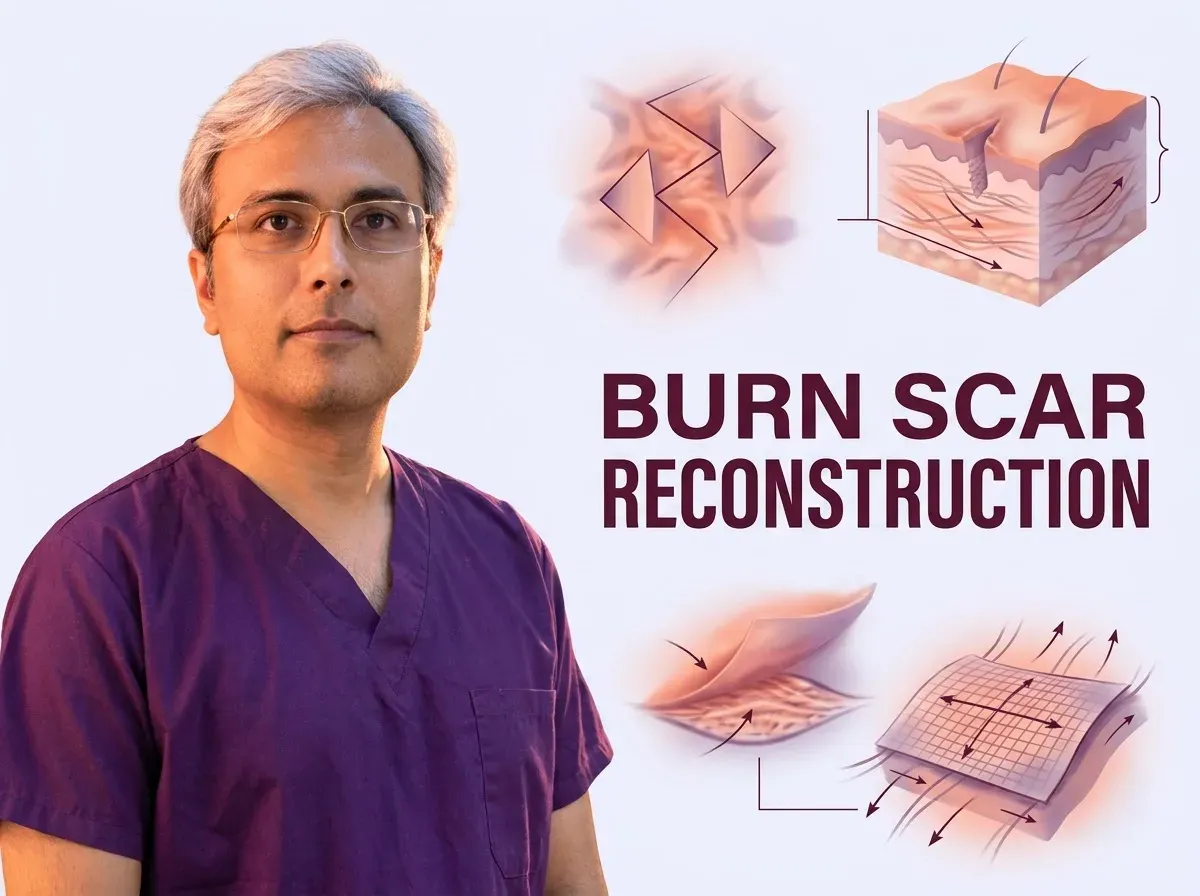
Multi-vector Z-plasties and thick skin grafting restoring full cervicomental angle and chin-to-chest extension.

Restorative plastic surgery freeing severe chin-sternum burn adhesion bands, restoring head rotation, airway alignment, and natural neck contour.

  • M.Ch Plastic Surgeon · RMC Reg. 28041/14185
  • Day-care / short-stay procedure
  • Tonk Road, Jaipur
  • Jump to FAQs (10)

Procedure Time

2–3.5 hours

Anesthesia

Awake fiberoptic intubation or video-laryngoscopic General Anesthesia

Hospital Stay

2–4 days

Recovery Time

Rigid cervical collar splinting: 6–8 weeks; Active physiotherapy: 3 months

Indications

Severe post-burn neck flexion contractures, obliteration of cervicomental angle, lower lip ectropion from downward skin traction

Techniques

Radical platysma contracture release, Multiple Z-plasties, thick Full-Thickness Skin Grafting (FTSG), Supraclavicular artery island flaps

Severe Chin-Sternum Burn Contracture

Can rigid burn scar bands tethering your chin be released?

Rigid hypertrophic scar bands physically bind the chin to the chest, obliterating normal neck contour while severely restricting head extension, rotation, mouth closure, and critical airway alignment.

Restricted Head Extension and Rotation

Dense anterior burn scars physically tether the chin to the sternum, blocking normal upward neck extension and lateral turning movement.

Lower Lip Ectropion and Drooling

Severe downward skin traction pulls the lower lip and mouth downwards, causing chronic drooling and obliteration of the cervicomental angle.

Compromised Airway Alignment

Distorted cervical anatomy and tethered tissue produce a difficult airway, complicating intubation and making conventional general anaesthesia dangerously challenging.

Why Fibrotic Contractures Demand Surgery

Deep anterior neck burns heal with rigid, hypertrophic contractures involving the skin and underlying fibrotic platysma muscle bands. Because this unyielding scar tissue anchors the mandible directly to the sternum, conservative measures cannot restore mobility; only radical transverse surgical transection and durable tissue resurfacing release the tension.

Dr. Vishal Purohit - M.Ch Plastic & Cosmetic Surgeon Jaipur

Dr. Vishal Purohit

M.Ch Plastic & Cosmetic Surgeon

✓

Credential Level

M.Ch Super-Specialty

RMC Reg. 28041/14185

Your Surgical Guide

Artistic Proportion & Advanced Surgical Safety

"Our priority is safe airway management during anaesthesia, followed by radical platysma contracture release and durable resurfacing using full-thickness skin grafts or flaps."

— Dr. Vishal Purohit

1

M.Ch Plastic & Reconstructive Surgery, SMS Medical College, Jaipur

The highest super-specialty surgical qualification in India, ensuring total anatomical mastery of neurovascular planes and soft tissues.

2

11+ Years as a Plastic Surgeon

Hundreds of procedures performed, with a focus on natural, proportionate results.

3

Accredited Operating Suites

Dr. Vishal Purohit operates in sterile hospital operating theatres, with certified cardiac anaesthesiologists and ICU support.

Simple & Transparent

Your 3-Step Surgical Journey

We remove anxiety and uncertainty with a structured, transparent pathway designed for absolute safety and peace of mind.

1

Confidential Assessment

Dr. Purohit evaluates your anatomical baseline, skin elasticity, and health history. You receive an honest feasibility blueprint, personalized surgical plan, and transparent cost with zero pressure.

Step 1: Planning
2

Precision Operating Suite Procedure

Performed by Dr. Vishal Purohit in a sterile hospital operating theatre under gentle anaesthesia. Using advanced minimally invasive techniques, target areas are treated with microscopic care.

Step 2: Procedure
3

Monitored Recovery & Transformation

Supported with tailored recovery guidelines and post-operative follow-up visits. As tissue heals and settling occurs over the coming weeks, your refined results emerge.

Step 3: Recovery
Clinical Guide & In-Depth Information

Comprehensive Medical Overview

Detailed procedural analysis, anatomical considerations, and patient guidelines by Dr. Vishal Purohit.

Surgical Correction for Severe Post-Burn Neck Contractures

Deep burn injuries of the anterior neck frequently heal with severe, rigid hypertrophic scar contractures that physically tether the chin to the sternum. This disabling deformity obliterates the cervicomental angle, pulls the lower lip and mouth downward (ectropion of the lower lip with chronic drooling), severely restricts head rotation and extension, and creates a difficult airway that makes conventional endotracheal intubation life-threatening.

Reconstructive Approach to Neck Contracture Release

Reconstructive plastic surgery aims to completely liberate neck movement and recreate natural cervical aesthetics:

  • Airway Management Safety: Accomplished via awake fiberoptic intubation or tumescent local scar release prior to tube placement, ensuring airway security at all times.
  • Radical Transverse Release: Incising the scar band completely from one trapezius margin across to the other, releasing fibrotic platysma muscle bands until full hyperextension of the neck is restored on the operating table.
  • Durable Resurfacing: Resurfacing the released defect with thick, unmeshed Full-Thickness Skin Grafts (FTSG) harvested from the abdomen/groin, or transposing a thin supraclavicular artery island flap to prevent secondary graft contraction.

Postoperative Splinting and Cervical Therapy

Following surgical release, customized rigid cervical orthoses (neck collars) and targeted neck physical therapy prevent re-contracture and maintain an attractive, sharp jawline-to-neck transition.

Your Safety Comes First

Why Your Surgeon’s Training Matters

Neck Burn Contracture Release Surgery in Jaipur involves delicate anatomy, blood supply and tissue handling. Choosing on price alone, or an operator without plastic-surgery training, raises the risk of contour irregularities and complications.

With Dr. Vishal Purohit, your safety is backed by intensive-care support, certified cardiac anaesthesiologists and hospital-grade theatre protocols.

What to watch out for

  • Operators without plastic-surgery training
  • Rushed or imprecise tissue handling
  • Clinic rooms without emergency backup
  • Higher chance of visible scars or revision surgery

With Dr. Vishal Purohit

  • M.Ch super-specialist plastic surgeon
  • Careful, tissue-preserving technique
  • Hospital-grade operating theatre
  • Personal follow-up through recovery
Restored Cervical Mobility

Liberating neck movement and chin-to-chest extension

Radical surgical release reconstructs a distinct cervicomental angle, frees mouth distortion, restores upward chin extension, and secures airway alignment through durable tissue reconstruction.

Full Chin-to-Chest Extension

Radical transverse release of platysma bands restores uninhibited head rotation and full cervical extension directly on the operating table.

Correction of Lip Ectropion

Relieving severe downward contracture tension restores normal lower lip position, relieving chronic drooling and defining a sharp jawline transition.

Durable Resurfacing with Flaps

Thick full-thickness skin grafting or supraclavicular artery island flaps resurface the surgical defect to prevent secondary graft re-contracture.

Got Questions?

Frequently Asked Questions

Honest, clinically precise answers from Dr. Vishal Purohit regarding Neck Burn Contracture Release Surgery in Jaipur.

What is neck burn contracture release surgery?

Neck burn contracture release surgery loosens scar tissue that has tightened after a burn, helping restore neck movement and comfort. It is considered when stretching and splinting cannot restore movement. M.Ch. plastic surgeon Dr. Vishal Purohit in Jaipur can explain whether release, grafting or another reconstructive option may suit your scar and function.

After a burn, scar tissue can shrink and pull the neck into a bent position, limiting movement and causing discomfort. Surgery releases this tight scar so the neck can move more freely. The approach varies with how severe and extensive the contracture is: some limited areas may be revised, while larger releases may need skin grafting or flap coverage to resurface the area. Many neck contractures can be managed with a thick split-thickness skin graft, sometimes staged to protect the airway first. Non-surgical stretching and splinting are tried first when possible. Because severe neck contractures can affect airway access, anesthesia planning is important. Even after a successful release, scar can tighten again during healing, so overcorrection and follow-up care matter.

Recovery depends on burn severity, age and general health. Grafted wounds may need dressings for up to six weeks, and long-term splinting is important to reduce recurrence. Major complications can include graft loss and contracture recurrence. If neck tightness after a burn limits your movement or comfort, you may consult Dr. Vishal Purohit in Jaipur to discuss release options and aftercare.

How will the anaesthetist plan a difficult airway during neck burn contracture release surgery if my neck cannot extend?

If your neck cannot extend, the anaesthetist plans airway management before neck burn contracture release, because limited extension, microstomia, reduced submandibular space and scar-related tracheal deviation can make intubation difficult. M.Ch. plastic surgeon Dr. Vishal Purohit in Jaipur can explain how preoperative airway assessment and surgical readiness are coordinated for this concern.

Preoperative planning is critical. An X-ray of the neck in AP and lateral views can show tracheal deviation, kinking, narrowing or pressure from scars, while indirect laryngoscopy helps the anaesthetist anticipate intubation difficulty. Before sedation, they should check whether bag-and-mask ventilation is possible. If available, fiberoptic intubation is the safest method because it allows direct visualization of the glottis. A laryngeal mask airway may be an acceptable alternative when indicated. Suxamethonium is contraindicated in this phase, whereas non-depolarizing neuromuscular blocking agents can be used safely. Dilute adrenaline may be used for a bloodless field, so anaesthetic agents must be compatible. The surgeon should be present at induction in case urgent release is needed.

Neck burn contracture release is usually considered months or years after injury; success depends on scar extent and severity, and some deformities cannot be fully reversed. In one study of 143 neck release procedures, postoperative use of a neck hyperextension brace for over one year after skin grafting decreased recurrence by 40% to 50%. Children may need repeat releases. If neck tightness limits movement or airway access, you may consult Dr. Vishal Purohit in Jaipur to discuss realistic options.

What is used to cover the neck after neck burn scar release?

After neck burn scar release, the neck is usually covered with a thick split-thickness skin graft, secured with a foam bolster or bolster dressing. M.Ch. plastic surgeon Dr. Vishal Purohit in Jaipur can explain when a graft, flap or staged reconstruction may suit your scar and airway needs.

The release is carried deep enough to free the scar, then the open area is resurfaced. Most neck contractures can be managed with a thick split-thickness skin graft, while full-thickness grafts can help counter contracture and restore flexibility. In difficult recurrent cases, a flap may be considered. Severe mentosternal contractures may need wider release, and strap muscles may need division. Preoperative airway assessment is critical. The majority may also be staged by initial release with a skin graft to assure a safe airway, then later resurfaced with tissue expansion or flap. Grafts are often secured with a foam bolster or bolster dressing. The choice depends on scar extent, donor skin, airway risk and movement limitation.

Postoperatively, the bolster may stay 10 to 14 days, then a neck brace holds the neck extended, ideally worn around the clock until the scar matures, possibly up to a year. In one study of 143 neck releases, wearing a hyperextension brace for over a year after grafting reduced recurrence by 40% to 50%. Graft loss and recurrence remain possible. If neck tightness limits you, consult Dr. Vishal Purohit in Jaipur to discuss release and coverage options.

How long must a neck collar splint be worn after neck burn contracture release surgery?

After neck burn contracture release surgery, a neck collar or brace is usually worn to keep the neck extended while scars mature. M.Ch. plastic surgeon Dr. Vishal Purohit in Jaipur can explain how splinting supports healing, comfort, and what duration may suit your release and graft.

Neck burn contractures pull the chin toward the chest and limit movement. Release often uses skin grafting, and scars can tighten again during healing. Postoperative splinting holds the neck in extension to reduce recurrence. A soft collar may help after smaller releases, while a stiffer thermoplastic collar can maintain position longer as scars mature. Postoperative management with neck splinting until the scar is fully mature is essential. Recurrence is significantly affected by long-term postoperative splinting, and a neck brace is crafted after bolster removal to hold the neck extended. One study of 143 neck releases found wearing a neck hyperextension brace for over one year after skin grafting reduced recurrence by 40% to 50%.

Typically, a foam bolster stays 10 to 14 days, then a neck brace is crafted for extended wear. It is ideally worn 24 hours daily until scar maturity and may be beneficial for up to a year; some patients use a soft collar for about six months. If you are planning release, you may consult Dr. Vishal Purohit in Jaipur to discuss splinting and follow-up.

Can neck burn contracture release surgery correct drooling and lower lip pull caused by neck scars?

Neck burn scars can pull the chin and lower lip downward, sometimes causing drooling and dental problems. Release surgery may improve this when scar tension is the cause, but results vary with severity, age and scar response. M.Ch. plastic surgeon Dr. Vishal Purohit in Jaipur can explain whether release, grafting or flap reconstruction may help your function and appearance.

Neck burn scars can pull the chin, cheeks and lower lip downward; extreme traction on the lip may cause drooling and dental problems. Burn scar contractures may also affect eating, speech, neck motion, airway and mandibular growth, especially in growing children. Release surgery cuts the tight scar down to a healthy plane, often including platysma, then covers the gap with a skin graft or flap chosen by scar extent, available donor skin and airway risk. Long-term postoperative splinting and physiotherapy matter because secondary contracture can recur later. Severe cases may need staged reconstruction and careful anesthesia planning for difficult intubation.

After release, graft take takes about 5 days before aggressive range-of-motion exercises; neck hyperextension brace over 1 year decreased recurrence 40-50% in one study of 143 procedures. Major complications include graft loss and recurrence. Postoperative splinting and physiotherapy help prevent recurrence. If neck scars affect eating, speech or lip control, you may consult Dr. Vishal Purohit in Jaipur to discuss realistic improvement and aftercare.

How soon does neck mobility return after neck burn contracture release surgery?

Neck mobility after release does not return on a fixed date; it depends on burn severity, graft healing, age and overall health. M.Ch. plastic surgeon Dr. Vishal Purohit in Jaipur can carefully and clearly explain how release, grafting, splinting, physiotherapy and follow-up work together in your own individual recovery case.

Release aims to restore a mobile, supple neck, often with skin grafting. Splinting and stretching are strongly recommended during scar maturation to reduce contracture. Aggressive range-of-motion exercises and physiotherapy usually begin after the graft has had enough time to take, about five days, to help prevent recurrence. Postoperative evaluation around seven days can show satisfactory graft take. Grafted wounds may need dressings for up to six weeks, and operated burned joints often show limited movement early on. Long-term splinting, follow-up and recurrence prevention also matter greatly, and recurrence can occur despite successful release. Graft loss is a major complication. Recovery varies by severity, age and health, so your plan should be individualized.

If neck tightness limits daily life, you may consult Dr. Vishal Purohit in Jaipur to discuss release options, graft care, splinting, physiotherapy and follow-up. No outcome is guaranteed, and recurrence can occur. Because severity, age and health affect recovery, your plan should be individualized. He can explain benefits and limitations during consultation. Graft loss is a major complication, so follow-up matters.

When is Z-plasty suitable for a narrow neck scar band in neck burn contracture release?

Z-plasty suits a short, supple, straight scar band that tightens the neck; it is not for extensive or severe contracture. M.Ch. plastic surgeon Dr. Vishal Purohit in Jaipur can explain whether your narrow band is flexible enough for this rearrangement, or whether release with grafting or another method is more appropriate.

Z-plasty cuts and interposes triangular skin flaps to lengthen the tight line and spread tension, which can help a limited band. It does not correct broad, severe or multi-directional neck contracture. Longer bands may need a more complex flap rearrangement; more extensive contractures often need nearby tissue flaps; severe cases may need incisional release and split-thickness skin grafting. Because neck burns can limit movement and sometimes affect airway access, the surgeon must match the method to scar severity, location and available healthy skin. Postoperative splinting and physiotherapy help maintain release. Recurrence can occur, especially with growth in children, so follow-up matters.

Recovery depends on burn severity, age and general health. Grafted wounds may need dressings for up to six weeks, and long-term splinting can reduce recurrence. Complications include graft loss and recurrent contracture; children may need repeat release as they grow. If a tight neck scar band limits your movement, you may consult Dr. Vishal Purohit in Jaipur to discuss whether Z-plasty or another release method suits your scar.

What can be done to prevent recurrence of neck burn contracture?

Preventing recurrence of a neck burn contracture usually means combining careful surgery with long-term splinting, stretching and follow-up, because scar can tighten again as it heals. M.Ch. plastic surgeon Dr. Vishal Purohit in Jaipur can explain which release and resurfacing options may suit your scar and movement limits.

Neck burn scars can pull the head forward and limit eating, speaking or breathing. In the scar maturation phase, splinting and stretching are recommended to reduce contracture. If function remains limited, release may be needed; the approach varies with severity, scar width, available supple skin and airway risk. Many contractures can be managed with a thick split-thickness skin graft, sometimes staged first to secure the airway, then resurfaced later. Surgeons overcorrect release because secondary contracture occurs with healing. Recurrence is significantly affected by long-term postoperative splinting: in one study of 143 neck release procedures with Z-plasties or split-thickness skin grafts, wearing a neck hyperextension brace for over one year after skin grafting decreased recurrence by 40% to 50%.

After release, graft loss and recurrence are major complications, and children may need repeat releases as they grow. Acute burn care also matters: posturing with a bolster and thermoplastic splints or neck collars can help prevent contracture during healing. If you are concerned about neck tightness after a burn, you may consult Dr. Vishal Purohit in Jaipur to discuss realistic prevention, splinting and surgical options.

Why choose Dr. Vishal Purohit for neck burn contracture surgery?

Neck burn contracture surgery aims to restore movement and comfort after scar shrinkage; the right approach depends on severity, airway risk and donor skin. M.Ch. plastic surgeon Dr. Vishal Purohit in Jaipur can explain which release and resurfacing options may suit your neck and what improvement is realistic.

Neck skin is thin and mobile, so burn scars can tighten and limit extension or rotation; severe cases may affect airway access. Surgery releases the scar and resurfaces the area, sometimes with grafts or flaps, while more limited bands may need simpler release. The plan varies with scar extent, growth in children, donor availability and whether chest or neck skin can be expanded. Long-term splinting and scar care matter because recurrence can occur, and airway planning is important before anesthesia. Dr. Vishal Purohit can discuss which release, graft or flap option fits your scar, airway needs and donor skin during consultation.

Recovery depends on burn severity, age and general health; grafted wounds may need dressings for up to six weeks, and children may need repeat releases as they grow. In one study of 143 neck releases, a neck hyperextension brace for over one year after skin grafting decreased recurrence by 40% to 50%. If neck tightness limits movement or comfort, you may consult Dr. Vishal Purohit in Jaipur to discuss realistic functional improvement and aftercare.

How is restriction in neck extension and rotation measured in neck burn contracture?

Restriction is measured in degrees of neck extension and lateral rotation; one example notes about 50 degrees of lateral rotation and 30 degrees of cervical superior extension. Passive range of motion may also be tracked after burn. M.Ch. plastic surgeon Dr. Vishal Purohit in Jaipur can explain how these measurements guide assessment.

Neck burn contracture means scarred skin has tightened and can limit how far you can extend or turn your neck. Measuring extension and rotation shows how much movement is lost and whether eating, speech or posture are affected. It also helps plan release, consider airway safety and choose graft or flap coverage. Passive range of motion may be checked after burn, and severe contracture can hold the head in a flexed, caudal position. Full-thickness grafts can help restore flexibility, while long-term splinting may reduce recurrence after grafting. Recovery and recurrence depend on severity, age, splinting and follow-up. A standard lateral cephalogram may help follow mandible and chin position.

Grafted wounds may need dressings for up to six weeks, and growing patients may need repeated releases. Long-term neck splinting after grafting may reduce recurrence. Airway assessment is important before surgery, and postoperative splinting compliance matters. If neck movement restriction concerns you, you may consult Dr. Vishal Purohit in Jaipur to discuss your detailed personalized assessment, release options, recovery, follow-up care and splinting plan.

Need more clinical answers?

Explore all 91 answered Neck Burn Contracture Release / Neck Scar Reconstruction questions.

Neck Burn Contracture Release / Neck Scar Reconstruction FAQ Hub (91 FAQs)
Begin Your Journey

Ready to Discuss Neck Burn Contracture Release Surgery in Jaipur?

Schedule a private consultation with Dr. Vishal Purohit at his OPD suite, Kalpana Aesthetics (2nd Floor), to evaluate your candidacy, discuss surgical options, and receive a transparent, tailored treatment plan.