A cheek dimple is a small operation through the inside of the cheek, and where it sits decides much of the impression it gives. The ideal site is subjective, so surgeons do not agree on a single point, and even the commonly used KBC landmark is not preferred by every patient.
This post sets out the classic landmarks, the ratings from a 3D-scan study, and why the two sides can still differ when both dimples are planned. A companion page on How a Dimple Is Created: The Surgical Steps places the marking stage in context.
Why Position Matters
The site must suit the face
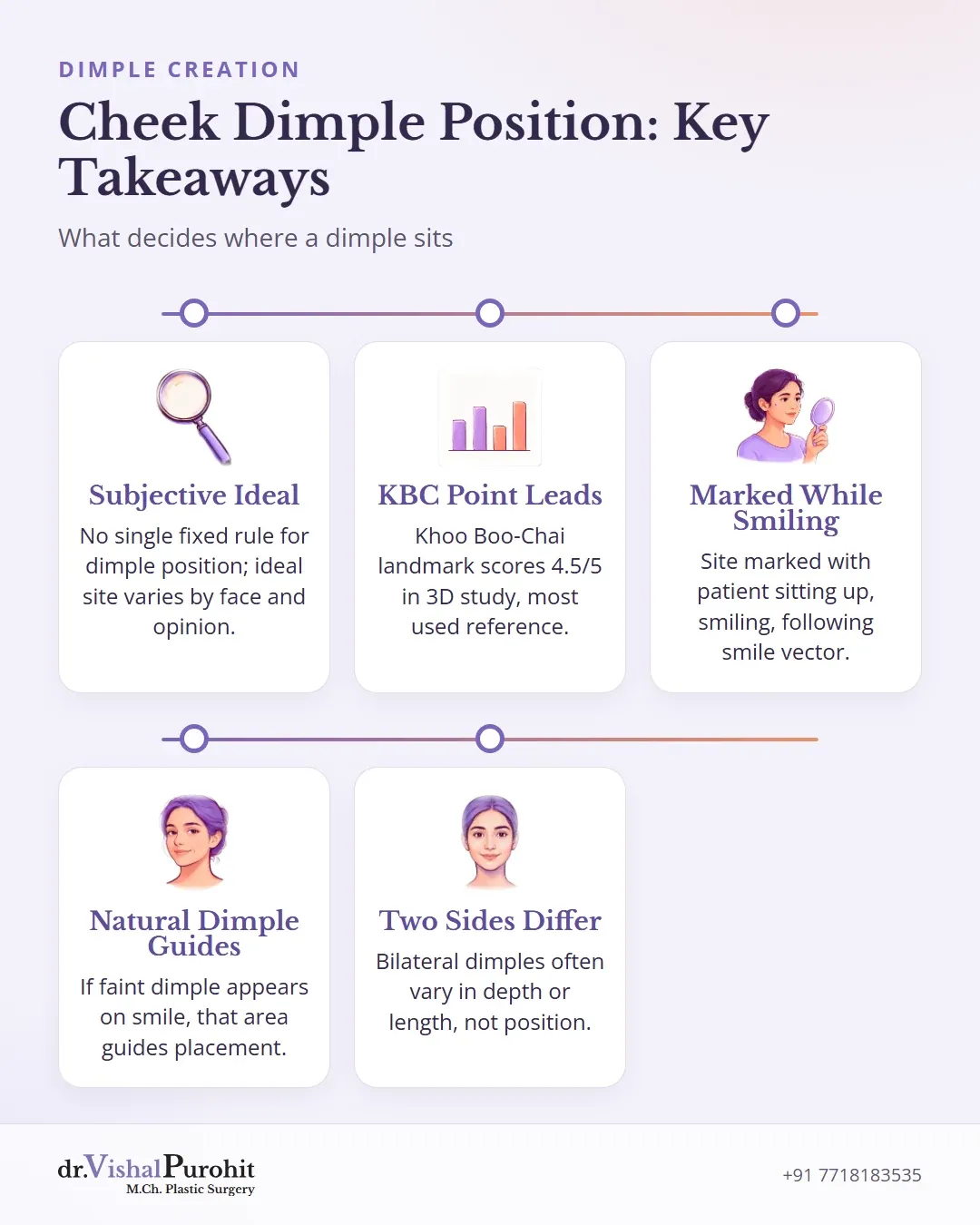
A dimple in the wrong place can look out of balance with the face. Position changes the impression a dimple gives, and the ideal site is subjective, so opinions vary. Even the commonly used KBC point, a landmark based on the outer eye corner and the mouth corner, is not preferred by every patient.
In a 3D-scan study, that KBC point scored highest for aesthetics at 4.5 out of 5; a more central point scored 4.0, a point at the mouth angle scored 3, and faces without a dimple scored 2.
Planning with the smile
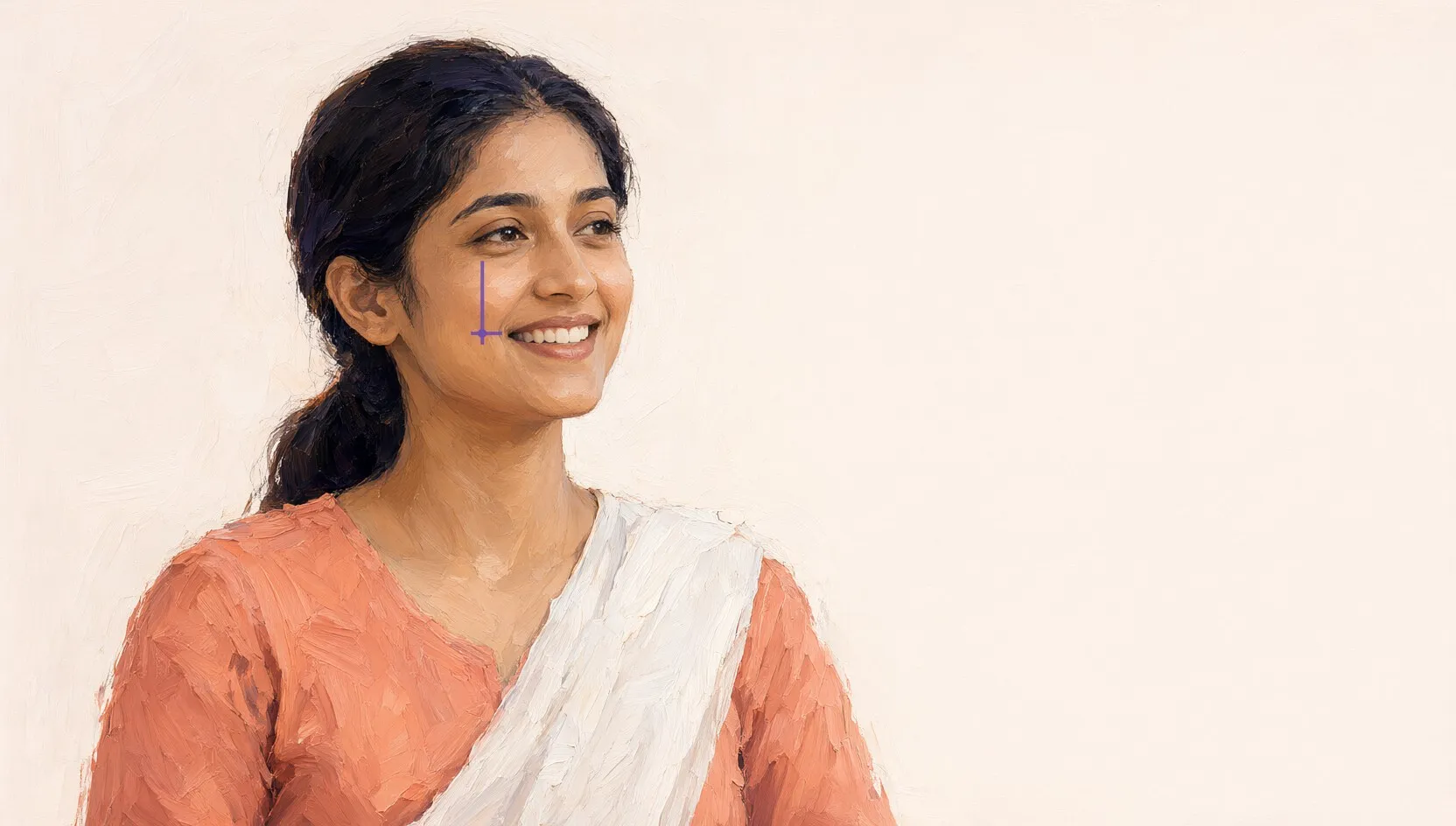
The mark is made while the patient smiles, following the vector of the smile. One described method uses the intersection of a horizontal line from the mouth angle and a vertical line from the outer corner of the eye; another places it at or slightly above the level of the mouth angle.
Dr. Purohit’s note: Dr. Purohit creates cheek dimples only, on one or both sides as the patient wishes, in his Jaipur practice.

Classic Landmarks
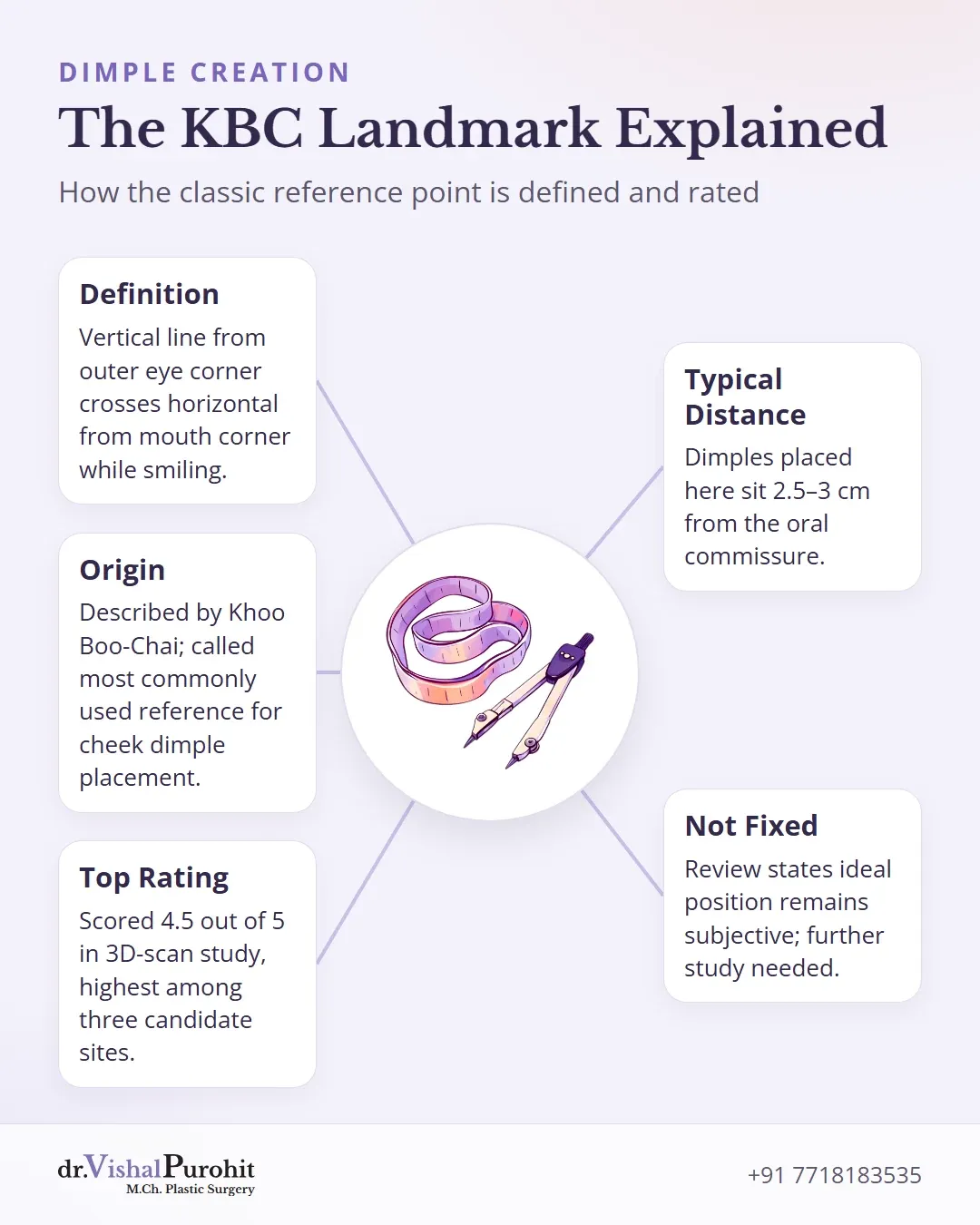
The classic reference for a cheek dimple is the point where a vertical line from the outer corner of the eye meets a horizontal line from the corner of the mouth. Khoo Boo-Chai described this landmark, and one review calls it the most commonly used reference for cheek dimple placement. The same review notes that the lines are drawn while the patient smiles.
Key points
- The intersection of lines from the outer eye corner and mouth corner is the classic reference point.
- Studies show this position receives high aesthetic ratings, typically sitting 2.5–3 cm from the mouth corner.
- Alternative landmarks exist, as ideal placement remains subjective.
What the literature says
In a three-dimensional study of dimple placement, this point was preferred overall and received the highest average aesthetic rating. Its position agrees with both the lateral canthus and the mouth corner, and the authors considered it natural across a range of faces. The review’s authors note that dimples placed by this reference are mostly 2.5–3 cm from the oral commissure.
The point is not settled; one review states that the ideal position remains subjective and that further study is needed. A dermatosurgery text notes that the older intersection method may sit too low, and describes a higher point using the Cupid’s bow. Other surgeons have proposed a point based on the smile vector.
What Newer Studies Compare
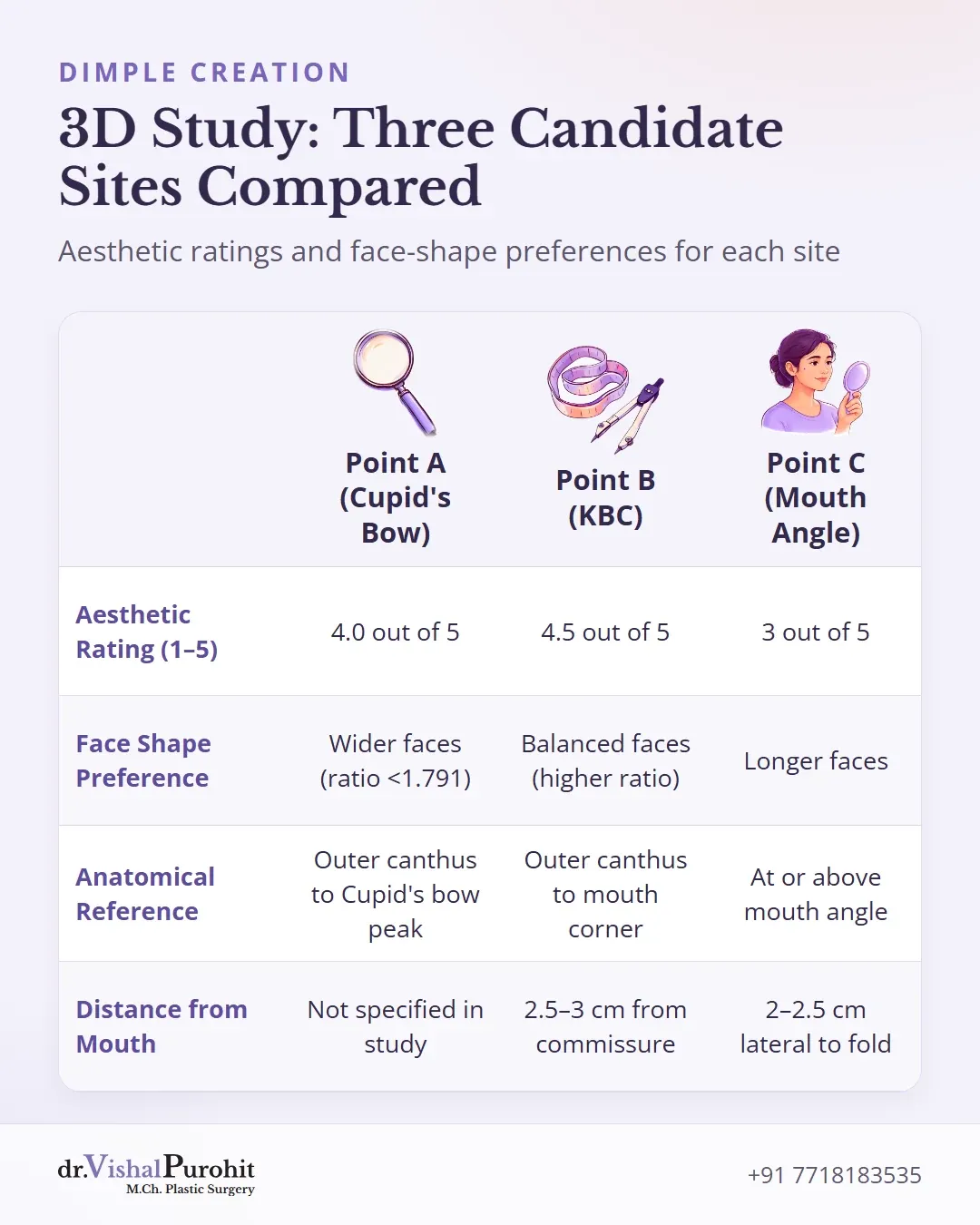
A 3D-scan study compared several candidate sites on the same faces, since there is no consensus on where a dimple should sit.
The Sites Compared
Each face was scanned in 3D, and each site was modelled on the scan:
Point A
- Where a perpendicular from the outer canthus crosses a horizontal from the peak of the Cupid’s bow.
Point B (Khoo Boo–Chai)
- Where a vertical from the outer canthus crosses a horizontal from the mouth corner.
Point C
- At or slightly above the mouth angle, along the smile vector.
Four panelists, including plastic surgeons, dermatologists, a non-medical person and the subject, rated each site on a five-point scale without knowing the participant’s identity.
What the Ratings Showed
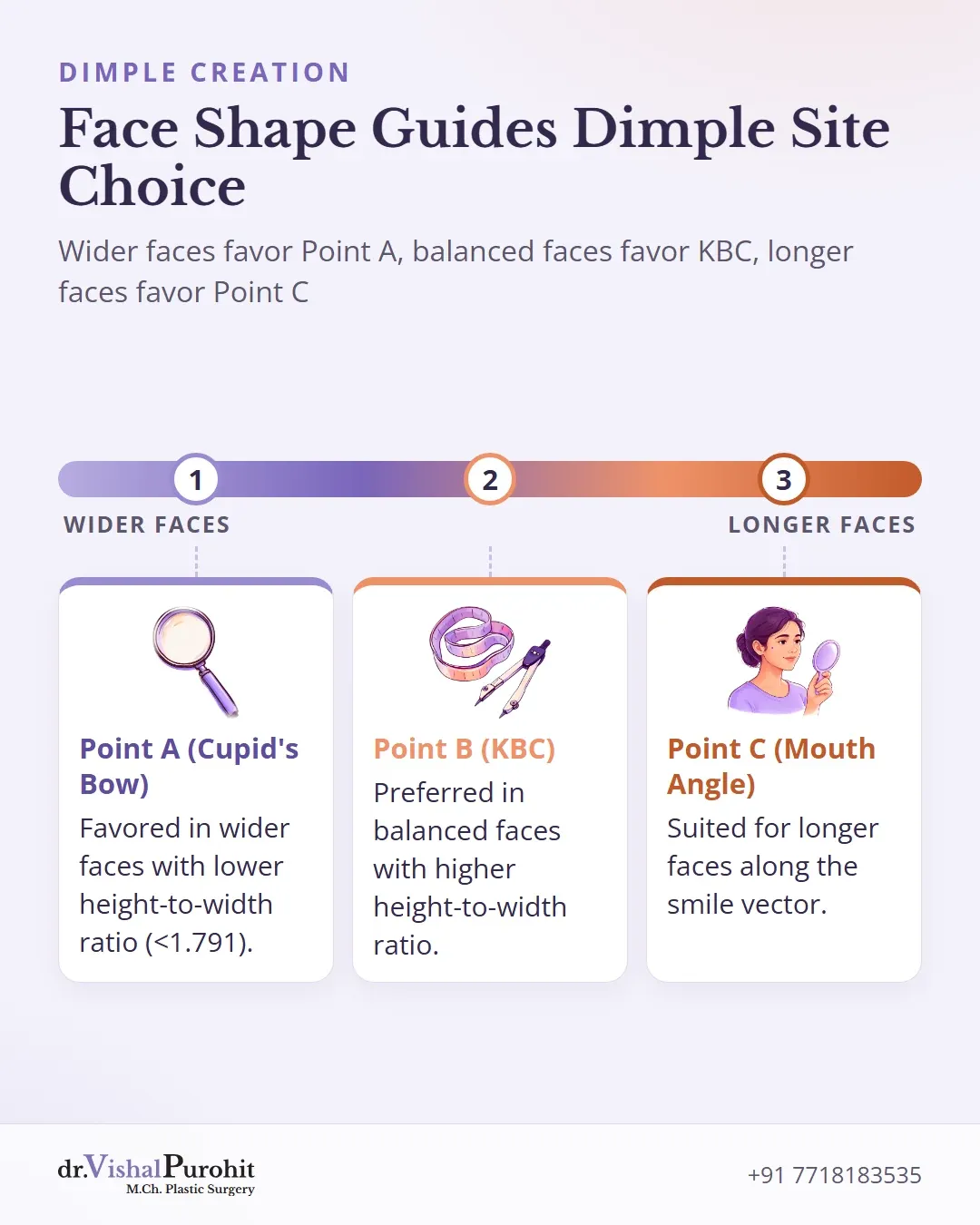
Point B scored highest at 4.5 of 5; Point A scored 4.0 and Point C an average of 3. Undimpled control faces scored 2. A higher face height-to-width ratio favoured Point B (r = 0.68) and wider faces favoured Point A (r = –0.54), cutoff 1.791. Point C suited longer faces.
The Older View
A textbook chapter places the classic point where a horizontal from the mouth angle meets a vertical from the lateral canthus, and notes it “might be too low”.
Marking on the Day
Sitting up, smiling
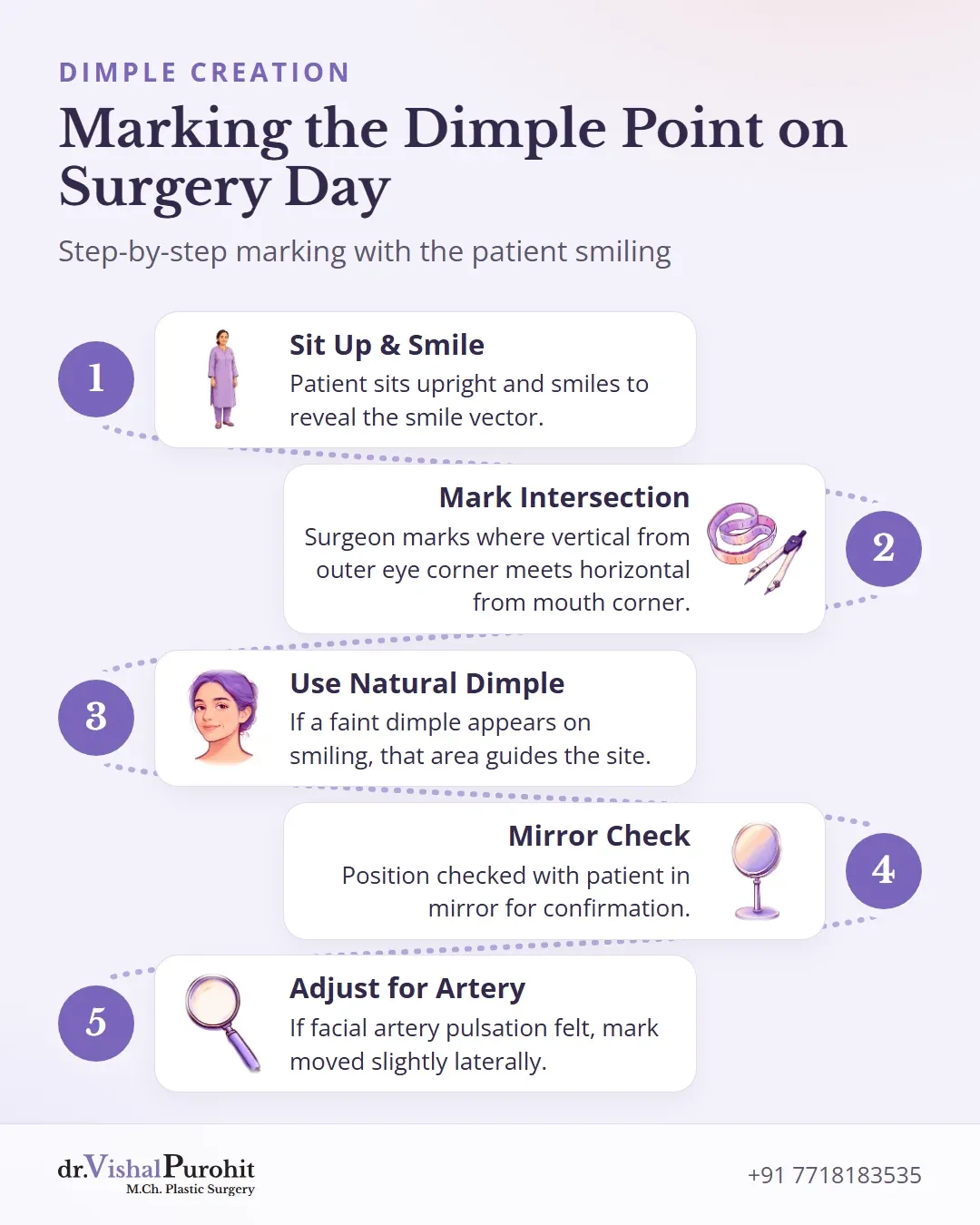
Dr. Purohit marks the dimple point with the patient sitting up and smiling, then checks the position with the patient in a mirror. Where a faint natural dimple appears on smiling, that area is used as the guide. When no dimple is visible, published descriptions place the point at the intersection of a perpendicular line from the external canthus and a horizontal line from the angle of the mouth. Other authors ask the patient to smile and mark 2 to 2.5 cm lateral to the nasolabial fold, at or slightly above the angle of the mouth. Some surgeons let the patient indicate the spot in front of a mirror. If facial artery pulsation is palpable, the mark has been moved slightly laterally.
One side or both
At his practice, cheek dimples are made on one side or both, as the patient wishes. Chin dimples are not created.

Two Sides Are Never Identical
Facial symmetry varies from person to person, and it is one of the reasons a suitable position for a dimple needs individual assessment rather than one fixed rule. When dimples are made on both cheeks, the two sides can still differ afterwards.
Why the two sides can differ
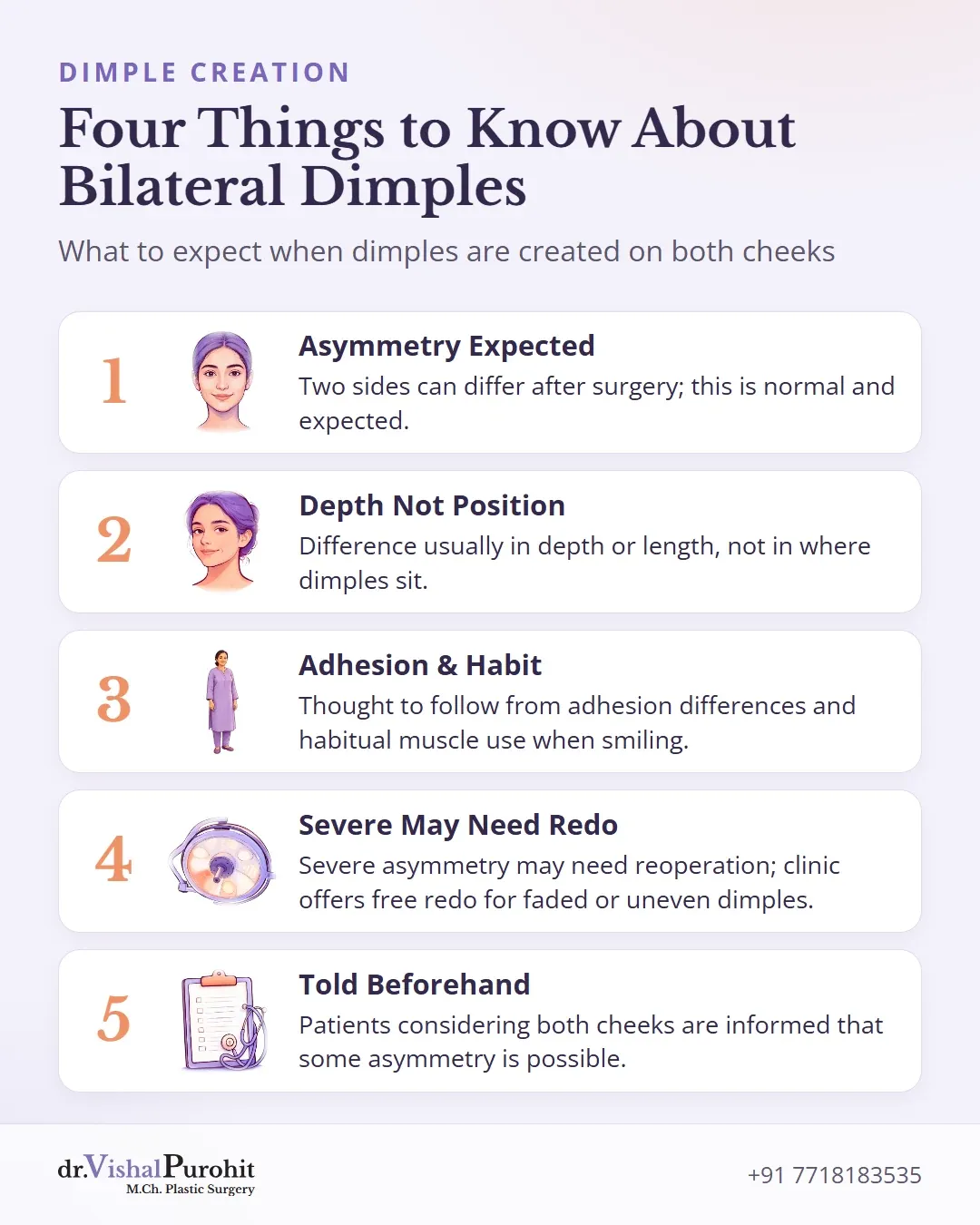
Asymmetry is more often a difference in the depth or length of the two dimples than a difference in where they sit. It is thought to follow from differences in adhesion on each side and from how habitually a person uses the facial muscles when smiling. One series found no cases of asymmetric dimple location, with unevenness coming from depth. Severe asymmetry may need reoperation, and patients considering both cheeks should be told beforehand that some asymmetry is possible.
What the clinic does
At his practice in Jaipur, a redo for a dimple that has faded or is uneven is done without charge. A redo can be planned after about 6 months, while reversal is charged.
Making the Choice in Jaipur
The cheek dimple position is a decision made with the individual face, not from a single formula. The classic landmarks give a starting point, the 3D ratings show how much opinion varies, and marking with the smile keeps the site in tune with movement. For details of the operation and the choices around it, see dimple creation in Jaipur and the dimple creation FAQs on one side or both, round or linear dimples, and how results settle.
This is educational information, not medical advice.