

TUE - SUN: 11:00 AM – 07:00 PM

Aesthetic & Reconstructive Surgery

Cheek & Midface Dermal Fillers in Jaipur

Cheek & Midface Dermal Fillers in Jaipur - Dr. Vishal Purohit Plastic Surgeon Jaipur11+ Years of Surgical Experience

Restoring Midface Support and Cheek Contours While Respecting Natural Facial Proportions

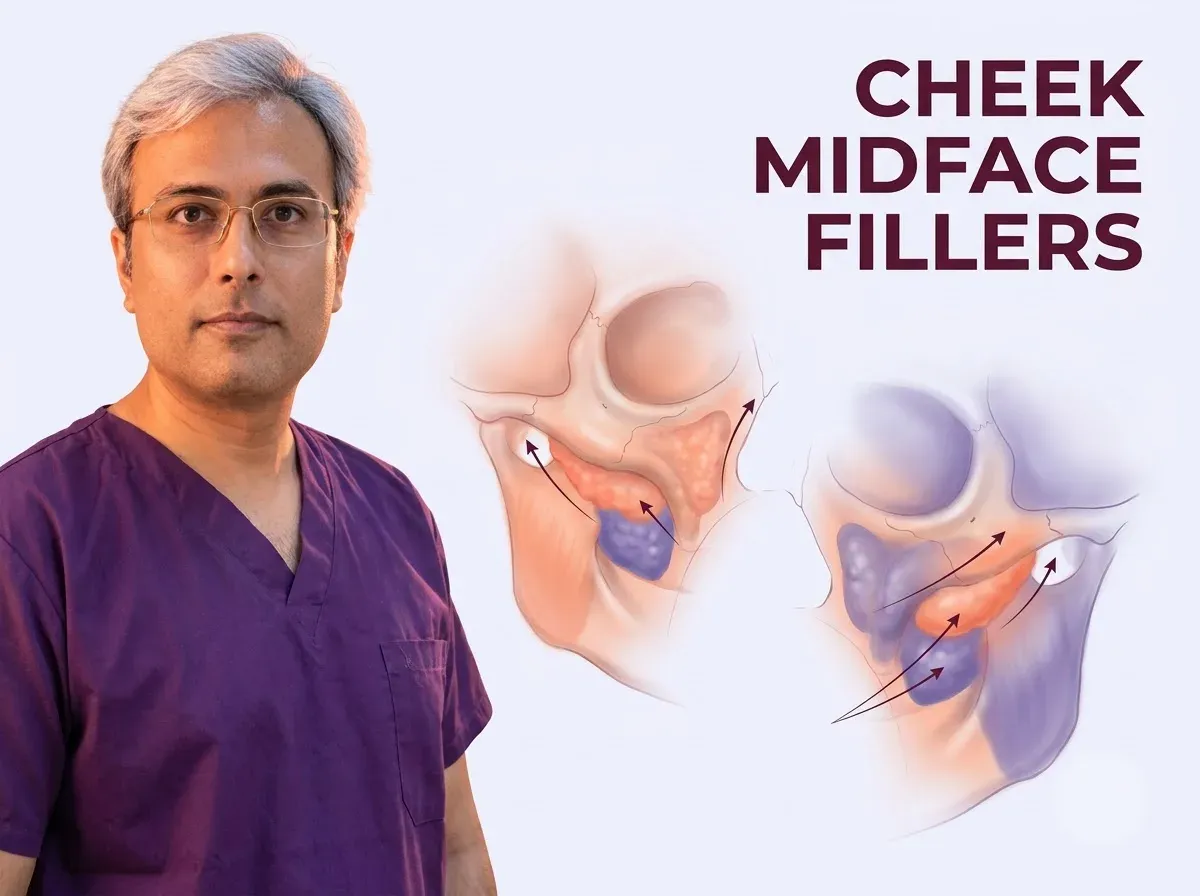
Midface hollowing develops as deep fat deflates and bone resorbs over time. Dr. Vishal Purohit, M.Ch. plastic surgeon, assesses midface volume loss, tissue descent and skin laxity first, and explains what dermal fillers can and cannot achieve.

View clinic timings and contact details →
  • M.Ch Plastic Surgeon · RMC Reg. 28041/14185
  • Day-care / short-stay procedure
  • Tonk Road, Jaipur
  • Jump to FAQs

Treatment Time

A short clinic visit

Anesthesia

Comfort options discussed at the visit

Downtime

Usually little; precautions explained

Results Onset

Over days; settling over about 2 weeks (studies)

Duration

Usually several months (studies)

Setting

Clinic visit, home the same day

Midface Architecture • Anatomical Reality

Why Cheek & Midface Fillers Requires Precision Medical Care

Midface aging involves distinct processes across multiple layers. Flattening and hollows stem from deep fat deflation alongside facial bone resorption over time. In contrast, loose skin and heavy soft-tissue descent arise from changing skin elasticity and gravity. Choosing no treatment is always a valid option.

Biological / Muscular Vector

Dermal fillers can replenish lost midface volume and provide structural contour support, but they cannot resect loose skin or lift significantly descended tissues. Restoring cheek support can sometimes soften adjacent creases, yet deep smile lines and tear troughs remain distinct anatomical concerns.

Aesthetic Frustration

Patients often feel their resting face conveys fatigue, stress, severity, or premature aging that does not reflect how energetic they truly feel inside.

Why Assessment Comes First

Product, amount and depth are planned for each face. A heavy brow, a droopy eyelid, an uneven smile or a problem with a blood vessel are known risks that careful assessment aims to reduce.

Biological Action

Hyaluronic acid dermal filler is placed into depleted midface areas to replace lost volume and provide contour support. By replenishing structural support where fat compartments have deflated and underlying bone has resorbed, the overlying soft tissues are supported, softening hollows while the gel gradually integrates and breaks down over months.

Dr. Vishal Purohit - M.Ch Plastic & Cosmetic Surgeon Jaipur

Dr. Vishal Purohit

M.Ch Plastic & Cosmetic Surgeon

✓

Credential Level

M.Ch Super-Specialty

RMC Reg. 28041/14185

Your Treatment Guide

Anatomy First, Honest Advice

"Cheek contouring requires separating localized volume loss from true skin laxity and tissue descent. As an M.Ch. plastic surgeon who also performs facial surgery, Dr. Vishal Purohit can tell when dermal filler suits your anatomy and when surgical repositioning or no treatment would be better, and explains both honestly."

— Dr. Vishal Purohit

1

M.Ch Plastic & Reconstructive Surgery, SMS Medical College, Jaipur

India's super-specialty degree in plastic surgery, with detailed training in facial muscles, nerves and blood vessels.

2

11+ Years as a Plastic Surgeon

A focus on natural, proportionate results that still look like you.

3

Assessment Before Any Injection

Dr. Vishal Purohit assesses your face in person, explains what treatment can and cannot change, and says when another option would help more.

Simple & Transparent

Your 3-Step Treatment Plan

A clear pathway: an assessment first, treatment only if it suits you, and a review afterwards.

1

Assessment

Dr. Purohit evaluates midface projection, checks static and smiling contours, screens for baseline puffiness, and reviews medical history.

Step 1: Planning
2

Treatment Visit

If treatment is suitable, the planned approach, product considerations, and consent are discussed, and injections are carried out in the clinic.

Step 2: Treatment
3

Settling and Review

Swelling and bruising settle over following days. Warning signs are reviewed before you leave, and follow-up guidance is provided.

Step 3: Review
Assessment and Method

Clinical Science and Methodology for Cheek & Midface Fillers

Midface aging involves distinct processes across multiple layers. Flattening and hollows stem from deep fat deflation alongside facial bone resorption over time. In contrast, loose skin and heavy soft-tissue descent arise from changing skin elasticity and gravity. Choosing no treatment is always a valid option. Dermal fillers can replenish lost midface volume and provide structural contour support, but they cannot resect loose skin or lift significantly descended tissues. Restoring cheek support can sometimes soften adjacent creases, yet deep smile lines and tear troughs remain distinct anatomical concerns. Dr. Vishal Purohit examines the cheeks in static repose and dynamic animation, checking both front and profile views. Evaluating baseline swelling, eyelid balance, and natural asymmetry before planning treatment helps avoid unnatural fullness or facial overfill syndrome.

Planned for Your Face

Individual Assessment

The plan follows your own muscle movement, skin and facial structure, looked at in person.

A Named, Sealed Product

Know What Is Used

You are told which product is used. Products differ, and their doses are not interchangeable.

Care Around Vessels and Nerves

Anatomy First

Technique is chosen with facial vessels and nerves in mind. Bruising and rarer side effects are explained before treatment.

Candidate Indicators and Focus Points

Adults with midface flattening or cheek hollows from deep fat loss or bone resorption.

Clinical Indication

People seeking subtle cheek contour support while maintaining natural facial animation.

Clinical Indication

People who understand that fillers restore volume rather than surgically lifting loose skin.

Clinical Indication

People willing to have their facial proportions, eyelids, and medical history evaluated first.

Clinical Indication

Clinical Guide & In-Depth Information

Comprehensive Medical Overview

Detailed procedural analysis, anatomical considerations, and patient guidelines by Dr. Vishal Purohit.

Midface Hollowing Versus Laxity: What Fillers Can Improve
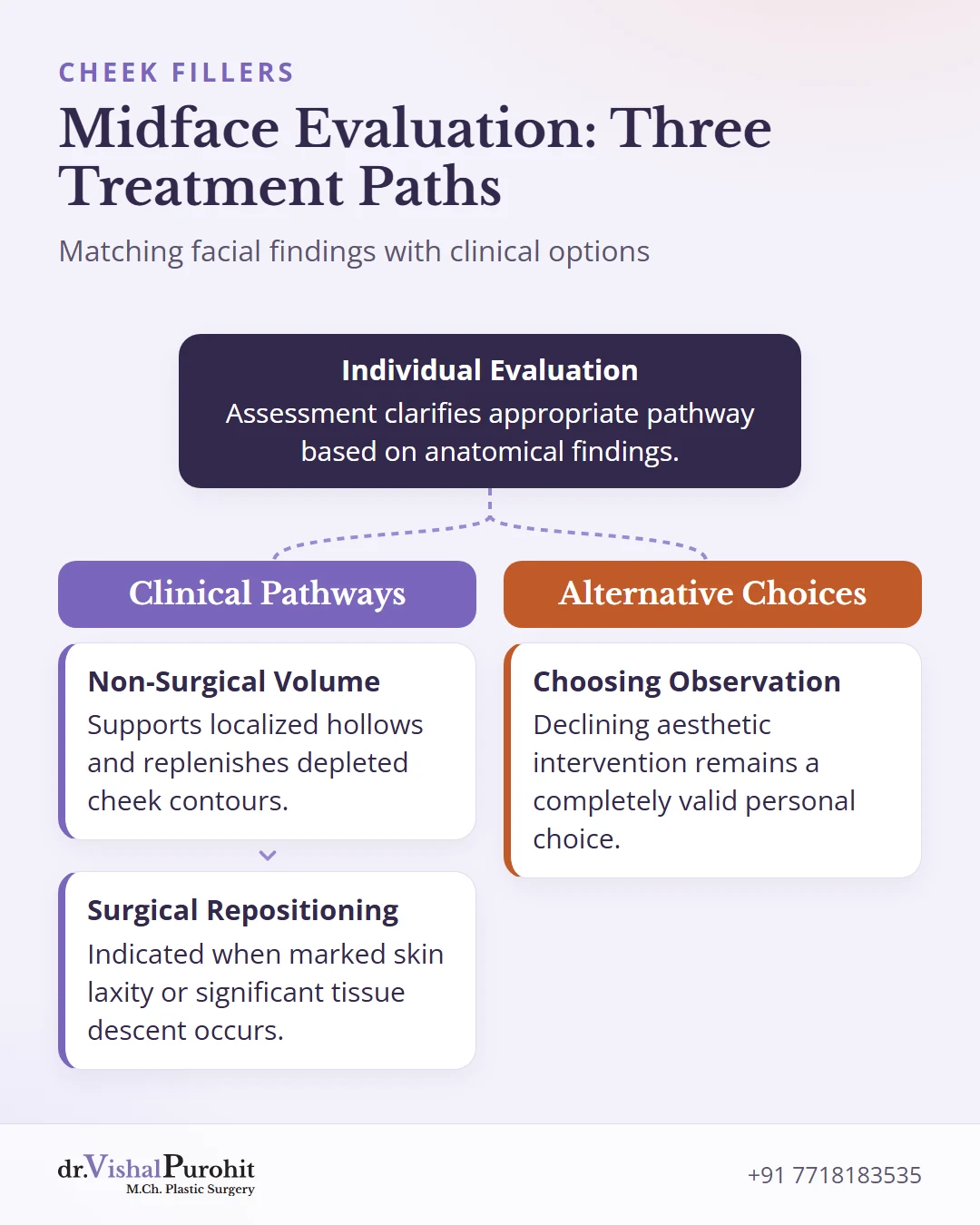
Diagram showing three treatment pathways: volume restoration, surgical repositioning, and choosing no treatment.

Midface changes can involve separate anatomical processes that require different approaches. Deep fat deflation and bone resorption lead to localized hollowing, whereas diminished tissue elasticity causes structural descent. Understanding these distinctions helps clarify realistic aesthetic outcomes.

Injections of hyaluronic acid dermal filler can replenish depleted midface volume and restore contour. However, filler cannot lift stretched skin or reposition descended soft tissues. Learning about hollowing versus true skin laxity clarifies what non-surgical injections can achieve and when surgical options such as tissue repositioning or fat grafting are better suited.

An individual evaluation helps clarify the appropriate path based on specific anatomical findings:

  • Non-surgical volume restoration to support localized hollows and replenish cheek contours.
  • Surgical intervention when marked skin laxity or significant tissue descent requires repositioning.
  • Choosing no aesthetic treatment, which remains a valid decision for every individual.

Cheek Support Assessment and Facial Fold Planning
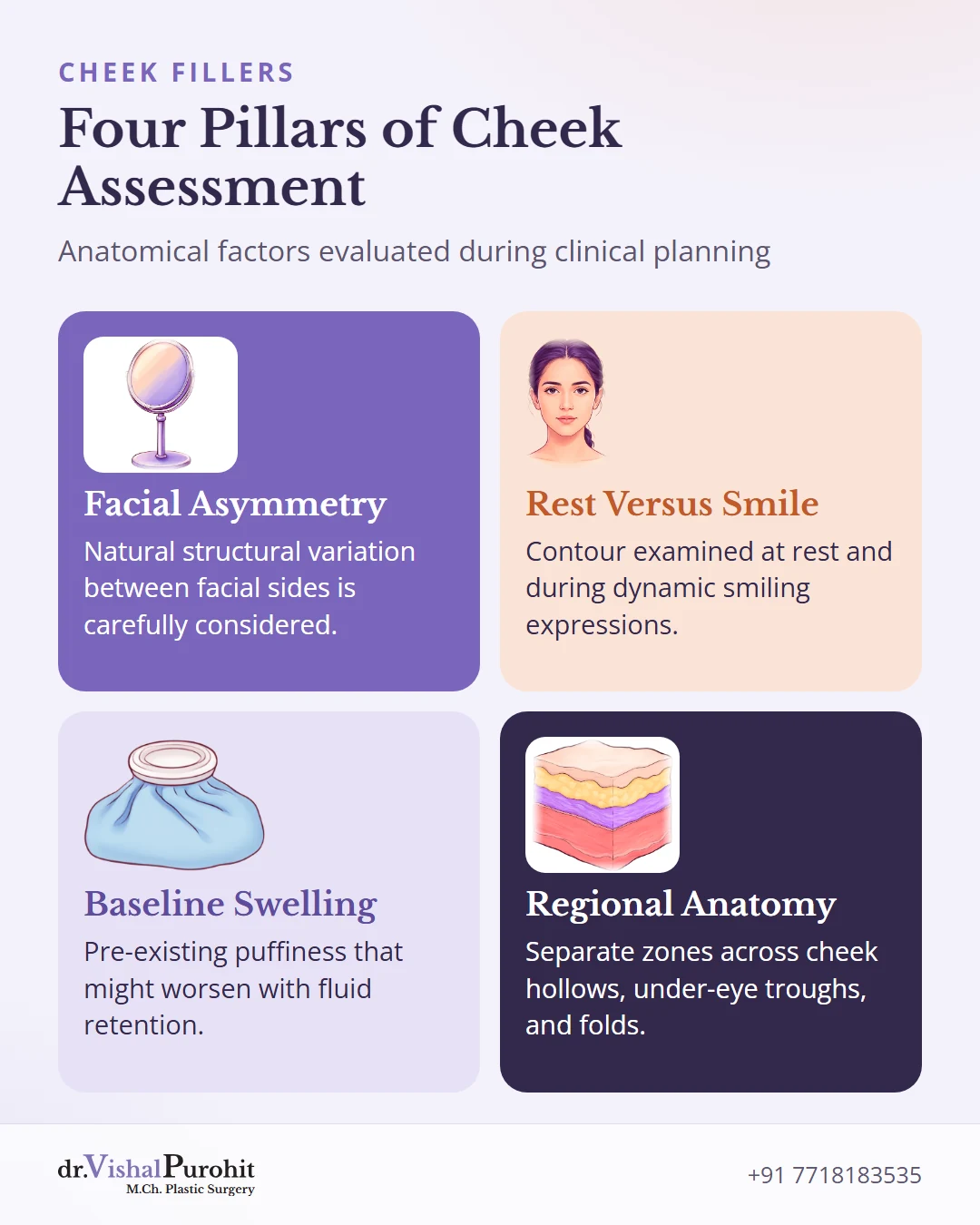
Four tiles illustrating asymmetry, static vs dynamic expressions, baseline swelling, and regional facial anatomy.

Midface volume loss develops as deep fat deflates and facial bone resorbs over time. A clinical assessment distinguishes localized flattening from true structural skin laxity. Choosing observation without any aesthetic treatment remains a completely valid option for every individual.

Dermal fillers replenish lost midface volume and provide structural support, but they cannot lift stretched skin or reposition descended deeper tissues. Learning how cheek fillers address midface volume loss helps clarify what non-surgical injection treatments can achieve alongside adjacent facial folds.

When planning midface restoration, clinical evaluation considers several anatomical factors:

  • Natural facial asymmetry between sides
  • Static contour at rest compared to dynamic smiling expressions
  • Baseline swelling or puffiness that may worsen with water retention
  • Distinct regional anatomy across cheek hollows, under-eye tear troughs, and nasolabial folds

Whether midface dermal filler, surgical repositioning, autologous fat grafting, or no treatment is appropriate is decided at the consultation.

Balancing Natural Facial Proportions to Avoid Overfilling
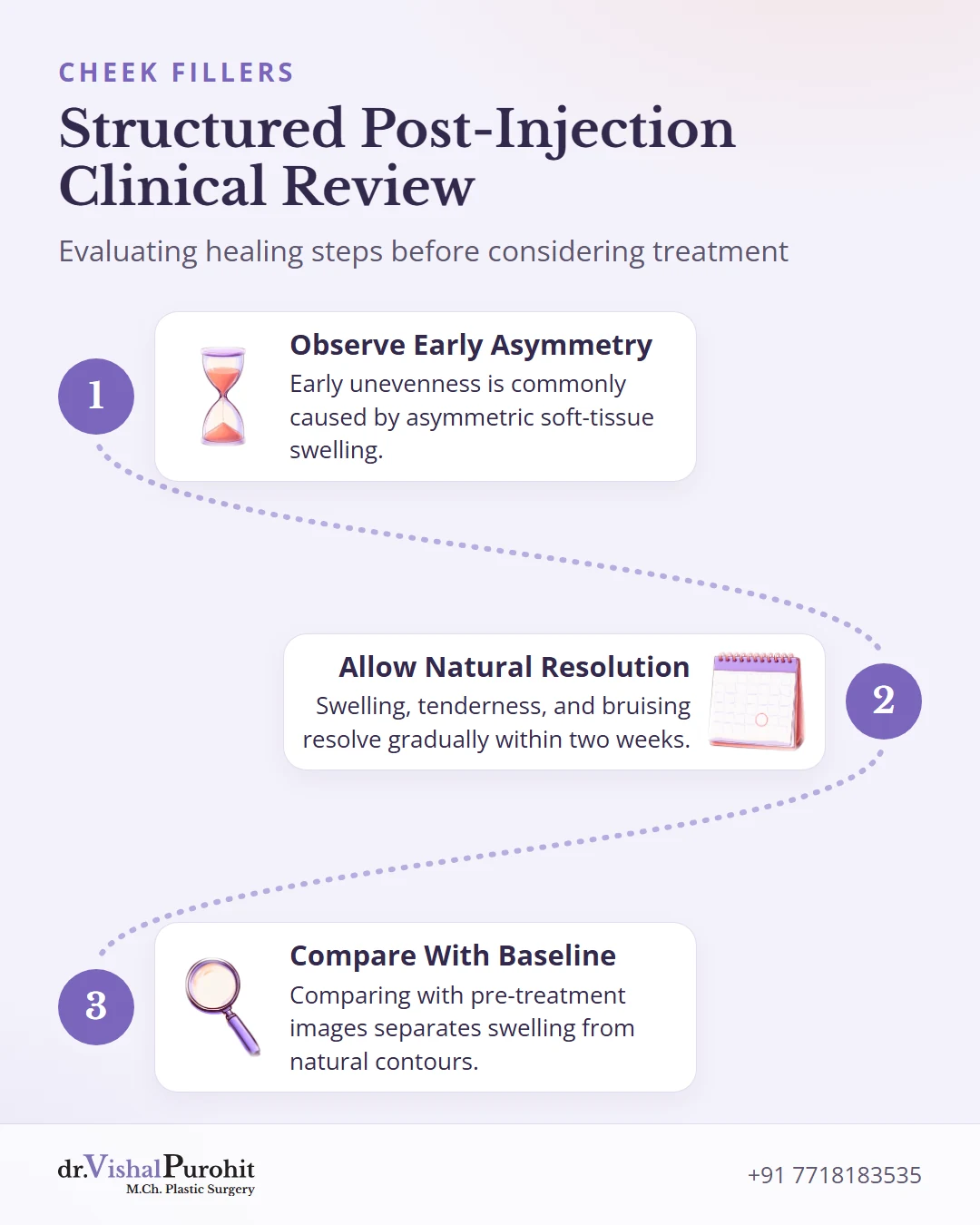
Step by step review process for normal post-injection swelling and assessment.

Midface rejuvenation requires careful anatomical assessment to preserve balanced expression. Injecting excessive product or placing it inappropriately distorts natural midface contours, creating disproportionate fullness, an unnatural smile, and a puffy appearance often referred to as facial overfill syndrome.

Studies report that overfilling frequently stems from excessive product volume, aggressive intervention without respecting anatomy, or repeated injections without adequate clinical reassessment. Learning how midface volume loss and flattening stem from deep fat deflation alongside bone resorption helps clarify what non-surgical volume replacement can realistically achieve.

Post-injection changes require structured medical review rather than immediate re-treatment:

  • Early asymmetry is most commonly caused by asymmetric soft-tissue swelling.
  • Transient swelling, tenderness, and bruising represent expected post-injection events that typically resolve gradually within two weeks.
  • Comparing the treated area with pre-treatment appearance separates early swelling or lumps from the natural facial shape.

Layering further filler over unresolved tissue expansion risks compounding distortion. While hyaluronic acid dermal filler can often be dissolved using hyaluronidase, the reversal process is never considered entirely free of risk. Choosing observation without undergoing any aesthetic treatment remains a completely valid option.

Urgent Warning Signs and Vascular Complication Risks

Warning graphic detailing severe pain, skin blanching, and vision changes as signs of vascular compromise.

Dermal filler injections carry inherent medical risks, and no cosmetic procedure is completely without risk. While routine effects like mild bruising, swelling, erythema, and localized tenderness typically resolve within two weeks, patients must understand serious complications before treatment.

Vascular compromise happens when filler obstructs or compresses an artery, reducing blood flow to facial tissues. Severe complications remain possible if product enters branches of facial or infraorbital vessels. Patients can review urgent warning signs and complications to understand critical differences between normal recovery and vascular occlusion.

A patient must seek immediate emergency medical care if any acute warning signs develop:

  • Sudden, severe, or worsening pain
  • Skin blanching, dusky discoloration, or skin turning white, grey, blue, or mottled
  • Any acute change in vision, blurring, double vision, or visual loss

When an intravascular injection involves hyaluronic acid filler, prompt intervention with hyaluronidase is required. Vision loss from vascular occlusion is an acute emergency where intervention must be rapid, though visual recovery remains poor.

Cheek Fillers Cost in Jaipur: Products and Consent
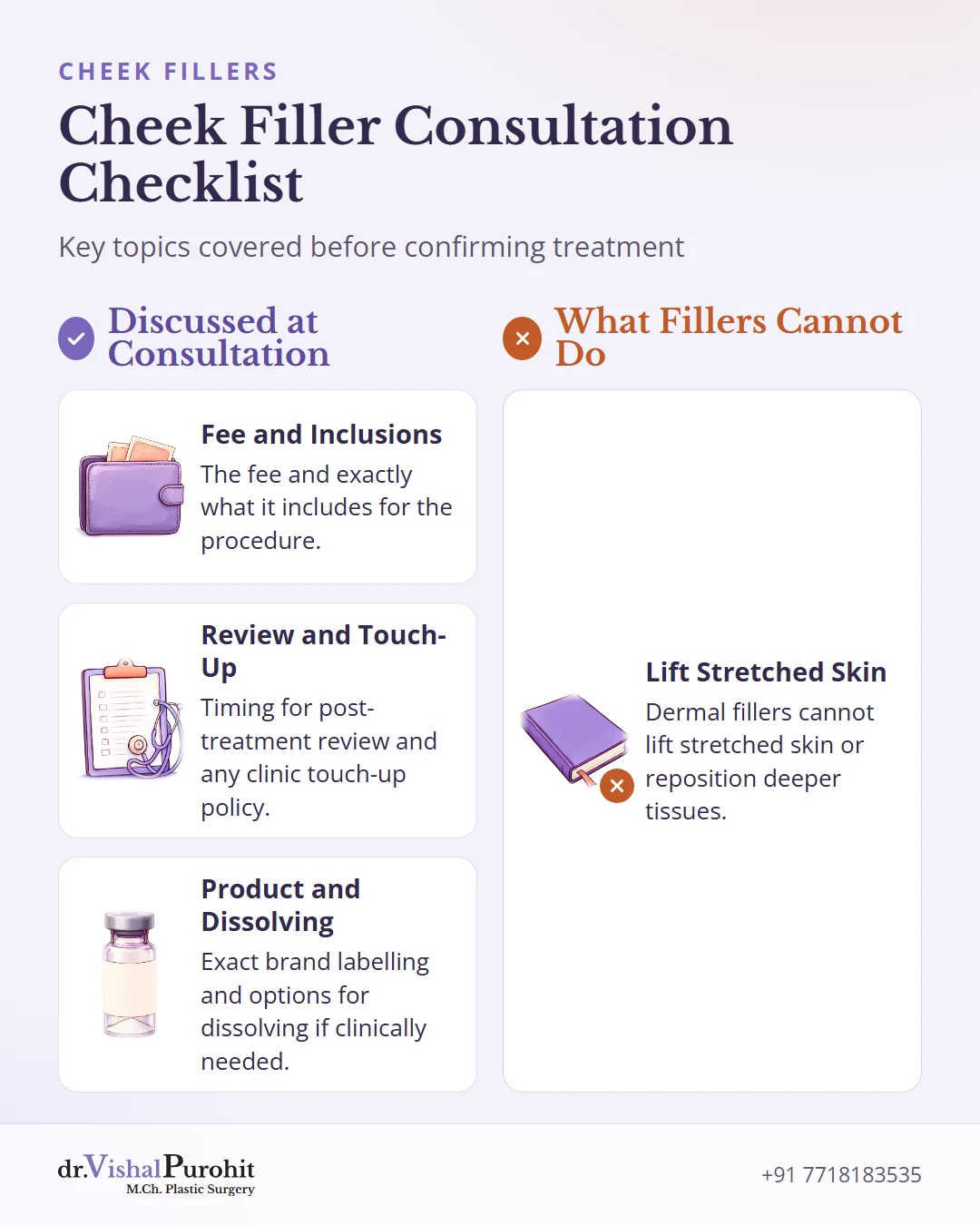
Checklist showing essential consultation topics and realistic limits of cheek fillers.

Treatment fees, what they include, and practical aftercare are not fixed in advance. Every facial assessment begins with an individualized discussion of clinical needs, product options, and safety considerations before any procedure is agreed upon.

Specific costs and details are explained at the consultation, including:

  • The fee and exactly what it includes for the planned procedure
  • Timing for a post-treatment review visit and any touch-up policy
  • Options for dissolving hyaluronic acid filler if clinical needs require it
  • The exact dermal filler brand, its labelling, and how products differ without interchangeable doses

Hyaluronic acid dermal fillers replenish depleted volume, but they cannot lift stretched skin or reposition descended deeper tissues. Learning what dermal fillers can achieve for midface volume loss helps patients weigh subtle contouring against surgical options or choosing no treatment at all.

Your Safety Comes First

Why Training and Assessment Matter

Cheek & Midface Dermal Fillers in Jaipur involves facial muscles, nerves and blood vessels. A careful assessment, a named product and clear warning signs help lower the risk of a heavy brow, an uneven result or rarer complications.

With Dr. Vishal Purohit, you are told which product is used, what to expect, and which symptoms need a call or emergency care.

Risks worth avoiding

  • Treatment before the brows and eyelids are checked
  • A product that is not named or shown
  • No clear plan if a brow or eyelid droops
  • A quote that is unclear about reviews and top-ups

With Dr. Vishal Purohit

  • M.Ch plastic surgeon
  • Brows, eyelids and skin assessed first
  • The product named before treatment
  • Warning signs explained before you leave
What to Expect

The Aim: A Refreshed, Natural Look

Cheek & Midface Volumization Fillers aims for a refreshed look that still looks like you. Results differ from person to person and are discussed honestly at the consultation.

Natural Expression

The plan aims to soften what bothers you while keeping the expressions you want to keep.

Risks Explained Up Front

Side effects and warning signs are explained before treatment by an M.Ch. plastic surgeon.

Planning Around Your Week

Most people return to daily routines soon after; any precautions are explained at the visit.

Got Questions?

Frequently Asked Questions

Honest, clinically precise answers from Dr. Vishal Purohit regarding Cheek & Midface Dermal Fillers in Jaipur.

Which dermal filler material is recommended for cheek enhancement?
Hyaluronic acid dermal fillers are widely studied for replenishing lost midface volume and restoring contour support. However, specific product selection depends entirely on individual anatomical needs and tissue characteristics. Dr. Vishal Purohit in Jaipur evaluates your facial framework during the consultation, explaining suitable product options, what their labels cover, and what non-surgical volume restoration can realistically achieve.
What medical history and previous treatments should I disclose at my consultation?
You should disclose all current medications, bleeding tendencies, underlying health conditions, and any history of facial injections, surgeries, or tendency toward fluid retention. Sharing this complete background with Dr. Vishal Purohit in Jaipur ensures proper risk evaluation, helps avoid complications like prolonged swelling, and allows him to determine safely whether midface dermal filler is appropriate for you.
How long does cheek swelling last before I see my final results?
Studies report that mild swelling, tenderness, and bruising are expected post-treatment events that typically resolve within days to about two weeks. Final contours become evident as initial tissue expansion settles and product integrates. Dr. Vishal Purohit in Jaipur explains what recovery pattern to expect and advises structured reassessment rather than hasty touch-ups during this settling period.
How often do cheek fillers need review and what influences total cost?
Review timing depends on individual tissue response, the extent of midface volume depletion, and how the filler integrates over time. The overall cost varies with the amount and type of product required. Rather than giving a standardized price, Dr. Vishal Purohit in Jaipur explains the exact fee and what it covers during your in-person consultation.
What are cheek and midface dermal fillers?
Cheek and midface dermal fillers are non-surgical injections designed to replenish depleted midface volume and provide contour support where deep fat has deflated and bone has resorbed. Dr. Vishal Purohit in Jaipur assesses midface structure and skin laxity first, clarifying that fillers restore lost volume but cannot surgically excise stretched skin or lift descended deeper tissues.
Who is an ideal candidate for cheek filler augmentation in Jaipur?
Ideal candidates are adults experiencing cheek flattening or midface hollows who desire subtle contour support while maintaining natural expressions. Those with marked skin laxity or significant tissue descent may need different surgical approaches. Dr. Vishal Purohit in Jaipur evaluates individual proportions, eyelid support, and baseline tissue puffiness to determine whether treatment is suitable or if observation fits better.
How long do cheek and midface dermal fillers last?
Studies report that dermal fillers in the midface usually provide volume support for several months, after which the gel gradually breaks down and tissues return toward their baseline state. The precise duration in an individual depends on biological factors and product characteristics, which are discussed with Dr. Vishal Purohit in Jaipur during your clinical consultation.
Will cheek fillers make my face look puffy or overfilled?
Unnatural fullness or facial overfill syndrome happens when excessive product is injected, anatomy is disregarded, or repeat treatments are layered before tissues settle. Dr. Vishal Purohit in Jaipur assesses facial contours both at rest and while smiling to ensure balanced volume restoration, advising restraint so natural animation and proportions are preserved without creating a bloated appearance.
Can cheek fillers lift sagging smile lines and jowls?
Restoring midface volume can sometimes subtly soften adjacent areas like prominent smile lines by providing structural support. However, dermal fillers do not lift heavy jowls or reposition descended tissues. Dr. Vishal Purohit in Jaipur assesses whether smile lines require separate consideration and explains the anatomical limits of non-surgical fillers versus surgical repositioning.
Is there any recovery downtime after cheek fillers?
Most patients experience little downtime, though temporary swelling, localized tenderness, and mild bruising can occur and generally resolve within days to two weeks. Individual precautions regarding physical exertion and facial pressure are explained by Dr. Vishal Purohit in Jaipur at your visit, along with clear signs that require clinical review or emergency attention.

Need more clinical answers?

Search 14,800+ answers in our FAQ directory.

Browse All 14,800+ FAQs
Begin Your Journey

Ready to Discuss Cheek & Midface Dermal Fillers in Jaipur?

At his OPD suite, Kalpana Aesthetics (2nd Floor), Dr. Vishal Purohit evaluates your candidacy, discusses surgical options and gives you a transparent, tailored treatment plan.