
TUE - SUN: 11:00 AM – 07:00 PM

Aesthetic & Reconstructive Surgery

Burn Contracture Release Surgery in Jaipur

Burn Contracture Release Surgery in Jaipur - Dr. Vishal Purohit Plastic Surgeon Jaipur11+ Years of Surgical Experience

Surgical release of tight scar bands to restore mobility, joint function, and quality of life.

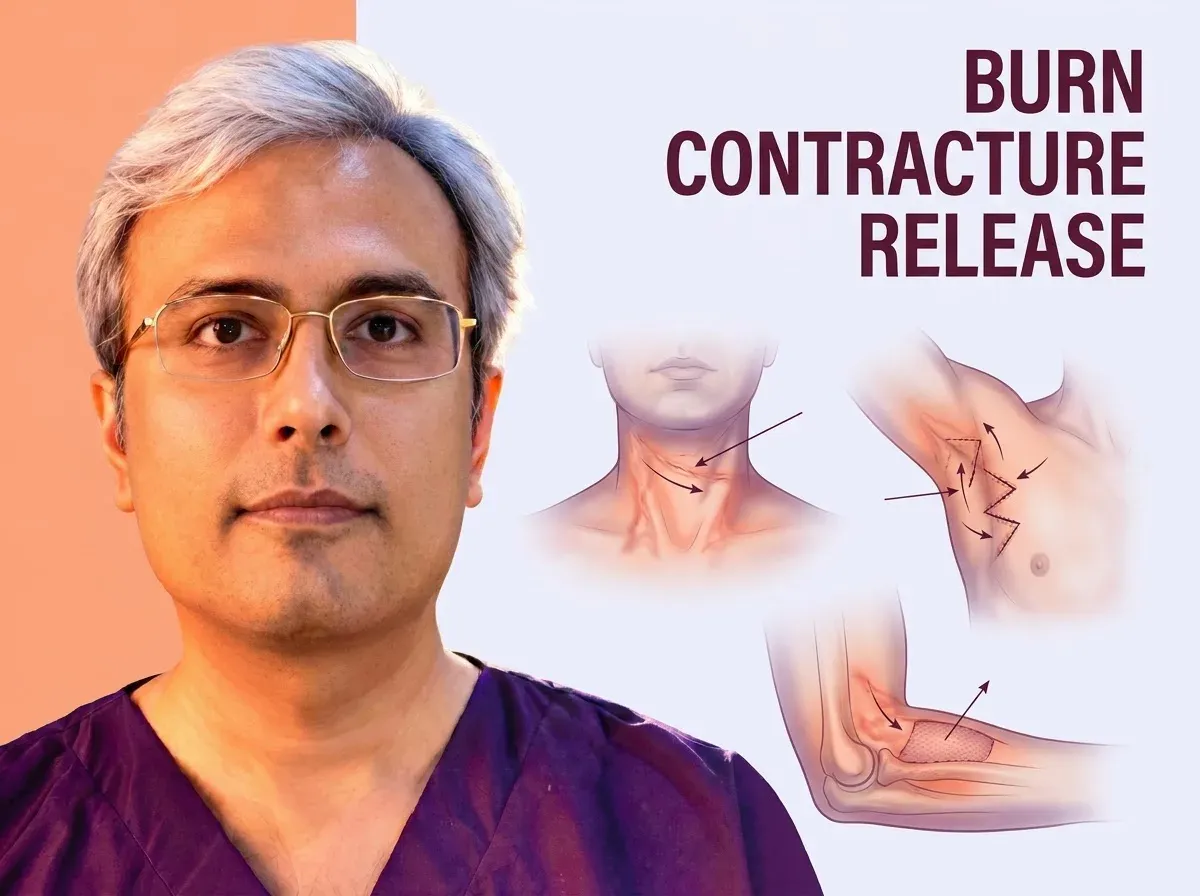
Advanced plastic surgery releasing debilitating burn contractures of the neck, axilla, elbows, and hands through multi-vector Z-plasties, skin grafts, and local tissue rearrangement.

  • M.Ch Plastic Surgeon · RMC Reg. 28041/14185
  • Day-care / short-stay procedure
  • Tonk Road, Jaipur
  • Jump to FAQs (10)

Procedure Time

1.5–3 hours

Anesthesia

General Anesthesia or Regional Nerve Block

Hospital Stay

1–2 days

Recovery Time

Splinting & light activity: 2–3 weeks; Physical therapy: 6–12 weeks; Long-term pressure garments

Indications

Neck flexion contractures, Axillary webs, Elbow/Knee joint contractures, Hand clawing

Techniques

Single & multiple Z-plasties, Full-Thickness Skin Grafts (FTSG), Local transposition flaps, Tissue expansion

Severe Burn Scar Tightness

Why are tight burn scars restricting your movement?

Thick contracting scar tissue across joints physically pulls the neck, armpit, elbow, or fingers into fixed positions, severely limiting everyday movement, grasping, and self-care.

Mentosternal Adhesions of the Neck

Tight platysma scar bands pull the chin down towards the chest, compromising head extension and normal airway access.

Axillary and Elbow Joint Immobility

Restrictive webbing across the armpit and flexor creases physically freezes joints, preventing essential overhead arm elevation and bending.

Post-Burn Hand Clawing

Contracted palmar bands and blunted finger web spaces curl digits inwards, impairing basic writing and object grasp.

Pathology of Scar Band Contraction

As deep thermal, chemical, or electrical burn injuries heal, maturation causes the healing tissue to naturally contract. Over mobile joint flexor surfaces, this relentless shrinkage produces thick, unyielding scar bands that overpower opposing muscles and lock surrounding anatomy into rigid, non-yielding functional deformities that require surgical release.

Dr. Vishal Purohit - M.Ch Plastic & Cosmetic Surgeon Jaipur

Dr. Vishal Purohit

M.Ch Plastic & Cosmetic Surgeon

✓

Credential Level

M.Ch Super-Specialty

RMC Reg. 28041/14185

Your Surgical Guide

Artistic Proportion & Advanced Surgical Safety

"Our priority is surgically incising or excising restrictive scar vectors and resurfacing defects with supple skin grafts or Z-plasties to restore anatomical joint motion."

— Dr. Vishal Purohit

1

M.Ch Plastic & Reconstructive Surgery, SMS Medical College, Jaipur

The highest super-specialty surgical qualification in India, ensuring total anatomical mastery of neurovascular planes and soft tissues.

2

11+ Years as a Plastic Surgeon

Hundreds of procedures performed, with a focus on natural, proportionate results.

3

Accredited Operating Suites

Dr. Vishal Purohit operates in sterile hospital operating theatres, with certified cardiac anaesthesiologists and ICU support.

Simple & Transparent

Your 3-Step Surgical Journey

We remove anxiety and uncertainty with a structured, transparent pathway designed for absolute safety and peace of mind.

1

Confidential Assessment

Dr. Purohit evaluates your anatomical baseline, skin elasticity, and health history. You receive an honest feasibility blueprint, personalized surgical plan, and transparent cost with zero pressure.

Step 1: Planning
2

Precision Operating Suite Procedure

Performed by Dr. Vishal Purohit in a sterile hospital operating theatre under gentle anaesthesia. Using advanced minimally invasive techniques, target areas are treated with microscopic care.

Step 2: Procedure
3

Monitored Recovery & Transformation

Supported with tailored recovery guidelines and post-operative follow-up visits. As tissue heals and settling occurs over the coming weeks, your refined results emerge.

Step 3: Recovery
Clinical Guide & In-Depth Information

Comprehensive Medical Overview

Detailed procedural analysis, anatomical considerations, and patient guidelines by Dr. Vishal Purohit.

Restoring Freedom of Movement After Burn Injuries

As deep thermal, chemical, or electrical burn wounds heal, the scar tissue naturally contracts. Over joint flexor surfaces—such as the neck, armpit (axilla), elbow, wrist, and hand—this contraction forms thick, unyielding scar bands that physically pull joints into fixed, frozen positions, causing severe functional disability and emotional distress.

Dr. Vishal Purohit specializes in comprehensive burn contracture releases. By surgically incising or excising the restrictive scar vectors and resurfacing the resulting defect with supple full-thickness skin grafts, multi-flap Z-plasties, or pre-expanded tissue flaps, we restore natural anatomical range of motion.

Site-Specific Burn Contracture Management

Neck Burn Contractures (Mentosternal Adhesions)

In severe cases where the chin is pulled down to the chest, complete surgical release of the platysma scar band restores head extension and normal airway access, resurfaced with thick skin grafts or pre-expanded shoulder flaps.

Axillary (Armpit) & Upper Extremity Contractures

Reconstructed using five-flap Z-plasties, local transposition flaps, or sheet grafting to restore full overhead arm elevation.

Post-Burn Hand Deformity Releases

Restoring the web spaces between fingers, releasing palmar flexor contractures, and straightening curled fingers to allow independent grasp, writing, and self-care.

Your Safety Comes First

Why Your Surgeon’s Training Matters

Burn Contracture Release Surgery in Jaipur involves delicate anatomy, blood supply and tissue handling. Choosing on price alone, or an operator without plastic-surgery training, raises the risk of contour irregularities and complications.

With Dr. Vishal Purohit, your safety is backed by intensive-care support, certified cardiac anaesthesiologists and hospital-grade theatre protocols.

What to watch out for

  • Operators without plastic-surgery training
  • Rushed or imprecise tissue handling
  • Clinic rooms without emergency backup
  • Higher chance of visible scars or revision surgery

With Dr. Vishal Purohit

  • M.Ch super-specialist plastic surgeon
  • Careful, tissue-preserving technique
  • Hospital-grade operating theatre
  • Personal follow-up through recovery
Restored Functional Freedom

Releasing Contractures to Regain Vital Daily Mobility

Surgical division of unyielding scar bands relieves joint tethering, allowing reconstructed tissues to move smoothly so you can resume essential daily personal activities.

Neck Mobility and Airway Access

Releasing mentosternal bands frees the chin from the chest, restoring upward head extension and facilitating unimpeded airway movement.

Restored Overhead Arm Elevation

Z-plasties and local transposition flaps release axillary webs to permit comfortable overhead reaching and functional joint flexion.

Functional Hand and Finger Grasp

Reconstructed palmar surfaces and deepened finger web spaces straighten clawed digits, enabling independent writing and daily self-care.

Got Questions?

Frequently Asked Questions

Honest, clinically precise answers from Dr. Vishal Purohit regarding Burn Contracture Release Surgery in Jaipur.

What is burn contracture release surgery and how is it performed in Jaipur?

Burn contracture release surgery loosens scar tissue that has tightened after a burn, often over a joint, to restore movement; it may involve cutting the scar and covering the area with a skin graft or flap. M.Ch. plastic surgeon Dr. Vishal Purohit in Jaipur can explain which approach may suit your scar and function.

A burn contracture is scar shrinkage after injury; when it crosses a joint, it can limit movement and tighten nearby tissues. Treatment is chosen by severity, location, duration, and functional or cosmetic goals. Options may include splinting and stretching, releasing tight bands, incision with skin grafting, or resurfacing with grafts or flaps. For neck contracture, the scar is released down to a healthy plane and the wound is spread carefully, with overcorrection because healing can tighten again. Anesthesia consultation is important when the airway may be affected, and children may need repeat release as they grow. Long-term splinting may reduce recurrence. Major complications include graft loss and recurrence.

Recovery depends on burn severity, age, and general health. Grafted wounds may need dressings for up to six weeks, and long-term splinting or bracing may reduce recurrence. Children may need repeat release as they grow, and complications can include graft loss or recurrence. If burn scars limit your movement, you may consult Dr. Vishal Purohit in Jaipur to discuss realistic options and recovery.

What common anatomical areas are affected by post-burn contractures?

Post-burn contractures commonly affect joints and nearby skin after a burn, especially the neck, armpit, hand, elbow, shoulder, hip, knee, ankle and toes. M.Ch. plastic surgeon Dr. Vishal Purohit in Jaipur can help you understand which areas are involved and how movement may be limited.

Scar shrinkage after a burn can tighten skin over joints and reduce range of motion. Lower-extremity contractures may involve all joints from hip to toes, with thin skin at the back of the knee, ankle top and toe top causing knee bending or ankle and toe overextension. Neck, armpit, hand, elbow and shoulder contractures are also common. Because nearby skin shares movement, contracture can affect more than the joint itself. Before release, a complete examination of joint mobility, strength, sensation and blood supply matters, since long-standing contractures may have abnormal nerve and blood-vessel bundles, and may need staged surgery if several areas are involved.

Recovery and risk depend on location, severity and whether multiple areas are involved. Neck releases may need repetition in growing children; in one study of 143 neck releases, postoperative neck hyperextension bracing for over one year decreased recurrence by 40% to 50%. Multiple contractures often require staged surgery because donor skin may be limited. If contractures affect your movement, you may consult Dr. Vishal Purohit in Jaipur to discuss functional goals and a staged plan.

What is the difference between Z-plasty and skin grafting for burn contractures?

Z-plasty rearranges nearby skin to lengthen a tight burn scar, while skin grafting covers a larger released area with skin from another site. M.Ch. plastic surgeon Dr. Vishal Purohit in Jaipur can explain which approach may suit your scar, movement limits, donor skin availability and recovery goals.

Z-plasty is used for smaller linear contractures when nearby skin has enough elasticity; it reorients scar tension and lengthens the scar. Skin grafting is chosen when primary closure is impossible or adjacent tissue is lacking, often after a larger release. Full-thickness grafts contract less and may match better, but have lower take and limited donor skin; split-thickness grafts are more common. Full-thickness grafts are usually reserved for the face, hands and joint surfaces. Flaps may be needed if bone, nerve or vessels are exposed. The choice depends on scar size, location, joint involvement, donor availability and functional goals. Z-plasty avoids a separate donor site when nearby skin is suitable, and the surgeon assesses scar maturity before choosing.

After release, grafts may need splinting, stretching and careful wound care; recurrence can occur, especially in growing children, and graft loss is a major complication. Z-plasty may need less postoperative therapy. Neck releases may need staged grafting and airway planning. If burn scarring limits your movement, you may consult Dr. Vishal Purohit in Jaipur to discuss realistic release options, recovery and possible repeat procedures.

How is recurrence of burn contractures prevented after surgery?

Recurrence after burn contracture release is reduced by careful timing, surgical overcorrection, strict postoperative splinting and physiotherapy, plus individualized follow-up. M.Ch. plastic surgeon Dr. Vishal Purohit in Jaipur can explain how scar maturity, joint position and your long-term follow-up plan affect the chance of tightness returning.

Recurrence is the most common complication after release. It often follows noncompliance with splinting, because healing creates secondary contracture. Patient compliance with splinting and physiotherapy must be ensured before another operation. Surgeons therefore overcorrect the release, avoid suture lines directly over joints, and preserve native soft tissue over joints when possible, since it resists contracture better than graft. Immature scars in the first one to two years can recur quickly, so waiting for scar maturation and using nonoperative measures first may improve outcomes. In children, growth can outpace scars, so releases may need repeating. Regular follow-up helps detect recurrence early, especially after lower-extremity releases.

Recovery focuses on protecting range of motion: splinting, stretching, exercise and regular follow-up, especially for children and lower-limb releases. In one neck study, a hyperextension brace for over one year after skin grafting reduced recurrence by 40 to 50 percent. Early surgical intervention and rehabilitation also matter for axillary contractures. If tightness returns, re-release with different coverage may be considered. If you are planning burn contracture release, you may consult Dr. Vishal Purohit in Jaipur to discuss prevention and follow-up.

Can facial and neck burn contractures be reconstructed in Jaipur?

Facial and neck burn contractures can often be reconstructed, but the plan depends on scar severity, movement limits and available donor skin. M.Ch. plastic surgeon Dr. Vishal Purohit in Jaipur can explain which release, graft or flap options may suit your scars and functional goals.

Neck skin is thin and prone to contracture after deep burns; scar shrinkage can limit movement and affect facial features. Options range from splinting and stretching to release with skin grafts or flaps, depending on severity, duration, available donor skin and functional goals. Airway access and intubation need anesthesia planning. Grafts may restore flexibility; long-term splinting can reduce recurrence. Children may need repeat releases as they grow. Reconstruction aims for meaningful functional and aesthetic improvement, not perfection, because one scar is replaced by another. If multiple areas are affected, release may be staged over time. The trade-off is accepting a scar or donor-site mark for better movement.

Recovery depends on burn severity, age and general health; major burns may need many operations and intensive care, while grafted wounds can need dressings for up to six weeks. Long-term splinting and physiotherapy help maintain release. Recovery also varies with scar maturity and adherence to splinting; children may need repeat releases. If you are considering reconstruction, you may consult Dr. Vishal Purohit in Jaipur to discuss staged options, donor sites and expected improvement.

What is the recovery period following burn contracture release in Jaipur?

Recovery after burn contracture release varies by burn site, scar maturity, joint involved, reconstruction method and individual healing. M.Ch. plastic surgeon Dr. Vishal Purohit in Jaipur can explain how release, grafting or flap reconstruction may affect healing, movement, scar care, splinting, follow-up and realistic timelines for your situation, comfort and daily activities.

Burn contracture release may use splinting, Z-plasty, incision and skin grafting, excision with grafts or flaps, tissue expansion or free flap reconstruction, depending on duration, joint or surface area, cosmetic and functional goals. A neck-release study found a neck hyperextension brace for over one year after skin grafting decreased recurrence by 40% to 50%. An axillary systematic review of 1602 patients reported pooled recurrence of 13.0% (95% CI 10.7-15.8), with flap-based reconstructions showing greater abduction gains than skin grafting. Functional impairment varies by body area and joint involvement. Long-term splinting may be needed after grafting to reduce recurrence, and recovery also depends on scar maturation and rehabilitation.

One case report described appropriate healing at seven days, progressive suture removal on days 12 and 14, and follow-up at six weeks and three months after inguinoperineal release. Burn recovery can include acute, healing and remodelling phases, with remodelling often lasting up to one year. Surgery may be needed months or years after the burn. If contracture limits movement or appearance, you may consult Dr. Vishal Purohit in Jaipur to discuss recovery, splinting and follow-up.

Is burn contracture surgery covered under health insurance in Jaipur?

Burn contracture surgery may be covered by health insurance in Jaipur when the insurer considers it medically necessary, but coverage is not guaranteed. M.Ch. plastic surgeon Dr. Vishal Purohit in Jaipur can explain how functional impairment, documentation and insurer approval affect your claim, and what records you may need.

Insurers usually distinguish functional problems from cosmetic concerns. A burn contracture that limits movement or daily function may be assessed differently from purely appearance-related surgery. The clinic can help with clinical documentation and pre-authorisation or reimbursement paperwork, and may coordinate eligible hospital cashless claims, but only subject to the insurer’s prior approval. You should confirm terms, exclusions and network hospitals directly with your insurer before planning surgery. No coverage, approval or cashless eligibility is guaranteed, and the final decision rests with the insurer. Medical necessity, severity, prior treatment and policy wording can all influence the outcome. Ask your insurer about pre-authorisation timelines and required medical records.

Recovery after burn contracture release varies with burn severity, age and general health. Major burns may need several operations and longer hospital care, while grafted wounds can need dressings for up to six weeks; surgery to improve function or appearance may be needed months or years later, especially in growing children. If you are considering burn contracture surgery, you may consult Dr. Vishal Purohit in Jaipur to discuss functional goals, documentation and realistic expectations.

Can childhood burn contractures be treated in adulthood?

Yes, childhood burn contractures can often be treated in adulthood, but correction depends on duration, joints involved, and whether deeper tissues shortened, with carefully individualized care. M.Ch. plastic surgeon Dr. Vishal Purohit in Jaipur can explain realistic options, limits, splinting after release and rehabilitation during consultation.

Scar maturation matters: surgery is usually delayed until scars mature, often about a year, because immature scars can recur quickly. Treatment may include serial splinting, surgical release, skin grafting or flap coverage, chosen by duration, area and function. The plan is individualized. Full-thickness skin grafts can help restore flexibility. In severe contractures present for decades, complete release may not be possible, especially if tendons, nerves, muscles or joints are involved; orthopedic input may be needed. Extreme cases may need bone resection or amputation, though this is less common now. Not every contracture needs immediate surgery; mild cases in growing children may be delayed cautiously. Regular follow-up helps detect recurrence early.

Recovery and recurrence depend on adherence to splinting, therapy and regular follow-up. Major complications include graft loss and recurrence. In one study of 143 neck releases, a hyperextension brace for over one year after skin grafting reduced recurrence by 40 to 50 percent. If childhood burn scarring limits your movement, you may consult Dr. Vishal Purohit in Jaipur to discuss realistic correction and rehabilitation.

Why select Dr. Vishal Purohit for burn contracture reconstruction in Jaipur?

Burn contracture reconstruction is highly individualized. M.Ch. plastic surgeon Dr. Vishal Purohit in Jaipur can explain realistic options, suitability, benefits and limitations after assessing your scar, movement, donor skin and goals, including how location and joint involvement may shape a staged plan. He can also discuss function, appearance and rehabilitation needs in a warm, patient-centered way.

After a burn, skin or scar can shrink and tighten, especially over a joint, limiting movement and sometimes tightening ligaments. Full-thickness skin grafts can help restore flexibility in selected areas. Treatment ranges from splinting and stretching to surgical release with skin grafts or flaps, depending on severity, location, available donor skin and functional goals. In children, releases may need repeating as they grow, and a written staged plan can help when several contractures exist. Choices are based on duration, joint involvement, cosmetic concerns and rehabilitation needs, with you as a major decision maker when possible. Long-term splinting may reduce recurrence after grafting.

Recovery depends on burn severity, age and general health. Minor burns may heal in weeks, while grafted wounds can need dressings for up to six weeks; major burns may require many operations and intensive care. Graft loss and recurrence are major complications, and long-term splinting can reduce recurrence. Surgery to improve function or appearance may be needed months or years later. If you are considering burn contracture reconstruction, you may consult Dr. Vishal Purohit in Jaipur to discuss options.

How do you distinguish a tight skin scar from stiffness in the underlying joint or tendon when assessing a burn contracture?

A burn contracture assessment distinguishes scar tightness from deeper stiffness by checking which tissues limit movement. Scar contraction across the joint is most common, but tendon, ligament, muscle or joint involvement can also restrict motion. M.Ch. plastic surgeon Dr. Vishal Purohit in Jaipur can explain how this distinction guides whether scar release alone or additional reconstruction may be needed.

Skin scar contractures often occur over joints and can lead to joint contracture. Secondary contractures may shorten musculotendinous units, neurovascular bundles and tissues around the joint, reducing movement. Primary arthro-osseous contractures can follow deep burns directly involving the joint and may be severe and irreversible. Differential diagnosis separates soft-tissue contracture from ankylosis, and connective-tissue contractures are classified by affected tissue: cutaneous or subcutaneous, tendon, ligament or muscle. Preoperative assessment includes joint mobility, strength, sensation and perfusion, with attention to exposed tendons and vital structures. Even with detailed examination, the exact cause of joint stiffness may only be delineated at surgery.

If tendon, ligament or muscle contracture is diagnosed, replacement or reconstruction methods may be considered in addition to releasing scar contractures. Neurovascular bundles can shorten with the joint and may be at risk during release, so the extent of safe release is assessed intraoperatively and staging may be needed. If a burn scar limits your movement, you may consult Dr. Vishal Purohit in Jaipur to discuss assessment and possible reconstructive options.

Need more clinical answers?

Explore all 96 answered Burn Contracture Release questions.

Burn Contracture Release FAQ Hub (96 FAQs)
Begin Your Journey

Ready to Discuss Burn Contracture Release Surgery in Jaipur?

Schedule a private consultation with Dr. Vishal Purohit at his OPD suite, Kalpana Aesthetics (2nd Floor), to evaluate your candidacy, discuss surgical options, and receive a transparent, tailored treatment plan.