
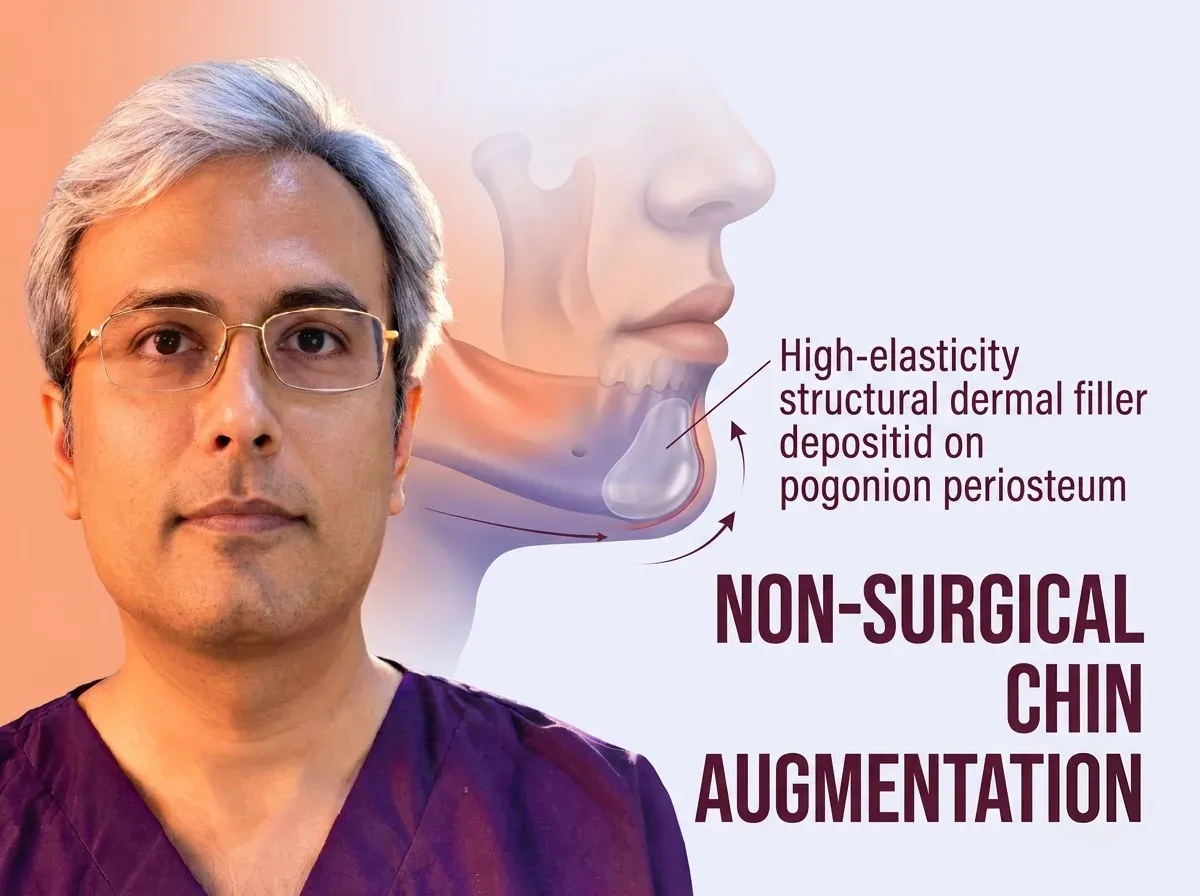

Facial Balance and Projection Goals for Chin Fillers
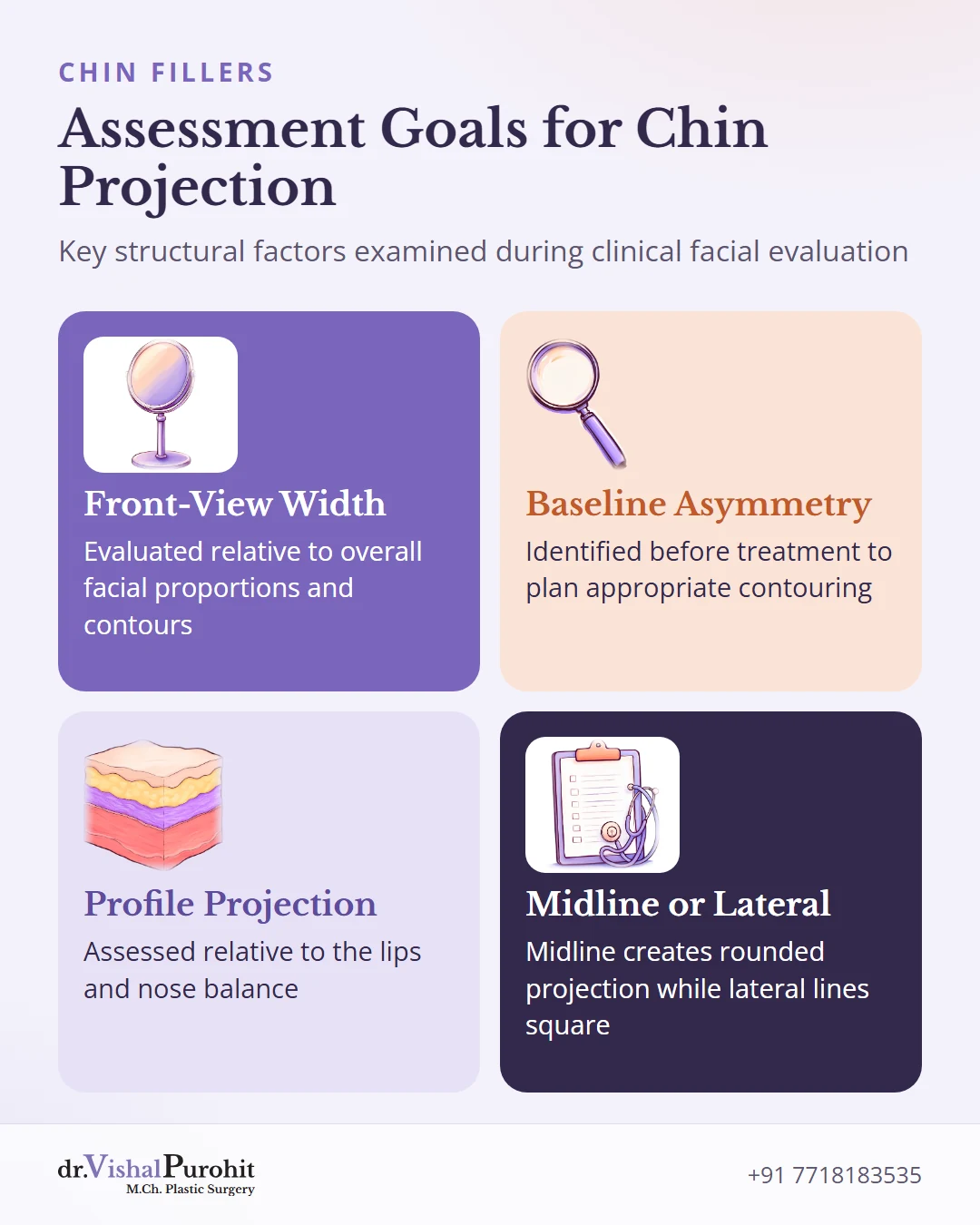
Dermal fillers provide anterior projection or vertical elongation to help balance the lower face relative to the lips and nose. Strategic placement supports overall facial harmony while respecting natural contours. Undergoing aesthetic enhancement remains an individual decision, and choosing no treatment is always a valid option.
During an evaluation, anatomical proportions and soft-tissue structure are assessed to determine whether injectable treatment is appropriate. Patients can understand projection and facial proportion goals by reviewing how front-view width, baseline asymmetry, and profile projection are examined.
Injecting in the midline provides forward projection for a rounded contour, whereas placing product along lateral lines creates a squarer appearance. In his practice, Dr. Vishal Purohit assesses facial structure individually in Jaipur. Specific filler products, numbing, longevity, aftercare, and touch-up policies are explained at the consultation.
Bite Limits and Clinical Assessment Before Treatment

Dermal fillers add soft-tissue volume to the chin, but they cannot reposition the underlying jawbone or correct dental bite problems. Choosing no treatment remains a valid option for anyone considering aesthetic care.
Cosmetic camouflage cannot address deeper bite discrepancies or airway compromise. When functional issues, severe retrusion, or excessive overbites occur, surgery or an oral and maxillofacial evaluation takes precedence over cosmetic injections.
During an evaluation, Dr. Vishal Purohit examines facial proportions alongside health history to see if injectable contouring is medically appropriate. Learning how injectables support chin projection and facial proportion goals helps clarify where dermal fillers fit before deciding on treatment.
Patients must disclose relevant medical details during their assessment, including:
- Prior injectable history and any previous facial surgeries
- Active skin, dental, or periodontal infections near the site
- Current medications, known allergies, or previous nerve symptoms
Treatment product, numbing, aftercare instructions, review timing, and touch-up policies are explained at the consultation rather than preset.
Surgical Alternatives and Review of Previous Fillers
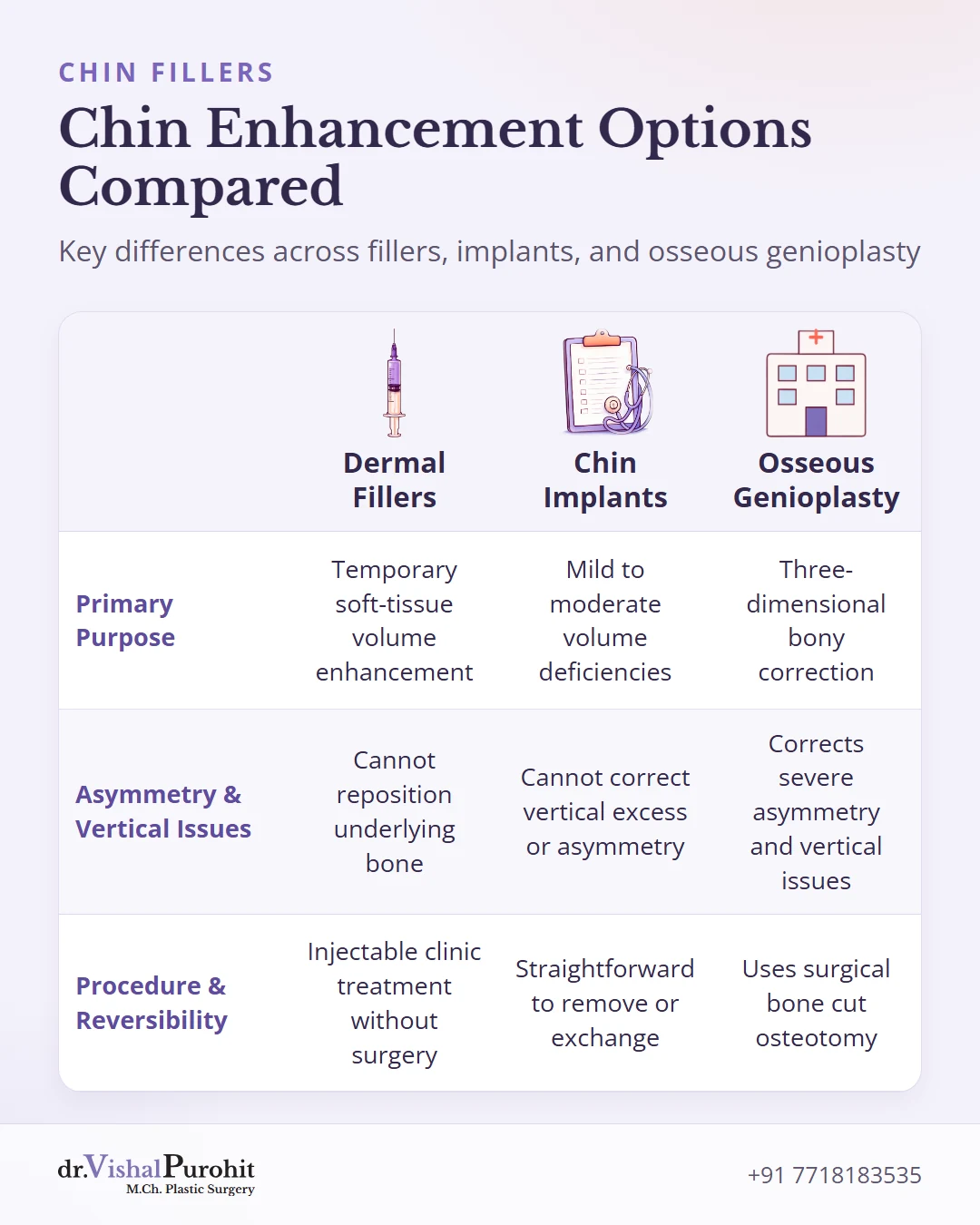
Dermal filler provides temporary enhancement and cannot serve as an exact trial or simulation for surgical options. Surgery involves lasting anatomical alterations and distinct procedural commitments.
Surgical chin enhancement is typically achieved through alloplastic implants or osseous genioplasty. Implants can correct mild to moderate mandibular volume deficiencies at the pogonion in the sagittal dimension, but they cannot correct vertical excess or reliably resolve asymmetries in any plane. Implants can be placed using transoral or transcutaneous approaches, and silicone chin implants are straightforward to remove or exchange if needed.
In contrast, osseous genioplasty uses an osteotomy, which is a surgical bone cut, to provide three-dimensional correction for severe asymmetry, vertical issues, or anatomy requiring setback. Understanding these structural distinctions helps clarify chin projection and proportion limits before choosing an intervention.
Any previous filler injections must always be disclosed during a surgical evaluation. Soft-tissue landmarks differ from underlying bony points, meaning overlying tissues directly influence surgical planning and final balance. In his practice, Dr. Vishal Purohit assesses facial structure and surgical candidacy individually during the consultation.
Normal Swelling Downtime and Urgent Symptoms to Report

After chin filler injections, the chin initially looks swollen and more rounded before temporary fluid buildup, known as edema, gradually subsides.
Expected recovery reactions after treatment include:
- Mild swelling
- Tenderness
- Firmness in the treated area
Planning recovery around these transient tissue changes is helpful when assessing how dermal fillers provide anterior projection or vertical elongation for facial balance. Deep placement onto bone also carries inherent risks, including mental nerve damage. Any new numbness or persistent lumps require direct clinical evaluation, and patients should never attempt home massage.
Vascular occlusion is a serious acute complication that occurs if filler enters an artery or compresses blood flow, potentially causing tissue necrosis or vision loss. Immediate emergency care is required for:
- Sudden severe pain during or following injection
- Skin blanching, turning white, grey, blue, or showing a livedo pattern
- Vision change, blurred vision, or visual disturbance
Chin Fillers Cost in Jaipur: Longevity and Consent
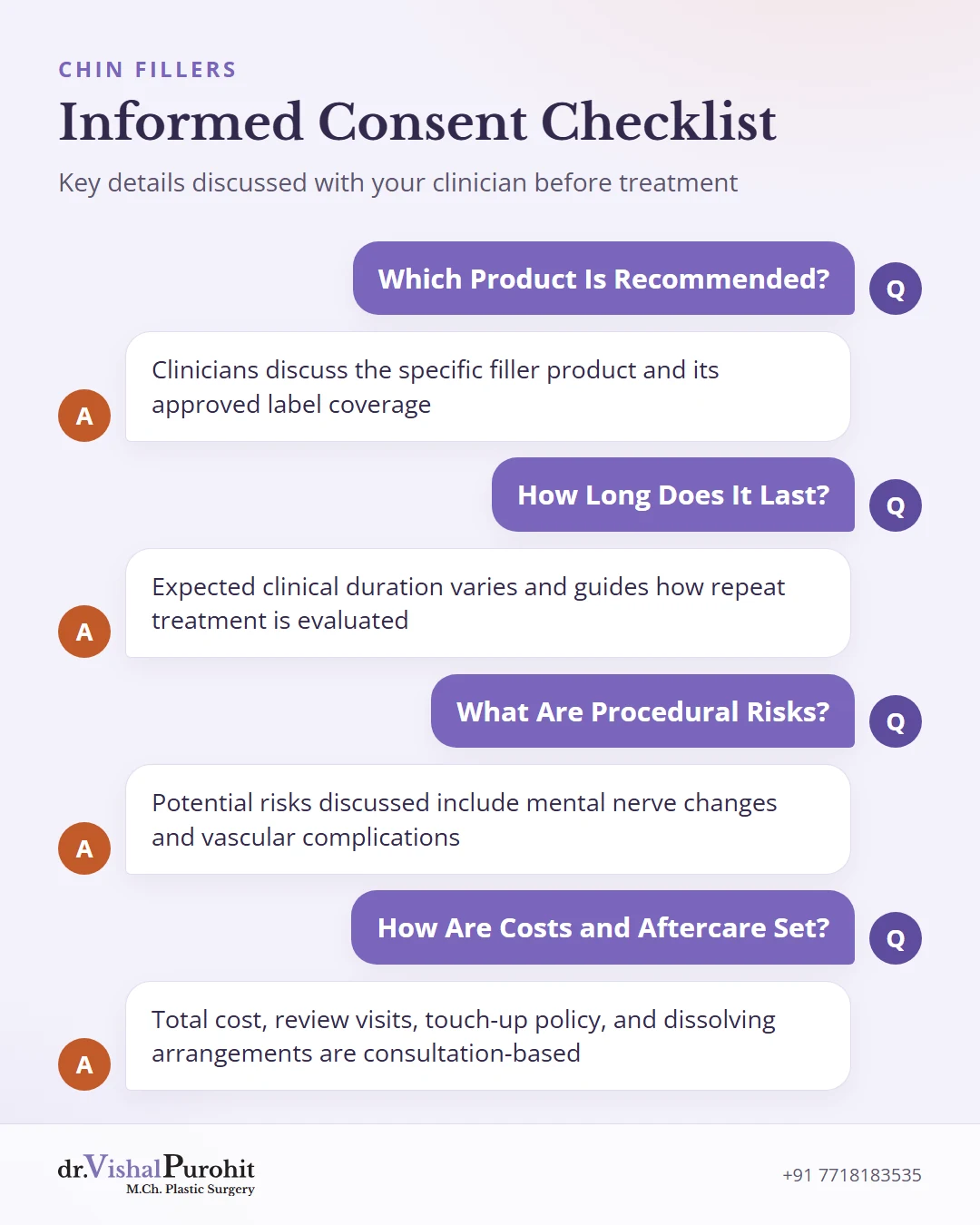
Dermal filler treatment adds contour or volume to the chin using injectable product. In Dr. Vishal Purohit's practice, the fee and what it includes are not set in advance. The total cost, review visit timing, touch-up policy, and dissolving arrangements are explained at the consultation.
Filler longevity varies across formulations, placement areas, and individual metabolism. Clinical studies report that products placed in mobile regions break down sooner than those placed in relatively immobile areas. Patients reviewing chin projection and facial proportion goals can understand how structural soft-tissue support and individual anatomy guide treatment planning.
Different filler products are not interchangeable. During clinical evaluation, individuals can discuss several key details before giving informed consent:
- Which specific product is recommended and what its label covers
- Expected clinical duration and how repeat treatment is evaluated
- Potential procedural risks, including mental nerve changes or vascular complications