

TUE - SUN: 11:00 AM – 07:00 PM

Aesthetic & Reconstructive Surgery

Bedsore & Pressure Ulcer Flap Surgery in Jaipur

Bedsore & Pressure Ulcer Flap Surgery in Jaipur - Dr. Vishal Purohit Plastic Surgeon Jaipur11+ Years of Surgical Experience

Deep vascularized muscle and fasciocutaneous flap coverage to heal non-healing decubitus ulcers.

Expert reconstructive flap surgery to obliterate deep dead space, cushion bony prominences, and permanently close chronic bedsores in paralyzed or bedbound patients.

View clinic timings and contact details →
  • M.Ch Plastic Surgeon · RMC Reg. 28041/14185
  • Day-care / short-stay procedure
  • Tonk Road, Jaipur
  • Jump to FAQs (10)

Procedure Time

1.5–3 hours

Anesthesia

General or Regional Epidural Anesthesia

Hospital Stay

3–5 days (with specialized air-fluidized bed support)

Recovery Time

Offloading strict bed care: 3–4 weeks; Flap fully consolidated: 6 weeks

Indications

Stage III & Stage IV Sacral, Ischial, and Trochanteric decubitus ulcers

Techniques

Gluteus Maximus rotation, Hamstring V-Y advancement, Tensor Fasciae Latae (TFL) flap

Non-healing decubitus ulcers

Why won't my bedsore close despite months of dressings and ointments?

Stage III and Stage IV pressure ulcers expose deep bony prominences, creating chronic dead space that routine wound care cannot reach, leading to persistent infection and severe systemic harm.

Deep dead space over bone

Ischemic necrosis leaves a hollow cavity beneath the skin that dressings cannot fill, allowing infection to persist unchecked.

Chronic osteomyelitis risk

Exposed sacral, ischial, or trochanteric bone becomes infected, driving cycles of inflammation that prevent any surface healing.

Life-threatening sepsis and protein loss

Uncontrolled deep ulcers cause severe protein depletion and systemic sepsis in paralyzed or bedbound patients.

Why tissue cannot heal itself

Sustained pressure over bony prominences cuts off local blood supply, causing ischemic necrosis of muscle, fat, and skin. Once tissue dies, it cannot regenerate from within. The resulting dead space harbours bacteria and resists all topical treatment, making healthy vascularised tissue transfer the only route to permanent closure.

Dr. Vishal Purohit - M.Ch Plastic & Cosmetic Surgeon Jaipur

Dr. Vishal Purohit

M.Ch Plastic & Cosmetic Surgeon

✓

Credential Level

M.Ch Super-Specialty

RMC Reg. 28041/14185

Your Surgical Guide

Artistic Proportion & Advanced Surgical Safety

"Our priority is thorough surgical debridement, bone smoothing through ostectomy, and precise transfer of well-vascularised muscle and fascia to permanently obliterate dead space and cushion the underlying bony prominence."

— Dr. Vishal Purohit

1

M.Ch Plastic & Reconstructive Surgery, SMS Medical College, Jaipur

The highest super-specialty surgical qualification in India, ensuring total anatomical mastery of neurovascular planes and soft tissues.

2

11+ Years as a Plastic Surgeon

Practising plastic surgery in Jaipur since 2015, with a focus on natural, proportionate results.

3

Accredited Operating Suites

Dr. Vishal Purohit operates in sterile hospital operating theatres, with certified cardiac anaesthesiologists and ICU support.

Simple & Transparent

Your 3-Step Surgical Journey

We remove anxiety and uncertainty with a structured, transparent pathway designed for absolute safety and peace of mind.

1

Confidential Assessment

Dr. Purohit evaluates your anatomical baseline, skin elasticity, and health history. You receive an honest feasibility blueprint, personalized surgical plan, and transparent cost with zero pressure.

Step 1: Planning
2

Precision Operating Suite Procedure

Performed by Dr. Vishal Purohit in a sterile hospital operating theatre under gentle anaesthesia. Using advanced minimally invasive techniques, target areas are treated with microscopic care.

Step 2: Procedure
3

Monitored Recovery & Transformation

Supported with tailored recovery guidelines and post-operative follow-up visits. As tissue heals and settling occurs over the coming weeks, your refined results emerge.

Step 3: Recovery
Clinical Guide & In-Depth Information

Comprehensive Medical Overview

Detailed procedural analysis, anatomical considerations, and patient guidelines by Dr. Vishal Purohit.

Definitive Reconstruction for Stage III & IV Pressure Ulcers

Chronic decubitus ulcers (bedsores) in bedridden or spinal cord injury patients frequently progress to expose deep bony prominences, leading to chronic osteomyelitis, severe protein loss, and life-threatening sepsis. Routine dressings and ointments cannot heal deep Stage 3 and Stage 4 ulcers because the tissue has suffered ischemic necrosis and underlying dead space exists.

Dr. Vishal Purohit specializes in comprehensive surgical debridement, bone smoothing (ostectomy), and well-vascularized tissue transfer that brings healthy muscle and fascia over the bared bone, providing an internal biological cushion that resists pressure.

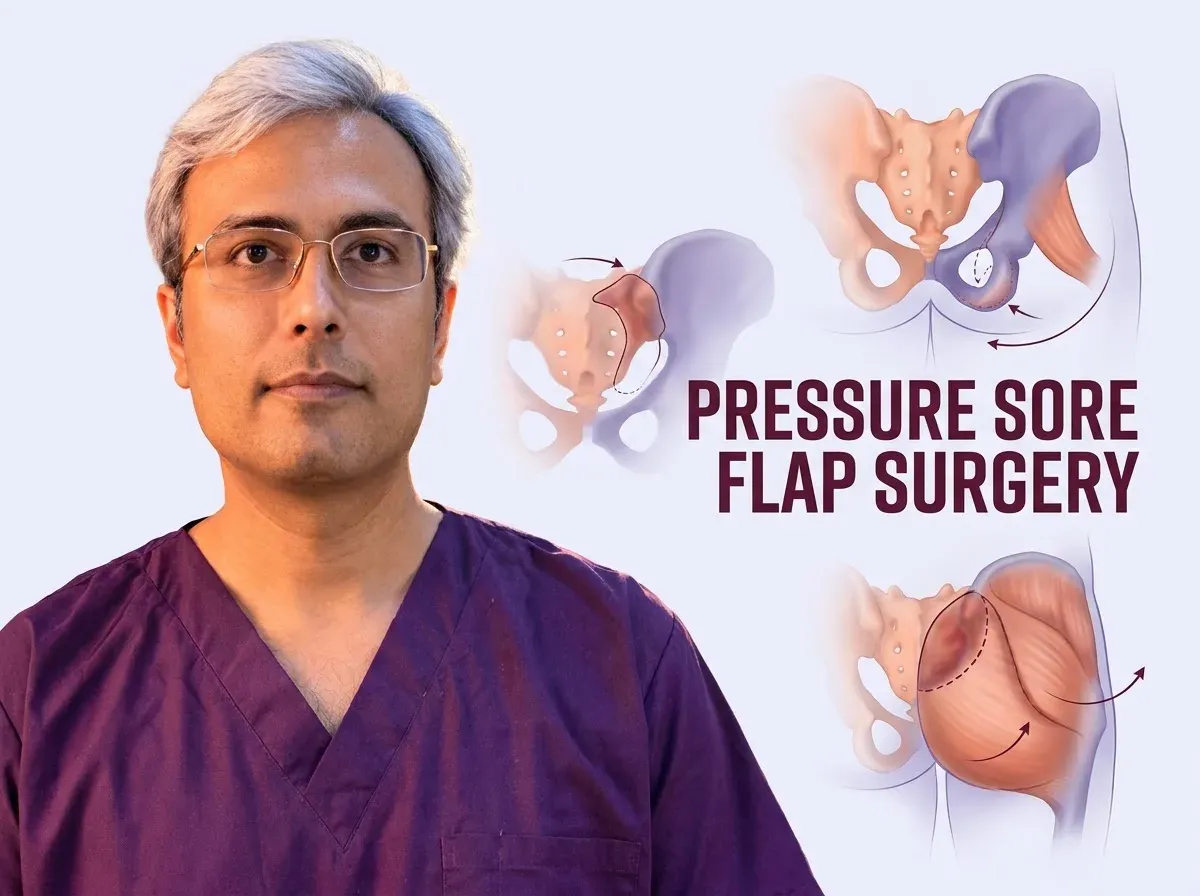
Site-Specific Reconstructive Flaps

Sacral Bedsores (Tailbone Ulcers)

Reconstructed using unilateral or bilateral gluteus maximus myocutaneous flaps, superior gluteal artery perforator (SGAP) flaps, or large V-Y fasciocutaneous advancement flaps that completely fill the sacral hollow.

Ischial Bedsores (Sitting Ulcers)

The most challenging ulcers in wheelchair-bound patients, reconstructed using hamstring V-Y advancement flaps, inferior gluteal flaps, or gracilis muscle flaps designed to withstand sitting pressure.

Trochanteric Bedsores (Hip Ulcers)

Reconstructed utilizing the pedicled Tensor Fasciae Latae (TFL) flap, providing thick, durable fascial support directly over the femoral greater trochanter.

Your Safety Comes First

Why Your Surgeon’s Training Matters

Bedsore & Pressure Ulcer Flap Surgery in Jaipur involves delicate anatomy, blood supply and tissue handling. Choosing on price alone, or an operator without plastic-surgery training, raises the risk of contour irregularities and complications.

With Dr. Vishal Purohit, your safety is backed by intensive-care support, certified cardiac anaesthesiologists and hospital-grade theatre protocols.

What to watch out for

  • Operators without plastic-surgery training
  • Rushed or imprecise tissue handling
  • Clinic rooms without emergency backup
  • Higher chance of visible scars or revision surgery

With Dr. Vishal Purohit

  • M.Ch super-specialist plastic surgeon
  • Careful, tissue-preserving technique
  • Hospital-grade operating theatre
  • Personal follow-up through recovery
Permanently closed, protected

Durable coverage that resists future pressure

Reconstructive flap surgery brings living, vascularised tissue over the bared bone, providing a biological cushion that closes the ulcer and helps protect the site against recurrent breakdown.

Internal biological cushion restored

Transferred muscle and fascia pad the bony prominence directly, replacing lost tissue with durable, pressure-resistant coverage.

Dead space obliterated

Site-specific flaps — gluteus maximus, hamstring V-Y, or TFL — completely fill the sacral, ischial, or trochanteric hollow, eliminating the infection cavity.

Systemic burden reduced

Closing a chronic open ulcer reduces the ongoing protein loss and sepsis risk that drain the health of bedbound or spinal cord injury patients.

Got Questions?

Frequently Asked Questions

Honest, clinically precise answers from Dr. Vishal Purohit regarding Bedsore & Pressure Ulcer Flap Surgery in Jaipur.

What is bedsore and pressure ulcer flap surgery in Jaipur?

A bedsore, or pressure ulcer, is skin and tissue damage from prolonged pressure. Flap surgery removes the damaged area and moves nearby living tissue with its blood supply to close the hole. M.Ch. plastic surgeon Dr. Vishal Purohit in Jaipur can explain when this reconstruction may be appropriate and what it can realistically achieve.

Pressure ulcers develop when prolonged external pressure, with friction, shear, moisture and poor nutrition, damages skin and deeper tissue; the exact mechanism is complex and not fully understood. Superficial stage I-II ulcers may heal with conservative care, while deeper stage III-IV ulcers may need surgery. In flap reconstruction, the ulcer, bursa and scarred tissue are removed, then living tissue is moved to fill the defect and close it without excessive tension. Because recurrence is common, risk factors must be corrected and the plan should allow for future procedures if needed. NHS guidance also notes surgery may be considered when an ulcer is severe or other treatments have not worked.

Possible complications include wound opening, fluid collection, infection and bleeding; long-standing ulcers can rarely undergo malignant change, so new drainage or change should be assessed. Surgery is often delayed until pressure, nutrition and other risks are improved. If a pressure sore is not healing or is deep, you may consult Dr. Vishal Purohit in Jaipur to discuss reconstruction, recurrence risk and long-term pressure care.

Why do Stage 3 and Stage 4 pressure ulcers fail to heal with dressings alone?

Stage 3 and Stage 4 pressure ulcers often do not heal with dressings alone because deep tissue may be exposed and unrelieved pressure keeps tissue starved of blood. M.Ch. plastic surgeon Dr. Vishal Purohit in Jaipur can explain when pressure relief, wound care or surgery may be needed.

Dressings can protect and support healing, but they cannot remove the pressure that caused the ulcer. In Stage 3 and 4 ulcers, tissue loss reaches deeper layers; Stage 4 may expose bone, tendon or muscle, sometimes with eschar or tunneling. Unrelieved pressure causes local tissue ischaemia, so even good wound care may fail until pressure is relieved with appropriate surfaces and regular repositioning. Deep wounds heal by granulation and contraction, and infection can delay healing, spread and cause significant harm. Surgery may sometimes shorten healing time, but it is not automatic and depends on the wound and your overall condition.

Pressure relief means turning at least every two hours in bed, lifting for ten seconds every ten to fifteen minutes when seated, and using an alternating air cell, low-air-loss or air-fluidized surface rather than static foam alone. Healing can take many weeks or months, and infection risk needs attention. If a deep pressure ulcer concerns you, you may consult Dr. Vishal Purohit in Jaipur to discuss wound care, pressure relief and whether surgery could help.

What surgical flap options are used by Dr. Vishal Purohit for bedsores?

For bedsores, Dr. Vishal Purohit, M.Ch. plastic surgeon in Jaipur, uses skin-and-tissue flaps with their own blood supply and muscle-containing flaps, chosen by wound size, location and your overall condition. He can explain how, after cleaning the wound, flap reconstruction closes the sore and fills dead space and supports wound healing.

Pressure ulcers develop when prolonged pressure damages skin and deeper tissue, sometimes exposing muscle or bone. Surgery is usually considered for severe ulcers after risk factors are addressed. The sore and nonviable tissue are removed, then living tissue with its blood supply is moved to close the defect and fill dead space. Tension-free closure matters because recurrence is common, so planning may preserve tissue for future reconstruction. The flap family is selected by defect size, location, tissue loss and your overall condition, not one fixed method. Complete debridement is essential before covering the wound. The operation aims to close the sore and restore function.

Recovery depends on wound size, your health and pressure-relief care. You may need dressings, drains and careful positioning; sitting or lying pressure must be avoided while healing. Results aim to close the sore and restore function, but recurrence remains possible. If a bedsore is not healing, you may consult Dr. Vishal Purohit in Jaipur to discuss flap options, debridement and realistic recovery and pressure care.

What is the post-operative recovery protocol following bedsore flap surgery?

After bedsore flap surgery, recovery is staged and pressure-free: published protocols describe about three weeks on a low air-loss bed with the operative site kept pressure-free, then a gradual sitting program. M.Ch. plastic surgeon Dr. Vishal Purohit in Jaipur can explain how your ulcer site, flap type and overall condition shape this plan.

The goal is to protect the flap while healing. Published protocols describe antibiotics tailored to intraoperative bone biopsies and cultures, drains kept until output is below 30 mm per day, and care to avoid pressure from drain tubing. Range-of-motion exercises for unaffected limbs may start soon after surgery. Sutures are often removed around the third week, with bowel programs resumed around the fifth postoperative day in spinal cord injury patients. Sitting may then increase in 30-minute increments after flap checks. These are published examples, not a universal prescription; your team individualizes turning, mattress support, wound care and activity. Recurrence risk varies widely, so pressure relief and education remain essential.

Published protocols also describe gentle turning, air-fluidized or air-loss mattresses, and nurse-administered wound care as healing progresses. Recurrence rates vary widely, from 3% to 100%, and thorough risk-factor review matters. If you are considering bedsore flap surgery, you may consult Dr. Vishal Purohit in Jaipur to discuss realistic recovery, pressure-relief needs and follow-up. Individual assessment determines whether surgery is appropriate and how long support is needed.

Is bedsore flap surgery covered by health insurance in Jaipur?

Insurance coverage for bedsore flap surgery in Jaipur depends on your policy and whether the insurer accepts it as medically necessary. Dr. Vishal Purohit, an M.Ch. plastic surgeon, can explain the procedure and help with documentation, but no coverage or cashless approval is guaranteed. Check policy terms and insurer requirements before planning.

Pressure ulcers can become severe enough that surgery is needed to clean and close the wound. Flap reconstruction moves living tissue with its blood supply to fill the defect after the sore and damaged tissue are removed. Because recurrence can be high, correcting pressure, friction, shear, moisture and nutrition risks matters before and after surgery. The operation is intended to close the ulcer and restore function, not to replace prevention. Stages III and IV ulcers may require flap surgery after risk factors are corrected. Complete debridement of nonviable tissue is essential before covering the wound, and tension-free closure helps prevent recurrence. The surgeon should also prepare for possible secondary procedures if recurrence occurs.

Possible complications include wound opening, fluid collection, infection and blood collection, and recurrence remains common even after good initial healing. The team can help with clinical documentation, pre-authorisation or reimbursement paperwork, and coordinate eligible hospital cashless claims subject to the insurer's prior approval. If you are considering bedsore flap surgery, you may consult Dr. Vishal Purohit in Jaipur about suitability, risks and paperwork.

Can dead bone or infected tissue be removed during the same bedsore flap surgery?

Dead or infected tissue and nonviable bone can be removed during the same bedsore flap operation, because thorough debridement is essential before flap coverage. M.Ch. plastic surgeon Dr. Vishal Purohit in Jaipur can explain how the wound is cleaned and whether closure is safe at that stage.

During surgery, the ulcer, bursa, scar tissue, calcification and any nonviable or infected bone are debrided so only healthy, pliable tissue remains. Incomplete debridement can cause flap failure and wound dehiscence. Bone is debrided back to clinically hard, healthy, bleeding bone, with biopsy sent when needed. If invasive infection is present, specimens may be cultured and the wound may be left open and lightly packed until infection resolves; closure with healthy tissue follows only then. Debridement should never be compromised to facilitate wound closure. Some evidence suggests one-stage debridement, ostectomy and immediate reconstruction can be as successful as staged approaches. A bone biopsy can also be taken at this time if desired.

Reconstruction aims to remove all devitalized tissue, excise the pseudobursa, obliterate dead space and achieve tension-free closure with pressure off-loading. Bone removal is kept to the minimum needed, because removing too much bone can alter pressure distribution and create new sores. If you are considering bedsore flap surgery, you may consult Dr. Vishal Purohit in Jaipur to discuss debridement, infection control and reconstruction options.

Can paralyzed or elderly patients safely undergo bedsore flap surgery?

Paralyzed or elderly patients may be considered for bedsore flap surgery when the ulcer is advanced and risk factors are corrected, but safety depends on overall health and wound stage. M.Ch. plastic surgeon Dr. Vishal Purohit in Jaipur can explain whether flap coverage, conservative care or staged treatment fits your situation.

Stage III and IV pressure ulcers require flap coverage after complete debridement, while superficial wounds may heal with conservative care. Before surgery, pressure, friction, shear, moisture and malnutrition should be corrected; surgery is often delayed until these factors improve. In high-risk patients, risks and benefits must be weighed and nonsurgical options considered. Paraplegic patients have been reported as suitable candidates in selected cases, including discharge about two weeks later, but one paraplegic patient died of pulmonary infection at one year. In older patients, some sophisticated flaps may carry disproportionately elevated risk, so simpler reliable options may be preferred. Suitability is individualized after assessment, and recurrence risk remains.

Recovery depends on pressure relief, nutrition, wound care and avoiding new sores during healing. Flap surgery can restore coverage, but recurrence remains possible and each flap uses limited tissue. Regular follow-up and pressure-relief planning are essential. If you or a family member has a pressure ulcer, you may consult Dr. Vishal Purohit in Jaipur to discuss realistic options, timing and care needs.

How are pressure ulcers prevented from recurring after successful flap surgery?

After successful flap surgery, preventing pressure-ulcer recurrence depends on relieving pressure, protecting the flap and correcting risk factors, not surgery alone. M.Ch. plastic surgeon Dr. Vishal Purohit in Jaipur can explain how pressure relief, skin care and follow-up fit your situation and what warning signs need prompt review.

Pressure ulcers recur because prolonged pressure, friction, shear, moisture and poor nutrition can damage tissue again. Surgery closes the wound after debridement, but long-term prevention needs pressure redistribution, turning, skin care and risk-factor correction. One source describes lying on air-fluid beds until stitches are removed, avoiding early buttock pressure and turning frequently; another stresses tension-free suturing and postoperative education. Recurrence rates vary widely, so prevention is ongoing. Complete debridement and flap coverage without excessive tension are also described as important surgical steps. Patients must be able to cooperate with pressure-area care, and risk factors should be corrected before surgery when possible. Prevention therefore combines surgical technique with daily care and follow-up.

Recovery may include early movement of unaffected limbs and gradual sitting, with education emphasized. Because recurrence can be high, your team should review pressure relief, nutrition and skin care. If you are considering flap reconstruction or worried about recurrence, you may consult Dr. Vishal Purohit in Jaipur to discuss prevention and follow-up. Regular follow-up helps adjust cushions, turning schedules and skin checks. Seek prompt care for redness, breakdown or fever. No outcome is guaranteed.

Why choose Dr. Vishal Purohit for pressure ulcer flap surgery in Jaipur?

In Jaipur, Dr. Vishal Purohit, an M.Ch. plastic surgeon with M.S. General Surgery training, can explain pressure-ulcer flap options, suitability, benefits and limitations for your wound and overall condition. He uses both skin-and-tissue and muscle-based flap families, selected according to the defect and patient, during a warm consultation.

Pressure ulcers mainly come from prolonged pressure, with poor blood flow, reperfusion injury and delayed healing contributing. Flap surgery can give durable coverage for advanced wounds, but results depend on nutrition, anaemia, infection control, pressure relief and careful technique. Before surgery, nutritional deficiency, anaemia, spasms and urinary infection should be corrected, with pressure-release beds and a cooperative attitude. During surgery, tension-free flap placement, drainage, bleeding control and thorough cleaning of dead tissue matter. Afterwards, strict pressure management, gradual return to sitting or wheelchair use, pressure-reducing surfaces and weight-shifting are important. Even with good care, recurrence and complications such as wound opening, fluid collection, infection or bleeding can occur, and new pressure injuries may appear elsewhere during recovery.

Recovery means careful wound care, pressure-release surfaces, gradual return to sitting or wheelchair use and careful long-term pressure management. New pressure injuries can develop at other sites during recovery, and recurrence at the operated site is possible. If you are considering pressure-ulcer flap surgery, you may consult Dr. Vishal Purohit in Jaipur to discuss realistic goals, risks and follow-up needs.

What stage is my pressure injury, and how deep does it extend?

Pressure injury stage depends on how much skin and tissue are lost and whether the wound base can be seen, not symptoms alone. A careful examination is needed because depth can be hidden. M.Ch. plastic surgeon Dr. Vishal Purohit in Jaipur can explain what your stage means and whether deeper structures may be involved.

Staging uses the NPIAP system: stage 1 is nonblanchable redness on intact skin; stage 2 is partial-thickness loss with exposed dermis; stage 3 is full-thickness skin loss; stage 4 involves deeper tissue, muscle, bone, tendon, ligament, cartilage or joint structures. Unstageable wounds have full-thickness loss hidden by slough or eschar, and suspected deep tissue injury may appear as persistent deep red, maroon or purple discoloration. Depth can be underestimated until the wound is examined and, if needed, debrided. Pressure ulcers remain a clinical diagnosis, so staging should be confirmed by examination. Commonly affected sites include the coccyx, heels, ankles, elbows, and sacrum and nearby bony areas.

Early sores may be managed with pressure relief and dressings, while severe or non-healing ulcers may need surgery to clean and close the wound. Bone or joint infection can occur if an ulcer reaches those areas. If you are concerned about a pressure injury, you may consult Dr. Vishal Purohit in Jaipur to discuss staging, wound care and possible surgical options.

Need more clinical answers?

Explore all 95 answered Bedsore & Pressure Ulcers questions.

Bedsore & Pressure Ulcers FAQ Hub (95 FAQs)
Begin Your Journey

Ready to Discuss Bedsore & Pressure Ulcer Flap Surgery in Jaipur?

At his OPD suite, Kalpana Aesthetics (2nd Floor), Dr. Vishal Purohit evaluates your candidacy, discusses surgical options and gives you a transparent, tailored treatment plan.