
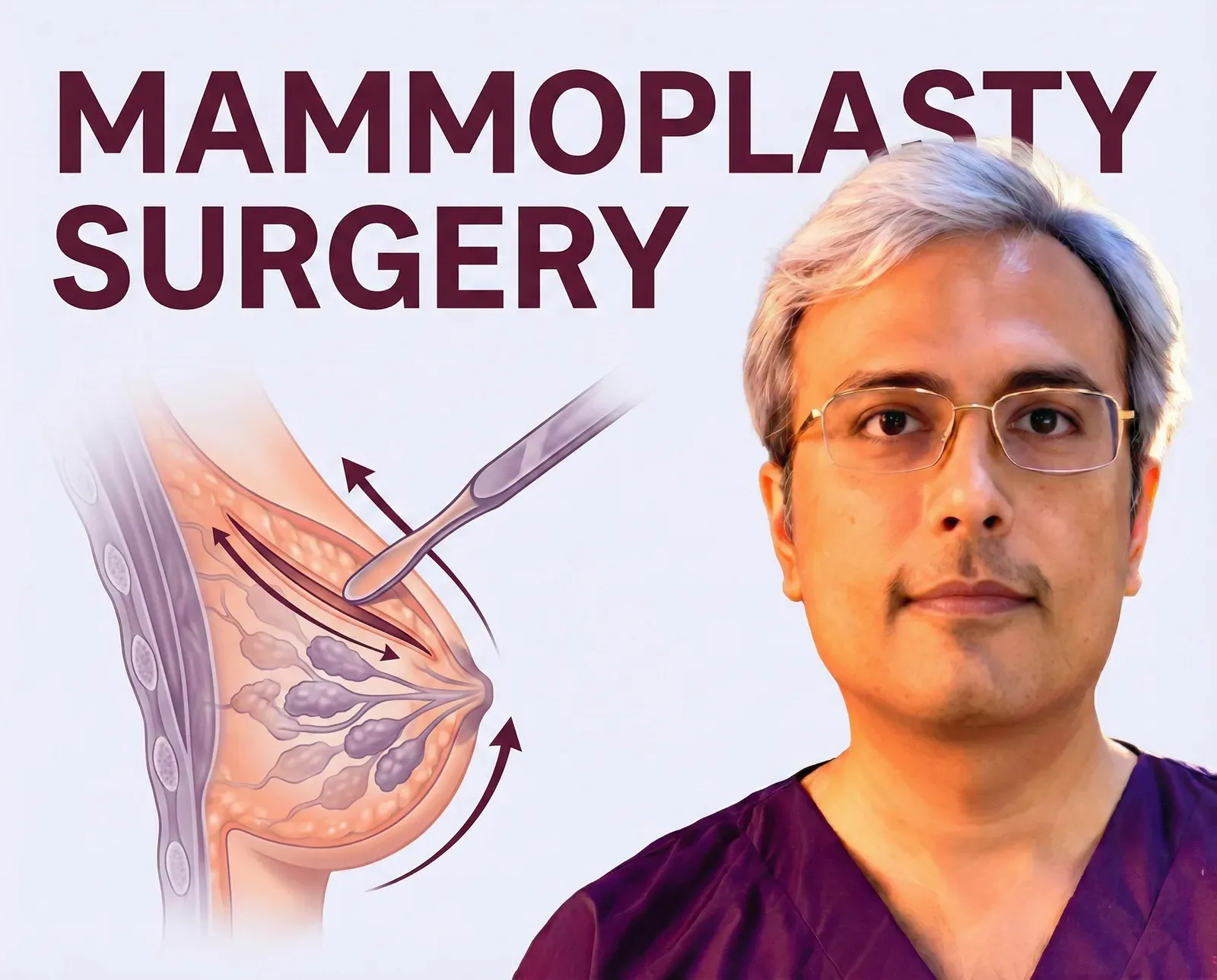

Introduction to Breast Lift Surgery
- Lifts and reshapes the breast
- Moves the nipple and areola to a higher, natural position
- Removes stretched, excess skin
- Add size or upper fullness Implants →
- Make large, heavy breasts smaller Breast reduction →
Breast lift surgery, medically termed mastopexy, is designed to reposition and reshape sagging breasts. Over time, tissue loses structural support, causing the breast mound to descend on the chest wall. The procedure lifts underlying tissue, raises the nipple and areola to a higher position, and removes stretched skin to restore a firmer contour.
Understanding what the operation does not accomplish is equally important. A breast lift alone does not increase breast size. When a person desires fuller upper pole volume or larger cup dimensions, breast implants are required. Similarly, mastopexy does not reduce heavy glandular tissue, which instead requires a formal reduction mammaplasty.
Dr. Vishal Purohit, M.Ch. plastic surgeon in Jaipur, evaluates each patient to determine whether tissue repositioning alone matches anatomical goals. When breast parenchymal volume is already adequate, lifting the native gland and redraping the skin envelope provides a proportionate, elevated contour without altering the overall breast mass.
Various Types of Breast Lift Procedures
Small incision along the top half of the areola, often with implants.
Scar lineAlong the upper edge of the areola
One incision around the areola.
Scar lineAround the edge of the areola
Around the areola and straight down to the crease.
Scar lineAround the areola, plus a vertical line
Adds a third incision along the breast crease.
Scar lineAreola, vertical line and the breast crease
Coral line: where the incision runs. Your surgeon recommends the pattern after examining you.
Different degrees of breast drooping require specific incision patterns to reposition tissue and excise excess skin. Studies report that selecting an incision depends on the position of the nipple-areola complex relative to the inframammary fold and the elasticity of the skin envelope. Dr. Vishal Purohit offers all four recognized breast lift patterns in his clinical practice.
- Crescent lift: Suitable for minimal sagging, using a small incision along the upper half of the areola border to slightly elevate the nipple-areola complex.
- Periareolar lift: Suitable for mild sagging, placing a circular incision completely around the areola border to tighten the skin envelope.
- Vertical lift: Suitable for moderate sagging, creating an incision around the areola and extending straight down to the lower breast crease.
- Anchor lift: Suitable for severe sagging, using an inverted-T incision around the areola, down the lower pole, and along the breast crease.
Textbooks describe that while limited incisions produce less scarring, extended patterns allow significant skin removal and glandular reshaping. The choice of pattern balances the extent of correction needed against the resulting scar lines.
Candidates for Breast Lift Surgery
- Breasts have saggedAfter ageing, pregnancy, breastfeeding or major weight loss.
- Does not smokeSmoking slows healing and raises the risk of complications.
- Good general healthNo condition that would impair healing.
- Realistic expectationsUnderstands what the surgery can and cannot change.
Breast sagging occurs naturally over time due to ageing, gravity, hormonal shifts, pregnancy, breastfeeding, and significant weight loss. These factors stretch the internal Cooper's ligaments and diminish skin elasticity. Candidates for surgery are generally healthy individuals who maintain a stable weight, do not smoke, and hold realistic expectations regarding surgical trade-offs.
Because subsequent pregnancies can restretch breast tissue and alter surgical outcomes, Dr. Vishal Purohit advises completing the family first before undergoing a breast lift. Planning surgery after childbearing helps protect the structural integrity of the lifted breast mound over a longer period.
Procedure choice depends on existing volume and tissue laxity. In Dr. Purohit's practice, patients with enough volume undergo a lift alone. Deflated breasts with empty skin indicate breast implants. Deflation combined with sagging requires a combined lift with implant, while excessive glandular volume requires a reduction.
Preoperative Consultation for Breast Lift Surgery
- Breast size and shape
- Skin quality
- Nipple position
- Degree of sagging
- —What you want to change
- —Realistic outcome
- —Previous surgeries
- —Current medicines
- —Breast imaging for every patient
The preoperative consultation begins with an open discussion of individual goals, concerns, and general health history. A thorough physical assessment evaluates breast dimensions, baseline symmetry, skin elasticity, nipple position, and the exact degree of ptosis. These clinical findings guide the choice of surgical technique and incision layout.
Prior surgical history, medication use, and underlying health factors are thoroughly reviewed. Dr. Vishal Purohit asks for breast imaging before surgery for every patient, both as a baseline record and to look for any markers of breast cancer.
Patient comfort and privacy remain central to the consultation process. In Dr. Purohit's practice, the female care standard includes a dedicated female nursing and assist team and a private female consultation suite, from the first consultation through surgery and recovery.
Preparing for Breast Lift Surgery
- Blood thinners
- Anti-inflammatory painkillers
- Certain herbal supplements
- Fasting as instructed before surgery
- Bathing and skin preparation
- Someone to take you home and help you
- Loose, comfortable clothes for the day
You receive the detailed list of medicines to stop at your consultation.
Careful preparation helps support smooth surgical healing and minimizes perioperative risks. Patients receive guidance on medicines and supplements to stop as advised by the surgical team. Blood thinners, anti-inflammatory painkillers, and specific herbal supplements must be discontinued before surgery because they can interfere with normal clotting mechanisms.
Tobacco use compromises microvascular circulation and increases the risk of wound-healing complications. Patients must stop smoking well ahead of surgery. Following fasting instructions before general anaesthesia is essential for safety. On the morning of surgery, patients bathe as instructed and wear loose, comfortable clothing.
Arrangements should be made for a responsible adult companion to escort you home after hospital discharge. For a structured overview of preoperative milestones, patients can review guidance on how to prepare for a breast lift so that personal and home arrangements are in place in advance.
The Surgical Procedure for Breast Lift
- Anaesthesia:
- General anaesthesia
- Operating time:
- 3–4 hours
- Hospital stay:
- One overnight stay
- 1MarkingPlanned while you stand.
- 2IncisionAlong the chosen pattern.
- 3ReshapingBreast tissue lifted and shaped.
- 4Nipple positionMoved to a natural height.
- 5Excess skinRemoved to tighten.
- 6ClosureSutures, skin adhesive or tape.
Breast lift surgery is carried out under general anaesthesia only in Dr. Vishal Purohit's practice; intravenous sedation is never utilized. The operating time for a breast lift alone typically ranges from 3 to 4 hours, depending on anatomical complexity and the chosen surgical incision pattern.
Preoperative markings are drawn with precision while the patient is standing upright, identifying the midline, breast meridians, and the new nipple position. After anaesthesia induction, incisions are placed according to the predetermined surgical plan. The underlying glandular tissue is mobilized, lifted, and securely reshaped to establish a firmer central breast mound.
The nipple-areola complex is carefully repositioned higher on the breast on a nourishing vascular pedicle. Stretched, redundant skin is tailored and excised before closing the incisions meticulously in layers. Surgical drains are used rarely for a lift alone in Dr. Purohit's practice, and patients complete one overnight stay of about 24 hours.
Recovery Period After Breast Lift Surgery
- Week 1 RestShort walks at home. Sleep on your back, upper body raised.
- Week 2 Desk work, drivingMost return to desk work; drive once a seatbelt is comfortable.
- Weeks 3–4 Light cardioBuild up gently.
- Week 6 Lifting, exerciseHeavy lifting, including a child, and strenuous exercise.
- Months Final shapeShape settles over about 3 months, then keeps improving.
Support bra day and night for the first month, 2–3 months in all. Timings are general textbook guidance and vary from person to person.
Postoperative care focuses on supporting healing tissues and managing normal surgical discomfort. The timings below are general guidance from plastic surgery textbooks and vary with the person and the extent of surgery. In Dr. Vishal Purohit's practice, patients wear a supportive medical bra day and night for the first month, and continue wearing it for 2 to 3 months in all to offload tension from delicate incision lines.
Dr. Purohit's note: Patients wear a supportive medical bra day and night for the first month, continuing for 2 to 3 months to protect healing incision lines.
- Week 1: Rest at home, manage mild soreness, take gentle short walks indoors, and sleep strictly on your back with the upper body slightly raised.
- Week 2: Gentle daily activities resume and back-sleeping continues. Most people return to desk work after about two weeks, and driving can restart once you feel safe and can wear a seatbelt comfortably.
- Weeks 3 to 4: Light cardio can be reintroduced gradually, building up over these weeks.
- Week 6 and beyond: Heavy lifting, strenuous activity, and upper-body workouts can be resumed after about six weeks as tissues strengthen.
Swelling gradually settles over weeks, while the breast mound settles over about 3 months, with tissue contours continuing to refine for several months thereafter.
Scar care
Surgical scars are permanent but typically fade over time. In Dr. Vishal Purohit's practice, scar care relies on sun protection only at first. Medical-grade silicone gel or silicone sheets are introduced only if a scar starts to turn hypertrophic during postoperative follow-up assessments.
Risks and Complications of Breast Lift Surgery
- Pain
- Swelling
- Bruising
- Bleeding
- Signs of infection at the wound
- Any change that worries you
Every surgical procedure carries inherent risks alongside expected postoperative effects. During the initial days, mild pain, swelling, and bruising are expected responses to tissue manipulation. Medical literature describes potential complications such as wound-healing problems, infection, bleeding, haematoma formation, asymmetry, wide or thickened scars, and fluid collections.
Research suggests that permanent changes in nipple sensation and alterations in the ability to breastfeed are possible following tissue repositioning. Dr. Vishal Purohit never guarantees preserved sensation or nursing capacity, as microvascular and neural pathways vary. Additionally, natural gravity and tissue ageing cause the recurrence of some sagging over time.
Patients receive clear guidance on identifying adverse warning signs during recovery. If you experience sudden unilateral breast swelling, active bleeding, spreading redness, high fever, or severe unrelieved pain, call the surgical team at once on +91 7718183535 for immediate clinical assessment.
Call the surgical team immediately if you experience sudden unilateral breast swelling, active bleeding, spreading redness, high fever, or severe unrelieved pain.
Results and Expectations of Breast Lift Surgery
- Right after surgerySome improvement is visible at once.
- First weeksSwelling and bruising settle.
- Several monthsFinal shape and position stabilise.
- A stable weight and a healthy diet
- A supportive bra, especially for exercise
- Sun protection for the scars
Initial improvements in breast position are visible immediately following surgery, though true contours remain masked by postoperative fluid retention. Swelling settles steadily over the initial weeks. The lifted breast shape settles over about 3 months, and subtle refinements in texture, scars, and contour keep improving for several months.
Key points
- Initial improvements appear immediately, while final contours and lifted shape settle over about 3 months.
- Results are long-lasting but remain subject to natural ageing, gravity, weight changes, and pregnancy.
- Consistent personal care, stable weight, supportive bras, and sun protection help maintain outcomes.
Surgical results are long-lasting but not immune to biological change. Factors that influence durability include continuous gravitational forces, natural tissue ageing, hormonal shifts, significant weight fluctuations, and future pregnancies. To understand the long-term timeline of surgical maintenance, patients often ask is a breast lift permanent when planning their care.
Maintaining surgical outcomes involves consistent personal care. Dr. Vishal Purohit recommends maintaining a stable body weight, wearing a supportive bra during athletic activities, and practicing strict sun protection across incision lines to preserve skin elasticity and protect long-term surgical contours.
Cost of Breast Lift Surgery in Jaipur
- 1Breast lift alone₹85,000, all-inclusive package.
- 2Lift with implants₹75,000 more: ₹1,60,000, all-inclusive.
- 3What it includesHospital and overnight stay, anaesthesia, surgery, garments and follow-up.
- 4FinancingThird-party financing, subject to availability.
A written quote follows your consultation.
Cosmetic surgery is usually not covered by health insurance.
Financial clarity is essential when considering elective aesthetic surgery. In Dr. Vishal Purohit's clinic, the price is ₹85,000 for a breast lift alone as an all-inclusive package. When the procedure is performed with implants, the price is ₹75,000 more, totaling ₹1,60,000 as an all-inclusive package.
The comprehensive surgical package covers hospital facility fees, operating theatre use, general anaesthesia services, surgeon fees, routine postoperative support garments, and scheduled follow-up visits. A definitive written quote detailing every component is provided directly to the patient following the in-person clinical consultation.
Because mastopexy is an elective aesthetic procedure, cosmetic surgery is usually not covered by health insurance policies. Patients seeking assistance with treatment expenses may explore third-party financing, subject to availability.
Alternatives to Breast Lift Surgery
Patients presenting with concerns about breast contour may explore various surgical options depending on anatomical needs. When sagging is accompanied by significant volume loss, breast augmentation with implants can replenish upper pole fullness. Conversely, patients with excessive glandular weight and sagging may benefit from a formal breast reduction.
For individuals seeking subtle volume enhancement without synthetic devices, autologous fat grafting transfers purified body fat to the breast. However, textbooks describe that fat grafting alone does not excise loose skin or significantly reposition a severely sagging nipple-areola complex.
Non-surgical modalities such as laser treatments, radiofrequency therapies, Thermage, pectoral exercises, and supportive brassieres exist in cosmetic practice. Studies report these non-invasive options offer mild or temporary skin-tightening effects at best. The clinic does not possess laser equipment, and Dr. Vishal Purohit does not offer laser, radiofrequency, or Thermage procedures.
Combining Breast Lift with Other Cosmetic Surgeries
A breast lift can be combined with other surgical procedures when indicated by individual anatomy. Combining a mastopexy with silicone implants allows simultaneous glandular elevation and volume restoration in a single operation. In Dr. Vishal Purohit's practice, patients undergoing a combined lift with implants require one overnight stay in the hospital.
When breast drooping and loose abdominal skin follow childbirth, procedures can be planned together. A breast lift can be performed alongside a tummy tuck or contouring with liposuction as part of an individualized mommy makeover treatment plan.
Multi-procedure surgeries require meticulous clinical evaluation to maintain patient safety. While select procedures can be performed together, larger combinations are planned case by case and often carried out in stages, for safety and a manageable recovery.