
TUE - SUN: 11:00 AM – 07:00 PM

Aesthetic & Reconstructive Surgery

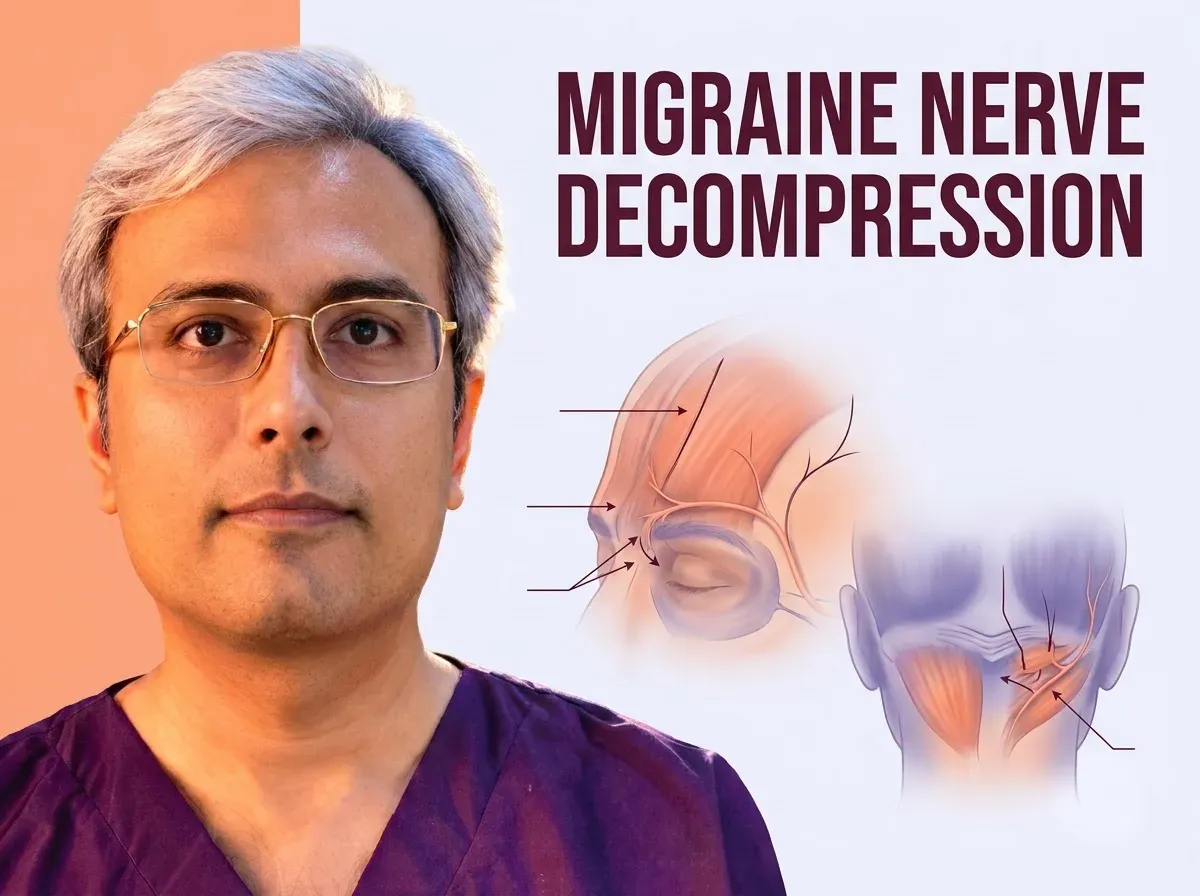
Migraine Decompression Surgery in Jaipur

Migraine Decompression Surgery in Jaipur - Dr. Vishal Purohit Plastic Surgeon Jaipur11+ Years of Surgical Experience

Minimally invasive peripheral nerve decompression to liberate you from chronic migraine pain.

Specialized sensory nerve decompression surgery in Jaipur targeting forehead, temple, and occipital nerve compression points to dramatically reduce migraine frequency and intensity.

  • M.Ch Plastic Surgeon · RMC Reg. 28041/14185
  • Day-care / short-stay procedure
  • Tonk Road, Jaipur
  • Jump to FAQs (10)

Procedure Time

1–2 hours

Anesthesia

General Anesthesia or Local Anesthesia with sedation

Hospital Stay

Daycare or 1 overnight stay

Recovery Time

Back to light desk work: 3–5 days; Stitches out: 7–10 days; Full exercise: 3 weeks

Success Rate

>85% of patients report at least a 50% reduction in headache days; over 35% achieve total elimination

Trigger Sites

Frontal (supraorbital), Temporal (zygomaticotemporal), Occipital (greater/lesser occipital), Rhinogenic

Trapped in chronic migraine

Why do your migraines keep coming back despite medication?

Chronic migraines force sufferers into dark rooms, dependent on triptans and preventive drugs that offer only temporary or inadequate relief from relentless, recurring pain.

Medication no longer controls pain

Prescription triptans and preventive medications fail a significant subset of migraine patients, leaving attacks frequent and debilitating.

Nerve compression at multiple sites

Sensory nerve branches are physically compressed in tight muscular, fascial, or vascular tunnels across the forehead, temples, and occipital region.

Rhinogenic pressure behind eyes

A deviated nasal septum or enlarged turbinates press against internal nasal sensory mucosa, triggering migraines from behind the eyes and nose.

Why the trigger point persists

In medically refractory migraine, the neurological cascade is physically initiated when sensory nerve branches — supraorbital, zygomaticotemporal, or occipital — are chronically irritated as they pass through tight muscular, fascial, or vascular tunnels. Medication quiets the cascade temporarily but cannot remove the compression causing it.

Dr. Vishal Purohit - M.Ch Plastic & Cosmetic Surgeon Jaipur

Dr. Vishal Purohit

M.Ch Plastic & Cosmetic Surgeon

✓

Credential Level

M.Ch Super-Specialty

RMC Reg. 28041/14185

Your Surgical Guide

Artistic Proportion & Advanced Surgical Safety

"Our priority is to surgically release the tight fascia, muscles, or crossing blood vessels irritating your sensory nerves — eliminating the peripheral trigger point and dramatically decreasing or completely resolving migraine attacks."

— Dr. Vishal Purohit

1

M.Ch Plastic & Reconstructive Surgery, SMS Medical College, Jaipur

The highest super-specialty surgical qualification in India, ensuring total anatomical mastery of neurovascular planes and soft tissues.

2

11+ Years as a Plastic Surgeon

Hundreds of procedures performed, with a focus on natural, proportionate results.

3

Accredited Operating Suites

Dr. Vishal Purohit operates in sterile hospital operating theatres, with certified cardiac anaesthesiologists and ICU support.

Simple & Transparent

Your 3-Step Surgical Journey

We remove anxiety and uncertainty with a structured, transparent pathway designed for absolute safety and peace of mind.

1

Confidential Assessment

Dr. Purohit evaluates your anatomical baseline, skin elasticity, and health history. You receive an honest feasibility blueprint, personalized surgical plan, and transparent cost with zero pressure.

Step 1: Planning
2

Precision Operating Suite Procedure

Performed by Dr. Vishal Purohit in a sterile hospital operating theatre under gentle anaesthesia. Using advanced minimally invasive techniques, target areas are treated with microscopic care.

Step 2: Procedure
3

Monitored Recovery & Transformation

Supported with tailored recovery guidelines and post-operative follow-up visits. As tissue heals and settling occurs over the coming weeks, your refined results emerge.

Step 3: Recovery
Clinical Guide & In-Depth Information

Comprehensive Medical Overview

Detailed procedural analysis, anatomical considerations, and patient guidelines by Dr. Vishal Purohit.

A Proven Surgical Solution for Medically Refractory Migraine

For millions of people suffering from chronic migraines, dark rooms, prescription triptans, and preventive medications offer only temporary or inadequate relief. In a significant subset of migraine patients, the neurological cascade is physically triggered by the compression and chronic irritation of sensory nerve branches as they pass through tight muscular, fascial, or vascular tunnels in the head and neck.

Dr. Vishal Purohit performs peripheral nerve decompression surgery. By surgically releasing the tight fascia, muscles, or crossing blood vessels irritating these sensory nerves, we eliminate the peripheral trigger point, dramatically decreasing or completely resolving migraine attacks.

The 4 Primary Migraine Trigger Sites We Treat

Site I: Frontal Trigger (Forehead & Above Eyes)

Compression of the supraorbital and supratrochlear nerves by the corrugator and depressor supercilii muscles. Released via an endoscopic hairline incision or through hidden eyelid creases.

Site II: Temporal Trigger (Temples)

Compression of the zygomaticotemporal nerve as it passes through the temporalis muscle.

Site III: Occipital Trigger (Back of Head & Upper Neck)

Entrapment of the Greater and Lesser Occipital Nerves (GON/LON) by the semispinalis capitis and trapezius muscles.

Site IV: Rhinogenic Trigger (Behind Eyes & Nose)

Deviated nasal septum or enlarged turbinates pressing against internal nasal sensory mucosa.

Your Safety Comes First

Why Your Surgeon’s Training Matters

Migraine Decompression Surgery in Jaipur involves delicate anatomy, blood supply and tissue handling. Choosing on price alone, or an operator without plastic-surgery training, raises the risk of contour irregularities and complications.

With Dr. Vishal Purohit, your safety is backed by intensive-care support, certified cardiac anaesthesiologists and hospital-grade theatre protocols.

What to watch out for

  • Operators without plastic-surgery training
  • Rushed or imprecise tissue handling
  • Clinic rooms without emergency backup
  • Higher chance of visible scars or revision surgery

With Dr. Vishal Purohit

  • M.Ch super-specialist plastic surgeon
  • Careful, tissue-preserving technique
  • Hospital-grade operating theatre
  • Personal follow-up through recovery
Life beyond migraine

Fewer attacks, lighter days, restored living

By removing the anatomical compression triggering your migraines, peripheral nerve decompression surgery aims to dramatically reduce headache frequency and intensity or resolve attacks entirely.

Peripheral trigger point eliminated

Surgically releasing the compressing fascia, muscle, or blood vessel removes the physical source that initiates the migraine cascade.

Return to daily activity quickly

The minimally invasive approach allows most patients to return to light desk work within days and resume normal life progressively.

Reduced dependence on migraine drugs

Eliminating the peripheral nerve compression reduces reliance on triptans and preventive medications for ongoing migraine management.

Got Questions?

Frequently Asked Questions

Honest, clinically precise answers from Dr. Vishal Purohit regarding Migraine Decompression Surgery in Jaipur.

What is migraine decompression surgery and how does it relieve chronic headaches in Jaipur?

Migraine decompression surgery aims to reduce or eliminate chronic headache frequency, duration and pain by releasing pressure on sensory nerves and vessels around the head. M.Ch. plastic surgeon Dr. Vishal Purohit in Jaipur can explain whether your headache pattern suggests a nerve compression trigger point and what surgery may realistically offer.

Chronic headaches in some people are linked to compression or irritation of peripheral sensory nerves at trigger points around the head, such as the forehead, temples, nose or back of the head. Surgery releases these compression points, sometimes by decompressing the nerve or removing muscle causing pressure. It is not a first-line treatment for every migraine patient; selection depends on symptoms and diagnostic assessment. A thorough headache history, examination and sometimes local anaesthetic blocks or imaging help identify whether a trigger point is involved. Surgery may reduce frequency, duration or pain rather than cure every headache. Reported outcomes vary widely, with complete elimination in 8.3% to 83% of patients in one review and 35% to 57.1% in randomized trials.

Complications are usually site-specific and relatively limited, such as scalp itching, temporary numbness, hollowing or nasal dryness depending on the treated area. Recovery and scar placement also depend on the treated site, so expectations should be discussed individually. No outcome is guaranteed. If chronic headaches affect your life, you may consult Dr. Vishal Purohit in Jaipur to discuss whether nerve compression could be contributing and what assessment would be appropriate.

Who is an ideal candidate for migraine surgery with Dr. Vishal Purohit?

An ideal candidate is a carefully selected patient with a confirmed headache diagnosis, often neurologist-evaluated, frequent severe attacks affecting daily life, and suspected peripheral nerve compression trigger sites, after thorough evaluation for migraine decompression surgery. M.Ch. plastic surgeon Dr. Vishal Purohit in Jaipur can explain suitability, benefits and limitations during consultation.

Migraine surgery is peripheral nerve decompression, not a universal migraine treatment. Selection usually starts with a thorough headache history and evaluation by a physician trained in headache assessment; Doppler, local anesthetic blocks, botulinum toxin and imaging may help identify trigger sites. One source describes ideal surgical candidates as neurologist-examined patients with at least two migraine headaches monthly that are severe enough to require prescription medication and significantly alter quality of life. Another describes frontal secondary headache candidates with high pain scores and refractory pharmacological treatment. Traditional criteria also include proper diagnosis, absence of medical or neurological conditions likely to cause headache, absence of unacceptable surgical risk, and exclusion of pregnant or nursing women.

Outcomes vary: one review reported migraine surgery successful in 68% to 95% of studies, while complete symptom elimination ranged from 8.3% to 83%, and three randomized trials reported 35% to 57.1% elimination. Complications are site-specific, such as frontal scalp itching or hair loss, temporal hollowing, occipital neck stiffness, or rhinogenic nasal dryness. If frequent migraines affect your life, you may consult Dr. Vishal Purohit in Jaipur to discuss whether nerve decompression is appropriate for you.

What are the common anatomical migraine trigger sites for migraine decompression surgery?

Migraine decompression surgery targets common trigger sites where nerves and vessels are compressed: frontal, temporal, rhinogenic and occipital areas; less common sites can also occur. Dr. Vishal Purohit, M.Ch. plastic surgeon in Jaipur, can explain whether your pain pattern suggests a surgically addressable compression point.

Frontal pain is above the eyes or forehead; temporal pain is over the temples; rhinogenic pain is inside the nose and may extend behind the eyes; occipital pain is at the back of the head and can radiate across the skull. Less common sites include auriculotemporal and lesser occipital areas. Surgery aims to reduce or eliminate headache frequency, duration and pain by releasing pressure points around the head, not to treat every migraine. Accurate identification depends on history and locating the pain origin; you may have one or several trigger points, and candidacy is individualized. A thorough assessment helps distinguish compression-related pain from other migraine causes, and the pain pattern guides which site is addressed.

Because trigger sites vary, assessment matters before considering surgery. Not all migraines are caused by peripheral nerve compression, and candidacy depends on identifying the point of origin. If chronic migraine patterns concern you, you may consult Dr. Vishal Purohit in Jaipur to discuss whether your symptoms suggest a surgically addressable compression point and what evaluation would be appropriate, including expected limitations.

How does Dr. Vishal Purohit confirm migraine trigger points before migraine decompression surgery?

Trigger points are usually mapped from your headache history, physical exam, and sometimes handheld Doppler or nerve blocks; imaging is not always needed. M.Ch. plastic surgeon Dr. Vishal Purohit in Jaipur can explain how this mapping guides whether decompression may be appropriate and what uncertainty remains.

Patients often can point with one fingertip to where an attack begins, and gentle pressure there may reproduce pain. For occipital symptoms, pain may start at the back of the head and move forward. A handheld Doppler can sometimes confirm an arterial signal near the point; in reported series this correlated with a close nerve-artery relationship in almost 98% of cases. Other tools may include local anesthetic blocks, botulinum toxin, or imaging in selected cases. Imaging is not always required, and Doppler is especially helpful for occipital trigger points. Because more than one trigger point can contribute, careful mapping matters; missed primary sites have been linked to failed surgery, and written consent is obtained before surgery.

A comprehensive headache questionnaire may be completed before surgery and again 12 months later to assess pain reduction and medication use. Outcomes are reported as highly successful in appropriately selected patients, but complications vary by trigger site. Written informed consent is required before surgery. If migraine trigger points concern you, you may consult Dr. Vishal Purohit in Jaipur to discuss mapping, possible decompression and realistic expectations.

Where are incisions placed in migraine decompression surgery and will there be visible scars?

Incision placement depends on the trigger site: occipital surgery uses a midline hair-bearing scalp incision, temporal surgery uses a small lateral canthal extension, and frontal endoscopic surgery may leave small scars. M.Ch. plastic surgeon Dr. Vishal Purohit in Jaipur can explain which site applies to you and how scars may be placed.

Migraine surgery releases pressure on sensory nerves at trigger sites such as frontal, temporal, occipital or rhinogenic areas. For occipital decompression, a 4-cm vertical midline incision in hair-bearing scalp or an 8–10 cm central incision along the superior nuchal line may be used; temporal decompression uses a 0.5–1 cm transverse lateral canthal extension incision. Frontal endoscopic surgery can leave 1-cm frontal cutaneous scars in about 20% of patients and hair thinning in 13.3%. Incision length and placement are chosen to match the trigger site, and some scars may be hidden in hair-bearing scalp or natural creases, though healing and visibility vary by patient and site.

Complications are site-specific: frontal decompression may cause scalp pruritus or alopecia; temporal decompression may cause hollowing or pruritus; occipital decompression may cause intermittent neck stiffness or weakness. Silicone-based lotions may aid scar control. Follow-up scar care and site-specific recovery vary. If you are considering migraine decompression surgery, you may consult Dr. Vishal Purohit in Jaipur to discuss trigger-site planning, incision placement and scar expectations.

What is the success rate of migraine decompression surgery?

Migraine decompression surgery success varies by trigger site, patient selection and success definition. Complete elimination has been reported in 8.3% to 83% of patients, while one systematic review found surgery successful in 68% to 95% of included studies. M.Ch. plastic surgeon Dr. Vishal Purohit in Jaipur can explain whether your headache pattern fits a surgically treatable trigger site.

It targets pressure on specific head or neck nerves, not every migraine. Assessment may include headache history, Doppler, local anesthetic blocks, botulinum toxin and imaging; each identified site is released by direct nerve decompression or removing pressing tissue. Outcomes are often good in carefully selected patients, but failure occurs in about 20% to 35%, often because not all trigger sites were found or surgery was inadequate. Compared with long-term targeted botulinum toxin, surgery may be more effective for sustained symptom reduction. Complications are site-specific, such as scalp itching, hair loss, temple hollowing, neck stiffness or nasal dryness, and recovery depends on treated sites and your surgeon's plan.

Recent site-specific studies reported success around 79% for one nerve release and 87% for another, but these are selected groups, not guarantees. Recovery and return to activities depend on the sites treated and your surgeon's plan. If you are considering migraine decompression surgery, you may consult Dr. Vishal Purohit in Jaipur to discuss trigger-site assessment, realistic improvement and possible complications.

What is the recovery period following migraine surgery in Jaipur?

Recovery after migraine surgery varies by trigger site and procedure. In one reported occipital group, patients resumed ordinary activities in one week and heavy exercise in three weeks. M.Ch. plastic surgeon Dr. Vishal Purohit in Jaipur can explain which approach may suit your headache pattern and what recovery to expect.

Migraine surgery decompresses peripheral nerves at identified trigger sites. In the occipital group, a midline occipital incision allowed removal of a segment of semispinalis capitis muscle medial to the greater occipital nerve, with a subcutaneous flap interposed to isolate the nerve. Procedures were outpatient and averaged under one hour. Patients were permitted to resume ordinary activities in one week and heavy exercise in three weeks. Outcomes are highly successful in appropriately selected patients, but results vary; one systematic review reported complete elimination in 8.3%–83% across trigger sites. Follow-up in the occipital group included visits at one, three, six, nine, and twelve months. Recovery timelines vary by individual and by the trigger sites treated.

Frontal surgery complications such as paresthesias or dysesthesias have resolved spontaneously within a few months in one series. Your individual recovery depends on sites treated, anesthesia, and healing. If migraine symptoms persist despite treatment, you may consult Dr. Vishal Purohit in Jaipur to discuss whether nerve decompression is appropriate and what recovery milestones apply to you. Follow-up visits help monitor healing and outcomes.

Is migraine surgery performed on the brain?

No, migraine surgery is not performed on the brain; it releases pressure around sensory nerves and blood vessels at trigger points on the head and neck. M.Ch. plastic surgeon Dr. Vishal Purohit in Jaipur can explain which trigger sites may matter and whether decompression could help your headaches.

Migraines can be linked to compression and irritation of sensory nerves and blood vessels around the head, not to brain surgery. Trigger points may be frontal, temporal, rhinogenic or occipital, and you may have one or several. Assessment may include, as appropriate, headache history, Doppler, local anaesthetic blocks, botulinum toxin and imaging. Each identified point can be decompressed by direct nerve decompression or avulsion of the offending nerve. The operation changes pressure around peripheral nerves; it does not remove brain tissue or alter structures inside the skull at all. Results are reported as highly successful in appropriately selected patients, but they vary by trigger site and patient factors.

Complications are relatively limited and site-specific: frontal decompression may cause scalp itching or hair loss; temporal decompression may cause hollowing or numbness; occipital decompression may cause intermittent neck stiffness or weakness; rhinogenic decompression may cause nasal dryness or a runny nose. If migraine headaches concern you, you may consult Dr. Vishal Purohit in Jaipur to discuss trigger-site assessment and whether peripheral nerve decompression is appropriate.

Why choose Dr. Vishal Purohit for migraine surgery in Jaipur?

Choosing Dr. Vishal Purohit in Jaipur means discussing migraine surgery with an M.Ch. plastic surgeon who can explain whether nerve decompression fits your headache pattern, trigger sites and prior treatments. Surgery is for appropriately selected patients, not most migraine patients, and outcomes vary by site and study.

Migraine surgery decompresses peripheral nerves of the head and neck in a subset of patients with compression trigger sites. Diagnosis uses a thorough headache history, hand-held Doppler, local anesthetic blocks, BTX-A and imaging; each trigger point is decompressed by direct nerve decompression or avulsion of the offending nerve. Outcomes are highly successful in appropriately selected patients. Surgery should not be considered the mainstay for most migraine patients. Reported complete elimination of migraine headache symptoms ranges from 8.3% to 83% in a 2019 systematic review, 35% to 57.1% in three randomized trials, and 57% after follow-up in one series; broader success ranges from 68% to 95%.

Site-specific complications include frontal itching 9%, hair loss 6%; temporal hollowing 53%, itching 11%, permanent numbness 5%; occipital neck stiffness or weakness 12%; rhinogenic nasal dryness 19%, runny nose 18%, sinus infection 5%, nosebleed needing desmopressin 5%. No major bleeding requiring return to operating room reported. Some patients still have migraine symptoms after surgery. If migraine surgery concerns you, you may consult Dr. Vishal Purohit in Jaipur to discuss suitability, benefits and risks.

How will a headache specialist confirm my diagnosis before migraine decompression surgery is discussed?

A headache specialist confirms the diagnosis with a detailed headache history, physical examination, trigger-point testing, and sometimes local anesthetic blocks, botulinum toxin, Doppler or imaging. M.Ch. plastic surgeon Dr. Vishal Purohit in Jaipur can explain how this assessment guides whether decompression surgery is discussed for your headaches.

The assessment usually starts with a careful history and physical examination. You may point with one fingertip to the exact trigger point where pain begins, and gentle pressure there can reproduce pain. For occipital symptoms, no diagnostic imaging is required, although handheld Doppler may help locate vessels near the nerve. A neurologist should first diagnose migraine or tension-type headache using ICHD criteria; candidates usually have frequent severe headaches, while cluster, episodic tension-type and secondary headaches are excluded. Local anesthetic blocks, botulinum toxin and imaging may also be used in the algorithm, and written informed consent is required before surgery. Not every patient qualifies, and selection is strict.

Outcomes vary: complete symptom elimination has been reported in 8.3% to 83% of patients, with 35% to 57.1% in randomized trials, and complications are site-specific. Surgery is not suitable for everyone and requires strict selection. A thorough assessment helps decide whether nerve decompression is appropriate. If you are considering migraine decompression surgery, you may consult Dr. Vishal Purohit in Jaipur to discuss diagnosis, trigger points and realistic expectations.

Need more clinical answers?

Explore all 86 answered Migraine Trigger-Point / Peripheral Nerve Decompression Surgery questions.

Migraine Trigger-Point / Peripheral Nerve Decompression Surgery FAQ Hub (86 FAQs)
Begin Your Journey

Ready to Discuss Migraine Decompression Surgery in Jaipur?

Schedule a private consultation with Dr. Vishal Purohit at his OPD suite, Kalpana Aesthetics (2nd Floor), to evaluate your candidacy, discuss surgical options, and receive a transparent, tailored treatment plan.