Dimples are small creases in the cheek that appear when a person smiles. They may sit on one cheek or on both, and they occur in males and females with equal prevalence. Their size and shape vary from person to person, because of soft-tissue elasticity, facial muscle tone and where the muscle fibres attach to the skin.
This post sets out the cheek dimple types reported in the literature, and how the side and position are decided. The landmarks used for marking are covered in Where Should a Cheek Dimple Sit? Facial Landmarks.
Types of Natural Dimples
One side or both
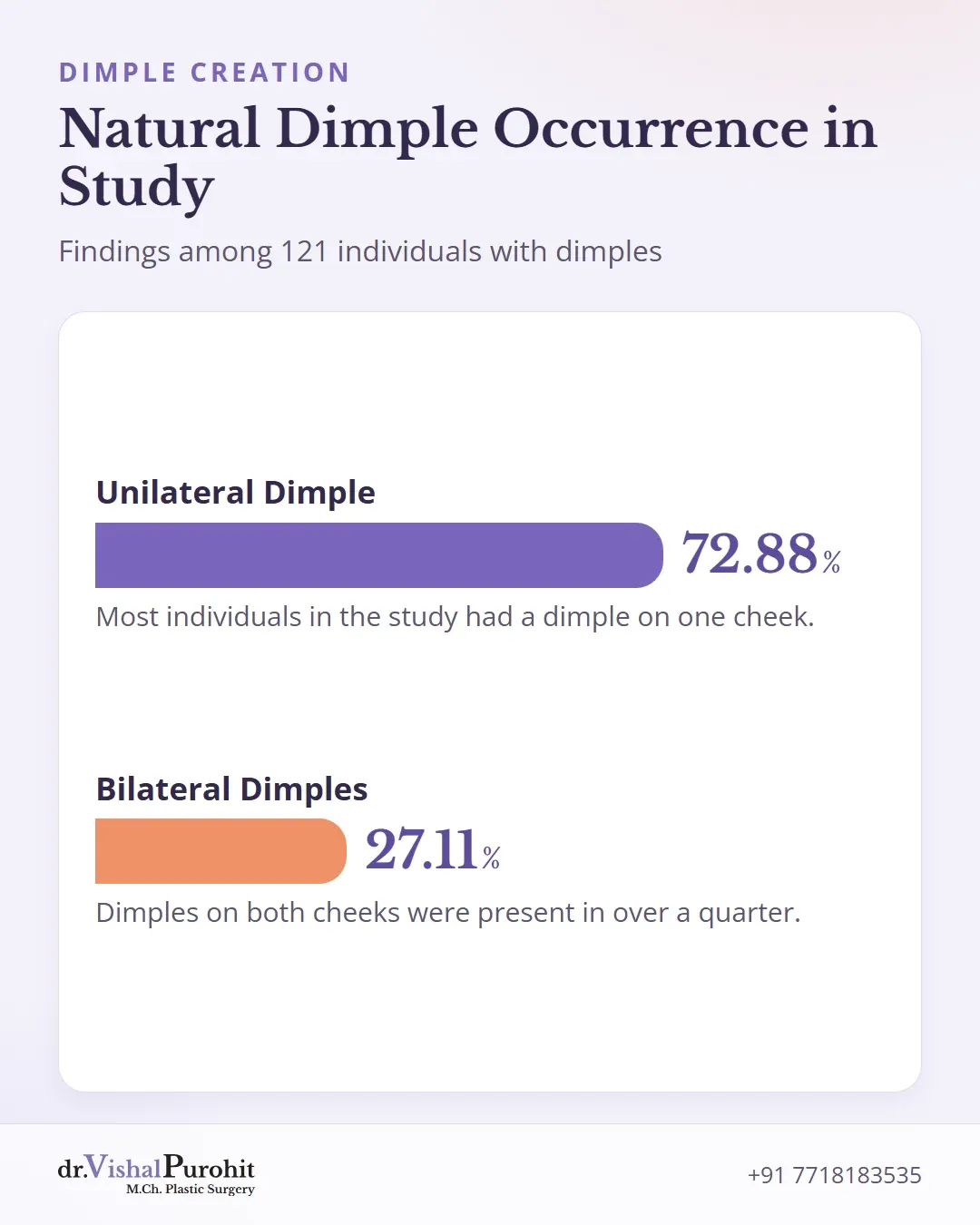
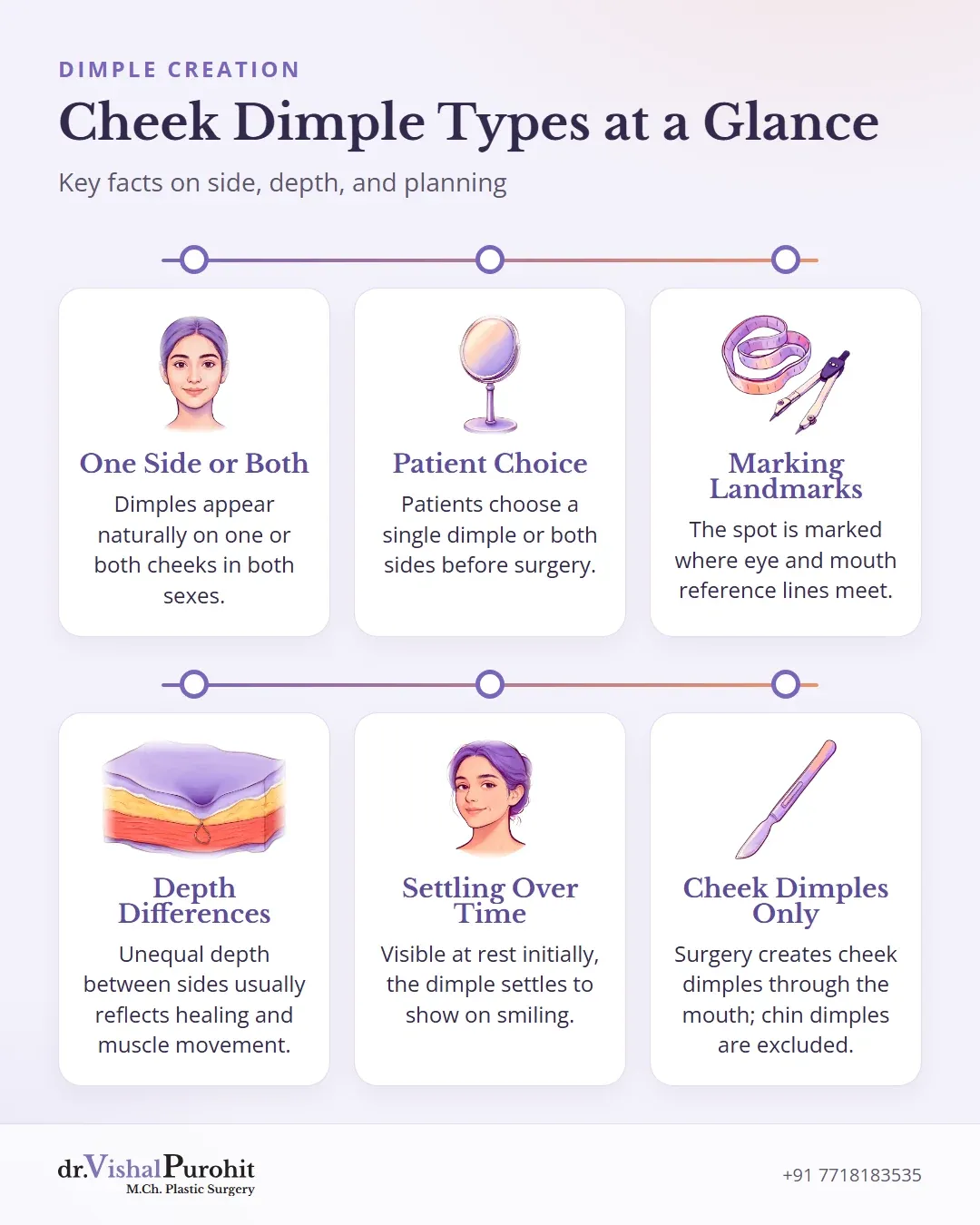
Natural dimples may sit on one cheek or on both. They occur in males and females with equal prevalence and present unilaterally or bilaterally, and are described in both sexes with no particular preponderance.
In a study of 1462 people in Sullia taluk, 121 were found to have natural dimples. Among those 121, unilateral cheek dimples (72.88%) were more common than bilateral dimples (27.11%). Cheek dimples were also seen more often on the right cheek than on the left in that population.
A surgical textbook reports the opposite pattern, stating that bilateral cheek dimples are much more common than unilateral ones. Published sources therefore do not agree on which pattern is more frequent.
Round or linear
One dimple or two in creation surgery
People who undergo creation surgery often choose one dimple or two. In a series of 100 dimples created in 64 patients, 16 patients had a single dimple created and 42 had dimples on both sides.
Dr. Purohit’s note: Dr. Vishal Purohit creates cheek dimples only, on one side or both as the patient wishes; chin dimples are not created.
One Dimple or Two
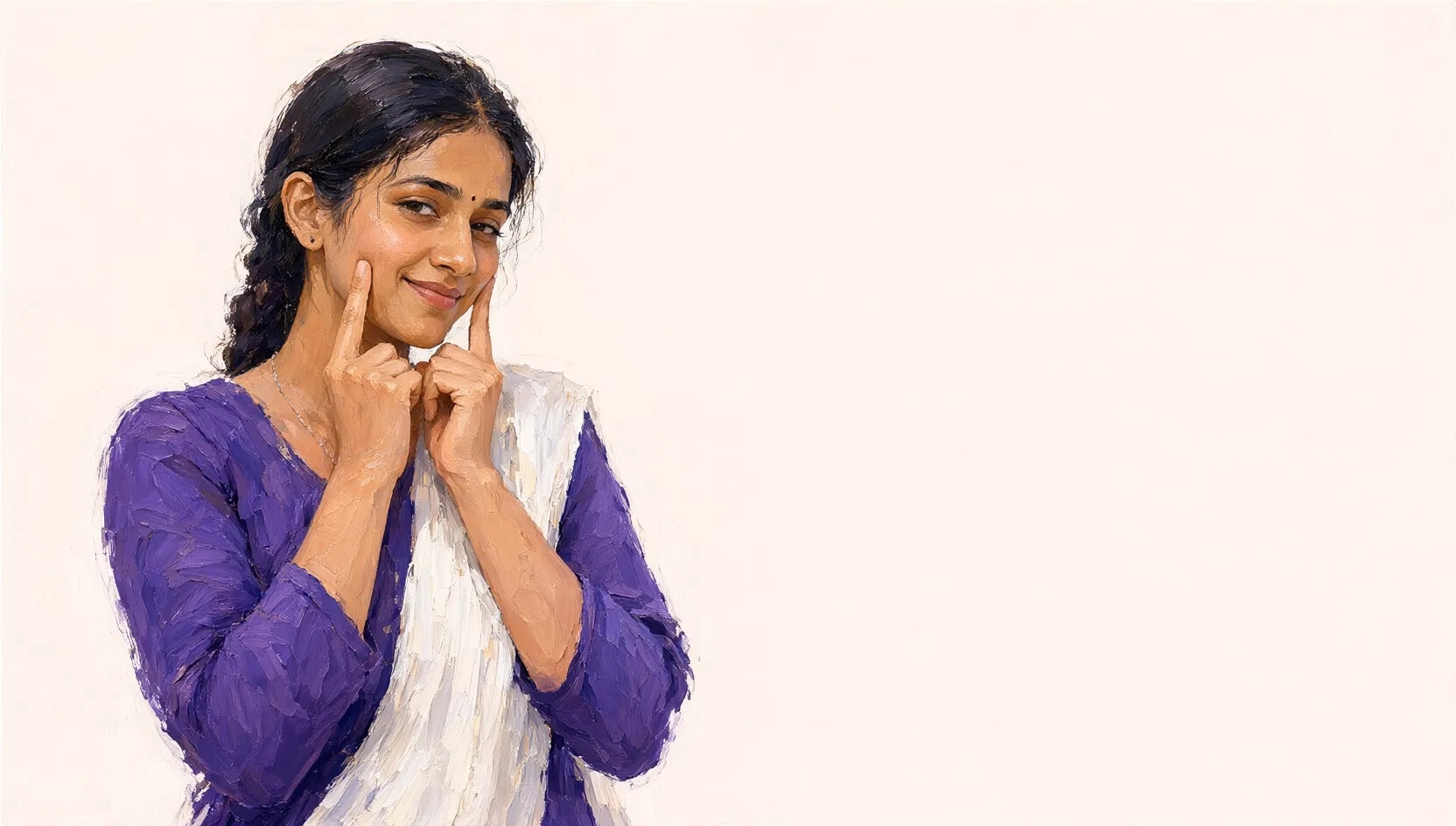
One side or both is a choice
Natural cheek dimples may appear on one side or both sides of the face, and dimples on both cheeks are much more common than a single one. In one series of 64 patients who had dimple creation, 16 had one dimple made and 42 had two.
Key points
- Dimples can naturally occur on one or both sides; studies differ on which is more common.
- Positioning is carefully planned using facial landmarks or matching an existing natural dimple.
- Patients can choose one or two cheek dimples, usually created under local anaesthesia as a daycare procedure.
How the position is planned
If a person already has a natural dimple on one cheek, the second is marked at the corresponding site on the other cheek so the face stays balanced. When no dimple exists naturally, one reference point is where a horizontal line from the corner of the mouth meets a vertical line from the outer corner of the eye.
The choice at his practice
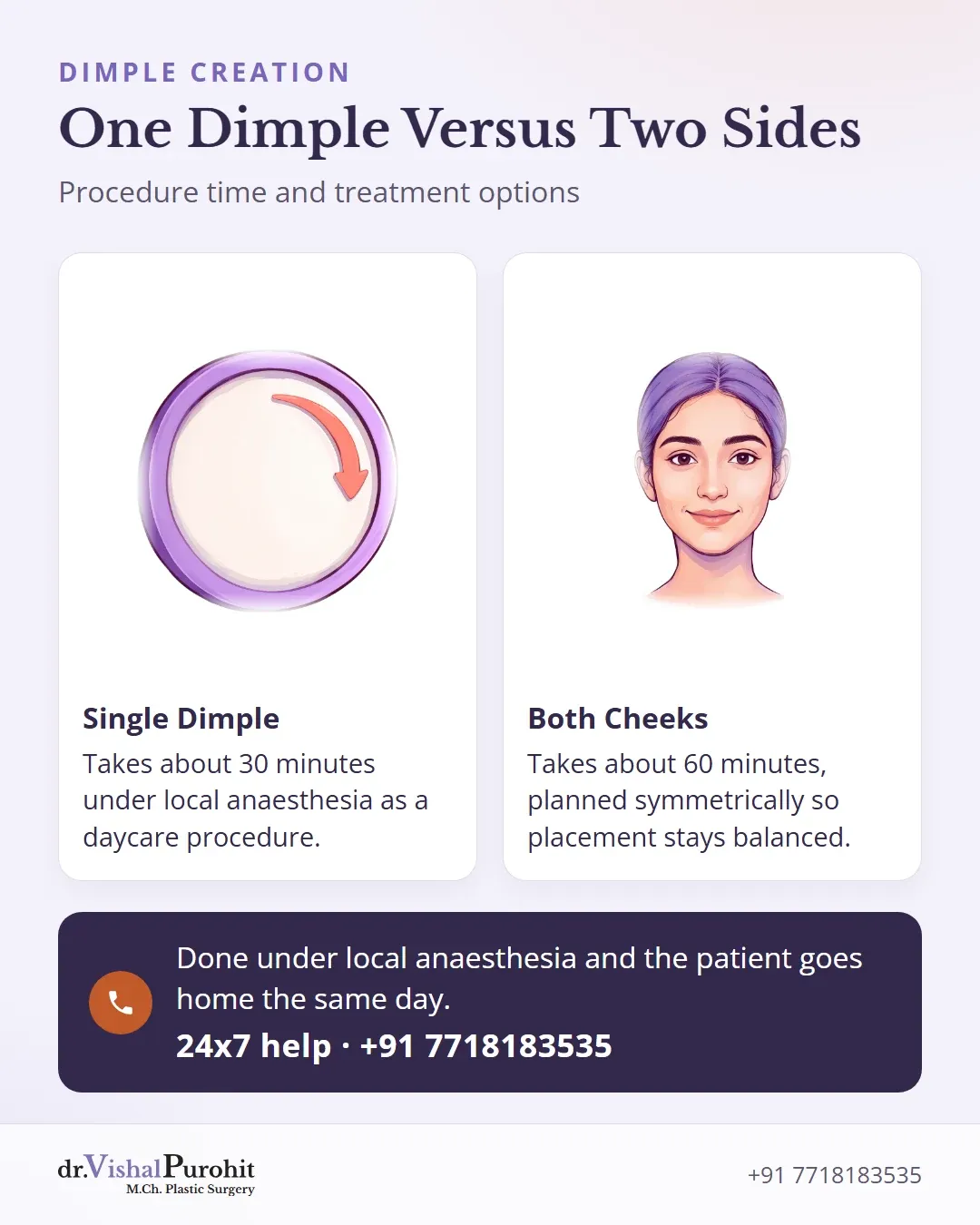
The choice rests with the patient. Dr. Vishal Purohit, a M.Ch. plastic surgeon in Jaipur, creates cheek dimples on one side or both sides as the patient wishes; chin dimples are not created. The operation takes about 30 minutes for one dimple and about 60 minutes for two. It is usually done under local anaesthesia as a daycare procedure, with general anaesthesia available on request, and the patient goes home the same day. Under local anaesthesia, pricing is ₹20,000 for one dimple and ₹35,000 for two, while under general anaesthesia it is ₹55,000 for one or both, confirmed after consultation. The technique is described as simple and safe, with minimal morbidity.

Shape and Depth
What the look depends on
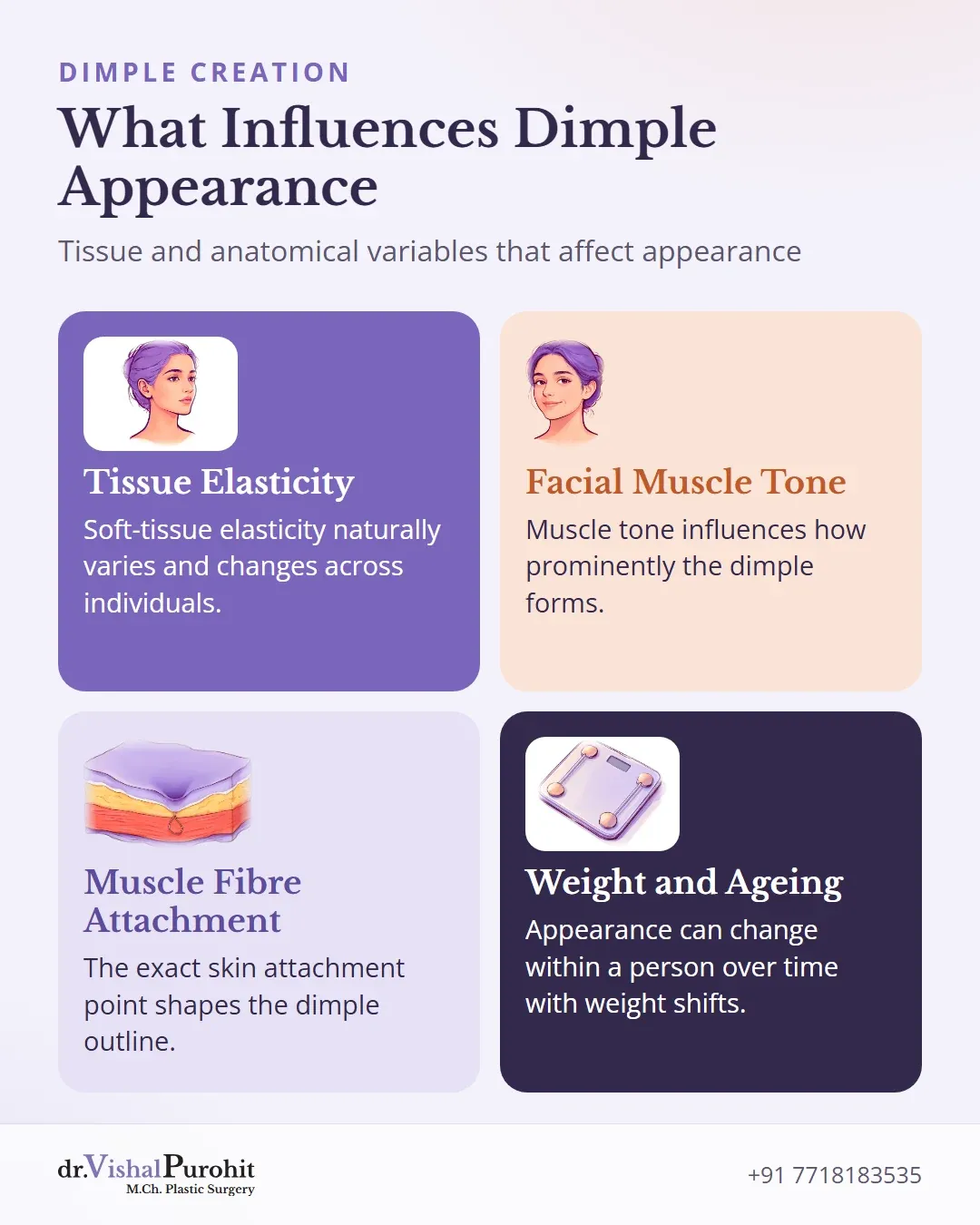
A dimple sits on mobile facial tissue, and its size and shape vary from person to person — they can even change within the same person with weight change or ageing, because of soft-tissue elasticity, facial muscle tone and where the muscle fibres attach to the skin. There is not much literature on the ideal position and depth of a created dimple.
Key points
- Natural dimple shape and size vary with facial anatomy, muscle tone, and ageing.
- The depth and width of a dimple depend on where and how deeply the stitch is placed.
- Asymmetry between both sides is usually caused by differences in healing, depth, or muscle activity.
In dimpleplasty, the surgeon can judge location, depth and size during the operation, and removing a wider area of tissue creates a wider dimple. Depth is adjusted more by the direction of the thread than by the force of the tie.
Why the two sides can differ
When dimples are made on both sides, a difference in depth rather than position is the usual reason one looks deeper. How the two sides heal, and how actively the facial muscles are used while smiling, also play a part. Designing the position symmetrically first is therefore important.
At his practice in Jaipur, Dr. Purohit treats very full or very thin cheeks as reasons to wait or not operate. He also states that the dimple shows at rest at first and settles by about 6 to 8 weeks to show mainly on smiling.
Chin Dimples
A separate operation in the literature
Chin dimple creation is described in the plastic surgery literature as a separate operation from cheek dimpleplasty. Reported techniques work on the midline of the jaw: thinning the skin flap, creating a concave indentation in the bone, and holding the skin against that notch with non-absorbable sutures. One published report used this technique in a single patient. The same authors note that weight change and ageing can change how such dimples look over time.
What is offered in Jaipur
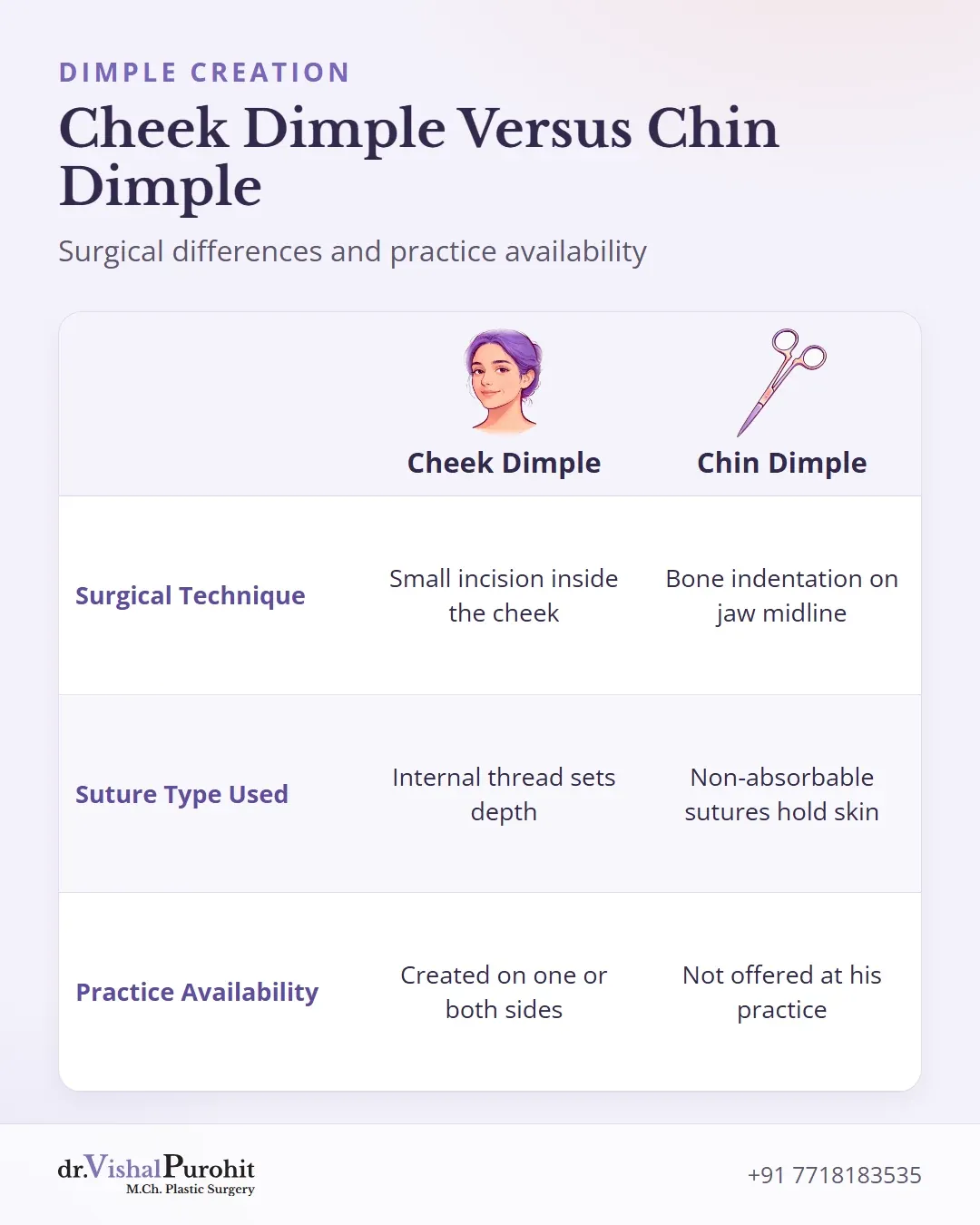
Dr. Purohit creates cheek dimples only, on one side or both sides as the patient wishes. Chin dimples are not offered at his practice. In his dimpleplasty, a small operation through the inside of the cheek creates a cheek dimple, not a chin dimple.
Deciding at the Consultation
Marking while smiling
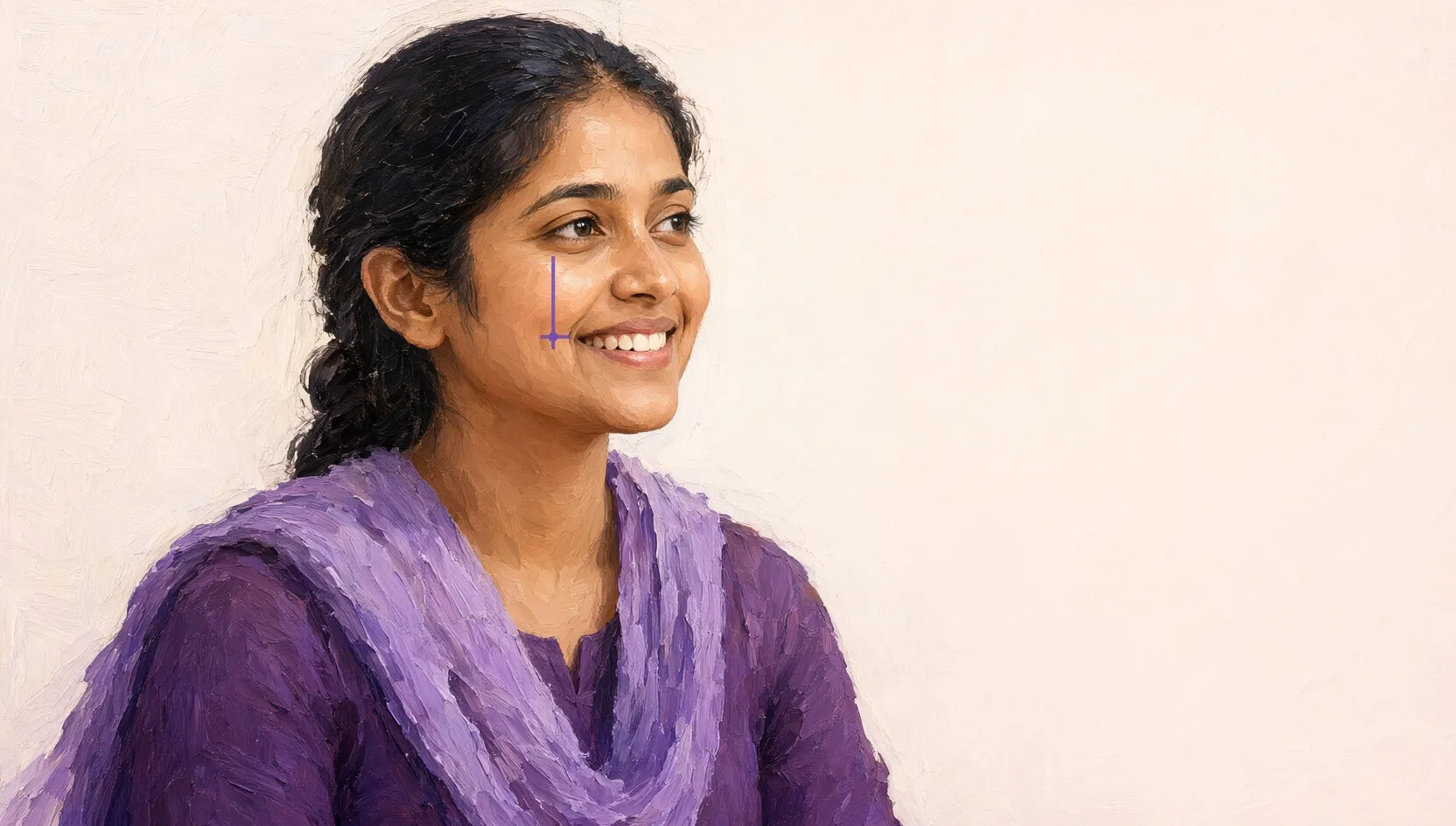
The site is marked while the patient smiles. Where a faint natural dimple already appears on smiling, that spot is chosen. If no natural dimple exists, surgeons commonly mark the intersection of a line dropped from the outer corner of the eye and a line drawn from the angle of the mouth. The patient then checks the mark in a mirror. The separate post on dimple position covers these landmarks in more detail.
Agreeing the side and the place
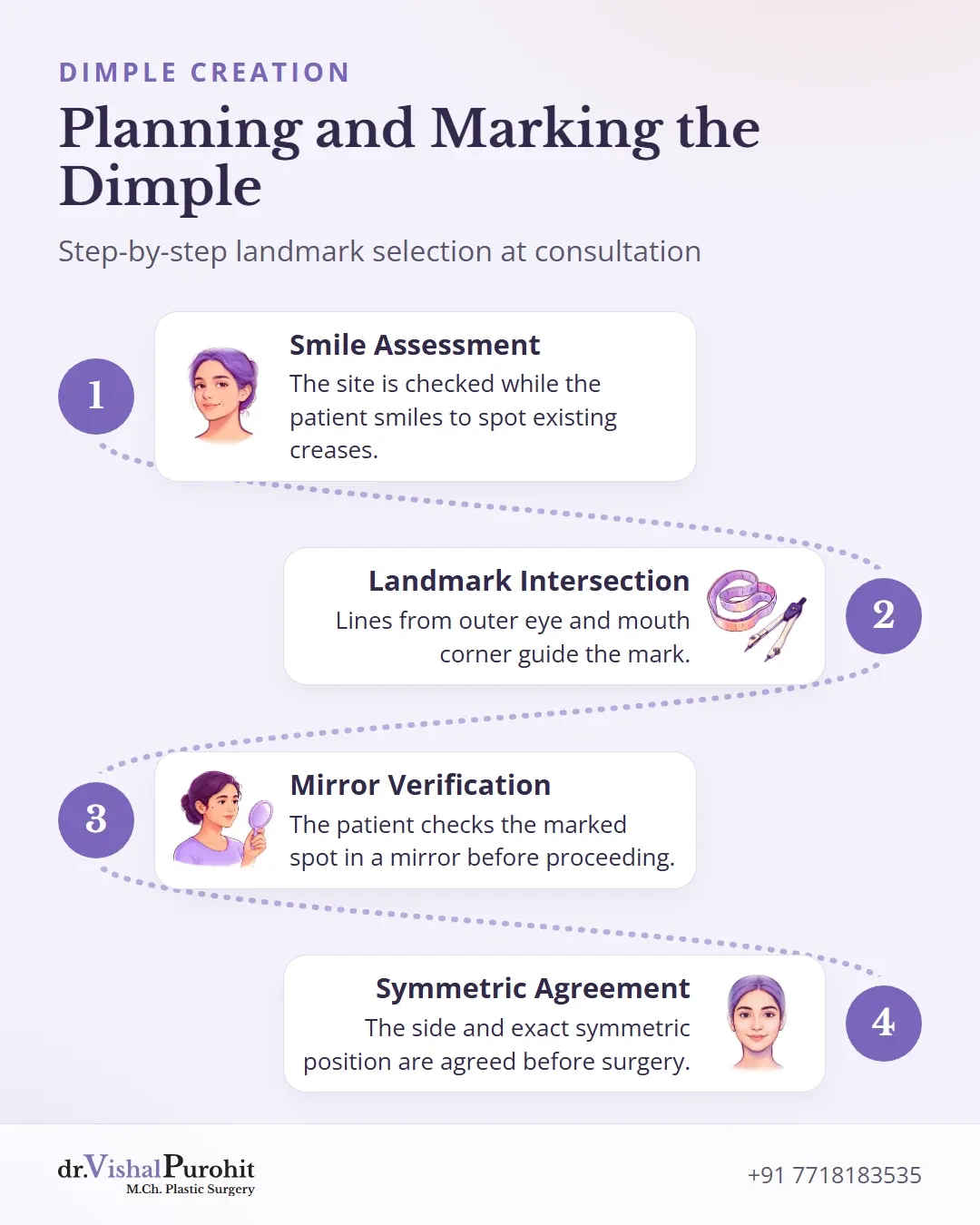
The desired position is subjective and opinions vary, so the side and the exact spot are agreed before surgery. When both dimples are wanted, the two positions are designed symmetrically first. Placement too far out, beyond the outer corner of the eye, may predispose toward facial nerve injury. At his practice in Jaipur, Dr. Purohit creates cheek dimples on one side or both, as the patient wishes; chin dimples are not created. The dimple creation landing page sets out the whole procedure.
Dimple Creation in Jaipur
The side and the exact spot are agreed at the consultation, with the position marked while the person smiles so the face stays balanced. Dr. Vishal Purohit, a M.Ch. plastic surgeon in Jaipur, performs dimple creation at his practice. The dimple creation in Jaipur landing page sets out the whole procedure, and the dimple creation FAQs answer common patient questions before a consultation.
This is educational information, not medical advice.