
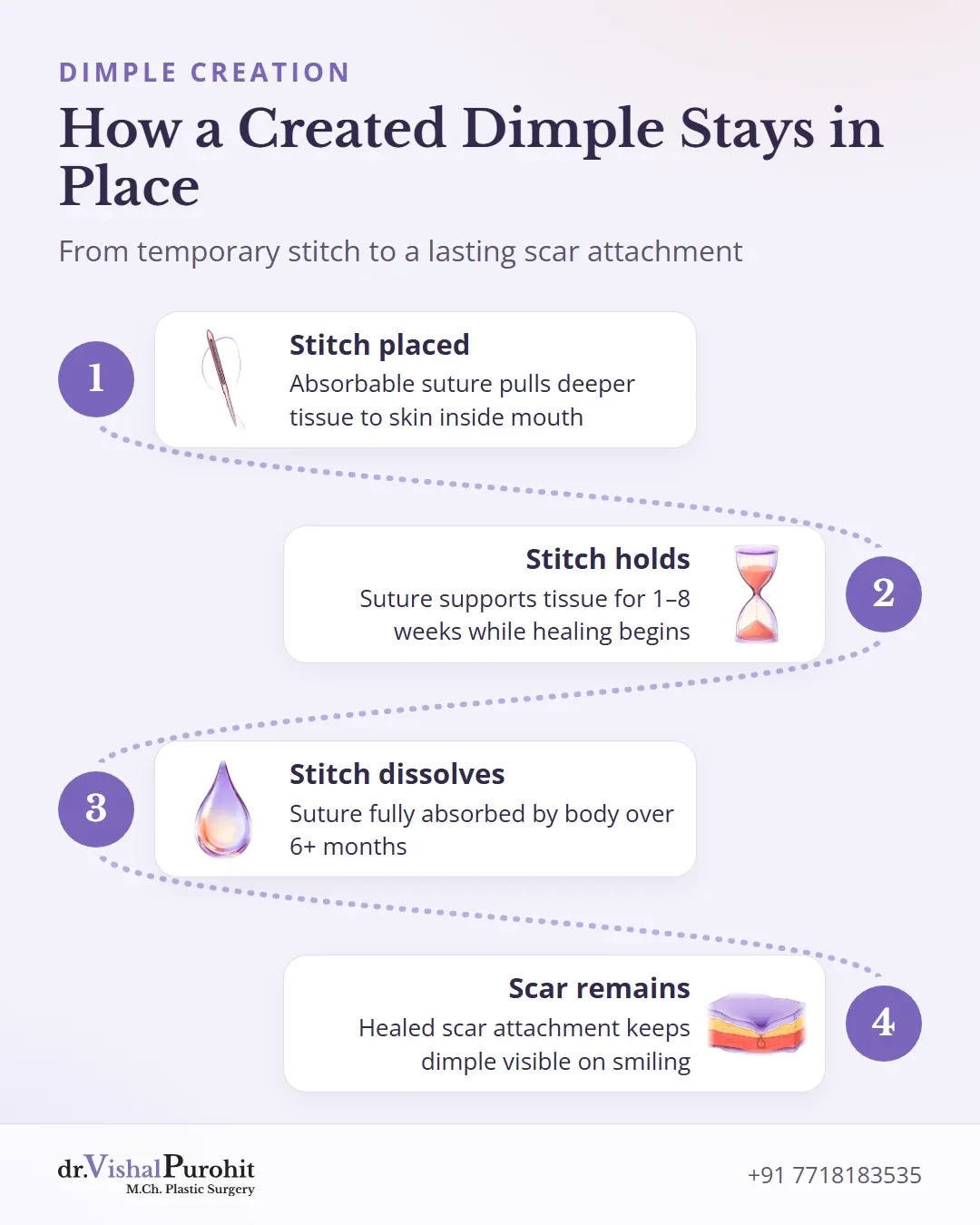
A surgical dimple is formed through an incision inside the mouth, where an absorbable stitch draws the deeper tissue toward the cheek skin. At first, the dent is visible even when the face is still. Over about 6 to 8 weeks, the tissue relaxes so the dimple settles to show mainly when smiling, a transition discussed in detail in Why the Dimple Shows at Rest First, Then Only When Smiling. No wide smiling is advised for the first 2 weeks.
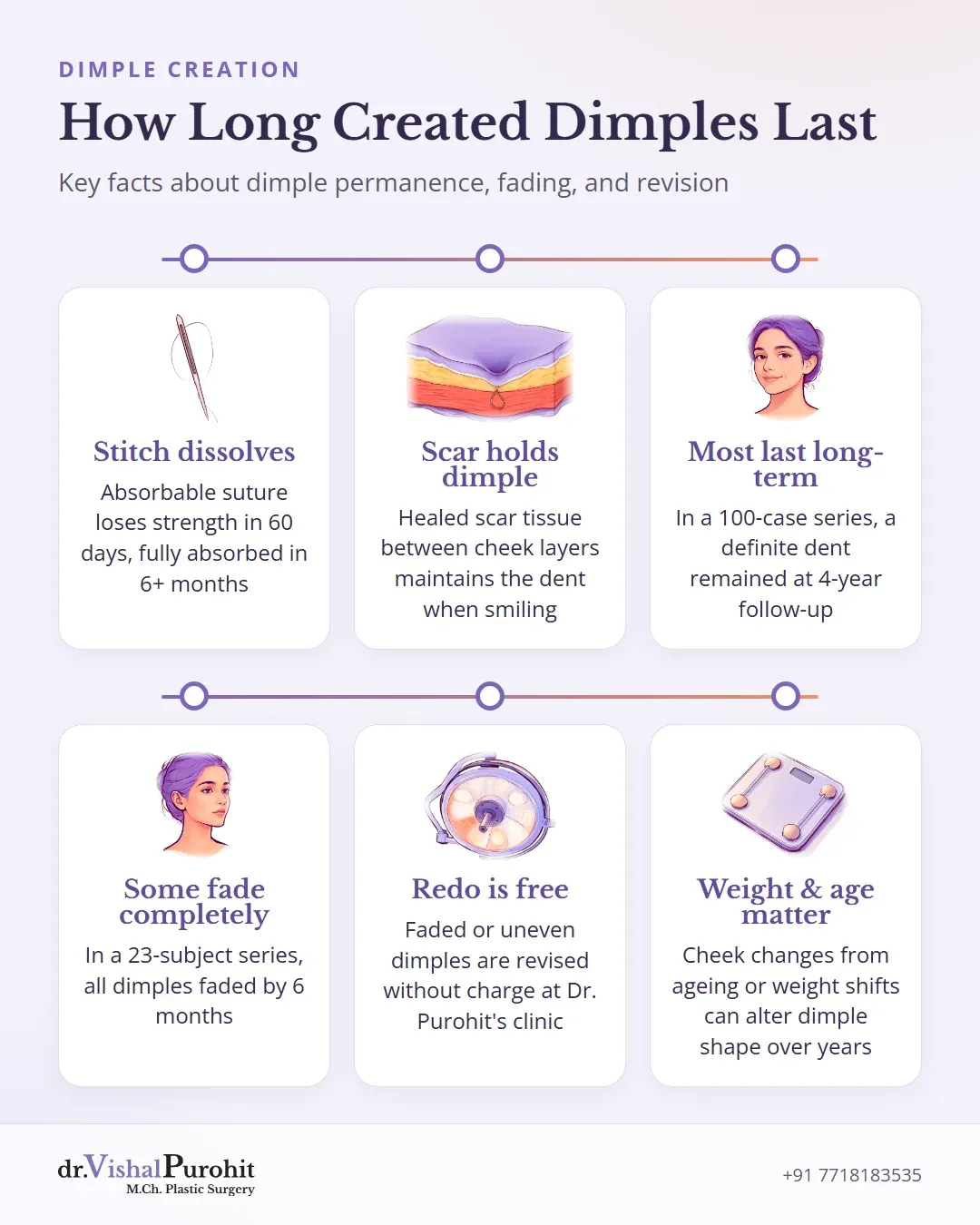
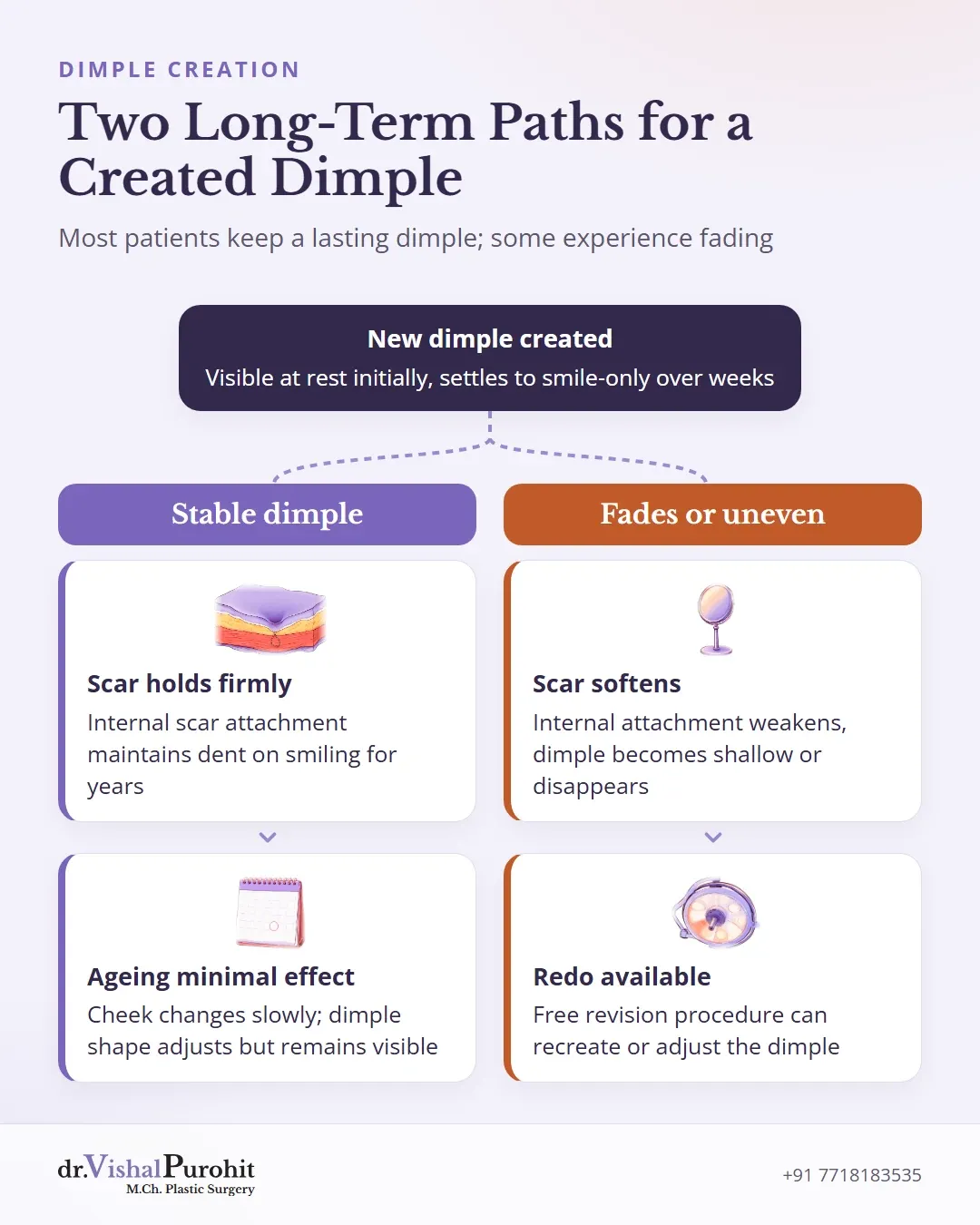
While the internal stitch dissolves on its own within weeks, the lasting dent depends on the scar that forms between the tissues. The dimple lasts for most patients, but gradual softening or fading can happen over time.
What Holds the Dimple
The stitch is temporary
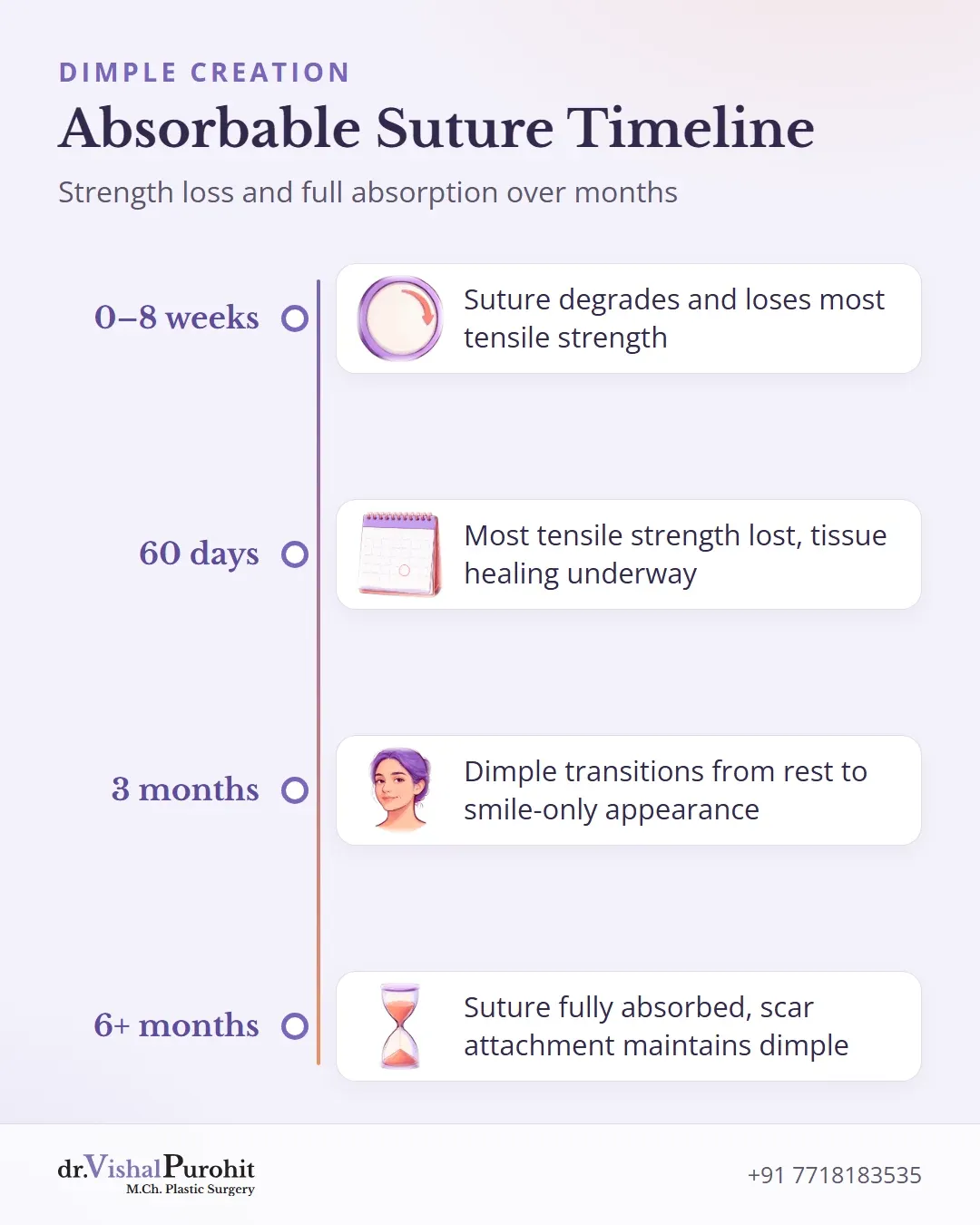
Absorbable sutures lose most of their tensile strength within 60 days and support the tissue until healing occurs. Their degradation and loss of strength take place over one to eight weeks, and full absorption can take longer than six months depending on the material. Such sutures hold the wound during the early phase of remodelling and are then broken down by the body.
Dr. Purohit’s note: The internal stitch is absorbable, dissolving on its own without needing removal.
The scar is what remains
What continues to hold the dimple afterwards is the attachment the healing scar forms between the cheek tissues. In a series of 100 dimples, an infection around the bolster did not harm the dimple and probably made it more pronounced, which was attributed to excessive scarring. When two patients in that series asked for a smaller dimple, the scar was partly released from inside the mouth.
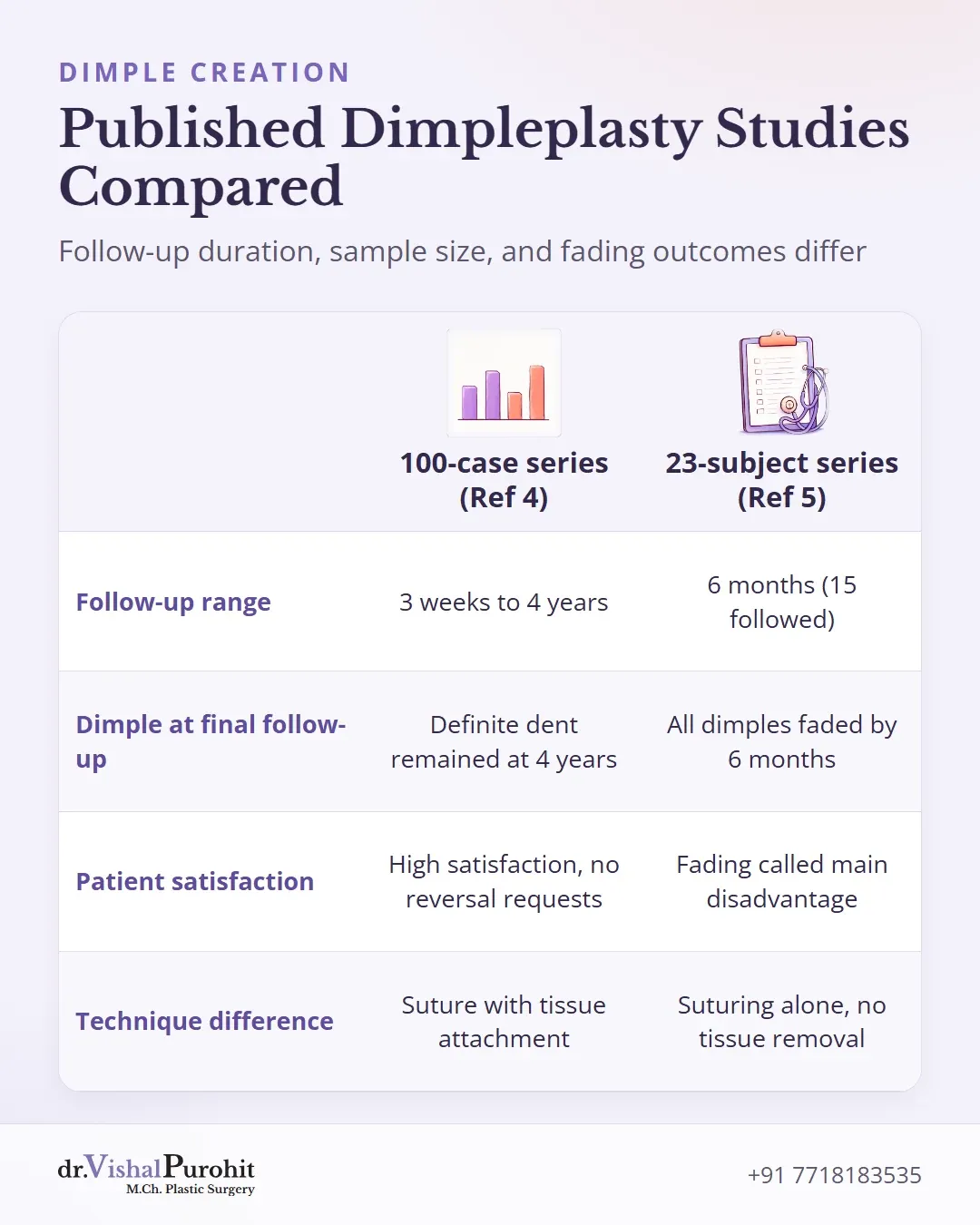
Not every suture-based method behaves the same way. One report states that suturing alone, without removing any tissue, gave no lasting result and the dimple faded with time.

What Studies Report on Lasting Results
Follow-up
Published dimpleplasty follow-up varies. In one series of 100 dimples, follow-up ranged from 3 weeks to 4 years.
By 3 months, only a small hint of the dimple was visible at rest, and it deepened on animation; the dent diminished over time, but a definite dent remained at 4 years.
The authors reported high patient satisfaction and no requests for complete reversal.
Fading rates
In another series of 23 subjects, 15 were followed for six months. All dimples had faded by the end of the sixth month, and the authors described fading or complete disappearance after four months as the main disadvantage. A textbook chapter lists sudden disappearance of the dimple among complications.
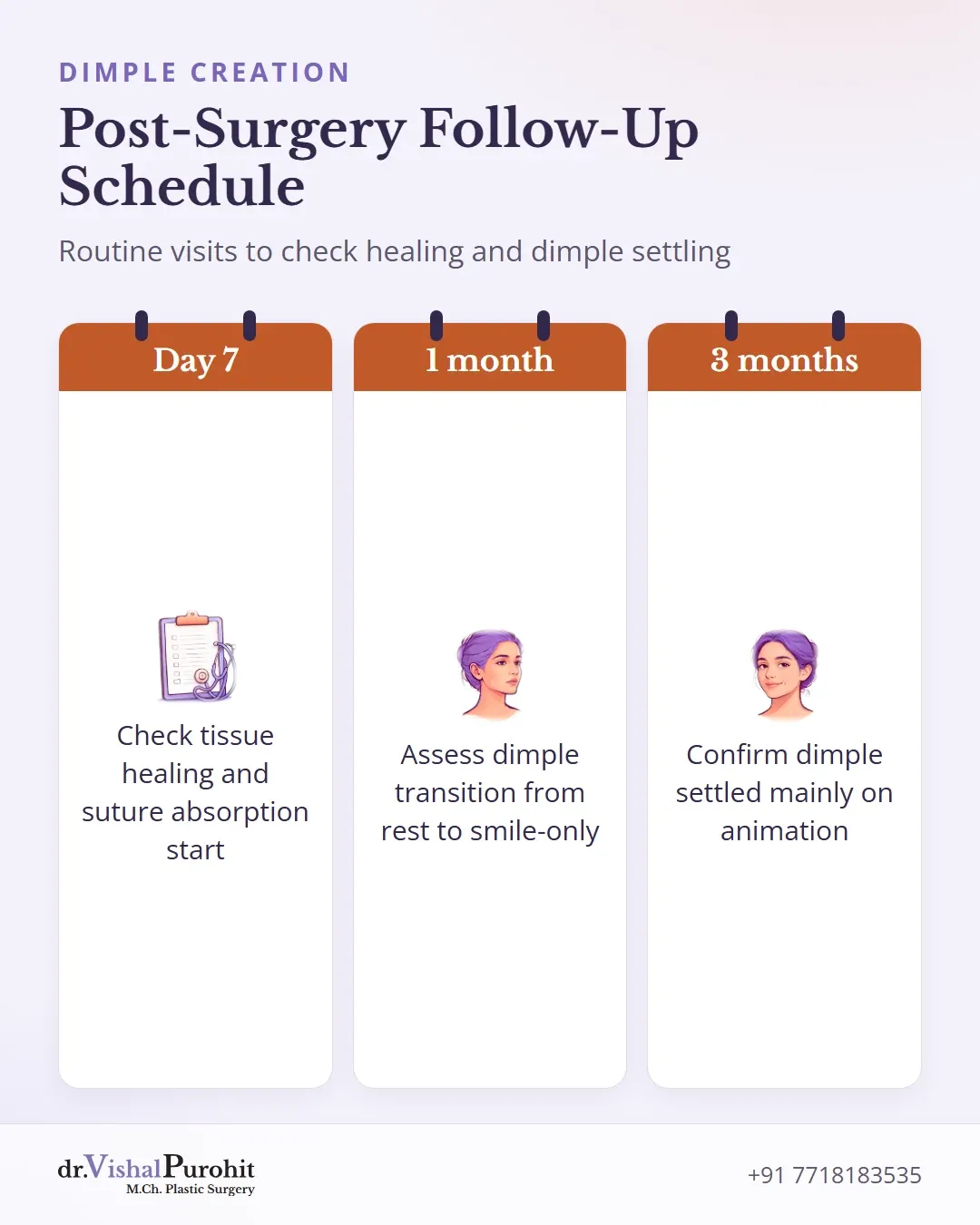
In his practice in Jaipur, Dr. Purohit states that the dimple lasts for most patients but can fade in some. He reviews patients at about day 7, 1 month and 3 months, and a redo for a dimple that faded or is uneven is done without charge.
Why Some Dimples Fade
What the literature shows
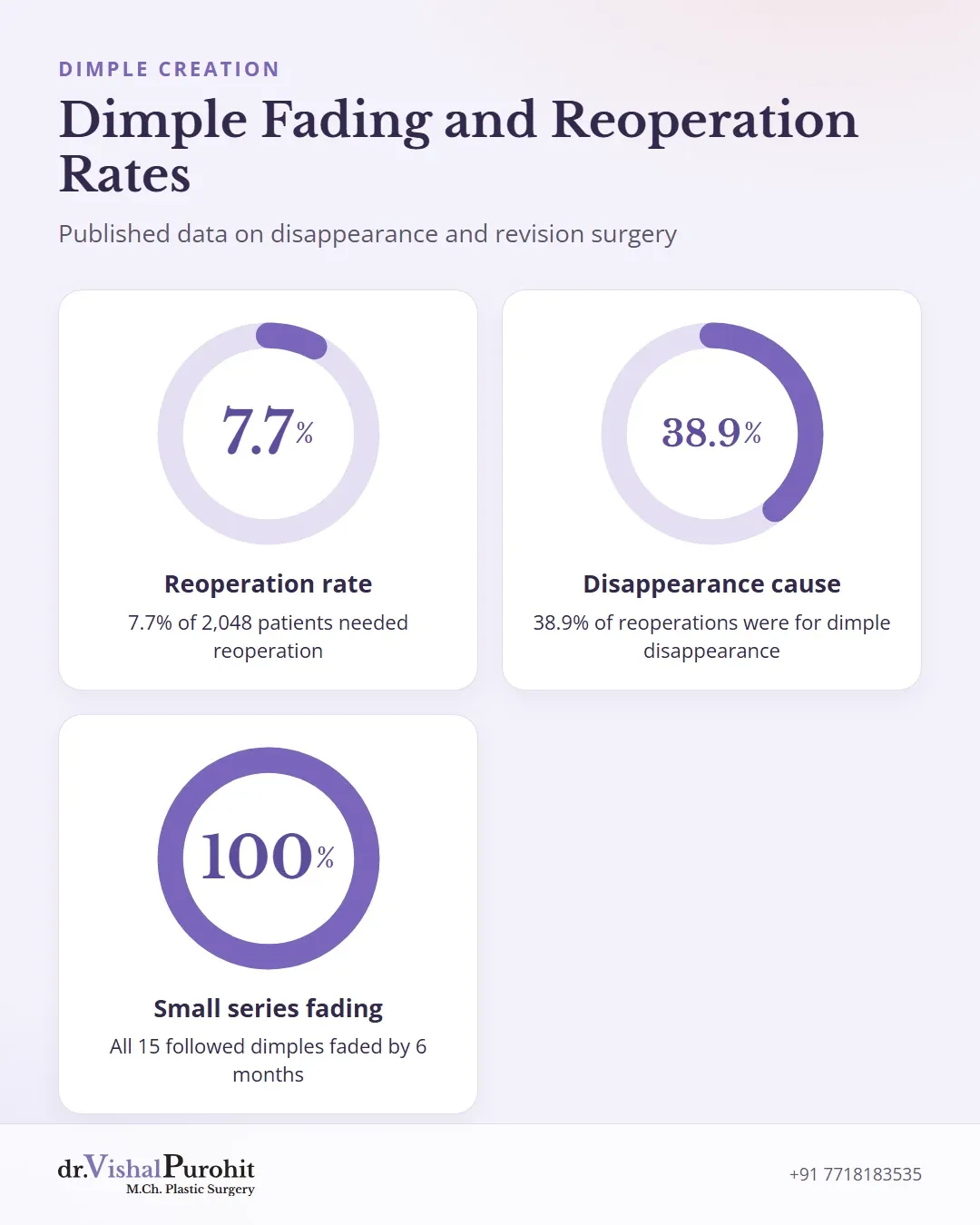
Fading is a recognised outcome after dimple creation. In one series of 2,048 patients, 159 (7.7%) needed reoperation, and disappearance of the dimple accounted for 38.9% of those reoperations. A textbook chapter lists sudden disappearance as a complication.
Key points
- Dimple fading or disappearance is a recognized outcome reported in surgical literature.
- Changes in body weight, aging, or suture timing can influence how long dimple results hold.
- Redo procedures can address a dimple that has faded or formed unevenly.
In a small series of 23 subjects, all dimples had faded by six months among the 15 subjects followed, with no difference between those who kept and those who removed their sutures. The author called fading the main disadvantage of that technique. Removing sutures before six weeks, or waiting four to six months, can also produce fading.
Thicker cheeks, attachment and weight
The sources do not directly examine thicker cheeks or a weak attachment as reasons for fading. A paper on chin dimple creation noted that shape can change with body weight and ageing; it does not report cheek dimple outcomes.
Dr. Purohit’s practice
In Dr. Vishal Purohit’s practice in Jaipur, the dimple lasts for most patients but can fade in some. A redo for a dimple that faded or is uneven is done without charge.
Ageing and Weight Change
The cheek around the dimple changes
A created dimple sits in the cheek, and the cheek changes over time. A review of dimple-creation techniques records that even dimples made to last can change in shape with changes in body weight and with ageing. It adds that there is no telling how a created dimple will look when the face begins to droop as the skin ages and loses elasticity.
Key points
- Dimples can alter in shape over time as cheek tissues age or body weight fluctuates.
- Cheek fullness affects surgical candidacy, and results may settle or occasionally fade over time.
- Changes in a dimple’s appearance can be evaluated and addressed during follow-up consultations.
In Dr. Purohit’s practice
- Very full or very thin cheeks are reasons to wait or not to operate.
- A new dimple shows at rest at first and settles by about 6 to 8 weeks to show mainly on smiling.
- The dimple lasts for most patients but can fade in some.
- A redo for a dimple that faded or is uneven is done without charge, and reversal of a dimple a patient no longer wants is charged.
Weight and age affect the cheek, and the dimple with it. Patients who notice a change can discuss it at follow-up rather than assume it will stay exactly as it first appeared.
If It Fades
A created dimple can soften with time. In one series of 100 dimples, by the end of 3 months there was only a small hint of the dimple at rest, which deepened on animation. With time the small dent gradually diminished, but a definite dent was still visible on follow-up to 4 years. Follow-up in that series ranged from 3 weeks to 4 years.
When a dimple fades
Three patients in that series asked for a more marked dimple and had a redo procedure; none asked for complete reversal. A review of 2,048 dimple-creation patients recorded reoperation, and the reason for reoperation, among the outcomes it tracked. These are published findings, not his own results.
A redo without charge
At his Jaipur practice, Dr. Vishal Purohit does a redo for a dimple that has faded or is uneven without charge. Reversal of a dimple the patient no longer wants is charged.
A redo procedure can be planned after about 6 months.
Dimple Creation Consultations in Jaipur
Understanding tissue healing helps set realistic expectations for cheek dimple longevity. Dr. Vishal Purohit reviews each patient to evaluate cheek thickness and assess healing at every stage. For full procedural details, view dimple creation in Jaipur or read dimple creation FAQs to learn more about fading and revision care.
This is educational information, not medical advice.