
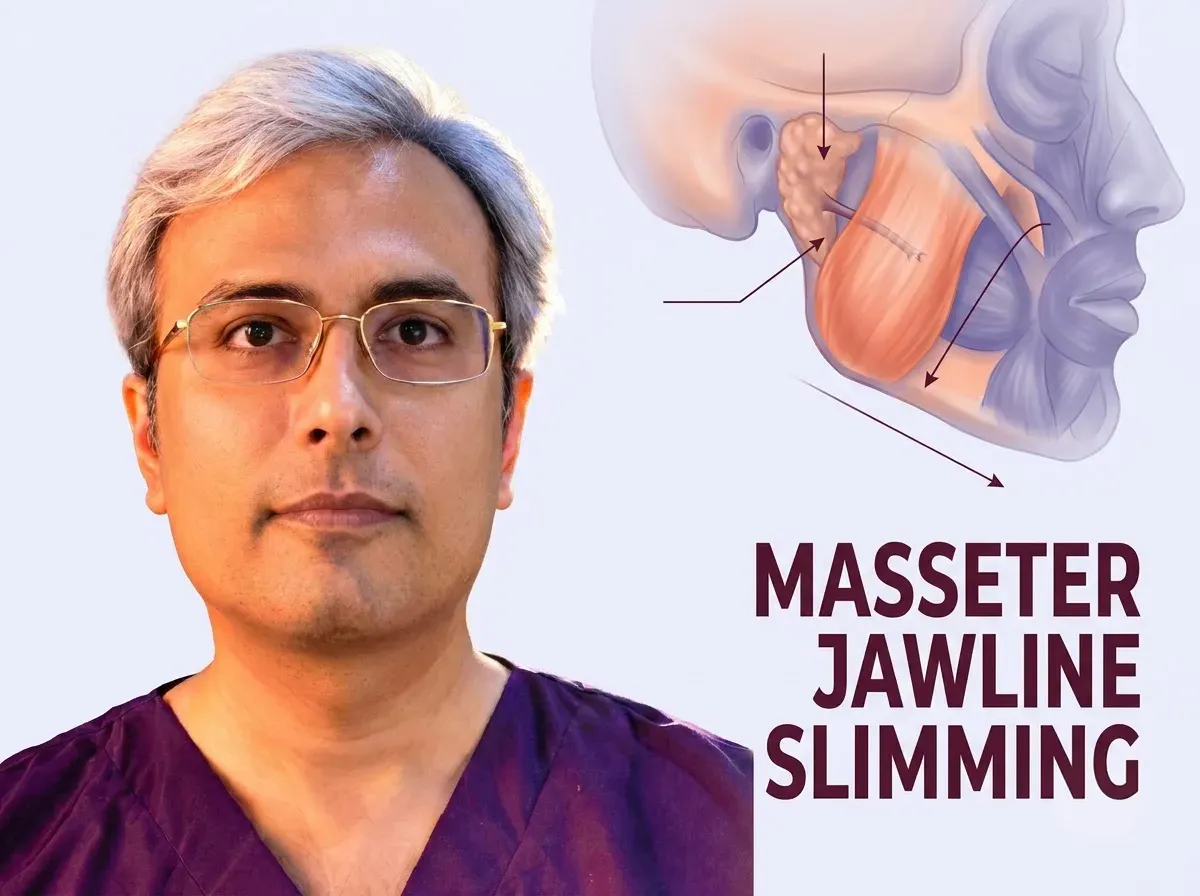

Who Masseter Botox Suits for Lower Face Slimming
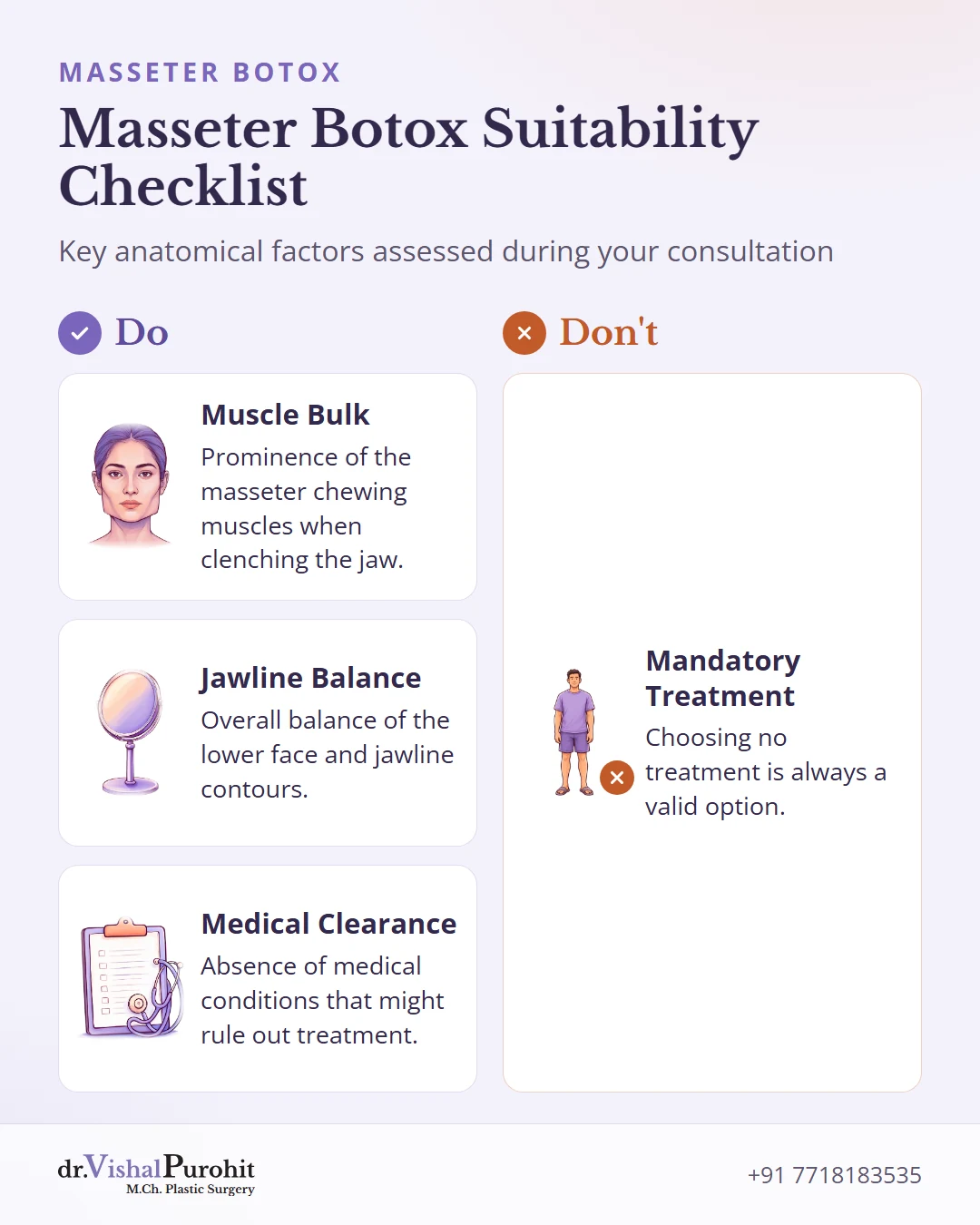
Masseter Botox is a non-surgical injection treatment that targets the chewing muscles at the angle of the jaw. It suits adults seeking to soften a wide lower face caused by muscle bulk. Choosing no treatment is always a valid option for anyone considering cosmetic changes.
An in-person consultation determines whether muscle enlargement contributes to lower facial fullness. Suitability depends on individual facial anatomy, including:
- Prominence of the masseter chewing muscles when clenching the jaw.
- Overall balance of the lower face and jawline contours.
- Absence of medical conditions that might rule out treatment.
Dr. Vishal Purohit assesses suitability during an evaluation in Jaipur. Treatment details, including the specific product, numbing, pricing, onset, duration, and aftercare rules, are explained at the consultation.
Wide Jaw Assessment: Muscle, Bone and Fat Checks
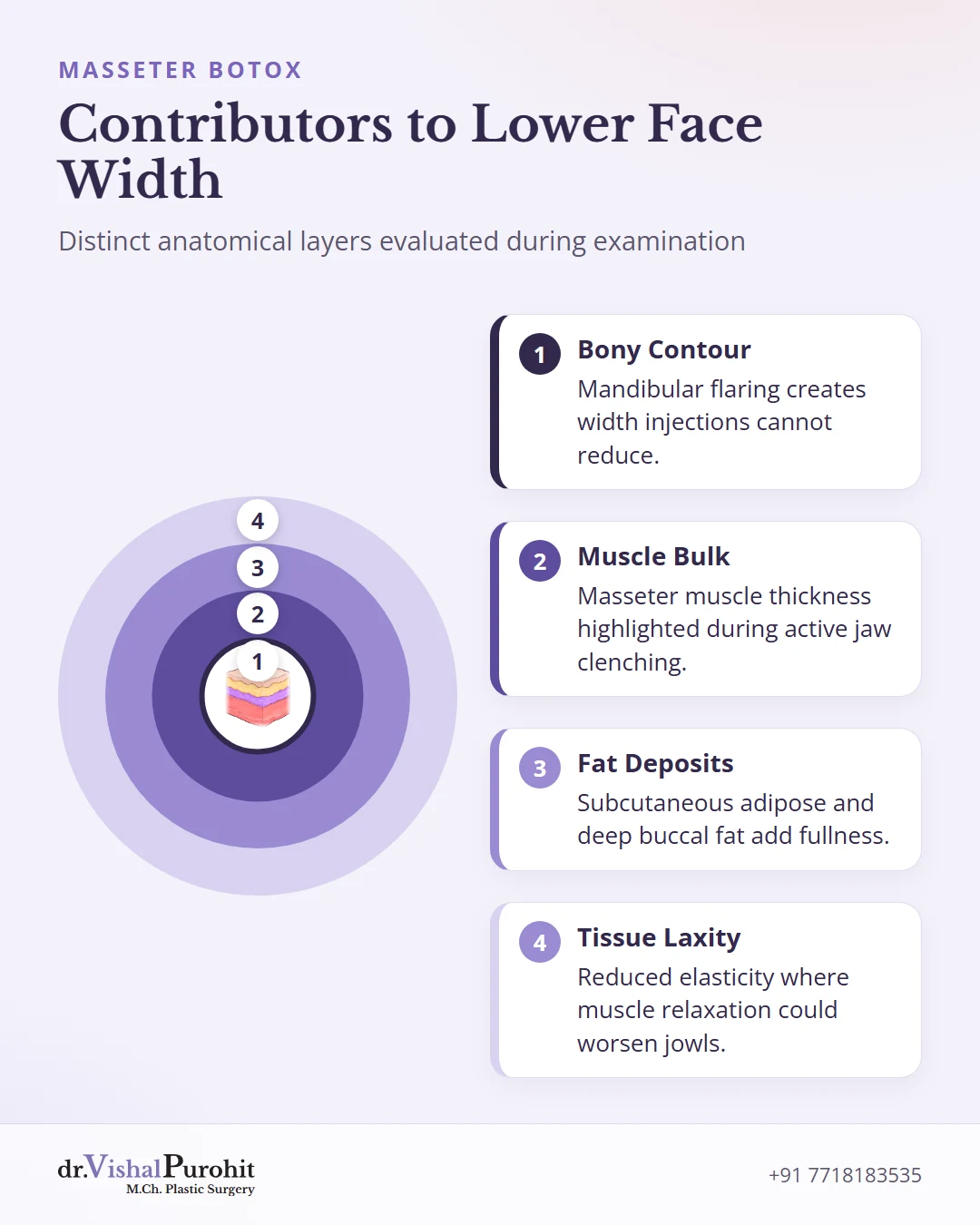
A wide or boxy lower face can arise from several distinct anatomical layers rather than a single source. Because muscle-relaxing injections target only muscle thickness, a thorough physical examination at rest and during clenching helps determine whether lower facial fullness stems from enlarged muscle, underlying bone, or soft tissue.
Dr. Vishal Purohit conducts a clinical examination to pinpoint the primary contributors to lower face width:
- Muscle enlargement: The masseter muscle elevates the mandible during chewing, and manual palpation during active jaw clenching highlights contractile thickness.
- Bony contour: Lateral flaring of the mandibular angle or overall skeletal prominence creates width that injections cannot reduce.
- Fat distribution: Subcutaneous adipose tissue and deep deposits, such as buccal fat near the cheek, contribute to lateral fullness.
- Tissue laxity: Reduced skin elasticity alters jawline definition, where muscle relaxation could worsen jowl appearance for up to 2 months.
Direct manual examination during relaxation and clenching is essential to separate contractile masseter bulk from salivary tissue or flared bone. In this careful assessment of lower face width from muscle, bone, and fat, parotid salivary gland enlargement presents behind or below the mandibular angle, unlike true masseter bulk which remains confined within the mandibular ramus.
Undergoing aesthetic intervention is entirely optional, and choosing no treatment is always a valid option. Whether treatment is undertaken is decided during the consultation.
Before Treatment: Medical History and Suitability Screening

Every non-surgical masseter injection begins with an in-person medical evaluation to confirm whether botulinum toxin type A is appropriate for you.
Dr. Vishal Purohit, an M.Ch plastic and reconstructive surgeon in Jaipur, reviews your health history and facial structure during your initial consultation. Details regarding the specific product, pricing, numbing, review visits, and aftercare are explained thoroughly at that time.
After Treatment: Chewing Changes and Warning Signs

Botox injection into the masseter (chewing) muscle works gradually by weakening muscle contraction. Because the muscle temporarily relaxes, everyday chewing mechanics can adapt as adjacent muscles compensate. Vishal Purohit.
Studies report that patients may notice functional chewing adjustments, including a temporary drop in bite force and chewing power at 2, 4, and 8 weeks after injection, with measurements trending back toward baseline by 12 weeks. To understand how temporary muscle relaxation affects daily function, learn more about chewing fatigue and paradoxical bulging after masseter injections.
Other transient effects documented in clinical literature include:
- Ineffective masticatory power reported in up to 50% of patients around 1 to 2 months post-treatment.
- Transient speech disturbances noted in up to 16% of study participants.
- Temporary smile asymmetry recovering within 3 to 4 weeks if medicine diffuses toward the risorius muscle.
Distant spread of botulinum toxin type A beyond the treated area is uncommon, but it requires immediate attention. Seek emergency medical care at once without waiting if any critical symptoms develop:
- Difficulty breathing or respiratory compromise
- Difficulty swallowing (dysphagia)
- Speech disturbances or difficulty speaking (dysarthria)
- Progressive or generalized muscle weakness
- Double vision (diplopia) or drooping eyelids
Gradual Slimming Timeline, Longevity and Bone Evidence
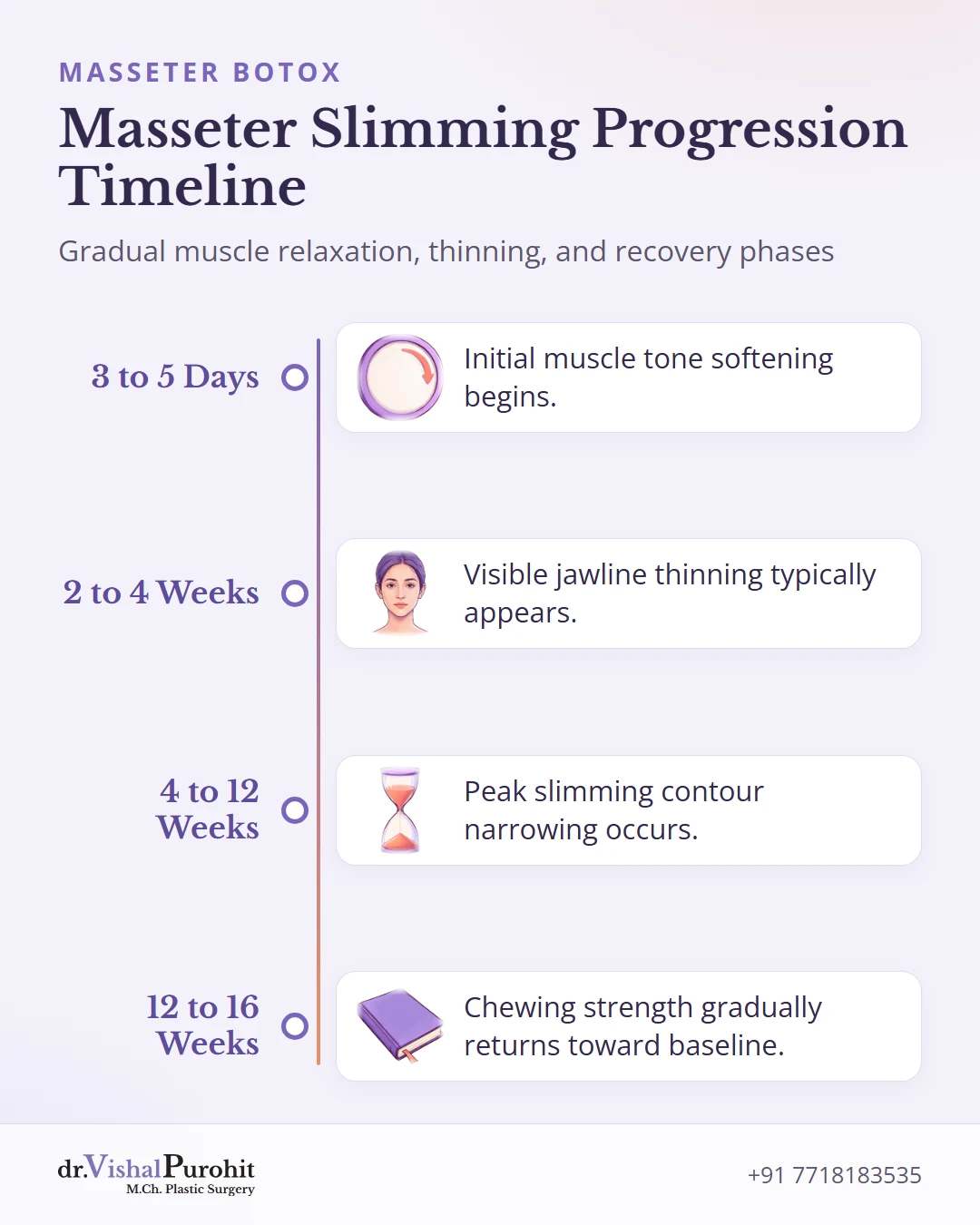
Botox into the masseter muscle creates lower-face narrowing through a sequence of functional softening followed by gradual disuse atrophy, rather than an immediate change in contour.
Studies report that muscle tone softens within 3 to 5 days, while visible thinning typically appears after 2 to 4 weeks and peaks around 4 to 6 weeks or 10 to 12 weeks. Detailed timelines of contour shifts and how chew strength returns over 12 to 16 weeks are outlined in the review of when jaw slimming shows and how it wears off.
At Dr. Vishal Purohit's practice, onset, longevity, and maintenance intervals are not fixed in advance and are explained at the consultation. Routine retreatments do not follow an automatic schedule. Instead, each visit reassesses:
- The degree of baseline muscle recovery and return of bulk
- Whether an aesthetic or functional reason for repeat treatment remains
- Any compensatory fatigue or changes in nearby muscles
Patients sometimes ask about the jawbone under repeated treatments. Preclinical animal experiments using high doses observed cortical bone thinning, but clinical human reviews at therapeutic doses show minimal or no significant structural impact, as detailed in the analysis of what is known about repeat treatment and the jaw bone. Any progressive plan is decided collaboratively at the consultation.
Masseter Botox Cost in Jaipur: Product and Consent
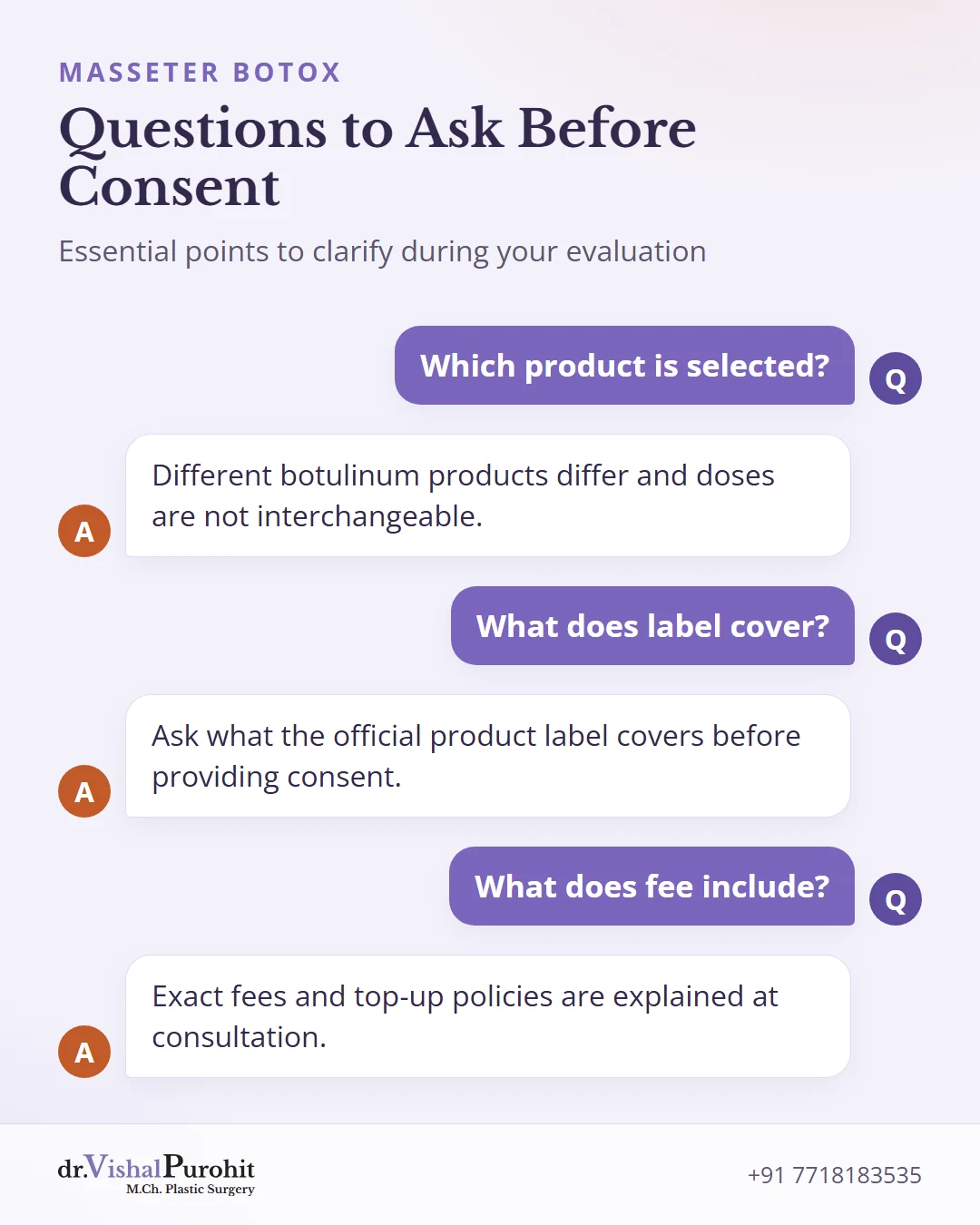
Masseter Botox is a non-surgical injection treatment tailored to individual facial anatomy. The exact fee, what it includes, review visit timing, and any top-up policy are not fixed in advance and are explained at the consultation.
Different botulinum toxin type A products differ in formulation, and their doses are not interchangeable between brands. During your initial assessment, you are encouraged to ask which specific product is selected and what its official label covers before providing informed consent.