
TUE - SUN: 11:00 AM – 07:00 PM

Aesthetic & Reconstructive Surgery

Cleft Lip & Palate Surgery in Jaipur

Cleft Lip & Palate Surgery in Jaipur - Dr. Vishal Purohit Plastic Surgeon Jaipur11+ Years of Surgical Experience

Gentle, compassionate pediatric reconstruction restoring facial symmetry, speech, and your child's smile.

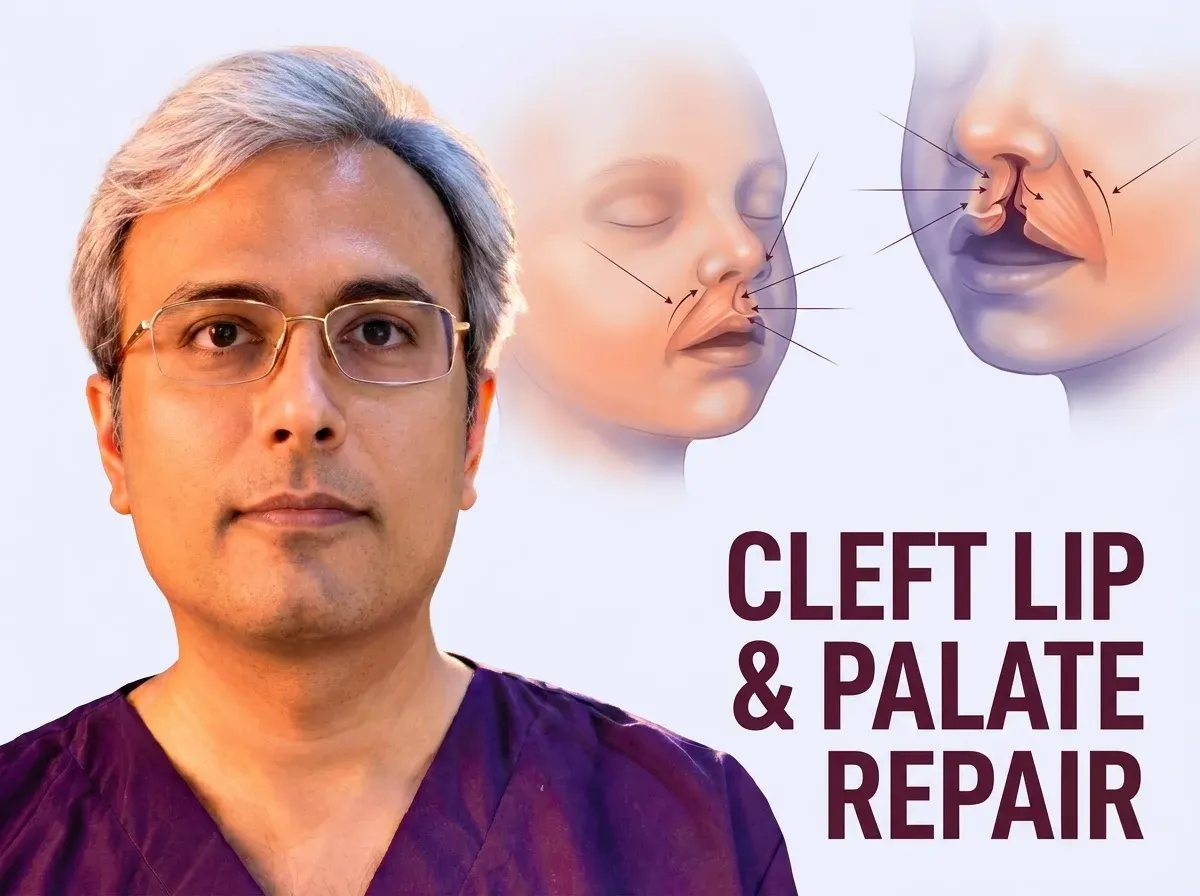
Specialized cleft surgery using modified Millard cheiloplasty and Furlow palatoplasty to reconstruct muscle anatomy for normal speech and feeding.

View clinic timings and contact details →
  • M.Ch Plastic Surgeon · RMC Reg. 28041/14185
  • Day-care / short-stay procedure
  • Tonk Road, Jaipur
  • Jump to FAQs (10)

Procedure Time

1.5–2 hours

Anesthesia

Pediatric General Anesthesia with specialized pediatric airway care

Hospital Stay

1–2 nights

Recovery Time

Initial healing: 7–10 days; Arm splints removed: 2 weeks; Long-term scar maturation: 6–12 months

Timing

Cleft Lip: 3–6 months of age; Cleft Palate: 9–15 months of age

Techniques

Modified Millard rotation-advancement, Fisher anatomical repair, Furlow double-reversing Z-palatoplasty

Born with a cleft

Will my child be able to eat, speak, and grow normally?

A cleft lip or palate disrupts infant feeding, delays speech development, raises the risk of middle ear infections, and affects facial growth from the earliest weeks of life.

Feeding difficulties from birth

An open cleft prevents the seal needed for effective suckling, making adequate nutrition in early infancy a daily challenge.

Hypernasal voice and unclear speech

When the soft palate cannot close against the throat, air escapes through the nose, producing a hypernasal voice and indistinct speech.

Recurrent middle ear infections

Cleft palate disrupts the muscles regulating the Eustachian tube, leaving children prone to repeated middle ear infections.

Why the muscle rings matter

In a cleft, the orbicularis oris muscle of the lip and the levator veli palatini muscle of the soft palate are displaced and fail to form their normal circular rings. Without surgical reconstruction of these rings, the lip cannot close symmetrically and the palate cannot valve against the throat wall, so feeding and speech problems persist regardless of how the skin appears.

Dr. Vishal Purohit - M.Ch Plastic & Cosmetic Surgeon Jaipur

Dr. Vishal Purohit

M.Ch Plastic & Cosmetic Surgeon

✓

Credential Level

M.Ch Super-Specialty

RMC Reg. 28041/14185

Your Surgical Guide

Artistic Proportion & Advanced Surgical Safety

"Our priority is to reconstruct the underlying muscle anatomy of the lip and soft palate so each child can feed well, develop clear speech, and achieve natural facial symmetry through every stage of growth."

— Dr. Vishal Purohit

1

M.Ch Plastic & Reconstructive Surgery, SMS Medical College, Jaipur

The highest super-specialty surgical qualification in India, ensuring total anatomical mastery of neurovascular planes and soft tissues.

2

11+ Years as a Plastic Surgeon

Practising plastic surgery in Jaipur since 2015, with a focus on natural, proportionate results.

3

Accredited Operating Suites

Dr. Vishal Purohit operates in sterile hospital operating theatres, with certified cardiac anaesthesiologists and ICU support.

Simple & Transparent

Your 3-Step Surgical Journey

We remove anxiety and uncertainty with a structured, transparent pathway designed for absolute safety and peace of mind.

1

Confidential Assessment

Dr. Purohit evaluates your anatomical baseline, skin elasticity, and health history. You receive an honest feasibility blueprint, personalized surgical plan, and transparent cost with zero pressure.

Step 1: Planning
2

Precision Operating Suite Procedure

Performed by Dr. Vishal Purohit in a sterile hospital operating theatre under gentle anaesthesia. Using advanced minimally invasive techniques, target areas are treated with microscopic care.

Step 2: Procedure
3

Monitored Recovery & Transformation

Supported with tailored recovery guidelines and post-operative follow-up visits. As tissue heals and settling occurs over the coming weeks, your refined results emerge.

Step 3: Recovery
Clinical Guide & In-Depth Information

Comprehensive Medical Overview

Detailed procedural analysis, anatomical considerations, and patient guidelines by Dr. Vishal Purohit.

Comprehensive Pediatric Cleft Care

A cleft lip or cleft palate is a congenital condition that occurs when facial structures fail to fuse during early embryonic development. Beyond the visible aesthetic difference, clefts create profound challenges with infant feeding, normal speech development, middle ear infections, and facial growth.

Dr. Vishal Purohit provides comprehensive, multidisciplinary cleft care. We believe every child deserves a beautiful, natural smile and the ability to speak clearly. Our surgical protocols reconstruct the underlying muscle rings of the lip (orbicularis oris) and soft palate (levator veli palatini), providing both aesthetic symmetry and functional speech.

Staged Treatment Timeline for Your Child

Stage 1: Primary Cleft Lip Repair (Cheiloplasty)

Performed around 3 to 6 months of age. Using anatomical subunit principles, we recreate the cupid's bow, align the philtral columns, and perform primary nasal base repositioning.

Stage 2: Primary Cleft Palate Repair (Palatoplasty)

Performed between 9 and 15 months, before your child begins speaking words. Muscle re-alignment ensures the soft palate can close against the back of the throat during speech, preventing hypernasal voice.

Stage 3: Secondary Cleft Rhinoplasty & Alveolar Bone Grafting

Alveolar bone grafting around age 8–10 allows permanent canine teeth to erupt stably; secondary cleft rhinoplasty in the teenage years finalizes nasal symmetry.

Your Safety Comes First

Why Your Surgeon’s Training Matters

Cleft Lip & Palate Surgery in Jaipur involves delicate anatomy, blood supply and tissue handling. Choosing on price alone, or an operator without plastic-surgery training, raises the risk of contour irregularities and complications.

With Dr. Vishal Purohit, your safety is backed by intensive-care support, certified cardiac anaesthesiologists and hospital-grade theatre protocols.

What to watch out for

  • Operators without plastic-surgery training
  • Rushed or imprecise tissue handling
  • Clinic rooms without emergency backup
  • Higher chance of visible scars or revision surgery

With Dr. Vishal Purohit

  • M.Ch super-specialist plastic surgeon
  • Careful, tissue-preserving technique
  • Hospital-grade operating theatre
  • Personal follow-up through recovery
A child who thrives

Normal feeding, clear speech, natural symmetry

Staged reconstruction — from primary lip and palate repair through to alveolar bone grafting and rhinoplasty — gives your child a foundation for normal development, clear communication, and a balanced face.

Feeding restored in infancy

Lip repair at three to six months of age re-establishes the muscle seal needed for adequate nutrition during infancy.

Clear speech from the start

Palate repair before your child begins speaking realigns the soft palate so it can close against the throat, preventing a hypernasal voice.

Stable facial growth long-term

Alveolar bone grafting allows permanent canine teeth to erupt stably, while secondary rhinoplasty finalises nasal symmetry in the teenage years.

Got Questions?

Frequently Asked Questions

Honest, clinically precise answers from Dr. Vishal Purohit regarding Cleft Lip & Palate Surgery in Jaipur.

What is cleft lip and palate repair surgery and at what age is it performed in Jaipur?

Cleft lip and palate repair closes the gap in a baby’s lip and/or palate to help feeding, speech and facial form. M.Ch. plastic surgeon Dr. Vishal Purohit in Jaipur can explain how timing and staged repairs are planned around your child’s health and cleft type.

The lip repair brings together skin, muscle and lining to rebuild the natural lip shape, while palate repair joins the two sides of the palate and repositions soft-palate muscles to separate the mouth from the nose. The plan depends on whether one or both sides are involved and on your child’s overall health. Lip repair is often done around 2–6 months and palate repair later, around 9–18 months, sometimes after lip repair. Some children need staged or combined procedures, and later revisions may improve speech, bite or appearance. Lip repair is often considered when a baby is over about 10 weeks old, weighs more than 10 pounds and has adequate haemoglobin, though protocols vary.

Follow-up often continues for years, and some children need ear tubes, bone grafting, speech therapy or later jaw or nose surgery. Scarring is expected, and facial growth may need monitoring. Healing and feeding support are guided by the surgical team after each stage, and questions about speech or hearing can be reviewed over time. If your child has a cleft, you may consult Dr. Vishal Purohit in Jaipur to discuss likely stages, timing and long-term follow-up.

What surgical technique is used for cleft lip repair by Dr. Vishal Purohit?

For unilateral cleft-lip repair, Dr. Vishal Purohit uses Millard/modified rotation-advancement; this confirmed detail does not establish his approach to bilateral cleft lip or palate repair. M.Ch. plastic surgeon Dr. Vishal Purohit in Jaipur can explain how cleft type, severity and your child’s needs guide planning and timing.

Cleft lip and palate repair surgically corrects abnormal development, restoring function to the lips and mouth and producing a more normal appearance. The approach varies because clefts differ in side, width, lip and nose involvement, and whether the palate is affected; thoughtful preoperative assessment of each patient’s unique cleft anatomy, medical comorbidities and wound-healing ability helps optimize outcomes. Specialist multidisciplinary care and experienced consultants are central to cleft treatment. No single named technique suits every child, so planning is individualized rather than standardized. Dr. Vishal Purohit in Jaipur can explain relevant procedure options, suitability, benefits, limitations, timing and follow-up for your child during consultation.

NHS guidance says cleft lip repair is usually done at 3 to 6 months and palate repair at 6 to 12 months. Avoiding unfavorable results requires careful operative technique, meticulous tissue handling and longitudinal team care into adulthood, with timely secondary interventions when appropriate. If you are considering cleft lip repair for your child, you may consult Dr. Vishal Purohit in Jaipur to discuss likely goals, timing and follow-up.

Why is cleft palate repair essential before a child with cleft palate starts speaking?

Cleft palate repair closes the gap between mouth and nose and rebuilds the soft-palate muscle sling, so speech can develop normally; without it, air escapes into the nose and speech sounds hypernasal. M.Ch. plastic surgeon Dr. Vishal Purohit in Jaipur can explain timing and likely speech benefits for your child.

The palate separates the mouth and nose. Repair closes that opening and repositions the levator muscle so the soft palate can lift and create pressure for speech sounds. Without correction, velopharyngeal insufficiency can cause hypernasal, hoarse speech and compensatory sound patterns. Speech and hearing development begins early, before obvious talking, and hearing needs are considered, so many teams aim to repair before about 12 months; some evidence suggests earlier repair may help speech, while very early repair has less long-term data. Earlier repair can also affect upper-jaw growth, so timing balances speech benefit with jaw development, cleft size, feeding and the child's overall health.

Repair is usually done under general anaesthesia, and children need adequate nutrition and weight gain beforehand. Some children need two-stage repair, and surgery may be delayed for illness or significant medical conditions. A specialist team also supports feeding, hearing and dental development. If your child has a cleft palate, you may consult Dr. Vishal Purohit in Jaipur to discuss timing, speech goals and the trade-offs involved.

Will my child have visible facial scars after cleft lip surgery?

Yes, cleft lip repair usually leaves a scar on the upper lip, often a small pink line above the lips that fades and becomes less noticeable as your child grows. M.Ch. plastic surgeon Dr. Vishal Purohit in Jaipur can explain expected scar placement, healing and care and possible later touch-ups.

The scar from the first lip repair usually takes one to one and a half years to settle. During early months it may look red and thick, which is normal; thorough scar massage and sometimes special taping can help. One side may look slightly different, and small differences at the lip or nose base can be addressed later if bothersome. Revision surgery is generally not considered until at least one and a half years after the original repair. Scarring can affect confidence, so careful planning and follow-up matter. Small touch-ups are sometimes combined with another procedure. The goal is to restore function and appearance, but scars remain.

Follow-up often continues until about age 20, because growth can reveal differences in lip, nose or jaw shape. Some children later need revision surgery, rhinoplasty or corrective jaw surgery after age 17. Scars remain, although they usually fade over time. If you are concerned about your child’s scar or appearance, you may consult Dr. Vishal Purohit in Jaipur to discuss realistic improvement and timing.

What is the recovery period and feeding guidelines after cleft lip and palate surgery in Jaipur?

Recovery and feeding after cleft lip and palate surgery vary by centre and by child. M.Ch. plastic surgeon Dr. Vishal Purohit in Jaipur can explain what your child’s team may recommend, including soft feeding, wound care and follow-up, without promising one fixed plan for every family.

Postoperative feeding recommendations vary among centres and remain controversial: some groups allow immediate unrestricted feeding, while others recommend a restricted approach to facilitate good healing. Some centres discourage sucking after cleft lip and palate repair and recommend a cup or spoon; others may recommend supplemental tube feeding for 7–10 days. One source advises a soft diet for about 14 days, avoiding straws, sports bottles and sippy cups, keeping the spoon in front of the mouth, and rinsing with lukewarm water after meals. Dissolvable sutures, lip moisture, elbow immobilizers, pain medicine for 2–3 days then weight-based ibuprofen, and return to school or day care in about 2 weeks are also described.

One source describes oral liquid as demanded, with full feeds restricted until the following morning and intravenous fluids meanwhile, because early oral feeding can risk vomiting and aspiration; liquid diet is given for 2–3 weeks before solids. Hospital stay may be about 48 hours, or about a week. Palatal fistula or hanging palate can occur, but are described as minimal with an experienced surgeon. For individual guidance on feeding and follow-up, consult Dr. Vishal Purohit in Jaipur.

Does cleft lip and palate repair require secondary procedures as the child grows?

Cleft lip and palate repair often needs further procedures as a child grows, because secondary deformities are common after early repair. Growth and scarring can change the result. M.Ch. plastic surgeon Dr. Vishal Purohit in Jaipur can explain which later steps may be relevant for your child.

Early repair supports normal development, but growth and scar can change the result over time. Other cleft-related surgeries may be needed, such as ear tubes for fluid buildup, bone grafting for the gumline, and dental or jaw surgery for bite. Revision lip, nose, jaw or facial procedures may also be considered. These are planned individually with care, not automatic for every child; the sequence depends on growth, function and appearance with the cleft team. Secondary deformities are common, so correction is often part of long-term cleft care. Not every child needs every procedure, and timing varies with development. A multidisciplinary team helps coordinate these steps.

Most children treated for cleft lip or palate grow up to have normal lives, and treatment can usually improve appearance, feeding and speech. A lip scar may fade over time as your child grows. Hearing, speech and dental follow-up may also be needed. If you are planning cleft care, you may consult Dr. Vishal Purohit in Jaipur to discuss likely later procedures and timing with your child's team.

Is pediatric general anesthesia safe for infant cleft lip and palate surgery in Jaipur?

Pediatric general anesthesia is generally very safe for infant cleft lip and palate surgery when experienced anesthesia providers manage it. M.Ch. plastic surgeon Dr. Vishal Purohit in Jaipur can help families understand surgical timing, preoperative checks, and what to expect before surgery for their child, including individual assessment and anesthesia planning.

General anesthesia is routinely used for these repairs. Infants differ from adults: they have a higher metabolic rate, more heart-rate-dependent cardiac output, a narrower drug window and a different airway. Clefting adds challenges, especially in syndromic cases with difficult airway or cardiac anomalies, so preoperative assessment matters. Experienced teams, newer airway devices and nonopioid pain plans reduce complications. Because this surgery is elective, it should be postponed for colds or respiratory infections. An experienced paediatric anaesthetist should administer it; infants are at greater hypothermia risk, so warming and monitoring are important. Most patients recover in a standard postoperative environment, though bleeding or airway swelling may require pediatric intensive care.

Side effects are rare; nausea and vomiting are most common. Lip repair is usually at 3 to 6 months and palate repair at 9 to 18 months. Most children recover in a standard postoperative environment, but bleeding or airway swelling may require pediatric intensive care. If your child has a cleft, you may consult Dr. Vishal Purohit in Jaipur to discuss anesthesia planning, timing and individual assessment.

Can an adult with an unrepaired or previously repaired cleft still benefit from specialist care?

Yes, adults with an unrepaired or previously repaired cleft can still benefit from specialist evaluation, because cleft care often continues into adulthood and residual concerns may be addressed. M.Ch. plastic surgeon Dr. Vishal Purohit in Jaipur can explain which functional or appearance concerns may suit revision or further care.

Cleft care is usually staged from infancy through adulthood, and additional procedures may be needed later to improve function, appearance or manage unfavorable results. Lip repair can have substantial benefits at any age, including reducing social stigma from a visible facial difference. However, late palate repair may not improve speech and may worsen speech predictability or nasal regurgitation. Revision procedures can correct several residual deformities, but multiple revisions in a short period can add scarring with little further improvement. Follow-up may continue until age 20, and jaw or nose concerns can require later surgery after growth. A multidisciplinary team helps plan timing and individualize procedures based on extensive evaluation.

If you have an unrepaired or previously repaired cleft, specialist assessment can clarify whether revision, jaw, dental, speech or nose-related care is appropriate for you. Surgery is highly individualized, and realistic goals matter. Recovery and timing depend on the procedure and your individual plan. If you are considering cleft-related care, you may consult Dr. Vishal Purohit in Jaipur to discuss your options and likely limitations.

Why choose Dr. Vishal Purohit for cleft lip and palate surgery in Jaipur?

Choosing Dr. Vishal Purohit in Jaipur means discussing cleft lip and palate repair with an M.Ch. plastic surgeon whose practice includes this surgery and who can explain timing, team-based care and realistic expectations. For a one-sided cleft lip he uses Millard or modified rotation-advancement; the approach for other cleft types varies with anatomy.

A cleft is a gap in the upper lip and/or palate present from birth. Care is usually multidisciplinary, and babies with cleft lip and/or palate are seen by a specialist nurse soon after diagnosis. All surgery is carried out by consultants with extensive experience in this area. Outcomes depend on careful preoperative assessment of the child’s anatomy, other health conditions, wound healing and caregivers’ understanding, plus meticulous tissue handling and longitudinal team care. Patient-, surgeon- and environment-related factors can all affect results, and only some are controllable; some complications are unavoidable, but many can be reduced by recognising at-risk patients and modifying protocols.

After palate repair, oral hygiene is maintained with mouthwashes or gargling, and tooth brushing can usually resume after the first postoperative week. Possible complications include bleeding from lateral releasing incisions, palatal fistula, speech disorders, midfacial growth disturbance and, rarely, early wound dehiscence requiring return to theatre. If your child has a cleft lip or palate, you may consult Dr. Vishal Purohit in Jaipur to discuss timing, team-based care and realistic expectations.

How does a cleft lip differ from a cleft palate?

A cleft lip is a gap in the upper lip; a cleft palate is a gap in the roof of the mouth. A baby may be born with either or both. M.Ch. plastic surgeon Dr. Vishal Purohit in Jaipur can explain how the two differ and what repair may involve.

Although both conditions share a patient population, they differ in anatomy and surgical assessment. A cleft lip repair is tailored to visible three-dimensional lip and nasal anatomy, while palate repair depends on precise, atraumatic dissection of hidden nasal and muscle layers. In cleft palate, an opening between the oral and nasal cavities can make feeding difficult, and soft-palate muscles may not be attached normally, which can affect speech. Palate results take years to assess until speech and facial growth, and cleft palate care needs multidisciplinary evaluation. Cleft lip and palate are common, affecting about one in 600-700 children in the UK.

Before surgery, a cleft can cause feeding and other early difficulties, so babies are usually seen quickly by a specialist nurse and managed by an expert multidisciplinary team. All surgery is carried out by consultants with extensive cleft experience. Outcomes have improved in recent years. If your child has a cleft, you may consult Dr. Vishal Purohit in Jaipur to discuss the difference between lip and palate repair and the care pathway.

Need more clinical answers?

Explore all 95 answered Cleft Lip / Cleft Palate Repair questions.

Cleft Lip / Cleft Palate Repair FAQ Hub (95 FAQs)
Begin Your Journey

Ready to Discuss Cleft Lip & Palate Surgery in Jaipur?

At his OPD suite, Kalpana Aesthetics (2nd Floor), Dr. Vishal Purohit evaluates your candidacy, discusses surgical options and gives you a transparent, tailored treatment plan.