
TUE - SUN: 11:00 AM – 07:00 PM

Aesthetic & Reconstructive Surgery

Head & Neck Cancer Free Flap Reconstruction in Jaipur

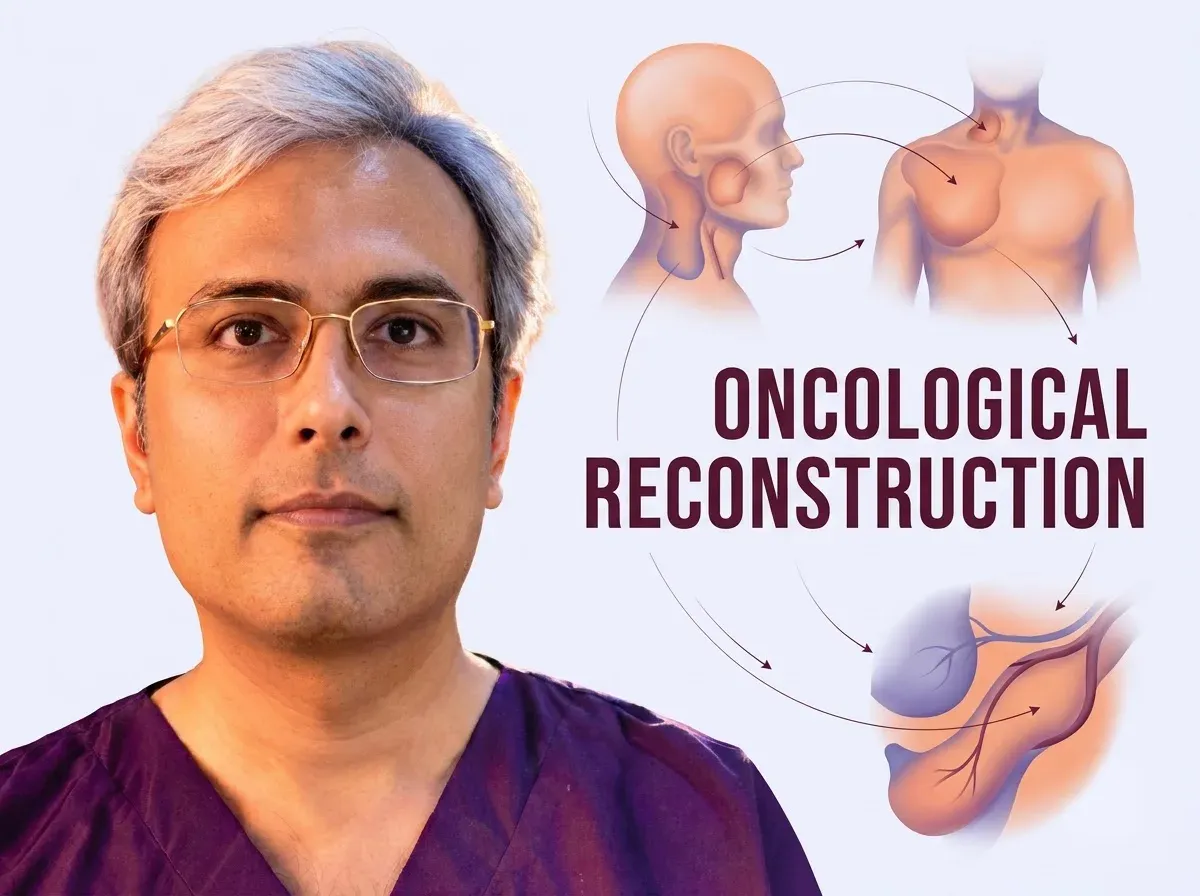
Head & Neck Cancer Free Flap Reconstruction in Jaipur - Dr. Vishal Purohit Plastic Surgeon Jaipur11+ Years of Surgical Experience

Microvascular free tissue transfer reconstructing the jaw, tongue, palate, and cheek after oncologic resections.

Ultra-precise microvascular reconstructive surgery reconnecting 1–2 mm blood vessels under the microscope to restore oral swallowing, speech, and facial symmetry.

  • M.Ch Plastic Surgeon · RMC Reg. 28041/14185
  • Day-care / short-stay procedure
  • Tonk Road, Jaipur
  • Jump to FAQs (10)

Procedure Time

5–8 hours

Anesthesia

General Anesthesia with temporary tracheostomy support

Hospital Stay

7–10 days (including ICU monitoring)

Recovery Time

Tracheostomy decannulation: 7–14 days; Oral swallowing rehabilitation: 2–4 weeks

Indications

Oral cavity cancers, composite mandibulectomy defects, total/partial glossectomy, maxillectomy, pharyngeal defects

Techniques

Free Fibula osteocutaneous flap, Anterolateral Thigh (ALT) flap, Radial Forearm free flap, microvascular anastomosis (1–2 mm vessels)

Post-Oncologic Tissue Loss

How will I speak, swallow, and look after cancer surgery?

Radical resection of advanced oral cancers leaves composite defects across the jaw, tongue, or palate, impairing safe airway protection, oral swallowing, clear speech, and normal facial symmetry.

Composite Mandibulectomy Defects

Surgical removal of the jawbone disrupts structural support, preventing oral closure, stable chewing, and lower facial definition.

Severe Speech and Swallowing Impairment

Extensive resections of the tongue or soft palate prevent oral nutrition and clear articulation without microvascular tissue reconstruction.

Loss of Essential Tissue Volume

Large through-and-through cheek or maxillectomy cavities cannot be repaired with adjacent tissues, leaving exposed functional voids.

Why Local Tissues Fall Short

Radical oncological resections leave composite gaps spanning bone, muscle, and mucosa that cannot close primarily. Restoring continuous structural integrity and preventing oral breakdown requires transferring autologous tissues with their own vascular pedicle, microsurgically reconnecting 1 to 2 mm arteries and veins under magnification to re-establish living circulation.

Dr. Vishal Purohit - M.Ch Plastic & Cosmetic Surgeon Jaipur

Dr. Vishal Purohit

M.Ch Plastic & Cosmetic Surgeon

✓

Credential Level

M.Ch Super-Specialty

RMC Reg. 28041/14185

Your Surgical Guide

Artistic Proportion & Advanced Surgical Safety

"Our priority is reconnecting 1 to 2 mm vessels under the operating microscope, restoring composite jaw and oral defects to re-establish safe swallowing, speech, and facial form."

— Dr. Vishal Purohit

1

M.Ch Plastic & Reconstructive Surgery, SMS Medical College, Jaipur

The highest super-specialty surgical qualification in India, ensuring total anatomical mastery of neurovascular planes and soft tissues.

2

11+ Years as a Plastic Surgeon

Hundreds of procedures performed, with a focus on natural, proportionate results.

3

Accredited Operating Suites

Dr. Vishal Purohit operates in sterile hospital operating theatres, with certified cardiac anaesthesiologists and ICU support.

Simple & Transparent

Your 3-Step Surgical Journey

We remove anxiety and uncertainty with a structured, transparent pathway designed for absolute safety and peace of mind.

1

Confidential Assessment

Dr. Purohit evaluates your anatomical baseline, skin elasticity, and health history. You receive an honest feasibility blueprint, personalized surgical plan, and transparent cost with zero pressure.

Step 1: Planning
2

Precision Operating Suite Procedure

Performed by Dr. Vishal Purohit in a sterile hospital operating theatre under gentle anaesthesia. Using advanced minimally invasive techniques, target areas are treated with microscopic care.

Step 2: Procedure
3

Monitored Recovery & Transformation

Supported with tailored recovery guidelines and post-operative follow-up visits. As tissue heals and settling occurs over the coming weeks, your refined results emerge.

Step 3: Recovery
Clinical Guide & In-Depth Information

Comprehensive Medical Overview

Detailed procedural analysis, anatomical considerations, and patient guidelines by Dr. Vishal Purohit.

Microvascular Free Flap Surgery for Head & Neck Cancer Reconstruction

Radical oncological resection of advanced oral cancers (tongue, jawbone, buccal mucosa, palate) leaves composite structural defects that cannot be closed primarily or with local tissues. Without immediate advanced reconstruction, patients face devastating impairments in speech, swallowing, airway security, and facial form. Microvascular free tissue transfer (free flap surgery) represents the worldwide pinnacle of reconstructive plastic surgery, restoring form, function, and dignity.

Workhorse Free Flaps in Head and Neck Reconstruction

Dr. Vishal Purohit selects and customizes free flaps based on the specific anatomical tissues lost:

  • Free Fibula Osteocutaneous Flap: The gold standard for jawbone reconstruction. A segment of vascularized leg fibula bone is harvested, osteotomized to recreate the mandibular arch, and plumbed into neck blood vessels to support future dental implants.
  • Anterolateral Thigh (ALT) Flap: A versatile, high-volume soft-tissue flap from the thigh, ideal for tongue reconstruction, cheek through-and-through defects, and total maxillectomy cavities.
  • Radial Forearm Free Flap: A thin, pliable fasciocutaneous flap ideal for reconstructing floor-of-mouth, soft palate, and mobile tongue defects requiring intricate mobility.

Microvascular Anastomosis and Functional Rehabilitation

Under 10x to 25x surgical microscope magnification, 1 to 2 mm arteries and veins are reconnected with 9-0 and 10-0 nylon sutures to establish immediate blood circulation. Comprehensive postoperative speech and swallowing therapy helps patients return to normal oral eating and social life.

Your Safety Comes First

Why Your Surgeon’s Training Matters

Head & Neck Cancer Free Flap Reconstruction in Jaipur involves delicate anatomy, blood supply and tissue handling. Choosing on price alone, or an operator without plastic-surgery training, raises the risk of contour irregularities and complications.

With Dr. Vishal Purohit, your safety is backed by intensive-care support, certified cardiac anaesthesiologists and hospital-grade theatre protocols.

What to watch out for

  • Operators without plastic-surgery training
  • Rushed or imprecise tissue handling
  • Clinic rooms without emergency backup
  • Higher chance of visible scars or revision surgery

With Dr. Vishal Purohit

  • M.Ch super-specialist plastic surgeon
  • Careful, tissue-preserving technique
  • Hospital-grade operating theatre
  • Personal follow-up through recovery
Restored Form and Function

Microsurgical reconstruction for essential oral functions

Customized vascularised free tissue transfer restores mandibular continuity, oral competence, and facial contour, enabling comprehensive speech and swallowing rehabilitation after cancer resection.

Mandibular Arch Reconstruction

The free fibula osteocutaneous flap rebuilds vascularised jawbone contour to restore lower facial symmetry and future dental support.

Mobile Tongue and Palate Restoration

Thin, pliable radial forearm flaps re-establish soft palate closure and mobile tongue mechanics essential for intelligible speech.

Soft-Tissue Cavity Obliteration

Anterolateral thigh flaps restore bulk for extensive cheek and maxillectomy defects, re-establishing mucosal separation and oral containment.

Got Questions?

Frequently Asked Questions

Honest, clinically precise answers from Dr. Vishal Purohit regarding Head & Neck Cancer Free Flap Reconstruction in Jaipur.

What is free flap reconstruction for head and neck cancer?

Free flap reconstruction for head and neck cancer rebuilds the area left after tumor removal using living tissue moved from another body part, with its blood vessels reconnected microsurgically. M.Ch. plastic surgeon Dr. Vishal Purohit in Jaipur can explain how this repair may restore shape and function after cancer surgery.

After cancer removal, the defect may involve skin, mouth lining, muscle, cartilage or bone, and reconstruction must protect swallowing, speech, breathing and appearance. A free flap is tissue with its own blood supply taken from a distant donor site; its artery and vein are joined to suitable vessels in the neck. Because tissue can be made thin and pliable or bulky and padded, surgeons can tailor repair to the defect. Immediate reconstruction is critical to minimize complications and restore function and appearance. Microvascular free tissue transfer is described as the gold standard for reconstruction after ablative head and neck cancer treatment, with high success rates and versatility.

Recovery focuses on protecting transferred tissue and healing. Avoid direct pressure on the free flap, including a tight belt, neck tie or tight bra. This is general information, not a personal diagnosis. Your cancer and reconstructive teams will guide your individual plan. If you are facing head and neck cancer surgery, you may consult Dr. Vishal Purohit in Jaipur to discuss reconstruction options, likely benefits and limitations.

In free flap reconstruction for head and neck cancer, what is a free fibula flap and how does it rebuild the jaw?

A free fibula flap is living bone and soft tissue moved with its own blood vessels to rebuild a jaw defect after cancer surgery. It can restore jaw height and support chewing, speech and swallowing. Dr. Vishal Purohit, M.Ch. plastic surgeon in Jaipur, can explain how this reconstruction may fit your defect and what benefits and limitations apply.

In head and neck cancer surgery, the tumour is removed and the resulting defect is repaired. A free flap is living tissue transferred from another body area, with its blood vessels disconnected and reattached microsurgically in the neck. The fibula flap can be shaped to fit the jaw defect, then fixed with screws and plates; it aims to restore jaw height and function, including chewing, speech and swallowing. Jaw reconstruction also depends on joint movement, dental support and soft-tissue repair, so outcomes vary with the defect and prior treatment. It is one option among several, and suitability depends on your health, defect size and cancer treatment.

Recovery depends on the extent of cancer surgery, reconstruction and your general health. Care after oral cancer resection with free flap transfer focuses on protecting the flap and supporting healing. Scars and donor-site healing also need follow-up. If jaw reconstruction concerns you, you may consult Dr. Vishal Purohit in Jaipur to discuss likely function, risks and recovery in your case.

In free flap reconstruction for head and neck cancer, will harvesting a fibula bone from my leg cause walking problems?

Harvesting a fibula for head and neck reconstruction can cause donor-site problems, but the fibula is not a weight-bearing bone and most patients return to their previous walking level. M.Ch. plastic surgeon Dr. Vishal Purohit in Jaipur can explain how donor-site risks and your leg circulation affect this choice.

The fibula is expendable for weight-bearing, yet harvest can affect ankle stability, mobility, strength and wound healing. Donor-site morbidity is often related to lower-leg anatomy and surgical technique. In one series of 157 patients, 31.2% had perioperative donor-site complications and 17% had long-term problems, including decreased ankle mobility 12%, hallux contracture 9%, leg weakness 8% and ankle instability 4%; 96% returned to preoperative ambulatory activity. Another report found delayed wound healing 17.4% and limited ankle range of motion 11.5%. Peroneal nerve injury can cause foot drop, pain and weakness. Wound dehiscence can expose tendons, and foot edema may occur. Surgical experience and meticulous technique help minimize long-term problems. These figures describe reported groups, not your personal risk.

Long-term leg weakness is uncommonly disabling, though strength testing may show reduced knee and ankle strength; up to 11% may have persistent donor-leg pain. With normal three-vessel runoff, peroneal artery harvest appears to have minimal distal vascular impact. If head and neck reconstruction is being planned, you may consult Dr. Vishal Purohit in Jaipur to discuss donor-site risks, alternatives and recovery.

Can patients speak and swallow normally after tongue reconstruction?

After tongue reconstruction, many patients can speak and swallow again, but normal function depends on how much tongue was removed, whether the larynx was preserved, and the reconstruction used. M.Ch. plastic surgeon Dr. Vishal Purohit in Jaipur can explain how free-flap reconstruction aims to restore speech and swallowing after oral cancer surgery.

Tongue reconstruction is planned to protect eating, speaking and swallowing. For larger defects, microvascular free tissue transfer is often preferred because it can be shaped to meet the palate, lips or teeth and support a functional swallow. Speech depends on tissue pliability and mobility, and long-term speech function varies with cancer size and location, reconstruction type, tongue movement, tracheostomy and motivation. With laryngeal preservation, most patients can communicate verbally and 85% have intelligible speech; after simultaneous total laryngectomy, about 50% regain phonation and 30% have intelligible speech. Reconstructive options include fasciocutaneous flaps such as radial forearm or anterolateral thigh flaps, and free tissue transfer has been associated with improved speech outcomes compared with pedicled flaps.

Most patients recover swallowing after total glossectomy reconstruction, but feeding-tube dependence at one year has been reported at 50% to 75%, while at least 75% maintain some oral intake and one-third become feeding-tube independent. If speech remains unclear, augmentative communication aids may help. If tongue reconstruction concerns you, you may consult Dr. Vishal Purohit in Jaipur to discuss expected function and rehabilitation.

What is the overall success rate of microvascular free flaps in head and neck cancer reconstruction?

Microvascular free flaps used after head and neck cancer resection have a cumulative success rate of about 97% across 9,652 cases, with documented rates generally between 95% and 97%. M.Ch. plastic surgeon Dr. Vishal Purohit in Jaipur can explain how flap choice, defect size and overall health affect your reconstruction plan.

A free flap transfers living tissue with its blood vessels, which are reconnected microsurgically to repair defects after tumour removal. This allows skin, lining, muscle, cartilage or bone to be tailored carefully to the defect. Free tissue transfer is widely considered the gold standard after ablative head and neck cancer treatment because it can match tissue to the defect. Success depends on patient factors such as smoking, weight loss, fluid balance and overall health, and complications such as venous thrombosis usually occur within 48 to 72 hours after surgery, so close postoperative monitoring matters. The main benefit is precise tailoring to your needs, but success is not guaranteed and depends on individual factors.

Even with high success, complications can affect recovery and treatment progress; donor-site issues and recipient-site perfusion problems may occur. If a flap fails, a second free flap may be considered, with reported success around 89% to 91% in selected series. If you are facing head and neck cancer reconstruction, you may consult Dr. Vishal Purohit in Jaipur to discuss options, risks and recovery.

Can free flap reconstruction be performed for head and neck cancer if radiotherapy is needed?

Free flap reconstruction can be performed for head and neck cancer even when radiotherapy is needed, but prior or planned radiation can complicate surgery and vessel quality. M.Ch. plastic surgeon Dr. Vishal Purohit in Jaipur can explain how defect size, cancer stage and radiation timing affect reconstructive options during consultation.

A free flap moves living tissue with its blood vessels and reconnects them microsurgically to repair defects after tumour removal. Microvascular free tissue transfer can be tailored to the defect, and skin, oral lining, muscle, cartilage and bone may be reconstructed. Radiation can cause fibrosis and microangiopathic changes in recipient vessels, increasing anastomotic failure risk. Some studies report irradiation of the recipient site does not adversely affect successful free flap transfer in salvage surgery, while other evidence notes higher complexity after radiation. In poor-prognosis patients, methods allowing rapid recovery, such as an obturator after partial maxillectomy, may be considered. The choice depends on prognosis, defect and vessel quality.

After surgery, avoid direct pressure on the free flap, including tight belts, neck ties or tight bras. Radiation-related fibrosis, osteoradionecrosis and reoperation can increase complexity, especially after multiple reconstructions or salvage surgery. If you are facing head and neck cancer reconstruction, you may consult Dr. Vishal Purohit in Jaipur to discuss timing, radiation effects, wound care, follow-up and realistic options, planning and support during recovery.

How long is a temporary tracheostomy tube required after head and neck cancer free-flap reconstruction?

A temporary tracheostomy after head and neck cancer free-flap reconstruction has no fixed duration; it stays until postoperative swelling has abated and the airway is safe. M.Ch. plastic surgeon Dr. Vishal Purohit in Jaipur can explain how airway protection, flap monitoring and swelling guide this decision.

Upper aerodigestive mucosal tumors often require intraoperative tracheostomy, and even minor resections may leave the endotracheal tube until swelling subsides. With a tracheostomy, the tube is left during early recovery so swelling can settle with a secure airway. The cuffed tube is used early, then exchanged for a fenestrated tube and corked to confirm the patient can manage before decannulation. The original tube should be secured at least three days for tract formation and may be changed after seven days if clinically indicated. Because free-flap pedicle pressure from ties can cause obstruction or thrombosis, ties are avoided and the tube is sutured in place. Airway care must be meticulous, with regular aspiration and a clean site.

Accidental decannulation is of greatest concern during the first five to seven days, before the tract matures. The tube stays until swelling has abated and the airway is safe; your team will guide each step. No fixed duration applies to every patient. If you are facing this reconstruction, you may consult Dr. Vishal Purohit in Jaipur to discuss airway planning, flap safety and recovery expectations.

Why choose Dr. Vishal Purohit for head and neck cancer free flap reconstruction in Jaipur?

Choosing Dr. Vishal Purohit in Jaipur means consulting an M.Ch. plastic surgeon whose practice includes microvascular reconstruction, for a complex cancer defect where living tissue must be transferred and blood vessels reconnected. He can explain reconstructive options, likely benefits and limitations, and what recovery may involve.

Microvascular free tissue transfer is the gold standard after ablative treatment for head and neck cancers. A flap is living tissue moved with its blood supply, and surgeons can match tissue characteristics to the defect. Resection leaves defects that may need skin, oral lining, muscle, cartilage or bone reconstruction; flaps can be tailored thin and pliable or bulky and padded. Large composite defects often require free flaps, while smaller defects may be managed with local flaps or grafts. Success rates for free flaps in the head, neck and upper extremities are high, around 97 to 98 percent. Medical complications, not surgical complications, often cause slow recovery and prolonged hospital stay, so thorough preoperative medical evaluation and optimization are essential.

After surgery, do not put direct pressure on the free flap, including tight belts, neck ties or tight bras; a scarf, hat or shawl may help cover the area. Because medical complications can prolong recovery, preoperative heart and lung assessment may be needed, especially with tobacco or alcohol history. If you are considering head and neck cancer reconstruction, you may consult Dr. Vishal Purohit in Jaipur to discuss options and recovery.

How will the expected cancer defect determine the reconstruction plan for head and neck cancer free-flap reconstruction?

The expected defect after cancer removal determines reconstruction by its size, depth, tissue layers, location and functional impact; M.Ch. plastic surgeon Dr. Vishal Purohit in Jaipur can explain how these factors guide whether a free flap is needed and what tissue characteristics it should have.

Each operation removes the tumour, then repairs the defect. Flaps are often most appropriate for complex defects. A free flap is living tissue transferred with its blood vessels reattached microsurgically. Surgeons can tailor it thin and pliable or bulky and padded; skin, oral lining, muscle, cartilage and bone can all be reconstructed. The defect's size, depth, tissue planes, surrounding tissue quality, location near the eye or mouth, and prior radiotherapy or surgery affect decisions. Larger composite or through-and-through defects usually require free tissue transfer, while smaller defects may allow primary closure or local flaps. Prognosis also matters: in poor prognosis, quicker rehabilitation may be preferred. Multidisciplinary care is essential.

Free flap success rates in head and neck and upper extremity reconstruction are high, around 97 to 98 percent. Too little tissue can lead to wound breakdown, fistulas or stenosis; an inadequate flap may cause trismus. Prior radiotherapy increases wound healing problems and flap failure risk. Avoid direct pressure on the flap after surgery. If you are facing head and neck cancer reconstruction, you may consult Dr. Vishal Purohit in Jaipur to discuss defect-specific options.

Will head and neck cancer free-flap reconstruction be performed immediately after tumour removal?

Head and neck cancer free-flap reconstruction is often done immediately after tumour removal, but it may be delayed until margins are confirmed clear or the patient is medically optimized. M.Ch. plastic surgeon Dr. Vishal Purohit in Jaipur can explain how timing depends on the defect, cancer stage and overall health.

After tumour removal, the defect may expose vital structures and affect swallowing, speech or breathing, so immediate reconstruction is often important to restore the mouth seal, anatomy and function. Microvascular free tissue transfer is a standard option because it can match tissue to the defect. Reconstruction may be immediate or delayed: flaps after cancer removal can usually be done immediately or within a few days when margins are confirmed clear. Patients must be fit for a long operation, and medical conditions may be optimized first; free flaps are not usually done as emergencies. The choice depends on cancer stage, prognosis and recovery goals and overall health status.

After surgery, the flap needs careful monitoring and direct pressure should be avoided, such as tight belts, neck ties or tight bras. Surgery can be lengthy, and complications such as infection, blood clots or delayed recovery may occur. If you are facing head and neck cancer reconstruction, you may consult Dr. Vishal Purohit in Jaipur to discuss timing, donor-site options and recovery expectations.

Need more clinical answers?

Explore all 92 answered Head and Neck Cancer / Free-Flap Reconstruction questions.

Head and Neck Cancer / Free-Flap Reconstruction FAQ Hub (92 FAQs)
Begin Your Journey

Ready to Discuss Head & Neck Cancer Free Flap Reconstruction in Jaipur?

Schedule a private consultation with Dr. Vishal Purohit at his OPD suite, Kalpana Aesthetics (2nd Floor), to evaluate your candidacy, discuss surgical options, and receive a transparent, tailored treatment plan.