
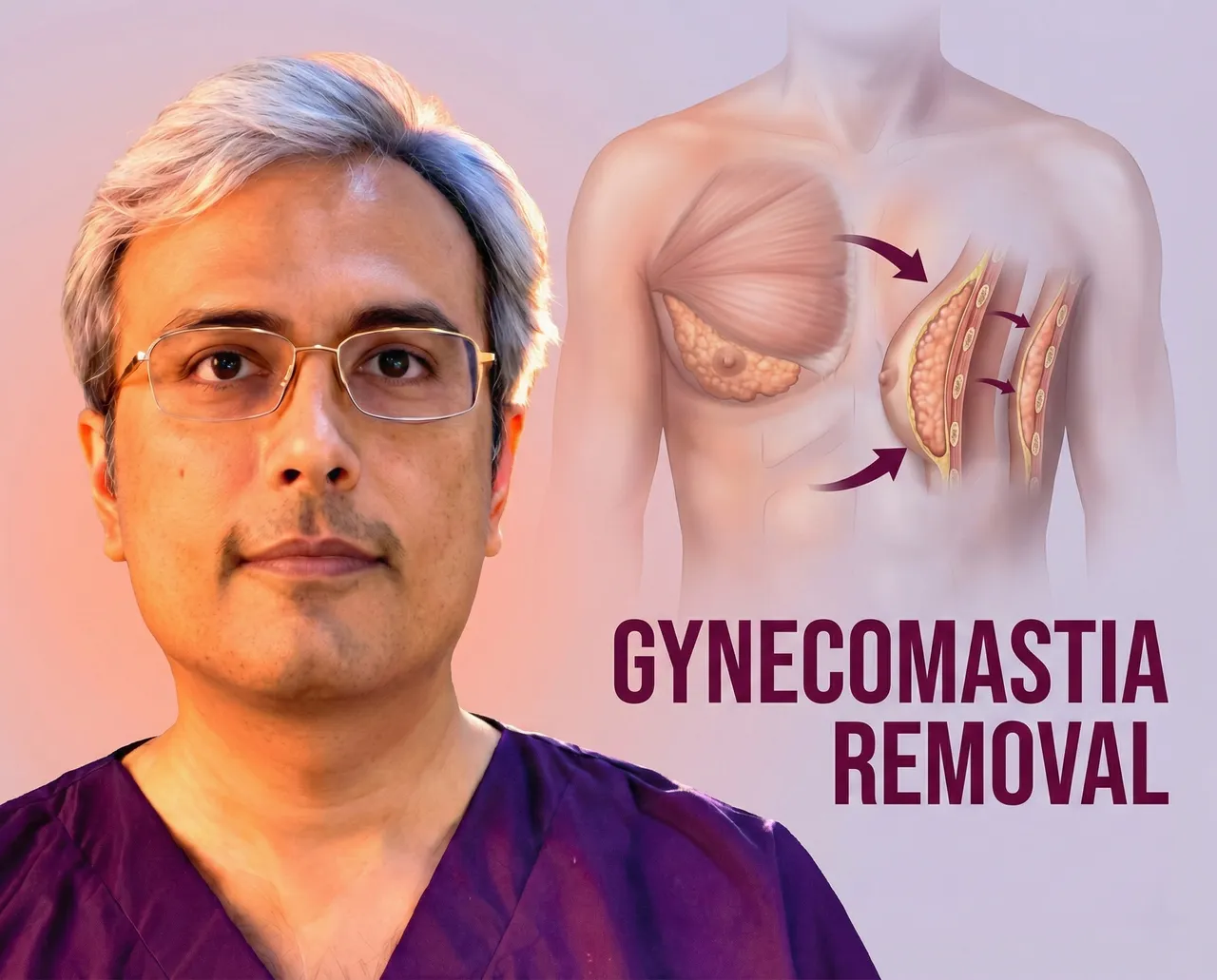
When patients research Gynecomastia Surgery in Jaipur, they often get stuck on one question: “Do I need just liposuction, or do I need ‘the cut’?”
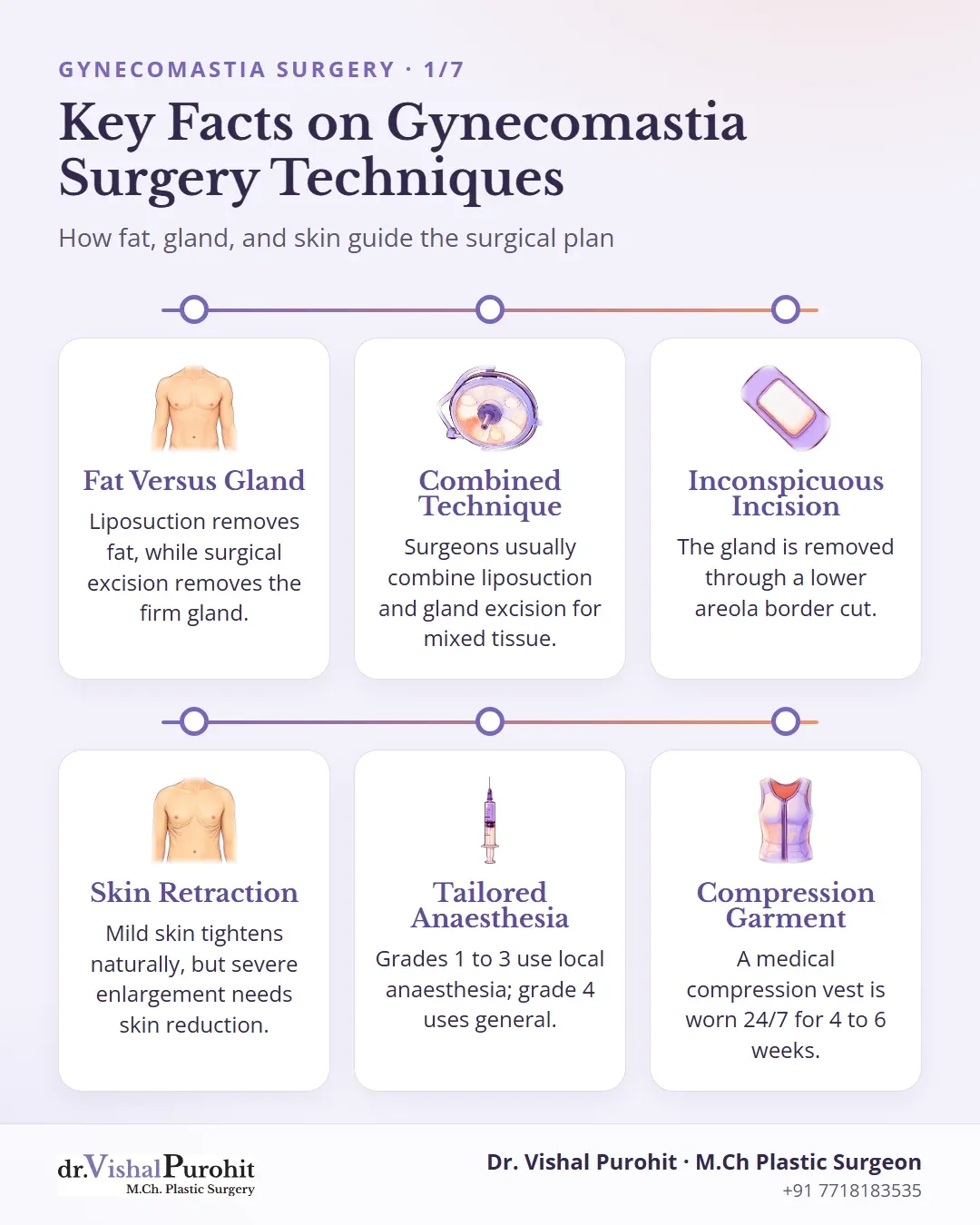
There is a common misconception that liposuction is the “modern” way and gland excision is the “old” way. This is false. They are two different tools for two different problems: Fat vs. Gland.
To achieve a truly sculpted, masculine chest, Dr. Vishal Purohit combines art with science. In this guide, he breaks down the techniques used to ensure your results are not just “flatter,” but anatomically correct.
The Two Components of Gynecomastia
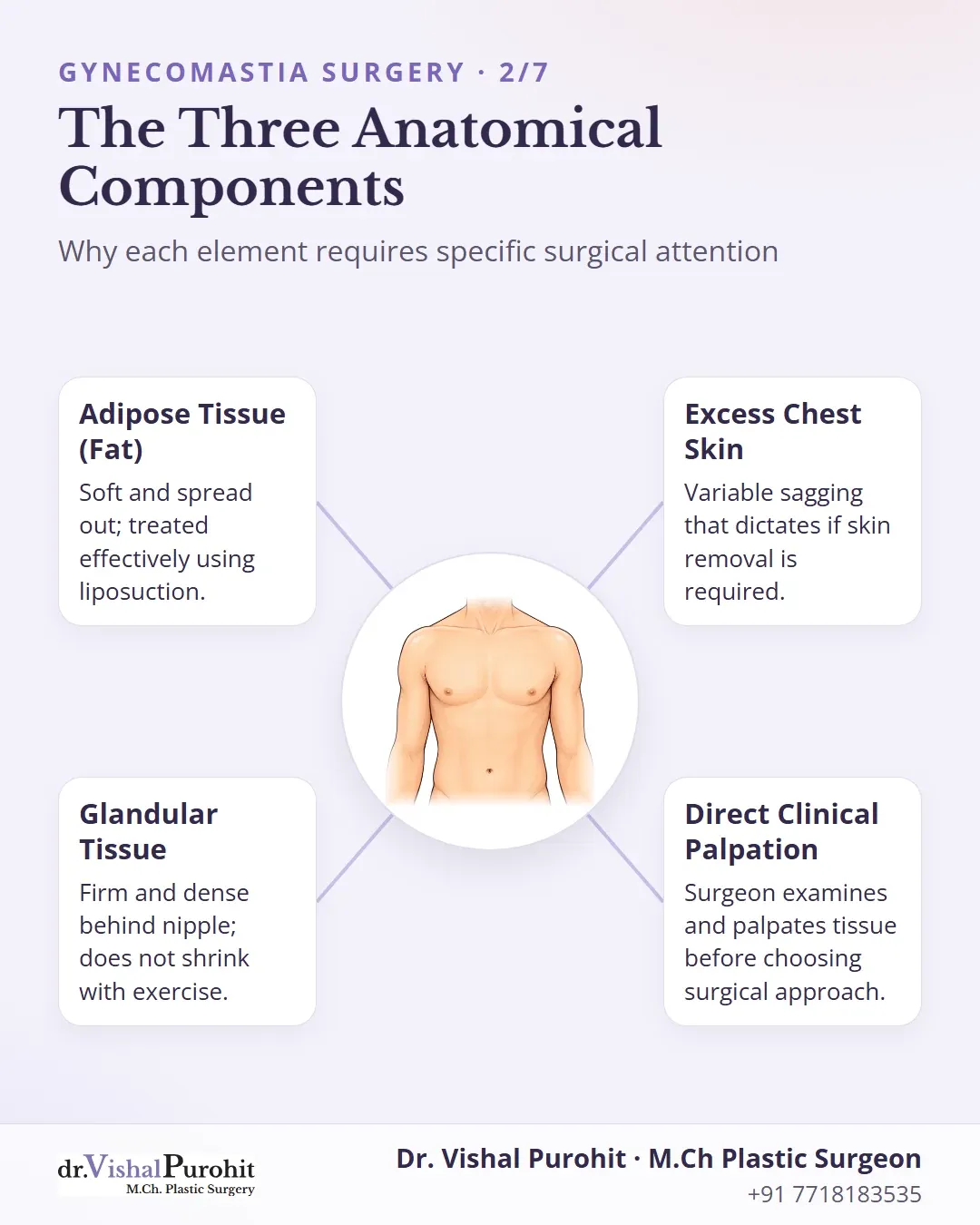
To understand the technique, you must understand the tissue. The male breast is made of two main components, and the ratio between them varies from man to man; in gynecomastia there may be an excess of both [1][2]:
-
Adipose Tissue (Fat): Soft and spread out. When the enlargement is mainly fat, it is called pseudogynecomastia [2].
-
Glandular Tissue (The Gland): Firm, dense and located directly behind the nipple. True gland tissue does not shrink with exercise or weight loss [2].
In Dr. Vishal Purohit’s practice, gynecomastia is diagnosed with clinical examination and direct palpation first, which is why this physical assessment comes before any choice of technique [3]. A third component matters too: excess skin, with a variable degree of sagging. Surgeons describe gland, fat and skin as the three parts that may need correction, and neglecting one of them can leave a less satisfactory chest shape [4]. If you are new to the condition, start with our guide to gynecomastia causes, symptoms and grades.
The Golden Rule: Liposuction removes fat. Excision removes the gland.
Comparative Analysis of Male Chest Contouring Techniques
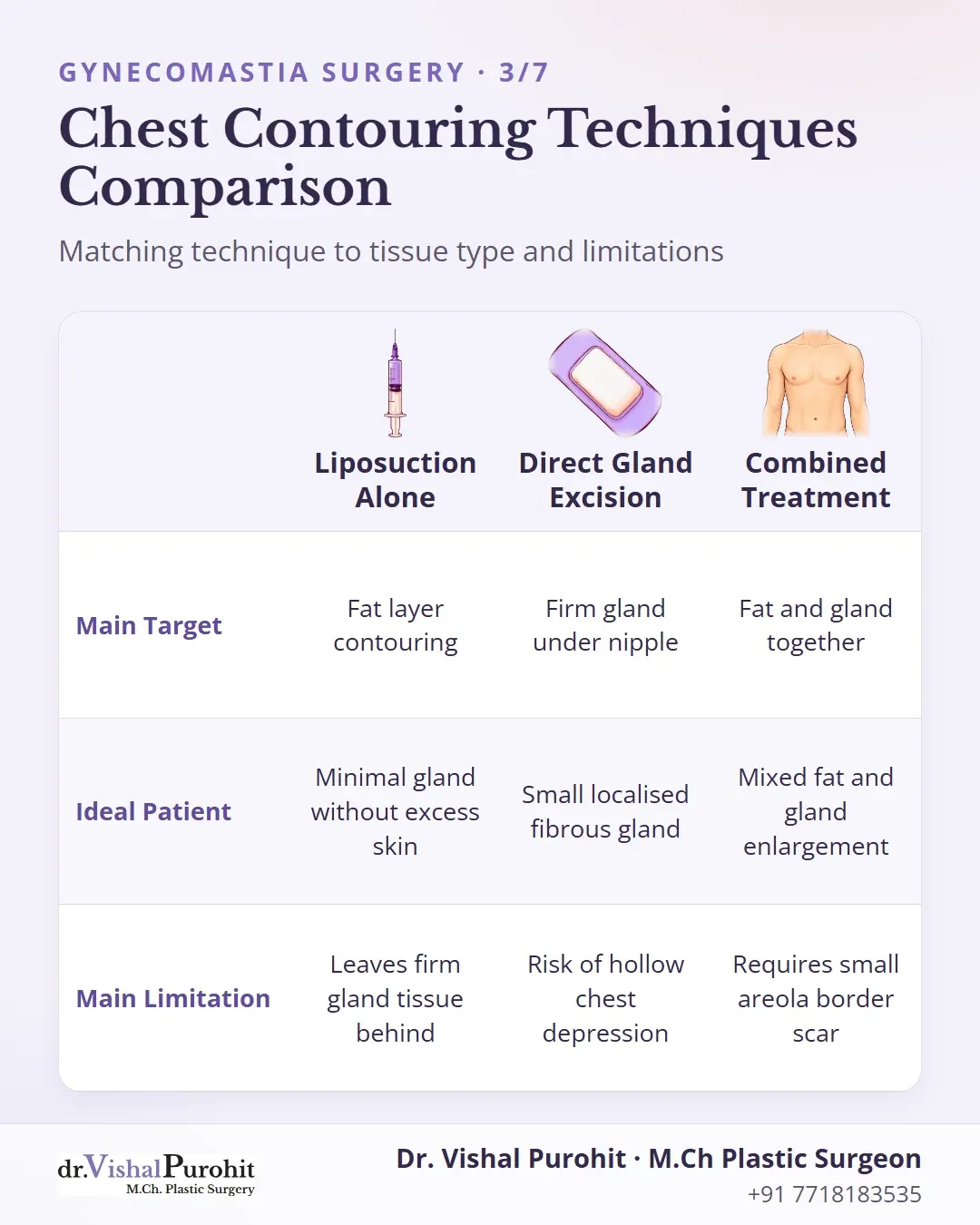
| Approach | What it mainly treats | Where it tends to fit | Main limitation |
|---|---|---|---|
| Liposuction alone (suction, power-assisted or ultrasound-assisted such as VASER) | Fat | Minimal gland enlargement with little skin excess [5] | Usually does not fully correct a firm gland; once the gland is removed true recurrence is biologically not possible, so any fullness afterwards is residual tissue [6] |
| Direct gland excision through the areola border | Firm gland under the nipple | Small, well-localised fibrous gland [5] | Excision alone can leave a hollow defect; up to half of patients were unhappy with the look in some reports [7] |
| Combined liposuction and gland excision | Fat and gland together | Mixed gynecomastia, studied mainly in grade I/II [8][4] | Leaves a scar at the areola edge as well as small liposuction entry scars [2] |
| Excision with skin reduction | Gland, fat and loose skin | Moderate or marked enlargement with excess skin [4][5] | Longer or additional scars, depending on how much skin is removed [5] |
Liposuction: The Foundation of Contouring
Contemporary gynecomastia surgery usually starts with liposuction to remove excess fat; other methods are then used for any remaining gland tissue or excess skin [5].
How It Works
A thin tube (cannula) is passed through a small incision to suction out the fatty layer [2]. For his liposuction entry points, Dr. Vishal Purohit makes two small openings on each side at the outer edge of the pectoralis major muscle along the anterior axillary line. Removing the fat around the gland first also makes the gland itself easier to identify and remove [8].
-
Technology: Power-assisted and ultrasound-assisted liposuction have increased how much tissue liposuction alone can remove [5]. VASER, a newer form of ultrasound-assisted liposuction, is considered by many surgeons a safer option for fibrous areas close to the skin [5]. The evidence for the superiority of newer devices is limited, though: in one industry-funded comparison, VASER showed a 6 percent increase in skin retraction over standard liposuction, and blinded patients preferred standard liposuction [9].
-
The Limitation: Liposuction alone usually does not fully correct a significant proportion of gynecomastia [6]. In Dr. Purohit’s practice, any fullness after surgery is residual tissue rather than true recurrence, which needs a planned return to theatre.
-
Research Insight: High-definition pectoral liposculpture has been combined with gland resection: one Colombian group reported 436 men treated this way, with minor complications in 3.2% and major complications in 1.6% (level IV evidence) [10]. In other words, even contouring-focused surgeons pair liposuction with gland removal when true gland is present.
At Kalpana Aesthetics, Dr. Vishal Purohit uses VASER or power liposuction as part of a combined approach, together with gland excision through an inconspicuous hemi-periareolar incision along the lower half of the areola border.
Surgical Excision: The Main Method for Gland Removal
If you have a puffy nipple or a firm lump behind it, gland tissue is likely to be part of the problem. Small amounts of fibrous gland localised under the nipple can be treated effectively with direct excision through a small incision at the areola [5]. Excision matters because the gland is what liposuction tends to leave behind. In Dr. Vishal Purohit’s practice, any fullness afterwards is residual tissue rather than a true recurrence [6].
The Webster Technique (Gland Excision)
-
The Incision: A semicircular cut is made along the lower border of the areola; one study describes it running from the three to the nine o’clock position [11]. Placing the incision along the lower half of the areola margin gives an inconspicuous scar [5]. (Worried about marks? Read our guide on Gynecomastia Scar Management).
-
The Removal: The gland is separated from the muscle and skin and removed, while a small amount of tissue is deliberately left under the nipple to avoid a depression or “saucer” deformity [5].
-
The Importance: When there is any concern about a higher risk of breast cancer, such as in Klinefelter syndrome, direct excision is preferred so that the tissue can be examined in a laboratory [5]. At Kalpana Aesthetics, all excised tissue is always sent for histopathology.
Lipo vs. Surgery: Which One Do You Need?
This decision depends entirely on your specific anatomy and directly influences the Cost of Gynecomastia Surgery. For some men, liposuction alone is enough; others also need gland tissue removed from behind the nipple through a small semicircular incision on the lower half of the areola; and a small group needs gland removal only, with no liposuction [12].
| Feature | Liposuction Only | Gland Excision | Combination |
|---|---|---|---|
| Suits | Mainly fatty enlargement with little gland [5] | Small, firm gland under the nipple [5] | A mix of fat and gland [12] |
| Incision | Two small openings on each side | Lower half of the areola border [5] | Both |
| Scarring | Small entry scars | A scar at the areola edge [2] | Both, kept as inconspicuous as possible |
For recovery, see our Recovery Timeline Guide for Gynecomastia Surgery, which follows the same protocol whichever technique is used.
The Verdict: At Kalpana Aesthetics in Jaipur, Dr. Vishal Purohit’s usual technique combines VASER or power liposuction with gland excision through an inconspicuous hemi-periareolar incision on the lower half of the areola border. Liposuction flattens and smooths the chest, and excision removes the firm tissue behind the nipple. The final plan is confirmed only after examination.
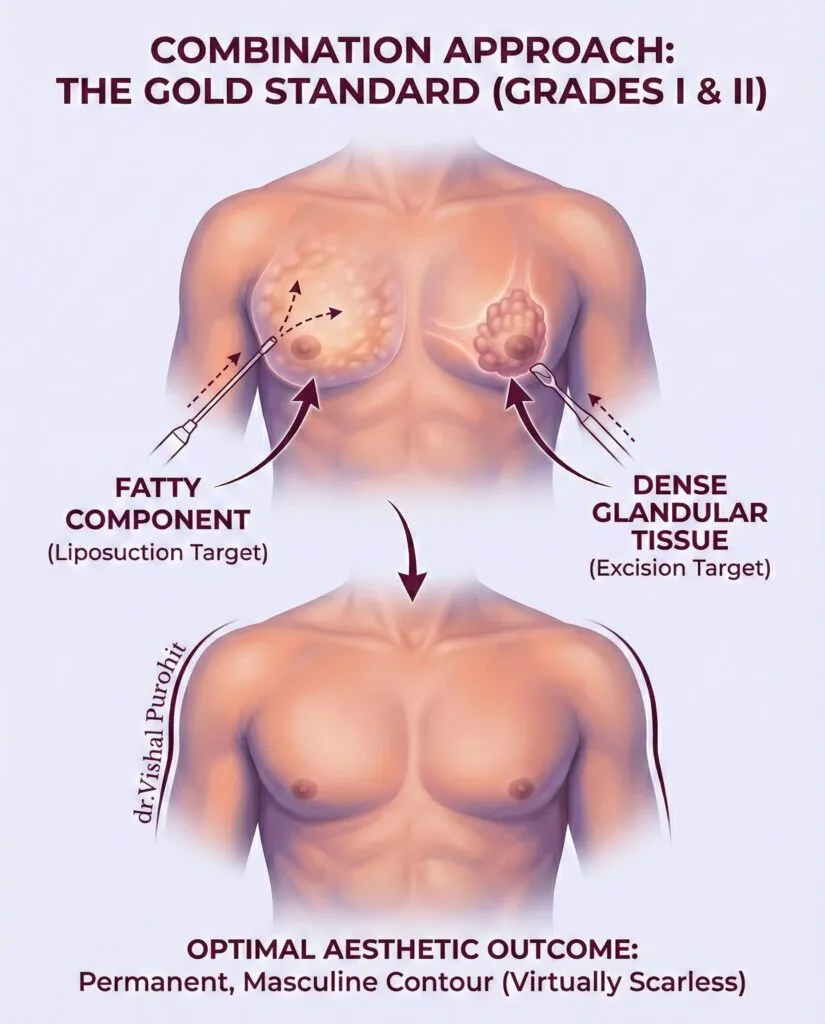
Dr. Vishal Purohit’s illustration of the combination approach in Grade I and II gynecomastia, showing the areas treated by liposuction and by excision.
Why Combined Treatment Is Often Discussed
Because gynecomastia can involve gland, fat and skin, a plan that treats only one component can fall short [4]. The literature points the same way from both directions:
- Liposuction without excision may leave the firm gland behind. In one series, a grade I patient treated with liposuction alone was under-corrected and needed a second session with gland excision [4].
- Excision without liposuction can leave a hollow area in the chest; traditional subcutaneous mastectomy has been reported to give cosmetically unsatisfactory results in up to 50% of patients [7]. Liposuction around the gland helps blend the edges.
In one series, grades I and IIa were treated mainly with liposuction combined with gland excision through a small lower hemi-circumareolar incision, and skin reduction around the areola was added for grades IIb and III [4]. A study of 30 men with grade I/II gynecomastia combined cross-chest liposuction with gland removal through a single minimal incision at the lower outer areola border and reported good, satisfactory aesthetic outcomes without the need for wound drains [8].
At Kalpana Aesthetics, Dr. Vishal Purohit follows this combined principle: VASER or power liposuction with gland excision through an inconspicuous hemi-periareolar incision along the lower half of the areola border. Drains are placed only in grade 4 gynecomastia; lower grades usually do not need drains. To see where surgery sits among all the options, including observation and medicines, read gynecomastia treatment options.
Incision Options, Explained
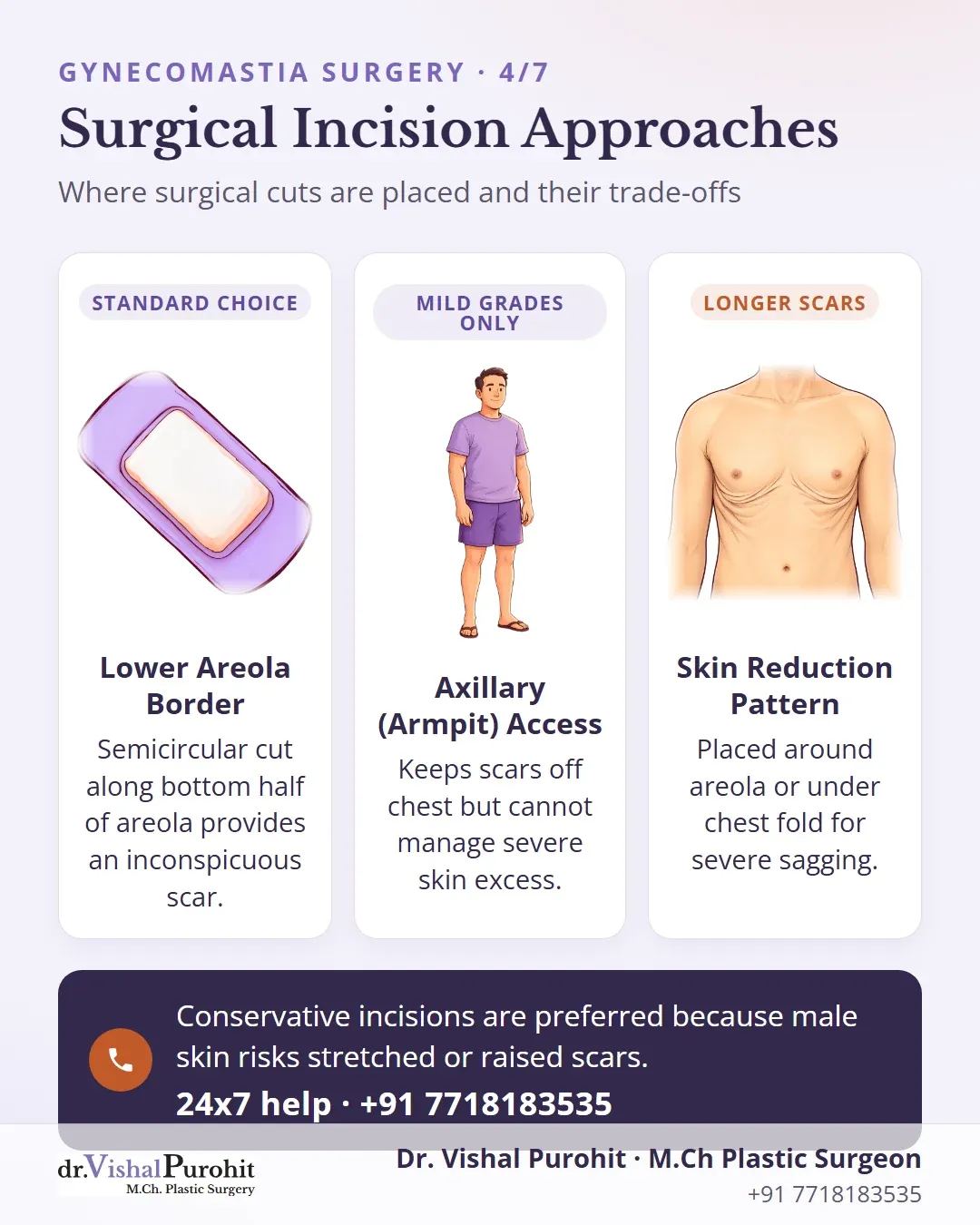
Surgeons can reach the gland through different access points. This overview explains what each option is, not how it is performed:
- Lower areola border (hemi-periareolar). The incision follows the lower half of the areola margin, a position chosen for an inconspicuous scar [5]. This is the approach Dr. Vishal Purohit uses at Kalpana Aesthetics, combined with liposuction.
- Small puncture incisions. Some surgeons remove gland through very small (3-mm) punctures at the areola margin, with an extra puncture near the armpit for liposuction [6].
- Pull-through technique. After power-assisted liposuction, the gland is freed and pulled out through the liposuction incision itself [13].
- Armpit (transaxillary) access. This keeps the scar off the chest and can remove gland, but it is not suitable for higher grades with a lot of fat and skin excess [4].
- Incisions for skin reduction. When skin must be removed, the incision usually goes around the areola; in the most extreme cases a longer incision in the fold under the chest may be needed [5]. In grade 4 gynecomastia, Dr. Purohit removes excess skin when needed, without reducing the areola.
Male skin is thicker than female skin, so wide incisions around the areola carry a risk of stretched, raised or puckered scars, and conservative incisions are preferred [14]. Which option fits you depends on your grade, the amount of gland and fat, and your skin, not on a fixed preference. For a deeper look at scar care, see gynecomastia surgery scars.
Limits of Minimal-Incision and “No-Scar” Claims
Small incisions are a genuine advance, but they have limits that patients should hear about honestly:
- Every excision leaves a scar. Removing gland tissue normally leaves a scar around the edge of the nipple [2], and the American Society of Plastic Surgeons lists unfavourable scarring among the risks of gynecomastia surgery [15]. Even endoscopic studies that advertise a “no-scar” goal describe small, hidden incisions, not the absence of a scar [10].
- Evidence is mostly in milder grades. Minimal-incision studies largely include grade I/II patients [8], and armpit access is not suitable for higher grades with skin excess [4].
- Trade-offs exist. Many minimal-incision designs needed more than one incision or gave a less satisfactory appearance [8]. A randomised comparison of endoscope-assisted liposuction with open excision in 140 men found shorter incisions, shorter operations and shorter hospital stays, but long-term data on recurrence remain limited [16].
- Scars still drive satisfaction. In one series of combined liposuction and excision, most of the few unsatisfied patients were unhappy because of the scar, and two hypertrophic scars needed revision [4].
So the useful question is not “will there be no scar?” but “where will my scar be, and how does it usually heal?” At Kalpana Aesthetics, Dr. Vishal Purohit places the hemi-periareolar incision along the lower half of the areola border to make the scar inconspicuous; no surgery can be entirely without a mark. In his practice, scar treatment is needed only in a few patients, and firm scar massage along with silicone sheets or gel are started if signs of a hypertrophic scar appear.
The Role of Skin Excess and Individualized Planning
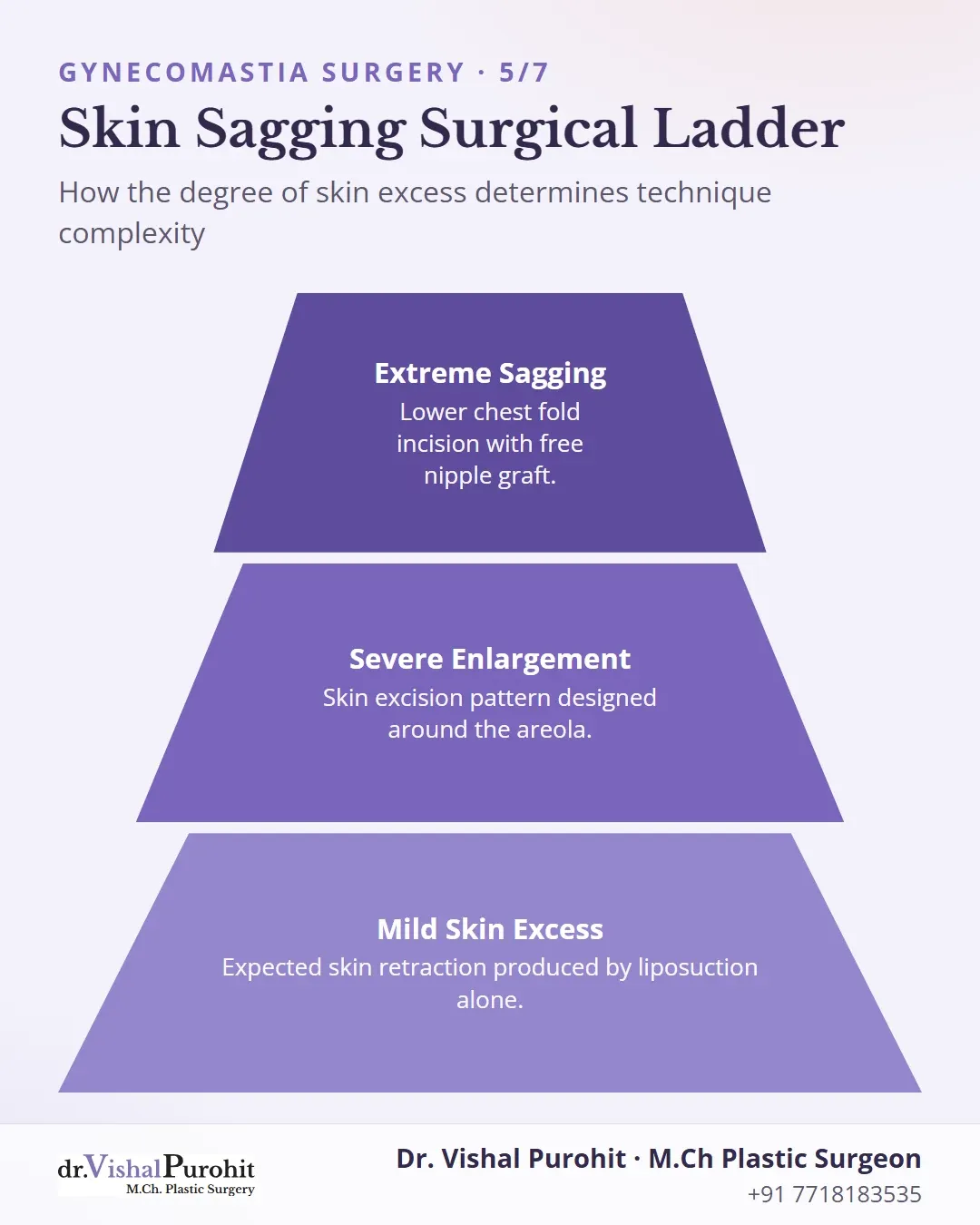
Skin is often what separates a simple plan from a more complex one. The Simon classification, widely used by surgeons, grades gynecomastia as I (small enlargement, no excess skin), IIa (moderate enlargement, no excess skin), IIb (moderate enlargement with excess skin) and III (marked enlargement with excess skin) [17]. Our guide to gynecomastia grades explains these in plain language.
- Mild excess: in many patients, liposuction itself produces the expected skin retraction [14].
- Severe gynecomastia: usually needs some form of skin removal [5]. An incision pattern around the areola can be used for almost all patients who need skin removal, though it has limits, and trying to remove too much skin this way can widen the scar or distort the nipple [5].
- Extreme excess and sagging, increasingly seen after massive weight loss, may need a longer incision under the chest with the nipple reattached as a graft [5].
The choice of technique should always be individualized: surgeons weigh the degree of gynecomastia, the ratio of gland to fat and how the tissue is distributed [7]. At Kalpana Aesthetics, drains are placed only in grade 4 gynecomastia; lower grades usually do not need them. A custom medical-grade compression vest is worn 24/7 for 4 to 6 weeks to help the skin redrape.
Anaesthesia and Operating Time at Kalpana Aesthetics
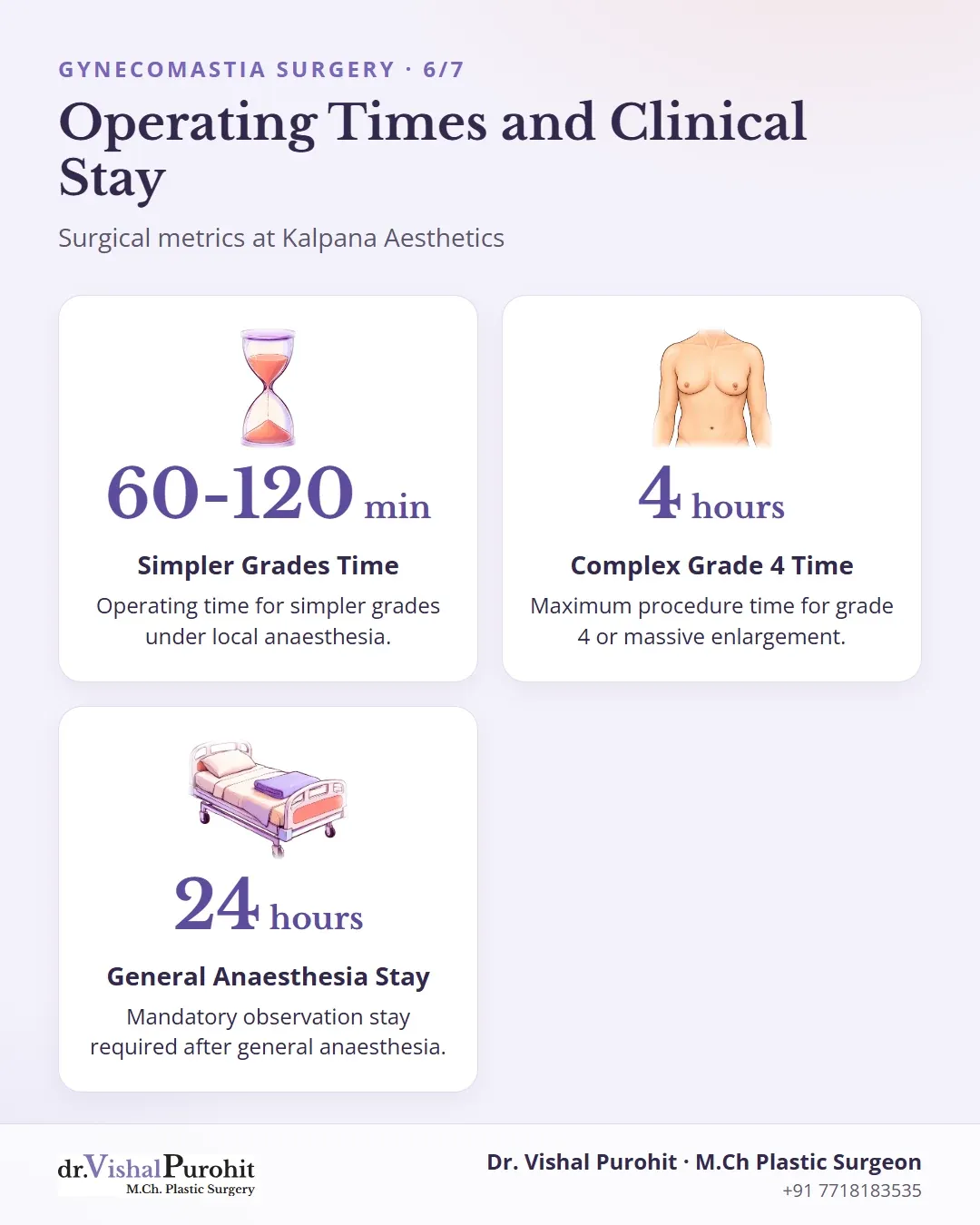
At Kalpana Aesthetics, Dr. Vishal Purohit performs gynecomastia surgery under either local anaesthesia (LA) or general anaesthesia (GA). Grades 1 to 3 are done under local anaesthesia; grade 4 needs a longer procedure and is done under general anaesthesia. In the literature, liposuction under general anaesthesia remains the most common approach, while one series of 60 men treated with liposuction and periareolar excision under tumescent local anaesthesia reported no case that needed conversion to general anaesthesia [11].
- Operating time: 60 to 120 minutes for simpler grades; up to about 4 hours for grade 4 or massive gynecomastia.
- Hospital stay: same-day discharge is possible under local anaesthesia (patients travelling from outside Jaipur may stay overnight); after general anaesthesia, a minimum 24-hour stay for observation is mandatory.
- Laboratory check: all excised tissue is always sent for histopathology.
High-Definition Contouring: Beyond “Just Flattening”
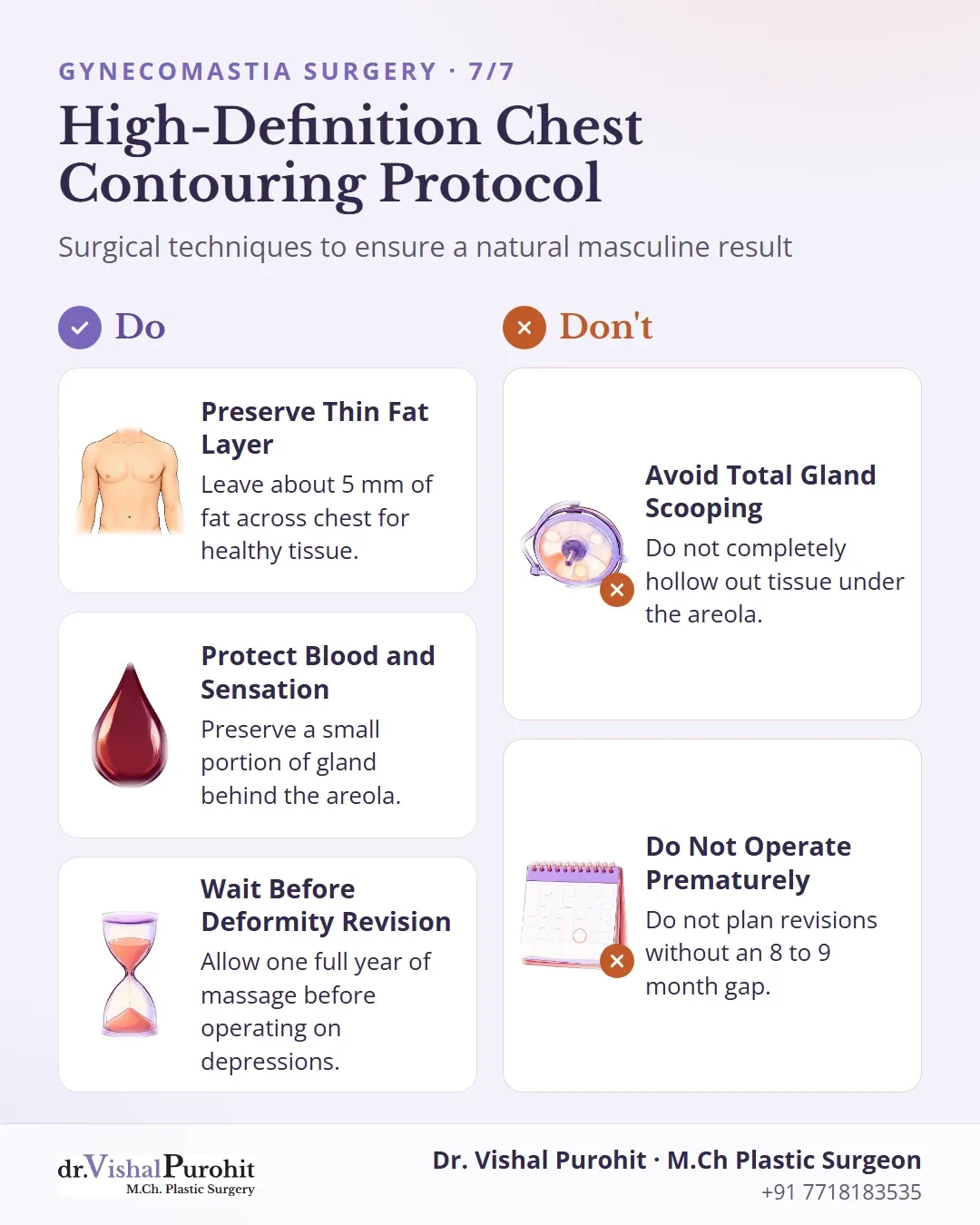
The goal isn’t just to make you flat; it’s to make the chest look natural and masculine.
That means not simply scooping out tissue. In one technique description, a layer of fat about 5 mm thick was left beneath the skin across the chest to keep a healthy layer of tissue [11], and surgeons deliberately leave some tissue under the areola to avoid a depression or saucer deformity [5]. Dr. Vishal Purohit prevents a crater (saucer) deformity through careful dissection. An established saucer deformity is not operated on for a year, because massage and skin remodelling over time correct it in most patients; a persistent deformity is treated with liposuction of the whole chest, and where the areola is stuck to the muscle underneath, subcision and fat grafting are options. Preserving a small portion of gland behind the areola also helps protect its blood supply and sensation [14]. Over-removal is exactly what produces the hollow look reported after excision alone [7].
Patient Satisfaction
Choosing the right technique for the individual chest matters more than any single device. Because the right choice depends on grade, gland-to-fat ratio and tissue distribution [7], a one-size-fits-all method is unlikely to suit everyone. The American Society of Plastic Surgeons suggests asking your surgeon what results are reasonable for you and what your options are if you are dissatisfied [15]. At Kalpana Aesthetics, if a patient is not satisfied, a revision or touch-up (such as liposuction) is planned with a gap of 8 to 9 months after the first surgery; no outcome or satisfaction percentages are quoted for the clinic.
Curious about the recovery time for these techniques? Check our Recovery Timeline Guide for Gynecomastia Surgery.
Ultimately, the complexity of the technique required, whether liposuction alone or liposuction with gland excision and skin reduction, is a key factor in determining the final cost of the procedure. At Kalpana Aesthetics, gynecomastia surgery costs ₹45,000 to ₹95,000, depending on grade and technique.
Expert Gynecomastia Surgery & Male Chest Contouring in Jaipur
Are you dealing with enlarged male breast tissue or stubborn chest fullness? Schedule a confidential clinical evaluation with Dr. Vishal Purohit, M.Ch. plastic surgeon in Jaipur, registered with the Rajasthan Medical Council (RMC Reg. 28041/14185).
- Comprehensive Master Guide: Review our complete clinical overview on What is Gynecomastia? Causes, Grades, and Treatment.
- Choosing your surgeon: Use our checklist for choosing a gynecomastia surgeon to ask the right questions about technique and aftercare.
- More answers: Browse the FAQs on types and techniques of gynecomastia surgery.
- Surgical Procedures & Pricing: Visit our dedicated Gynecomastia Surgery in Jaipur page to explore surgical techniques, recovery, before/after transformations, and book your appointment.
This is educational information, not medical advice.