Once you have decided that gynecomastia surgery is right for you, the most important decision left is who will do it. Gynecomastia correction is chest contouring: the gland and fat are removed, but the result also depends on symmetry, a smooth outline and a well-placed scar. That depends heavily on the surgeon and on how the operation is organised around you.
If you are planning to undergo gynecomastia surgery in Jaipur, understanding how surgical technique and individual assessment shape your contour will help you evaluate prospective specialists clearly.
This checklist explains what to verify, what to look at and what to ask before you book, whether you consult Dr. Vishal Purohit in Jaipur or any other surgeon. It does not rank clinics. It gives you the tools to judge them yourself.
Checklist at a Glance
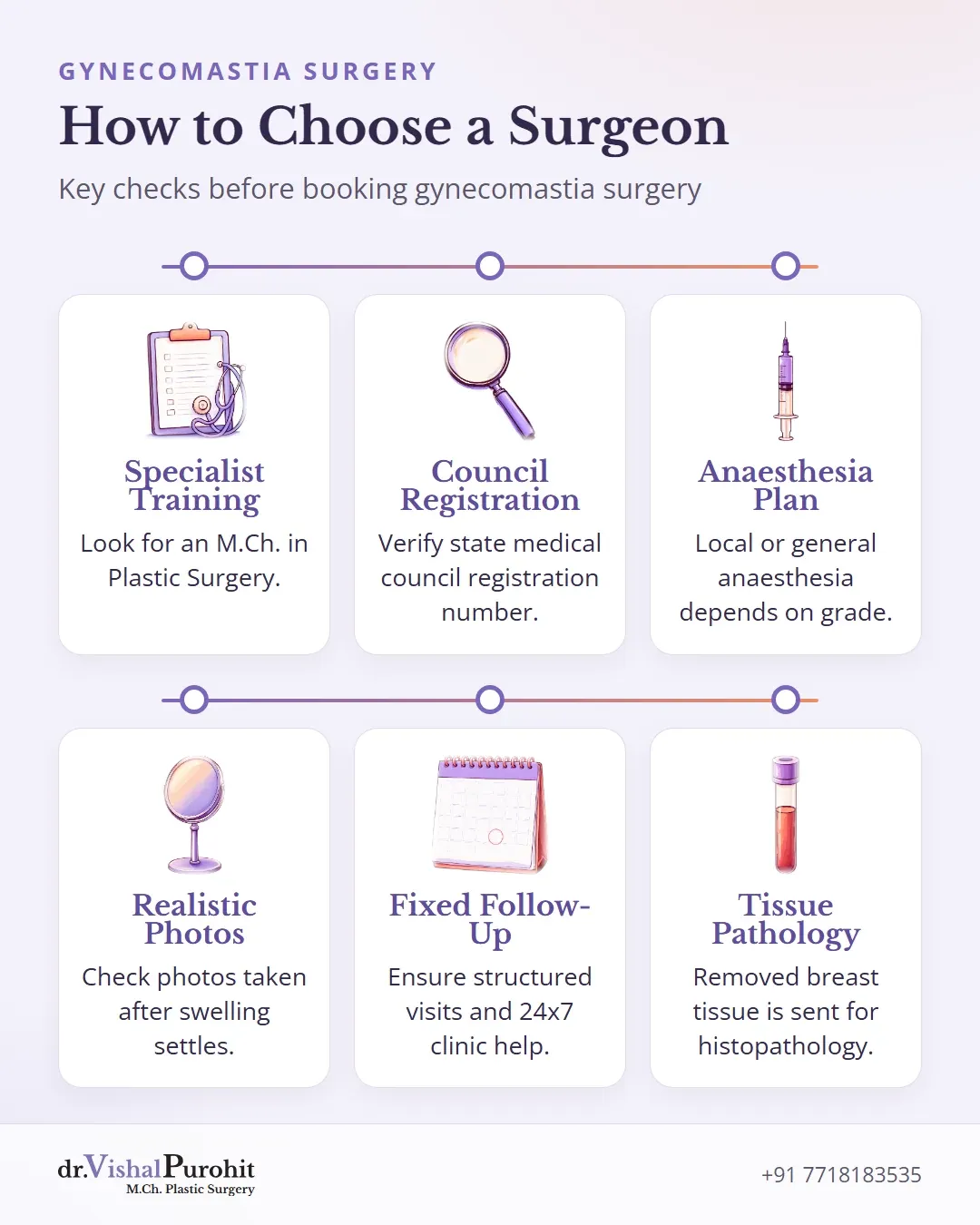
| What to check | Why it matters | What to ask or look for |
|---|---|---|
| Degree | Specialist training in plastic surgery: MBBS, then MS in General Surgery, followed by M.Ch. in Plastic Surgery (or DNB) | “Which plastic surgery degree do you hold, and from where?” |
| Registration | Legal permission to practise in India; patients can verify registration with the State Medical Council (Dr. Vishal Purohit is registered with the Rajasthan Medical Council, RMC Reg. 28041/14185) | The state medical council registration number |
| Experience and counselling | Technique and planning for your grade | “Which technique do you recommend for me, and why?” |
| Anaesthesia and facility | Safety on the day of surgery: grades 1 to 3 are done under local anaesthesia and grade 4 under general anaesthesia | Local or general anaesthesia, who monitors you, how long you stay |
| Before-and-after photos | Evidence of the surgeon’s own results | Similar chests, same angles, photos taken after swelling settles |
| Consent and follow-up | Help if something goes wrong | Written risks, fixed review visits, a contact number that works at night |
Verify Recognised Qualifications and Registration
You may have read advice, much of it written for American patients, telling you to choose a “board” surgeon. That is a United States system.
There, it means a doctor has completed a training programme accredited by the Accreditation Council for Graduate Medical Education (ACGME) in that specialty and then passed a certifying examination in it1. It is not how surgeons in India are qualified.
The confusion matters even in the United States. Few patients know that any physician with a medical degree is legally allowed to perform cosmetic surgery there.
In a survey of 474 medical students, 54.3% mistook a cosmetic surgeon’s website for that of a qualified plastic surgeon2. If medical students find this hard, patients can too. Titles on a signboard or a website are not proof of training.
In India, two checks replace that idea:
- The plastic surgery degree: Ask which specialist degree in plastic surgery the surgeon holds, such as the M.Ch. in Plastic Surgery, and from which institution.
- State medical council registration: Every doctor practising in India is registered with a state medical council. Ask for the registration number; a genuine surgeon will share it without hesitation.
The American Society of Plastic Surgeons suggests asking whether the surgeon was trained specifically in plastic surgery and how many years of plastic surgery training they have had3. These questions translate directly to the Indian setting.
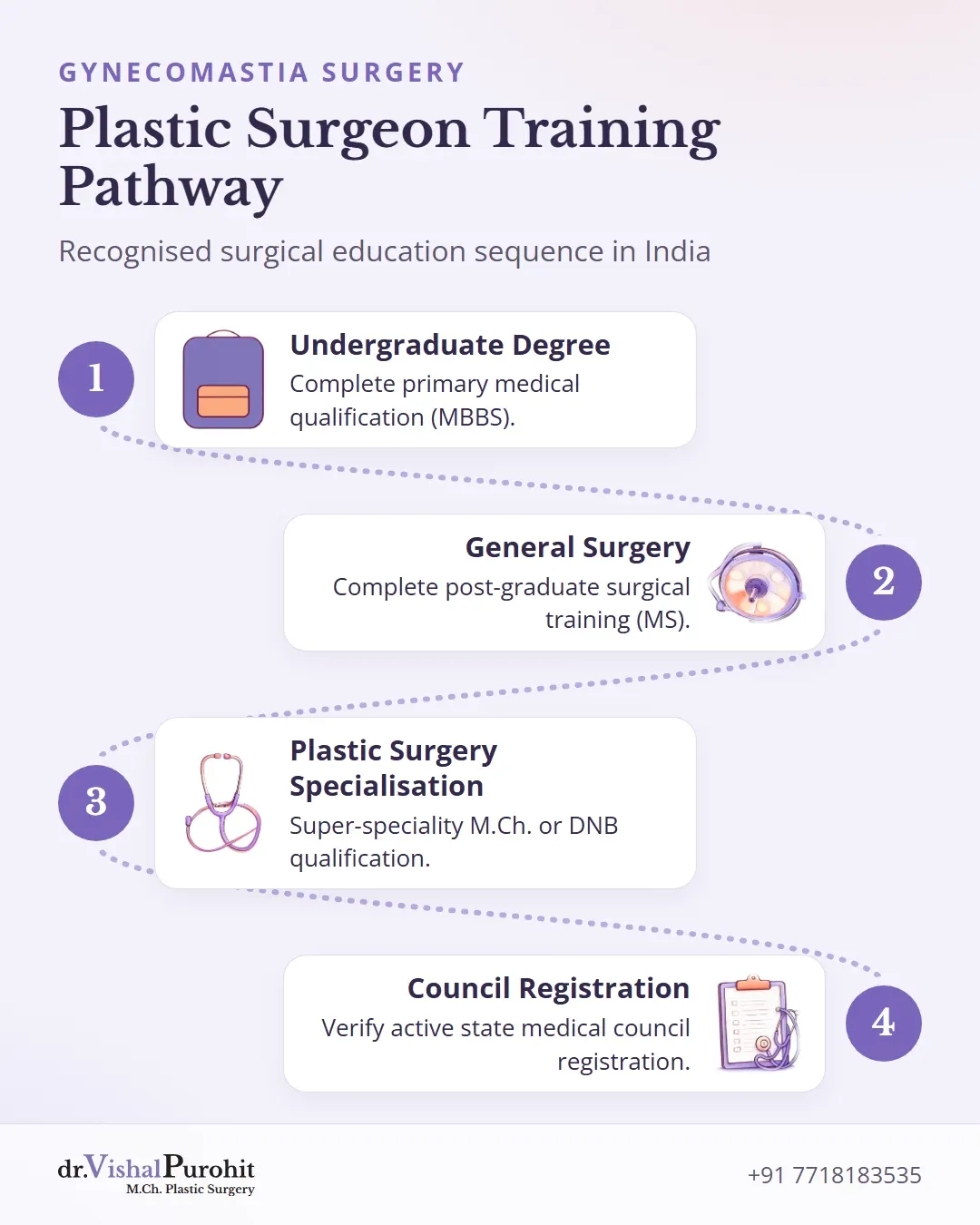
In India, the training pathway involves:
- Completing an MBBS
- Completing an MS in General Surgery
- Earning an M.Ch. in Plastic Surgery (or DNB)
Patients can check a doctor’s registration with the State Medical Council.
Dr. Purohit’s note: Dr. Vishal Purohit holds an M.Ch. in Plastic and Reconstructive Surgery and an MS in General Surgery, and is an alumnus of Sawai Man Singh (SMS) Medical College and Hospital, Jaipur. He is registered with the Rajasthan Medical Council (RMC Reg. 28041/14185) and directs Dr. Vishal Purohit’s practice in Jaipur.
Relevant Case Experience and Realistic Counselling
There is no magic number of operations that makes a surgeon “safe”. Rather than chasing a case count, judge whether the surgeon does this operation regularly and whether the plan you are offered is clearly reasoned for your chest.
Experience shows most in the finish. In liposuction, contour irregularity is the most common long-term complication, and it relates directly to surgeon experience4. A surgeon who operates often should explain how they avoid unevenness and a hollow under the nipple.
Good counselling at consultation should cover:
- Whether you are a good candidate and what will be expected of you to get a good result3.
- Which technique is recommended and why3. Dr. Vishal Purohit combines tumescent liposuction of the whole chest with excision of the firm gland through an inconspicuous hemi-periareolar incision along the lower areola border, tailoring these gynecomastia surgery techniques to each patient.
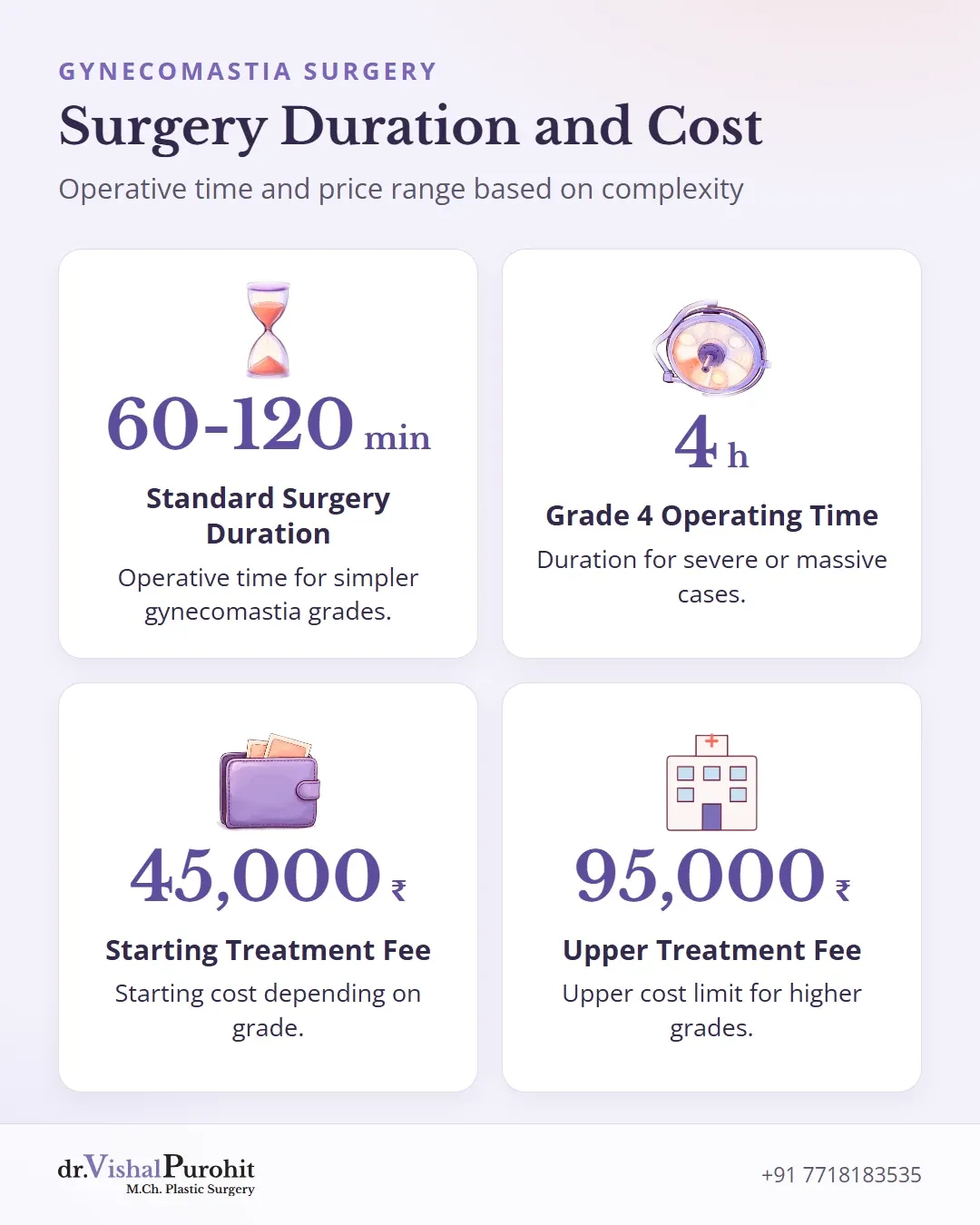
- How long the operation takes. In Dr. Purohit’s practice, it is 60 to 120 minutes for simpler grades and up to about 4 hours for grade 4 or massive gynecomastia.
- Honest limits. The decision is personal: you weigh whether the benefits meet your goals and whether the risks are acceptable to you5. A surgeon who promises perfection is not counselling you.
- Cost, explained. In Dr. Vishal Purohit’s Jaipur practice, the fee is ₹45,000 to ₹95,000, depending on the grade and technique, reflecting the overall cost of gynecomastia surgery in Jaipur based on case complexity.
Regular Experience
Judge whether the surgeon operates regularly and provides a clearly reasoned plan rather than chasing a case count.
Smooth Contour
A surgeon who operates often should explain how they avoid unevenness and hollows under the nipple.
Tissue Testing
All removed breast tissue is sent for histopathology as routine, without quoting clinic satisfaction percentages.
Dr. Purohit also sends all removed breast tissue for histopathology as routine, and does not quote outcome or satisfaction percentages for the clinic.
Facility and Anaesthesia Arrangements
Ask exactly where the operation will be done, what type of anaesthesia will be used and who will look after you afterwards. Anaesthesia carries its own risks, which should be discussed with you before you consent5.
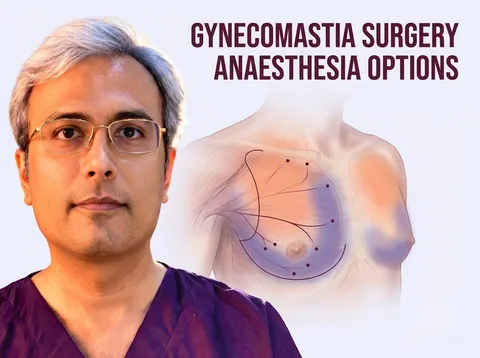
Local or general anaesthesia. Gynecomastia surgery can be done under either.
In one published series, 60 men treated between 2010 and 2023 had liposuction with periareolar gland excision under tumescent local anaesthesia, with no lidocaine or adrenaline toxicity and no case needing conversion to general anaesthesia6.
The authors add that candidates for it should meet ASA physical status I or II criteria, and that general anaesthesia remains the most commonly used approach6.
The facility. Reviews of body contouring safety stress that procedures done as day cases must take place in a facility that is appropriately equipped7.
Dr. Purohit’s protocol in Jaipur:
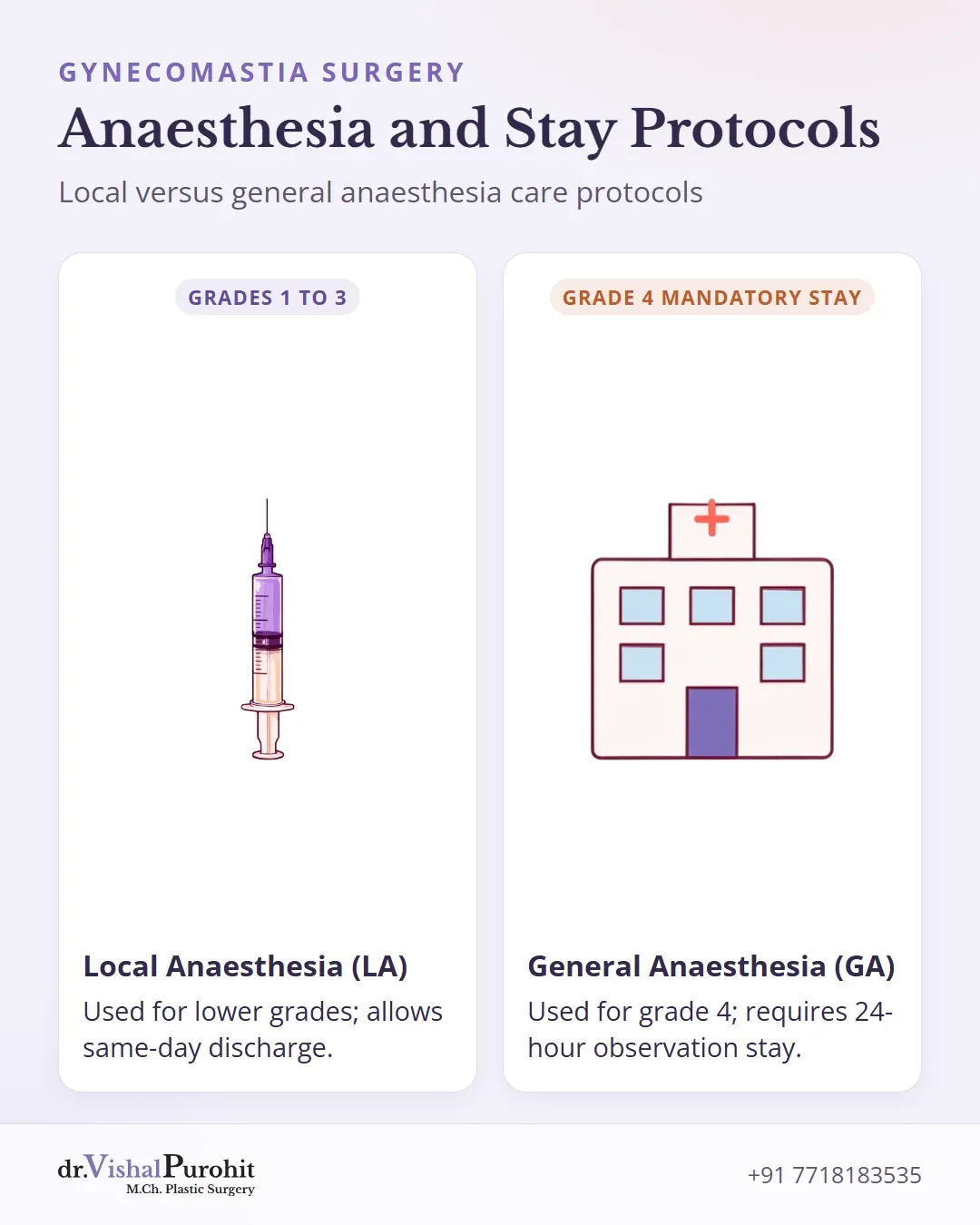
- Anaesthesia is either local anaesthesia (LA) or general anaesthesia (GA), chosen according to the grade.
- Under LA, same-day discharge is possible; patients travelling from outside Jaipur may stay overnight.
- Under GA, a minimum 24-hour hospital stay for observation is mandatory.
- Drains are placed only in grade 4; lower grades usually do not need them.
In Dr. Vishal Purohit’s Jaipur practice, an anaesthesiologist monitors the patient throughout gynecomastia surgery, whether it is done under local or general anaesthesia.
How to Assess Before-and-After Images
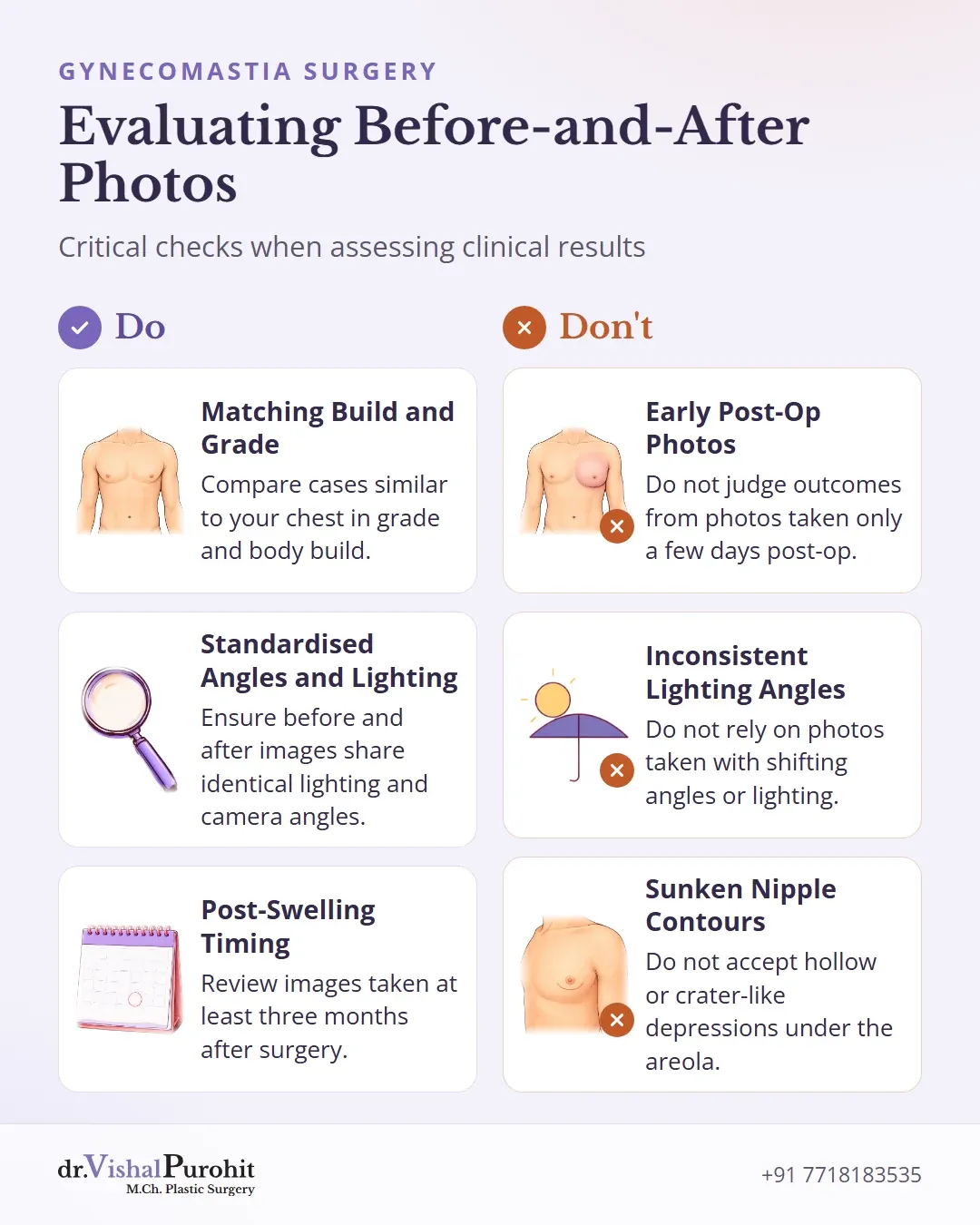
The American Society of Plastic Surgeons suggests asking to see before-and-after photos for this procedure and asking what results are reasonable for you3. Photos are useful only if you look at them critically.
Check how the photos were taken. In published studies, standardised photographs are taken under the same lighting and camera settings, and post-operative photos are taken at least 3 months after surgery so that swelling has settled8.
Photos taken from different angles, distances or lighting, or only a few days after surgery, can flatter a result.
Judge the same features surgeons judge. In a study of combined liposuction and gland excision, results were assessed at 6 months for breast symmetry, the shape of the nipple and areola, projection of the nipple-areola complex, contour regularity and overall appearance9.
In that technique, enough tissue was deliberately left under the areola to keep its contour and avoid a depression9.
Look for:
- Chests similar to yours in grade and build
- Both sides matching, from the front and from the side
- A natural nipple position, without a sunken or crater-like look
- A smooth outline into the armpit and the side of the chest
- How visible the scar is at the areola border
Photos should be of the surgeon’s own patients, shown with consent. If you are only shown a few photos, ask why.
Consent, Follow-Up and Handling Complications
Before surgery you will be asked to sign consent forms confirming that you understand the procedure, its risks and possible complications5. Read them, and ask about anything that is not clear.
Key points
- Understand the risks and ask questions before signing surgical consent forms.
- Complication rates are low, and contour irregularities are managed conservatively before considering revision.
- Follow-up involves structured visits, compression vest wear, and clear revision timelines.
Risks to discuss. The American Society of Plastic Surgeons lists several potential issues5:
- Bleeding (hematoma) or fluid collection (seroma)
- Infection
- Asymmetry, contour and shape irregularities
- Temporary or permanent changes in nipple or breast sensation
- Poor wound healing and the possibility of revision surgery
Understanding gynecomastia surgery safety and risks helps you prepare thoroughly for these discussions beforehand.
How often problems need further treatment. In one series of more than 200 men, two (1.0%) developed a small hematoma that was drained in the clinic, and two (1.0%) needed further suction for undercorrection10.
Contour irregularities after liposuction are usually treated conservatively for at least 6 months before further liposuction, fat grafting or skin excision is considered4.
Questions about complications. Ask how complications are handled and what your options are if you are not happy with the outcome3. A surgeon should answer these as clearly as they answer questions about results.
Dr. Purohit’s follow-up and revision protocol:
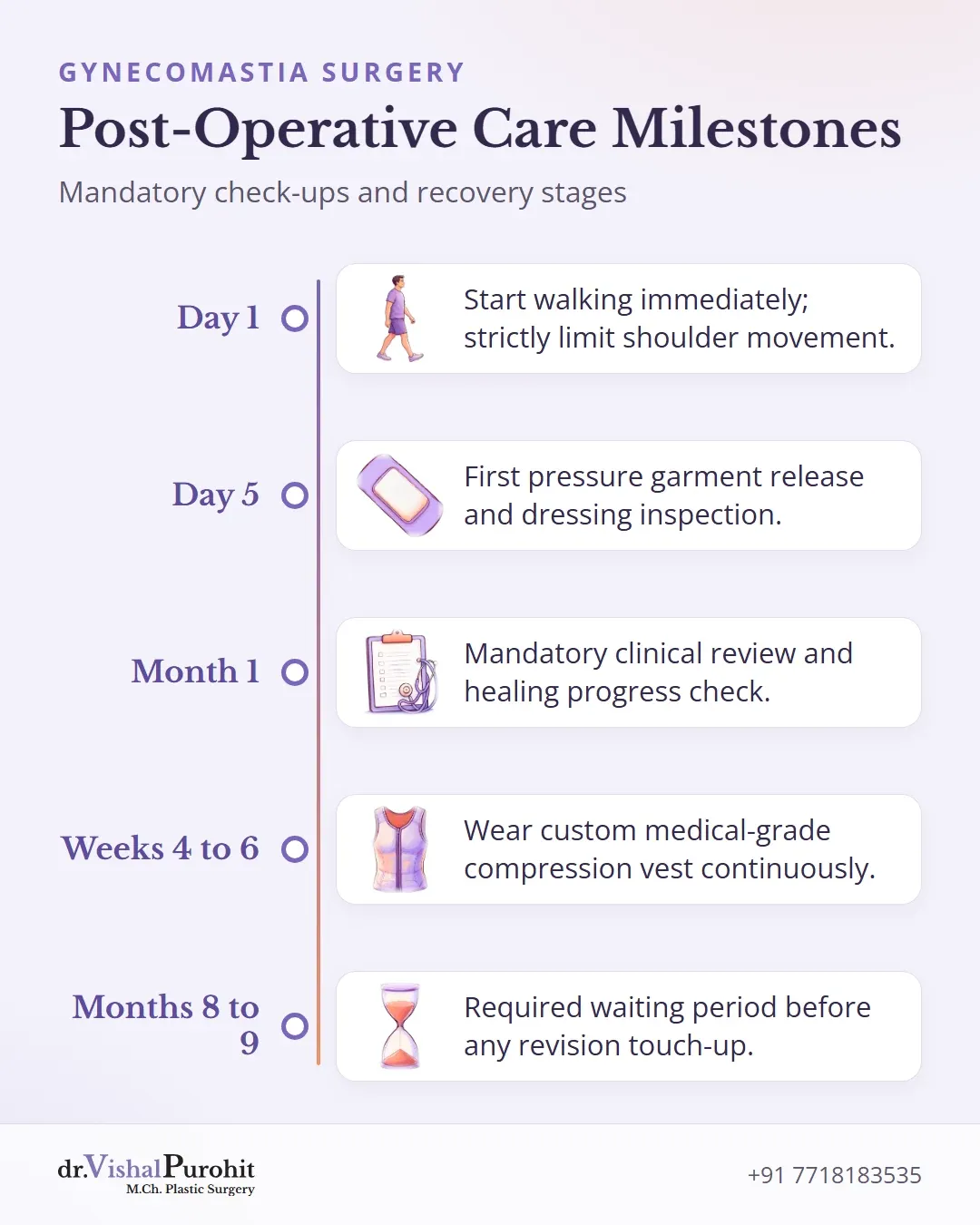
- A mandatory visit on day 5 for the first pressure-garment release and dressing removal or change if required.
- A mandatory visit at 1 month.
- 24x7 help is always available after surgery.
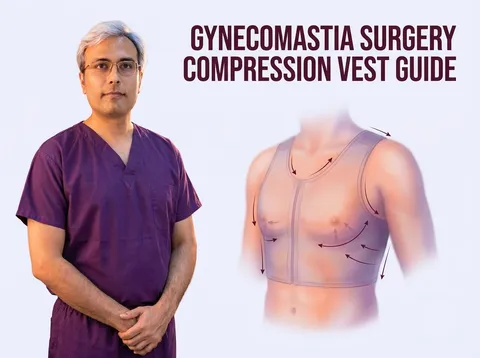
- A custom medical-grade compression vest is worn 24/7 for 4 to 6 weeks.
- Bed rest is never advised; patients walk and move from the start, with strict shoulder restriction for the first 5 to 7 days.
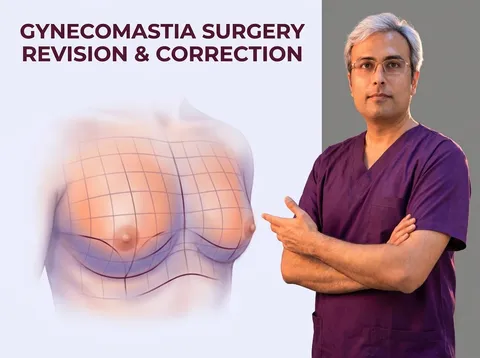
- If a patient is not satisfied, a revision or touch-up (such as liposuction) is planned with a gap of 8 to 9 months after the first surgery.
Consultation Questions to Take With You
Print or save this list and take it to every consultation. Several questions follow the checklist published by the American Society of Plastic Surgeons, adapted for India3.
In India, the qualification pathway comprises an MBBS, followed by an MS in General Surgery, and then an M.Ch. in Plastic Surgery (or DNB). Patients can verify a doctor’s registration with the State Medical Council; Dr. Vishal Purohit is registered with the Rajasthan Medical Council (RMC Reg. 28041/14185).
Qualifications
- Which plastic surgery degree do you hold, and from which institution?
- What is your state medical council registration number?
Plan and experience 3. Am I a good candidate, and what grade is my gynecomastia? 4. Which technique do you recommend for me, liposuction, gland excision or both, and why? 5. How often do you perform gynecomastia surgery? 6. Will the removed tissue be sent for histopathology?
The day of surgery 7. Will I have local or general anaesthesia, and who will monitor me? 8. Where will the operation be done, and how long will I stay? 9. Will I need drains?
Results 10. Can I see before-and-after photos of your own patients with a chest like mine? 11. What result is realistic for me, and how visible will the scar be?
After surgery 12. When are my follow-up visits, and whom do I call at night? 13. How are complications handled, and what happens if I am not satisfied? 14. What does the quoted fee include?
Carefully choosing a gynecomastia surgeon and clinic helps address further practical concerns before scheduling your procedure.
Choosing With Confidence in Jaipur
A careful choice does not need insider knowledge. In India, qualification follows MBBS, then MS in General Surgery, followed by M.Ch. in Plastic Surgery (or DNB). Patients can verify a doctor’s registration with the State Medical Council; Dr. Vishal Purohit is registered with the Rajasthan Medical Council (RMC Reg. 28041/14185).
Admission and anaesthesia depend on your case:
- Grades 1 to 3 involve same-day discharge.
- Grade 4 under general anaesthesia requires a mandatory 24-hour observation stay.
Look at honest photos, and make sure follow-up and complication care are written into the plan. A surgeon who welcomes these questions is usually one you can trust with your care.
Dr. Vishal Purohit, M.Ch plastic surgeon in Jaipur, discusses techniques, recovery, and appointments during a consultation for gynecomastia surgery in Jaipur.
This is educational information, not medical advice.