In short
- Gynecomastia treatment depends on the cause, how long the enlargement has been present, how severe it is and whether it hurts.
- Pubertal and recent-onset gynecomastia often settles with observation; a medicine or illness causing it should be dealt with first.
- Dr. Vishal Purohit does not prescribe medicines for gynecomastia: pubertal gynecomastia does not need medication, and once the gland is removed surgically it cannot grow back.
- Surgery may be considered when true gland tissue persists. Dr. Vishal Purohit in Jaipur combines liposuction with gland excision, under local or general anaesthesia.
Men who notice breast enlargement usually ask one question first: do I need surgery? The honest answer is that gynecomastia treatment is a pathway, not a single choice. The right step depends on what is causing the enlargement, how long it has been there, how large it is and how much it troubles you1. This guide from Dr. Vishal Purohit, M.Ch. plastic surgeon in Jaipur, walks through each option so you can see which one may fit your situation. If you are not yet sure what gynecomastia is or how it is graded, start with our guide to gynecomastia causes, symptoms and grades.
While conservative management helps in early stages, men with persistent glandular tissue often consider gynecomastia surgery in Jaipur to restore a flat, natural chest contour.
Key figures at a glance
| Item | What applies |
|---|---|
| Pubertal gynecomastia | Usually settles within 6 months to 2 years of onset2 |
| When to look further | Enlargement lasting more than 2 years, or past age 172 |
| Medicines | Most useful in the early, active phase, before fibrosis34 |
| Surgery in Jaipur | Tumescent liposuction plus gland excision |
| Anaesthesia | Local or general anaesthesia |
| Operative time | 60-120 minutes for simpler grades; up to about 4 hours for grade 4 |
| Compression vest | Custom medical-grade vest, worn 24/7 for 4-6 weeks |
| Cost in Jaipur | ₹45,000 to ₹95,000, depending on grade and technique |
Option 1: Observation and treating an underlying cause
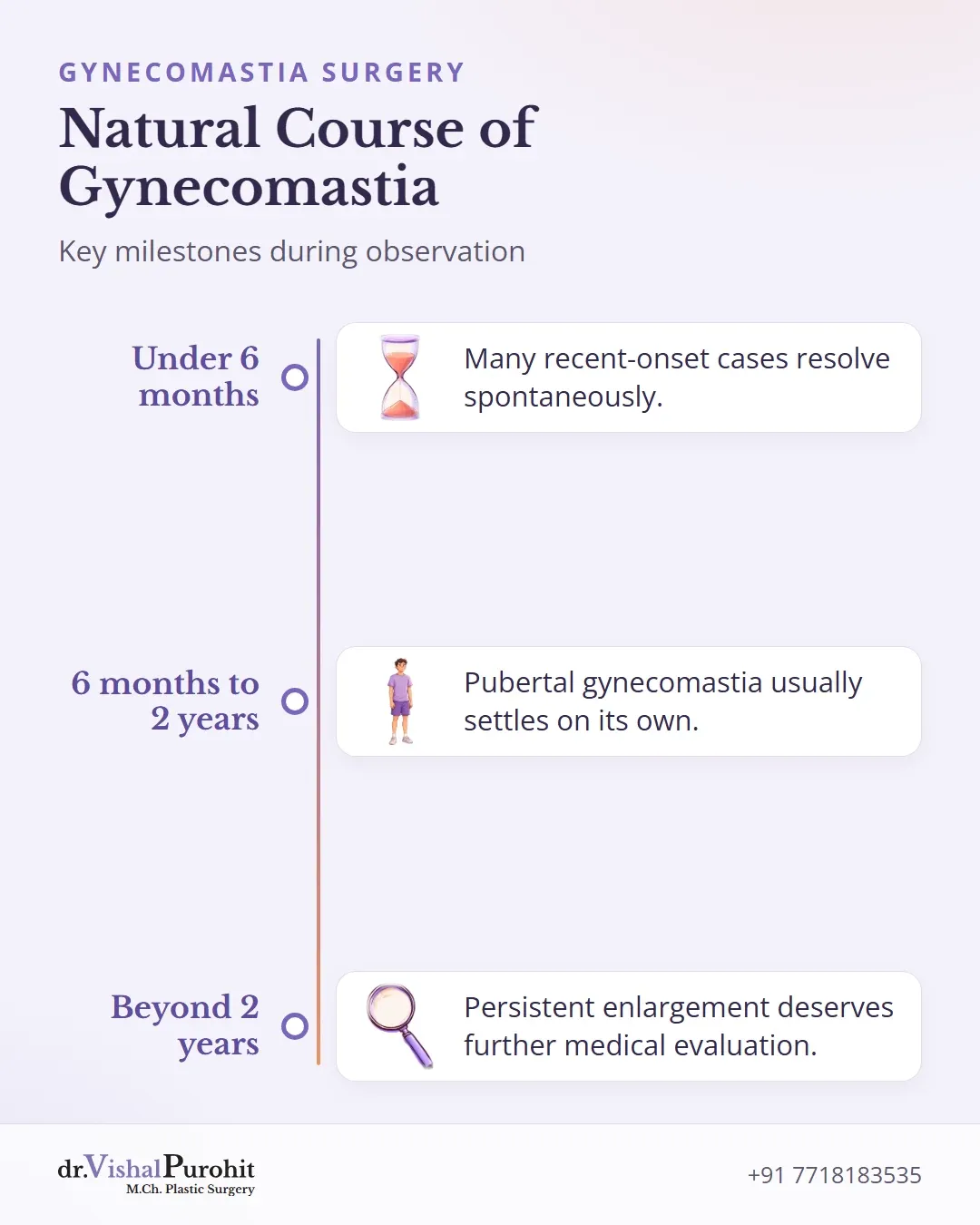
For many men and boys, the first treatment is no treatment at all, but careful watching. Pubertal gynecomastia is common and usually temporary. American Family Physician notes that it should resolve within six months to two years after it starts2; patient guides give a range of about 6 months to 3 years56.
For pubertal enlargement, reassurance and observation are usually enough7. In adults, a US insurer policy summarising the medical literature lists observation as part of initial management, because many cases of recent onset (under 6 months) resolve spontaneously1.
Dr. Purohit’s note: In Dr. Vishal Purohit’s practice, diagnosis begins with clinical examination and direct palpation, followed by ultrasound or MRI when imaging is needed, while hormone blood tests are reserved only for cases with other symptoms of hormonal imbalance.
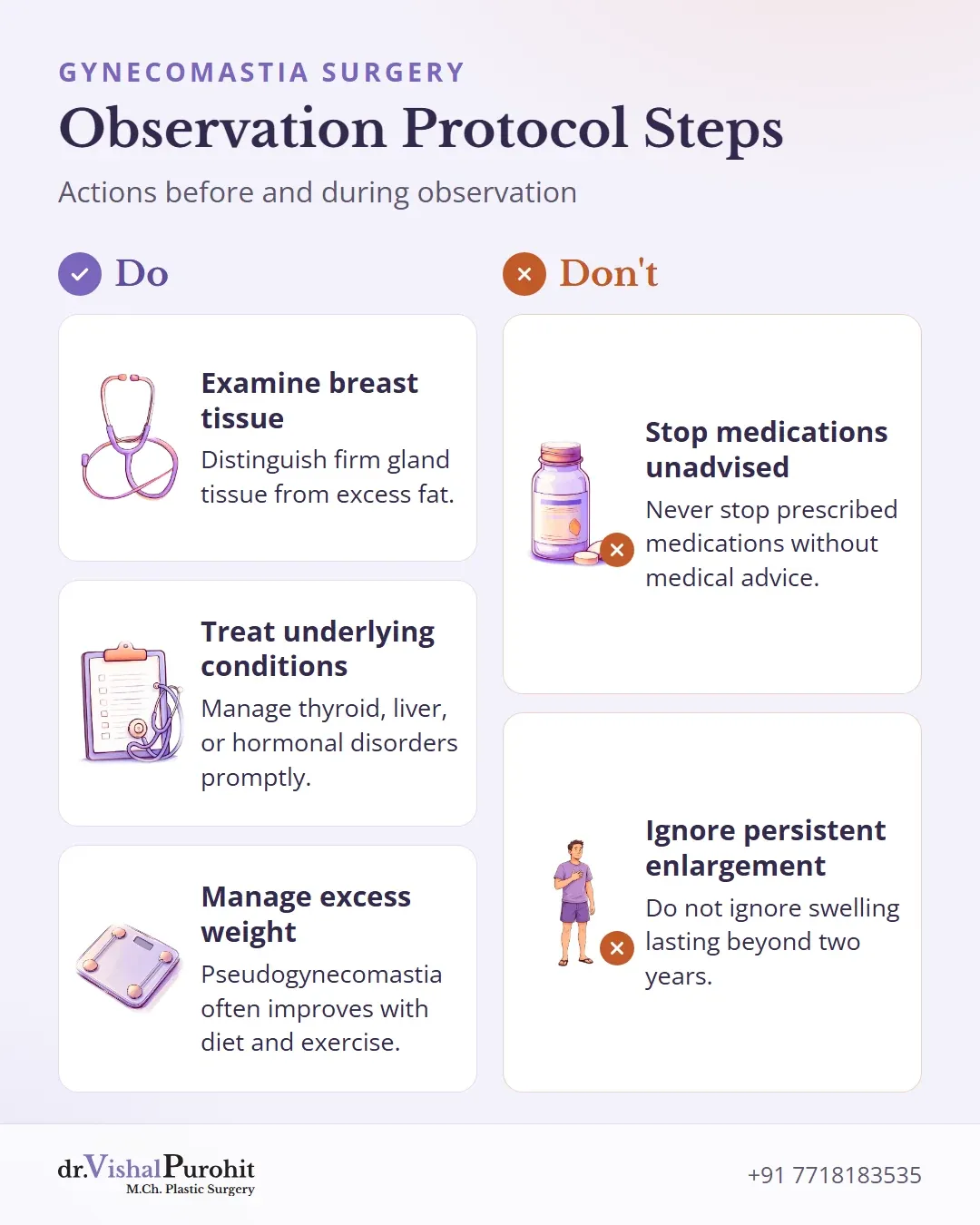
Observation is not the same as ignoring the problem. The same sources describe a short list of steps that come first18:
- A breast examination to tell true gynecomastia (gland tissue) apart from pseudogynecomastia (fat only).
- Stopping or changing a medicine or substance that may be causing the enlargement. This should always be done with your doctor; patients are advised not to stop any prescribed medicine on their own5.
- Treating an underlying illness, such as a hormonal or thyroid disorder, liver or kidney disease. If the cause is treated, the enlargement may settle; if it is not addressed, the condition can come back even after treatment6. Dr. Purohit refers patients to an endocrinologist only when gynecomastia develops suddenly, well after puberty is complete, or when other symptoms of hormonal imbalance are present.
- Weight management when the enlargement is mainly fat. Obesity-related pseudogynecomastia often improves with diet and exercise7.
Initial Observation
For many men and boys, the first treatment is careful watching, as pubertal enlargement is common and usually temporary.
Underlying Causes
Addressing contributing medications or treating underlying illnesses can allow the enlargement to settle naturally.
Persistent Cases
Enlargement that persists beyond two years, or past age 17, is less likely to resolve on its own and warrants further evaluation.
Enlargement that persists beyond two years, or past the age of 17, is less likely to go away without surgery and deserves further evaluation21.
Option 2: Medical assessment and selected non-surgical treatment
Before any treatment is chosen, a medical assessment looks for a cause. A US insurer policy recommends hormone testing (such as thyroid-stimulating hormone, estradiol, prolactin, testosterone and luteinizing hormone) to find reversible causes3. American Family Physician advises suspecting primary hypogonadism in any adolescent whose pubertal gynecomastia persists2.
Key points
- Medical assessment focuses on identifying reversible causes or hormone imbalances before deciding on treatment.
- Medications have limited effectiveness and are only useful during the early proliferative phase before fibrous tissue forms.
Dr. Vishal Purohit refers patients to an endocrinologist, a hormone specialist, only when gynecomastia develops suddenly, well after puberty is complete, or when there are other symptoms of hormonal imbalance5. The clinical workup, including blood tests and scans, follows the standard process for how gynecomastia is diagnosed.
Medicines are a limited option, and this is a summary only:
- Who they are for. Medicines are generally reserved for persistent, symptomatic true gynecomastia after puberty, or for specific underlying conditions7. For pubertal gynecomastia in adolescents, drug treatment is not routinely recommended, and the US Food and Drug Administration has not approved any drug for this use1.
- Which medicines. The drugs most often used are the selective estrogen receptor modulators tamoxifen and raloxifene4. Aromatase inhibitors such as anastrozole are also described7, although a randomised trial in 80 pubertal boys found anastrozole no more effective than placebo4.
- When they work. Medicines can help during the early, active (proliferative) phase, before the gland becomes fibrous34. Long-standing gynecomastia is marked by fibrosis and responds poorly to conservative treatment3.
- How strong the evidence is. Two small placebo-controlled crossover trials of tamoxifen found only modest benefit2.
Pubertal gynecomastia does not need medication, and once the gland is removed surgically it cannot grow back. Patient outcomes and study results depend heavily on when medical treatment is effective during the proliferative stage.
Option 3: When surgery may be considered

Surgery is usually considered when true gynecomastia persists after any cause has been treated or excluded, after a sensible period of observation, and when the enlargement causes pain, tenderness or distress13.
Key points
- Surgery is considered when persistent gynecomastia causes pain, tenderness, or distress after underlying causes are addressed.
- Correction typically addresses glandular tissue, excess fat, and loose skin using combined liposuction and excision techniques.
- Surgical approach, anesthesia type, operative time, and hospital stay depend on the grade and severity of gynecomastia.
American Family Physician notes that if no cause is found and the patient wants treatment, referral for surgery to improve the chest contour is one of the reasonable options2. In teenagers, Dr. Vishal Purohit operates at least 2 years after puberty is complete; in boys who are still early in puberty, surgery is rarely indicated7.
Before surgery, a medical evaluation should be completed, offending drugs withdrawn and any underlying disease corrected; any suspicion of a breast tumour must be dealt with before definitive treatment8.
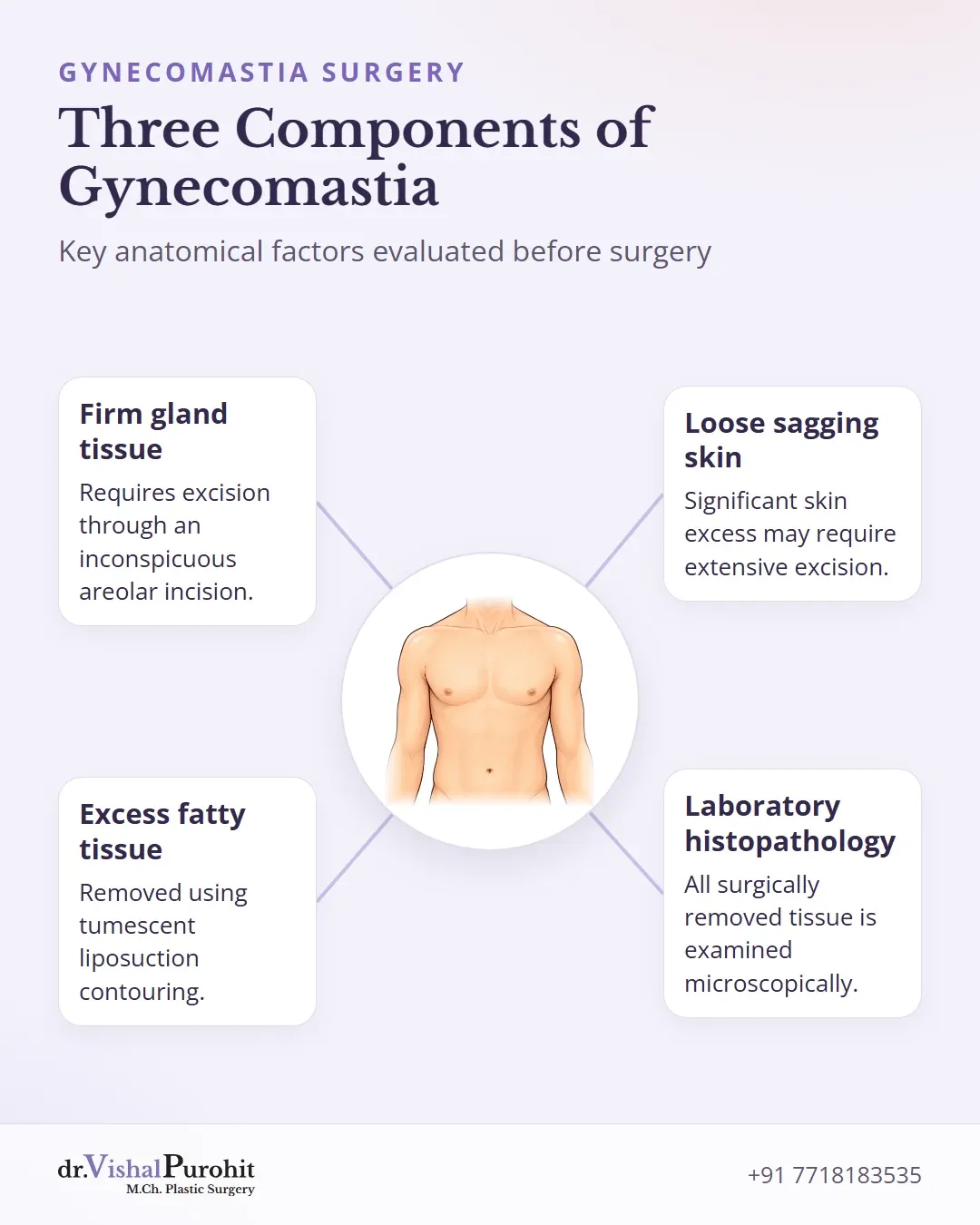
Gynecomastia involves three components that may need correcting, and leaving one of them untreated tends to give a less satisfactory chest shape9:
- Glandular tissue
- Excess fat
- Loose skin
Contemporary surgery usually starts with liposuction to remove excess fat, with other methods used for the remaining gland tissue and, when present, excess skin8. Patients can review how liposuction alone compares to skin-reducing and other gynecomastia surgery techniques when deciding on an operative plan.
The clinic’s approach. Dr. Vishal Purohit uses a combined approach: tumescent liposuction to contour the chest, together with excision of the firm gland through an inconspicuous hemi-periareolar incision along the lower half of the areola border. Published series describe good aesthetic outcomes with combined liposuction and gland excision through a small areolar incision in grade I and II gynecomastia10.
Key procedural details vary according to severity:
- Surgery is performed under local anaesthesia (LA) for grades 1 to 3, while grade 4 requires general anaesthesia (GA).
- Simpler grades take about 60 to 120 minutes, and grade 4 or massive gynecomastia can take up to about 4 hours.
- Same-day discharge is possible under LA, while a minimum 24-hour stay for observation is mandatory after GA.
- All removed tissue is always sent for histopathology.
Understanding these steps helps address gynecomastia surgery basics regarding operative timing, anaesthesia, and what to expect during initial recovery.
Factors in candidacy, stability and expectations
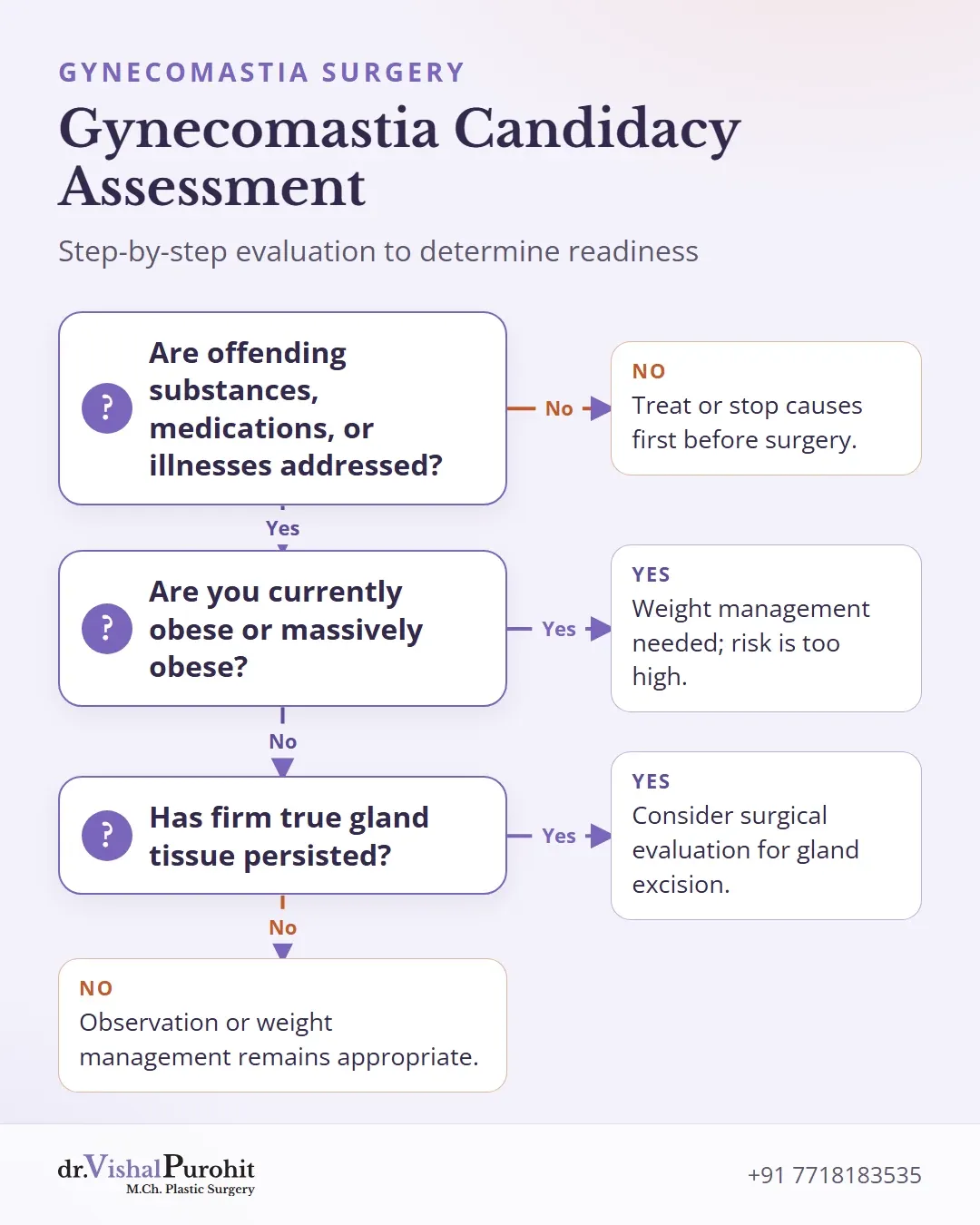
Not every man with breast enlargement needs, or will benefit from, the same treatment. These are the factors that usually shape the decision:
- Gland or fat. Examination separates true gynecomastia from pseudogynecomastia1. Fat responds to weight management7; firm gland tissue does not melt away with diet.
- Duration. Recent-onset and pubertal enlargement may still settle21. Long-standing tissue becomes fibrous and is less likely to respond to medicines3.
- A treated or excluded cause. Drugs, substances and medical conditions should be dealt with first, otherwise the enlargement can come back68.
- Severity and skin. A select group of patients with significant excess skin and sagging may need a more extensive operation, with longer scars8.
- Stability. In Dr. Vishal Purohit’s practice, target BMI is within the normal range. Slightly overweight men may also benefit from surgery without waiting. Obese and massively obese men are not operated on because the risk is too high and skin may sag after later weight loss, needing further correction. Steroid and prohormone users must stop for a minimum of 6 weeks before surgery; 3 months is preferable.
- Expectations. Surgery can improve chest shape, but results cannot be promised, and sometimes optimal results are not possible with a single procedure11. All such operations leave scars, which fade over time but do not disappear completely12. Risks include bleeding, unequal size or shape, bruising, infection and changes in nipple-area sensation12.
Dr. Vishal Purohit plans a revision or touch-up (such as liposuction) if a patient is not satisfied, with a gap of 8 to 9 months after the first surgery. No outcome or satisfaction percentages are quoted for the clinic.
Questions to ask before deciding
A good consultation should leave you clear about your own pathway. The American Society of Plastic Surgeons suggests patients ask, among other things, how complications are handled, what the options are if they are dissatisfied, and what results are reasonable for them11.
Useful questions include:
- Is my enlargement gland, fat or a mix of both?
- Has a cause been looked for, and do I need hormone tests or imaging first? (In Dr. Vishal Purohit’s practice, clinical examination and direct palpation come first, followed by ultrasound or MRI when imaging is needed; hormone blood tests are ordered only when there are other symptoms of hormonal imbalance.)
- Is observation still reasonable in my case, or has the tissue been present too long to settle?
- Would medicines help me, given how long I have had the enlargement? (Pubertal gynecomastia does not need medication and once the gland is surgically removed it cannot grow back.)
- If surgery is advised, which technique, which anaesthesia (local or general) and how long a hospital stay? (In Dr. Vishal Purohit’s Jaipur practice, same-day discharge is possible for grades 1 to 3, while grade 4 requires a mandatory 24-hour observation stay.)
- Will the removed tissue be examined in a laboratory? (At Dr. Vishal Purohit’s practice it always is.)
- What does recovery involve, and what follow-up is planned? In Dr. Vishal Purohit’s Jaipur practice, follow-up visits on day 5 and at 1 month are mandatory, and help is available 24x7.
- What does the full treatment cost, including the overall cost of gynecomastia surgery in Jaipur?
Credentials matter too. Dr. Vishal Purohit is an M.Ch. plastic surgeon registered with the Rajasthan Medical Council (RMC Reg. 28041/14185).
Expert Gynecomastia Surgery & Male Chest Contouring in Jaipur
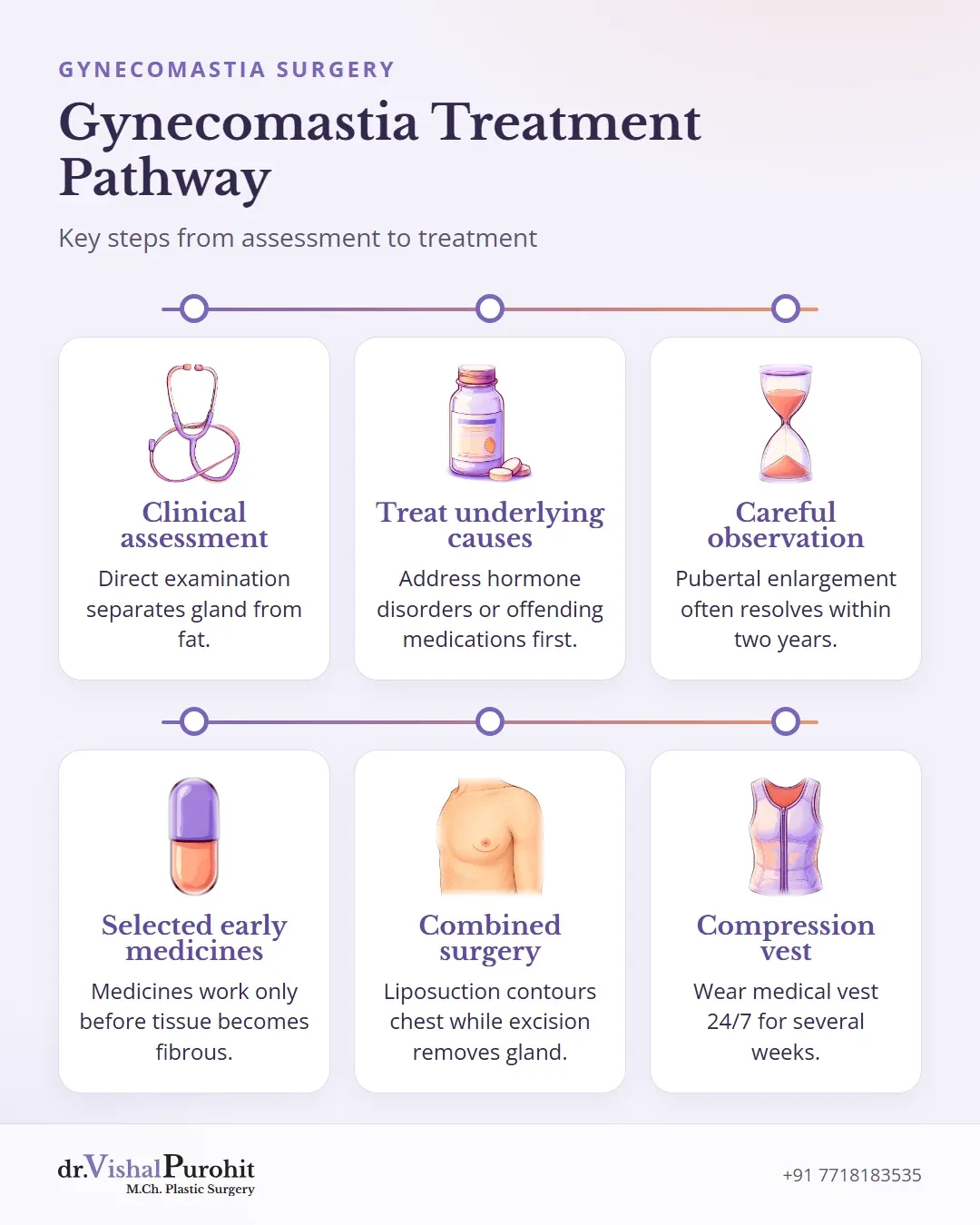
Gynecomastia treatment follows a series of sensible, structured steps to ensure the right approach for each patient:
- Assessment clinical evaluation of breast tissue
- Treating causes addressing underlying medical triggers
- Observation monitoring cases that may settle
- Medication considered in selected early cases
- Surgery excision when true gland persists
In Jaipur, Dr. Vishal Purohit begins with an examination to separate gland from fat and to look for a cause, and discusses surgery only when it fits the picture.
If you would like a personal assessment, details of the procedure and consultation are on the gynecomastia surgery in Jaipur page.
This is educational information, not medical advice.