Few things worry a patient more than looking in the mirror after gynecomastia surgery and feeling the result is not what was hoped for. Before anything else, healing needs time: swelling settles over the first weeks and the contour becomes stable.
This post explains why early judgement misleads, the common concerns that lead to a revision, how a revision is assessed and timed, and the limits of repeat surgery. It also looks at why true regrowth does not happen, covered in Can Male Breasts Grow Back After Gynecomastia Surgery in Jaipur?.
Give Healing Time Before Judging the Result
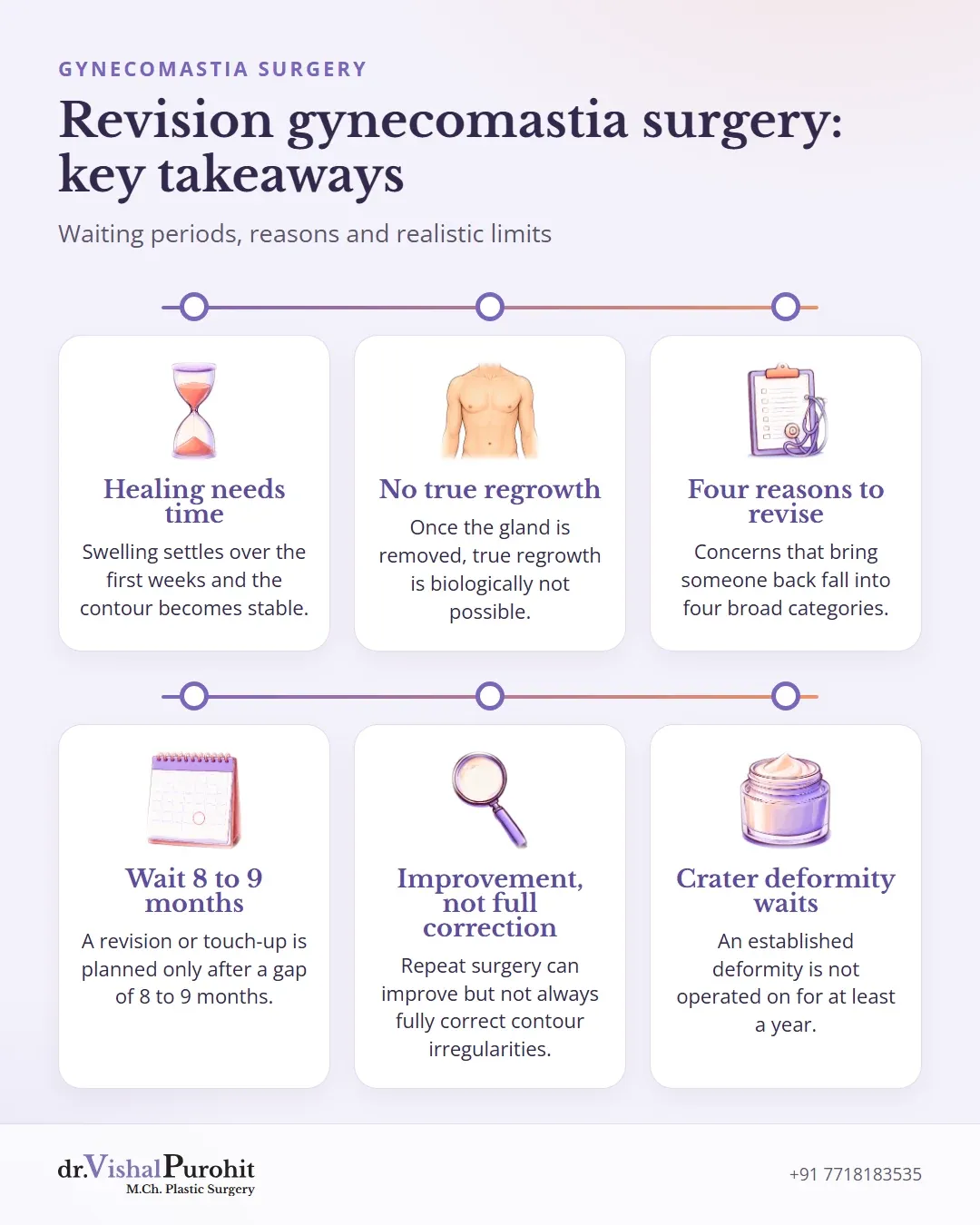
The chest after gynecomastia surgery does not show its final shape on the operating table or even in the first week. Tissue needs time to settle, and judging the result too early leads to unnecessary worry.
Swelling disappears completely by 2 to 3 months.
Why the Chest Looks and Feels Different Early On
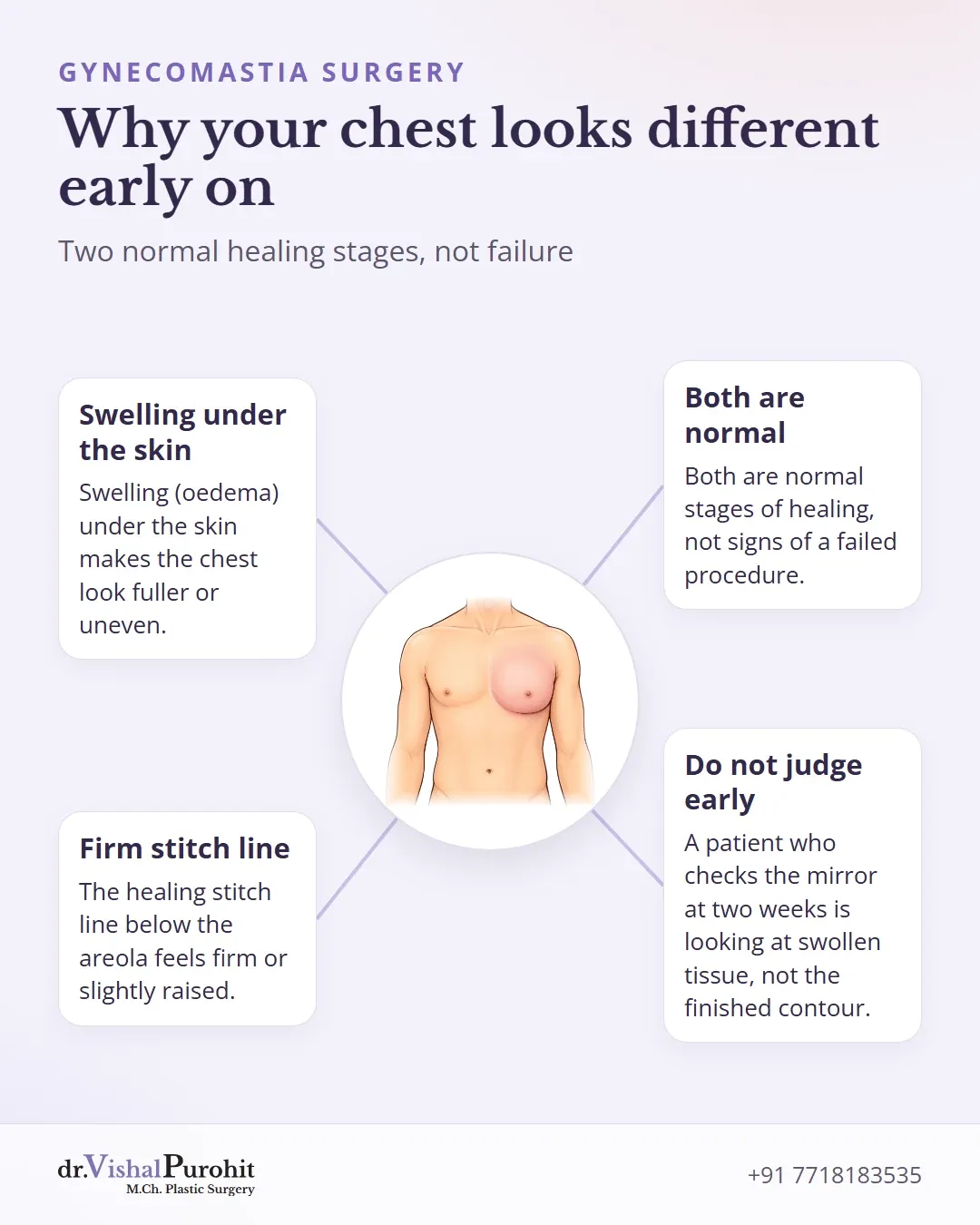
Two things create the misleading early appearance:
- Swelling (oedema) under the skin makes the chest look fuller or uneven. This lumpiness resolves in about 2 months.
- The healing stitch line below the areola feels firm or slightly raised. This firmness softens over 2 to 4 months.
Both are normal stages of healing, not signs of a failed procedure.
Why Early Judgement Misleads
A patient who checks the mirror at two weeks is looking at swollen tissue, not the finished contour. What appears to be a residual bulge or asymmetry at this stage may simply be fluid and healing tissue that has not yet settled. Forming a firm opinion before the 2- to 3-month mark means judging work that is still in progress.
Dr. Purohit’s note: Dr. Purohit tells patients that a near-final chest contour can be seen as early as 1 month after surgery, and the mandatory 1-month visit is the earliest useful point to discuss how the result is developing.
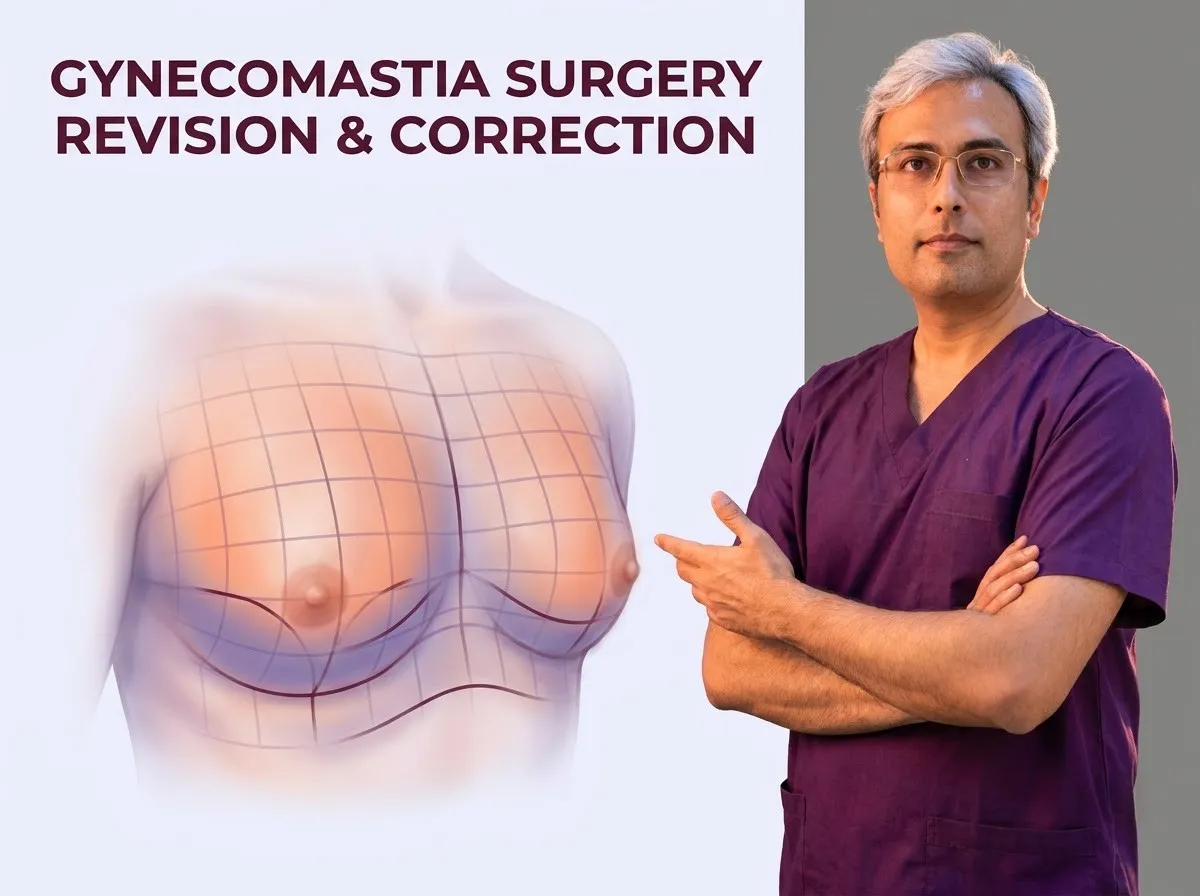
Common Reasons for a Revision
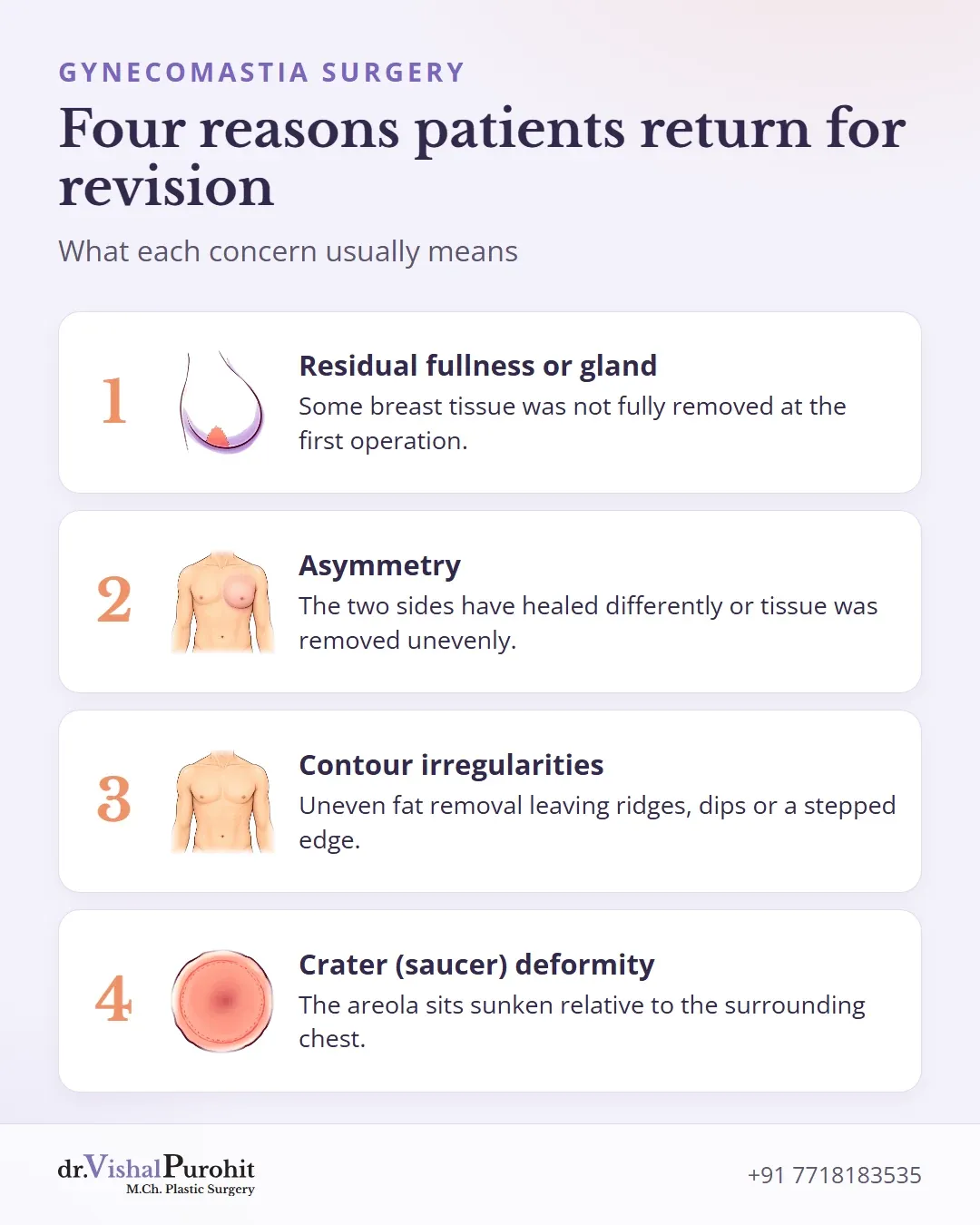
When a patient is unhappy after gynecomastia surgery, understanding what went wrong is the first step. The concerns that most often bring someone back for a revision fall into four broad categories.
Key points
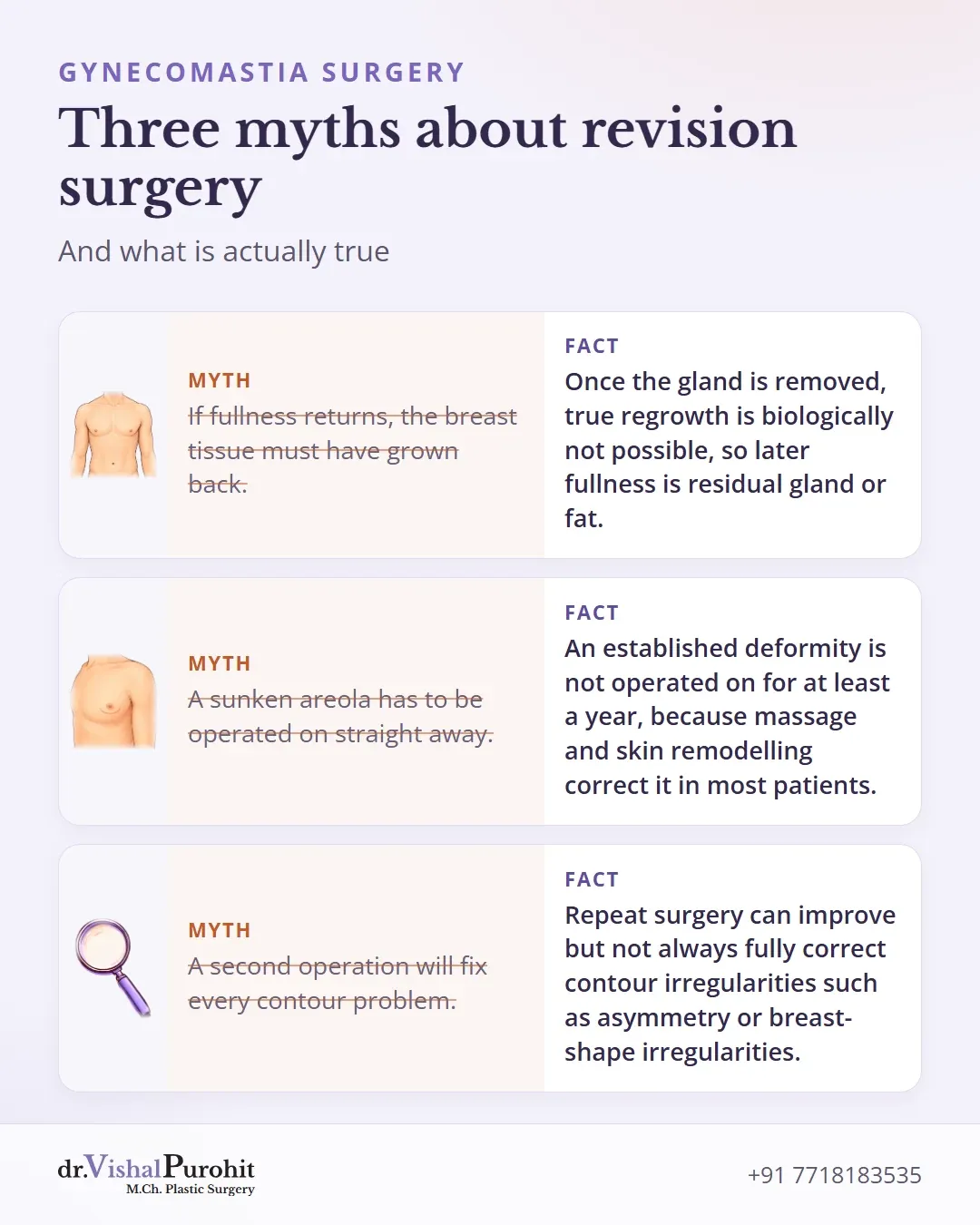
- True regrowth of the breast gland is not possible once it has been removed; any remaining fullness is residual tissue.
- Planning for asymmetry waits until early swelling has settled, so the correction addresses the true difference.
- An established crater deformity is often managed with massage and skin remodelling before any further surgery is considered.
| Concern | What it usually means | How it is approached |
|---|---|---|
| Residual fullness or gland | Some breast tissue was not fully removed at the first operation | A planned revision, once the chest has settled (timing below) |
| Asymmetry | The two sides have healed differently or tissue was removed unevenly | Reassessed once swelling has settled fully (by 2 to 3 months); corrective liposuction or minor excision is then planned |
| Contour irregularities | Uneven fat removal leaving ridges, dips or a stepped edge | Addressed with liposuction of the affected area after adequate healing time |
| Crater (saucer) deformity | The areola sits sunken relative to the surrounding chest | See below |
Residual Fullness or Gland
Once the breast gland is removed, true regrowth is biologically not possible. Any fullness that appears or remains afterwards is residual tissue — gland or fat that was not fully cleared at the first operation. This needs a planned return to theatre, not a repeat diagnosis.
Asymmetry and Contour Irregularities
Mild asymmetry in the first weeks is expected because the two sides rarely swell and heal at exactly the same pace. Revision planning waits until the swelling has gone, so that the correction addresses the true remaining difference, not temporary oedema.
Crater (Saucer) Deformity
A crater deformity — where the areola appears sunken into the chest — is prevented at the primary operation by careful dissection that avoids removing tissue directly beneath the areola. In Dr. Vishal Purohit’s Jaipur practice, this is a deliberate part of Dr. Vishal Purohit’s dissection technique.
When an established saucer deformity is present, Dr. Vishal Purohit does not operate on it for at least a year. Massage and skin remodelling over time correct it in most patients without further surgery. If the deformity persists beyond that period, liposuction of the whole chest is considered, and where the areola is adherent to the muscle underneath, subcision and fat grafting are options.
Whether the result itself lasts, and why true regrowth does not happen, is covered in permanent results of gynecomastia surgery.
How a Revision Is Planned
Reviewing What Was Done Before
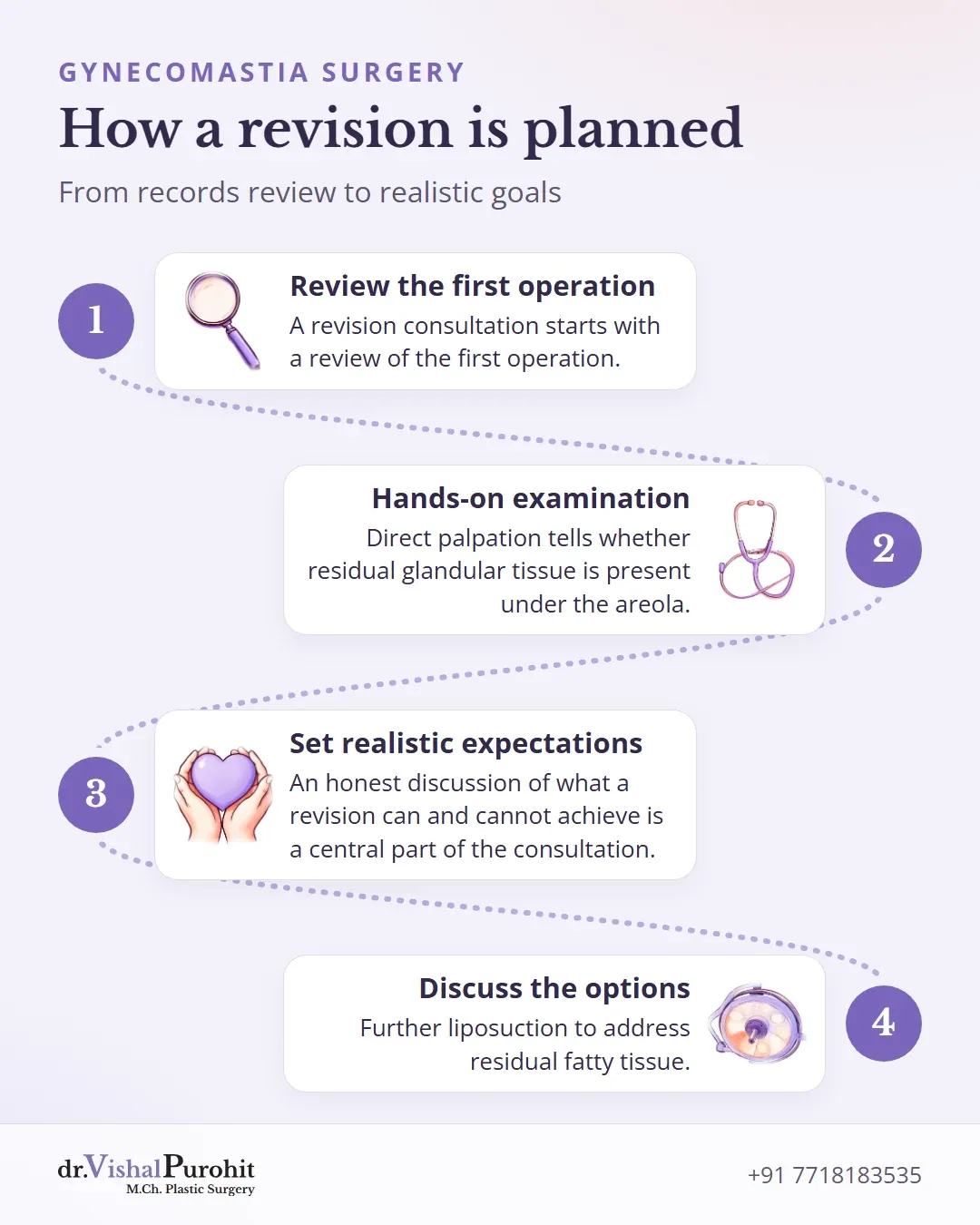
A revision consultation starts with a review of the first operation: the operative notes, photographs and histopathology report, where they are available. They show how much tissue was removed, which technique was used, and what the chest looked like before.
Key points
- The consultation starts by reviewing the operative notes, photographs and histopathology report of the first operation.
- A hands-on examination checks for residual glandular tissue, fatty fullness or contour asymmetry.
- Revision or touch-up surgery is planned only after a gap of 8 to 9 months from the first surgery.
Clinical Examination
After reviewing the records, a hands-on examination follows. Direct palpation tells whether residual glandular tissue is present under the areola, whether a fatty fullness remains in the chest, or whether the concern is a contour irregularity such as asymmetry. The findings from the examination guide what, if anything, needs to be corrected.
Setting Realistic Expectations
An honest discussion of what a revision can and cannot achieve is a central part of the consultation. The options discussed, where evidence supports them, include:
- Further liposuction to address residual fatty tissue [1]
- Removal of remaining glandular tissue through excision [1]
- Other contour corrections as the clinical findings indicate
The Timing Rule in Jaipur
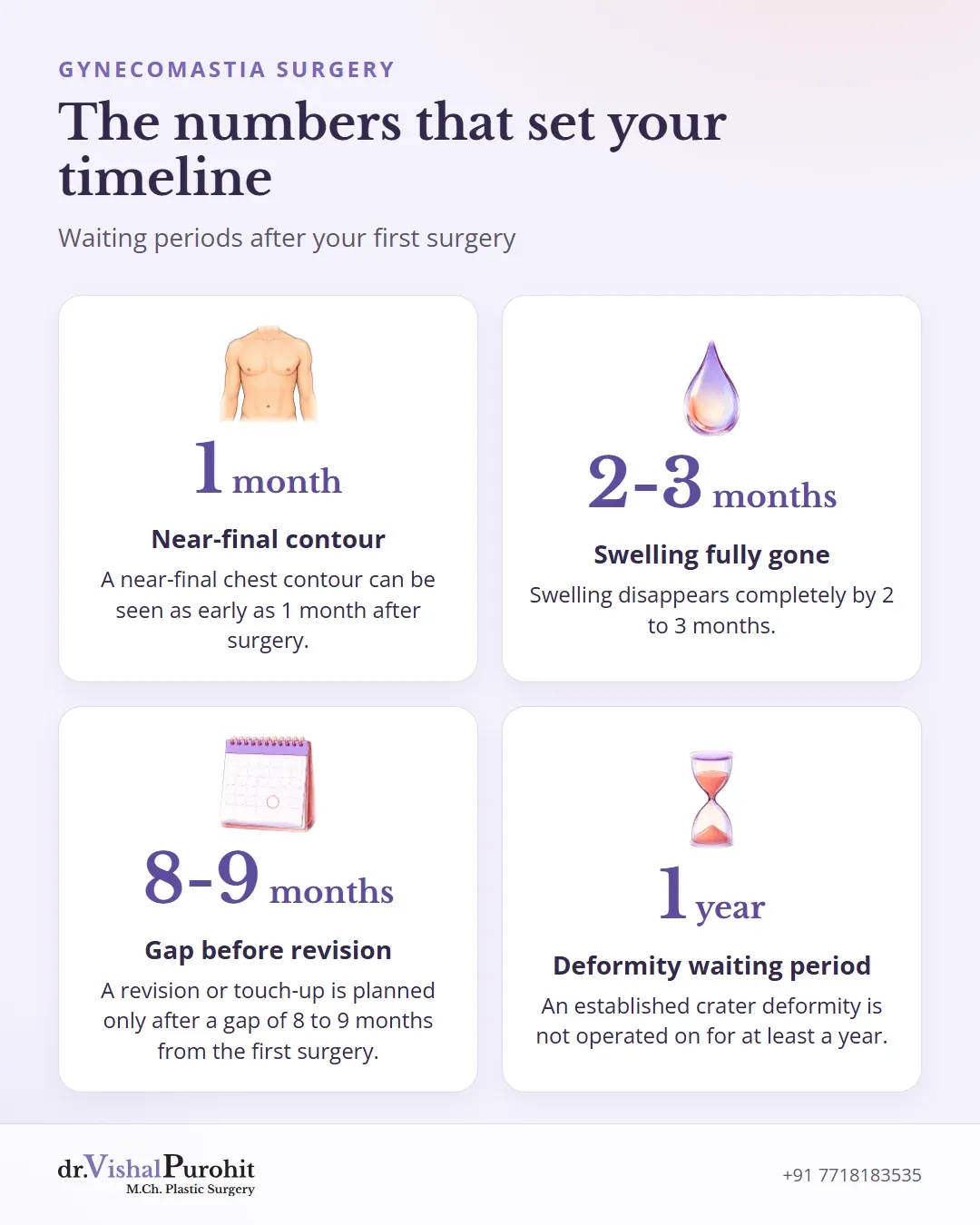
Dr. Vishal Purohit’s practice is to plan a revision or touch-up, such as liposuction, only after a gap of 8 to 9 months from the first surgery. This waiting period allows swelling to fully resolve and the chest to reach a stable final contour before any decision about further surgery is made.
Risks and Limits of Repeat Surgery
Revision gynecomastia surgery carries the same risks as the first operation, and scar tissue from the earlier procedure can make the second surgery more demanding.
Surgical risks
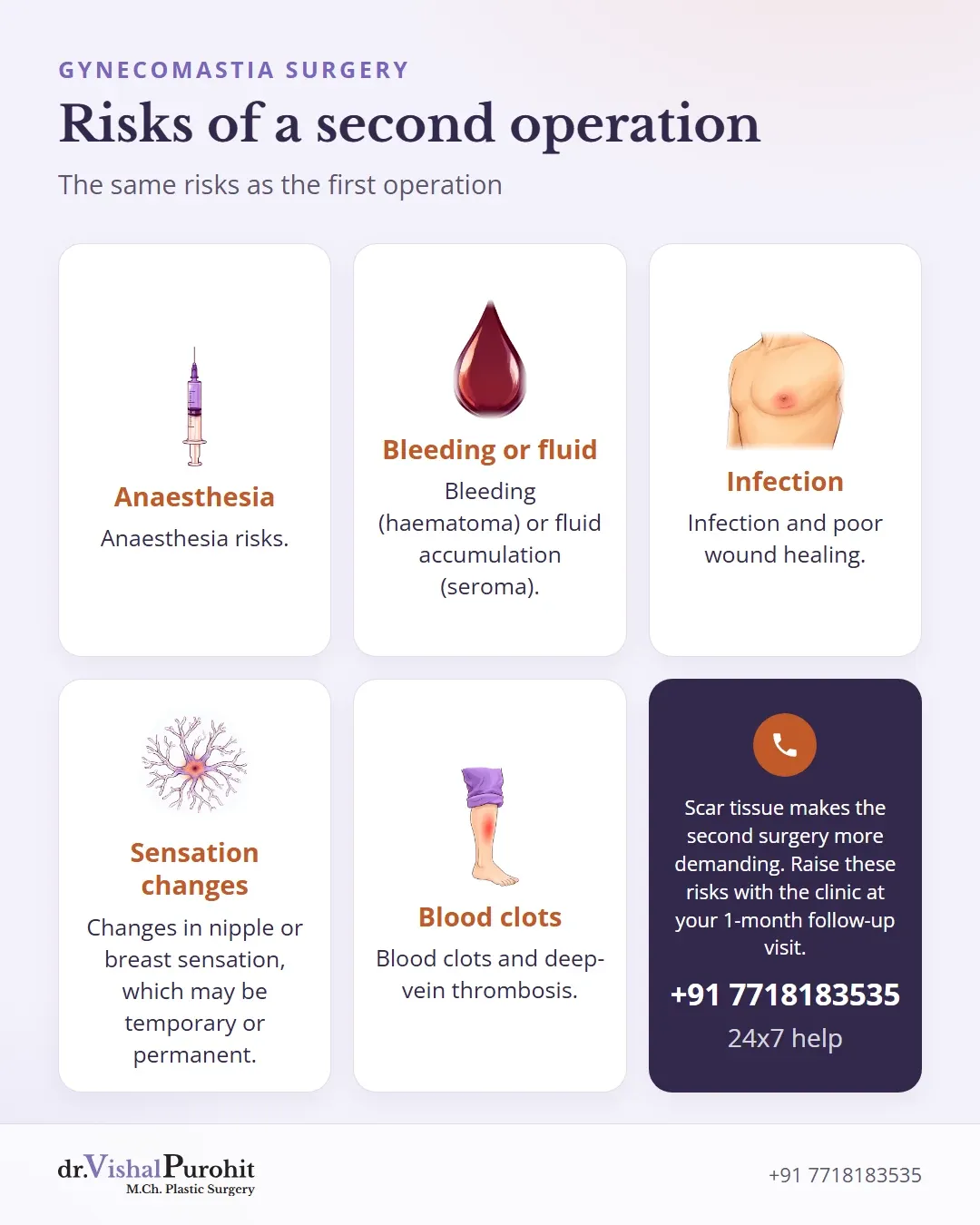
Any return to theatre may involve [2]:
- Anaesthesia risks
- Bleeding (haematoma) or fluid accumulation (seroma)
- Infection and poor wound healing
- Changes in nipple or breast sensation, which may be temporary or permanent
- Damage to deeper structures such as nerves, blood vessels and muscles, which may also be temporary or permanent
- Blood clots and deep-vein thrombosis
- Fat necrosis
Unfavorable scarring is also a recognised risk of gynecomastia surgery [2].
The scar tissue problem
Operating through previously scarred tissue is technically harder.
Contour limits
Repeat surgery can improve but not always fully correct contour irregularities such as asymmetry or breast-shape irregularities [2]. An open and honest discussion of realistic goals is essential before proceeding [3].
Touch-Ups in Jaipur
What patients pay for a touch-up
In Jaipur, the charges depend on the anaesthesia required:
| Anaesthesia needed | Charge to patient |
|---|---|
| Local anaesthesia | Not charged |
| General anaesthesia | Anaesthesia charges paid by the patient |
Next Steps for Revision Gynecomastia Surgery in Jaipur
If you remain unhappy with your result, the sensible next step is a proper assessment rather than a firm opinion formed early. A revision consultation reviews the first operation, examines the chest and discusses what a revision can realistically achieve and when it could be planned. You can also read the gynecomastia FAQs or explore gynecomastia surgery in Jaipur to prepare for that conversation.
This is educational information, not medical advice.