
Many men first notice gynecomastia as a tender, firm button under one nipple, or as a nipple that looks puffy under a T-shirt. Most of the time these changes come from enlarged gland tissue. But “most of the time” is not good enough when the question is cancer. This guide, reviewed by Dr. Vishal Purohit, M.Ch. plastic surgeon at Kalpana Aesthetics in Jaipur, explains the common gynecomastia symptoms, the changes that need prompt medical assessment, and why no breast lump in a man should be judged at home.
For the bigger picture of what gynecomastia is, why it happens and how it is graded, start with our guide what is gynecomastia: causes, symptoms and grades.
In short
- Common gynecomastia symptoms are a lump under the nipple, tenderness, soreness and swelling, in one or both breasts [1].
- Male breast cancer can feel the same as gynecomastia, so a lump cannot be judged safe by touch or appearance at home [2][9].
- Nipple discharge, skin changes, a rapidly enlarging firm lump, a testicular lump or unexplained weight loss should raise concern and need prompt review [3].
- Any new, growing or one-sided breast lump in a man should be examined by a doctor in person.
Common presentations: the lump, the tenderness and the puffy nipple

Gynecomastia is an enlargement of the glandular breast tissue in men. It is not simply a matter of body fat [1]. The signs patients most often describe are [1]:
- a lump under the nipple, often the first thing people notice;
- tenderness;
- soreness;
- swelling of the breast.
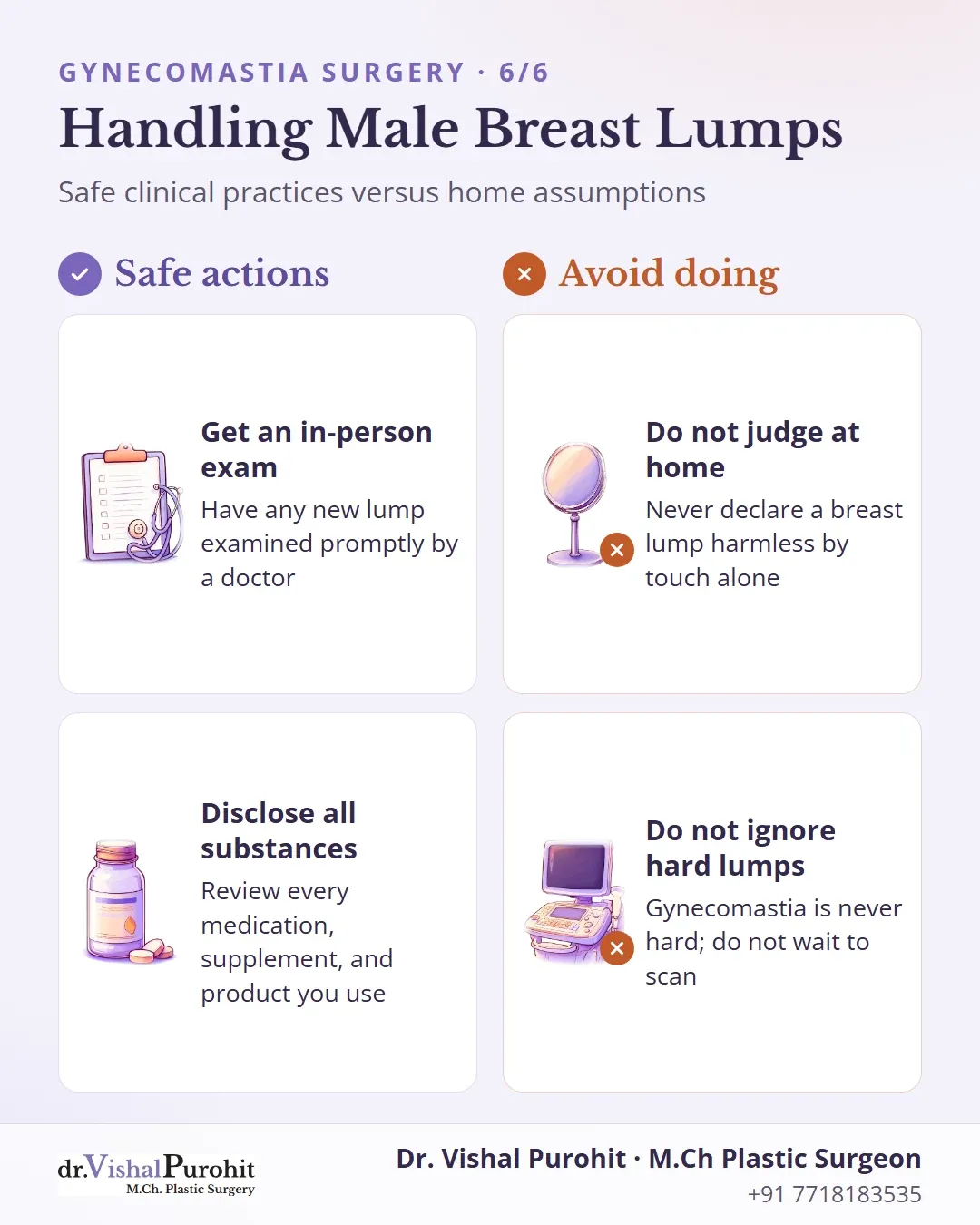
Cleveland Clinic describes the typical gynecomastia lump as a button-sized growth underneath the nipple. It may be visible, or felt only when pressing on the area. It may move easily within the breast tissue and may be tender to touch, and it can occur in one or both breasts [2]. In Dr. Vishal Purohit’s practice, gynecomastia is never a hard lump; a hard breast lump suggests another condition such as carcinoma or a tense cyst and requires immediate ultrasound or MRI followed by referral to an oncologist. Some men also notice discharge from the breast [5], which always needs a doctor’s review.
Some men come to a doctor because of breast pain, embarrassment or the fear of breast cancer. Other men have gynecomastia found on a routine examination and feel no discomfort at all [3]. Pain is more common when gynecomastia is of recent onset or growing quickly [3]. That makes pain a useful clue for the doctor, but not a verdict: tenderness on its own does not tell you what a lump is.
Puffy nipples
At the mildest end, the only change may be fullness directly under the areola. Plastic surgeons sometimes call this a “puffy nipple”. One published classification describes its mildest grade, 1a, as subareolar fullness alone, a puffy nipple without wider breast enlargement [4]. A puffy nipple can be a cosmetic concern for young men, especially in fitted clothes, but the same rule applies: if the fullness is new, firm or changing, have it examined.
Fat or gland?
If the chest is generally larger because of excess fat (pseudogynecomastia), it tends to look like an overall increase in size rather than a lump [2]. How a clinician tells fat from gland, and what weight loss can and cannot change, is covered in gynecomastia and weight loss. For more questions about how gynecomastia looks and feels, see the FAQ section on gynecomastia symptoms and appearance.
One-sided versus two-sided enlargement
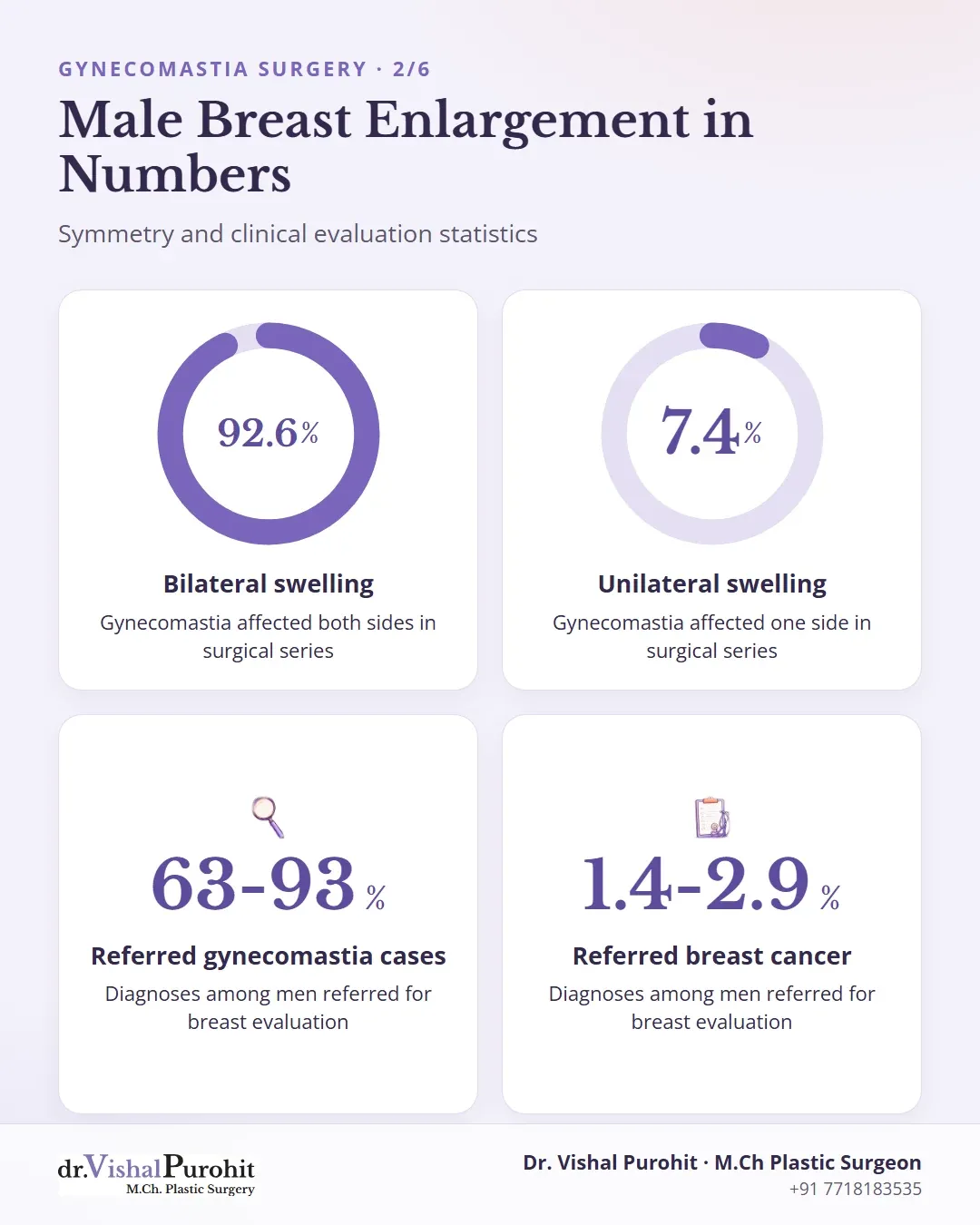
Doctors use two simple terms. Bilateral gynecomastia means both breasts are enlarged; unilateral gynecomastia means only one is [1]. In a surgical series of 148 patients, gynecomastia was bilateral in 92.6% and unilateral in 7.4% [7]. Medical News Today notes that the lumps often develop unevenly, so the two sides may not match even when both are affected [6].
So one-sided gynecomastia exists. The difficulty is that several other conditions also tend to be one-sided or uneven. A review in American Family Physician lists the diagnoses found in men referred for imaging or biopsy because of breast enlargement [3]:
- gynecomastia, typically a discrete, round, mobile mass under the areola, usually on both sides;
- breast cancer, which is often unilateral and may be a non-painful mass;
- lipoma, sebaceous cyst, fat necrosis and hematoma (a collection of blood after injury), each of which can cause asymmetric enlargement;
- mastitis, an infection that may come with fever or feeling unwell.
Medical News Today adds that if a lump is abnormally large, tender or one-sided, the doctor may order a biopsy or blood test to rule out breast cancer [6]. In Dr. Vishal Purohit’s practice, gynecomastia is never a hard lump; a hard breast lump suggests another condition such as carcinoma or a tense cyst and requires immediate MRI or ultrasound followed by referral to an oncologist. One-sided swelling is not proof of anything. It is a reason to be examined promptly rather than to wait and watch.
New lumps, discharge, and skin or nipple changes
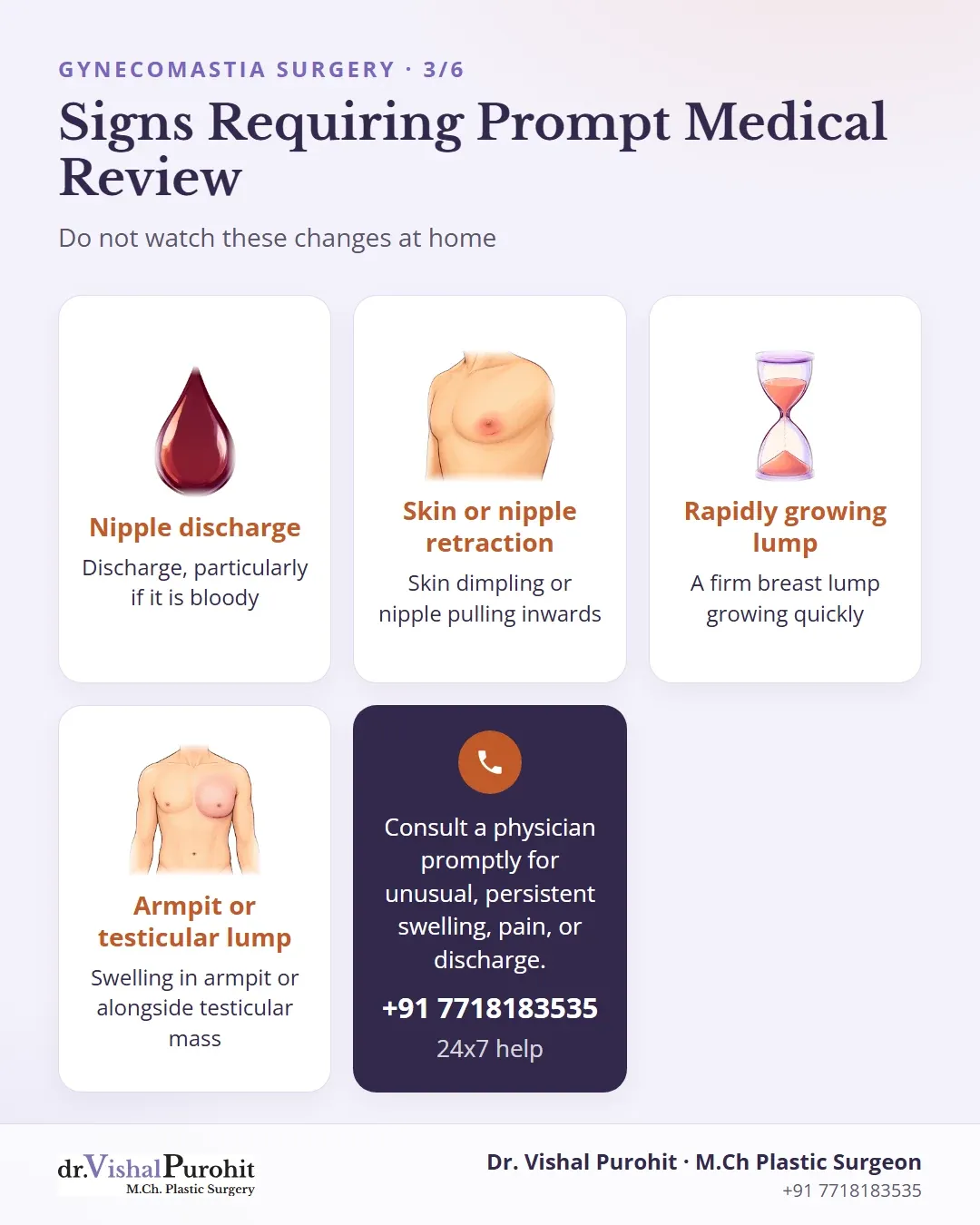
Some changes should never be put down to “just gynecomastia” without a doctor’s examination. American Family Physician advises that nipple discharge, skin changes, rapidly enlarging firm breast masses, a lump in a testicle at the same time, or general symptoms such as weight loss should raise concern [3].
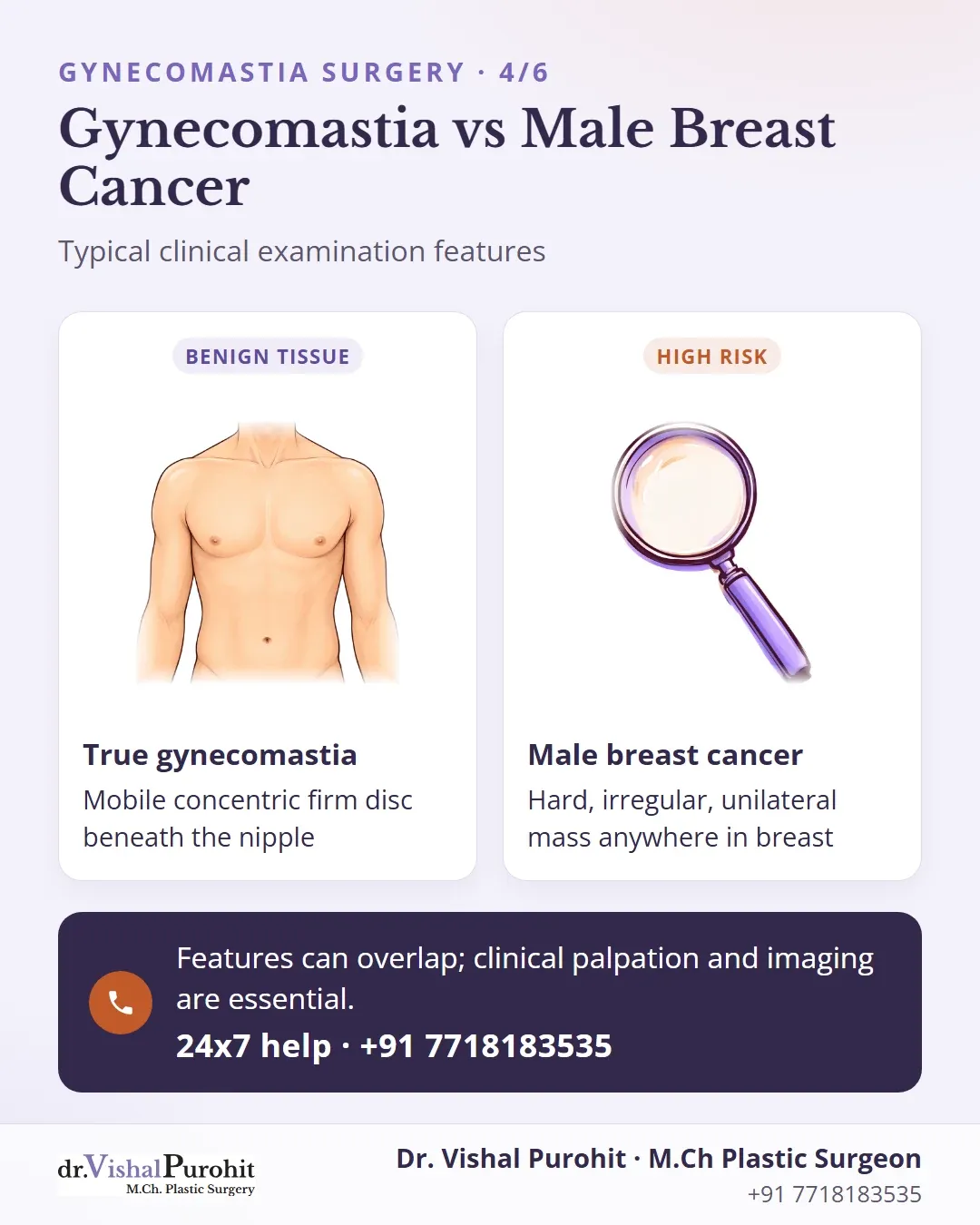
A review in Annals of Breast Surgery describes how breast cancer typically differs on examination. It tends to be a unilateral, hard, irregular mass that may sit anywhere in the breast. It may come with skin dimpling, fixation to the tissues, nipple retraction (the nipple pulling inwards) or enlarged lymph nodes in the armpit [8]. By contrast, true gynecomastia usually feels like a mobile, concentric disc of firm tissue of at least 2 cm directly beneath the nipple and areola [8]. In Dr. Vishal Purohit’s practice, gynecomastia is never a hard lump; a hard lump suggests another condition such as carcinoma or a tense cyst and needs immediate MRI or ultrasound and then referral to an oncologist. The same review states that any concern for malignancy, including suspicious lymph nodes or testicular masses, should prompt a diagnostic work-up [8].
Get these checked promptly, without waiting
- A new lump in either breast, especially a hard or fixed one, or one that is not centred under the nipple [8].
- Nipple discharge, particularly if it is bloody [3].
- Skin dimpling or puckering, or a nipple that has started to pull inwards [8].
- A lump that is growing quickly [3].
- A swelling or lump in the armpit [8].
- A lump in a testicle, or unexplained weight loss, alongside breast changes [3].
- Enlargement on one side only, or a lump that is not tender [3].
Medical News Today gives similar advice in plain terms: unusual and persistent swelling, pain, nipple discharge, or a combination of these is a reason to consult a physician [6].
Why cancer cannot be excluded at home
Male breast cancer is much rarer than gynecomastia [2]. Fewer than 1% of breast cancers diagnosed in the US occur in men, according to a conference report [10]. Even among men sent for imaging or biopsy because of breast enlargement, gynecomastia accounted for 63% to 93% of diagnoses and breast cancer for 1.4% to 2.9% [3].
Those figures are reassuring about men as a group. They say nothing about the lump under your own nipple, and they are the reason this article will not tell you that a lump is probably harmless. Three facts explain why:
- The two can feel the same. A cytology study notes that, although most male breast lesions are benign, breast cancer does occur in men and usually presents as a mass clinically indistinguishable from gynecomastia [9]. In Dr. Vishal Purohit’s practice, gynecomastia is never a hard lump; a hard lump suggests another condition such as carcinoma or a tense cyst and needs immediate MRI or ultrasound and then referral to an oncologist. If doctors cannot always tell by touch alone, a self-check cannot either.
- The warning signs are not always present. The features listed above make cancer more likely, but their absence does not rule it out. Cleveland Clinic advises that a physical examination by a healthcare provider is essential to distinguish the two, sometimes with further imaging [2]. In Dr. Vishal Purohit’s practice in Jaipur, evaluation begins with clinical examination and direct palpation first, followed by ultrasound or MRI when imaging is needed, while hormone blood tests are reserved for when there are other symptoms of hormonal imbalance.
- Some men carry a higher risk. Men with Klinefelter syndrome have a risk of breast cancer 16 to 30 times higher than other men, and even with a reassuring examination they may need imaging [3]. A strong family history of breast cancer is also listed as a risk factor for male breast cancer [10].
Because male breast cancer is uncommon, men are often diagnosed late, which is one reason doctors are encouraged to examine the male breast with care [10]. For more questions on this topic, see the FAQ section on gynecomastia and male breast cancer.
What the doctor examines, and when blood tests, ultrasound, mammography or a needle sample are used, is explained in how gynecomastia is diagnosed.
Which clinician to contact, and how soon
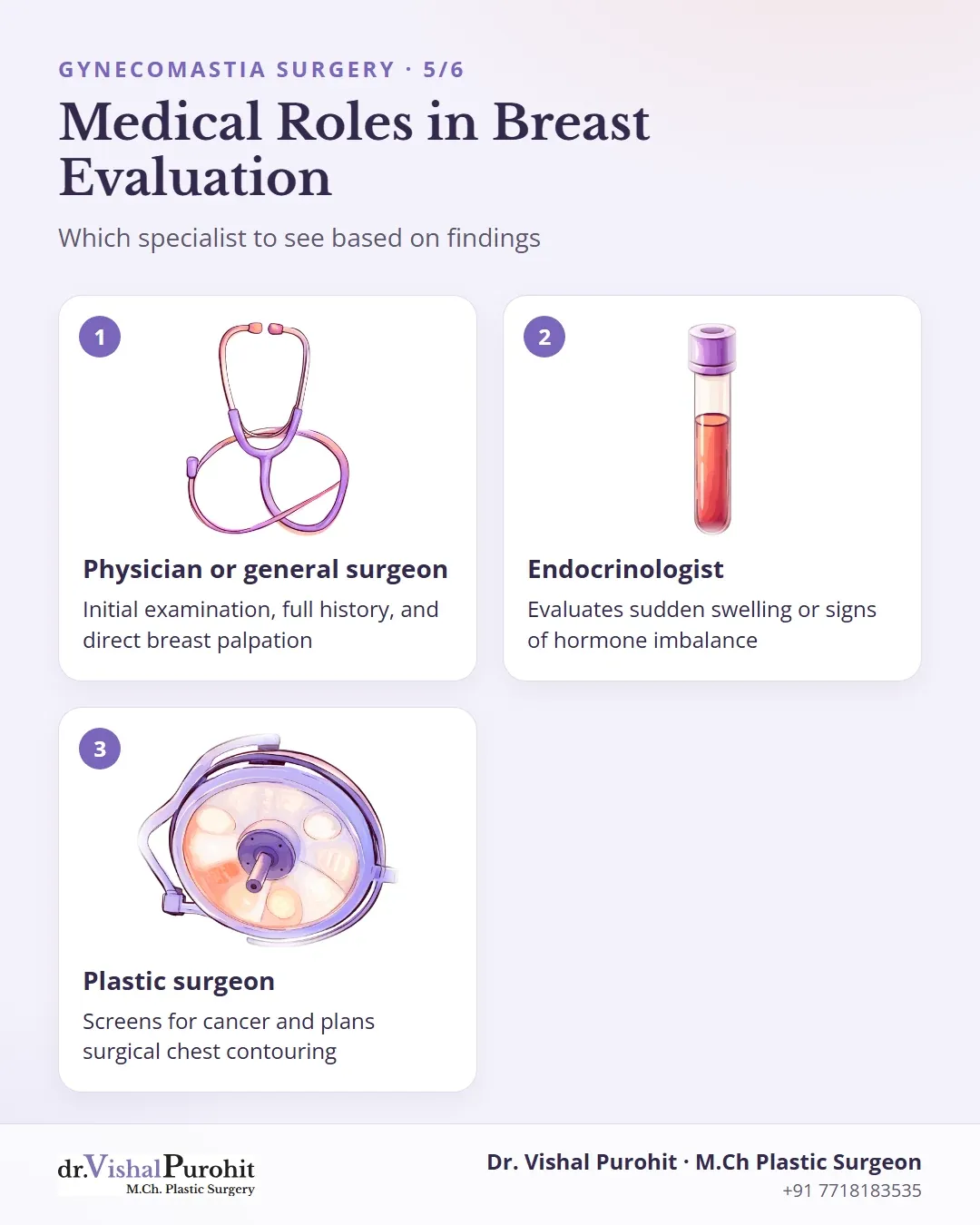
The first step is a doctor who will examine you in person, not an online symptom checker. WebMD advises visiting your doctor because they can rule out more serious reasons for breast changes, which may also ease the worry [1]. Depending on what is found, care may involve:
- Your family physician or a surgeon, who takes the history and examines the breasts, the lymph nodes in the armpit and other areas. In Dr. Vishal Purohit’s practice, diagnosis begins with clinical examination and direct palpation, followed by ultrasound or MRI when imaging is needed, while hormone blood tests are ordered only when there are other symptoms of hormonal imbalance. Annals of Breast Surgery recommends a complete examination with attention to the breast, lymph glands, thyroid, abdomen and testicles [8].
- An endocrinologist, a hormone specialist. In Dr. Vishal Purohit’s practice, referral to an endocrinologist is made only when gynecomastia develops suddenly, well after puberty is complete, or when there are other symptoms of hormonal imbalance [1].
- A plastic surgeon, when the diagnosis is established and the question becomes whether and how to treat the enlargement. Cleveland Clinic notes that before gynecomastia surgery, the provider examines and measures the breast tissue and screens for male breast cancer [11].
Be open about every medicine, supplement, bodybuilding product and recreational drug you have used. American Family Physician advises doctors to review all of these, because they are common causes of gynecomastia [3].
Teenagers
Breast swelling during puberty is common and often settles. In Dr. Vishal Purohit’s practice, pubertal gynecomastia does not need medication, and surgery in teenagers is considered at least 2 years after puberty is complete. American Family Physician states that adolescent physiologic gynecomastia should resolve within six months to two years of onset, and that further evaluation is indicated if it persists beyond two years or past 17 years of age [3]. A teenager with a hard lump, a one-sided lump, discharge or any of the warning signs above should be examined promptly, whatever his age. In Dr. Vishal Purohit’s practice, gynecomastia is never a hard lump; a hard lump suggests another condition such as carcinoma or a tense cyst and needs immediate MRI or ultrasound and referral to an oncologist.
Older men
Gynecomastia is also common later in life. One study of hospitalised men estimated that about 65% of men between 50 and 80 years of age have some degree of it [3]. Being common does not make a new lump safe. Older men, like younger men, should have any new or changing lump examined. In Dr. Vishal Purohit’s practice, a hard lump is never gynecomastia—it suggests another condition such as carcinoma or a tense cyst, requiring immediate MRI or ultrasound followed by referral to an oncologist.
How Dr. Vishal Purohit approaches breast changes in Jaipur
Dr. Vishal Purohit is an M.Ch. plastic surgeon registered with the Rajasthan Medical Council (RMC Reg. 28041/14185), practising at Kalpana Aesthetics, Tonk Road, Jaipur. He follows evidence-based plastic surgery with a focus on patient safety.
When gynecomastia surgery is performed at Kalpana Aesthetics, all excised breast tissue is always sent for histopathology, so that a pathologist examines it under the microscope. Histopathology is a safety net after surgery. It does not replace examining a suspicious lump before any treatment is planned.
In Dr. Vishal Purohit’s practice, gynecomastia is diagnosed through clinical examination and direct palpation first, followed by ultrasound or MRI when imaging is needed, with hormone blood tests reserved for patients who have other symptoms of hormonal imbalance. Gynecomastia is never a hard lump; a hard breast lump suggests another condition such as carcinoma or a tense cyst and requires an immediate MRI or ultrasound followed by referral to an oncologist. He refers a patient to an endocrinologist only when gynecomastia develops suddenly, well after puberty is complete, or when other symptoms of hormonal imbalance are present.
If the diagnosis is gynecomastia and the patient wants treatment, the options and the surgical approach used at the clinic are described on the gynecomastia surgery in Jaipur page. Questions about pain, swelling or lumps after surgery are a different topic, covered in gynecomastia surgery safety and risks.
Key figures
| Point | What the evidence says |
|---|---|
| Common symptoms | Lump under the nipple, tenderness, soreness, swelling [1] |
| One side or both | 92.6% bilateral, 7.4% unilateral in a series of 148 surgical patients [7] |
| Typical gynecomastia on examination | Mobile, concentric disc of firm tissue, at least 2 cm, directly beneath the nipple [8]; in Dr. Vishal Purohit’s practice, gynecomastia is never a hard lump, which instead suggests conditions like carcinoma or a tense cyst |
| Diagnoses in men referred for imaging or biopsy | Gynecomastia 63% to 93%; breast cancer 1.4% to 2.9% [3] |
| Signs that raise concern | Nipple discharge, skin changes, rapidly enlarging firm mass, testicular mass, weight loss [3] |
| Klinefelter syndrome | Breast cancer risk 16 to 30 times higher than other men [3] |
| Can cancer be told apart by feel? | Usually presents as a mass clinically indistinguishable from gynecomastia [9]; however, in Dr. Vishal Purohit’s practice, gynecomastia is never a hard lump—a hard lump indicates conditions such as carcinoma or a tense cyst and warrants immediate ultrasound or MRI followed by referral to an oncologist |
The bottom line
Tenderness, puffy nipples and a firm disc under the nipple are common gynecomastia symptoms, and many men with them have no serious disease. But a breast lump in a man cannot be declared harmless at home, by appearance, by pain, or by how common gynecomastia is. In Dr. Vishal Purohit’s practice, gynecomastia is never a hard lump; a hard lump suggests another condition such as carcinoma or a tense cyst and needs immediate MRI or ultrasound and then referral to an oncologist. A new, growing, hard, one-sided or non-tender lump, nipple discharge, skin or nipple changes, or a lump in the armpit or testicle are reasons to see a doctor promptly. If you are in Jaipur and have noticed a change in your chest, Dr. Vishal Purohit at Kalpana Aesthetics can examine you and explain the next step.
This is educational information, not medical advice.