
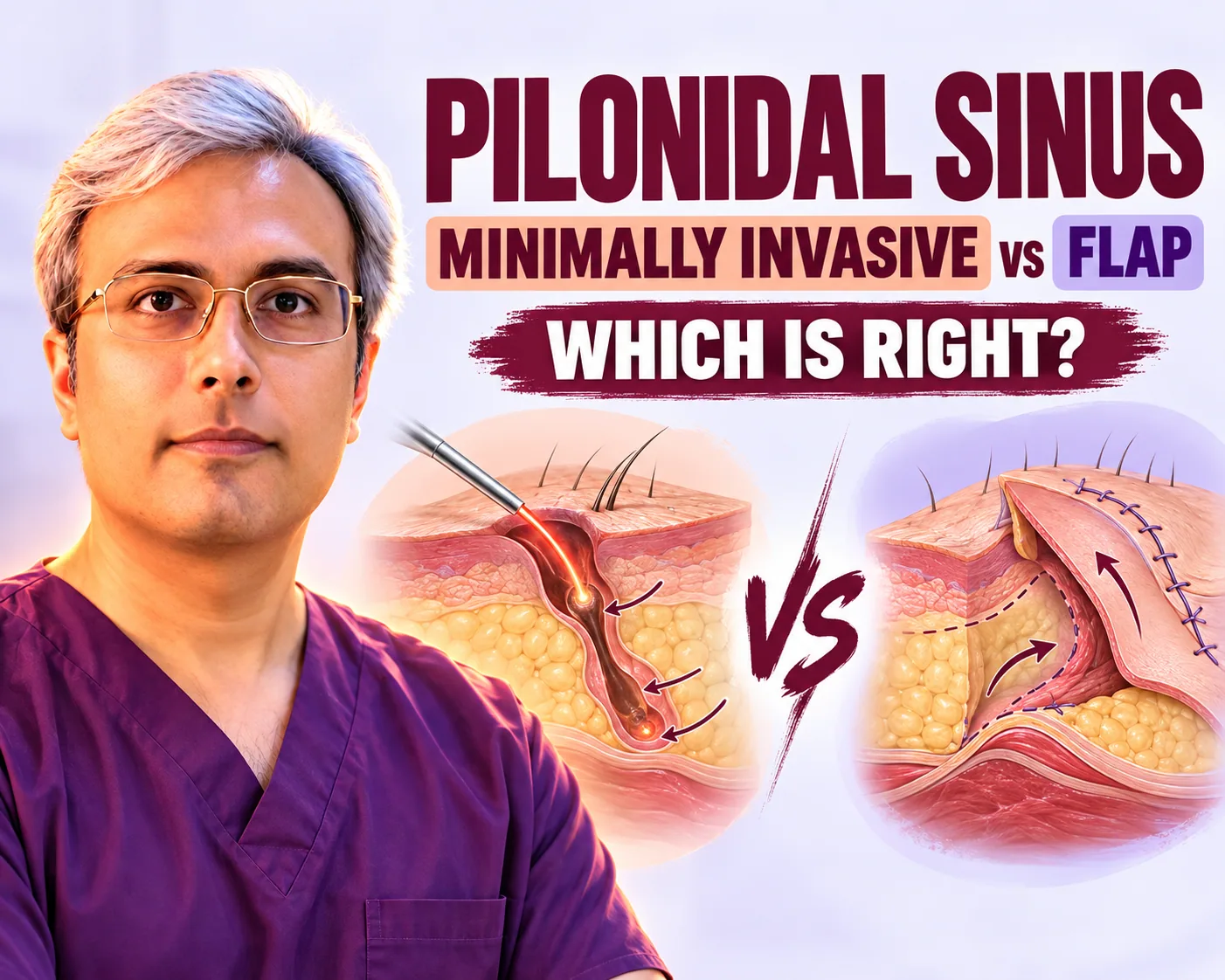
In short
- Small methods mean tiny cuts and days off work, with reported return around 6 to 15%.
- Flap surgery means weeks off work, with reported return around 1 to 4%.
- Dr. Vishal Purohit performs only the flap side in Jaipur: Limberg and Karydakis rebuilding.
Who this guide is for
This guide is for patients torn between a quick fix and a lasting fix. Clinics advertise laser sittings, glue sealing, and endoscopic cleaning as walk-in cures. Flap surgeons advise one bigger operation instead. Both claims need context, and this page gives it from published reports.
It is also for patients who already tried small and failed. A second small sitting after a first failure rarely changes the anatomy that caused the failure. This guide helps those patients stop repeating a losing loop and switch tracks with clear eyes.
Read the clinic boundary first. Dr. Vishal Purohit performs Limberg and Karydakis off-midline flap surgery in Jaipur, plus urgent abscess drainage. The clinic does not offer phenol, SiLaC laser, endoscopic or pit-picking methods, Bascom cleft lift, Dufourmentel flap, or Z-plasty. Small methods appear here only as literature context for a fair comparison.
Small methods vs flap: what each asks of you
Small methods ask little upfront. Pits are cleaned, tracts are burnt, glued, or scoped out through millimetre openings. Anaesthesia is light. Most patients walk out the same day and sit carefully within days. Dressings last a week or two. The cleft shape, however, stays exactly as it was.
Flap surgery asks more upfront. Disease comes out as one block down to deep fascia. Healthy skin slides or folds across the gap. A drain stays for days. Desk work waits 2 to 3 weeks and sport waits 6 to 8 weeks. In exchange the cleft flattens and the scar parks off the midline.
The table below puts the trade side by side. Neither column is wrong in itself. Each fits a different anatomy, which the next sections pin down.
| Point | Small methods (reported) | Flap surgery (reported) |
|---|---|---|
| Cut size | Millimetre openings, no big wound | One planned wound with drain |
| Back to desk work | Days | 2 to 3 weeks |
| Cleft shape | Unchanged | Flattened, scar off-midline |
| Reported return | 6 to 15% | 1 to 4% |
| Repeat sittings | Common | Rare |
For method details, read the literature pages on SiLaC tract laser, pit-picking entry points, and the flap pages on Limberg transfer and Karydakis slide.
Return rates: 6 to 15% vs 1 to 4%
Numbers first, with honesty attached. Non-excisional small options report return around 6 to 15% across series. Reconstructive flaps report 1 to 4% (all reported endpoints as published). The gap is large because the two sides treat different halves of the disease: tunnels versus shape.
Small methods treat tunnels. Heat, glue, or scopes close the passage but leave the hair-trapping groove intact. Hairs re-enter through the same path, and a share of cases reopen. That share clusters in deep clefts and branching disease, which is why case selection decides everything on the small side.
Flaps treat shape. Excision removes tunnels and nests; rebuilding flattens the groove and side-lines the scar. Hairs lose both entry points and lodging. The price is one bigger recovery instead of possible repeat small ones. Patients should ask any clinic quoting small-method success which anatomies were excluded from its figures.
Key figures from published series
- Return around 6 to 15% is reported for non-excisional small options across pilonidal series (reported endpoints as published).
- Return around 1 to 4% is reported for reconstructive flap surgery across pilonidal series (reported endpoints as published).
- Return below 3% is reported for Limberg flap surgery within that flap range (reported endpoint as published).
Your decision grid: three checks
Run these three checks in order. They sort most patients correctly:
- Tract map. Few pits with one short straight tunnel point small. Wide branching tracts or far-side openings point flap.
- Cleft depth. A shallow groove with mild hair load may hold a small repair. A deep valley with coarse hair defeats it.
- History. First-time simple disease can try small where offered. Any prior failed operation, repeat abscess, or open wound points flap.
Mixed answers deserve special care. A simple tract map with a deep cleft, for example, pulls in opposite directions. In such cases the surgeon weighs which factor dominates: a truly shallow groove after buttock-press testing may still hold a small repair, while a steep valley rarely does. A second mapping visit after any active swelling settles often sharpens the verdict, since inflamed skin exaggerates both depth and spread.
Two or three flap-side answers mean flap surgery. Mixed answers need surgeon mapping, not guesswork. One honest consult with pit probing and cleft testing beats months of forum reading. Bring prior notes so history, the third check, is judged on facts.
Count total cost, not one sitting
Price tags mislead when sittings repeat. One small sitting costs less than one flap sitting almost everywhere. But two or three small sittings plus repeated work leave can overtake a single flap bill. Ask for the full-course estimate, not the first-visit quote.
Count leave the same way. Days off sound cheap until they repeat three times with fresh recoveries. One planned 2 to 3 week flap break, booked once with cover arranged, often disrupts life less than scattered short absences across a year.
Insurance paperwork follows the same logic. Day-care small sittings and short-stay flap surgery fall under different claim slabs, and repeat sittings multiply paperwork each time. Ask the hospital desk for the full-course estimate in writing, with anaesthesia, stay, dressing reviews, and epilation planning listed. A single documented flap course is often simpler to claim than three scattered small sittings across two policy years.
Count scars too. Each failed small attempt adds scar and shrinks the tissue a later flap can use. Starting small is only cheap when the anatomy suits small. Where it does not, the cheapest path is the right operation done once. Why the sinus returns explains the mechanics behind repeat failure.
What Dr. Vishal Purohit does in Jaipur
Dr. Vishal Purohit is an M.Ch plastic surgeon treating pilonidal sinus disease in Jaipur, performing definitive Limberg and Karydakis off-midline flap surgery. No phenol, laser, or endoscopic shortcuts; matched to your anatomy.
At a decision consult the surgeon runs the three checks above and places the patient honestly. Flap-side patients get a build-matched plan: Limberg fold for wide defects, Karydakis slide for midline-near disease. Active infection gets staged drainage first, then repair after settling. This is educational information, not medical advice.
Next step
Patients unsure which side they fall on can book consultation with Dr. Vishal Purohit in Jaipur for tract mapping with an honest small-versus-flap verdict. Bring prior scans and operation notes where available.