
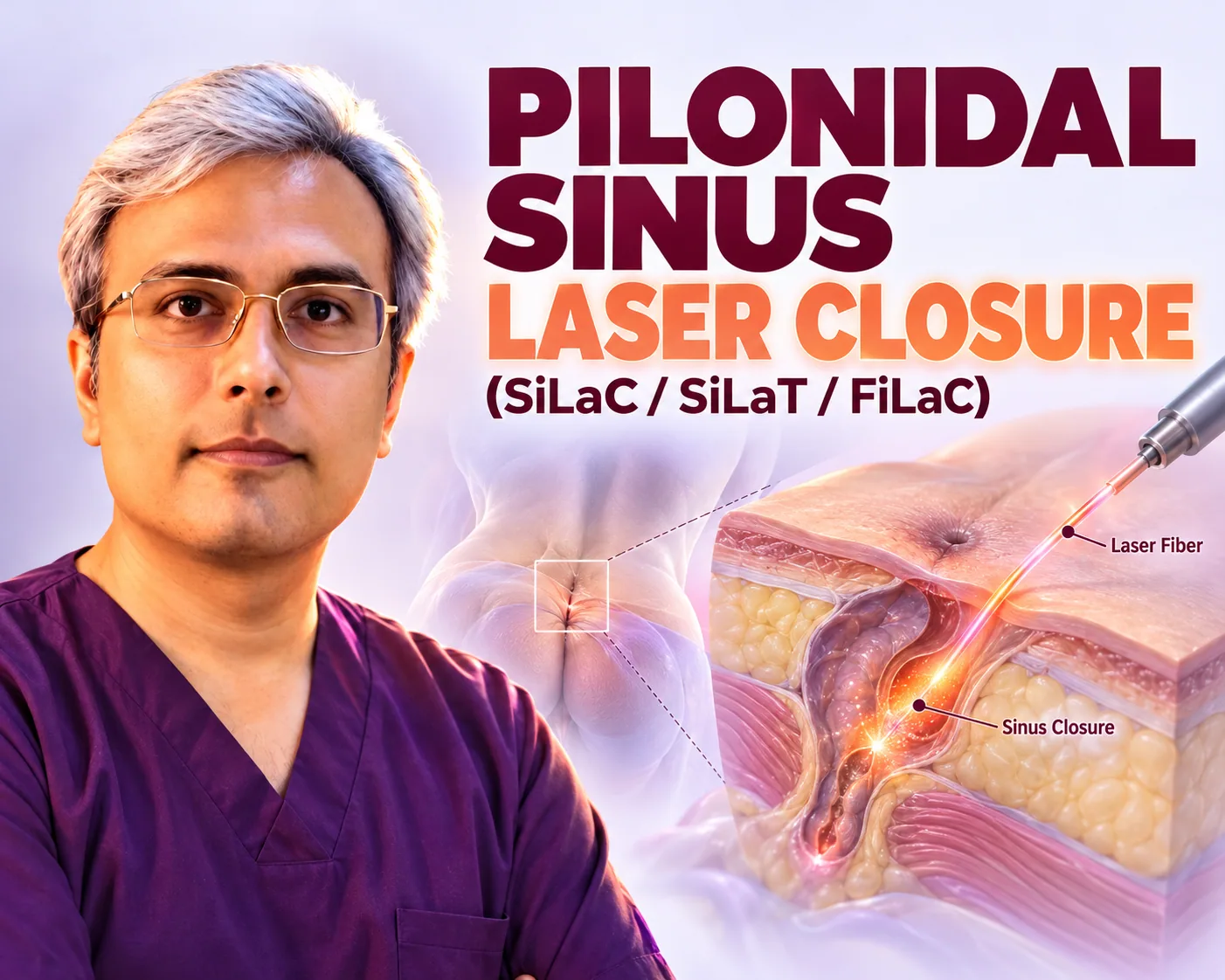
In short
- SiLaC threads a radial laser probe into the tract and seals it with circular heat.
- Reports describe daily activity back in 1 to 3 days with low early pain.
- This clinic does not offer SiLaC; Dr. Vishal Purohit treats pilonidal disease in Jaipur with Limberg and Karydakis flap surgery.
Who this page is for
This page is for patients researching laser options for pilonidal sinus. The names SiLaC, SiLaT, and FiLaC all describe the same idea: closing the sinus tunnel with laser heat instead of cutting it out. SiLaT and FiLaC are close variants that use the same fibre-in-tunnel idea under different brand names. This page explains that idea from published literature so patients can weigh it fairly.
It is also for patients confused between two lasers. Tract laser (SiLaC) burns the sinus from inside. Hair laser (epilation) destroys surface hair roots after healing. They share only the word laser. Mixing them up leads to wrong choices, so this page keeps them strictly apart.
Read this page as background, not as a clinic menu. Dr. Vishal Purohit performs Limberg and Karydakis off-midline flap surgery in Jaipur, plus urgent abscess drainage. The clinic does not offer SiLaC laser, phenol, endoscopic or pit-picking methods, Bascom cleft lift, Dufourmentel flap, or Z-plasty. SiLaC appears here only as literature and guideline context.
How laser burns the tract closed
The tool is a thin fibre carrying diode laser energy, commonly at 1470 nm wavelength. Nm means nanometres, the light’s colour code. The fibre tip glows in a full circle, so heat strikes the tunnel wall in 360 degrees as it moves. Doctors call this radial emission.
The heat destroys the tract lining. That lining is the smooth skin-like layer that keeps the tunnel open and draining. Burnt lining scars down onto itself. The tunnel walls stick together and the passage seals. No cutting, no open wound, no stitches across the cleft.
The physics is neat but narrow. Heat seals what it touches: the tunnel wall. It cannot flatten a deep cleft, move a scar off the midline, or remove hair nests sitting outside the tract. Those three jobs need excision and rebuilding, which is exactly what flap surgery adds.
What happens step by step
Published protocols follow a fixed order. Each step prepares the next:
- Pit cleaning. The surgeon opens and clears each midline pit of hair and debris so the tract entries lie visible.
- Tract washing. The tunnel is flushed clean to remove pus, loose hair, and loose lining flakes.
- Probe placement. The laser fibre slides into the tract to its far end under direct guidance.
- Stepwise withdrawal. The fibre pulls back in small increments, firing circular heat so the full tunnel length gets treated.
- Wound check. Tiny entry points are left to close on their own, usually with simple dressings and early washing advice.
Pit care decides success before the fibre even enters. Each midline pit is a doorway that keeps feeding hair into the tunnel. Published protocols open and clear every pit first, because sealing a tunnel while its doorways stay active invites quick reopening. Missed side branches fail the same way: heat treats the main passage while a side pocket keeps draining.
The sitting is short and usually day-care. Pain scores in reports stay low because no large wound is cut. Most protocols send patients home the same day with tablets and a review date. Small pits such as pit-picking entry points heal the same quiet way, and endoscopic cleaning follows a similar clean-and-close logic in published reports.
Gains and limits in plain numbers
The gains are about speed. Reports describe return to daily activity in 1 to 3 days. Early pain stays low. There is no drain, no large scar, and no weeks of dressings. For a student or desk worker with a small simple tract, that speed is genuinely attractive.
The limits are about lasting repair. Long-term cure rates in reports read as acceptable rather than excellent, and figures vary widely across series. The cleft stays deep. The scar, where one forms, stays midline. New hairs keep the same entry path they always had. Complex or branching tracts respond poorly because heat cannot reach every side pocket evenly.
| Point | SiLaC laser (reported) | Flap surgery (reported) |
|---|---|---|
| Back to daily life | 1 to 3 days | Desk work in 2 to 3 weeks |
| Early pain | Low scores | Soreness for days, tablet-controlled |
| Cleft shape | Unchanged | Flattened with scar off-midline |
| Reported return | Acceptable, varies by series | Below 3% for Limberg; 1 to 4% for flaps generally |
Follow-up reviews matter more after laser than patients expect. The sealed tunnel firms up over weeks, and the surgeon checks each pit mouth for refilling at review. Any doorway that reopens is spotted early, while still small. Patients should keep every review date even when the skin looks calm, since tunnels can smoulder quietly before showing discharge again.
Think twice about laser alone if you have
- Wide or branching tracts reaching far to one side.
- A deep cleft with repeat abscesses or prior failed surgery.
- An active pus pocket right now — that needs drainage first, not heat.
None of this makes SiLaC useless. It makes it selective. Small straight tracts in shallow clefts are its natural territory in published reports. Anything bigger asks for shape correction, which only excision with rebuilding provides. Patients can compare both paths on small methods versus flap surgery before deciding.
Key figures from published series
- A 1470 nm radial diode probe delivering 360-degree heat is the reported SiLaC mechanism (technique as published).
- Return to daily activity in 1 to 3 days with low early pain scores is reported after SiLaC (reported endpoints as published).
- Long-term cure rates read as acceptable but varied across series, and the cleft shape stays unchanged (reported endpoints as published).
What Dr. Vishal Purohit does in Jaipur
Dr. Vishal Purohit is an M.Ch plastic surgeon treating pilonidal sinus disease in Jaipur, performing definitive Limberg and Karydakis off-midline flap surgery. No phenol, laser, or endoscopic shortcuts; matched to your anatomy.
At consult the surgeon maps pits, tracts, and cleft depth, then explains honestly where SiLaC-style heat would likely fail for that anatomy. Wide defects get the Limberg fold; midline-near disease gets the Karydakis slide. Acute pus pockets are drained urgently first, with staged flap repair after settling. Post-healing laser hair removal after healing is timed at a skin unit to guard the result. This is educational information, not medical advice.
Next step
Patients weighing laser against lasting repair can book consultation with Dr. Vishal Purohit in Jaipur for tract mapping with an honest verdict on whether heat alone or flap rebuilding fits. Bring prior scans and operation notes where available.