
In short
- Pit-picking removes single pits with a 3 to 5 mm punch and cleans the cavity. No stitches; healing in 2 to 4 weeks.
- It suits only simple first-time disease with few pits and a shallow cavity.
- It does not flatten the cleft, so deep or branched disease fails more and needs flap surgery.
Who this page is for
This page is for people with mild pilonidal disease who found pit-picking online. The promise is a small clinic procedure with fast return to work. The full picture is more nuanced.
Pilonidal sinus is common in young adult males. Care spans from tiny punch methods to full flap rebuilding. One published single-centre study compared Bascom-type care with pit excision in about 50 patients. It showed the method feasible for chosen cases. Small disease suits a small operation. Large or scarred disease demands rebuilding. Punch holes heal in 2 to 4 weeks with light dressing. Flap wounds heal in 2 to 3 weeks with a drain for 5 to 7 days. Consultation measures which trade fits your map. Patients on blood thinners or with weak immunity should state this at booking, because even punch wounds need a clear healing window. Knowing what pilonidal sinus disease is first helps place this method in order.
One rule frames this page. In Jaipur, Dr. Vishal Purohit performs only Limberg and Karydakis flap surgery, plus prompt abscess drainage. He does not offer pit-picking, Bascom, phenol, SiLaC laser, or endoscopic care. Those methods appear here as published context only, so readers can compare fairly.
How the small operation works
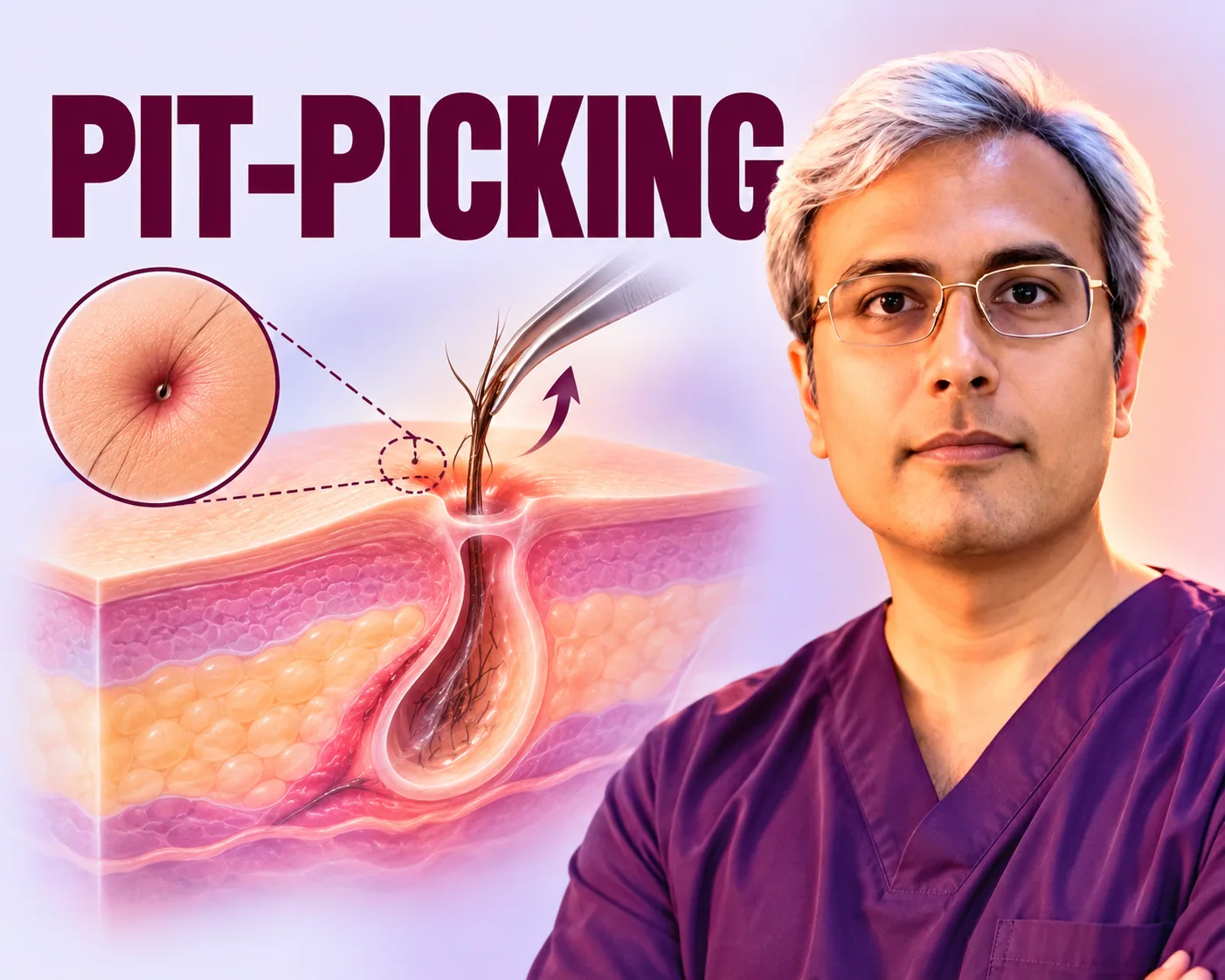
Pit-picking is also called trephination or the Gips procedure. It sits in the Bascom I family of ideas. Instead of cutting a skin ellipse, the surgeon removes each diseased pit alone.
Published reports describe these steps:
- Map the pits — patient face down, each midline pit marked, at times with a probe or dye.
- Numb the skin — local anaesthesia, at times with light sedation, 20 to 40 minutes total.
- Punch each pit — a 3 to 5 mm trephine or biopsy punch with about 1 mm margin, no wide ellipse.
- Clean the cavity — scrape hair nests and debris through the punch holes, then wash until clear.
- Dress it open — no stitches, no flap, light dressing only.
Side openings, if small, may be removed or opened in limited form. The focus is tissue saving. Remove the pit lining. Keep all else.
The Bascom school adds a key point. It blames the deep cleft itself for repeat disease. Its full answer pairs pit care with cleft flattening (the Bascom II cleft lift). Pit-picking alone does half the job. It clears current pits but leaves cleft depth, moisture, and friction unchanged. That gap drives later failure.
Healing without stitches
Healing is the lightest of any pilonidal operation. Pain is often mild for 2 to 3 days. Many patients return to desk work in 2 to 5 days. No drain is placed. Dressing stays light.
Care rules for open punch wounds:
- Keep holes clean — bathe as advised, pat dry, change light gauze.
- Do not let skin bridge early — holes should fill from below over 2 to 4 weeks.
- Cut friction — avoid long sitting and tight synthetics while pink tissue fills in.
- Control hair — gentle cleft cleaning so loose hairs do not pack fresh holes.
Success or failure is set on the table, not in the dressing room. Scraping that leaves debris or a side branch means discharge stays. Even when early healing looks good, follow-up runs long — 2 week, 6 week, and 6 month checks until each punch site fully closes. New pits months later signal disease that outgrew the small method, and any sticky discharge between visits earns an early return. Readers weighing timelines also check the flap recovery timeline to weigh speed against staying power.
This method does not suit you if
- Many pits, wide side tracts, or thick old scars are present
- The cleft is deep, very hairy, or often moist
- There is an active abscess — acute abscess treatment (drainage first) is needed instead
Who it suits — and who it fails
In well-chosen simple disease, reports show healing with low pain and fair short-term success. The logic is clean. Where all disease is a shallow, easy-to-clean cavity with 1 to 3 pits, punch and scrape clears the field. Clinic care under local anaesthesia adds logistic appeal.
As anatomy worsens, results fall. Trephination does not change cleft shape. Deep, moist, high-friction clefts keep driving hair into skin. Two failure modes repeat in reports:
- Missed side branches beyond punch reach keep oozing.
- New pits form months later in the same deep cleft.
| Feature | Pit-picking | Off-midline flap |
|---|---|---|
| Tissue removed | Pits only, 3 to 5 mm holes | Full tract block to fascia |
| Cleft shape | Unchanged | Flattened, scar off midline |
| Healing | 2 to 4 weeks open | 2 to 3 weeks with 5 to 7 day drain |
| Best for | Few pits, shallow cavity | Wide, deep, or repeat disease |
Comparative reviews rank Limberg and Karydakis rebuilding as the two most used off-midline closures. They are the staying-power standard. Minimal methods are staged or chosen options for light disease, not equals.
Four direct questions help at consultation. How many pits do I have, and how far do they spread. How deep is my cleft, and is it moist or scarred. Are there side branches a punch cannot reach. What will my scar look like at 12 months with each option. Answers place each patient on the right side of the small-versus-flap line. Lasting options are detailed in minimal-incision versus flap surgery. This is educational information, not medical advice.
Key figures from published series
- A single-centre study of Bascom-type versus pit-excision care reports on about 50 patients meeting entry criteria — feasibility data for chosen mild disease.
- Limberg and Karydakis rebuilding are the two most used off-midline closures for pilonidal disease (systematic review and meta-analysis) — the staying-power standard.
- Endoscopic methods are counted in the literature as minimal-incision care for chosen first-time disease, like pit-picking, not flap equals. All figures here describe pilonidal groups only.
What Dr. Vishal Purohit does in Jaipur
Dr. Vishal Purohit is an M.Ch plastic surgeon treating pilonidal sinus disease in Jaipur, performing definitive Limberg and Karydakis off-midline flap surgery. No phenol, laser, or endoscopic shortcuts; matched to your anatomy.
The clinic does not perform pit-picking, Gips, Bascom, phenol, SiLaC laser, or endoscopic methods. Patients with simple pit-level maps receive counsel as per literature reports, including failure in deep clefts. Patients with wide, repeat, or scarred disease are planned for flap rebuilding with written operation and care plans. This is educational information, not medical advice.