
In short
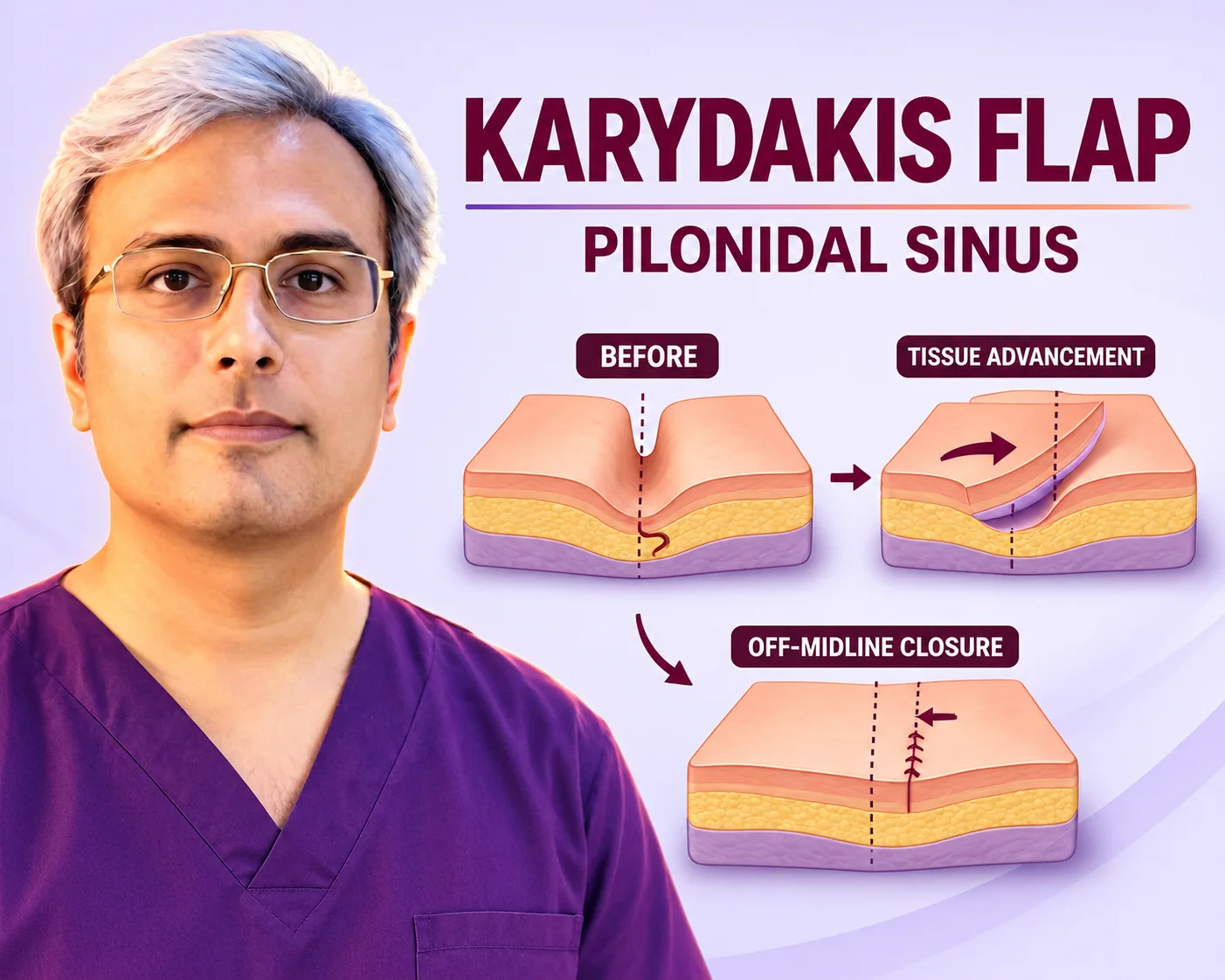
- The Karydakis flap removes diseased skin and slides healthy skin across, so the scar sits to one side.
- Trials show it works as well as the Limberg flap, and one trial found it about 7 minutes quicker to perform.
- Dr. Vishal Purohit performs Karydakis and Limberg flap surgery in Jaipur, matched to each patient’s shape.
Who this surgery is for
The Karydakis flap is an off-midline operation for pilonidal sinus disease. Off-midline means the final scar sits away from the centre line. It treats leaking pits, returning abscesses, and side tracts that spread under the skin near the tailbone.
The idea behind it is simple. Pilonidal disease starts in a deep buttock cleft. Loose hairs collect there. Friction pushes them into the midline skin. A scar sitting in that damp groove invites the same trouble back. So this surgery moves the final scar out of the groove and flattens the cleft at the same time.
This page is for two groups. The first is patients with active disease who have been advised flap surgery. The second is patients whose midline closure or open excision failed elsewhere. The Karydakis shape works well in redo cases, because it cuts out scarred midline skin and swaps in healthy moving tissue.
One fact shapes this whole page. Dr. Vishal Purohit performs Limberg and Karydakis off-midline flap surgery in Jaipur, plus urgent abscess drainage. The clinic does not offer phenol, SiLaC laser, endoscopic or pit-picking methods, Bascom cleft lift, Dufourmentel flap, or Z-plasty. Those appear here only as published background where a comparison is needed.
How the surgeon removes the diseased skin
The patient lies face down under spinal or general anaesthesia. The surgeon first maps every part of the disease: midline pits, side openings, the firm tracts joining them, and scars from old infection or surgery.
Then the marking is drawn. The surgeon outlines an uneven ellipse around all pits and tracts. One curved edge runs near the midline on the diseased side. The other edge swings wide onto healthy buttock skin. This uneven shape is deliberate. When the two edges join, the mismatch pushes the final wound off the midline.
The ellipse must hold the full disease area with a rim of healthy tissue. Any missed tract lining or trapped hair nest can bring early failure. Side openings join the marking wherever the skin allows. The outer edge must sit on truly healthy, well-supplied skin, because that side gives the sliding flap. In redo cases the ellipse takes as much old scar as can be removed while still closing without pull.
The cut goes down to the presacral fascia. This is the shiny layer over the tailbone. It forms both the deep safety margin and the anchor layer for repair. All tracts, pus tissue, hair nests, and swollen fat inside the ellipse come out in one piece. Bleeding is stopped with care, because trapped blood under the flap spoils healing.
How healthy skin is slid across and anchored
Once the disease block is out, the surgeon opens the flap from the healthy side. This is a full-thickness slide that carries deep fat with it. Its blood vessels stay intact so the moving edge keeps strong supply. Full thickness matters. A flap with deep fat feeds the wound edge well. A thin skin-only slide risks a pale edge that splits.
The opening spreads wide enough sideways that the flap glides across the gap with no pull. Pull is the enemy of every pilonidal closure. This design accepts a slightly wider side opening in exchange for a flat, relaxed closure.
Then comes the key repair step. The flap slides across the gap. Its deep surface is stitched to the presacral fascia with rows of dissolving stitches. This anchoring does three jobs at once:
- Holds position — the flap cannot drift back toward the midline while healing.
- Closes empty space — fluid gets no pocket to collect in under the flap.
- Keeps the cleft shallow — deep stitches hold the new flat shape, not just the skin stitches above.
The stitches use dissolving thread placed without strangling small blood vessels. A thin suction drain often lies beside the repair and leaves through a small side cut. It stays on gentle suction for the first days. Drains are standard care in these flaps, not a sign of poor technique. Even a well-anchored flap sheds early fluid, and removing that fluid lets it seal faster.
Why the scar sits to one side
Skin closure keeps the scar promise. The flap edge joins the inner wound edge so the scar lies off the midline, on the raised buttock slope. This side shift is the treatment.
A cleft scar sits in a warm, damp, high-friction groove where new loose hairs dig in easily. A slope scar sits on drier, calmer skin where hairs get less grip. Deep and middle stitch layers carry the load, so the skin itself feels almost no pull. The skin is closed with stitches or staples per surgeon choice.
Before skin closure the surgeon checks the empty space. Any leftover pocket invites fluid, infection, and breakdown. Deep anchoring, layered middle stitches, and suction drainage handle this three ways: the anchor keeps tissue joined, layered stitches close small gaps, and the drain removes early fluid. Before dressing, the surgeon presses the buttocks together to confirm the plan — a shallow cleft with the scar clearly off centre.
After surgery: what to expect
- Walk the same day; manage pain with standard tablets.
- Drain out in the first week; desk work in 2 to 3 weeks.
- Full sport at 6 to 8 weeks once wound review allows.
Contact the clinic early for spreading redness, foul-smelling discharge, fever, or wound edges opening. The lowest point of the wound needs the closest watch. Small edge slips there are the most reported nuisance and usually settle with dressings, because the anchored bed below carries rich blood supply.
Karydakis vs Limberg: what trials show
Patients often ask how this compares with the Limberg flap. Trial results reassure: pooled randomised trials in systematic reviews show similar return rates for both flaps. Both fix cleft mechanics rather than just removing tissue. So in skilled hands the shared approach gives equally lasting results.
The only recorded difference is speed. One randomised trial found the Karydakis flap about 7 minutes quicker than the Limberg flap. The reason is shape. Karydakis uses one uneven ellipse and a straight slide. Limberg needs exact diamond measures and a folded flap. Seven minutes is a small saving, but it shows the simpler build. Wound problems stay low for both, with minor lower-edge slips and fluid pockets reported at low rates.
| Feature | Karydakis flap | Limberg flap |
|---|---|---|
| Shape | Uneven ellipse with side slide | Diamond with folded flap |
| Scar position | Off-midline on buttock slope | Off-midline zigzag crossing the cleft |
| Reported return rate | Same as Limberg in trials | Same as Karydakis in trials |
| Operating time | About 7 minutes less in one trial | Slightly more for marking and folding |
For a Jaipur patient the takeaway is direct. Both clinic options belong to the same proven off-midline family. Karydakis suits midline-near disease, a medium-deep cleft, and healthy side skin. Wide or far-side defects may suit Limberg transfer better. The consult matches shape to build. Patients weighing smaller methods can read how smaller options compare with flap surgery. After healing, laser hair removal after healing protects the result.
Key figures from published series
- Limberg and Karydakis rebuilding are the 2 most used off-midline closure techniques in pilonidal sinus surgery (reported endpoint as published in a systematic review and meta-analysis).
- Karydakis and Limberg flaps show similar return results across randomised controlled trials (reported endpoint as published).
- About 7 minutes shorter operating time was reported for Karydakis flap than Limberg flap in one randomised trial (reported endpoint as published).
What Dr. Vishal Purohit does in Jaipur
Dr. Vishal Purohit is an M.Ch plastic surgeon treating pilonidal sinus disease in Jaipur, performing definitive Limberg and Karydakis off-midline flap surgery. No phenol, laser, or endoscopic shortcuts; matched to your anatomy.
At consult the surgeon maps pits, tracts, side branches, and old scars. He explains whether a Karydakis slide or a Limberg fold suits the cleft depth and disease spread. Every patient gets a written plan for anaesthesia, drain care, dressing dates, and hair-care teaching. Acute abscesses are drained urgently first, with staged flap repair once swelling settles.
Outstation patients get clear dates: mapping at the consult visit, day-care or short-stay surgery, drain removal in the first week, and reviews at 1, 3 and 6 weeks. Redo cases get longer watch. The flap is chosen for the build seen, never from a fixed menu. This is educational information, not medical advice.
Next step
Patients with leaking pits, repeat abscesses, or a failed operation elsewhere can book consultation with Dr. Vishal Purohit in Jaipur for scar and tract mapping with a build-matched Limberg or Karydakis plan. Bring old operation notes and scans where available.