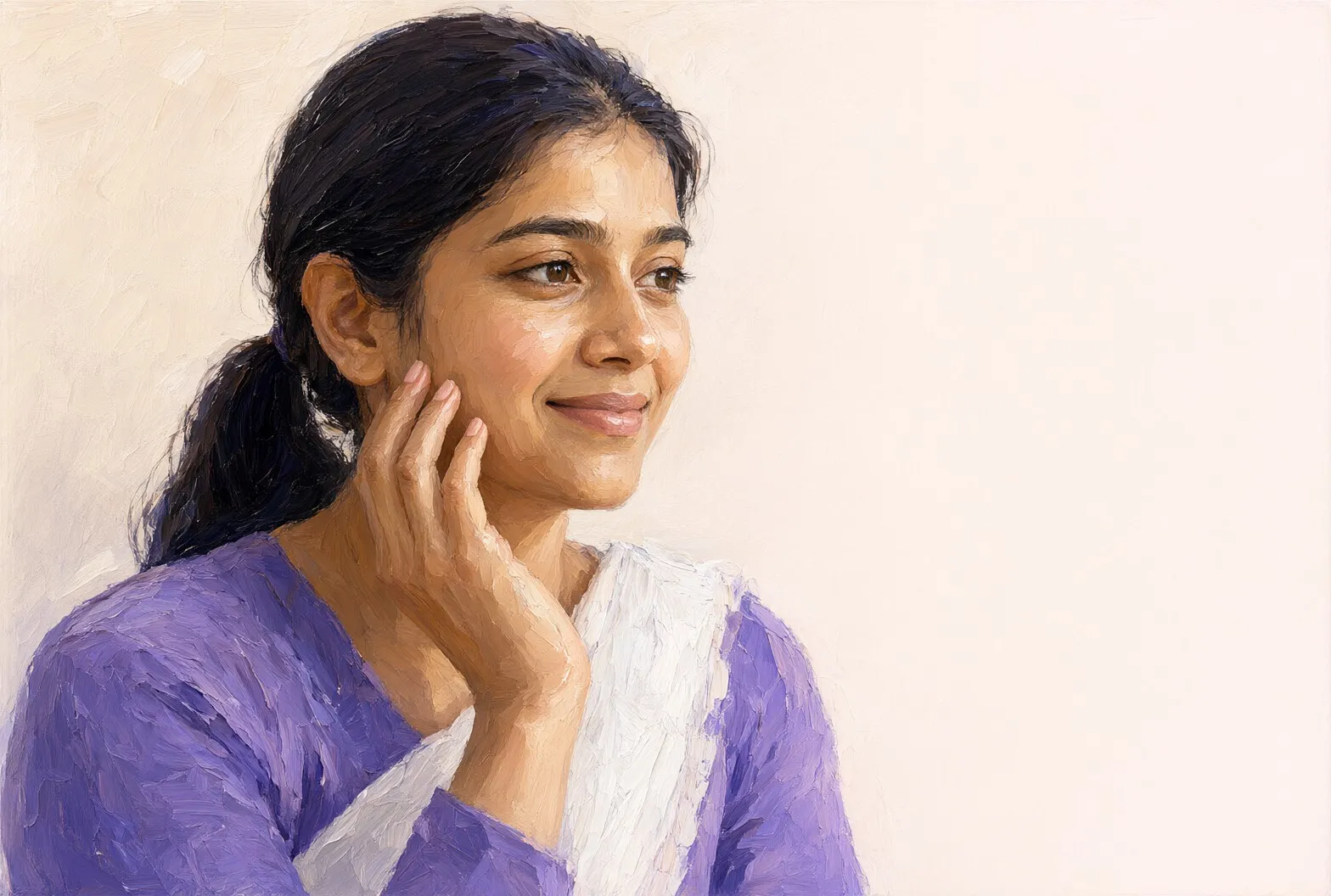
Cheek dimples often occur naturally when facial muscles attach directly to the dermis. Surgical dimpleplasty recreates this dynamic by forming an internal connection through the oral mucosa, leaving the external facial skin untouched.
Understanding how a dimple is created: the surgical steps helps clarify why incisions are kept inside the mouth. The resulting internal tether pulls the cheek skin inward to produce an indentation without external cuts.
Where the Incision Is
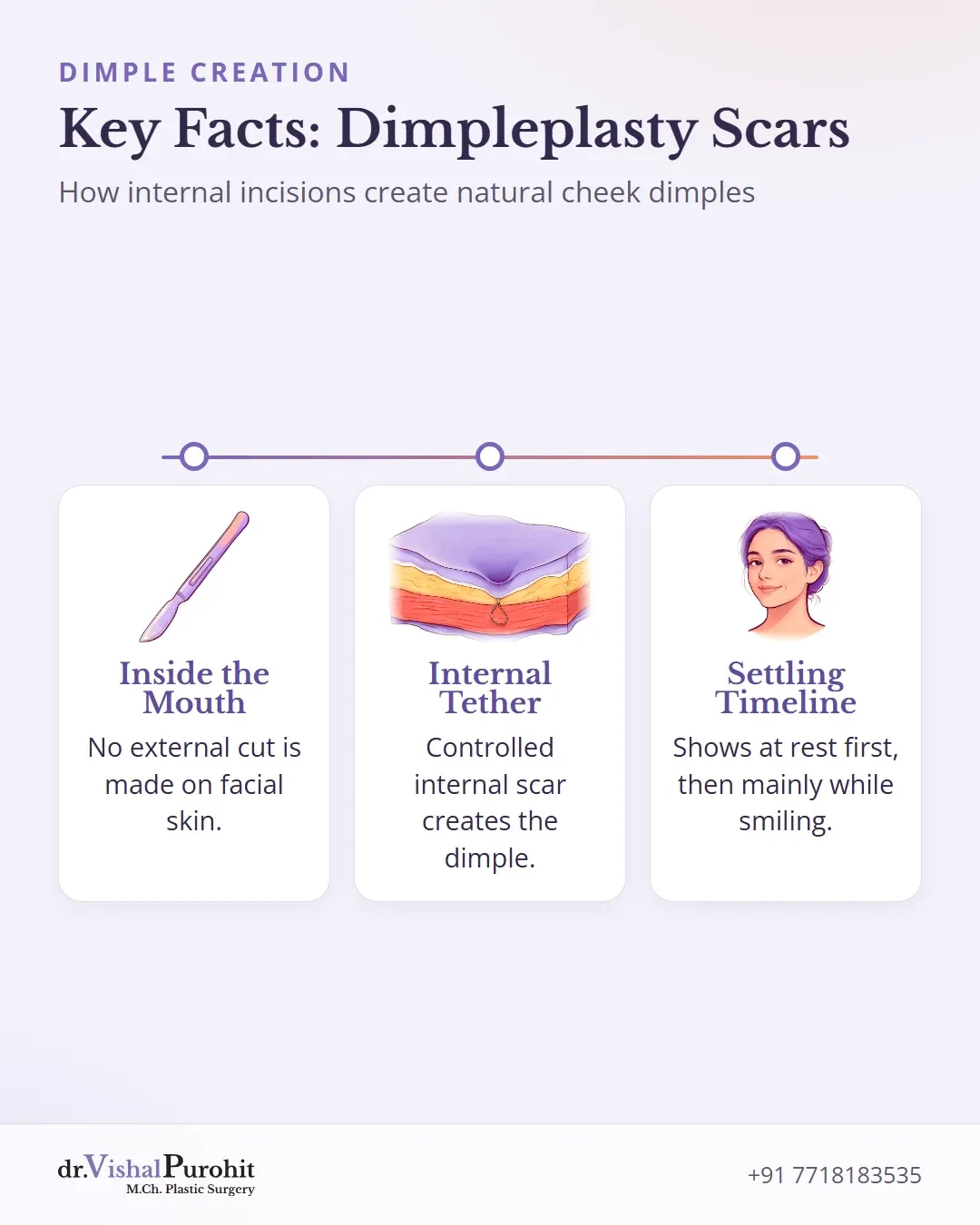
In Dr. Vishal Purohit’s practice, dimple creation is performed entirely from within the mouth. There is no cut made on the skin of the face.
Dr. Purohit’s note: He makes a small incision inside the cheek and uses an absorbable internal suture along with very slight electrocautery to the muscle.
The Intraoral Route in Literature
Surgical literature describes dimple creation as the formation of an attachment between the buccinator muscle and the dermis. Most surgeons consider the intraoral approach through the oral mucosa to be the preferred route of access.
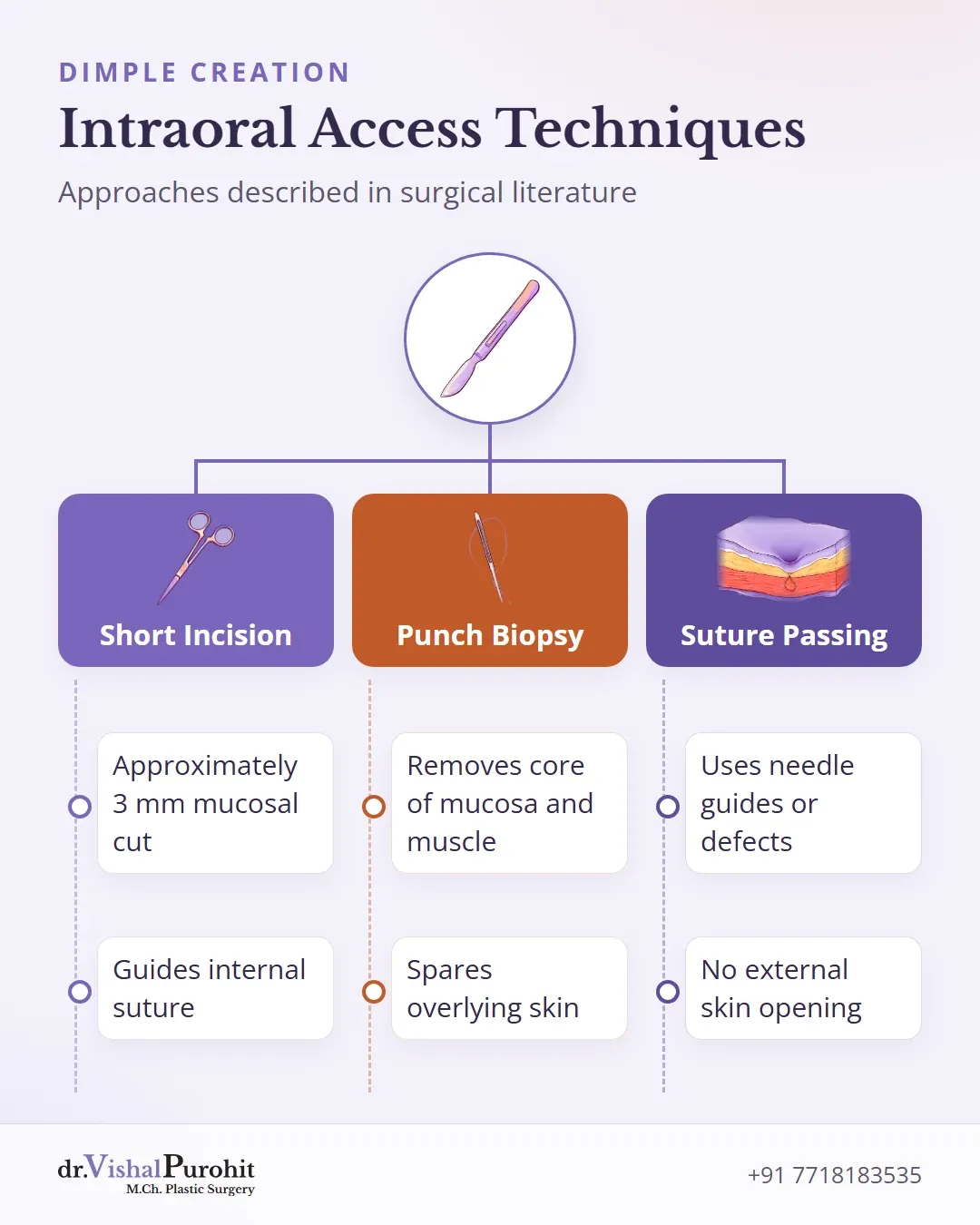
Literature records several intraoral techniques:
- Making a short mucosal incision of approximately 3 mm to guide a suture through the dermis, as described in classic methods.
- Using a punch biopsy instrument inside the mouth to remove a core of mucosa, submucosal fat, and cheek muscle while sparing the overlying skin.
- Passing sutures between the skin and muscle through needle guides or mucosal defects without an external skin opening.
Operating through the inside of the cheek keeps the surgical cut concealed within the mouth, sparing the facial skin from an external incision.

How the Inside Wound Heals
The mucosal lining inside the mouth heals quickly because oral tissues have an early onset of the inflammatory phase, rapid re-epithelialisation, and rapid fibroblast proliferation. The oral epithelium also serves as an important mechanical barrier to penetration.
Key points
- Tissues inside the mouth heal rapidly due to fast re-epithelialisation and early inflammation.
- Dimple creation uses an internal absorbable suture placed through the cheek lining without skin cuts.
- Diligent oral hygiene and a soft diet protect the internal stitch from complications.
In Dr. Vishal Purohit’s practice, dimple creation is performed through a small incision inside the cheek using an absorbable internal suture with very slight electrocautery to the muscle, leaving no cut on the facial skin. The internal stitch dissolves on its own and is not removed.
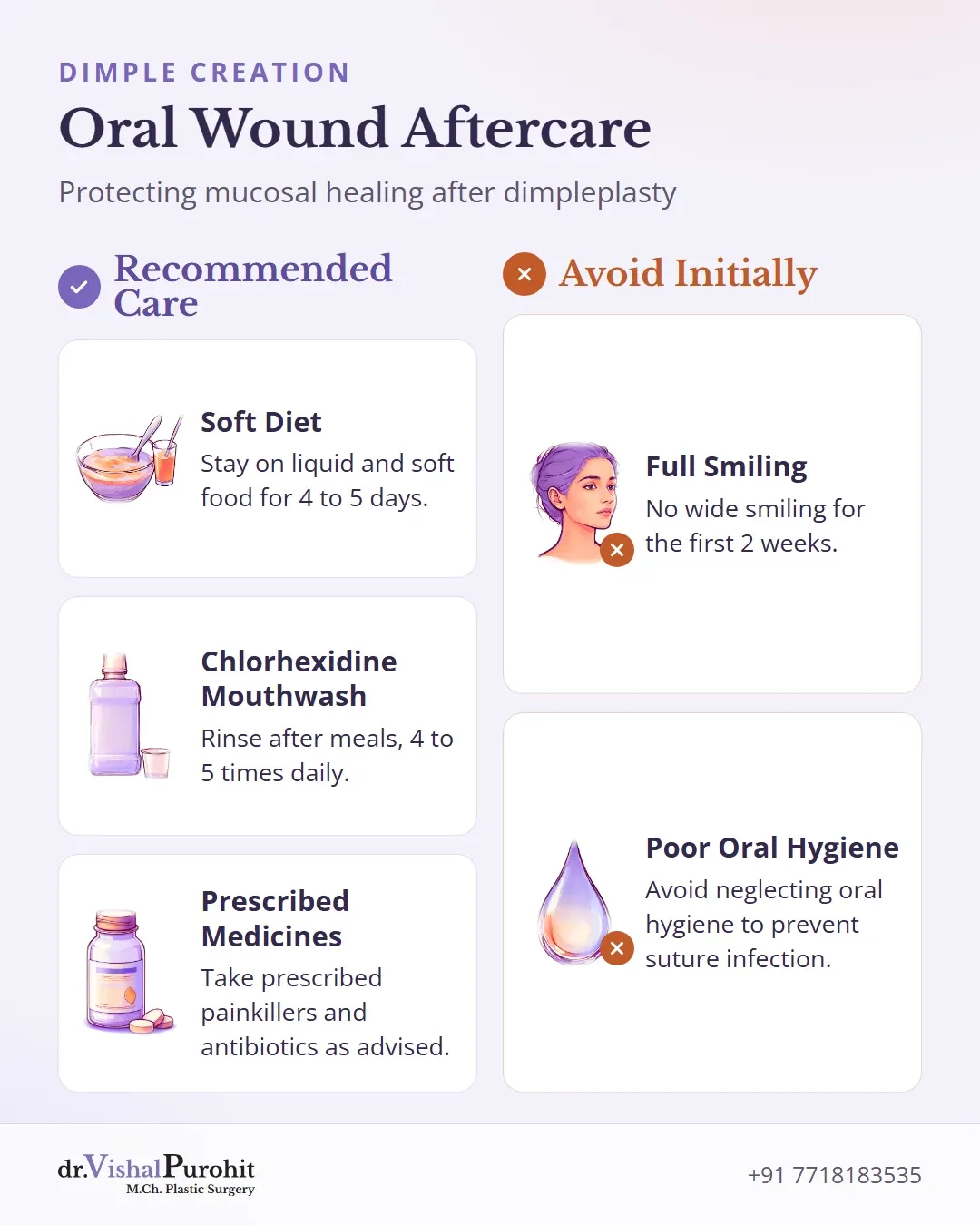
To protect the healing wound inside the mouth, postoperative care includes:
- Staying on a liquid and soft diet for 4 to 5 days
- Avoiding tooth brushing for the first 48 hours, then brushing gently at the back of the mouth
- Using chlorhexidine mouthwash after every meal, 4 to 5 times a day
- Taking prescribed painkillers and antibiotics
Surgical literature notes that dimple creation involves forming scar tissue between the buccinator muscle and the dermis. In published reports, good oral hygiene with mouthwash and oral rinsing is instructed during the immediate postoperative period. Although complications are reported to be rare, infections around surgical sutures can occur if oral hygiene is poorly maintained. In Dr. Purohit’s practice, patients must avoid wide smiling for the first 2 weeks, a precaution also reflected in literature advising against full smiling during early healing.

The Scar That Makes the Dimple
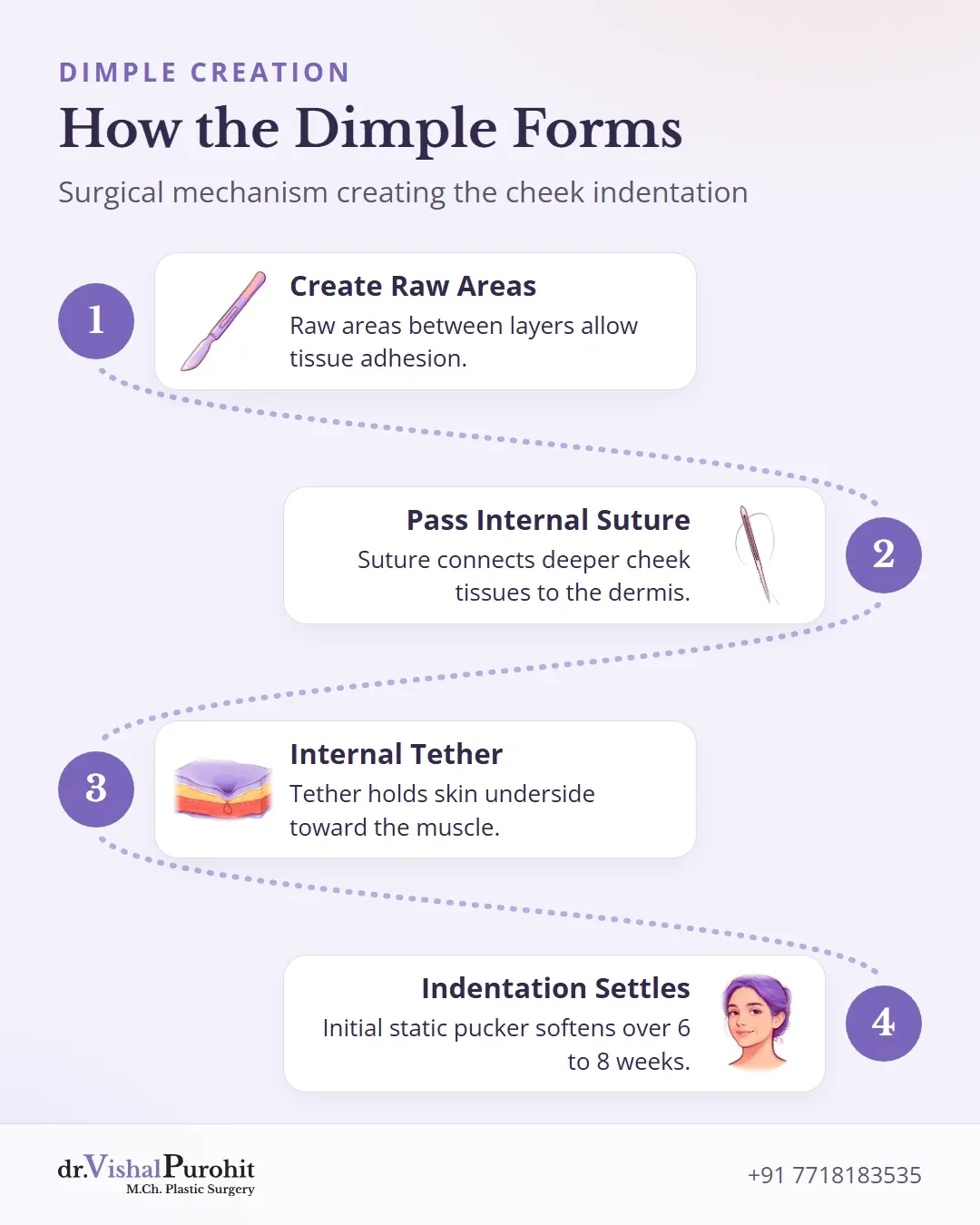
A natural cheek dimple is often linked to an anatomical variation, such as a bifid zygomaticus major muscle. When this variation is absent, a dimpleplasty creates a similar effect by relying on a controlled internal scar attachment.
Key points
- Dimpleplasty creates a natural-looking dimple by establishing a controlled internal scar between the cheek tissues and dermis.
- The procedure is done from inside the mouth with absorbable sutures, with no cut on the facial skin.
- The dimple is visible at rest initially and gradually settles by about 6 to 8 weeks to appear primarily upon smiling.
In surgical techniques, creating raw areas between opposing tissue layers allows them to adhere together. By passing an absorbable suture through the deeper cheek tissues and the dermis, an internal connection forms. This internal tether holds the under-surface of the skin toward the underlying buccinator muscle.
In Dr. Vishal Purohit’s practice in Jaipur, dimple creation is performed entirely through a small incision inside the cheek. He uses an absorbable internal suture along with very slight electrocautery to the muscle, ensuring there is no cut on the facial skin. The internal stitch dissolves on its own and is not removed.
This internal healing creates the tether that pulls the skin inward. The resulting dimple shows at rest at first, and then settles by about 6 to 8 weeks so that it appears mainly on smiling.

Marks on the Skin
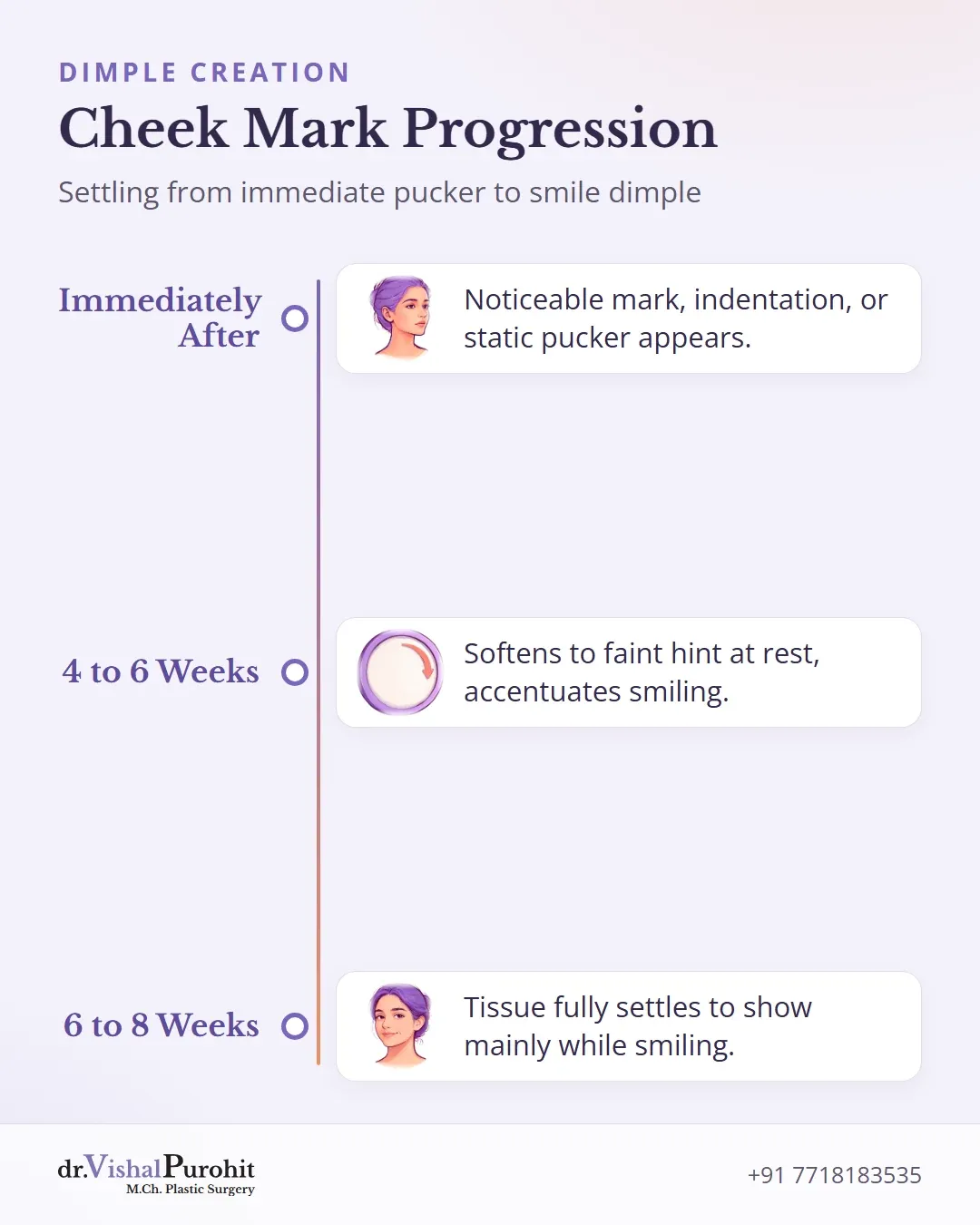
Because the incision is placed inside the mouth, there is no surgical cut on the exterior cheek skin during dimple creation. However, the procedure intentionally secures the deeper tissue to the underside of the cheek dermis to form the indentation.
Consequently, patients should not expect an absence of visible surface effects. A noticeable mark, indentation, or static pucker is expected on the cheek immediately following surgery. In Dr. Purohit’s practice, the dimple typically shows at rest at first and settles by about 6 to 8 weeks to show mainly on smiling.
Surgical literature describes this initial static appearance as part of the normal healing progression. Published reports note that an initially static dimple gradually softens to a faint hint at rest, accentuating naturally during facial animation within 4 to 6 weeks. General surgical texts also note that while postsurgical complications are rare in the initial stage, minor skin puckering or prolonged tethering can occasionally persist. Individuals with a known tendency toward keloids or abnormal scarring are advised against undergoing the procedure.
Keloid-Prone Skin
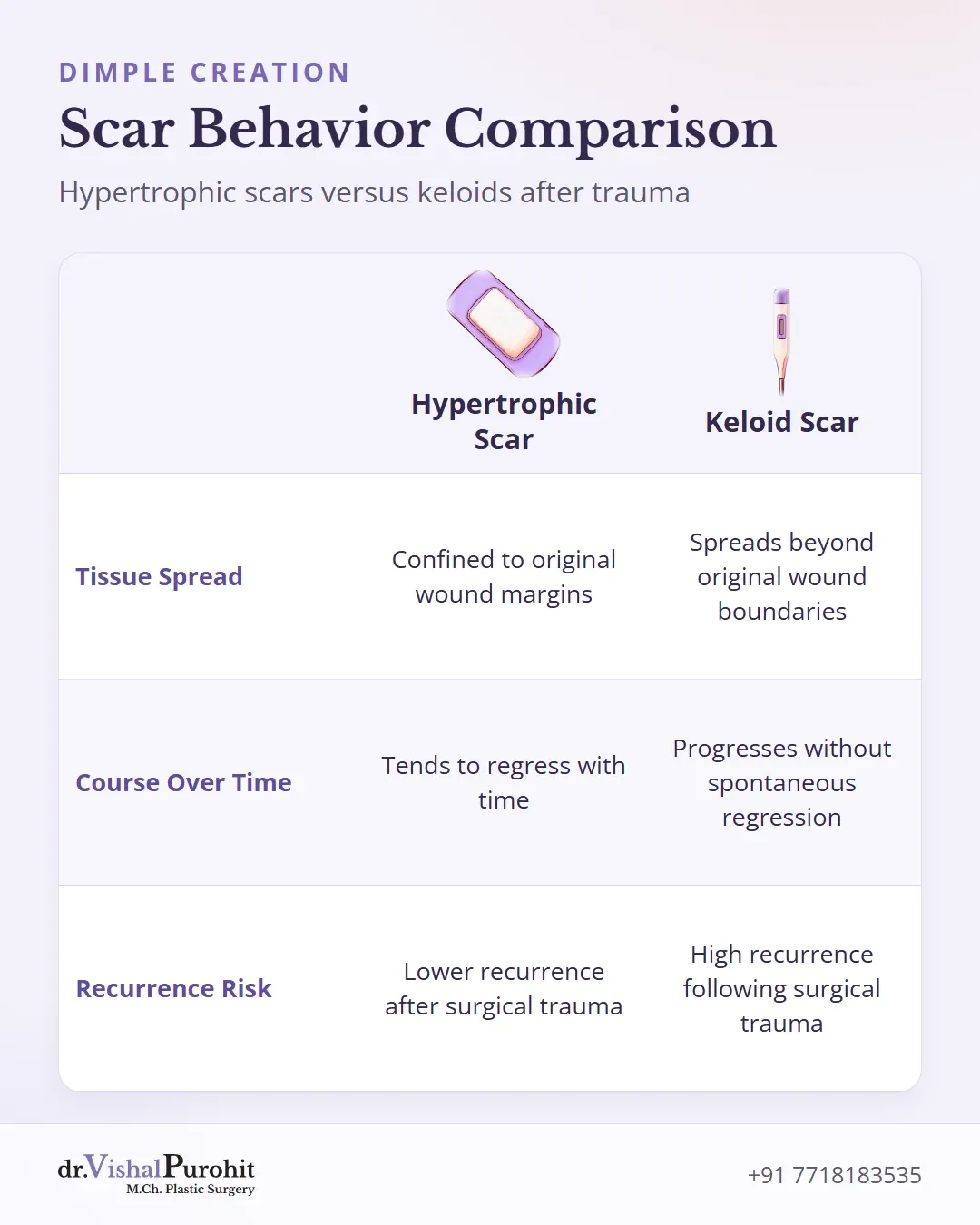
In the practice of Dr. Vishal Purohit, an M.Ch. plastic surgeon in Jaipur, a tendency to keloids or abnormal scarring is a clear reason to wait or not operate for cheek dimple creation.
Although cheek dimple creation places the surgical cut inside the mouth without an incision on the facial skin, people with a history of thick, raised scars need careful consideration before any elective procedure. A keloid scar is an overgrowth of dense fibrous tissue that spreads beyond the boundaries of the original wound. While hypertrophic scars stay confined to original wound margins and tend to regress with time, keloids often progress, do not spontaneously regress, and carry high recurrence risks following surgical trauma. Darker-skinned individuals and Asian populations also show a higher predilection or susceptibility to keloid formation.
Patients concerned about abnormal scar formation can consult the keloid treatment page for detailed guidance on how excessive scars are evaluated and managed.
Dimple Creation Consultations in Jaipur
Adults considering dimpleplasty can learn more about dimple creation in Jaipur to understand the technique and candidacy requirements. In Dr. Purohit’s practice, dimple creation under local anaesthesia costs ₹20,000 for one dimple and ₹35,000 for two dimples, or ₹55,000 under general anaesthesia for one or both, with the final figure confirmed after consultation. For additional details regarding safety, aftercare, and surgical expectations, review the dimple creation FAQs or call +91 7718183535.
This is educational information, not medical advice.