

Blepharoplasty is eyelid surgery. It removes or repositions the excess skin, muscle and fat that collect around the eyes with age, and it can be done on the upper lids, the lower lids, or both.
For many patients the goal is appearance — a less tired, less heavy look around the eyes. For others the goal is function, because loose upper eyelid skin has started to block the upper part of their vision. Both are valid reasons to have the operation, and the surgical plan is different for each.
At Kalpana Aesthetics, these procedures are performed by Dr. Vishal Purohit (M.B.B.S., M.S., M.Ch. Plastic Surgery). The aim is a result that suits your own face and still looks like you.
For the complete picture, read our full guide to blepharoplasty.
The Two Surgical Approaches
There are two ways to reach the tissues of the eyelid, and the names are often confused.
Transcutaneous (through the skin). The incision is placed in the natural crease of the upper lid, or just below the lash line on the lower lid. Because it gives direct access to skin, muscle and fat, this is the approach used whenever excess skin needs to be removed. It is the standard approach for upper eyelid surgery.
Transconjunctival (through the inner lining). The incision is made on the inside surface of the lower eyelid, against the conjunctiva, so there is no external scar at all. This approach reaches the fat pads but cannot remove skin. It is therefore used for the lower lid in patients whose main problem is bulging fat and whose skin still has good tone — often younger patients. Some surgeons refer to it as “closed” blepharoplasty, though that terminology is inconsistent in the literature.
Which approach suits you is decided at examination, not in advance. It depends on how much skin is redundant, where the fat sits, and the tone of your lower lid.
Surgical Approaches in Blepharoplasty Compared
| Surgical Approach | Incision Placement | Primary Target Tissue | Visible Scar Location | Ideal Candidate Profile |
|---|---|---|---|---|
| Upper Blepharoplasty | Natural supratarsal lid crease | Redundant skin and orbicularis muscle ± preaponeurotic fat | Well-hidden inside natural eyelid crease | Hooded lids, impaired visual field, dermatochalasis |
| Lower Transcutaneous | Subciliary (1–2mm below lash line) | Orbital fat bags and excess redundant lower skin | Inconspicuous subciliary margin | Prominent under-eye bags with loose, wrinkled skin |
| Lower Transconjunctival | Inner mucosal surface of lower lid | Herniated medial, central, and lateral fat pads | Zero external scar (internal incision) | Younger patients with fat bulges and firm skin tone |
| Pinch Blepharoplasty | Conservative pinch at subciliary line | Superficial skin pinch without muscle/fat disruption | Extremely fine subciliary line | Isolated fine skin laxity with zero fat herniation |
What Blepharoplasty Does — and What It Does Not Do
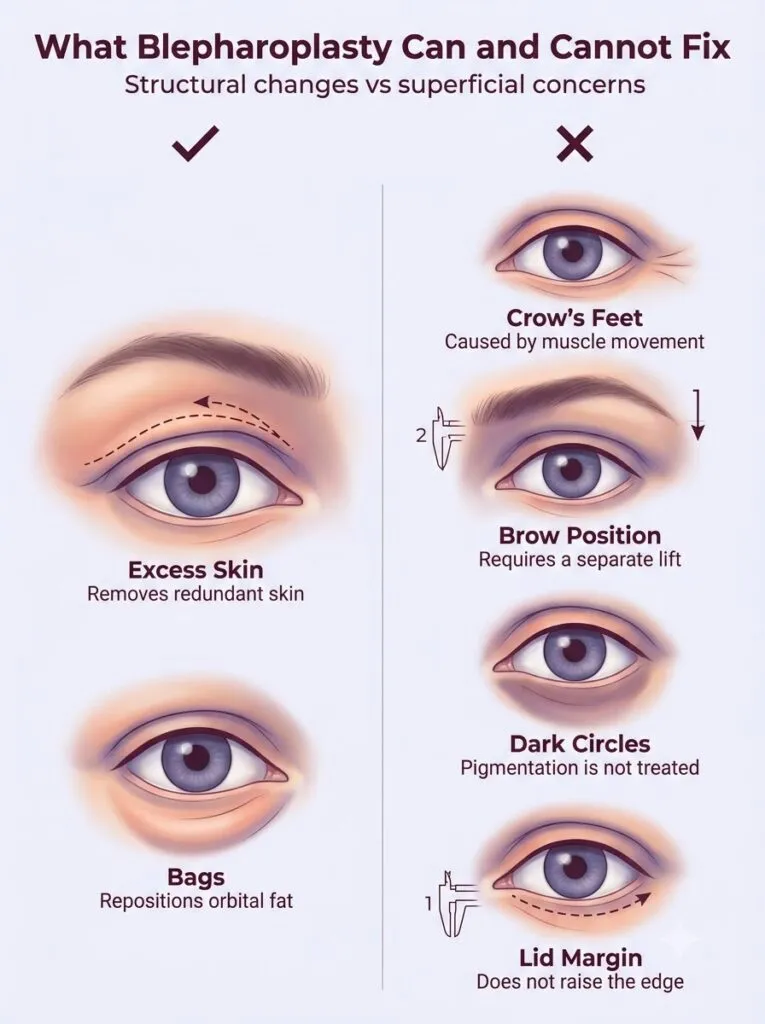
Eyelid surgery treats volume and laxity. It removes redundant skin, and it removes or repositions herniated orbital fat so the transition between the lower lid and the cheek is smoother. The result is usually a more open, more rested appearance, and this holds up because the change is structural rather than superficial.
It is equally important to be clear about the limits.
-
It does not treat crow’s feet or fine lines. Those wrinkles are caused by muscle movement and sun damage. They respond to botulinum toxin, resurfacing or chemical peels, not to eyelid surgery.
-
It does not lift the eyebrow. If a heavy brow is contributing to the hooding, removing more upper lid skin will not fix it, and may make the brow sit lower. A brow lift is a separate operation.
-
It does not remove dark under-eye circles. Pigmentation and thin skin are different problems, though correcting a shadow cast by a fat bulge can make circles look better.
-
It does not raise the eyelid margin. More on this below — it is the single most common misunderstanding.
Dermatochalasis Is Not the Same as Ptosis
This distinction changes the operation, so it is worth understanding before your consultation.
Dermatochalasis is excess, loose upper eyelid skin. The eyelid itself opens normally; there is simply too much skin draping over it. This is what blepharoplasty corrects.
Ptosis is a droop of the eyelid margin itself, usually because the levator muscle has stretched or detached from the tarsal plate. The lid sits low over the iris, and the eye looks smaller or sleepy even when the skin is lifted away.
The two often occur together. If ptosis is present and only the skin is removed, the eye will still look heavy afterwards — a disappointing and entirely avoidable outcome. Ptosis needs a separate manoeuvre, usually a levator advancement or a Müller’s muscle–conjunctival resection, performed through the same incision. Part of the purpose of the pre-operative examination is to measure your lid position and tarsal platform show so that this is identified before, not after, surgery.
Upper vs. Lower Blepharoplasty
Lower Eyelid Bags: Preserving Fat Rather Than Simply Removing It
The older approach to lower eyelid bags was straightforward fat removal. It works in the short term, but over the following years the mid-face continues to lose volume, and patients who had generous fat resection in their forties can look hollow and skeletonised in their sixties.
Current practice has moved towards fat preservation. Rather than excising the herniated fat, it is released and repositioned over the orbital rim to fill the tear trough hollow, so that the bulge and the groove correct each other. Selective, conservative resection still has a place where the fat volume is genuinely excessive, but it is now used judiciously rather than as the default.
This matters because periorbital skin thins and loses elasticity with age, and an over-resected lower lid is difficult to correct later.
Risks and Complications
Blepharoplasty is generally safe and well tolerated, but it is real surgery on a delicate structure, and you are entitled to know what can go wrong before you consent.
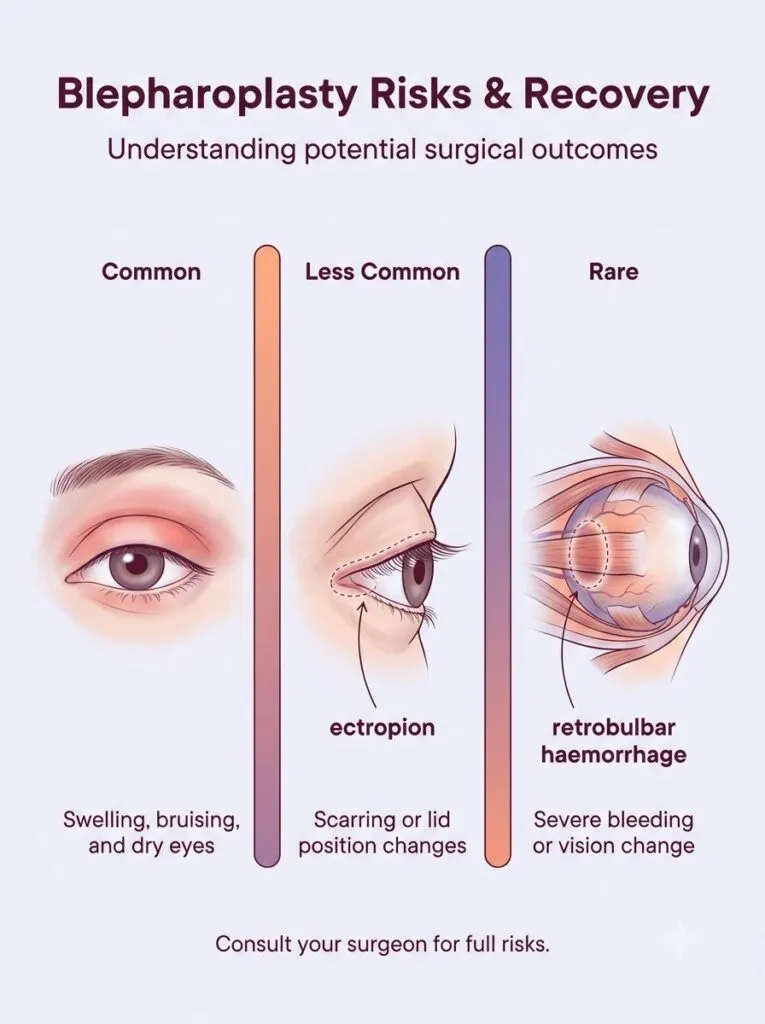
Common and usually temporary:
-
Swelling and bruising, occasionally marked, and often asymmetric between the two sides
-
Dry, gritty eyes and sensitivity to light, typically for a few weeks; some patients need lubricating drops for longer
-
Blurred vision from ointment and swelling in the first days
-
Chemosis — a jelly-like swelling of the conjunctiva that can take several weeks to settle
-
Numbness or altered sensation along the incision
Less common:
-
Visible or thickened scarring, or a small cyst along the suture line
-
Asymmetry, or residual skin or fat, sometimes needing a minor revision
-
Lower lid malposition — the lid pulling downward or outward (retraction or ectropion), which is the most significant aesthetic complication of transcutaneous lower blepharoplasty. Careful assessment of lid laxity beforehand, and canthal support where indicated, reduce this risk
-
Difficulty closing the eyes fully, usually transient
-
Infection, or a wound that separates
Rare but serious:
-
Retrobulbar haemorrhage — bleeding behind the eye. It is uncommon, but it is a surgical emergency, because untreated it can threaten vision. Sudden severe pain, rapidly increasing swelling or loss of vision after surgery must be reported immediately, at any hour.
-
Permanent visual change. This is very rare, but it is not zero, which is why the warning signs above are taken seriously.
Who Is Not a Good Candidate
Some patients should delay surgery, or avoid it. At consultation we specifically look for:
-
Thyroid eye disease that is active or not yet stable, and other causes of proptosis
-
Significant dry eye or previous LASIK, both of which make post-operative dryness worse
-
Uncontrolled hypertension, diabetes or bleeding disorders, and anticoagulant or antiplatelet medication that cannot safely be paused
-
Active smoking, which impairs wound healing
-
Glaucoma or other ongoing eye disease, which may need ophthalmology input first
-
Expectations that surgery cannot meet — for example, expecting eyelid surgery to change the shape of the eye, remove dark circles, or produce a specific celebrity result
If the assessment suggests you would not benefit, we will say so.
The Functional Side: When Eyelid Surgery Is Not Cosmetic
A number of patients arrive assuming this is purely an aesthetic operation, and are surprised to learn their symptoms have a name. When redundant upper eyelid skin hangs low enough, it obstructs the upper visual field. Patients describe lifting their eyebrows to see, tired or aching foreheads by evening, difficulty reading, and trouble with overhead signage while driving.
This is assessed objectively with a visual field test comparing the field with the lid taped up and untaped. Where the obstruction is documented, the surgery is functional rather than cosmetic, and it may be covered by insurance — worth checking with your insurer before you plan.
Anaesthesia and the Recovery Timeline
Most upper eyelid procedures are done under local anaesthesia with or without light sedation, as day surgery. Four-lid surgery, transconjunctival lower lid surgery, or blepharoplasty combined with another procedure is often more comfortable under sedation or general anaesthesia. This is decided with you and with the anaesthetist.
Two honest caveats. First, swelling resolves at very different rates between individuals and between the two sides of the same face, so do not judge symmetry early. Second, the lower lid takes longer than the upper. Scar maturation and the last of the deep swelling run to three to six months, so the result you see at one month is a good result, but not the final one.
Follow-up visits are scheduled through this period. Our detailed guidance on managing swelling and bruising covers the practical side at home.
Why the Choice of Surgeon Matters
The eyelid has very little margin for error. A millimetre of over-resection on the upper lid can prevent the eye closing; a few millimetres of unsupported lower lid can produce a lasting malposition. Judging how much to take, and how much to leave, is the substance of the operation.
Dr. Vishal Purohit holds an M.Ch. in Plastic Surgery and practises periorbital and facial aesthetic surgery in Jaipur. The approach here is conservative — assessment first, a plan matched to your anatomy and your reason for seeking surgery, and a frank conversation about what the operation will and will not change.
You can read what happens at your first consultation before you book.
Cost and Consultation
The cost of blepharoplasty in Jaipur varies with whether one or both lids are treated, whether ptosis correction or canthal support is needed, and the type of anaesthesia and facility required. A single quoted figure would be misleading before examination. You will receive a written estimate covering the surgeon’s fee, anaesthesia, facility charges and follow-up after your consultation, with no obligation to proceed. Where the surgery is functional, we can help you document the visual field findings for your insurer.
Frequently Asked Questions
Is the blepharoplasty procedure painful?
Blepharoplasty is generally not considered a painful procedure. Patients at Dr. Vishal Purohit’s Jaipur clinic typically experience mild discomfort, tightness, or a sensation of heaviness around the eyes rather than sharp pain. The surgery is performed under local anesthesia with sedation or general anesthesia, ensuring you feel nothing during the operation. Post-operative discomfort is easily managed with prescribed oral pain medication and cold compresses. As a board-certified plastic surgeon, Dr. Purohit utilizes precise surgical techniques that minimize tissue trauma, leading to a highly comfortable recovery.
How long is the recovery after blepharoplasty?
Initial recovery after an eyelid lift with Dr. Vishal Purohit takes about 7 to 10 days, at which point most patients in Jaipur feel comfortable returning to work and normal social activities. Bruising and swelling peak around the second or third day and gradually subside over the first two weeks, with sutures typically removed within 5 to 7 days. To ensure optimal, complication-free healing, Dr. Purohit advises avoiding strenuous exercise, heavy lifting, and activities that increase blood pressure for at least two to three weeks.
Will I have visible scars after blepharoplasty surgery?
Visible scarring after blepharoplasty is extremely minimal. Dr. Vishal Purohit strategically places incisions in the natural creases of the eyelids to ensure that any resulting scars are naturally concealed. For upper eyelid surgery, the incision is hidden within the natural fold of the lid; for lower eyelid surgery, it is placed either just below the lash line or inside the lower eyelid (transconjunctival approach). With advanced surgical training, Dr. Purohit’s meticulous suturing techniques ensure that once fully healed, the incision lines fade significantly and remain virtually undetectable.
How long do the results last after blepharoplasty?
The results of a blepharoplasty are highly durable, often refreshing a patient’s appearance for 10 to 15 years or more. Lower eyelid surgery rarely needs to be repeated, as the removed fat pads typically do not return. While the procedure permanently removes excess skin and fat, it does not stop the natural aging process, meaning upper eyelids may eventually show signs of aging again due to the natural loss of skin elasticity over time. Dr. Purohit recommends maintaining a healthy lifestyle and a good skincare regimen to preserve your rejuvenated appearance.
Will my results look like someone else’s after a cosmetic eyelid surgery?
No, your results will be uniquely tailored to your own facial anatomy. Dr. Vishal Purohit’s goal in Jaipur is to restore your natural, rested appearance, not to alter the fundamental shape of your eyes or mimic another person’s features. During your consultation, a customized surgical plan is created based on your specific degree of skin laxity, fat distribution, and bone structure. Dr. Purohit emphasizes a conservative approach—removing just enough tissue to eliminate the “tired” look while preserving your distinct ethnic and individual identity.
Can blepharoplasty be combined with other procedures?
Yes, blepharoplasty is frequently and safely combined with other facial rejuvenation procedures at Dr. Vishal Purohit’s Jaipur clinic for a more comprehensive transformation. It is commonly performed alongside a facelift, eyebrow lift, or structural fat grafting to address multiple signs of aging in a single surgical session. Combining procedures not only ensures balanced, harmonious facial proportions but also consolidates your downtime, allowing you to undergo one unified recovery period rather than multiple separate ones.
Expert Blepharoplasty & Eyelid Rejuvenation in Jaipur
Are you seeking a rested, refreshed, and natural appearance around your eyes? Schedule a comprehensive periorbital consultation with Dr. Vishal Purohit, board-certified M.Ch plastic surgeon at our premier Jaipur clinic.
- Surgical Procedures & Consultations: Visit our dedicated Blepharoplasty Surgery in Jaipur suite to review treatment plans, daycare recovery, and book your evaluation.
- Candidate & Recovery Guides: Review our detailed guides on Am I a Good Candidate for Blepharoplasty? and Week 1 Blepharoplasty Recovery.