
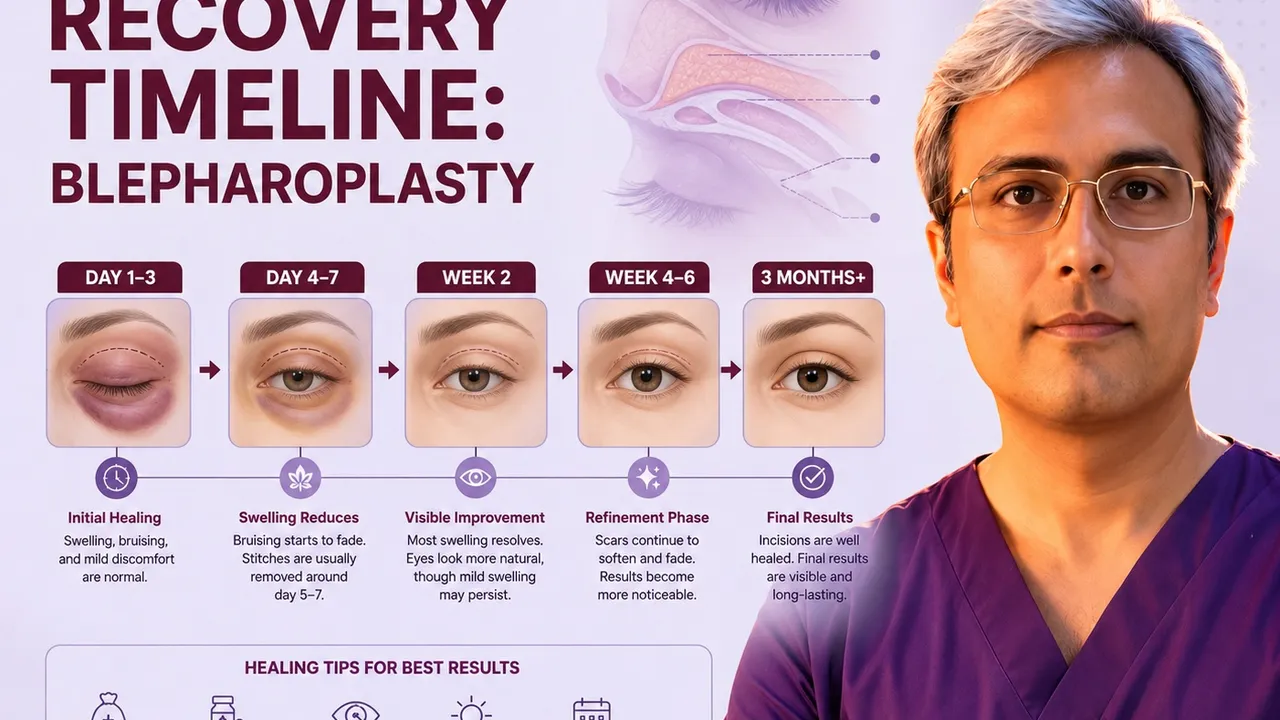
Most people are presentable in public around ten to fourteen days after eyelid surgery. But that figure hides a lot of variation, and it is not the same answer as “when will my eyes look finished.” Swelling settles in stages, and the last few percent of refinement can take several months.
This guide sets out what actually happens, week by week, for both upper and lower eyelid surgery — and, just as importantly, which symptoms mean you should call us straight away.
As an M.Ch. Plastic Surgery specialist, Dr. Vishal Purohit tailors the recovery plan to the procedure performed and to your individual healing. For the full picture of the operation itself, see our complete guide to blepharoplasty, or read about our approach at our cosmetic surgery centre in Jaipur.
Warning signs: when to call us immediately
Complications after eyelid surgery are uncommon, but a small number are urgent. Contact us or attend an emergency department without delay if you notice any of the following:
-
Sudden or worsening loss of vision, or double vision. This is the single most important warning sign.
-
Severe, escalating pain behind the eye, particularly with a tense, bulging eye or rapidly increasing swelling.
-
Bleeding that does not settle with gentle pressure, or a swelling that visibly expands over minutes to hours.
-
Fever, spreading redness, or thick discharge after the first few days, which may suggest infection.
The first two can indicate a retrobulbar haemorrhage — bleeding behind the eye. It is rare, but it is sight-threatening and time-critical, and it needs assessment within hours, not the next morning. Do not wait for your scheduled follow-up.
Multi-Stage Healing Milestones After Blepharoplasty
| Healing Phase | Visible Appearance & Swelling Level | Permitted Daily & Physical Activities | Makeup & Contact Lens Rules |
|---|---|---|---|
| Week 1 (Days 1–7) | Visible swelling, bruising around eyes | Desk work at home, short walks, resting | No eye makeup; glasses only (no contacts) |
| Week 2 (Days 8–14) | Mild residual puffiness; bruising fading | Return to office work, driving, social outings | Mineral makeup allowed; contacts cleared |
| Weeks 3 – 4 | 80% swelling resolved; incisions pink | Light gym workouts, brisk walking, yoga | Full makeup application permitted |
| Weeks 6 – 8 | 90% resolution; natural lid mobility | Heavy weightlifting, running, contact sports | Unrestricted athletic activities |
| Months 3 – 6 | 100% final contour; scars mature to white | Full long-term stabilized periorbital result | Complete aesthetic outcome achieved |
The recovery timeline
Upper and lower eyelid surgery do not heal at the same pace. Lower lid work involves a larger tissue plane and more lymphatic disruption, so swelling lingers noticeably longer.
Individual healing varies. Older patients, those with thicker skin, and anyone who has had previous eyelid surgery may sit at the slower end of every row above.
Activity, work and exercise
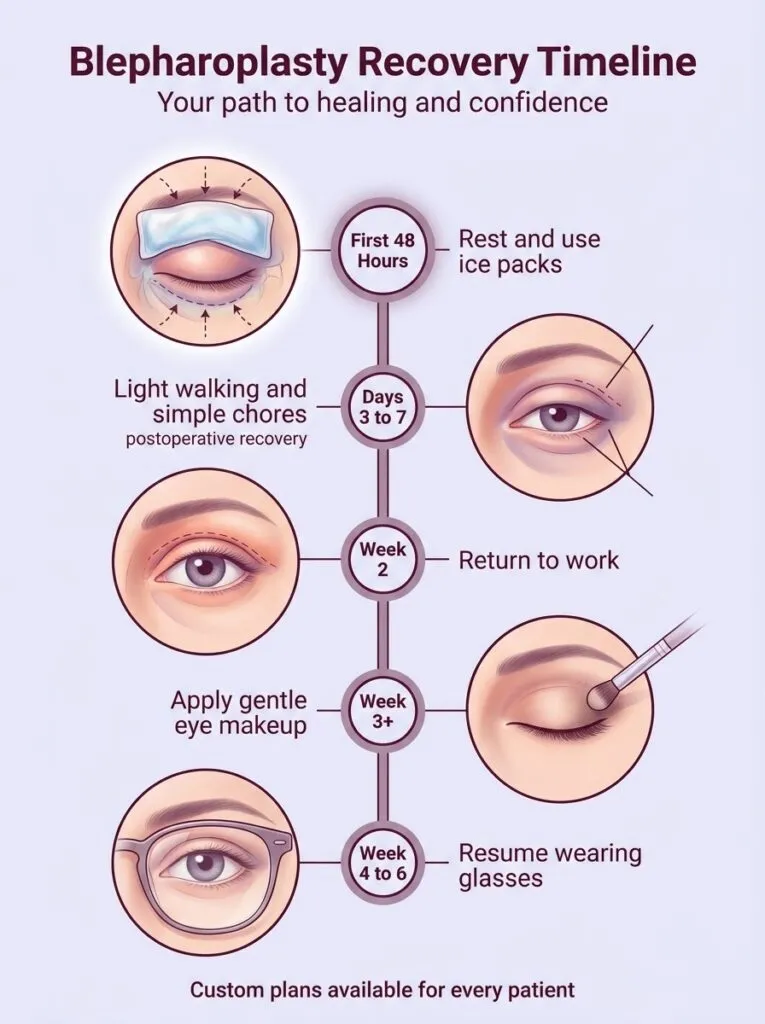
First 48 to 72 hours. Rest with your head elevated, including while sleeping — two pillows or a recliner. Apply cold compresses in short intervals rather than continuously. Avoid bending forward, lifting, and straining, all of which raise venous pressure in the head and increase bleeding and swelling.
Days 3 to 7. Gentle walking is encouraged; it helps circulation without raising blood pressure sharply. Light household activity is fine. Reading and screens are permitted, though your eyes may tire quickly and feel dry.
Week 2. Most patients return to desk-based work. Physically demanding jobs and anything involving heavy lifting or heat exposure should wait longer — discuss your specific role with us.
Weeks 3 to 4. Most people resume moderate exercise. Swimming, hot tubs and saunas should wait until the incisions are fully sealed, typically around four weeks.
Contact sports and anything with impact risk should wait a minimum of four to six weeks.
Makeup, lenses and eye protection
Eye makeup should be avoided until the incisions are fully closed and your surgeon confirms it is safe — usually around two to three weeks, and later around the lower lid margin. Use fresh products rather than old ones, and remove them gently without dragging on the skin.
Contact lenses are the real restriction after eyelid surgery, and are typically avoided for around two weeks. Insertion and removal both stretch the lid, and post-operative dryness makes lenses uncomfortable in any case. Spectacles, by contrast, rest on the nose and ears rather than the eyelids and are generally not a problem — heavy frames are simply worth avoiding in the first few days.
Sun protection matters more than most patients expect. Ultraviolet exposure on healing scars drives pigmentation that can take many months to fade. Wear large sunglasses and a hat outdoors for the first several weeks, and use sun protection on the scars once they have sealed.
Normal but unsettling: what to expect
These are common, temporary, and not causes for alarm:
-
Dryness, grittiness or watering. Very common in the first few weeks. Lubricating drops help; the sensation usually resolves as lid function normalises.
-
Chemosis — a jelly-like swelling of the surface of the eye, seen more after lower lid surgery. It looks alarming and settles with time and lubrication.
-
Incomplete lid closure at night (lagophthalmos). Usually transient, and managed with ointment at bedtime.
-
Blurred vision from lubricating ointment, which clears once it disperses.
-
Asymmetry during healing. The two sides almost never swell and settle at the same rate. Judging symmetry before three months is judging an unfinished result.
Post-operative care
Our standard instructions cover the following:
-
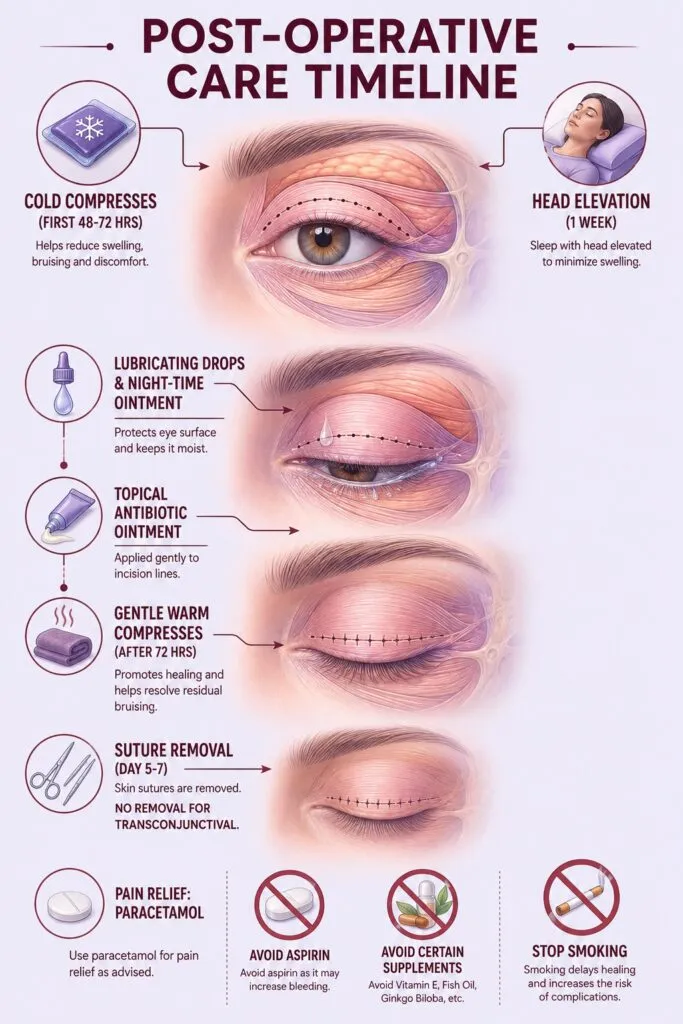
Cold compresses for the first 48 to 72 hours, switching to gentle warm compresses afterwards to help resolve bruising.
-
Head elevation, including at night, for the first week.
-
Lubricating drops and night-time ointment to protect the eye surface while lid function recovers.
-
Topical antibiotic ointment to the incision lines. Routine oral antibiotics are not used for clean eyelid surgery, as the evidence does not support them and they carry their own risks. They are reserved for specific clinical indications.
-
Pain relief with paracetamol as first line. Avoid aspirin and NSAIDs such as ibuprofen unless we have specifically advised otherwise, as they increase bleeding risk. The same applies to fish oil, vitamin E, ginkgo and several other supplements — tell us what you take before surgery.
-
Minimal or no dressing. The incisions are usually left open so that compresses, drops and ointment can be applied and so that the wounds can be inspected. A bulky compressive dressing is not routine.
-
Suture removal at day five to seven for skin sutures. Transconjunctival lower lid surgery generally uses dissolving sutures and needs no removal.
-
Stopping smoking, ideally for several weeks either side of surgery. Nicotine constricts small vessels and measurably impairs wound healing.
Why the final result takes months
The visible swelling resolves quickly, which is why patients often feel presentable within two weeks. What takes longer is the resolution of deep tissue oedema and the maturation of scar tissue. Collagen in a healing incision continues to remodel for months, and the fine contour of the lid — the crease height, the fullness beneath the lashes — only settles once that process is largely complete.
Scars remain slightly pink and firm for six to twelve weeks before softening and paling. Upper lid incisions sit within the natural crease and typically become difficult to see; lower lid incisions sit just below the lash line or are hidden entirely inside the lid.
Practically, this means: judge your early result generously, and reserve final judgement for three to six months.
Surgical technique and healing
Technique influences recovery. A transconjunctival approach to the lower lid, for example, avoids an external skin incision altogether and leaves no visible scar, while a skin-muscle flap allows skin redraping where laxity is the main problem. Careful tissue handling, meticulous haemostasis and conservative fat management are the elements that most affect swelling and downtime.
The right choice depends on your anatomy and your goals rather than on any single method being superior. We discuss the options, and the trade-offs of each, at consultation. Detail on managing the early phase is available in our guide to swelling and bruising after eyelid surgery.
Frequently asked questions
How long does the swelling last afte eyelid surgery?
Swelling peaks in the first two to three days and falls substantially over the following week. Most visible swelling has resolved by two weeks. Subtle fullness, particularly in the lower lids, can persist for six to twelve weeks, and fine contour continues to refine for several months.
How long does bruising take to clear after blepharoplasty?
Bruising typically peaks around day two to three, changes colour through the first week, and has usually faded by ten to fourteen days. Lower lid bruising can track down onto the cheek and may take a few days longer. Concealer is usually effective from around two weeks.
When can I go back to work after Cosmetic Blepharoplasty?
Around two weeks for most office-based roles, once bruising is concealable and swelling has settled. Some patients working from home resume light duties within a week. Physically demanding work requires longer.
Will I have visible scars after a cosmetic blepharoplasty?
Upper eyelid incisions are placed within the natural crease and generally become very difficult to see once mature. Lower lid incisions sit just beneath the lash line or, with a transconjunctival approach, entirely inside the lid with no external scar. All scars pass through a pink, firm phase before softening over three to six months.
When is the final result visible after cosmetic blepharoplasty?
You will look considerably better within two to three weeks. The settled, final result is typically apparent between three and six months, and sometimes a little later after lower lid surgery.
This article is for general education and does not constitute individual medical advice. Recovery varies between patients and between procedures. Please follow the specific instructions given to you by your own surgeon.
Written by Dr. Vishal Purohit, M.Ch. Plastic Surgery. Last updated 26 July 2026.
To discuss your suitability or book a consultation in Jaipur, call +91 77181 83535.
For day-by-day care guidance immediately following surgery, review our guide to the first week of blepharoplasty recovery.
Expert Blepharoplasty & Eyelid Rejuvenation in Jaipur
Are heavy, drooping upper eyelids or prominent under-eye bags making you look tired, aged, or obstructing your visual field? Schedule a detailed periorbital examination with Dr. Vishal Purohit, board-certified M.Ch plastic surgeon in Jaipur.
- Comprehensive Master Guide: Explore our foundational clinical overview on What is Blepharoplasty? Eyelid Surgery Explained.
- Surgical Procedures & Consultations: Visit our specialized Blepharoplasty Surgery in Jaipur suite to review surgical approaches, recovery milestones, and book your clinical evaluation.