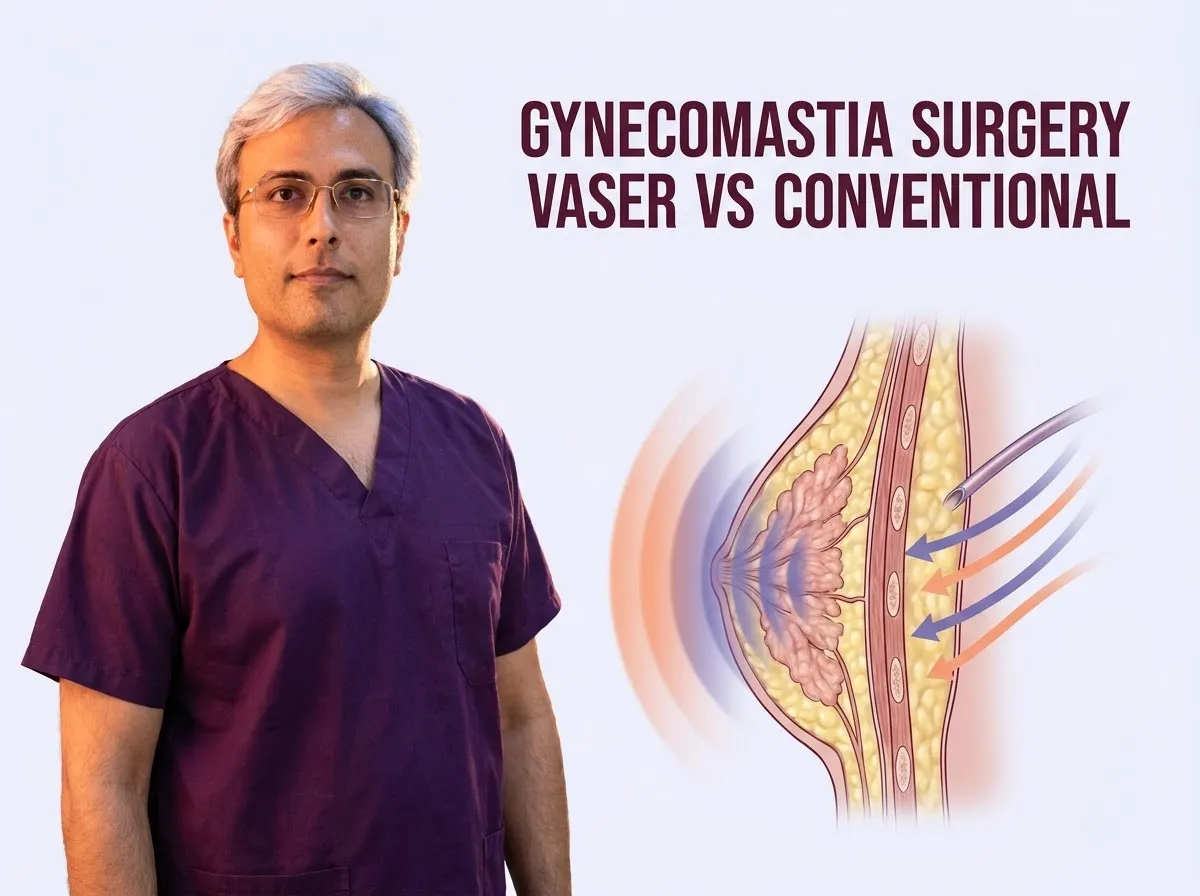
Not all liposuction is the same, but the differences matter less than many patients expect. Suction-assisted liposuction (SAL), power-assisted liposuction (PAL), and VASER ultrasound-assisted liposuction all end the same way — a cannula removes emulsified fat through a small skin opening. The technologies differ in how the fat is loosened before aspiration.
During an evaluation with an M.Ch gynecomastia surgeon in Jaipur, the choice of approach depends more on your individual tissue density and skin elasticity than on the specific aspiration tool alone.
The published comparison between UAL and conventional liposuction for gynecomastia rests largely on a single retrospective study of 219 patients over 13 years, so the evidence is real but limited. Understanding what each technique can and cannot do helps set realistic expectations before any consultation.
Liposuction Technologies in Plain Words
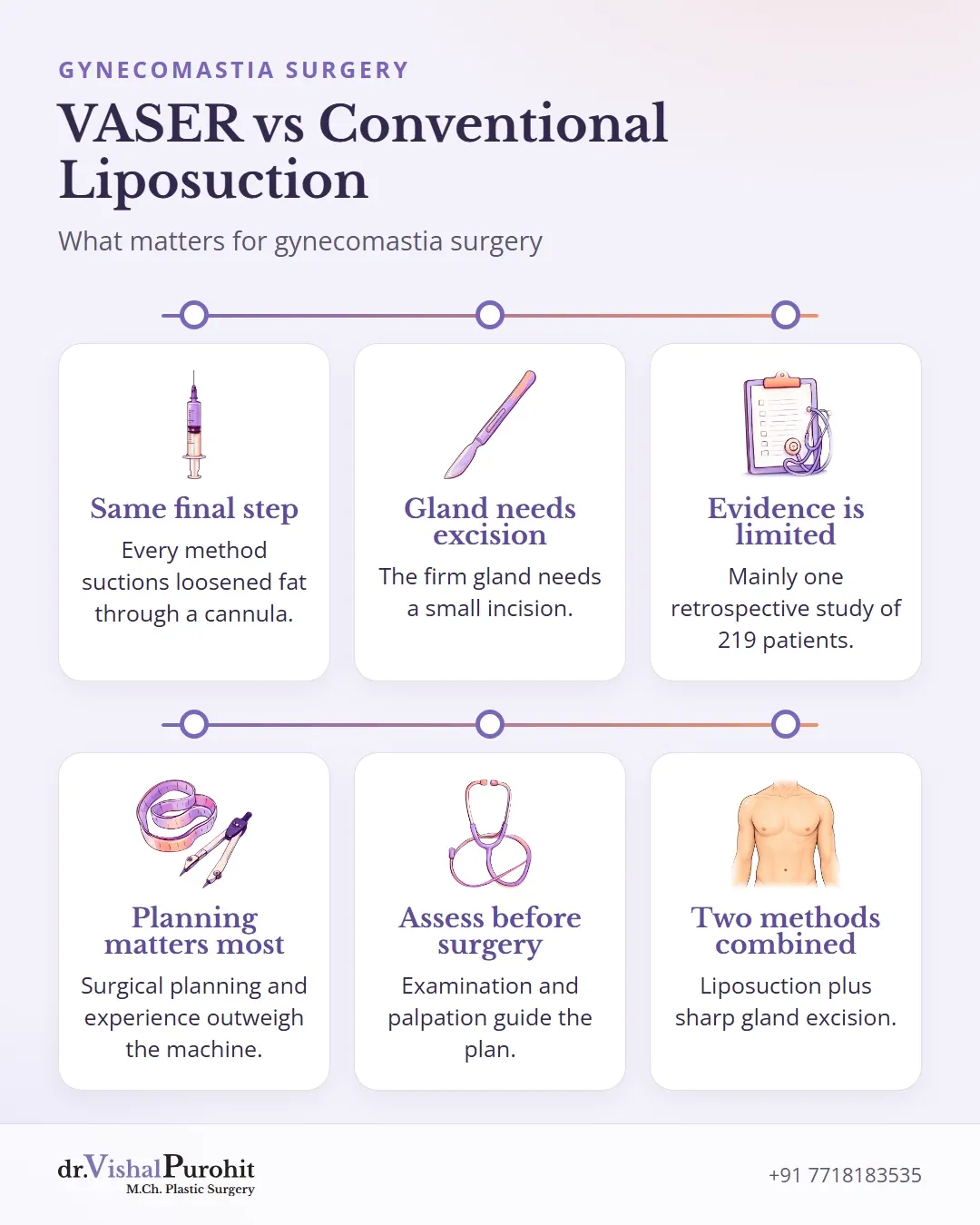
All liposuction methods share the same final step: a thin hollow tube, or cannula, is passed through a small skin opening and connected to a suction device that draws away loosened fat. The technologies differ in how they loosen the fat before it is suctioned out.
Key points
- Every liposuction method suctions loosened fat through a small skin opening.
- The methods differ mainly in how they loosen fat before suction.
Suction-Assisted Liposuction (SAL)
Conventional liposuction, also called suction-assisted lipectomy (SAL), relies on the back-and-forth movement of the cannula alone to break up fat cells1. It is effective for soft fatty tissue and is still widely used for blending contours around the chest2.
Power-Assisted Liposuction (PAL)
PAL adds a rapid mechanical vibration to the cannula tip. This oscillation breaks up tissue with less physical effort from the surgeon and is described in the literature as reducing operative fatigue while improving control during chest wall contouring3. PAL and UAL have both increased the amount of tissue that can be removed by liposuction alone in gynecomastia surgery3.
Ultrasound-Assisted Liposuction — VASER
UAL delivers ultrasonic energy through the cannula to emulsify fat before aspiration3. VASER is a newer form of UAL that applies alternating ultrasonic energy; many practitioners consider it a safer option when treating fibrous areas close to the skin surface3. The immediate subdermal layer is targeted with the aim of increasing skin contraction, though this requires care to avoid thermal injury3.
Water-Assisted Liposuction (WAL)
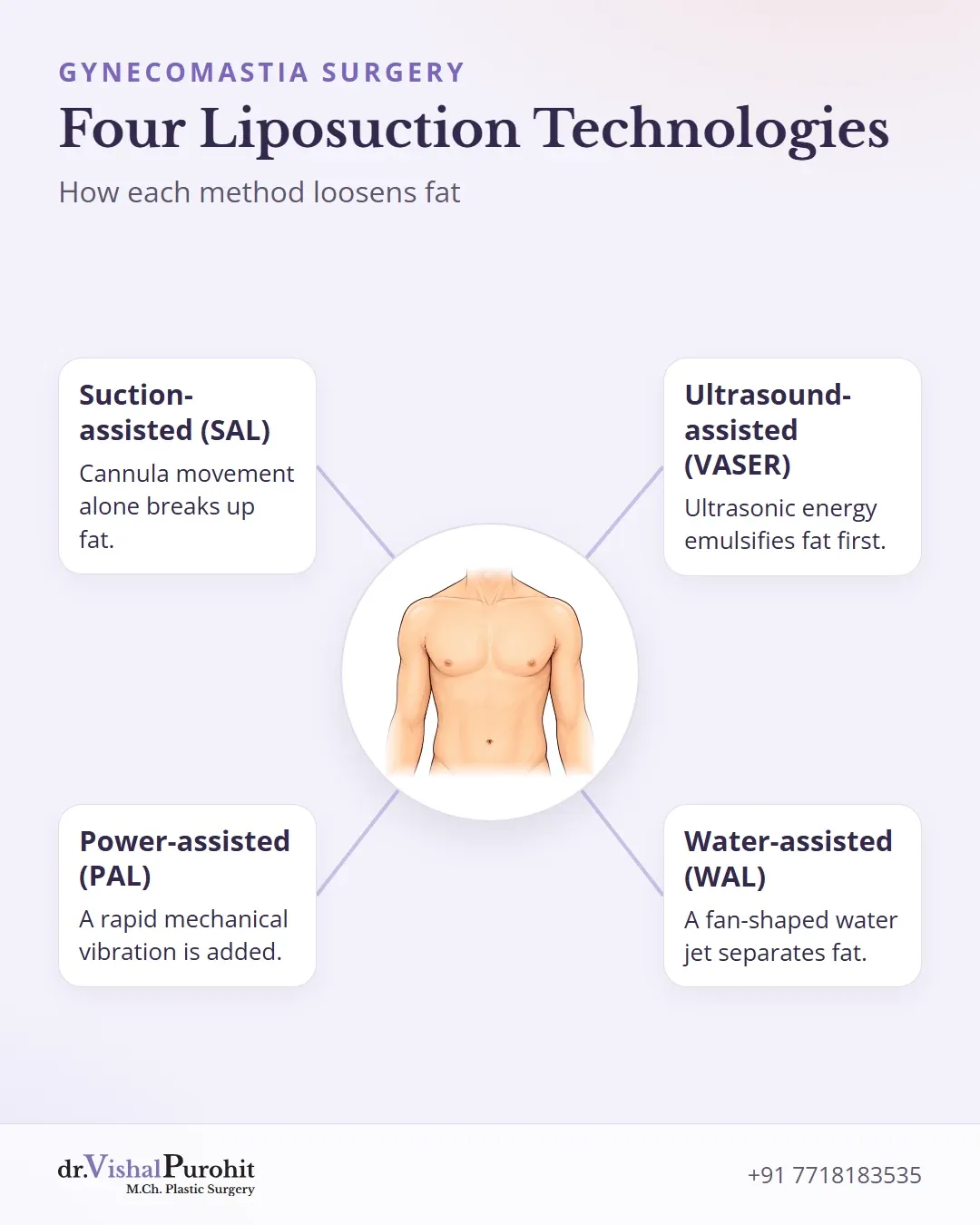
WAL uses a fan-shaped hydro-jet of fluid to separate fat cells from surrounding connective tissue and blood vessels, which is reported to reduce operative trauma and bruising2.
What Liposuction Can and Cannot Remove
What liposuction removes
Liposuction — whether VASER ultrasound-assisted or conventional power-assisted — breaks up and aspirates fat. In gynecomastia surgery, this step reduces the fatty volume around and beneath the chest, allowing the skin to redrape and the chest to look flatter3. The device used changes how efficiently the fat is emulsified, but both approaches address the same target: excess adipose tissue3.
Why the gland is a different problem
Behind the nipple sits a disc of firm, fibrous glandular tissue. Liposuction cannulas cannot reliably remove this structure because it is too dense and fibrous to be aspirated3. Leaving it behind is the most common reason patients remain dissatisfied after a liposuction-only approach3.
For this reason, gland excision through a separate — but small — incision is a standard part of the procedure whenever glandular tissue is present3. Switching from one liposuction device to another does not change this need.
What assessment must establish before surgery
The device choice does not replace a careful pre-operative assessment of what is actually inside the chest.
Dr. Purohit’s note: Dr. Purohit begins with clinical examination and direct palpation to judge the ratio of fat to glandular tissue, and uses ultrasound or MRI only when imaging adds information beyond what palpation shows.
Comparing the Methods: Benefits and Limits
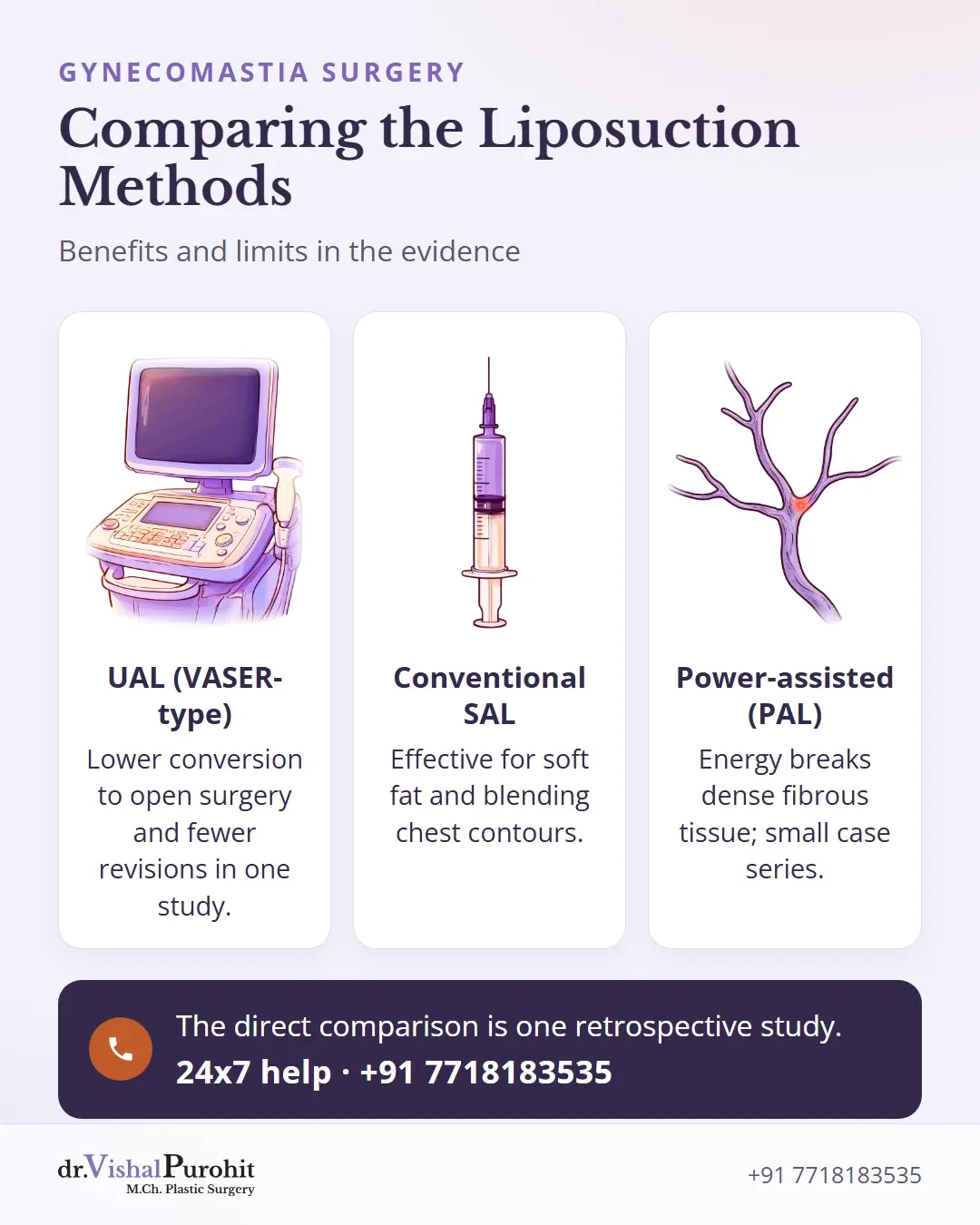
The evidence on VASER (a form of ultrasound-assisted liposuction, UAL) and conventional suction-assisted liposuction for gynecomastia comes mainly from a single retrospective study and a small number of case series, so the findings below carry the limitations of that body of literature.
What the evidence reports
| Method | What the evidence suggests it helps with | Limits or risks the evidence names |
|---|---|---|
| UAL (ultrasound-assisted / VASER-type) | Lower rate of intraoperative conversion to open excision (25% vs 39%) and lower postoperative revision rate compared with conventional liposuction, in a single-surgeon retrospective comparison1 | Concerns about cavitational effects have been noted1. Earlier UAL equipment required continuous cooling-fluid irrigation to reduce thermal injury risk; newer devices have improved heat dissipation1. Only private-sector patients received UAL in the study, so socioeconomic differences may have affected outcomes1 |
| Conventional suction-assisted liposuction (SAL) | Effective for lipodystrophy breakdown and peripheral contour blending2; adequate as a definitive treatment for patients with minimal glandular hypertrophy and little skin excess3 | Significantly higher intraoperative conversion to open excision (39%) and higher revision rates in the retrospective comparison; 31 patients required 61 revision surgeries, though this was counted as one revision per patient1 |
| Power-assisted liposuction (PAL) | UAL and PAL both deliver energy to break down dense fibrous stromal matrices in the male chest wall2; a case series combining PAL with periareolar excision in 23 patients reported a 1.5% complication rate per breast and no revisions required4 | Small case series (23 patients, 46 breasts); no comparative control group4 |
Important context about the evidence
The retrospective single-surgeon comparison1 is the only published study that directly measures UAL against conventional liposuction for gynecomastia. The authors note it is not a randomised trial, that grade-based comparisons were not possible, and that patient selection differed by ability to pay1.
How Good Is the Evidence?
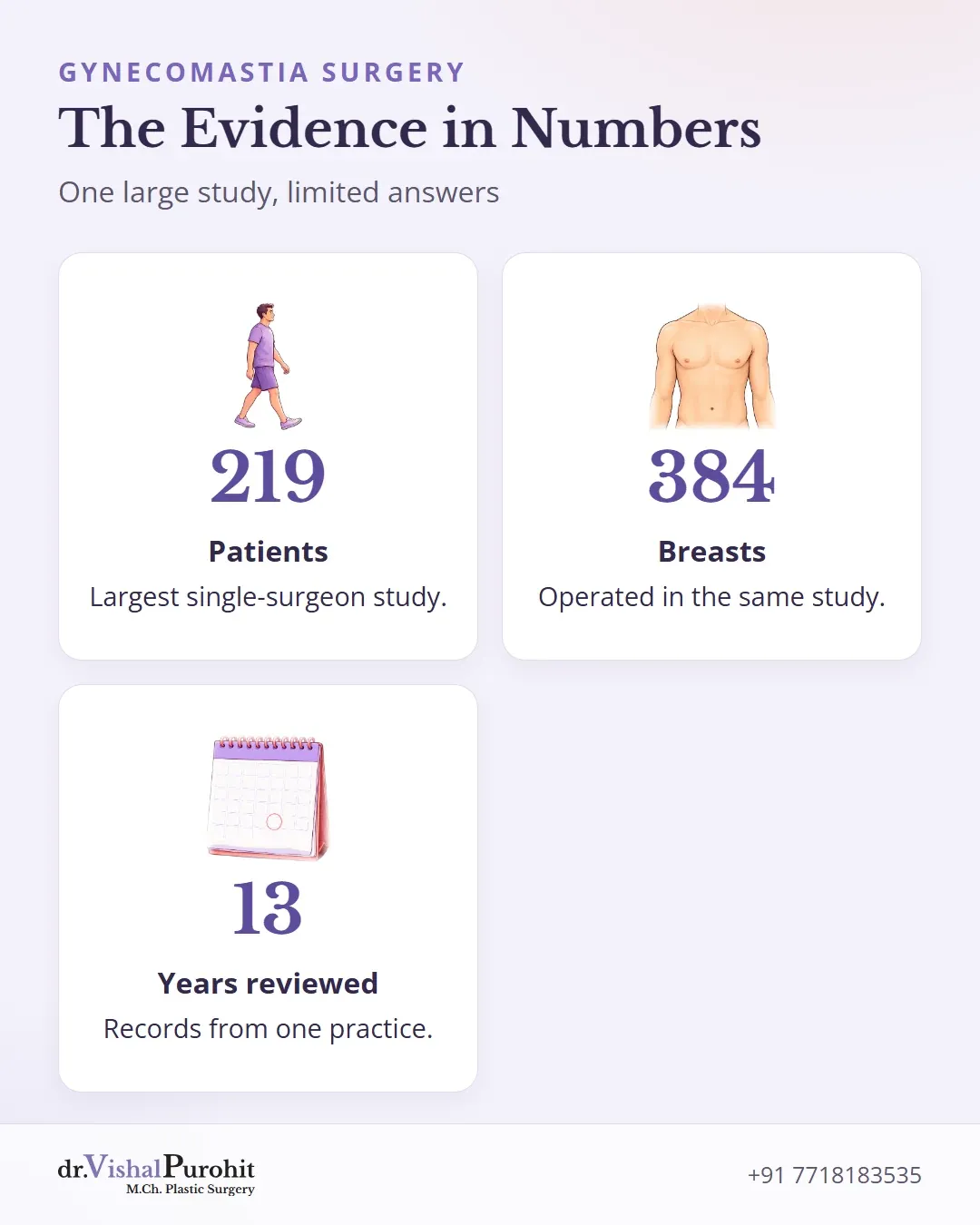
The available comparisons are limited. The largest is a single-surgeon study of 219 patients (384 breasts) over 13 years1.
Why caution is warranted
- Most comparisons are from a single surgeon or a single centre1.
- UAL was available only in the private sector in that study, introducing a potential selection bias1.
- No large, randomised, independently funded trial comparing these devices for gynecomastia was found in the literature reviewed for this article.
What this means in practice

Evidence suggests energy-assisted liposuction handles fibrous male breast tissue better than suction alone23.
Myth: The choice of machine decides the result.
Fact: Surgical planning and the operating surgeon’s experience matter more than the choice of machine.
The Approach in Jaipur
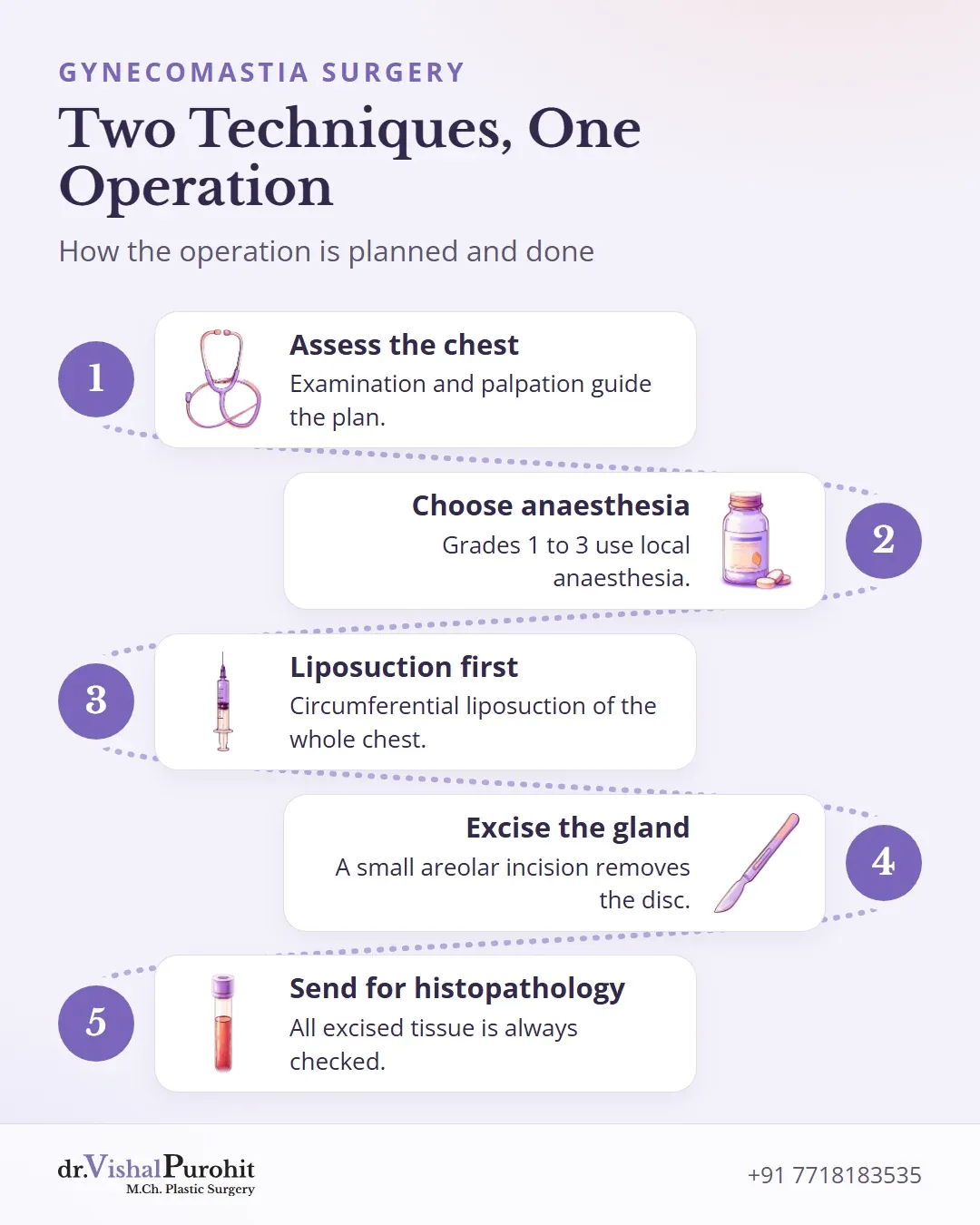
Dr. Vishal Purohit performs gynecomastia surgery in Jaipur, using a dual-modality technique: circumferential liposuction of the whole chest combined with sharp excision of the glandular tissue.
Liposuction Component
Depending on the case, VASER or power-assisted liposuction is used. The liposuction cannula enters through two small openings on each side, placed at the outer edge of the pectoralis major muscle along the anterior axillary line. This positioning keeps the entry points out of sight.
Gland Excision
After liposuction, the firm glandular disc is removed through a small incision along the lower half of the areolar border. This hemi-periareolar placement keeps the resulting scar within the natural colour transition of the areola, where it becomes inconspicuous as healing matures45.
Anaesthesia by Grade
- Grades 1 to 3 are performed under local anaesthesia.
- Grade 4, which requires a longer procedure, is done under general anaesthesia.
- An anaesthesiologist monitors the patient under both local and general anaesthesia.
All excised breast tissue is always sent for histopathology.
Gynecomastia Surgery in Jaipur: Choosing the Right Approach
The device used for liposuction matters, but surgical planning and the operating surgeon’s experience matter more. Dr. Vishal Purohit assesses each patient through clinical examination and direct palpation before planning his usual tumescent liposuction with gland excision. Anyone considering gynecomastia surgery in Jaipur can find answers to common questions about technique and recovery in the gynecomastia FAQs.
This is educational information, not medical advice.