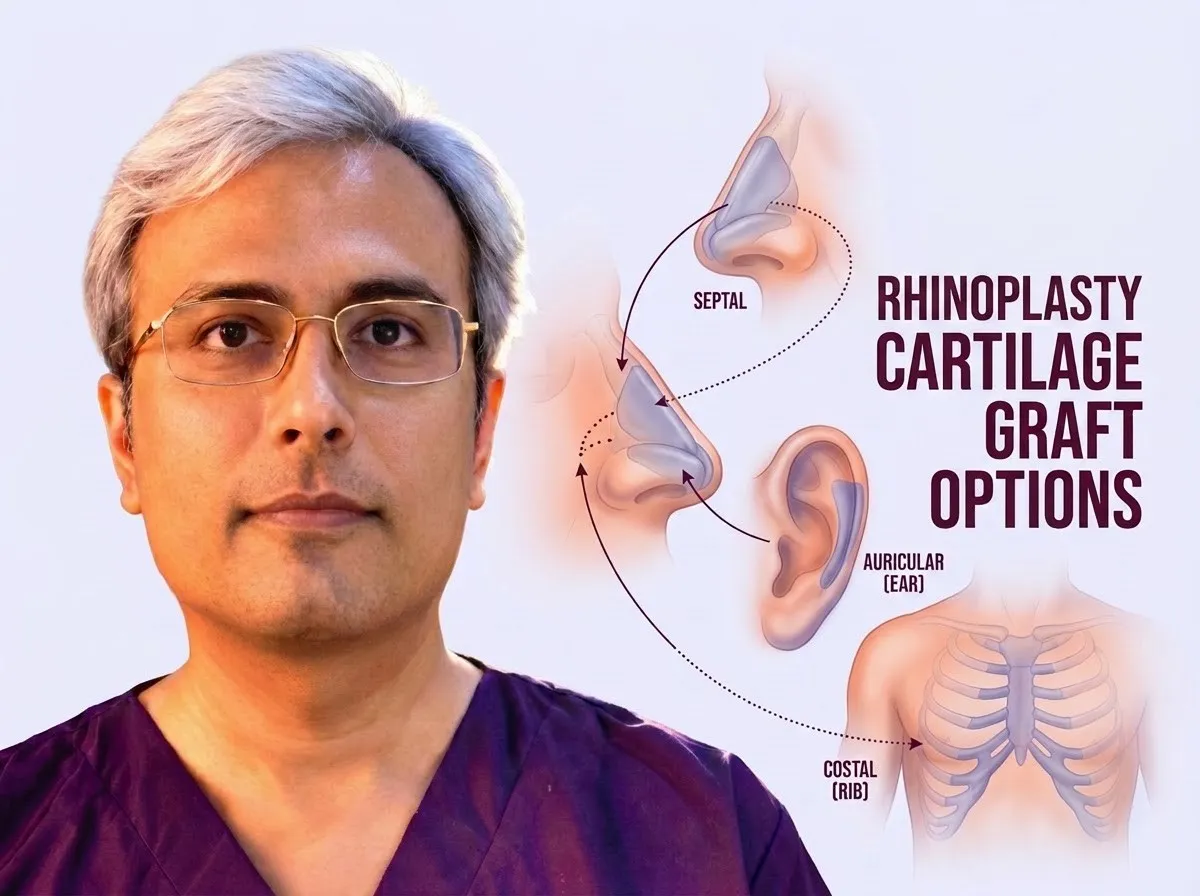
Rhinoplasty often involves structural reinforcement to reshape the nasal framework and maintain long-term stability against contracting skin forces. Strategic placement of autologous cartilage helps support the nasal tip, straighten deviated structures, or augment a low bridge.
During consultations for rhinoplasty in Jaipur, Dr. Vishal Purohit assesses nasal anatomy carefully to determine when graft reinforcement is necessary to preserve airway function and framework support.
Surgical planning depends on whether reduction or augmentation is required, as explored in Nasal Hump or Low Bridge: Reduction and Augmentation Are Different Decisions. Autologous cartilage from the patient remains central to achieving structural framework support.
Adding Support, Not Only Removing
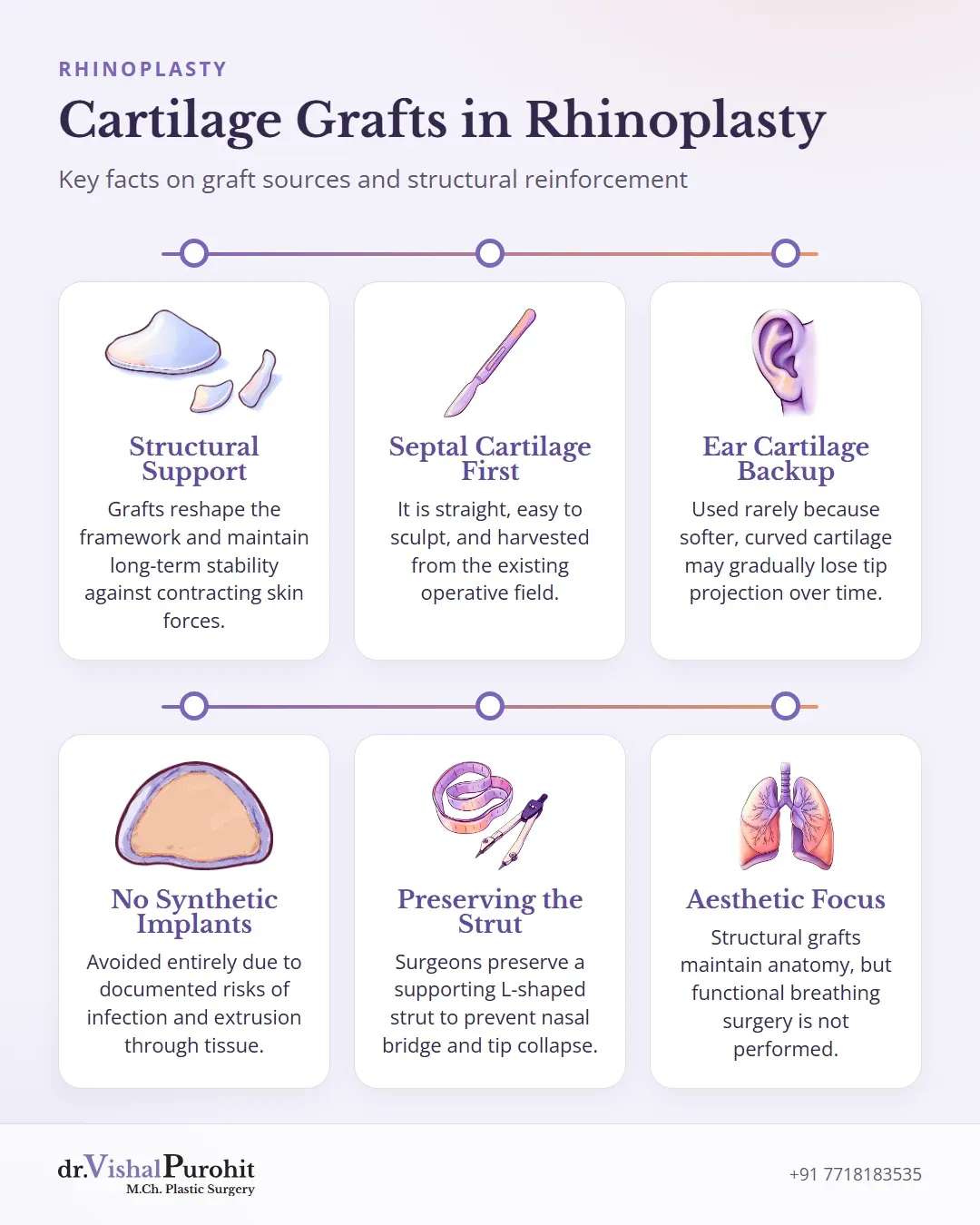
Rhinoplasty often involves structural reinforcement rather than simple reduction. Cartilage grafts are positioned strategically to reshape the nasal framework and maintain long-term stability against tissue forces1.
Dr. Purohit’s note: Autologous septal cartilage serves as the first-choice graft in Dr. Purohit’s practice, while ear cartilage is used rarely, avoiding synthetic implants entirely.
What Cartilage Grafts Provide
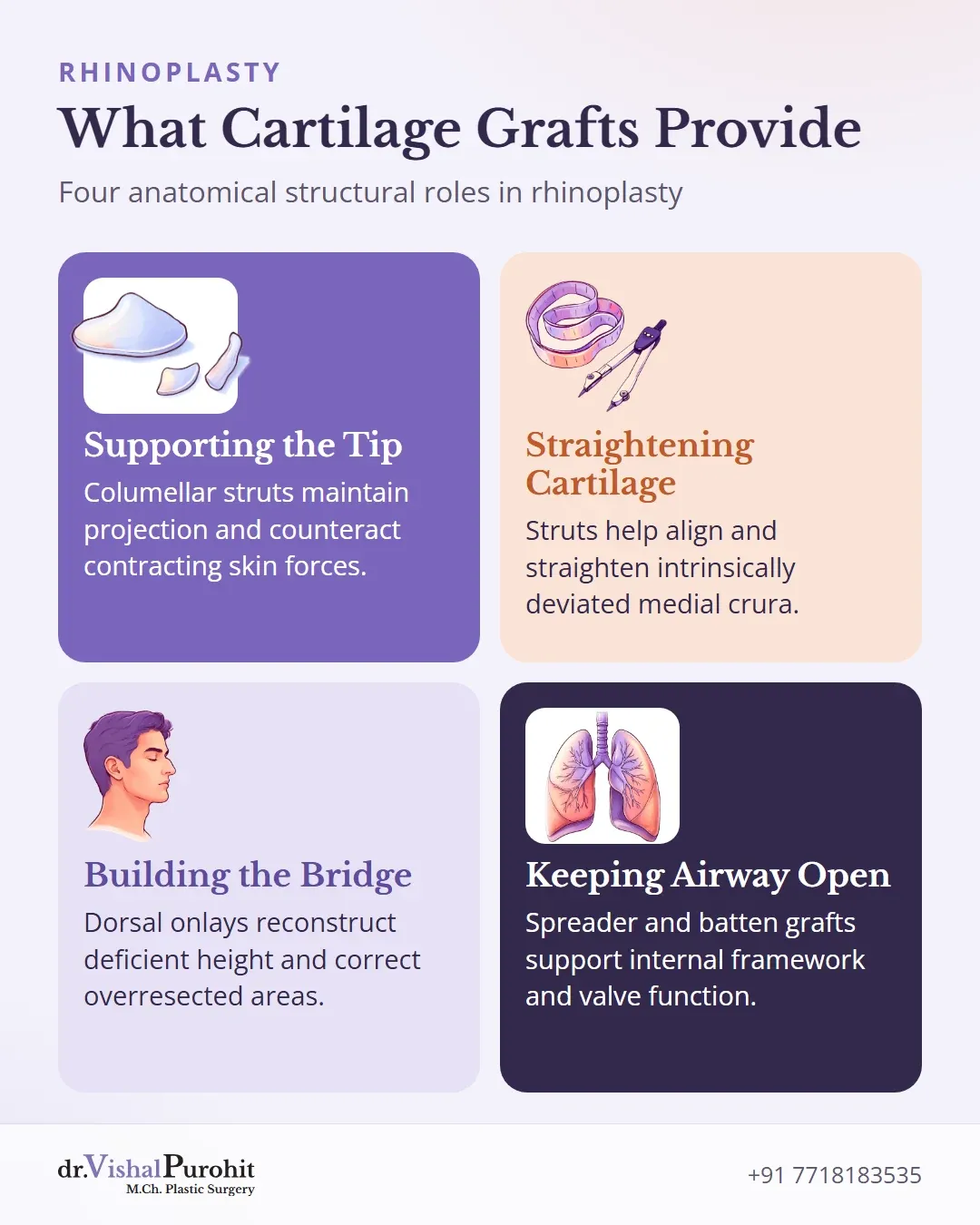
- Supporting the tip: A columellar strut placed between the crura provides tip support23, maintains tip projection134, and counteracts the contractual forces of the skin envelope1. It also creates a stable foundation for tip grafts3.
- Straightening: Struts help align and straighten intrinsically deviated medial crura5.
- Building the bridge: Dorsal onlays and grafts reconstruct deficient bridge height, address saddle deformities, and correct overresected areas678.
- Keeping the airway open: Extended spreader grafts support structural framework and enhance internal valve function9, while batten grafts can address external valve collapse7.
While structural grafts can maintain anatomical pathways, Dr. Purohit does not perform functional breathing surgery, and better breathing is never promised. Patients presenting with breathing difficulties are referred for an independent ENT assessment.
Septal Cartilage First
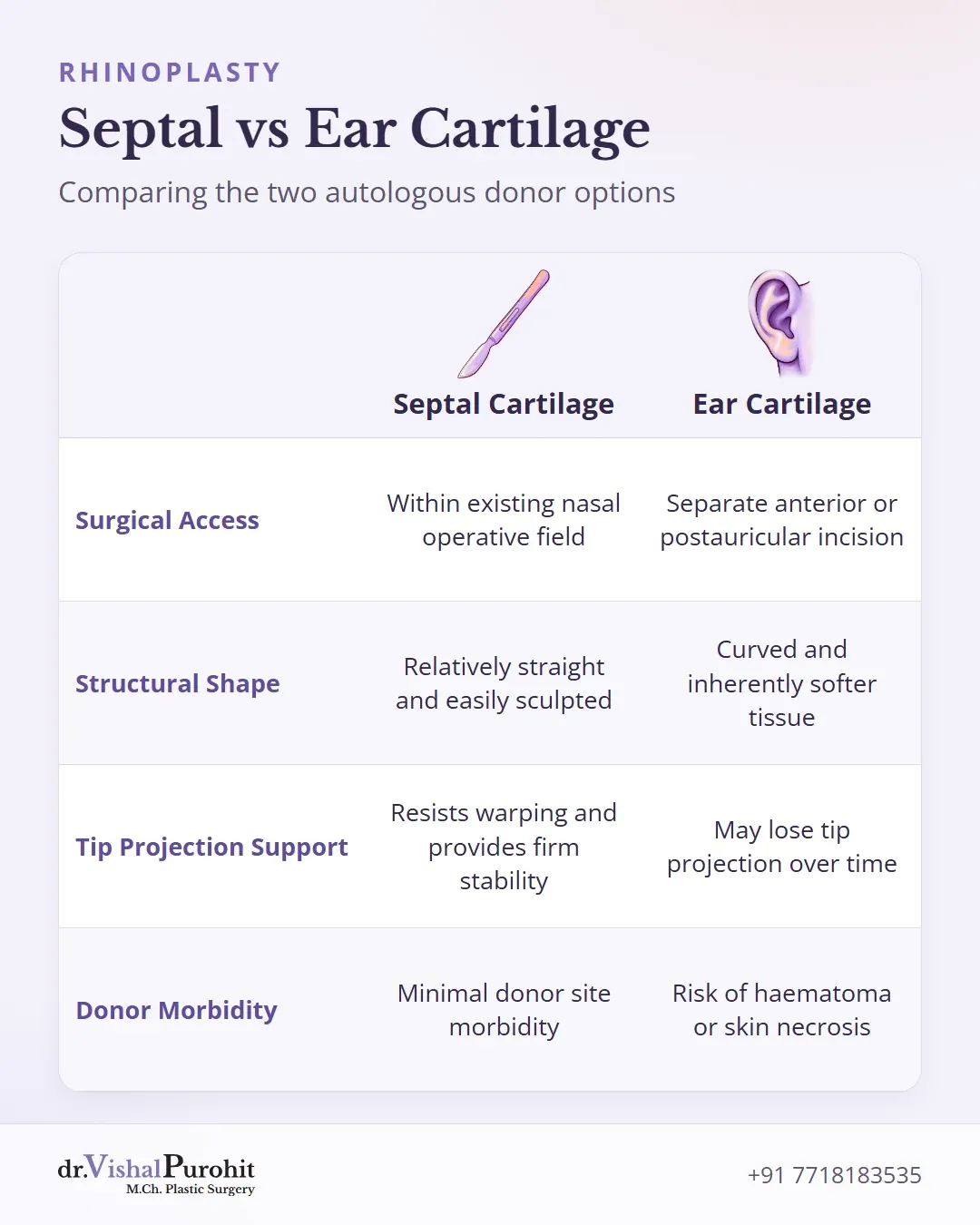
Septal cartilage is the first-choice graft in Dr. Vishal Purohit’s rhinoplasty practice. Because it comes from inside the nose, it is accessible within the existing operating field and causes minimal donor site morbidity1011. The harvested cartilage is relatively straight, easy to sculpt, and provides adequate structural support without a tendency to warp1213.
Key points
- Septal cartilage is the preferred graft material because it is accessible in the same surgical field and does not warp.
- Surgeons preserve a sturdy L-shaped strut to maintain nasal stability and avoid structural collapse.
- Available cartilage volume varies, and depleted tissue in revision cases may require alternative donor sources.
When a patient has a deviated septum, Dr. Purohit corrects the septum during the same operation. However, functional breathing surgery is not performed, and better breathing is never promised.
Surgical Preservation and Trade-Offs
During harvesting, a supporting L-shaped strut of cartilage must be preserved dorsally and caudally to maintain nasal support and prevent collapse141516. In the literature, surgeons maintain at least a 10 mm141517 or 15 mm1213 strut for stability.
The primary limitation of septal cartilage is graft volume:
- The quantity and thickness of septal cartilage vary between individuals1118.
- In revision rhinoplasty or after nasal trauma, usable septal cartilage may already be absent or depleted1218.
- If septal tissue is insufficient, alternative donor sources may be necessary1219. Dr. Purohit rarely uses ear cartilage, and he does not use synthetic implants.
Ear Cartilage
In his rhinoplasty practice, Dr. Vishal Purohit uses ear cartilage rarely, as septal cartilage remains his first choice for grafting.
Donor Site and Technique
The donor graft is taken from the conchal bowl of the ear2021. Surgeons access this area through an anterior or posterior approach, often using a postauricular incision placed behind the ear2021. During harvest, at least 3 to 4 mm of cartilage medial to the antihelical fold margins is preserved within the conchal fossa to maintain the structural frame of the ear21. Meticulous hemostasis and careful closure of potential space with bolsters or sutures minimize the risk of haematoma or skin necrosis20.
Characteristics and Trade-Offs
Ear cartilage has specific structural properties documented in rhinoplasty literature:
- It provides a curved, softer graft material suitable for specific nasal areas2223.
- Because of its inherent lack of rigidity, using ear cartilage alone can result in a progressive loss of nasal tip projection over time23.
- Overlying skin can occasionally contract firmly over placed ear cartilage tip grafts, which may cause them to become visible24.
Rib Cartilage and Synthetic Implants
Rib Cartilage in Complex Cases
In the surgical literature, costal (rib) cartilage is often reserved for revision rhinoplasty or extensive nasal framework reconstruction when more rigid support is required2325. However, autologous costal cartilage carries specific donor-site drawbacks:
Key points
- Costal rib cartilage provides strong structural support in complex reconstructions but carries donor-site morbidity and warping risks.
- Synthetic alloplastic implants carry distinct risks of infection and tissue extrusion.
- Autologous cartilage remains the safer graft choice to avoid extrusion and implant-related complications.
- Graft warping or bending over time remains an unpredictable surgical challenge262728.
- Harvesting the rib graft involves donor-site morbidity, including chest wall scarring, prolonged postoperative pain, and the potential risk of pneumothorax2329.
Other reported complications in published studies include contour irregularities, graft resorption, and infection26.
Risks of Synthetic Implants
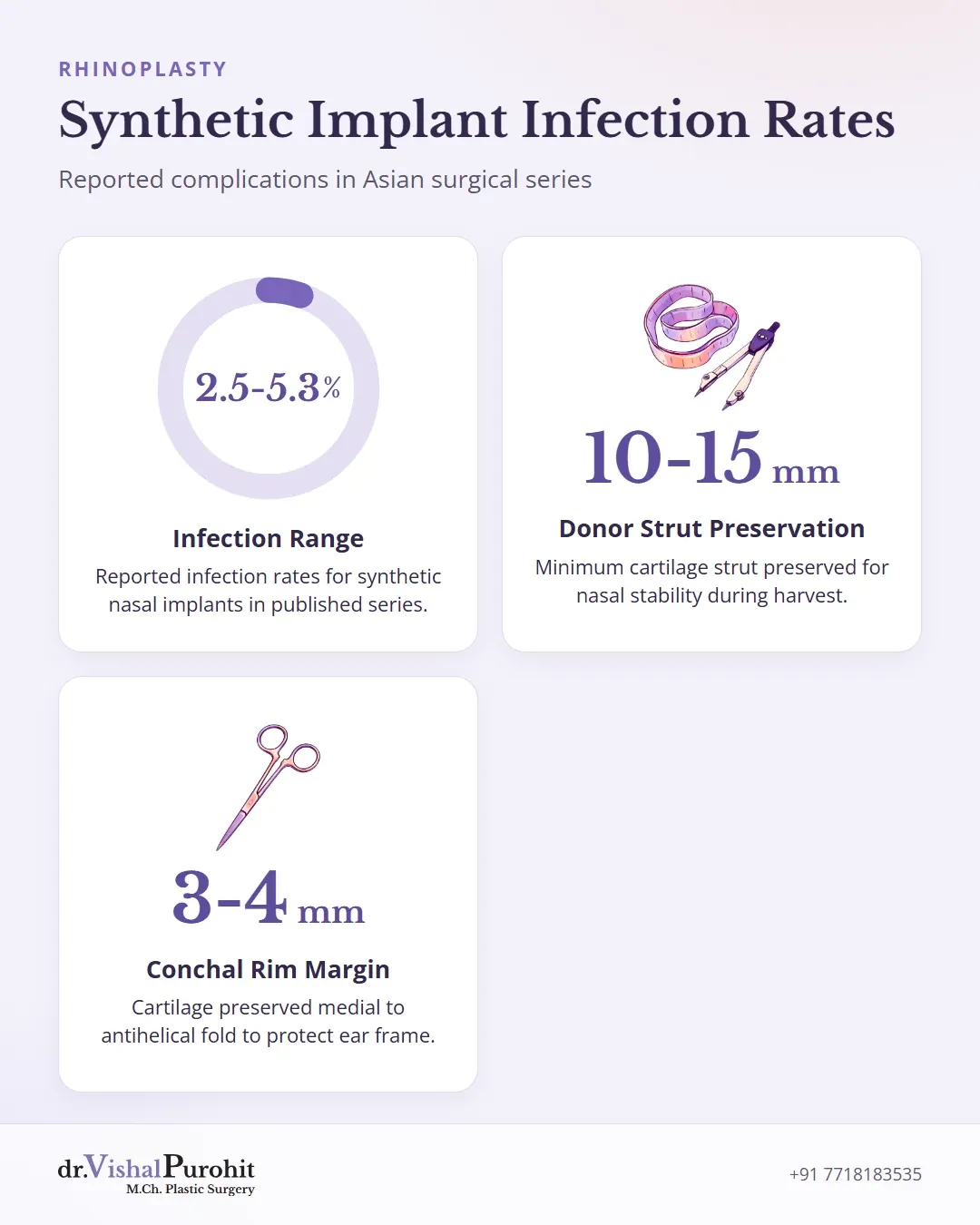
Alloplastic materials such as silicone, Medpor, or Gore-Tex carry distinct risks compared to autologous tissue3031. In published reports, synthetic nasal implants are associated with a higher risk of infection, with reported infection rates varying between 2.5% and 5.3% in Asian series303132.
Extrusion through the skin or nasal mucosa is another serious complication of alloplastic implants3334. When an alloplastic implant becomes infected or begins to extrude, active treatment typically requires expeditious removal of the implant to avoid soft tissue necrosis, contracture, and scarring323334.
Surgical Approach
In his rhinoplasty practice in Jaipur, Dr. Vishal Purohit does not use synthetic implants (such as silicone, Medpor, or Gore-Tex). He relies on autologous septal cartilage as his first-choice graft material, with ear cartilage used rarely.
Questions About Your Graft
During a consultation, patients often ask where cartilage is taken from, what donor recovery involves, and how a previous nasal operation changes surgical options.
Donor Sites and Recovery
In Dr. Vishal Purohit’s practice, autologous septal cartilage is the first-choice graft, while ear cartilage is used rarely. Septal cartilage is accessed through the same surgical field during rhinoplasty35. When ear cartilage is harvested, the incision is placed anteriorly or posteriorly on the ear20. Donor-site risks include haematoma, infection, or scarring36. Meticulous closure and bolster dressings help minimize the risk of haematoma or skin necrosis at the ear donor site20.
Previous Surgery and Revision Cases
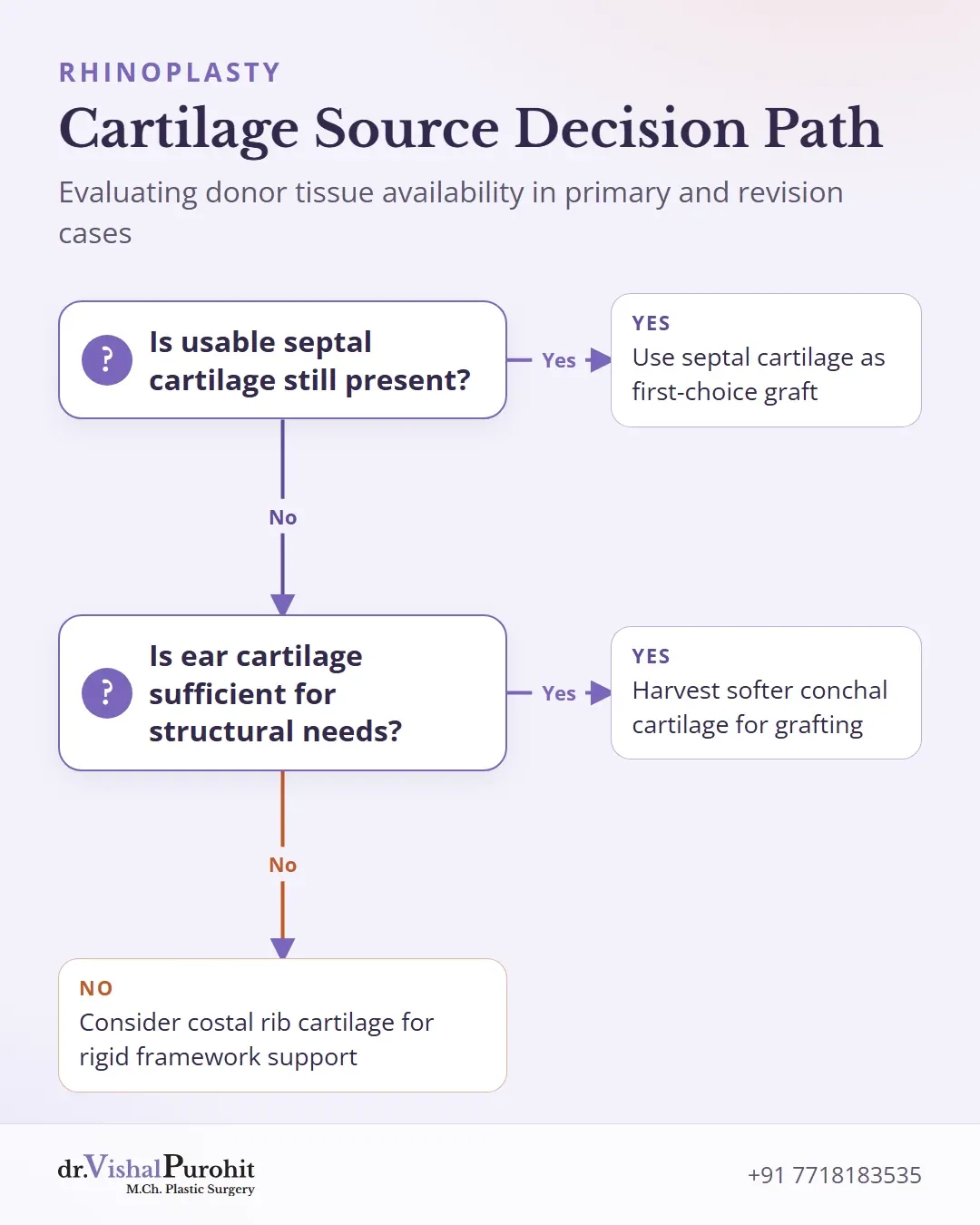
When a patient has undergone earlier nasal surgery, the quadrangular cartilage of the septum may already be depleted or absent3537. In secondary rhinoplasty, careful preoperative assessment helps determine whether adequate residual septal tissue remains35. If the septum was depleted during an earlier procedure, alternative sources such as conchal cartilage must be considered3537. Patients considering secondary surgery can read further details in the discussion on revision rhinoplasty.
Rhinoplasty Consultations in Jaipur
Planning structural nasal surgery requires careful evaluation of available donor cartilage and anatomical framework needs. To understand surgical options, donor recovery, and structural techniques, explore rhinoplasty in Jaipur. For detailed answers regarding operative steps, pre-anaesthetic preparation, and post-surgery care, review the comprehensive rhinoplasty FAQs.
This is educational information, not medical advice.