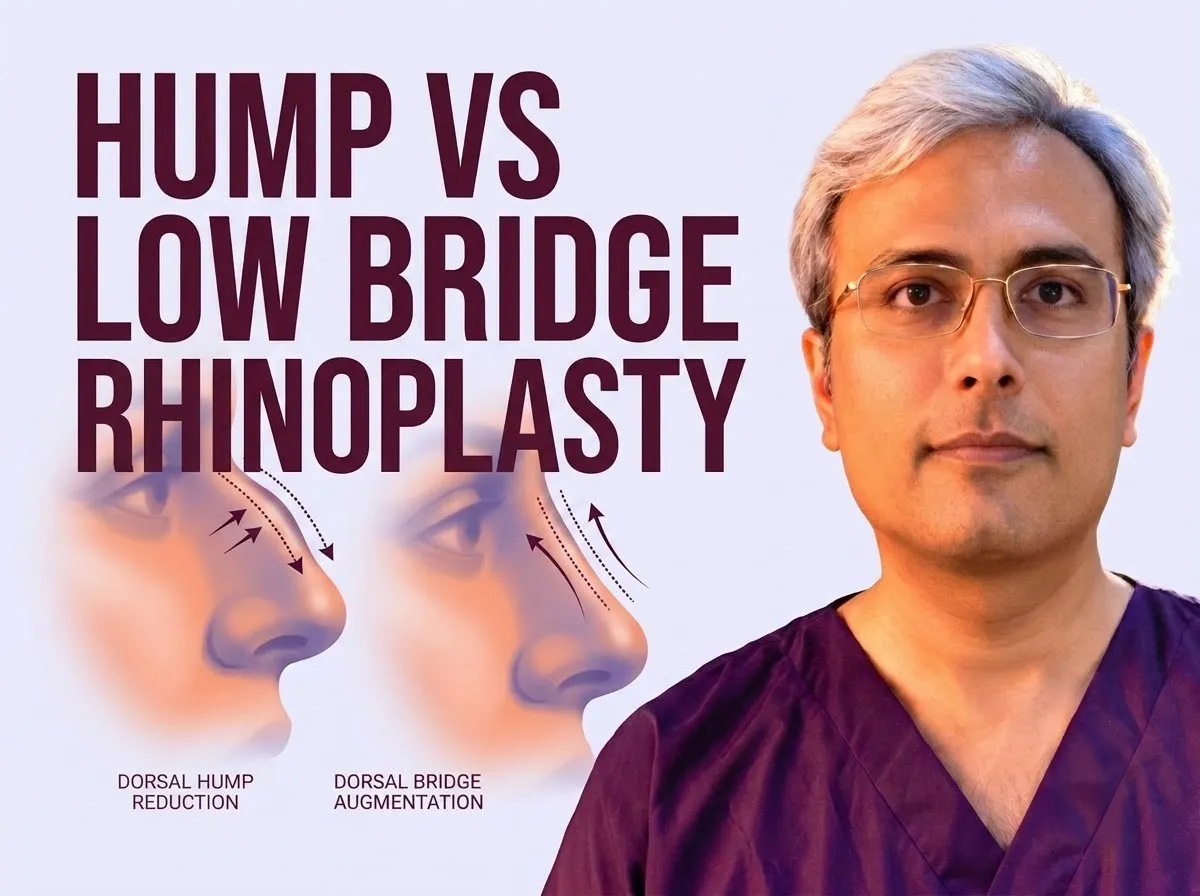
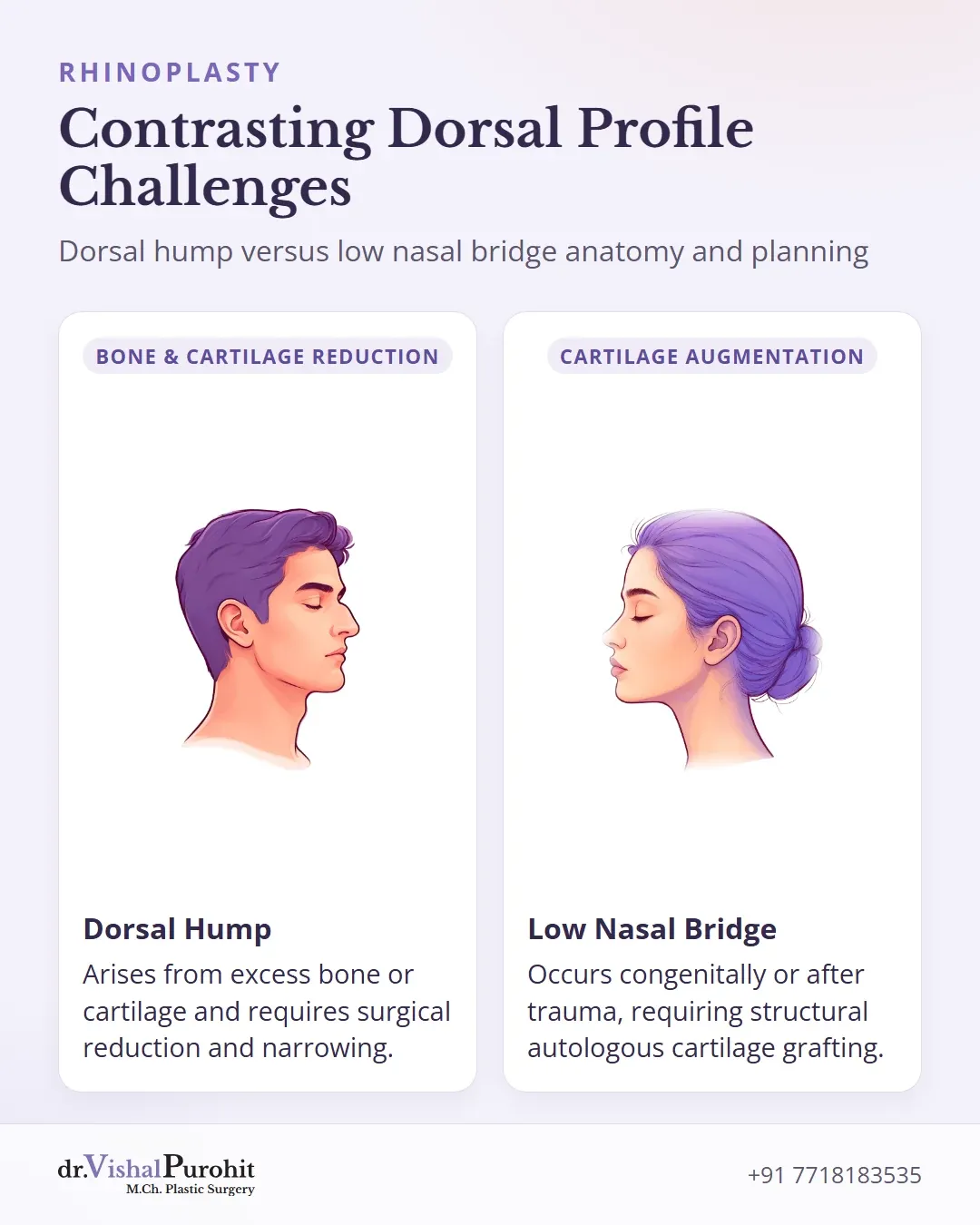
A nasal hump and a low nasal bridge create very different structural challenges along the profile, requiring contrasting surgical planning. Lowering an elevated bridge involves bone reduction and narrowing, while raising a flat dorsum requires structural volume augmentation.
When planning corrective surgery, M.Ch rhinoplasty surgeon in Jaipur Dr. Vishal Purohit carefully distinguishes between these opposing requirements to tailor dorsal reshaping to each patient’s individual anatomy.
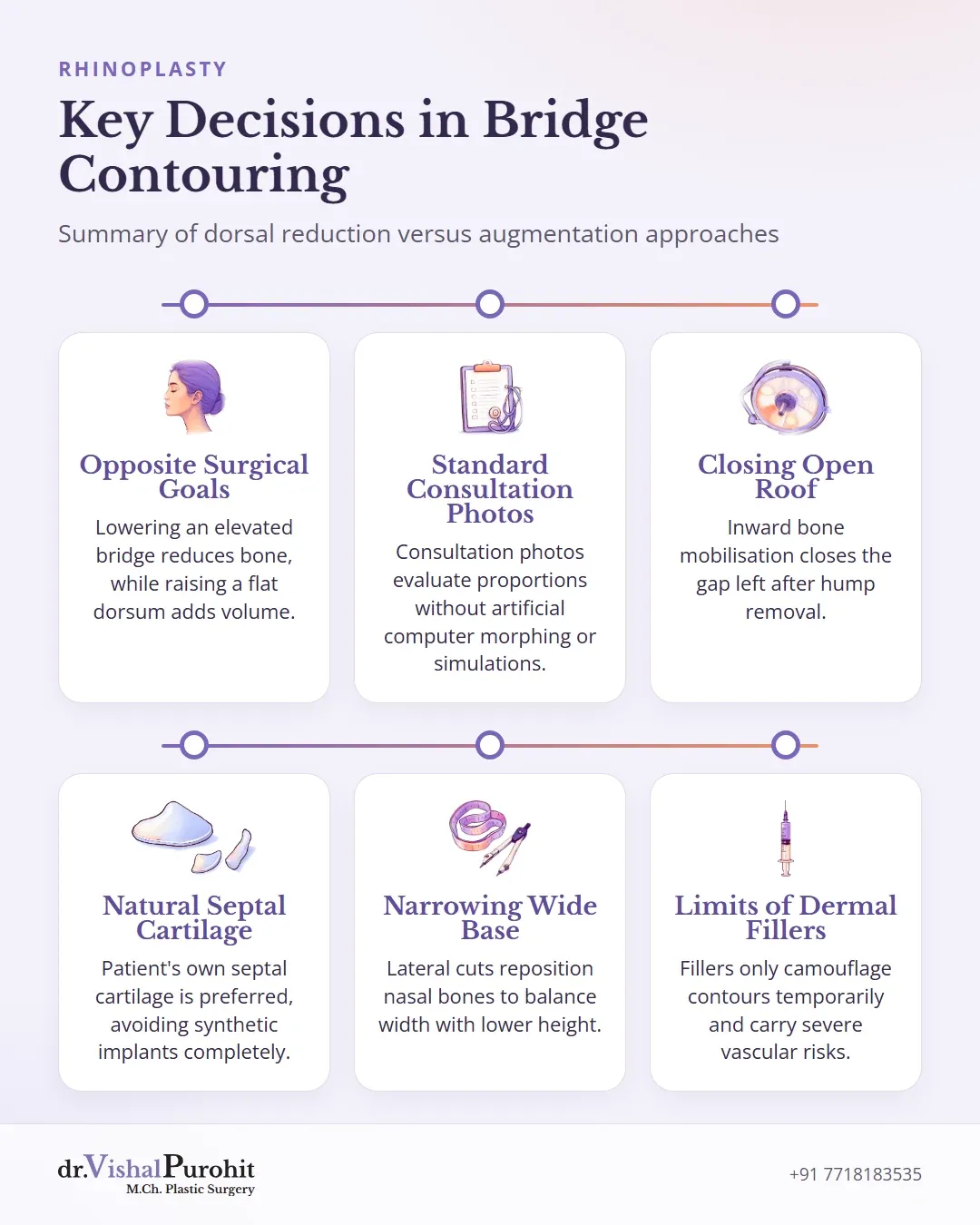
Evaluation relies on assessing facial proportions across every angle rather than focusing solely on dorsal prominence. During assessment, using standard consultation photographs helps document facial balance without relying on artificial computer simulations.
Hump, Dip or Both
A nasal hump and a low nasal bridge represent two opposite structural contours along the dorsal profile, though both alter how the nose balances with the rest of the face.
Where a Hump Comes From
A dorsal hump can arise from bone, cartilage, or a combination of both1. In some patients, the bony dorsum forms the primary prominence, while in others, overdeveloped cartilaginous structures—including the dorsal septum or alar cartilages—create the projection12.
Dr. Purohit’s note: During reduction, Dr. Vishal Purohit uses standard osteotomes rather than ultrasonic instruments to reshape the nasal bones.
Low or Flat Bridge
A low nasal dorsum lies lower than ideal relative to the facial profile, often presenting congenitally, after trauma, or as a natural ethnic feature3. A concave contour, or saddle deformity, occurs when structural support is compromised, commonly following injury, previous surgery, or septal cartilage loss345. When bridge height requires augmentation, autologous septal cartilage serves as Dr. Purohit’s first-choice graft material, and synthetic implants are not used.
Viewing the Whole Profile
Assessing the dorsum requires an examination across all viewpoints4. A dorsal prominence or deficiency may not be fully apparent on frontal examination alone4. Furthermore, an overprojected nasal tip or a high nasofrontal angle can create an illusion of a depressed bridge46. Dr. Purohit relies on standard consultation photographs and clinical evaluation rather than computer morphing or 3D simulations.
Taking Down a Hump
A dorsal hump consists of both cartilage in the lower dorsum and bone in the upper nasal bridge78. During reduction, the surgeon lowers the cartilaginous septum and upper lateral cartilages, and removes or rasps the excess bone78.
Closing the Open Roof
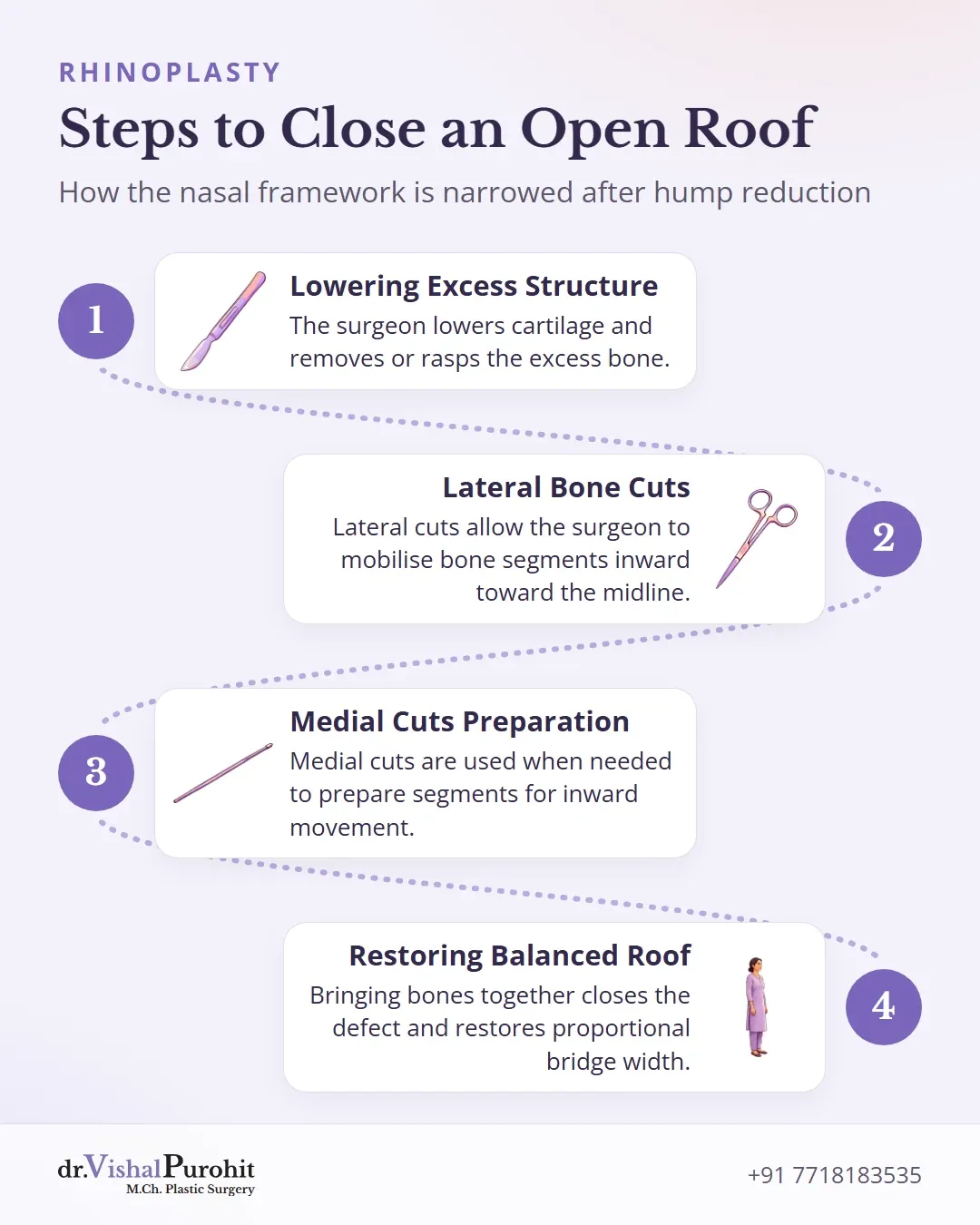
Removing a prominent dorsal hump leaves a gap between the nasal bones and the midline septum, termed an open-roof deformity789. This defect leaves the bridge flattened with palpable bony edges910.
To correct this and narrow the bridge:
- Lateral cuts in the bone allow the surgeon to mobilise and shift the nasal bones inward toward the midline791112.
- Medial cuts may also be used when needed to prepare the bone segments for inward movement8911.
- Bringing the bones together closes the roof and restores balanced proportions between the nasal base and the new bridge height912.
In his practice in Jaipur, Dr. Vishal Purohit reshapes the nasal bones using standard osteotomes, rather than piezo or ultrasonic instruments. Controlled bone repositioning establishes a smooth, natural dorsal contour across the upper and middle thirds of the nose1012.
Building Up a Low Bridge
A low nasal bridge requires augmentation rather than bone reduction. Adding volume elevates the dorsum to bring it into balance with the rest of the facial features13.
Key points
- A low nasal bridge is elevated through augmentation to balance facial proportions.
- Autologous cartilage from the septum or ear is preferred over synthetic implants to avoid implant-related risks.
- Synthetic materials carry documented complications including infection, skin thinning, and implant extrusion.
Autologous Cartilage
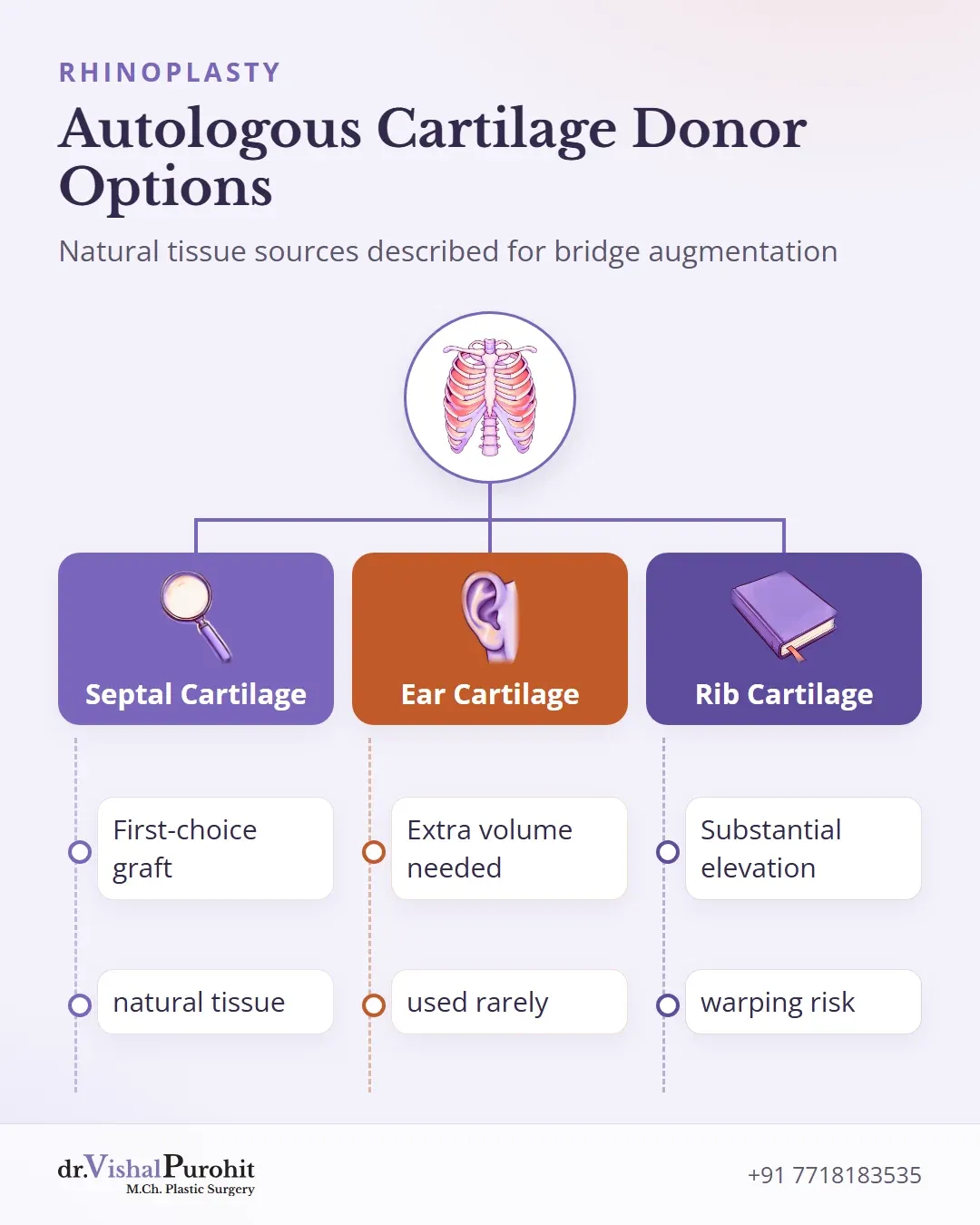
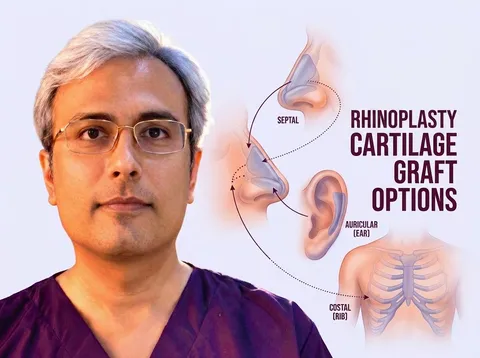
Dr. Vishal Purohit relies entirely on natural tissue for dorsal augmentation and does not use synthetic implants like silicone, Medpor, or Gore-Tex. His protocol uses the patient’s own septal cartilage as the first-choice graft. When additional material is required, ear cartilage is used rarely.
In the wider surgical literature, autologous rib cartilage is described for cases needing substantial dorsal elevation1314. Published reports note that rib cartilage grafts may carry risks of warping over time or visible graft contours beneath the skin15. To reduce warping, surgical texts describe carving techniques and soaking the cartilage in saline before placement1516.
Synthetic Implants and Reported Risks
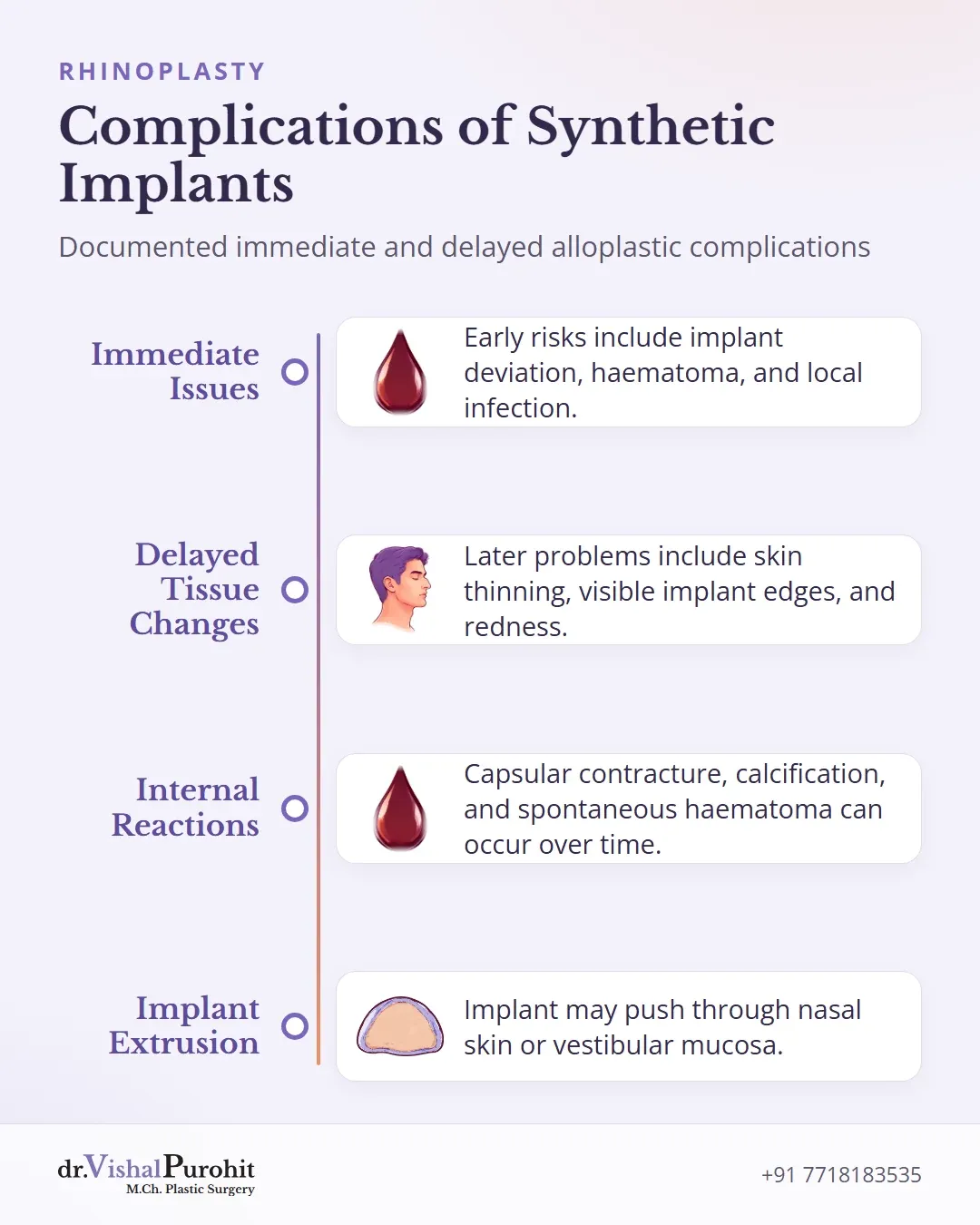
Synthetic materials are described in international literature for dorsal augmentation, but they carry documented risks1718. Reported complications from alloplastic materials include:
Width Changes With Height
Reducing a prominent nasal hump lowers the height of the bridge, but removing this roof of bone leaves a gap known as an open-roof deformity91120. This defect separates the nasal bones and creates flattened, palpable bony edges on either side91120. Furthermore, lowering a large hump significantly decreases the dorsal height, which makes the bony base appear wider by comparison9.
To restore balanced proportions, surgical narrowing is required9. Closing an open roof and narrowing a broad bony base are accomplished by performing lateral osteotomies, which mobilize and move the nasal bones inward toward the midline92021. If lateral cuts alone do not close the gap, medial or intermediate osteotomies may be added922. In certain situations, any persistent roof gap can be filled with crushed or diced cartilage911.
In his practice, Dr. Vishal Purohit reshapes the nasal bones using standard osteotomes rather than ultrasonic or piezo instruments. Controlled cuts allow him to narrow the upper bridge and close the open roof while preserving natural nasal contours.
A Filler Is a Different Decision
Dermal fillers can temporarily camouflage a dorsal hump by adding volume above or below it23, but this approach involves distinct clinical considerations, covered on the liquid rhinoplasty page.
Key points
- Dermal fillers can temporarily camouflage a dorsal hump without surgical alteration.
- Nasal filler injections carry serious vascular hazards, including skin necrosis and sudden blindness.
- Fillers can soften contours but cannot achieve total alignment or correct underlying skeletal misalignment.
Vascular Risks of Liquid Rhinoplasty
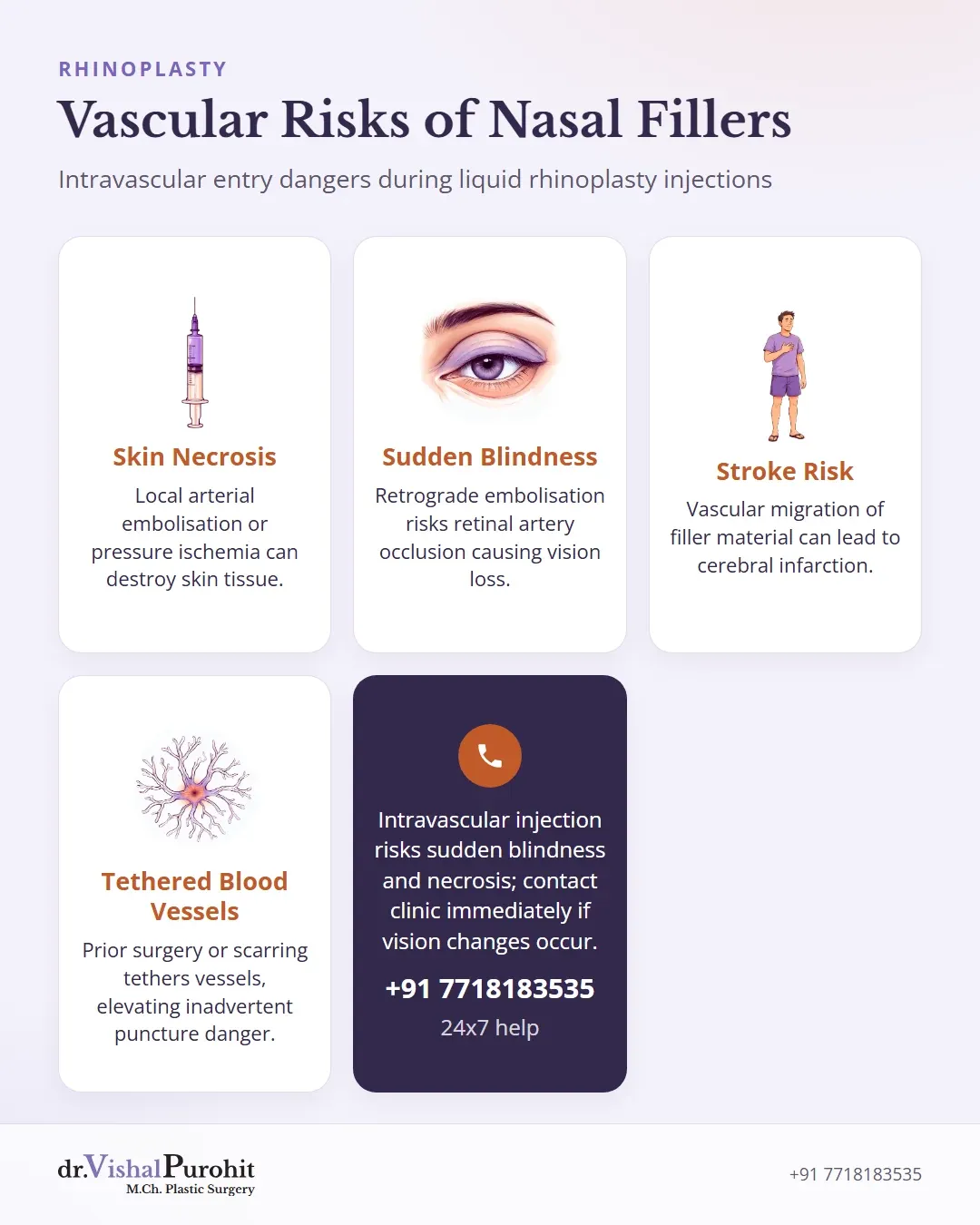
Injecting soft-tissue filler into the nasal framework carries significant vascular hazards2324. The nasal blood supply forms an intricate network where accidental intravascular entry can lead to severe events242526:
- Skin necrosis from local arterial embolisation or pressure ischemia242526
- Retrograde embolisation risking ophthalmic or central retinal artery occlusion, which can cause sudden blindness2324252627
- Stroke or cerebral infarction from vascular migration2425
In addition, previous nasal interventions or scarring can tether local blood vessels, increasing the potential for inadvertent cannulation during injection28.
Realistic Limits on Nasal Alignment
Patients seeking nonsurgical correction must understand that complete straightness or symmetry cannot be guaranteed2429. In structural contouring, natural anatomy, skin thickness, and underlying tissue boundaries define what can be achieved2930. When nasal bones or cartilages are misaligned, filler can soften an angle, but total alignment remains unobtainable without surgical alteration of the skeleton29.
Consulting for Bridge Contouring in Jaipur
Whether addressing an elevated hump or a deficient dorsum, structural balance depends on choosing the correct surgical pathway. Learn more about dorsal profile planning through rhinoplasty in Jaipur or review recovery expectations through the rhinoplasty FAQs. Tailored consultations ensure each surgical step respects natural facial contours.
This is educational information, not medical advice.