
Several common medicines — from heart drugs and antifungals to antipsychotics and HIV therapies — can shift the balance between androgens and estrogens in male breast tissue, triggering glandular growth. Understanding what causes gynecomastia helps put medication-related cases in context, since drug use is among the most common causes of non-physiologic gynecomastia.
When glandular enlargement persists even after discontinuing or adjusting the responsible medication, consulting for gynecomastia surgery in Jaipur can help evaluate definitive treatment options.
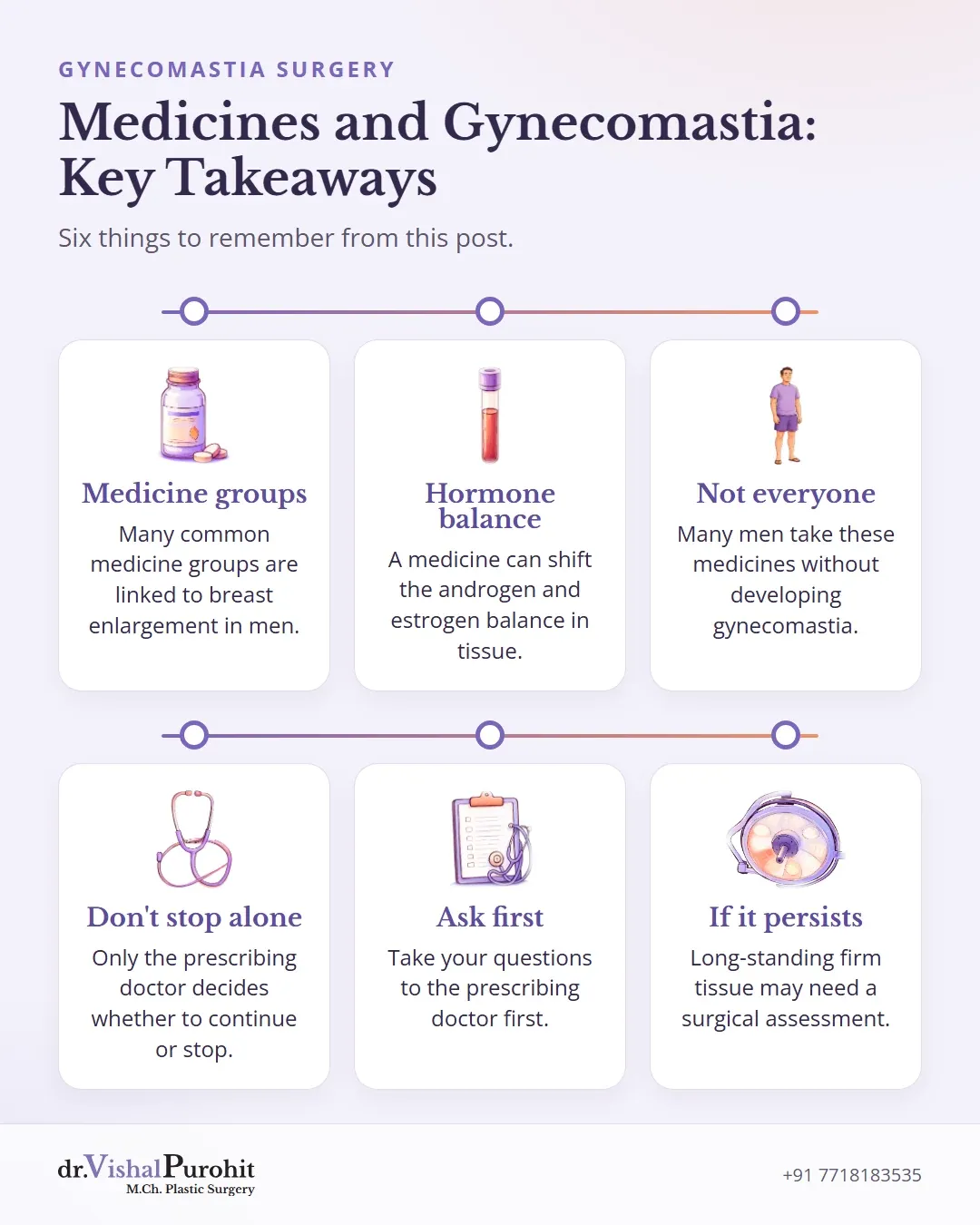
Not every man who takes these medicines develops gynecomastia, and enlargement often has more than one cause at the same time. This post covers the medicine groups named in medical literature, what to discuss with the prescribing doctor, and when a surgical assessment becomes the appropriate next step.
How a Medicine Can Lead to Breast Enlargement
Male breast tissue stays flat because androgens (primarily testosterone) suppress its growth while estrogens stimulate it. When a medicine shifts this balance, the tissue can respond by growing1.
Three ways a medicine can tip the balance
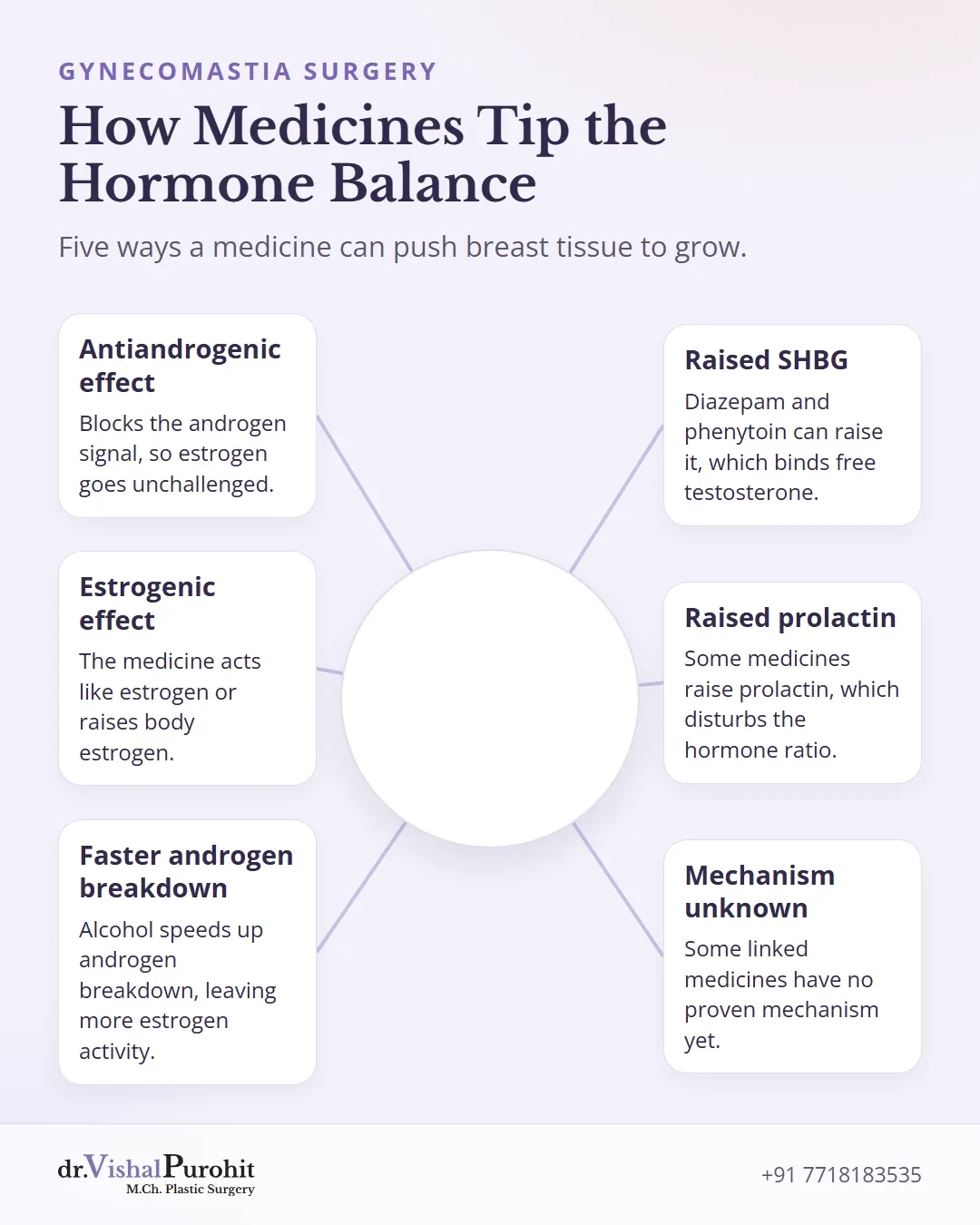
Evidence names the following mechanisms2:
- Antiandrogenic effect — the medicine blocks or weakens the androgen signal at breast tissue, so the estrogen signal goes unchallenged. Spironolactone, cimetidine, and ketoconazole work this way2.
- Estrogenic effect — the medicine carries estrogen-like activity itself, or raises the amount of estrogen the body produces. Digoxin, anabolic steroids, and gonadotropin-releasing hormone agonists fall into this group2.
- Increased metabolism of androgens — alcohol speeds up the breakdown of androgens, leaving relatively more estrogen activity behind2.
- Raised sex hormone–binding globulin (SHBG) — diazepam and phenytoin can raise SHBG, which binds free testosterone and reduces the androgen effect on tissue2.
- Hyperprolactinaemia — medicines such as haloperidol, metoclopramide, and phenothiazines raise prolactin, which indirectly disrupts the estrogen-to-androgen ratio2.
Hormone balance
Male breast tissue stays flat because androgens (primarily testosterone) suppress its growth while estrogens stimulate it. When a medicine shifts this balance, the tissue can respond by growing1.
Unknown mechanism
A separate group of medicines — including several antihypertensives, antidepressants, and antiretroviral agents — is consistently linked to gynecomastia in clinical reports, but the exact mechanism has not been established by evidence2.
In practice
Any process that raises bioavailable estrogens, lowers free testosterone, or impairs androgen receptor responsiveness can trigger glandular growth in the male breast1.
When the mechanism is not known
A separate group of medicines — including several antihypertensives, antidepressants, and antiretroviral agents — is consistently linked to gynecomastia in clinical reports, but the exact mechanism has not been established by evidence2.
What this means in practice
Any process that raises bioavailable estrogens, lowers free testosterone, or impairs androgen receptor responsiveness can trigger glandular growth in the male breast1.
Medicine Groups Linked to Gynecomastia
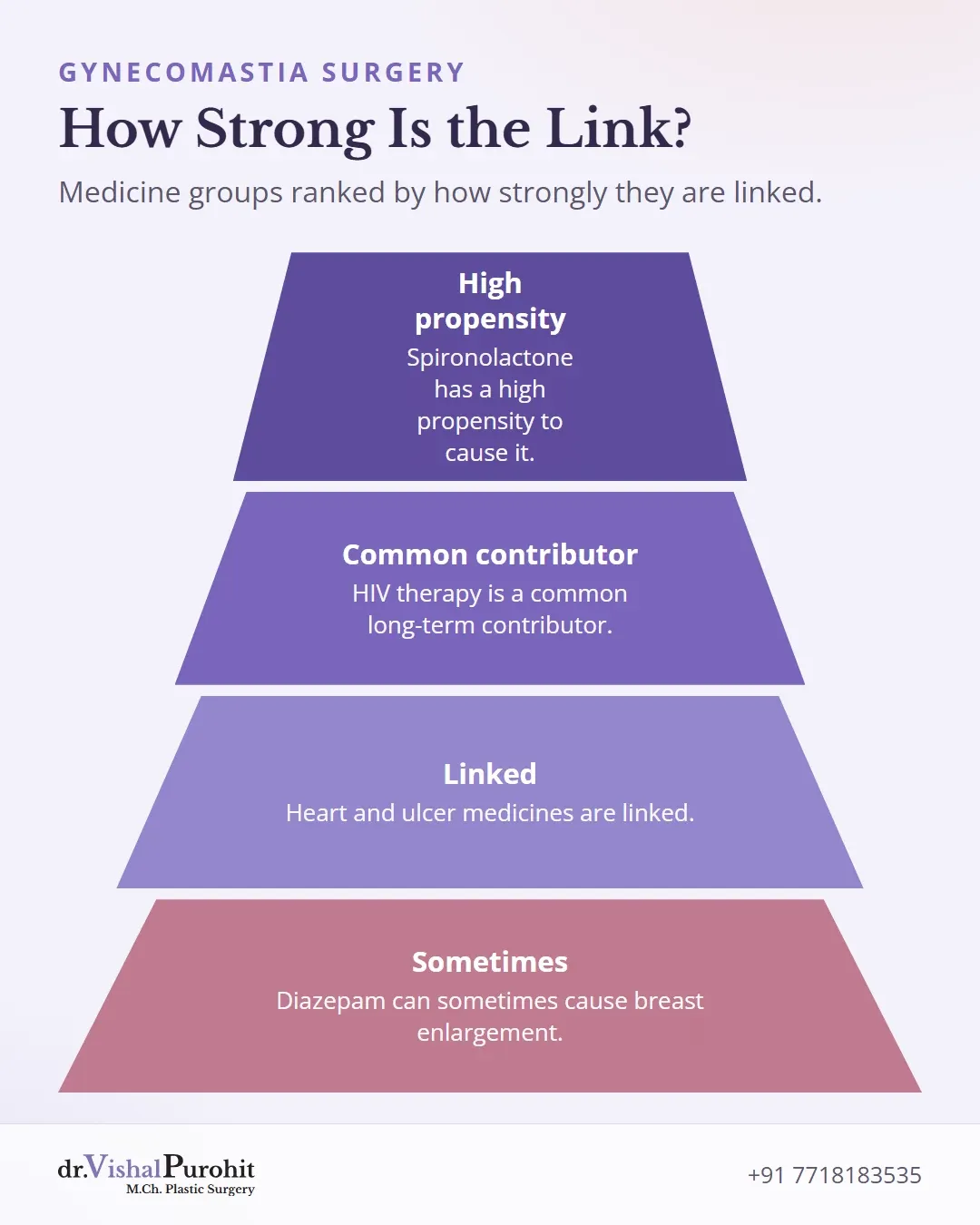
Several medicine groups appear in the medical literature as contributors to male breast enlargement. The table below covers only the groups named in the evidence. Strength of association is stated only as the evidence states it.
Key points
- Several medicine groups appear in the medical literature as contributors to male breast enlargement.
- Where a contributing agent is identified, stopping or switching it often allows breast tissue to regress.
- Antiandrogen treatment for prostate cancer, such as bicalutamide, is a well-documented cause of bilateral breast enlargement.
| Medicine group | Named examples | How strong is the link |
|---|---|---|
| Antiandrogens / prostate cancer therapies | Bicalutamide | High; long-term use is a common contributor23 |
| Mineralocorticoid receptor antagonists | Spironolactone (Aldactone) | High propensity; other agents in the same class, such as eplerenone (Inspra), have not produced similar effects2 |
| Antipsychotics | Not individually named in the evidence | Named as a common contributor with long-term use2 |
| Antiretrovirals (HIV medicines) | Highly active antiretroviral therapy (HAART) | Named as a common contributor with long-term use24 |
| Heart medicines | ACE inhibitors, calcium channel blockers | Linked to gynecomastia4 |
| Stomach-acid / ulcer medicines | Not individually named in the evidence | Named as a medicine category linked to gynecomastia5 |
| Antifungal medicines | Ketoconazole | Listed among agents commonly associated with gynecomastia2 |
| Anti-anxiety medicines | Diazepam (Valium) | Can sometimes cause gynecomastia4 |
| Opioids | Methadone, morphine | Noted to have hormonal side effects4 |
| Anabolic steroids | — | Can cause gynecomastia; this group is covered in detail in a separate post on steroids. |
What this means in practice
Medication use and substance use are among the most common causes of non-physiologic gynecomastia after persistent pubertal gynecomastia2. Where a contributing agent is identified, stopping or switching it often allows breast tissue to regress23. Before any surgery is considered, identifying and addressing a drug-induced cause is an important step1.
A note on individual cases
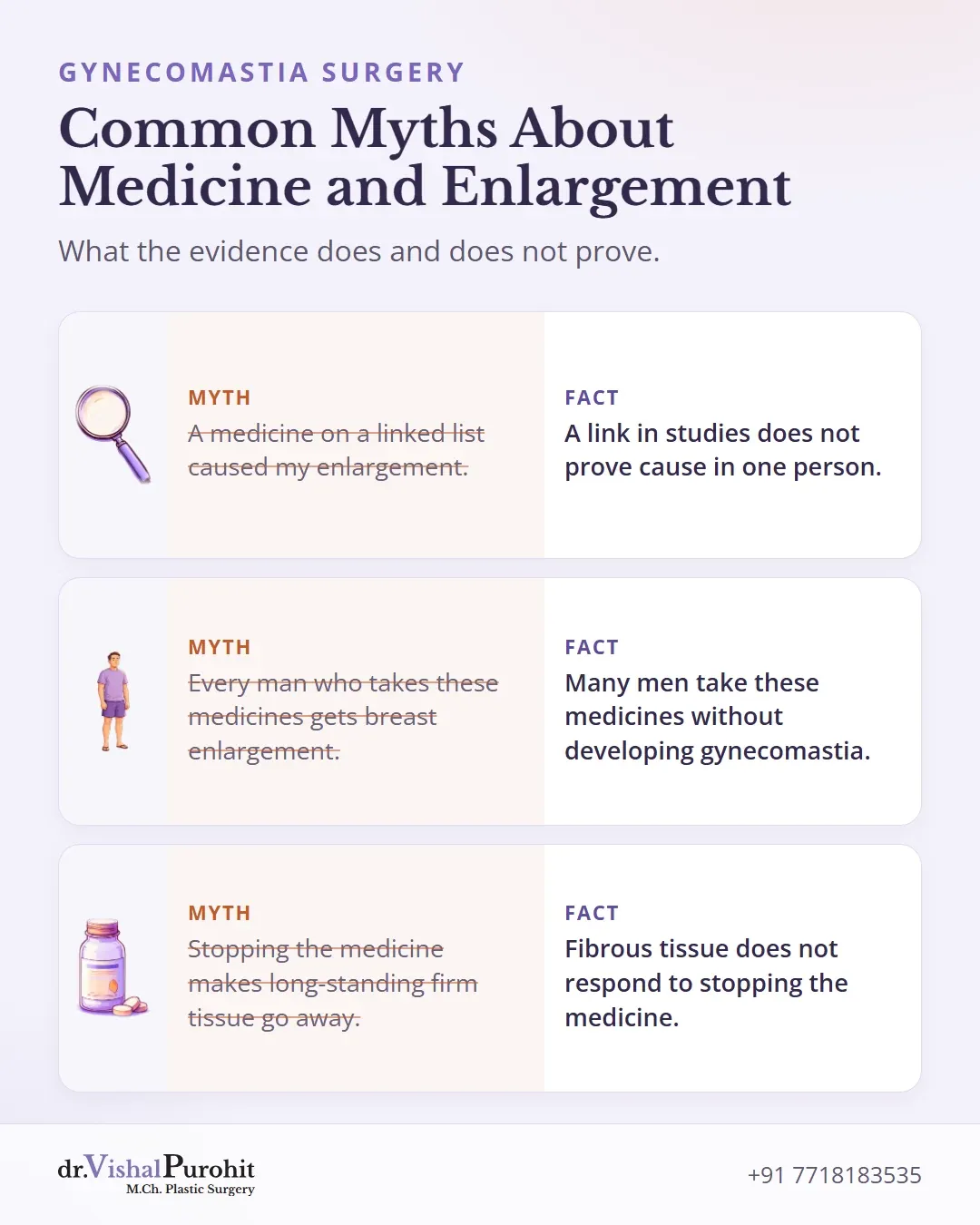
A link seen in studies does not prove that a medicine caused enlargement in any one person. Many men take these medicines without developing gynecomastia, and enlargement can have more than one cause at the same time. A clinical assessment is needed to weigh each person’s situation.
Prostate cancer therapies
Antiandrogen treatment for prostate cancer, such as bicalutamide, is a well-documented cause of bilateral breast enlargement3. In those cases, watchful waiting, a change in prostate cancer treatment, or medical management with an agent such as tamoxifen may be discussed with the treating urologist3. Radiotherapy has also been considered for gynecomastia associated with antiandrogen therapy3.
Timing, Medical History and Association Versus Cause
Why the Timeline Matters
When a man notices breast enlargement, one of the first questions a doctor asks is whether the swelling began after a medicine was started or after the dose was changed. This sequence does not prove that the medicine is responsible, but it is an important clue. If the condition stems from a medication, switching to a different drug may be enough to resolve it, and if the individual is using the medication for a short time, the condition will be temporary6.
Other Causes Are Still Investigated
Even when the timing looks convincing, other explanations must still be checked. Nonphysiologic gynecomastia can occur at any age as a result of a number of medical conditions, medication use, or substance use2. Puberty, weight changes, and conditions affecting the liver, kidney, thyroid, or testes can all produce similar enlargement, and some of these may be present at the same time as a suspect medicine.
Dr. Purohit’s note: In Jaipur, Dr. Vishal Purohit begins assessment with clinical examination and direct palpation, then arranges ultrasound or MRI when imaging is needed, and requests hormone blood tests only when there are other symptoms of hormonal imbalance.
Association Is Not the Same as Proven Cause
For many medicines that appear in medical literature, the link to gynaecomastia rests on individual case reports rather than controlled studies. A temporal association — enlargement appearing after a medicine was started — is a reasonable reason to review the prescription, but it does not confirm that the medicine is the sole or definite cause2.
Never Stop a Prescribed Medicine on Your Own
The decision belongs to the prescribing doctor
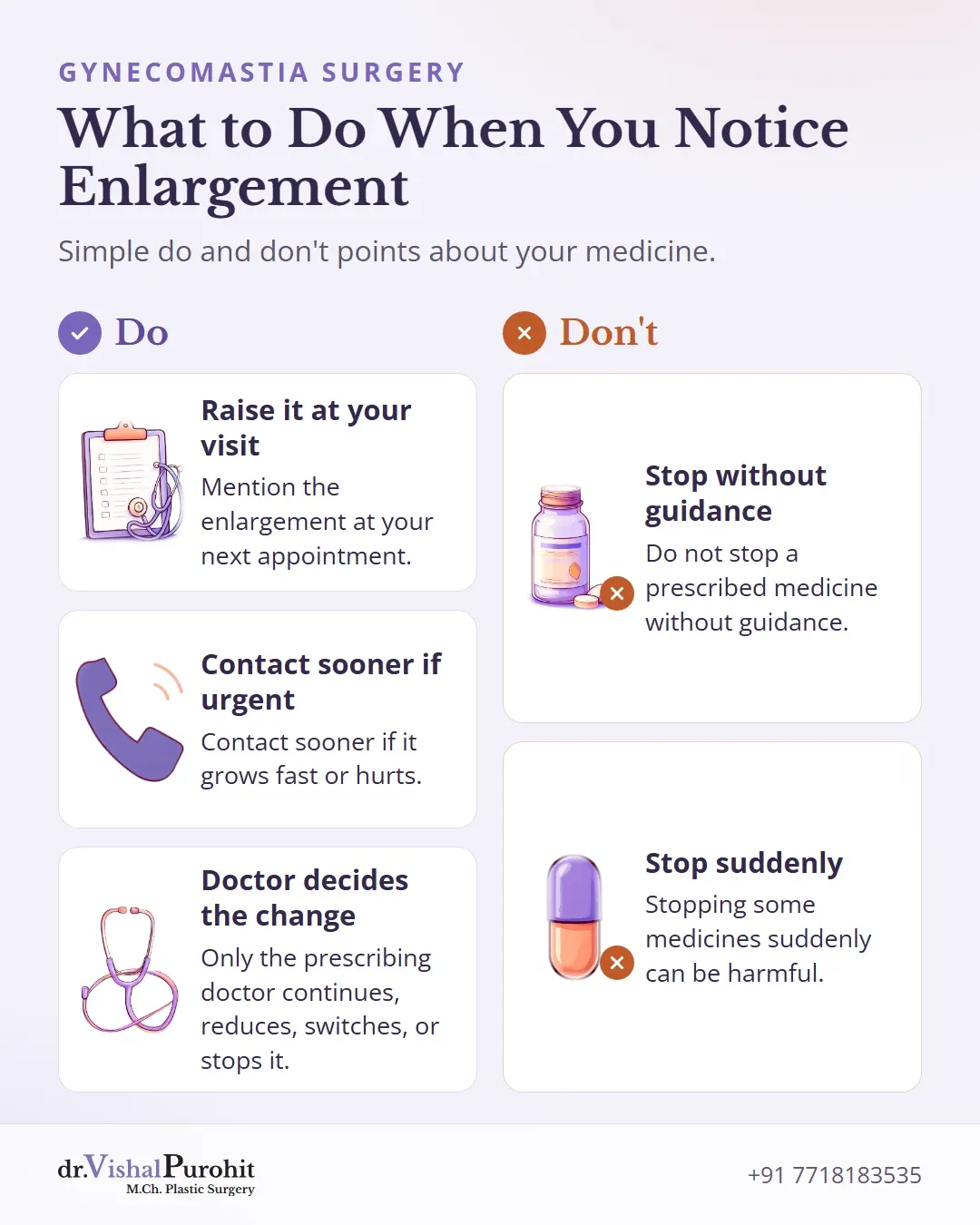
Only the doctor who prescribed a medicine can decide whether it should be continued, reduced, switched to an alternative, or stopped. Stopping some medicines suddenly can be harmful, so a patient who notices breast enlargement should not stop a medicine without guidance.
The right step is to raise the concern at the next appointment, or sooner if the enlargement is rapid or painful.
What may happen after a clinician-directed change
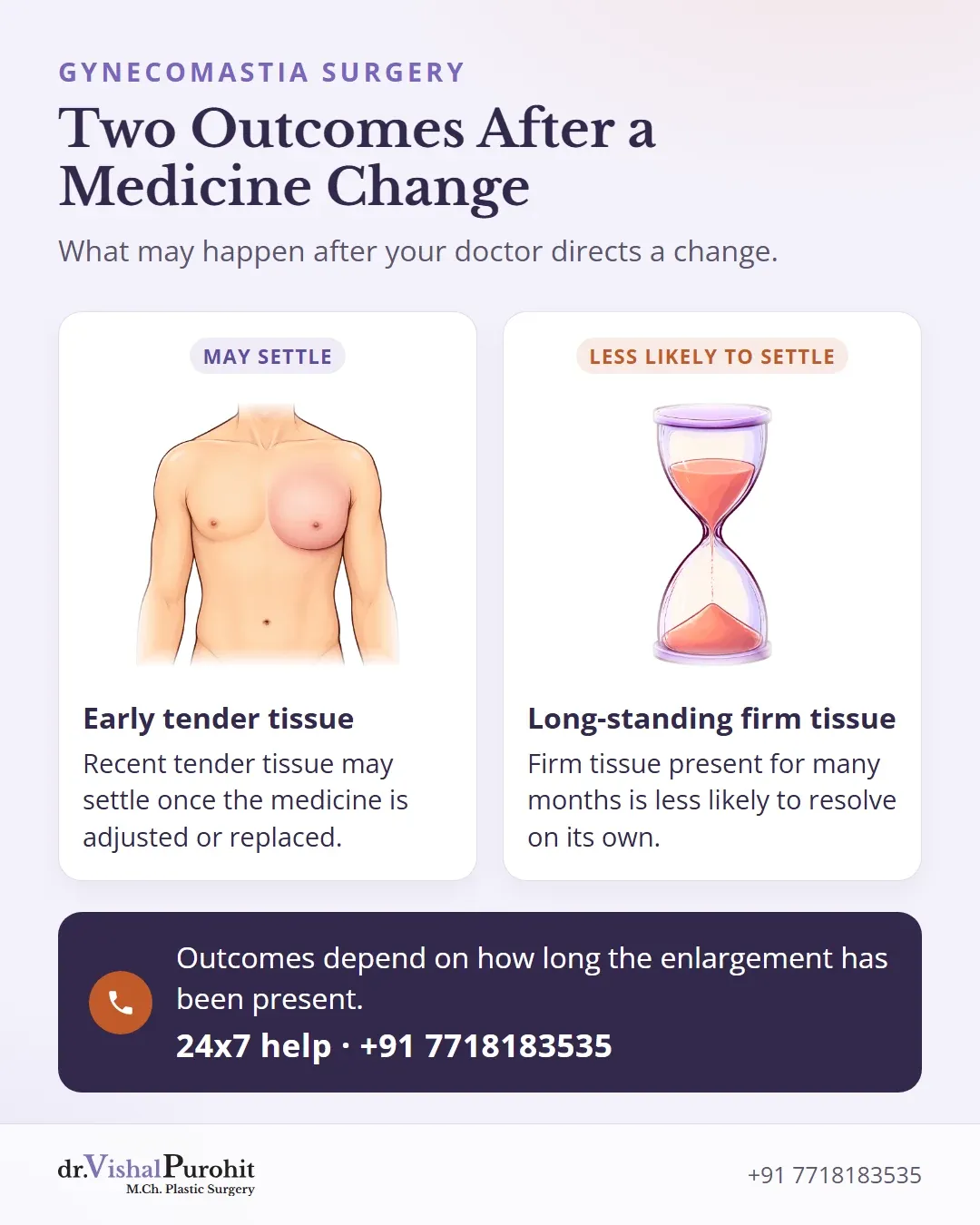
When a doctor reviews the situation and directs a change, outcomes depend on how long the enlargement has been present3:
Questions to Take to Your Doctor
What to Ask the Prescribing Clinician
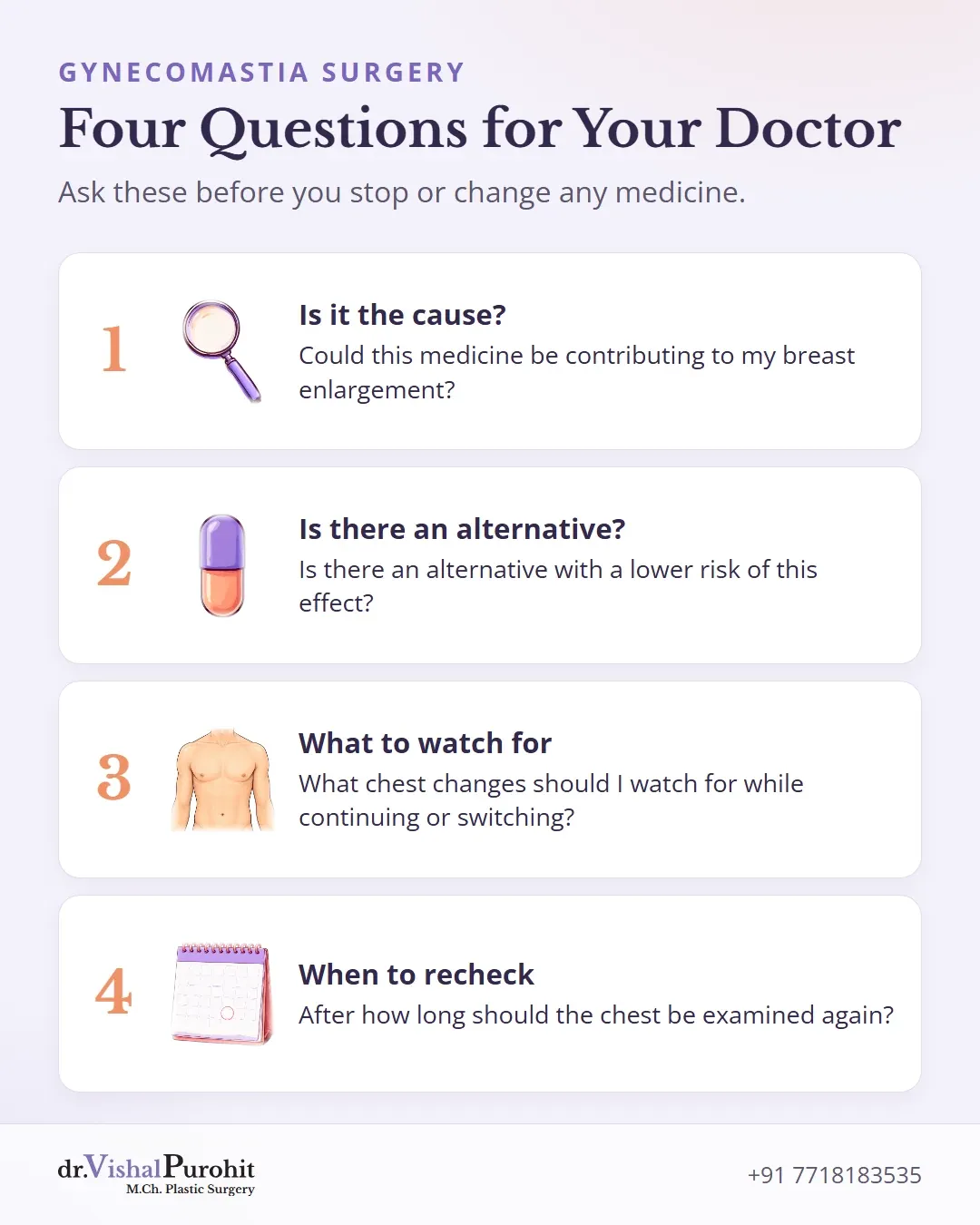
Before stopping or changing any medicine, a man who notices chest enlargement should raise the following with the doctor who prescribed it:
- Could this medicine be contributing to the breast enlargement I am experiencing?
- Is there an alternative medicine that carries a lower risk of this effect?
- What changes in the chest should I watch for while continuing or switching treatment?
- After how long, and at what point, should the chest be re-examined to see whether the enlargement has settled?
When a Plastic Surgeon Becomes Relevant
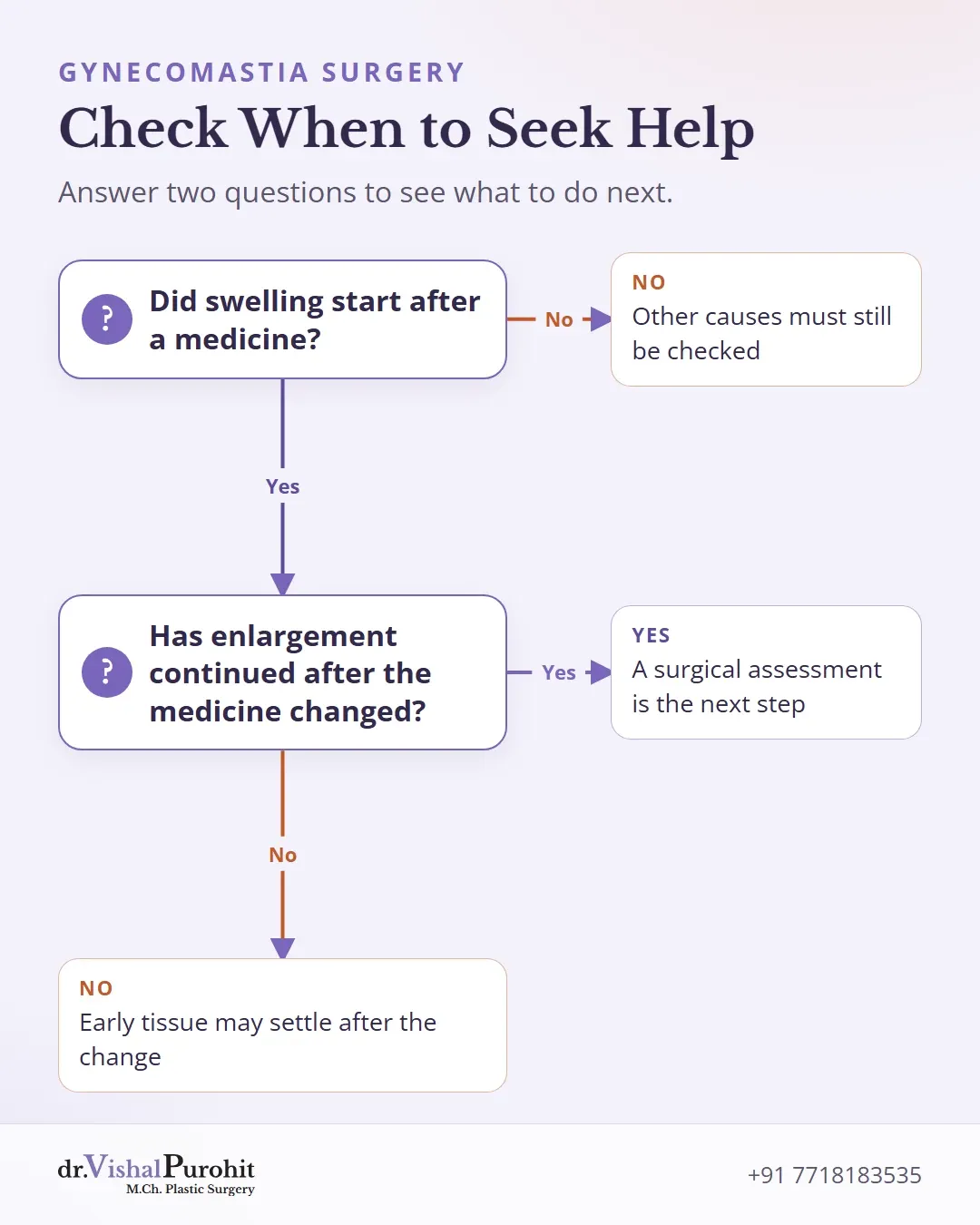
These questions are worked through with the prescribing clinician first. If the enlargement persists even after the medicine has been stopped or changed and the underlying cause has been addressed, a consultation with a plastic surgeon is the appropriate next step, because glandular breast tissue that has been present for some time does not reliably resolve on its own2.
When Enlargement Persists
When drug-induced gynecomastia has been present for a long time, the glandular tissue can become fibrous1. Fibrous tissue does not respond to stopping the offending medicine and is unlikely to shrink on its own3. At that stage, a surgical assessment becomes the logical next step3.
Dr. Vishal Purohit’s approach to medicines
In Jaipur, Dr. Vishal Purohit does not prescribe medicines for gynecomastia. Once the gland is removed surgically, it cannot grow back, making medication unnecessary.
Persistent Drug-Induced Gynecomastia: Getting an Assessment in Jaipur
When gynecomastia has been present for a long time despite addressing the suspected medicine, glandular tissue can become fibrous and will not resolve on its own. At that point, a surgical consultation is the appropriate next step. To understand what the procedure involves, visit the gynecomastia surgery in Jaipur page, or explore common patient questions on the gynecomastia FAQs page. Dr. Vishal Purohit in Jaipur can be reached by WhatsApp at +91 7718183535.
This is educational information, not medical advice.