
In short
- Laser epilation kills the deep hair roots whose shafts re-enter cleft skin and restart disease.
- Small series report return falling from about 33.6% to 2.7 to 10.5% with epilation (low-quality evidence).
- Dr. Vishal Purohit times laser sessions in Jaipur only after the flap wound has fully healed.
Who this page is for
This page is for patients healing from pilonidal flap surgery. Surgery removes the disease and flattens the cleft. Hair control protects that result. Without it, new loose hairs drift back into the groove and the cycle can restart.
It is also for patients with repeat flare-ups despite good wound care. If pits keep refilling with hair, epilation is often the missing step. The advice here covers laser epilation as aftercare, not as a stand-alone cure for active tracts.
Note the boundary of this clinic. Dr. Vishal Purohit performs Limberg and Karydakis off-midline flap surgery in Jaipur, plus urgent abscess drainage. Laser epilation sessions happen at a skin or laser unit once healing is complete, timed and planned by the surgeon. The clinic does not offer SiLaC tract laser, phenol, or endoscopic methods.
How laser stops hair from restarting disease
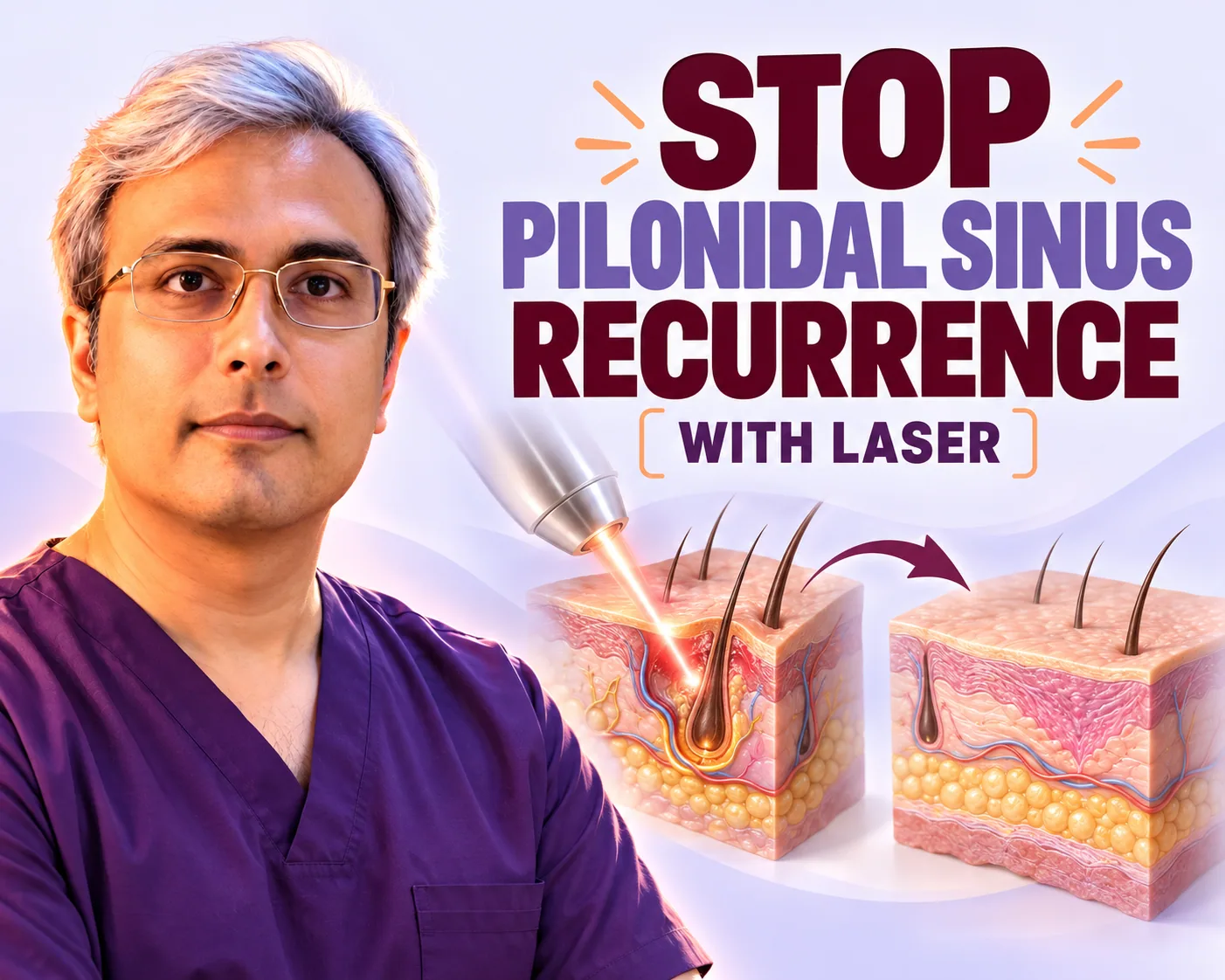
Epilation means destroying hair roots. The laser beam targets melanin, the dark pigment in hair. Melanin turns light into heat. The heat travels down the shaft and injures the deep root bulb in the dermis. A dead bulb grows no new shaft.
This matters because pilonidal disease is a hair-shaft disease. Loose shafts, not germs alone, start it. Friction pushes sharp cut shafts into soft cleft skin. Each buried shaft sparks a foreign-body reaction, then a pit, then a tract. Kill the nearby roots and the supply of loose shafts dries up.
Shaving cannot do this job. A razor cuts the visible shaft but leaves the bulb alive. The stump regrows sharp within days. Laser reaches the bulb itself, so regrowth thins session by session until the zone stays largely bare.
What studies show: return can fall fast
The numbers come from small pilonidal series, so read them as signals, not guarantees. With that caution: series report return around 33.6% without epilation, dropping to between 2.7 and 10.5% with laser epilation (reported endpoints as published, low-quality evidence). The gap is wide enough that guidelines discuss epilation as sensible aftercare.
Why would one step change so much? Because it attacks the cause, not the scar. Flap surgery fixes shape. Epilation removes fuel. Together they cover both halves of the disease. Either step alone leaves a door open.
Honest limits apply. The series are small and mostly non-randomised. Skin tone, hair thickness, and device type shift results. Dark coarse hair responds most strongly because it carries more pigment. Fine pale hair responds less. Your plan should state these limits before the first pulse.
Key figures from published series
- Return around 33.6% without epilation versus 2.7 to 10.5% with laser epilation is reported in small pilonidal series (reported endpoints as published, low-quality evidence).
- The reported treatment zone is the cleft plus 5 cm on each side, treated only after complete wound healing.
- Multiple sittings spaced weeks apart are required, since each pulse treats only hairs in the active growth phase.
Treatment plan: zone, timing, and sittings
A safe plan has three parts. First the zone: the natal cleft plus about 5 cm on each side. Hairs from nearby slopes slide downhill into the groove, so the margin matters as much as the centre. The surgeon marks this zone at the healing review.
Second the timing: only after complete healing. For flap patients this usually means several weeks post-surgery, once the scar is closed, dry, and calm. Laser on broken or weeping skin risks burns, dark patches, and delayed healing. Clearance happens at wound review, never by calendar guess.
Third the sittings: several sessions spaced weeks apart. Hair grows in cycles, and the beam works best on actively growing roots. Each sitting catches a new crop. Shedding is reviewed between sittings, and settings adjust to skin response. Patients can follow the recovery timeline to see where clearance usually falls, and pair sessions with the lifestyle steps that prevent return.
While healing: what to do before the first sitting
- Clip or carefully shave nearby slopes only; keep blades off the healing scar line.
- Skip waxing and depilatory creams on fresh scars until the surgeon allows them.
- Keep the cleft clean and dry; report trapped hairs or refilling pits at once.
Do not confuse this with SiLaC tract laser. That is a different procedure that burns the sinus from inside, and this clinic does not offer it. Epilation treats surface hair roots after healing. The names sound alike, but the targets differ completely.
What Dr. Vishal Purohit does in Jaipur
Dr. Vishal Purohit is an M.Ch plastic surgeon treating pilonidal sinus disease in Jaipur, performing definitive Limberg and Karydakis off-midline flap surgery. No phenol, laser, or endoscopic shortcuts; matched to your anatomy.
For aftercare, the surgeon clears each patient for epilation at wound review, marks the cleft plus 5 cm zone, and sets session spacing with the laser unit. Dressing visits include interim hair-care teaching so no sharp stubble collects near the scar. Flap choice itself follows the build seen: Limberg fold for wide defects, Karydakis slide for midline-near disease. This is educational information, not medical advice.
Next step
Patients healing from flap surgery can book consultation with Dr. Vishal Purohit in Jaipur for a healing check with an epilation zone and timing plan. Bring your surgery notes and current scar photos where available.