
In short
- EPSiT cleans the sinus from inside with a thin camera scope — no wide cut.
- Published series note small scars and high satisfaction, mainly for limited tracts.
- This Jaipur clinic does not offer EPSiT — the page is literature context; flaps are offered.
Who this page is for
Pilonidal sinus is a frequently observed disease in young adult males. Many patients hope for the smallest possible procedure. Camera-guided cleaning sounds ideal to them.
This page explains endoscopic pilonidal sinus treatment (EPSiT) and its child version (PEPSiT). It suits readers with limited tracts researching keyhole options. It also suits parents weighing choices for a teenager.
A clear frame helps. EPSiT is described in guidelines and published series as an option for limited disease. This clinic does not perform it. The page below is literature context, not a service menu.
How the camera procedure works
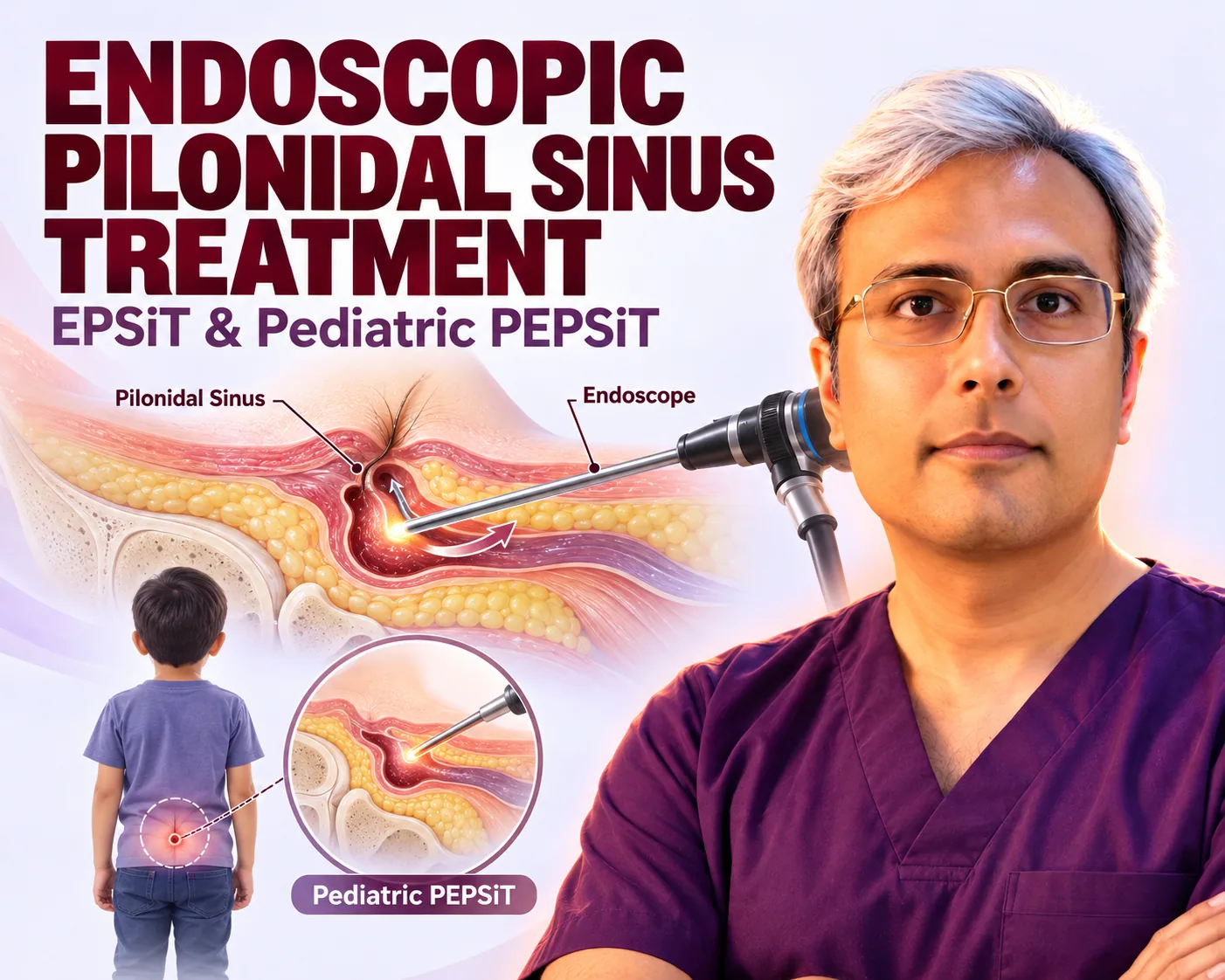
EPSiT uses a special thin scope called a video fistuloscope. It slides into the sinus through a tiny entry cut. A bright light and camera show the tunnel walls on screen.
The procedure runs in two phases:
- Diagnostic phase — the scope maps every pit, tunnel, and side branch from inside.
- Therapeutic phase — tools passed through the scope clean and seal the tract.
No wide excision happens. Skin stays almost fully intact. Entry cuts measure only millimetres.
Anaesthesia varies by series. Some centres use local with sedation. Others use spinal or short general anaesthesia. The choice follows tract extent and patient age.
Operating time stays short in published series for limited tracts. Most patients go home the same day. Sitting limits still apply for a week or two while entry points seal.
Aftercare runs a simple sequence:
- Days 1 to 3 — light dressings, side-lying rest, brief sits only.
- Week 1 to 2 — entry points close; showers follow clinic timing, then pat dry.
- Week 3 to 4 — review checks sealing; trimming near the points resumes.
Antibiotics are not automatic. They follow signs of contamination at presentation. Clean limited cases often need none beyond the sitting itself.
Readers comparing keyhole tools can also review laser sinus closure (SiLaC) literature for a second small-incision context.
What happens inside the tract
The screen guides every move. The surgeon sees hair nests, debris, and granulation tissue directly. Nothing is guessed from outside.
Cleaning follows a fixed order:
- Hair extraction — forceps pull out trapped hair bundles under direct vision.
- Brush debridement — a small brush scrubs the tract walls clean.
- Electrocautery — gentle heat seals the cavity lining so it scars shut.
Wash-outs flush the loosened debris. The scope re-checks each branch. Missed side pockets are the main cause of repeat trouble.
No stitches close the tract. Entry points stay open to drain for a few days. Dressings stay light and dry. Hair around — never on — the entry points gets trimmed.
Healing differs from flap healing. There is no large wound line to guard. But the sealed tract can re-open if hair re-enters. Long-term hair control matters just as much here. For the chemical alternative in small disease, see phenol and fibrin glue literature.
EPSiT is not right if you have
- Wide branching tracts or multi-recurrent scarred fields — these need definitive Limberg flap closure
- An active hot abscess — drainage must come first
- Deep tracts near the anal verge needing wide clearance
Results in teens and young adults
Teens form a large share of pilonidal patients. School, sports, and exams make long recoveries costly. Small-scar options appeal strongly to this group.
Published series in adolescents and young adults note three pulls:
| Measure | What series report | Caveat |
|---|---|---|
| Scarring | Minimal — millimetre entry dots | Limited tracts only |
| Satisfaction | High in published cohorts | Single-centre series |
| Complications | Low rates described | Needs longer follow-up |
PEPSiT adapts the same scope for children. Smaller instruments fit smaller tracts. Parents should still ask about repeat-treatment rates before choosing.
Consent for a teen should cover three honest points. First, the method suits limited tracts — wide disease needs a flap. Second, a second sitting is possible if tracts persist. Third, hair control after healing decides much of the lasting result, whatever the method.
Repeat treatment is the honest trade-off. Small-incision methods treat less tissue. If tracts persist, a second sitting or a flap follows. Failed EPSiT never blocks later flap surgery.
Parents often ask how the scope differs from a flap for a teenager. The table below sets the trade in plain terms:
| Point | EPSiT (literature) | Off-midline flap (offered here) |
|---|---|---|
| Cut size | Millimetre entry points | One planned off-midline line |
| Best disease | Small, limited tracts | Wide, branching, or repeat tracts |
| Cleft shape | Unchanged | Flattened, less future trapping |
| Repeat sitting | More likely | Less likely, one definitive stage |
Broader small-versus-definitive context sits in minimally invasive pilonidal treatments. Families gain most from reading both pages before the visit.
Key figures from published series
- Pilonidal sinus is a frequently observed disease in young adult male patients, traditionally treated surgically with growing use of small-incision options for limited disease.
- Guidelines list EPSiT among options for limited disease — described in guidelines and single-centre series, not as clinic offerings.
- A crystallized-versus-liquid phenol comparison for pilonidal sinus (Demir et al. 2025, n=80) shows small-incision research is active — context only for how limited disease is studied.
What Dr. Vishal Purohit does in Jaipur
Dr. Vishal Purohit is an M.Ch plastic surgeon treating pilonidal sinus disease in Jaipur. He performs definitive Limberg and Karydakis off-midline flap surgery. If an acute infection needs urgent care, abscess drainage is available.
The clinic does not offer EPSiT/PEPSiT, phenol, SiLaC laser, pit-picking, Bascom lift, Dufourmentel, or Z-plasty. Endoscopic treatment appears on this page only as published-literature context for limited disease.
Patients with limited tracts are counselled honestly: small-incision methods exist in literature, but this clinic’s path is one-stage off-midline flap closure matched to the tract map. This is educational information, not medical advice.