

Most people heal from eyelid surgery without any drama. Swelling, bruising, watering, and a gritty feeling are all part of the normal process, and they settle on a predictable schedule.
But a small number of problems are genuinely time-critical — and one of them can threaten your sight within a couple of hours. This guide tells you which is which, and exactly what to do about each.
In an emergency, do not wait for clinic hours. Call +91-7718183535, and if you cannot reach us immediately, go straight to the nearest hospital with a 24-hour eye casualty. In India you can also dial 108.
Quick triage: what to do right now
Go to an emergency department immediately — do not wait
-
Sudden or worsening loss of vision in the operated eye
-
Deep, severe, increasing pain behind the eye, out of proportion to soreness
-
The eye feels hard, tense, or looks like it is bulging forward
-
Double vision that appears hours or days after surgery
-
Rapidly expanding swelling with tightness you cannot relieve
-
Breathlessness or chest pain with a racing pulse
Call the clinic today
-
Fever above 38°C (100.4°F)
-
Redness spreading outward from the incision, especially with warmth
-
Yellow or green discharge from the wound
-
Pain that is getting worse after day three rather than better
-
Pain when you move your eye
-
The wound has opened
-
Marked new dryness, light sensitivity, or a persistent scratchy sensation
-
Your eyelid will not close fully at night after the second week
Mention it at your next follow-up
-
Bruising, puffiness, and mild asymmetry in the first two weeks
-
A jelly-like swelling on the white of the eye (chemosis)
-
Small white bumps along the scar (milia)
-
Mild dryness or watering
-
A scar that feels firm or looks pink at four to six weeks
Post-Operative Symptom Triage Matrix
| Urgency Level | Symptoms & Physical Findings | Probable Underlying Cause | Mandatory Action Required |
|---|---|---|---|
| Green (Normal Healing) | Mild swelling, yellowing bruise, slight grittiness | Expected inflammatory response | Continue cold compress & prescribed eye drops |
| Yellow (Contact Clinic) | Persistent wound oozing, focal stitch redness, chemosis | Mild infection, stitch irritation, lymphatic lag | Message clinic; attend scheduled review |
| Red (Immediate Emergency) | Severe deep orbital pain, bulging eye, sudden vision loss | Retrobulbar hematoma (deep bleeding behind eye) | Go to hospital immediately; call surgeon 24/7 |
The one true emergency: bleeding behind the eye
The most serious complication after blepharoplasty is not infection. It is retrobulbar haemorrhage — bleeding into the closed space behind the eyeball, which raises pressure inside the orbit and can strangle the blood supply to the optic nerve. This is called orbital compartment syndrome.
It is rare. Published surveys of oculoplastic surgeons put retrobulbar haemorrhage at roughly 1 in 2,000 procedures, and permanent vision loss at around 1 in 10,000. But when it does happen, the window for treatment is measured in hours, not days. The retina and optic nerve tolerate only about 90 to 120 minutes of severe pressure before damage becomes permanent.
What it feels like:
-
Deep, boring pain behind the eye that keeps escalating — not the dull surface ache of a healing incision
-
The eye feels tight and hard, and may look pushed forward
-
Vision dimming, blurring, or greying out
-
Double vision, or difficulty moving the eye
-
Sometimes nausea and vomiting
When it happens: most cases occur within the first 24 hours, and often within the first few hours. Later bleeds are usually triggered by a spike in blood pressure — straining, heavy lifting, bending forward, violent coughing, or vomiting.
What is done about it: the treatment is a small emergency procedure at the outer corner of the eye called a lateral canthotomy and cantholysis, which releases the pressure. A published case report describes a man who presented less than 24 hours after upper blepharoplasty with reduced vision in one eye; canthotomy was performed even though his measured eye pressure was normal, and his vision recovered shortly afterwards.[1]
That last detail matters: a normal pressure reading does not rule it out. If the symptoms fit, go to hospital. Nobody will be annoyed with you for arriving and turning out to be fine.
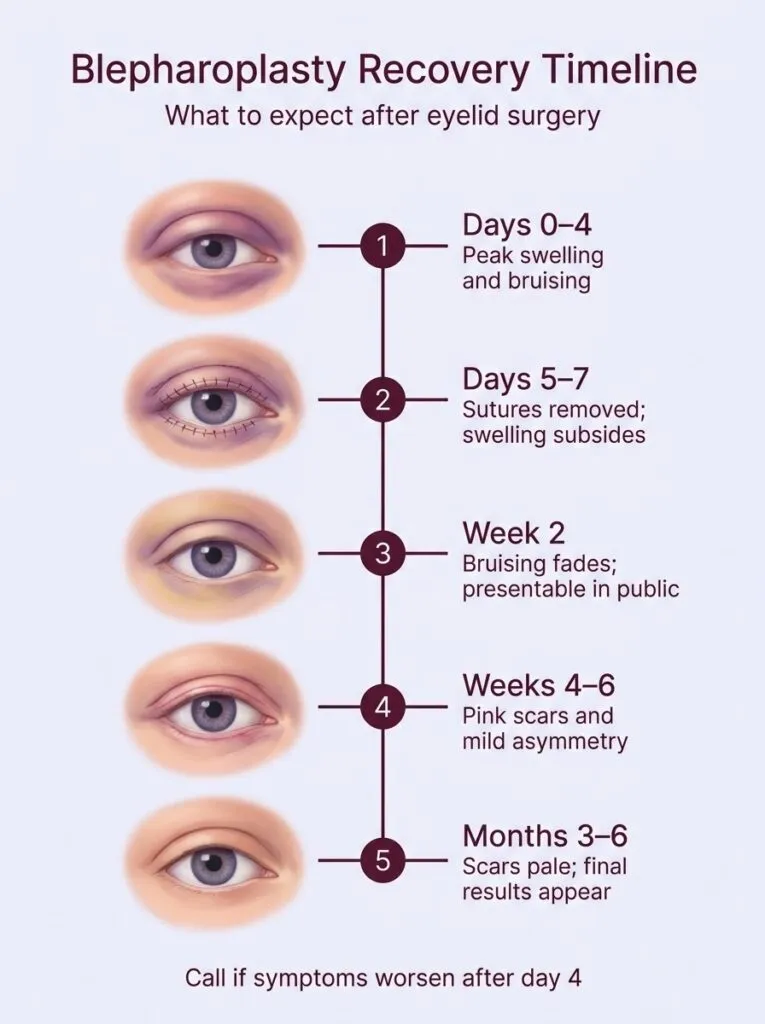
What normal healing actually looks like
Most anxiety after eyelid surgery comes from not knowing the schedule. Here is the usual course.
The direction of travel is the key signal. Swelling and pain should be improving by day three or four. Anything that gets worse when it should be getting better deserves a phone call.
Changes in vision
Some blurriness in the first few days is expected. Lubricating ointment smears the surface, swelling distorts the shape of the eye slightly, and the tear film is disrupted. This kind of blurring comes and goes, improves when you blink, and settles over days.
Worry instead about sudden change. A distinct drop in sharpness, a dark or grey patch, or vision that fades over minutes to hours is not swelling. Combined with pain or a tense eye, treat it as the emergency described above.
Double vision deserves its own mention because the original advice on this is often missed. New double vision after eyelid surgery can indicate raised orbital pressure, or injury to one of the small muscles that move the eye — a recognised risk in lower eyelid surgery. Anaesthetic-related double vision wears off within hours. Anything lasting longer needs assessment.[2]
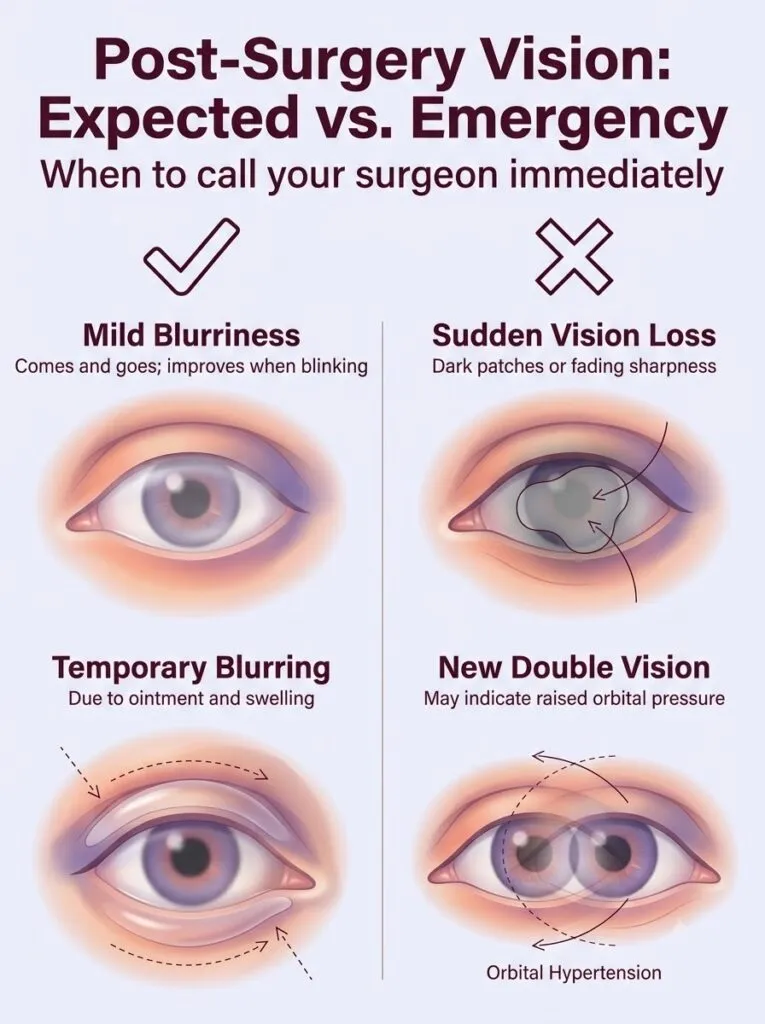
Educational guide by Dr. Vishal Purohit detailing expected and emergency vision changes after periorbital surgery. This resource helps patients identify signs of orbital hypertension for immediate medical attention.
Bleeding and swelling: telling the harmless from the dangerous
Not all bleeding is the same, and the distinction is the whole point.
Bruising and eyelid ecchymosis — the purple and yellow discolouration spreading across the lids and sometimes down the cheek. Ugly, universal, harmless. Resolves over two to three weeks.
A superficial eyelid haematoma — a firm collection of blood in the lid itself. It feels like a discrete lump, the overlying skin may be tight, and it does not soften with ice. It is not sight-threatening, but it can distort your result if left, so it should be reviewed. Small ones are watched; larger ones may be drained.
A retrobulbar haematoma — blood behind the eyeball. This is the emergency. The distinguishing features are pain behind the eye rather than in the lid, tightness of the whole eye rather than a lump you can locate, and any change in vision.
Chemosis — a translucent, blistered-looking swelling of the white of the eye, common after lower lid surgery. It looks genuinely alarming and is almost always benign, settling over two to six weeks with lubricants.
What raises your bleeding risk
Blood thinners are the single biggest modifiable factor: aspirin, clopidogrel, warfarin, and the newer anticoagulants, plus over-the-counter supplements that most people never think to mention — fish oil, vitamin E, ginkgo, high-dose garlic, and ginseng. Uncontrolled blood pressure is the second.
For pain relief afterwards, use paracetamol, not aspirin or ibuprofen, unless your surgeon has told you otherwise.
Signs of infection
Infection after blepharoplasty is genuinely uncommon — reported rates are well under one percent — because the eyelids have an exceptionally rich blood supply. But it does happen, and it typically appears around days three to seven, not immediately.
The distinction that matters is between two kinds:
Preseptal cellulitis — infection in the eyelid tissue in front of the eye. Redness, warmth, swelling, tenderness. The eye itself moves normally and vision is unaffected. This needs prompt antibiotics but is not an emergency in the same sense.
Orbital cellulitis — infection that has spread behind the eye. The tell-tale additions are pain on moving the eye, restricted eye movement, bulging, and reduced vision, usually with fever. This is a hospital admission.
Call the clinic for: spreading redness, increasing warmth, yellow or green discharge, worsening pain after day three, or fever above 38°C. Go to hospital for: any of those plus pain on eye movement or vision change.
Systemic warning signs
Fever above 38°C (100.4°F) after eyelid surgery is unusual and always worth a call, particularly if it comes with local signs of infection.
A racing pulse on its own is a much weaker signal than it is often made out to be. After surgery under local anaesthesia, a fast heartbeat is far more commonly caused by adrenaline in the anaesthetic, pain, anxiety, or simple dehydration. What makes it significant is the company it keeps:
-
Fast pulse with breathlessness or chest pain → go to hospital. This can indicate a clot in the lung, a risk that rises if your eyelid surgery was combined with a longer procedure under general anaesthesia.
-
Fast pulse with fever and spreading redness → call urgently; this suggests infection becoming systemic.
-
Fast pulse alone, settling with rest and fluids → mention it, but do not panic.
When the eyelid will not close
Mild difficulty closing the eye completely — lagophthalmos — is common after upper eyelid surgery and is usually temporary. Swelling and tissue tightness prevent full closure for the first days to couple of weeks, then it resolves as things settle.
The risk while it lasts is that the cornea dries out, which causes grittiness, light sensitivity, and, if neglected, actual damage to the surface.
What to do in the meantime:
-
Preservative-free lubricating drops through the day, as often as every one to two hours
-
A lubricating ointment at night
-
Taping the lid gently closed overnight, if your surgeon has shown you how
-
Avoid fans and air conditioning blowing directly on your face
When to call: if closure has not improved by the second week, if you develop pain, marked light sensitivity, or blurred vision, or if the eye feels persistently raw rather than just dry. Sustained corneal exposure needs proper assessment, not more drops.[2]
Lower lid position
After lower eyelid surgery, the lid can sit lower than it should, showing white below the iris (scleral show) or pulling away from the eye (ectropion). Some of this in the early weeks is swelling and scar tightness, and it often improves with massage and time. If it persists past six to eight weeks, or the eye is exposed and drying, it needs review — this is a correctable problem, but correcting it early is easier.
While you wait for help
If you are travelling to hospital with any of the emergency signs above:
-
Sit upright. Do not lie flat.
-
Do not press on the eye, and do not apply ice to it.
-
Do not bend forward, strain, or lift anything.
-
Do not take aspirin or ibuprofen.
-
Do not eat or drink, in case a procedure is needed.
-
Bring your operation details and a list of your medications.
Frequently Asked Questions
Is swelling and bruising normal after eyelid surgery?
Yes, mild to moderate swelling and bruising around the eyes are completely normal and expected after a blepharoplasty. The swelling typically peaks within the first 48 to 72 hours and gradually subsides over the following two weeks. Keeping your head elevated and applying cold compresses helps minimize this. Dr. Vishal Purohit advises his Jaipur patients that while most visible bruising fades in 10 to 14 days, subtle residual swelling may take a few months to fully resolve.
What is the single most dangerous complication of blepharoplasty?
The most dangerous, though extremely rare, complication of blepharoplasty is retrobulbar hemorrhage—bleeding behind the eye. This condition causes pressure to build up in the eye socket, which can compromise blood supply to the optic nerve and threaten vision if not treated immediately. As a board-certified plastic surgeon (M.Ch.), Dr. Vishal Purohit utilizes precise, minimally invasive techniques to mitigate bleeding risks and ensures all patients are thoroughly monitored and educated on emergency signs post-surgery.
How do I tell normal soreness from dangerous pain while healing after a blepharoplasty?
Normal healing involves a feeling of tightness, mild soreness, or a dull ache that is easily managed with prescribed pain medication. Dangerous pain is typically severe, deep, throbbing, and sudden. If you experience intense pain that isn’t relieved by medication—especially if accompanied by sudden swelling on one side or a change in vision—it requires immediate medical evaluation. Dr. Vishal Purohit emphasizes that any severe, asymmetric, or vision-altering pain should be reported to the clinic immediately.
My eye feels dry and gritty after cosmetic eyelid surgery. Is that a problem?
A dry, gritty, or itchy sensation is a very common and temporary side effect immediately following blepharoplasty. This occurs because post-operative swelling can temporarily prevent the eyelids from closing completely, altering tear film distribution. It is usually safely managed with lubricating eye drops or ointments. Dr. Purohit routinely prescribes lubricating drops during the first few weeks of recovery, but if dryness persists or causes severe discomfort, a follow-up evaluation is required to ensure the cornea remains protected.
One side looks different from the other after cosmetic blepharoplasty. Should I be worried?
Mild asymmetry in the first few weeks of recovery is normal and usually no cause for worry, as the two sides of your face often heal and shed swelling at different rates. It is common for one eyelid to appear slightly more swollen or sit higher than the other initially. Dr. Vishal Purohit cautions patients to wait at least 3 to 6 months for the tissues to settle completely before judging the final outcome. However, if the difference is drastic or impairs your ability to close the eye, contact the clinic for an assessment.
In case of an emergency after blepharoplasty. Should I call my own surgeon or go to hospital?
For general post-operative concerns like prolonged swelling, mild oozing, or medication questions, you should call your operating surgeon first. However, for severe, sudden symptoms, head to the nearest hospital emergency room immediately. Sudden vision loss, severe throbbing pain, rapidly expanding swelling, or heavy bleeding require urgent hospital care. Dr. Vishal Purohit provides his patients with clear direct-contact protocols for after-hours concerns to help navigate whether an immediate hospital visit is necessary.
What if my blepharoplasty surgery was done elsewhere? Who do i contact in an emergency?
In a true medical emergency—such as sudden vision loss or severe eye pain—you must go immediately to the nearest hospital emergency room, ideally one with an ophthalmologist or plastic surgeon on call. Do not delay care by waiting for an out-of-town surgeon to respond. While Dr. Vishal Purohit manages complications for his own patients, anyone experiencing a post-operative emergency in Jaipur should prioritize immediate medical intervention at a major hospital before seeking secondary corrective consultations.
About the author
Dr. Vishal Purohit — M.B.B.S., M.S. (General Surgery), M.Ch. (Plastic Surgery) — is a consultant plastic and cosmetic surgeon practising at Kalpana Aesthetics in Jaipur. He performs upper and lower blepharoplasty and other periorbital procedures.
This article is for general information and does not replace personalised medical advice. If you are recovering from surgery, your operating surgeon’s instructions take precedence.
To discuss your recovery or book a consultation, call +91-7718183535.
Related reading: Complete guide to blepharoplasty · Common risks and safety · Managing swelling and bruising · Managing side effects like dryness and asymmetry · Cosmetic surgery in Jaipur
References
-
Libet L, Garcia J, Dalia A. Emergent cantholysis post blepharoplasty: a case report. Clinical Practice and Cases in Emergency Medicine. 2025;9(4). doi:10.5811/cpcem.42014
-
Alharbi MM, Bin Dlaim MS, Alqahtani JM, et al. Ophthalmic complications of periorbital and facial aesthetic procedures: a literature review. Cureus. 2023;15(7):e41246. doi:10.7759/cureus.41246
Expert Blepharoplasty & Eyelid Rejuvenation in Jaipur
Are heavy, drooping upper eyelids or prominent under-eye bags making you look tired, aged, or obstructing your visual field? Schedule a detailed periorbital examination with Dr. Vishal Purohit, board-certified M.Ch plastic surgeon in Jaipur.
- Comprehensive Master Guide: Explore our foundational clinical overview on What is Blepharoplasty? Eyelid Surgery Explained.
- Surgical Procedures & Consultations: Visit our specialized Blepharoplasty Surgery in Jaipur suite to review surgical approaches, recovery milestones, and book your clinical evaluation.