Recovery following reduction mammaplasty requires patience as soft tissues gradually heal and adjust over several months. While mild swelling, tenderness, and temporary asymmetry are typical postoperative experiences, developing complications require careful attention. Understanding what represents standard healing versus unexpected tissue changes helps patients navigate their recuperation safely.
Complications such as wound edge separation, localized fluid buildup, or newly felt lumps should never be evaluated or managed without medical oversight. For any warning sign after surgery, call the surgical team immediately on +91 7718183535. For broader guidance on distinguishing routine recovery from complications that warrant prompt review, see our guide on Warning Signs After Breast Reduction: When to Call Your Surgeon.
Healing Concerns at a Glance
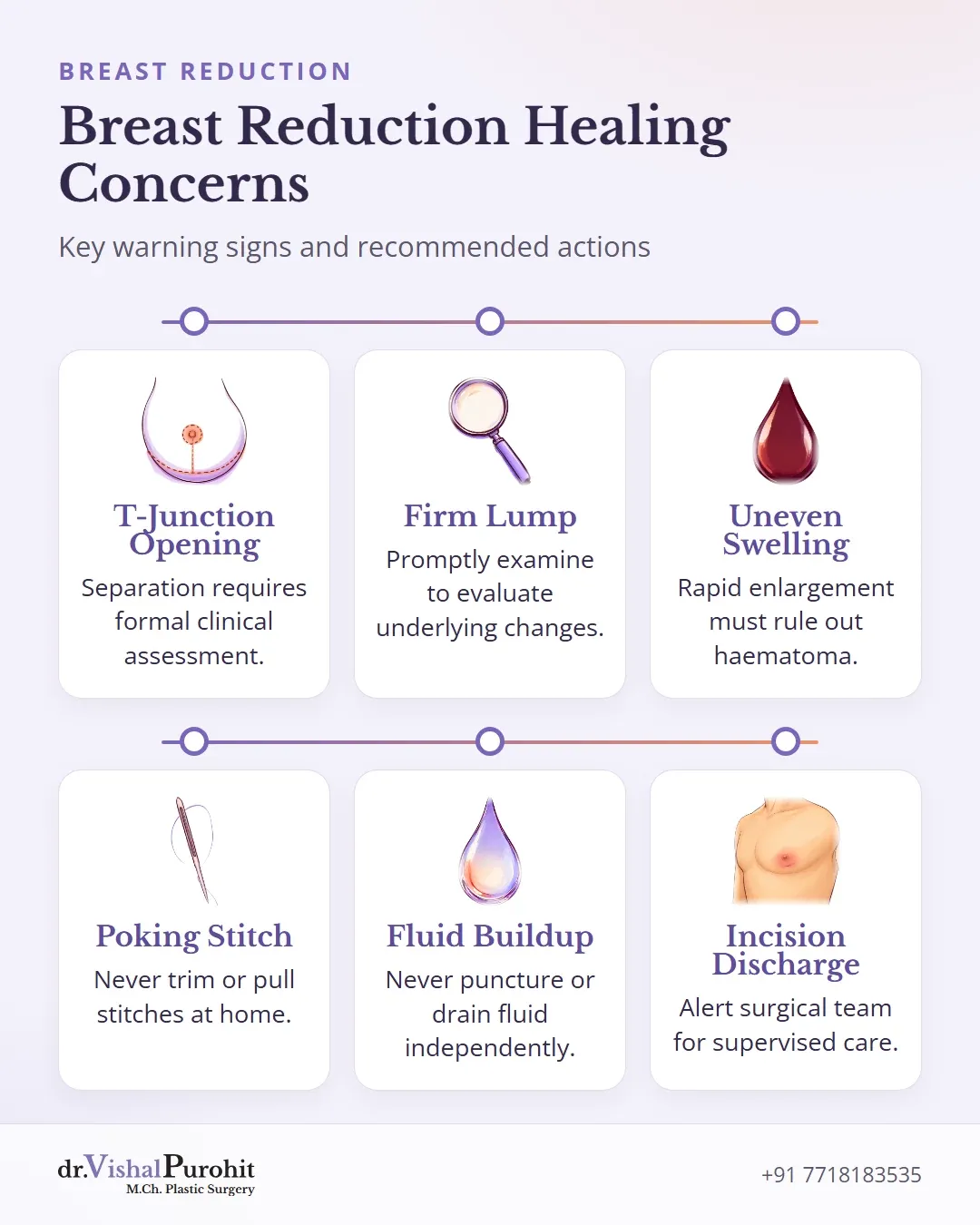
Wound healing complications, delayed healing, or visible marks along incisions can occur after reduction mammaplasty [1, 2]. At Kalpana Aesthetics in Jaipur, surgical concerns must be evaluated directly by Dr. Vishal Purohit and his surgical team.
Home interventions, trimming stitches, or draining fluid independently should never be attempted.
| Concern | What it can be | What to do |
|---|---|---|
| Small opening at the T-junction | Wound disruption or delayed wound healing [2]. | Contact Dr. Vishal Purohit’s surgical team for formal clinical evaluation; do not apply unprescribed home dressings. |
| Larger opening or discharge | Non-healed tissue breakdown [2], infection [1, 3], or seroma [1, 3]. | Alert the surgical team immediately (+91 7718183535) for assessment and potential surgical debridement or wound care [2]. |
| A firm lump | Haematoma [1, 3] or localized tissue changes. | Promptly contact the surgical team for a clinical examination. |
| One side more swollen | Uneven post-operative oedema [4] or underlying haematoma formation [1, 3]. | Notify the surgical team promptly to rule out an active haematoma [3]. |
| A stitch poking out | Suture extrusion through the skin incisions [2]. | Contact the surgical team for in-clinic review and management; never trim or pull sutures at home. |
Expected Healing Versus New Symptoms
After breast reduction surgery (reduction mammaplasty), distinguishing expected tissue recovery from signs that warrant timely clinical review helps patients monitor their progress safely.
Normal Recovery Timeline
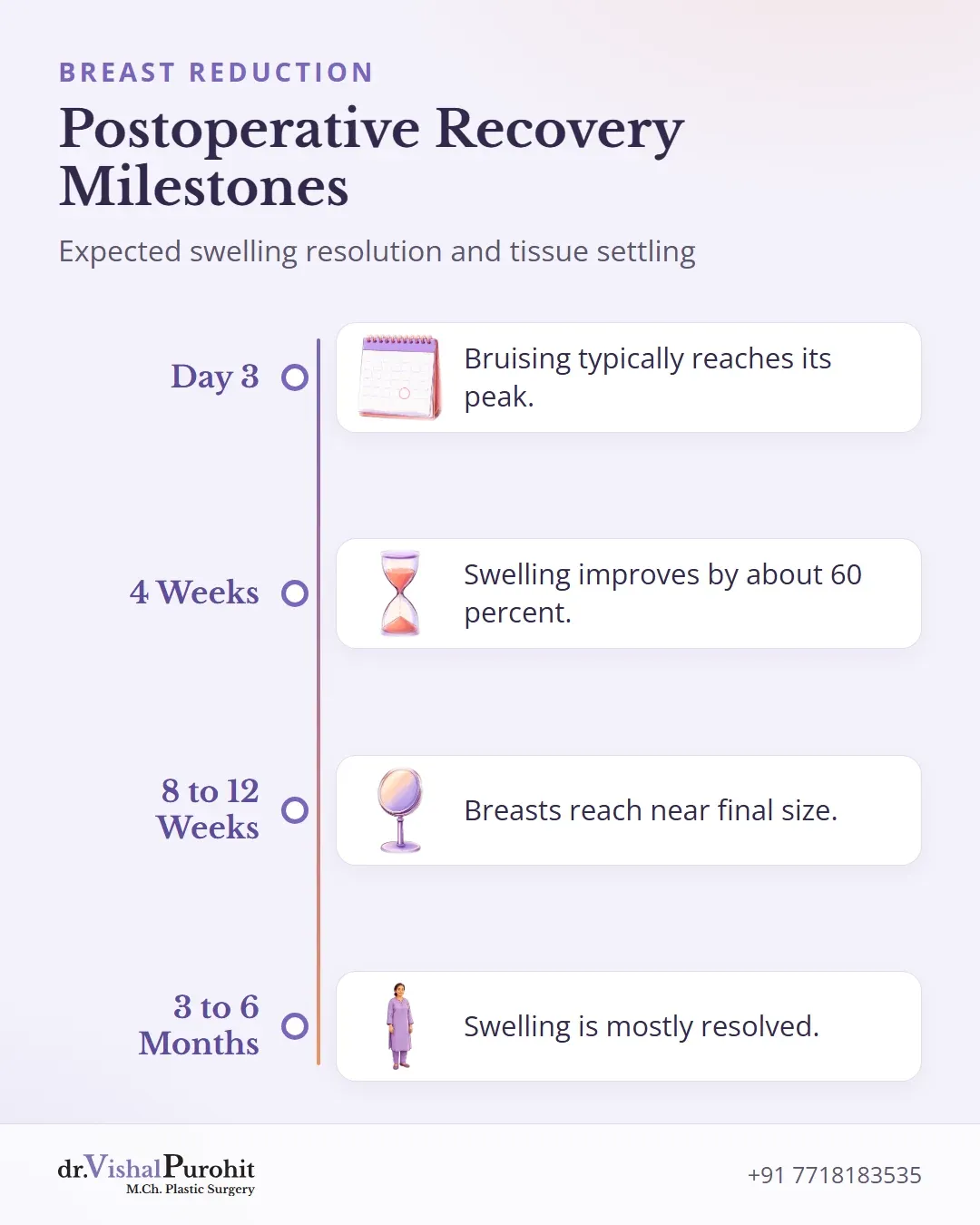
Published literature notes that postoperative swelling and bruising can obscure the final breast shape, and complete recovery can take several months [5].
In Dr. Vishal Purohit’s practice in Jaipur, bruising peaks around day 3, swelling is about 60% better at 4 weeks and about 90% resolved by 3 to 6 months, and the breasts reach about 85% of their final size at 8 to 12 weeks.
In standard healing trajectories:
Swelling and Firmness
- Breasts frequently feel swollen, tender, and lumpy after surgery [6].
- Postoperative swelling often persists for around 3 months [6], with soft-tissue swelling resolving over the initial months [7].
- Subtle contour changes can continue for 6 to 12 months [8].
Asymmetry
- Because each breast often heals at a different rate, temporary asymmetry is common during the first few months [8].
Signs Requiring Medical Review
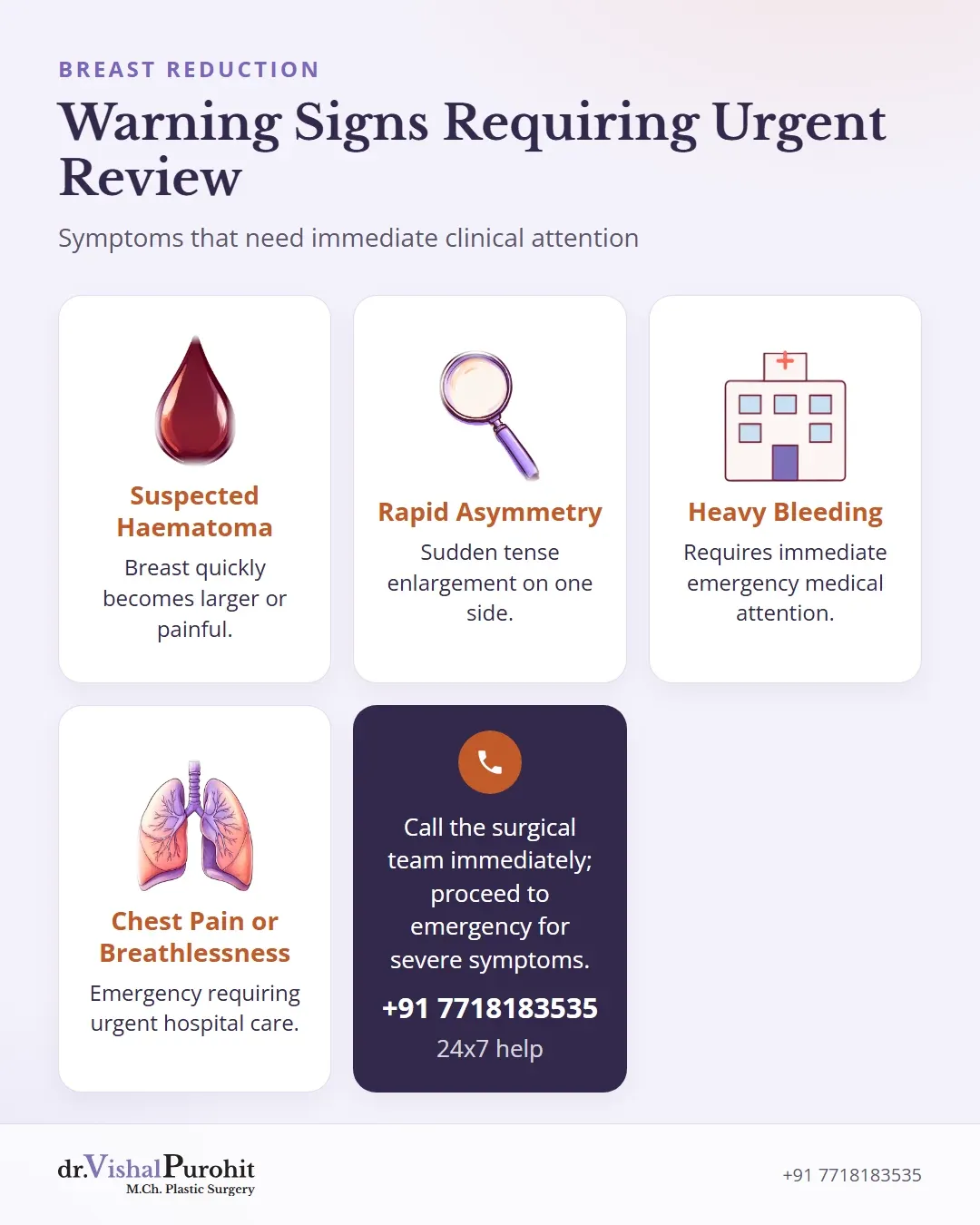
While gradual settling is expected, sudden changes or worsening issues are not part of routine recovery and require evaluation:
- Suspected Haematoma: A breast that becomes quickly larger, tense, or painful needs prompt treatment.
- Worsening Asymmetry or Swelling: Rapidly expanding swelling or sudden, tense enlargement on one side.
For any warning sign after surgery, the single instruction is to call the surgical team immediately on +91 7718183535; patients can call at any time, day or night, and the team arranges to resolve the issue.
Call the surgical team immediately if a breast becomes quickly larger, tense, or painful, or if you notice rapidly expanding swelling or sudden, tense enlargement on one side.
In any medical emergency, such as heavy bleeding, chest pain, or sudden breathlessness, patients should proceed immediately to the nearest emergency department.
Wound Opening Where the Scars Meet
In reduction mammaplasty, incisions are commonly planned using a Wise-pattern anchor or a vertical scar design.
When an anchor pattern is chosen, the scars join at an inverted-T junction where the vertical line meets the fold beneath the breast (inframammary fold).
Contributing Risk Factors
Complications in breast reduction can include wound dehiscence [9, 10]. In published series of reduction mammaplasty, overall dehiscence rates have been documented at 1% in a review of 300 breasts [10], while an earlier report noted minor wound breakdown or superficial infection in 3 of 19 patients [11].
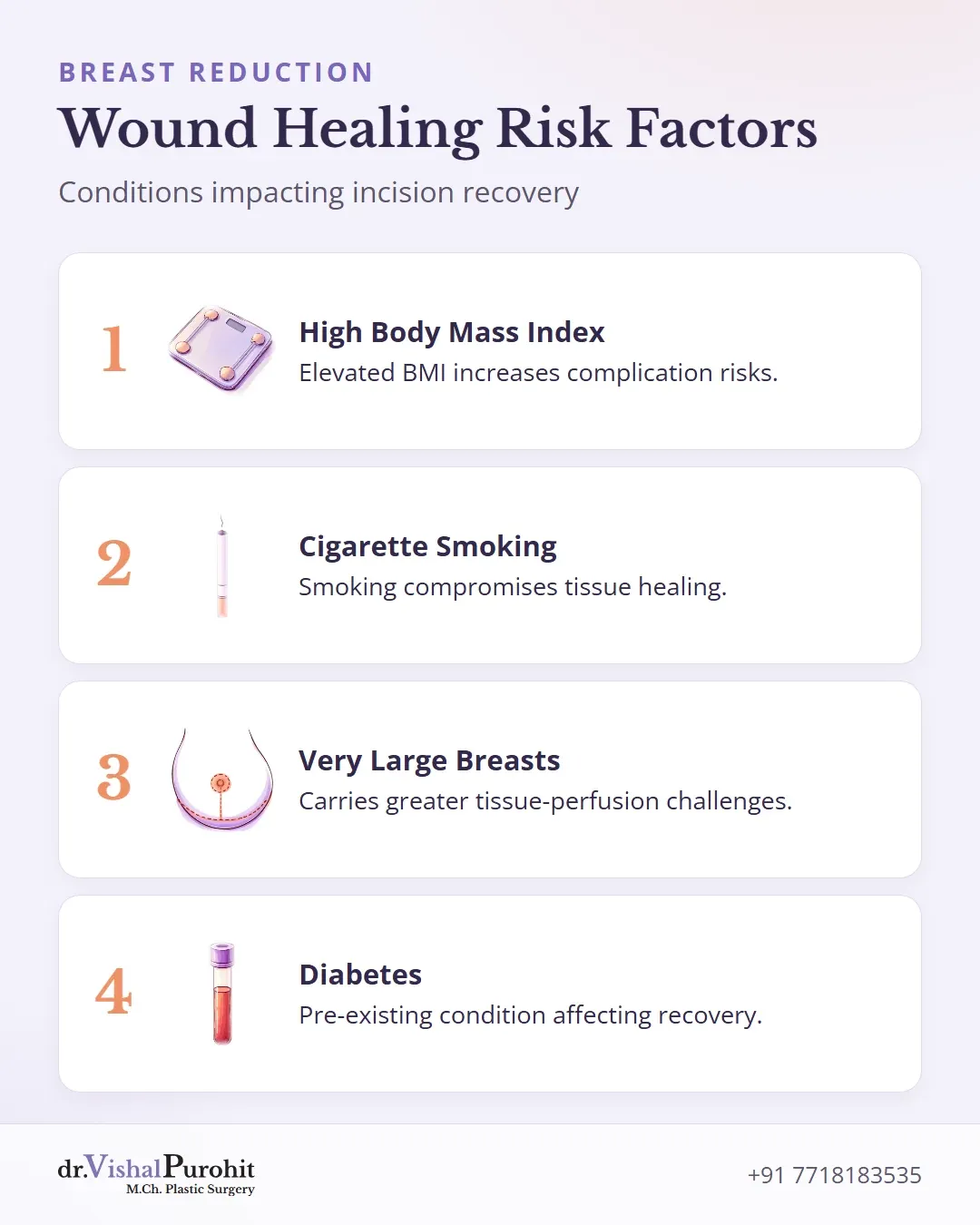
Clinical research shows that key risk factors for developing surgical complications following reduction mammaplasty include [12]:
- High body mass index (BMI) [12]
- Cigarette smoking [12]
- Having very large breasts [12]
- Diabetes [12]
In addition, large-volume procedures can encounter tissue-perfusion challenges, as long tissue pedicles carry a more tenuous blood supply [9].
Professional Clinical Management
Wound separation should never be handled through self-treatment, home dressings, or trimming sutures at home. Any breakdown along an incision line requires direct evaluation by the surgical team to assess the depth, check for underlying collection, and evaluate tissue viability.
In surgical reports, patients presenting with minor wound dehiscence or superficial infections responded rapidly to supervised dressing changes after clinical evaluation [11]. Operative cultures and wound swabs may be taken to determine whether bacteria are present or if the breakdown has a non-bacteriological cause [11].
Dr. Purohit’s note: In Dr. Vishal Purohit’s practice at Kalpana Aesthetics in Jaipur, routine follow-up visits are scheduled on day 3 and day 7, at 4 weeks, and at 3, 6, and 12 months.
Skin closure is performed with subcutaneous (buried) stitches in layers using internal Monocryl sutures. Skin glue (Dermabond) and waterproof tape are not used because small micro-abscesses can go unnoticed beneath them and compromise the stitch line.
Bathing is permitted from day 5, and drains are removed on day 4 to 5 once the fluid is clear.
For any healing concerns or warning signs after surgery, patients should call the surgical team immediately on +91 7718183535 (available day or night).
Fluid Collections and Bleeding
During the healing period after a breast reduction, fluid can sometimes accumulate within the surgical area. The two principal types of fluid collections encountered after surgery are seromas and haematomas.
Understanding Seroma and Haematoma
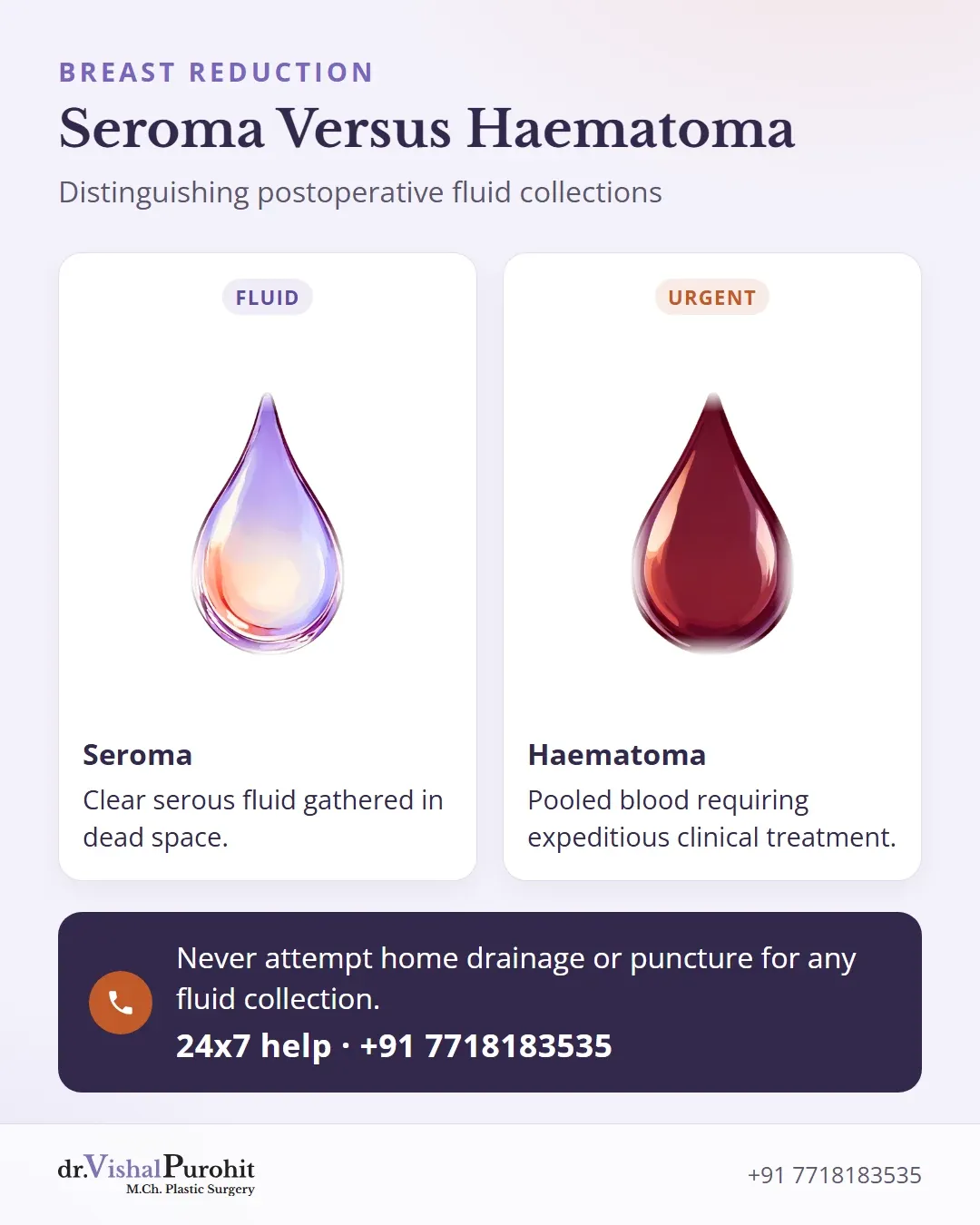
- Seroma: A localized collection of clear serous wound fluid that gathers in dead space left following breast tissue reduction [9].
- Haematoma: A collection of blood within the operated breast tissue, which represents a surgical concern requiring expeditious clinical treatment.
Assessment and Safety Protocols
Neither a seroma nor a haematoma should ever be regarded as harmless or left without medical evaluation. Patients must never attempt home drainage, puncture, or self-management under any circumstances.
Any sudden enlargement, tense swelling, or fluid buildup requires formal assessment by the surgical team.
In Dr. Vishal Purohit’s practice, surgical drains are routinely used.
For any warning sign after surgery, the instruction is to call the surgical team immediately on +91 7718183535; patients can call at any time, day or night, and the team arranges to resolve the issue.
Fat Necrosis and New Lumps
Fat necrosis refers to areas of injured fat tissue that may break down after breast reduction surgery (reduction mammaplasty).
Key points
- Fat necrosis occurs when injured fat tissue breaks down after breast reduction, sometimes causing liquid discharge or contour changes.
- Studies link higher BMI and larger tissue resections to an increased risk of fat necrosis.
- Any newly noticed lump after surgery requires medical evaluation and imaging rather than assuming it is harmless.
When fat tissue is altered during surgery, fat liquefaction can cause a liquid discharge from the incision line, or it may produce skin contour irregularities [2].
How Often Studies Report Fat Necrosis
Published studies show that fat necrosis can occur in operated breasts:
- In a comparative trial of 49 drained breasts and 49 undrained breasts, fat necrosis was identified in 2 breasts in the drained group and 1 breast in the undrained group [1].
- Higher BMI, as well as undergoing surgery for larger breasts or very large tissue resections, have been reported to increase the risk of fat necrosis [2, 13].
- While mild fat necrosis might cause no measurable change in breast volume, considerable tissue necrosis can reduce final breast size more than originally planned [13].
- If an area becomes infected, it requires medical management with antibiotics or surgical treatment, and additional surgery may sometimes be necessary to remove necrotic areas [2].
Why Every New Lump Must Be Evaluated
A newly noticed firm lump or mass after breast reduction should never be assumed to be harmless fat necrosis. Clinical examinations and diagnostic breast imaging, such as mammography and breast ultrasonography, are utilized in surgical settings to evaluate breast tissue thoroughly [10].
Other breast conditions can also present, and regular breast evaluation remains necessary to identify any abnormal tissue changes or separate underlying breast lesions [14].
For any warning sign after surgery, including a new lump, persistent hardening, or unexpected discharge, the instruction in Dr. Vishal Purohit’s practice is to call the surgical team immediately on +91 7718183535.
Stitches Working Their Way Out
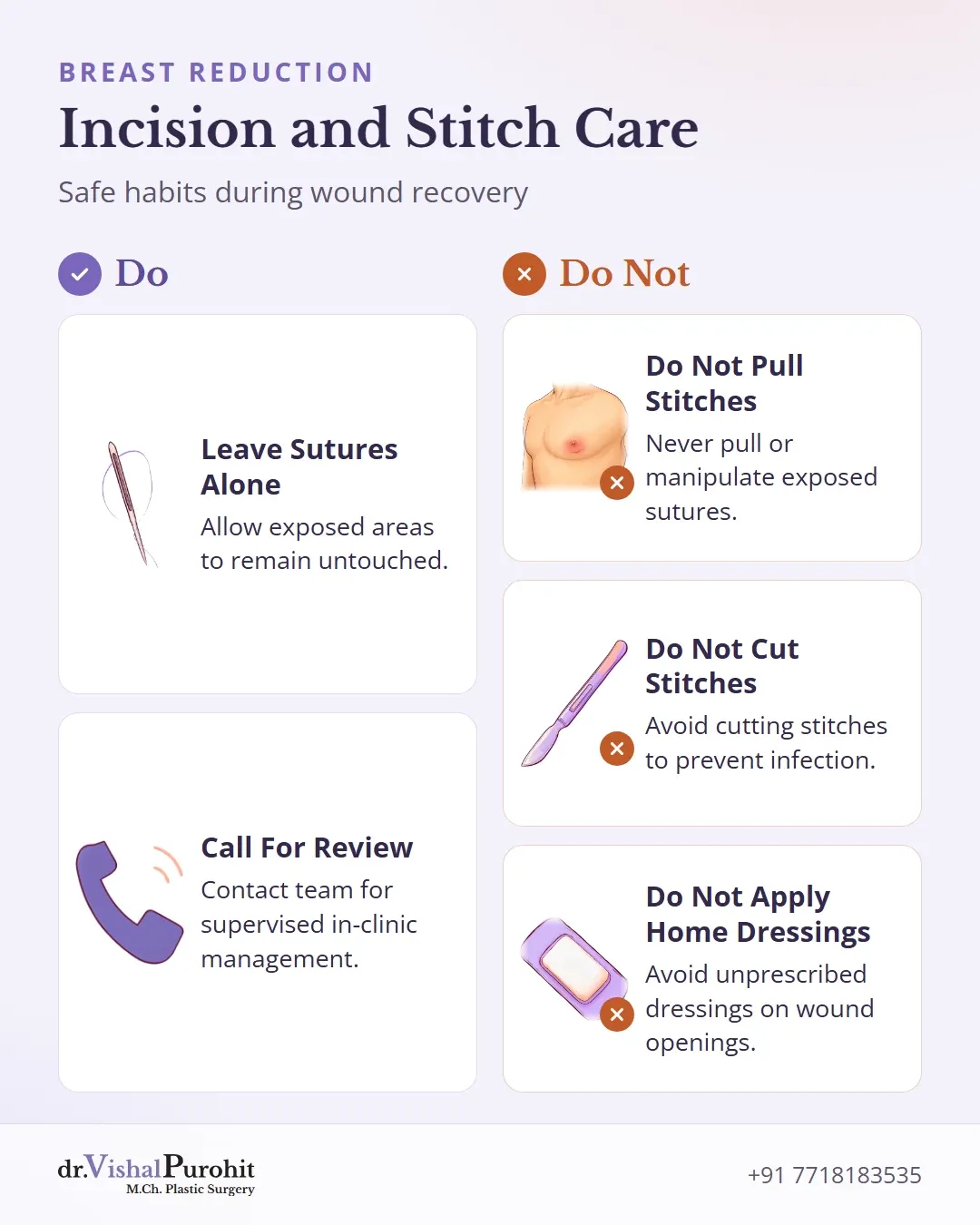
During breast reduction surgery, deeper absorbable sutures are placed to support the breast tissue and hold the lower dermal layers together [2]. In Dr. Vishal Purohit’s practice at Kalpana Aesthetics in Jaipur, the skin is closed with subcutaneous (buried) stitches in layers using internal Monocryl sutures. Over time, these dissolving stitches are gradually broken down by the body [2].
Occasionally, a patient may notice an exposed stitch or a process known as suture extrusion (“spitting” suture) [2]. In some individuals, redness can appear along an incision line that had previously seemed fully healed—often three or more weeks following surgery—accompanied by material that resembles pus [2].
This is usually the body’s reaction to the dissolving stitch [2], but redness and discharge always need to be evaluated because they can be hard to tell apart from an infection. Multiple suture extrusions may occur concurrently or at separate points during recovery [2].
Patients must not pull, trim, or attempt to remove exposed stitches at home. Any manipulation risks introducing bacteria or disrupting the healing wound edge. Instead, such areas should be left alone.
For any warning sign after surgery, the instruction is to call the surgical team immediately on +91 7718183535; patients can call at any time, day or night, and the team arranges to solve the issue.
Postoperative Care and Clinical Assessment in Jaipur
Monitoring surgical incisions and tissue changes is an essential part of recuperation after breast reduction surgery in Jaipur.
Understanding expected healing and potential risks, complications, and side effects helps you navigate recovery safely. For any warning sign after surgery, call the surgical team immediately on +91 7718183535.
This is educational information, not medical advice.