
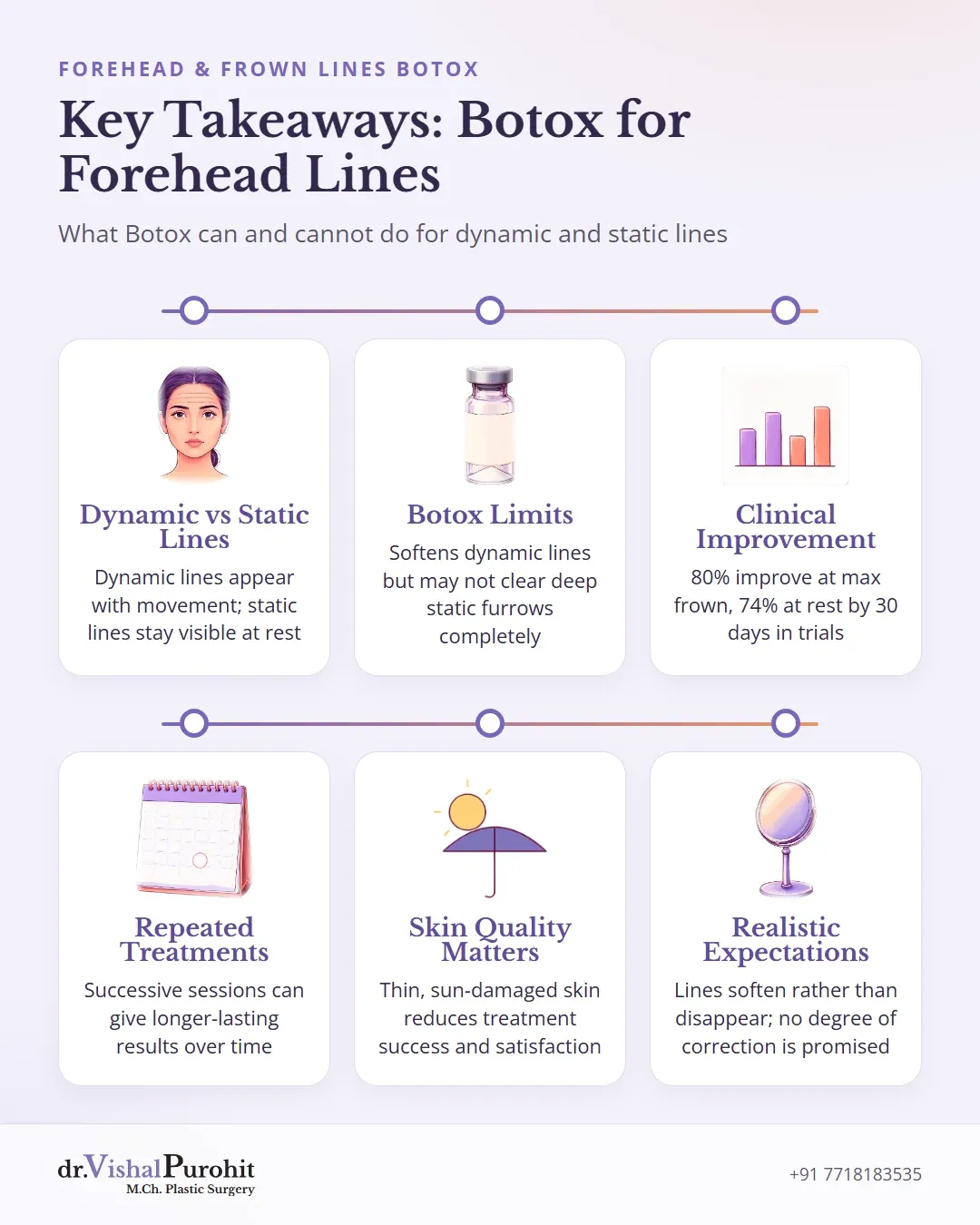
Dynamic lines form when facial muscles contract during expressions like frowning or raising the eyebrows, whereas static lines remain etched in the skin even at rest. Over time, repeated muscle contraction combined with sun exposure and natural ageing can turn movement lines into creases that stay at rest.
While neuromodulator injections temporarily reduce muscle activity to soften dynamic wrinkles, deep resting furrows may not completely clear. Understanding how these patterns interact is an essential part of forehead lines and 11 lines: why they are assessed together before deciding whether injection treatment is suitable.
Moving Lines and Lines at Rest
Dynamic lines
Dynamic lines appear when the facial muscles move, such as when raising the eyebrows or frowning. They are often seen on the forehead and between the eyebrows12. Everyone has some, and they tend to get deeper with age1. Repeated muscular contraction over the years is what gradually turns these lines into static furrows34.
Lines at rest
Static lines stay visible even when the face is not moving12. They are there because the skin has creased over the years, along with changes in the skin itself from factors such as sun exposure and smoking34. Dynamic and static lines can occur together4.
What Botox can and cannot smooth


Botox can make dynamic lines less noticeable and may delay their conversion into static lines1. Established static furrows may not respond to botulinum toxin alone35, and evidence that treatment prevents static lines from forming remains limited and heterogeneous3.
What Relaxing the Muscle Changes
Lines made by movement
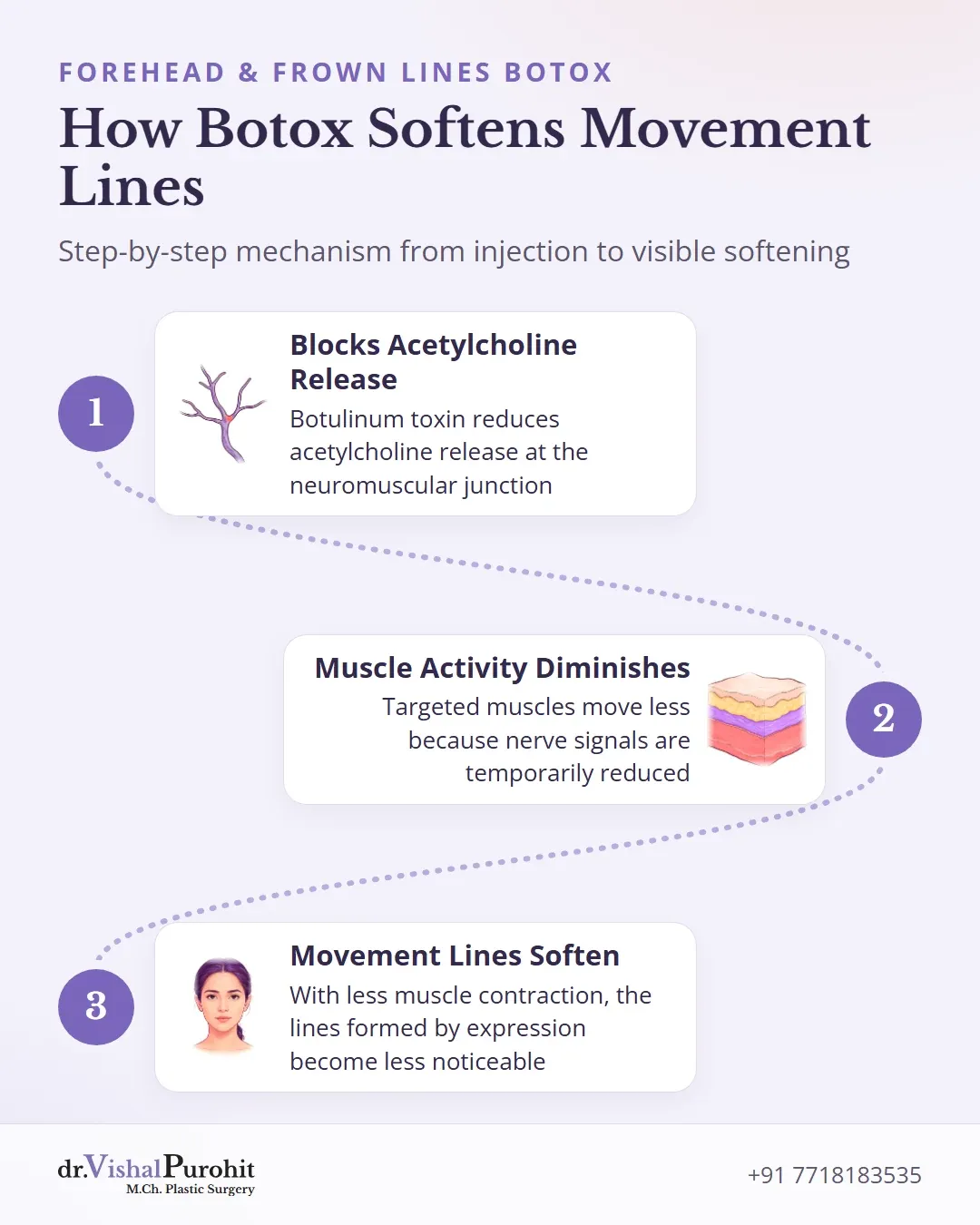
Botulinum toxin reduces the release of acetylcholine at the neuromuscular junction, so muscle activity is temporarily diminished6. Because the muscle moves less, the lines that movement makes soften7.
Key points
- Botulinum toxin temporarily reduces muscle activity to soften lines caused by facial movement.
- Improvement typically appears within one week and can last up to four months.
- Clinical trials evaluate frown lines and resting lines as two separate outcomes.
In published studies, improvement of the vertical lines between the brows generally occurs within one week of treatment, and the effect has been demonstrated for up to four months8. These figures are general information.
Frown lines and resting lines are scored separately

Trials of the vertical lines between the brows measure two different things: how the lines look at maximum frown, and how they look at rest8.
At maximum frown, 80% of treated patients (325/405) were rated none or mild 30 days after injection, against 3% (4/132) with placebo8, and severity remained reduced for up to 120 days9.
At rest, 39% of enrolled patients had moderate or severe resting lines89. Among treated patients who had lines at rest, 74% (119/161) were rated none or mild 30 days after injection, against 20% (10/49) with placebo8.
Why Deep Lines May Only Soften
Why deep lines behave differently
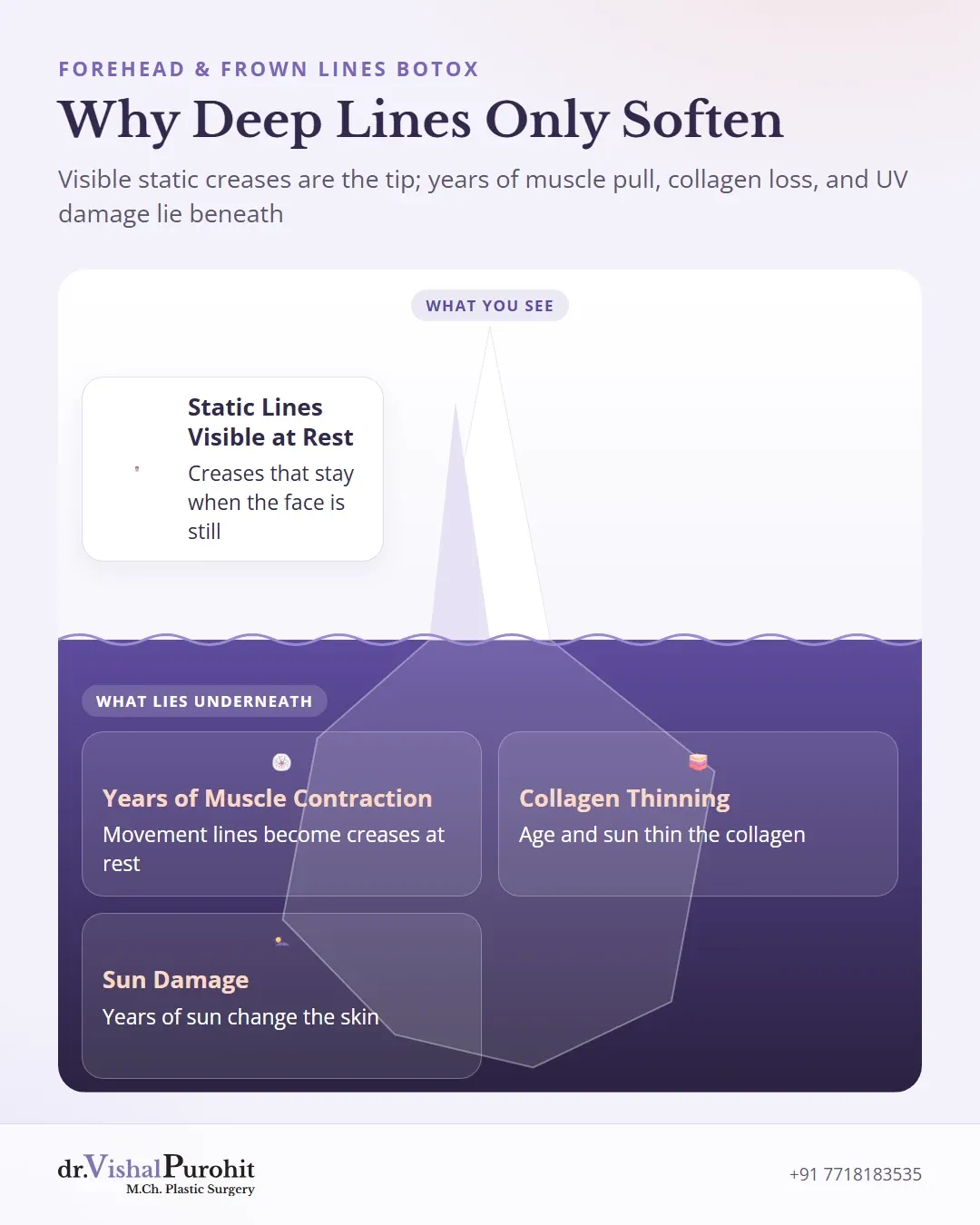
Lines that stay visible when the face is at rest are static lines. Over the years, repeated muscle contraction turns dynamic lines into static furrows that do not respond fully to neuromodulator treatment alone3. This is why a deeply etched line often improves rather than disappears.
Key points
- Deep resting lines often soften with Botox rather than disappearing completely.
- Skin can repair gradually when muscle movement is reduced over successive sessions.
- Results are temporary, so maintaining the softening requires ongoing treatments.
What Botox can realistically do
Botox reduces the movement of the underlying muscles, and static lines can improve as the skin repairs itself in the absence of movement10. Softening has a limit: botulinum toxin may not always completely eradicate lines11. Patients with very deep or resting frown lines should be told this honestly at the initial consultation11.
What repeated treatments may add
- Safety and efficacy of repeated treatments for glabellar lines have been shown, and increased benefits occur with successive treatments12.
- Repeated treatments have been documented to give longer-lasting results11.
- The effect is temporary, so maintaining the improvement requires further treatment13.
Botulinum toxin can make lines less noticeable1, but no particular degree of correction can be promised in advance.
Skin, Sun and Age
Skin thickness and quality
Fine lines form when collagen in the skin thins, and both ageing and sun damage cause that thinning, which makes facial skin stretch and sag1. Thin, crepey, sun-damaged skin also reduces the success of botulinum toxin treatment in the frontalis, so skin quality is closely linked to treatment satisfaction14.
Sun damage and age
Static lines result from long-term ultraviolet exposure, and are distinct from the muscle-driven lines that Botox treats15. As sun damage progresses into the deeper dermis, many lines become visible at rest and the skin can appear leathery16. Ageing also reduces skin elasticity, flattens the forehead and thins fat pads, which can worsen forehead wrinkles17.
Protecting the skin
- Avoidance of environmental damage comes first, followed by protection18.
- Photoaging brings increased lines and skin laxity, so daily sun protection matters19.
Dr. Purohit’s note: Dr. Vishal Purohit’s practice in Jaipur offers no laser or resurfacing of any kind.
Questions to Ask About Your Own Lines

Movement, or a line that stays
Ask how much of a line comes from muscle movement and how much is an etched crease that stays when the face is still. The lines may be checked while the patient frowns or raises the brows to show which lines move20. Botox only relaxes muscles; wrinkling also reflects a loss of elasticity, volume and gravity, so it does not always smooth every line21.
What a realistic change looks like
Botox can greatly improve facial lines, but lines are not always completely cleared11. Some patients expect every wrinkle to disappear; that is an unrealistic expectation22. The limits and the expected result are discussed before treatment21.
Choosing no treatment
Choosing not to have any treatment is a valid option, with no pressure based on age or looks. How much of the concern is movement, how much is an etched crease, and whether to treat at all are decided at the consultation with Dr. Purohit.
More about the treatment is on the Botox landing page.
Consulting Dr. Vishal Purohit in Jaipur for Facial Lines
Understanding what injections can accomplish helps set clear, achievable expectations for facial rejuvenation. Those interested in clinical evaluation for movement-related creases or etched furrows can review forehead and frown lines Botox in Jaipur to understand the procedural framework. For additional details regarding treatment duration, clinical assessments, and realistic limits, please browse the forehead Botox FAQs before arranging a professional consultation.
This is educational information, not medical advice.