
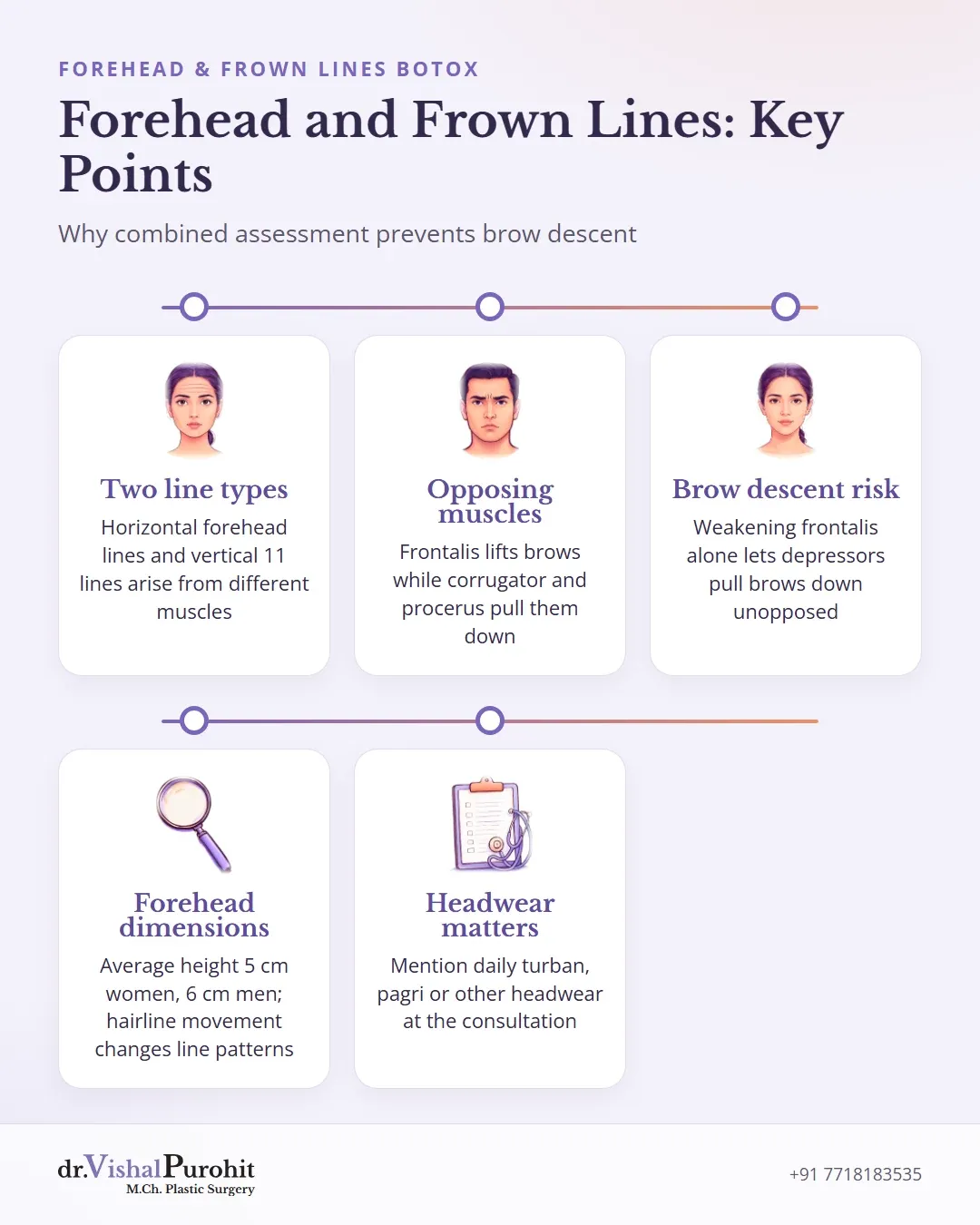
Upper facial wrinkles develop from repetitive muscle movement across the forehead and glabella. While horizontal lines form as the frontalis lifts the brow, vertical 11 lines arise from depressor muscles pulling downward and inward.
Evaluating both muscle groups together ensures treatment maintains functional balance. When dynamic movement is altered without examining opposing forces, subtle eyelid descent or brow heaviness can occur, as discussed in Heavy Eyelids and Raised Brows: Why They Matter Before Forehead Botox.
Two Kinds of Upper-Face Lines
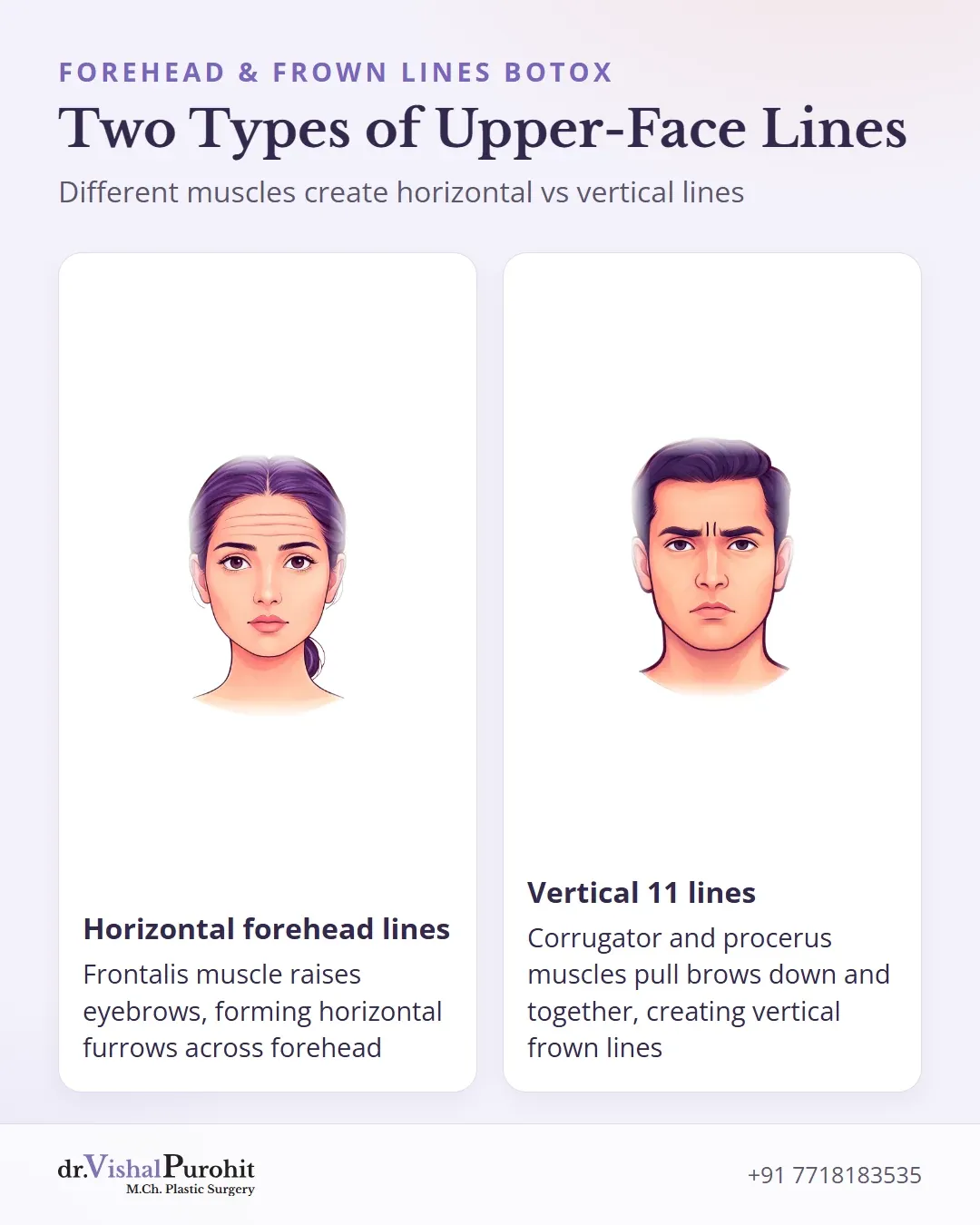
Facial expressions in the upper face create dynamic lines that run perpendicular to the direction of the underlying muscle fibers1. These wrinkles develop from two distinct muscle groups:
- Horizontal forehead lines: The frontalis is a broad muscle with vertically oriented fibers that raise the eyebrows12. Repetitive contraction of this muscle elevates the brow and forms horizontal furrows across the forehead123.
- Vertical 11 lines between the brows: The vertical glabellar frown lines are primarily produced by the contraction of the paired corrugator supercilii muscles, which draw the eyebrows medially and together124. The procerus muscle pulls the brow downward and creates transverse lines across the bridge of the nose124.
Because the frontalis lifts the eyebrows upward while the corrugator and procerus depress them downward and together, these muscles act in close anatomical balance123. In clinical literature, addressing frontalis action alone without considering the glabellar depressor muscles can disrupt this balance and risk brow ptosis35.
Dr. Purohit’s note: Dr. Vishal Purohit assesses both muscle groups during the consultation to understand how they interact before planning any non-surgical injection treatment.
Muscles That Pull Against Each Other
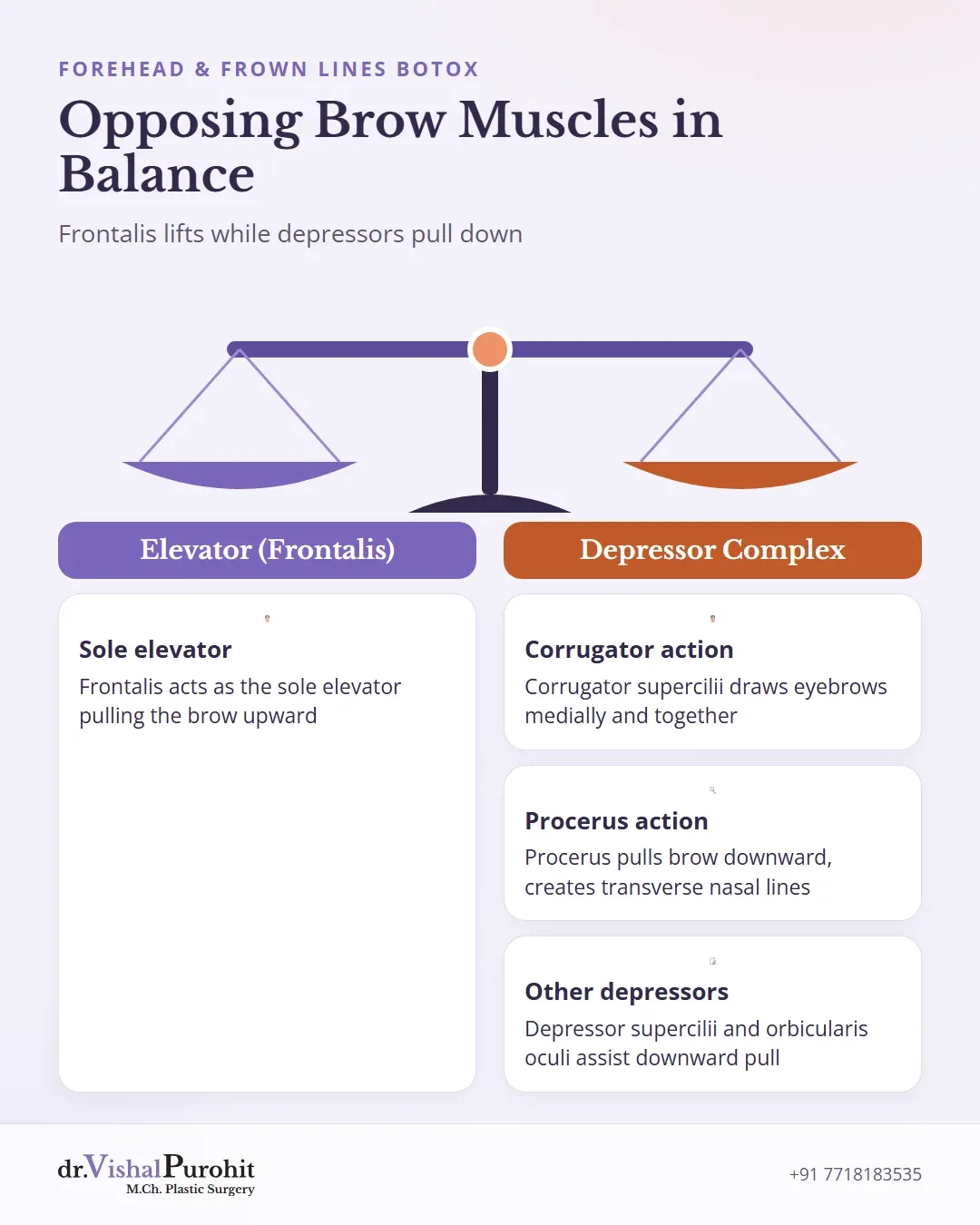
Eyebrow position is determined by an anatomical balance between opposing vertically oriented forces6. Because the skin across the brow is not anchored directly to bone, resting brow height reflects a continuous equilibrium between lifting and lowering muscle groups6.
Key points
- Brow height depends on a continuous balance between opposing lifting and lowering muscle groups.
- The frontalis raises the eyebrow, while a complex of depressor muscles pulls it down and inward.
- Relaxing one muscle group alters the pull of the other, making precise evaluation essential to prevent brow dropping or asymmetry.
The opposing forces include:
- The frontalis muscle, which acts as the sole elevator pulling the brow upward6789.
- The depressor complex, consisting of the procerus, depressor supercilii, orbicularis oculi, and corrugator supercilii, which pulls the brow downward and inward6910.
A published review on integrative frontalis-glabellar assessment explains that relaxing one muscle group alters the relative pull and dominance of the other6. Weakening the depressor complex during glabellar treatment can allow the unopposed elevator action to lift the eyebrow6. However, if the suspensory action of the lower frontalis is unintentionally weakened, the brow can drop, leading to suboptimal positioning or unmasking eyelid ptosis6.
In his practice in Jaipur, Dr. Vishal Purohit carefully evaluates these interacting upper facial muscle dynamics6. Maintaining functional equilibrium between the frontalis and depressor muscles remains essential to avoiding asymmetry or an unnatural appearance11.
Why Treating Only the Forehead Can Lower the Brows
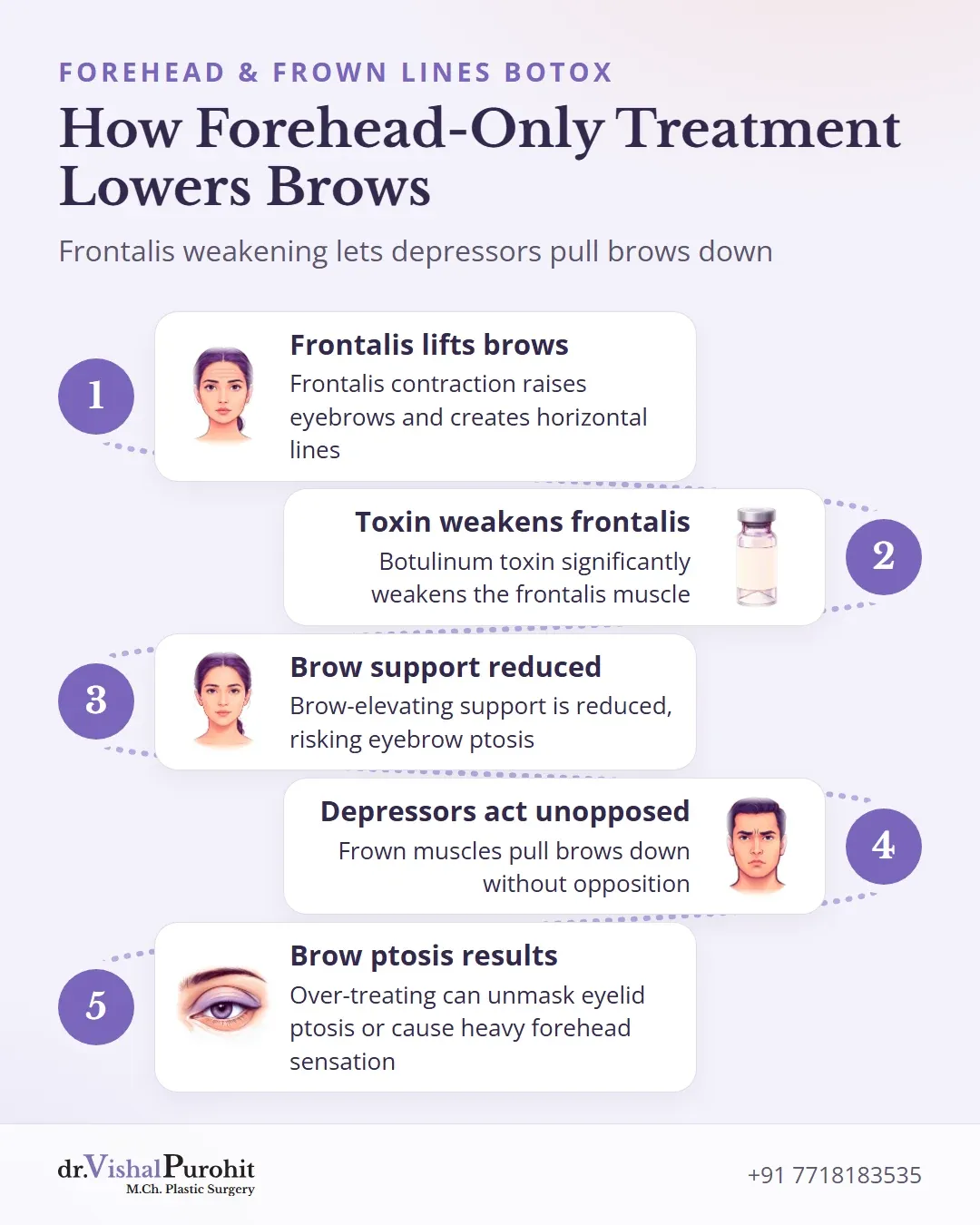
Contraction of the frontalis muscle raises the eyebrows and upper eyelids while producing horizontal forehead lines7. When botulinum toxin type A significantly weakens the frontalis muscle, this brow-elevating support is reduced, which can cause eyebrow ptosis712.
Leaving the frown muscles untreated allows the downward-pulling brow depressor muscles to act without opposition7. Literature notes that simultaneous treatment of the brow depressors alongside the frontalis can help minimize the potential for brow descent57.
In patients who already rely on frontalis contraction to elevate heavy eyelids or compensate for subtle brow descent, over-treating the muscle can lead to a heavy forehead sensation or unmask underlying eyelid ptosis131415. A discussion of these mechanisms is available in the post on heavy eyelids.
Clinical evaluations prior to treatment assess baseline brow height, resting asymmetry, and frontalis mobility to prevent unintended brow descent121516. Dr. Vishal Purohit assesses individual muscle dynamics in person during the consultation to determine an appropriate treatment approach.
High Foreheads, Hairlines and Headwear
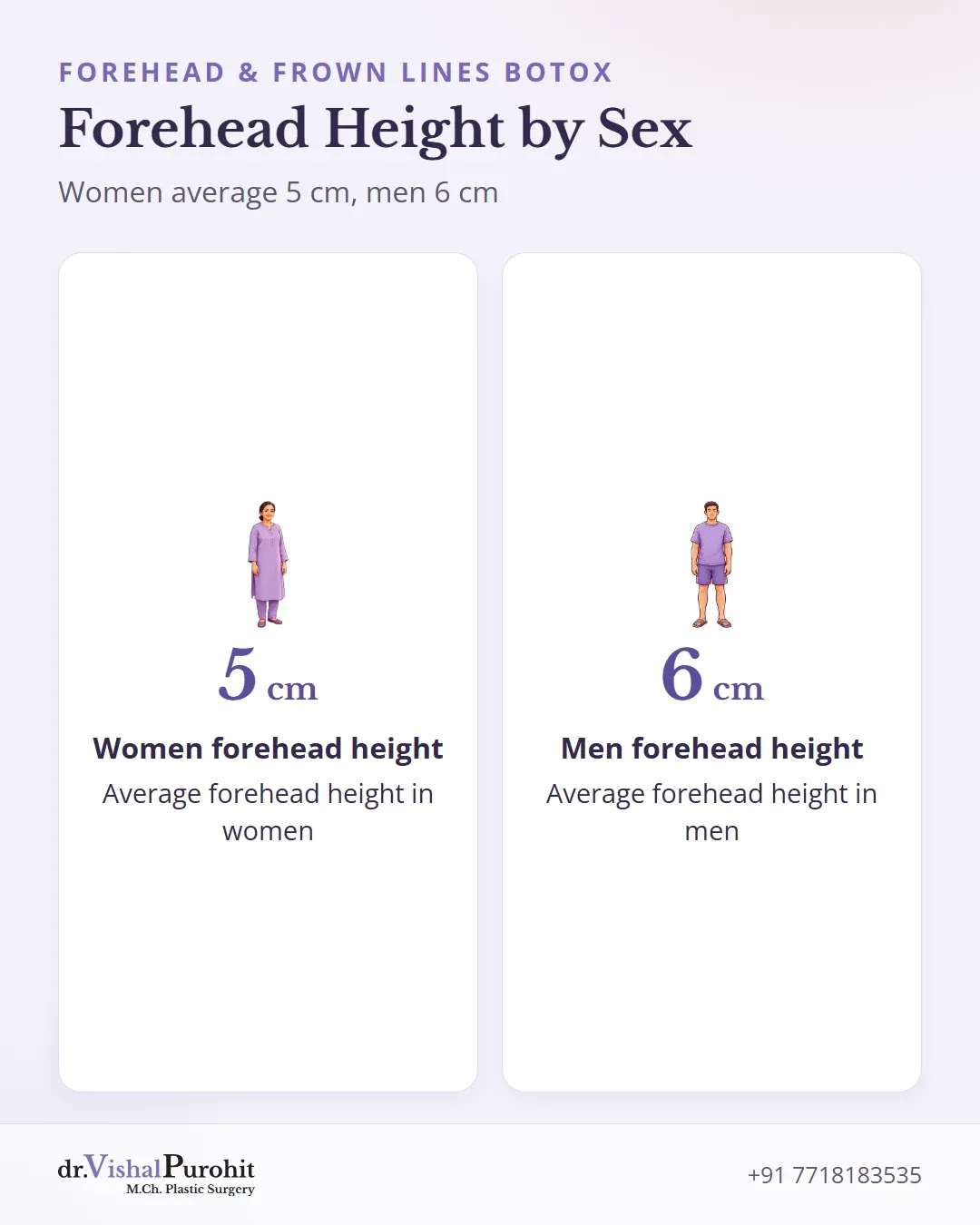
A tall forehead or a receding hairline alters facial proportions and changes where horizontal lines sit. Studies show that average forehead height is approximately 5 cm in women compared to 6 cm in men11. Men typically present with greater forehead height and width, accompanied by a backward slope to the hairline11.
Anatomical variations directly influence muscle behavior and line patterns. When elevating the eyebrows, some individuals depress their hairline, which can leave upper horizontal lines untreated unless addressed7. In addition, differences in forehead height, baseline brow position, and frontalis muscle strength affect treatment outcomes17.
Patients who wear a daily turban, pagri, or other tight headwear should mention this routine during their initial assessment. Dr. Vishal Purohit evaluates forehead height, hairline movement, and dynamic muscle activity in person to plan an individualised approach. Every detail of the proposed treatment is decided at the consultation.
What a Combined Assessment Means
Evaluating horizontal forehead lines alongside vertical 11 lines ensures the upper face is assessed as an interconnected muscular unit18. Examining both areas together does not mean both must receive injections1920. Instead, it allows for a clear understanding of how movement in one muscle group affects resting brow position and neighboring dynamic lines618.
Key points
- Evaluating forehead and frown lines together treats the upper face as a connected muscular system.
- Examining both areas helps protect resting brow position without requiring injections in both sites.
- Consultation determines whether injections alone fit your anatomy or if other factors are present.
Choosing no treatment is always a valid choice during this evaluation. For patients who choose to explore care, treatment choices are individualized:
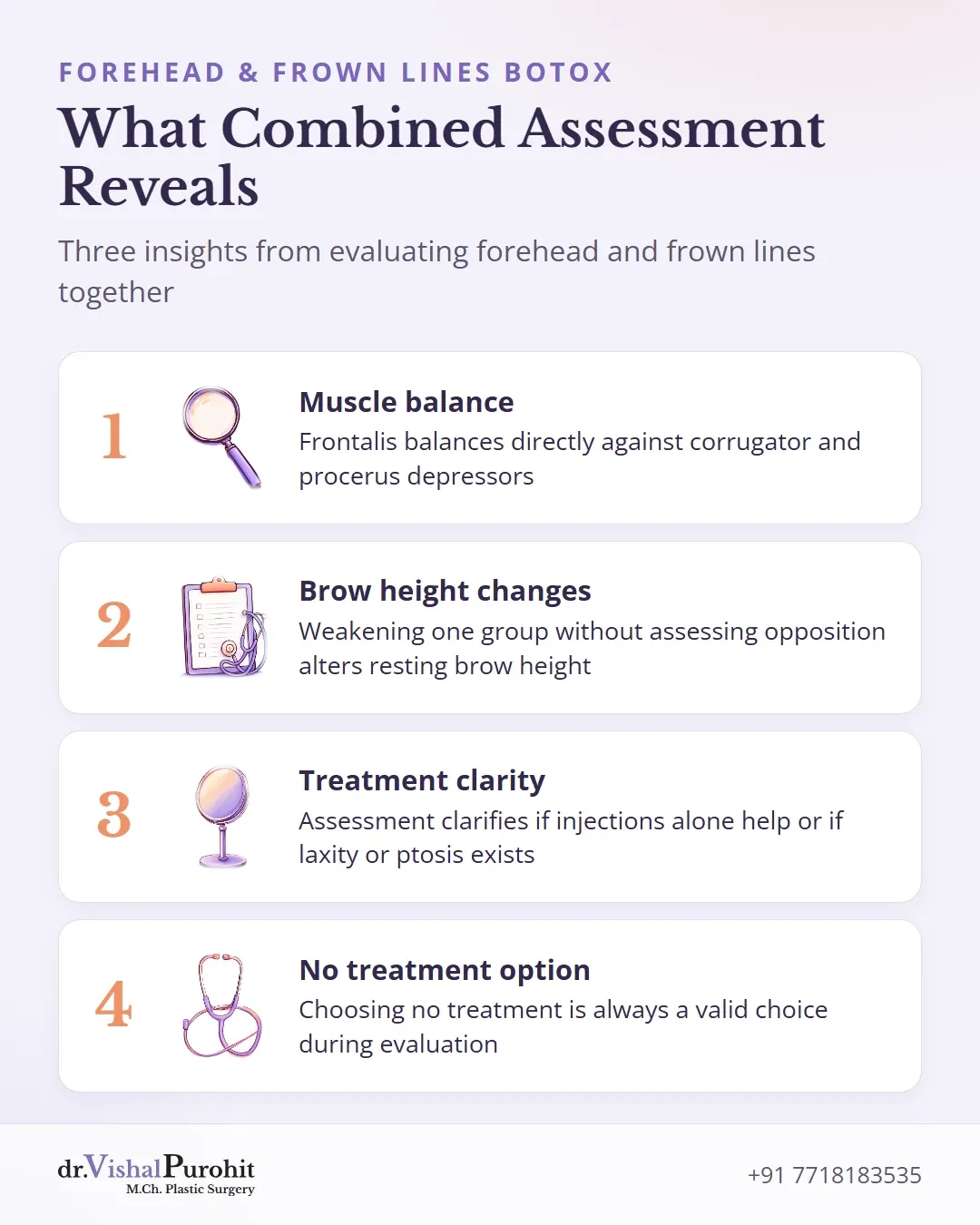
- The elevator frontalis muscle balances directly against brow depressors, including the corrugator supercilii and procerus18.
- Weakening one muscle group without assessing opposing pull can alter resting eyebrow height or balance618.
- An assessment clarifies whether injections alone can address patient concerns, or if underlying skin laxity or ptosis is present192122.
Whether horizontal lines, frown lines, or neither are injected in a single session is decided at the consultation. Dr. Vishal Purohit plans each step according to the individual patient’s anatomical movement and aesthetic goals. Patients can review full procedure details on the Botox landing page.
Upper Facial Line Consultations in Jaipur
Balancing opposing upper-face dynamic forces requires an individualised anatomical evaluation. Dr. Vishal Purohit assesses brow height, hairline movement, and muscular balance in person before recommending any non-surgical care. To understand treatment options or arrange an appointment, explore forehead and frown lines Botox in Jaipur or read answers to common questions in the forehead Botox FAQs. Every procedural detail is decided at the consultation.
This is educational information, not medical advice.