
Many people considering aesthetic treatment worry about developing a frozen or unnatural appearance that alters everyday communication. Modern approaches focus on softening horizontal creases while preserving individual character and facial balance.
Treatment planning considers upper facial dynamics as an integrated system, which is why heavy eyelids and raised brows: why they matter before forehead Botox are examined prior to planning any injection procedure.
Why People Worry About a Frozen Look

Early aesthetic uses of botulinum toxin drew criticism for creating an unnatural or frozen look marked by reduced expressiveness and disrupted facial harmony1. Modern patient expectations have shifted toward natural-looking results that preserve emotional expression and individual features1. Natural outcomes also correlate with gains in quality of life and psychosocial well-being1.
Hesitation remains common among individuals considering treatment:
- In a global survey of 14,584 adults, concerns regarding an unnatural appearance, unsatisfactory outcomes, or adverse effects caused hesitation toward neuromodulator therapy2.
- A survey of 141 aesthetic practitioners noted that concern about an unnatural or frozen appearance arose at least sometimes in 86.6% of responses for younger toxin-naïve patients and in 93.0% for older patients2.
- Market research across nine countries showed that 79% of 12,286 adults wished to preview aesthetic outcomes temporarily before committing to longer-lasting interventions2.
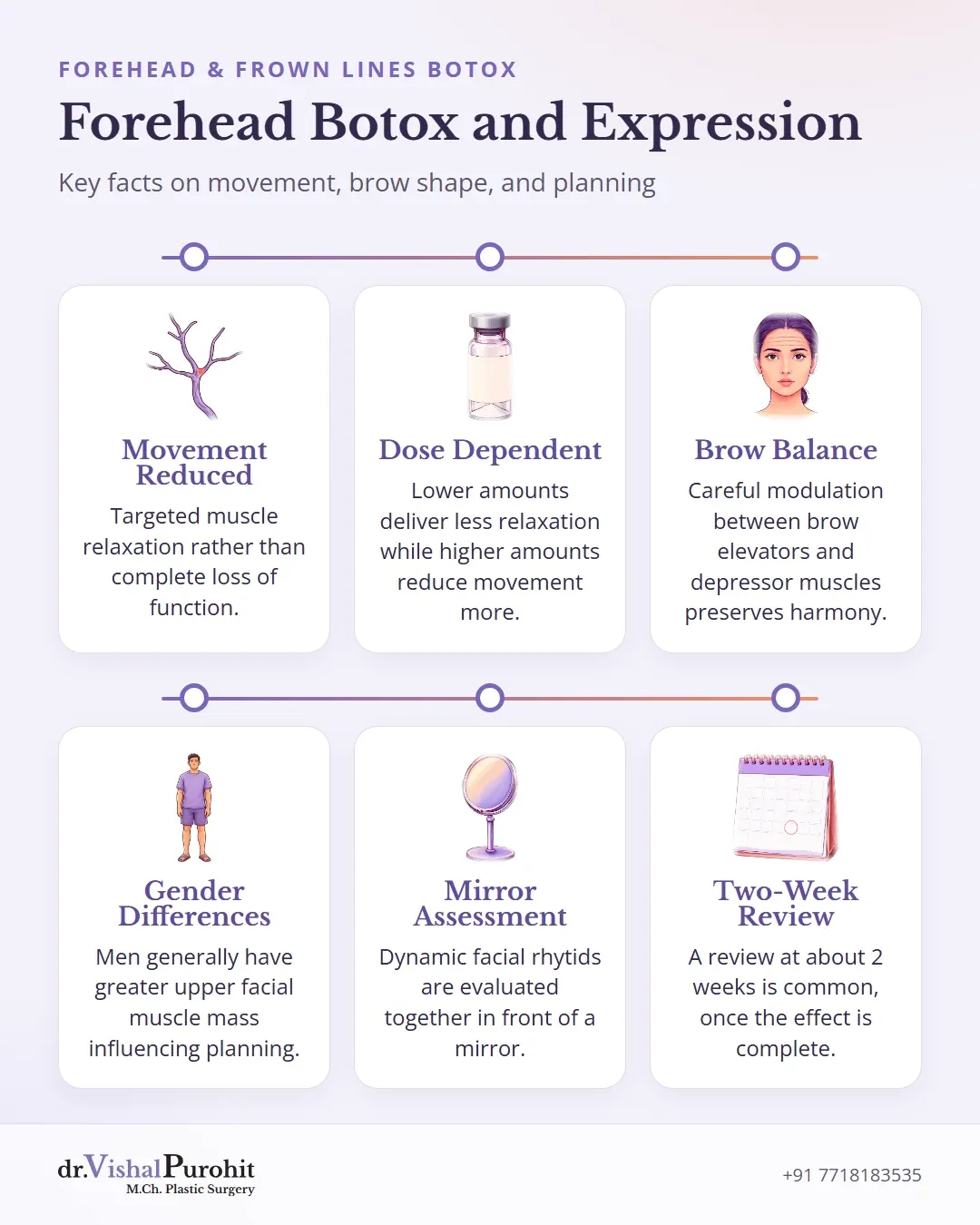
Preserving natural balance requires careful modulation between brow elevators and depressor muscles rather than isolated muscle paralysis1.
Dr. Purohit’s note: At his practice in Jaipur, Dr. Vishal Purohit approaches facial rejuvenation through an evidence-based assessment of individual dynamics.
Movement Is Reduced, Not Switched Off
Botulinum toxin type A works by temporarily inhibiting the release of acetylcholine at the neuromuscular junction, which leads to targeted muscle relaxation rather than a complete loss of function1. Clinical literature shows that muscle relaxation follows a dose-dependent response, meaning lower amounts deliver less relaxation while higher amounts create more pronounced reduction in movement34.
Key points
- Botulinum toxin temporarily softens targeted muscle movement rather than freezing facial expression entirely.
- The extent of remaining movement depends on individual anatomy, dosage, and careful treatment planning.
- Tailored injection strategies aim to reduce dynamic lines while preserving natural brow mobility and expression.
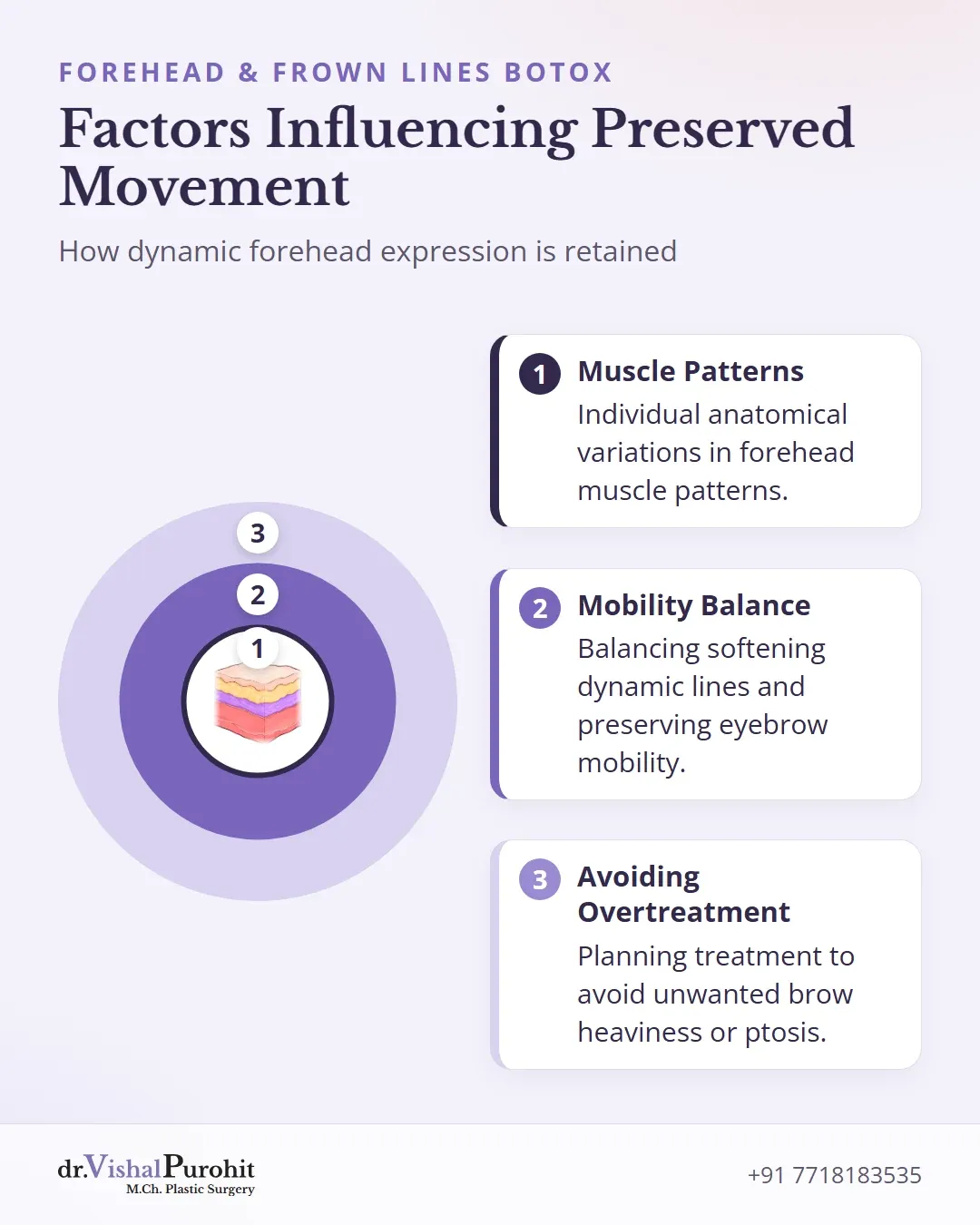
How much movement remains depends on individual clinical anatomy and the treatment plan chosen during the consultation5. The degree of dynamic expression retained after injection is influenced by several factors:
- Individual anatomical variations in forehead muscle patterns5.
- The balance between softening dynamic lines and preserving eyebrow mobility16.
- Planning treatment to avoid overtreatment that could lead to unwanted brow heaviness or brow ptosis17.
In peer-reviewed reports, refined injection strategies for the upper face demonstrate that neuromodulation can soften dynamic lines while preserving natural facial expression and eyebrow dynamics1. Rather than creating an immovable appearance, carefully tailored treatment aims to maintain facial harmony and allow normal expressive movement1. Dr. Vishal Purohit assesses forehead anatomy and personal goals in person so each plan is decided at the consultation.
Unwanted Shapes: Raised Tails and Flat Brows
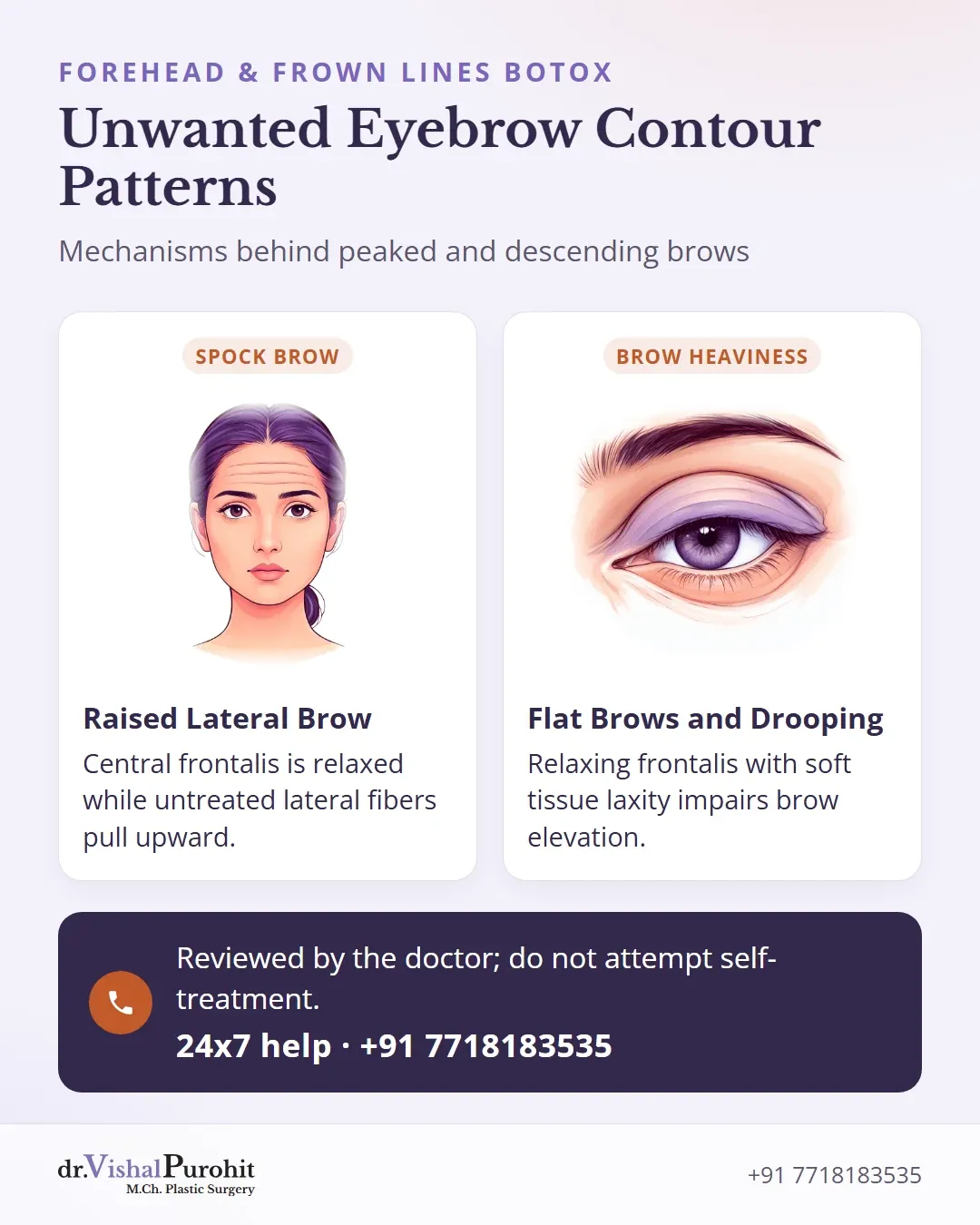
Following botulinum toxin injections to the upper face, unintended changes in eyebrow shape can occasionally develop89. Two notable patterns described in clinical literature are an unnaturally peaked brow and a flat or descended brow79.
Key points
- Botulinum toxin injections can occasionally lead to an unnaturally arched or flattened eyebrow contour.
- A raised lateral brow occurs when untreated outer forehead fibers pull upward, while over-relaxing the muscle can cause brow heaviness.
- Contour concerns are reviewed by the doctor and must never be managed with self-treatment at home.
The Raised Lateral Brow (“Spock” Brow)
An exaggerated lift of the outer eyebrow, known as the Mephisto sign or “Spock” brow, produces a surprised or unnatural expression8910. This effect occurs when the central or medial frontalis muscle is relaxed while untreated lateral fibers remain active and pull upward89. Over-treating brow depressors without balancing frontalis movement can also contribute to this appearance9.
Flat Brows and Drooping
When forehead lines are treated in the presence of underlying soft tissue laxity, relaxing the frontalis muscle can impair its ability to elevate the brow, increasing brow heaviness or brow ptosis7. This can flatten the natural arch or make the upper facial area feel heavy7.
Clinical Review
These contour concerns are assessed and managed in clinical follow-up:
- In published practice, a follow-up at about 2 weeks gives the medication time to reach full effect before expression concerns are evaluated11.
- When a persistent Mephisto effect occurs, targeted corrective treatment into the active lateral frontalis may be considered by the treating physician911.
- Patients must not attempt any corrective self-treatment at home.
Men and Women
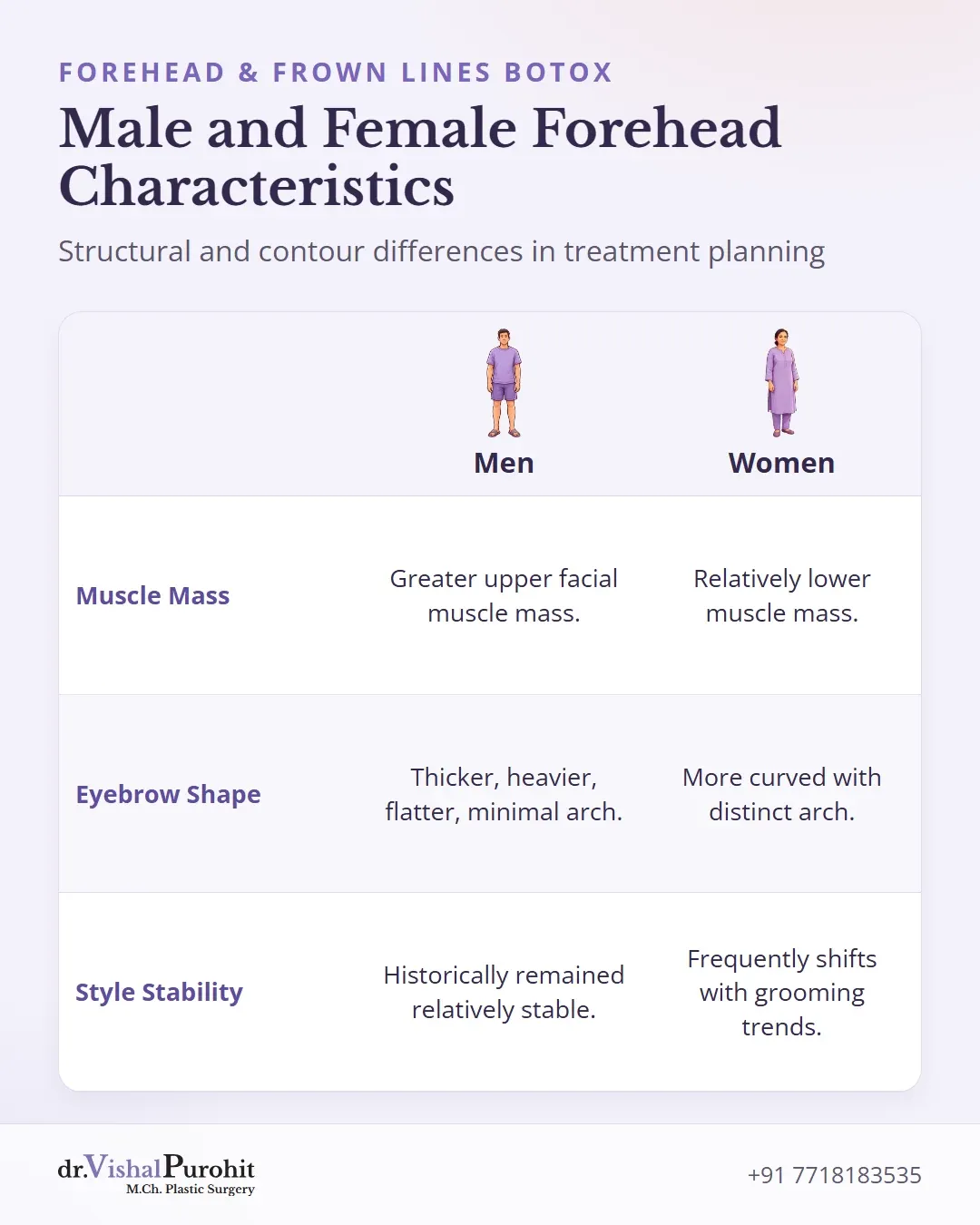
Facial anatomy, muscle mass, and aesthetic preferences vary between men and women5. Clinical literature notes that men generally have greater muscle mass in the upper face, which can influence baseline line severity and treatment planning512.
In terms of anatomy and appearance:
- Male brows are typically thicker, heavier, and flatter, resting closer to the supraorbital rim with minimal arch13. In contrast, feminine brows tend to be more curved, often arching near the junction of the middle and lateral thirds13.
- While female eyebrow styling frequently shifts with grooming trends, male eyebrow shapes have historically remained relatively stable13.
- Preferences for eyebrow contour vary over time and between individuals, with no single universal ideal for either sex10.
Dr. Vishal Purohit assesses individual muscle contraction patterns and forehead structure at the consultation to preserve a natural balance suited to each patient’s facial features5.
Choosing How Much Movement to Keep
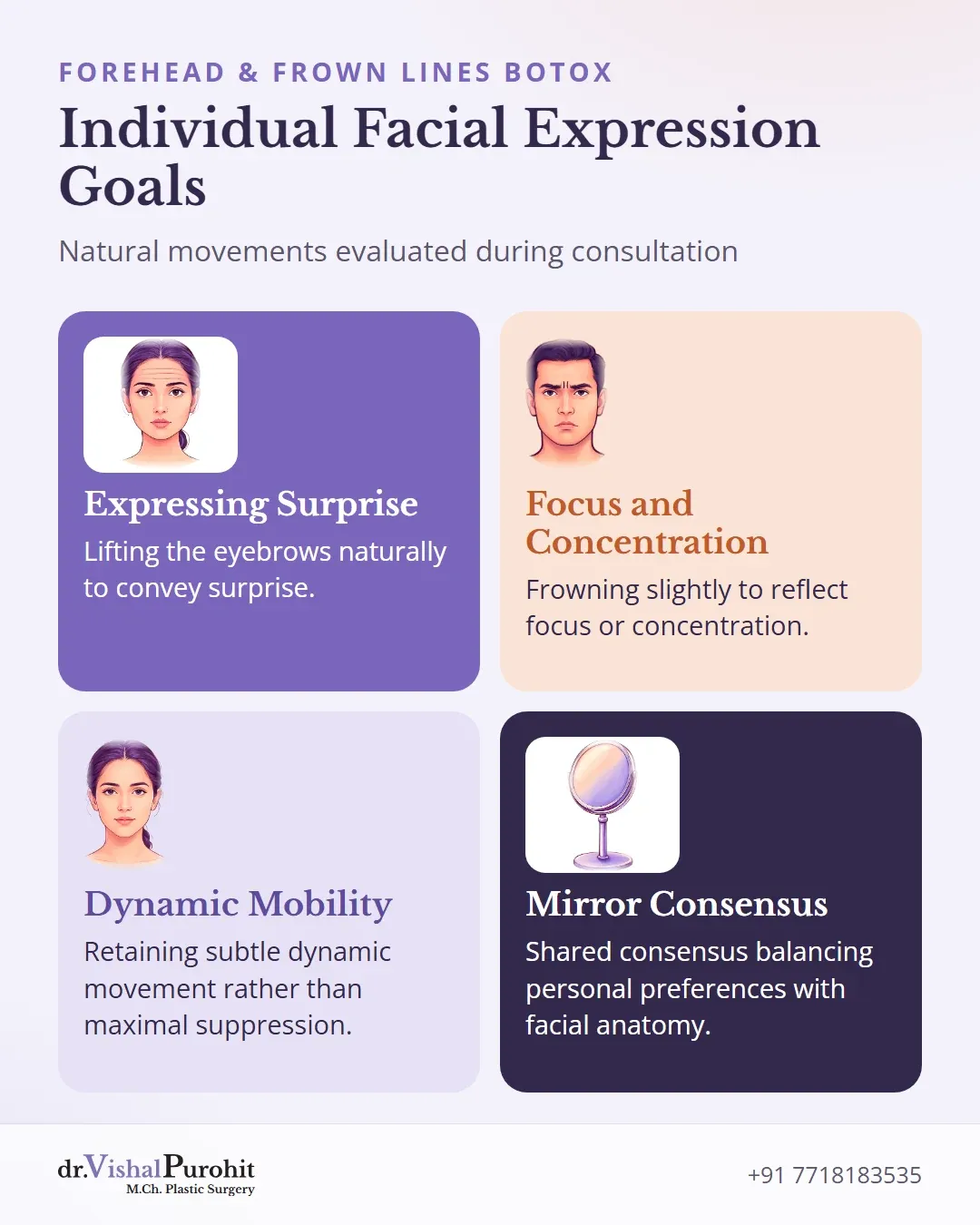
During a consultation, the injector and patient evaluate dynamic facial rhytids together in front of a mirror14. Patients are asked to look surprised to assess forehead lines or to frown to examine glabellar lines14. Treatment planning develops as a shared consensus15, balancing personal preferences with facial anatomy1516.
Individual treatment goals often center on specific expressions:
- Lifting the eyebrows naturally to convey surprise1416
- Frowning slightly to reflect focus or concentration14
- Retaining subtle dynamic movement rather than seeking maximal muscular suppression16
Selecting a lighter treatment plan or choosing no treatment at all remains entirely valid16. In the frontalis, clinical reasoning considers baseline eyebrow position, forehead dimensions, and the patient’s individual preference for preserved movement16.
The product, and whether the forehead is treated alone, are decided at the consultation with Dr. Vishal Purohit.
Personalised Facial Assessment in Jaipur
Planning upper facial rejuvenation requires a careful balance between smoothing dynamic lines and preserving genuine expressiveness. To learn more about treatment details, review forehead and frown lines Botox in Jaipur and explore common queries in the forehead Botox FAQs. In-person consultation with an M.Ch. plastic surgeon ensures individual anatomy guides every decision. For scheduling, contact +91 7718183535.
This is educational information, not medical advice.