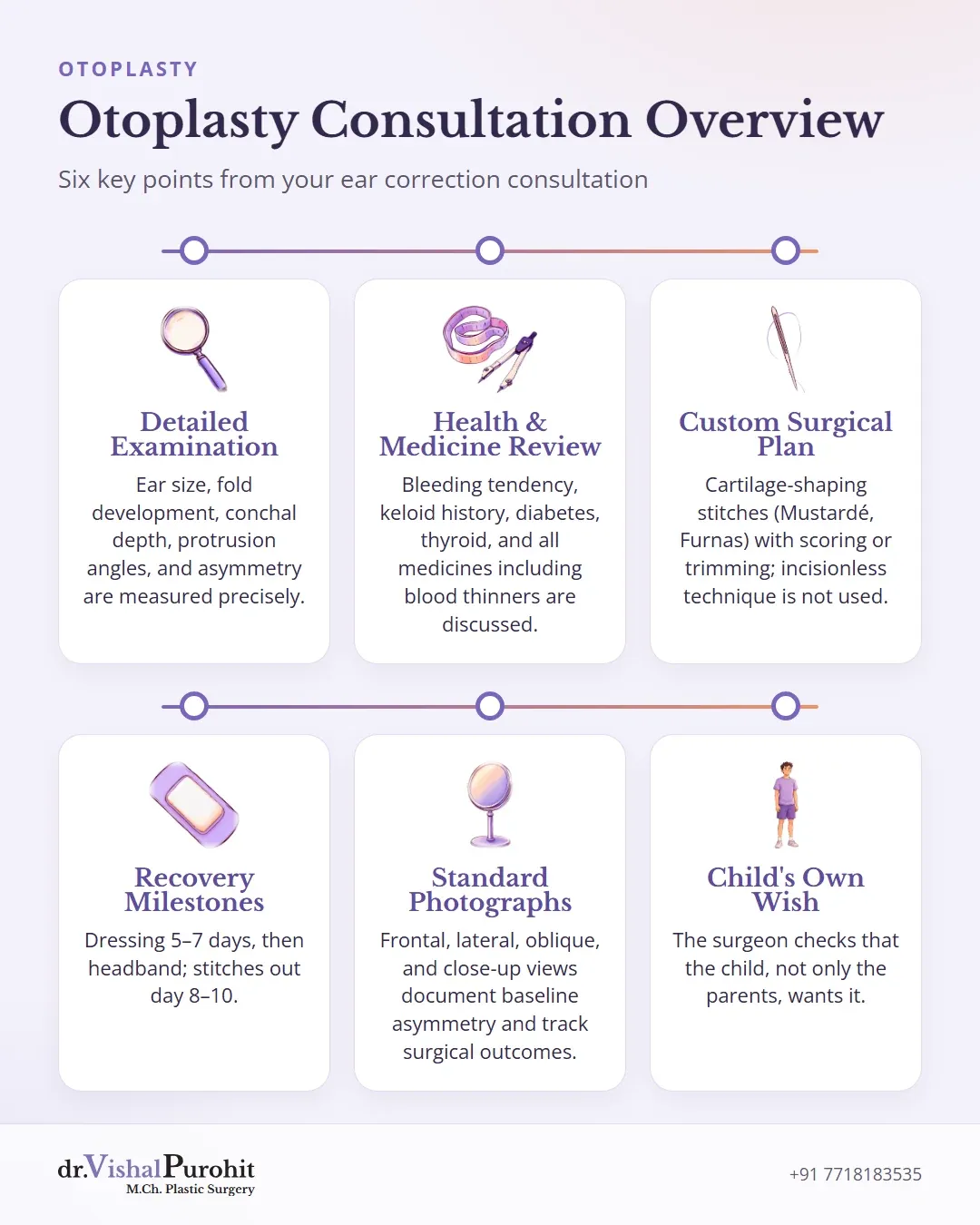
An otoplasty consultation begins with a structured clinical assessment of ear anatomy, fold formation, and cartilage flexibility. The surgeon measures key proportions, evaluates conchal depth, and reviews baseline medical conditions or previous scars to plan safe correction.
During consultations for otoplasty in Jaipur, Dr. Vishal Purohit examines ear cartilage structural elasticity and facial balance to outline realistic, individualized surgical approaches.
Patients also discuss anaesthesia choices, surgical steps, and practical recovery care. Reviewing local or general anaesthesia for otoplasty: what to ask helps clarify how local or general anaesthesia is selected before finalizing a treatment plan.
What the Surgeon Examines
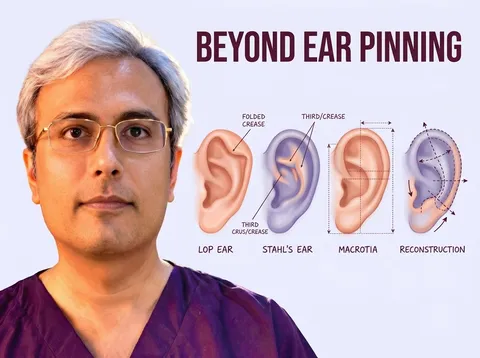
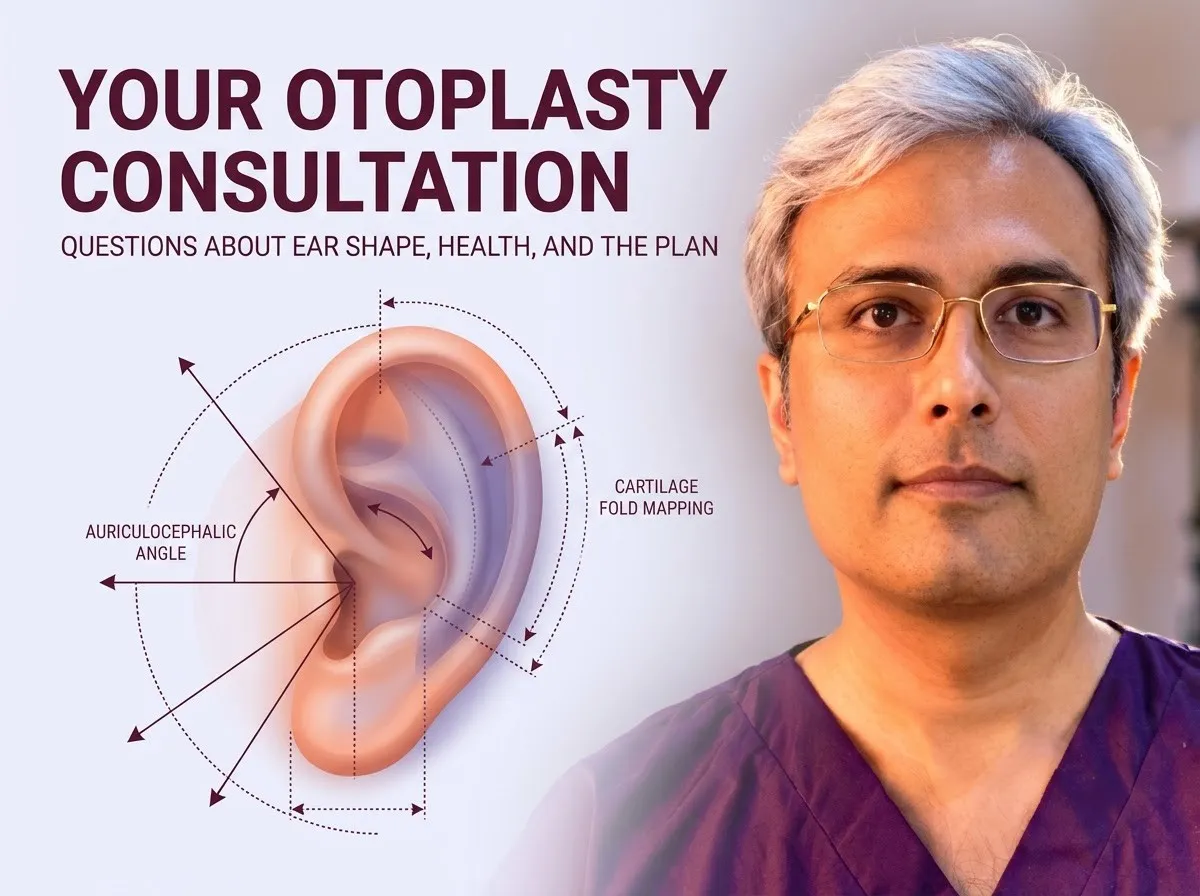
The consultation is largely a careful look and a set of measurements. Otoplasty needs precise preoperative evaluation, and the ear is assessed for its size, its relationship to the scalp, and the interrelationship of its four parts: helix, antihelix, concha and lobule1.
Fold and Concha
The antihelical fold is checked for how well it has developed, including the superior and inferior crus2. Conchal depth is assessed23. The cartilage is felt and gently bent to judge its stiffness, spring and thickness45.
Lobe, Angle and Distance
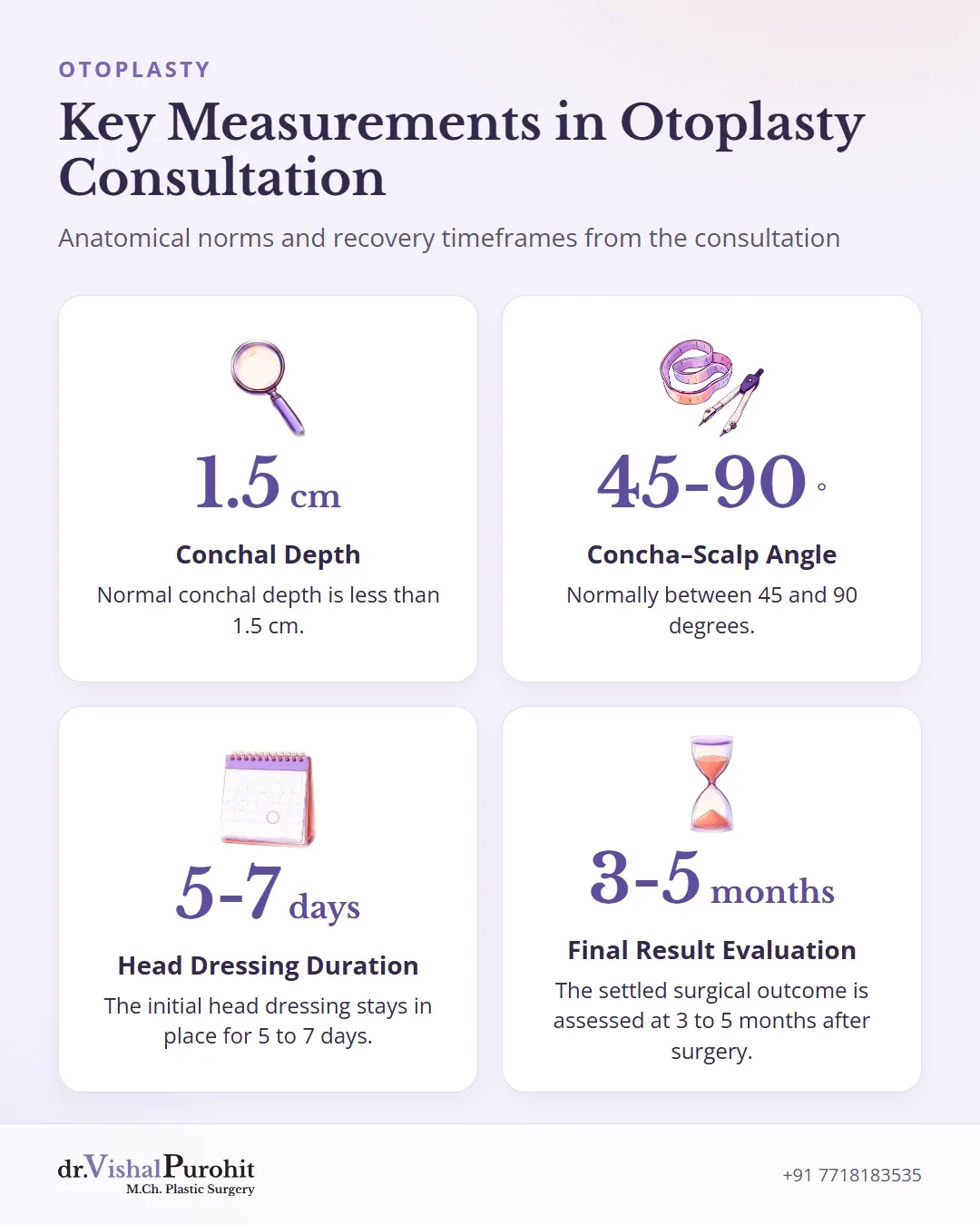
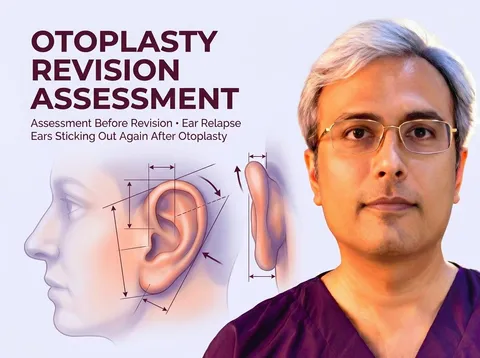
The plane of the lobule and any deformity there are noted35. Protrusion is judged from the angle between the helical rim and the mastoid plane35 and from the distance between the auricle and the scalp. Distances are typically recorded from the mastoid to the helix at the top, at the ear canal and at the lobule1. In normal ears, conchal depth is usually described as less than 1.5 cm, and the angle between the concha and the scalp over the mastoid ranges from 45 to 90°6.
One Ear at a Time
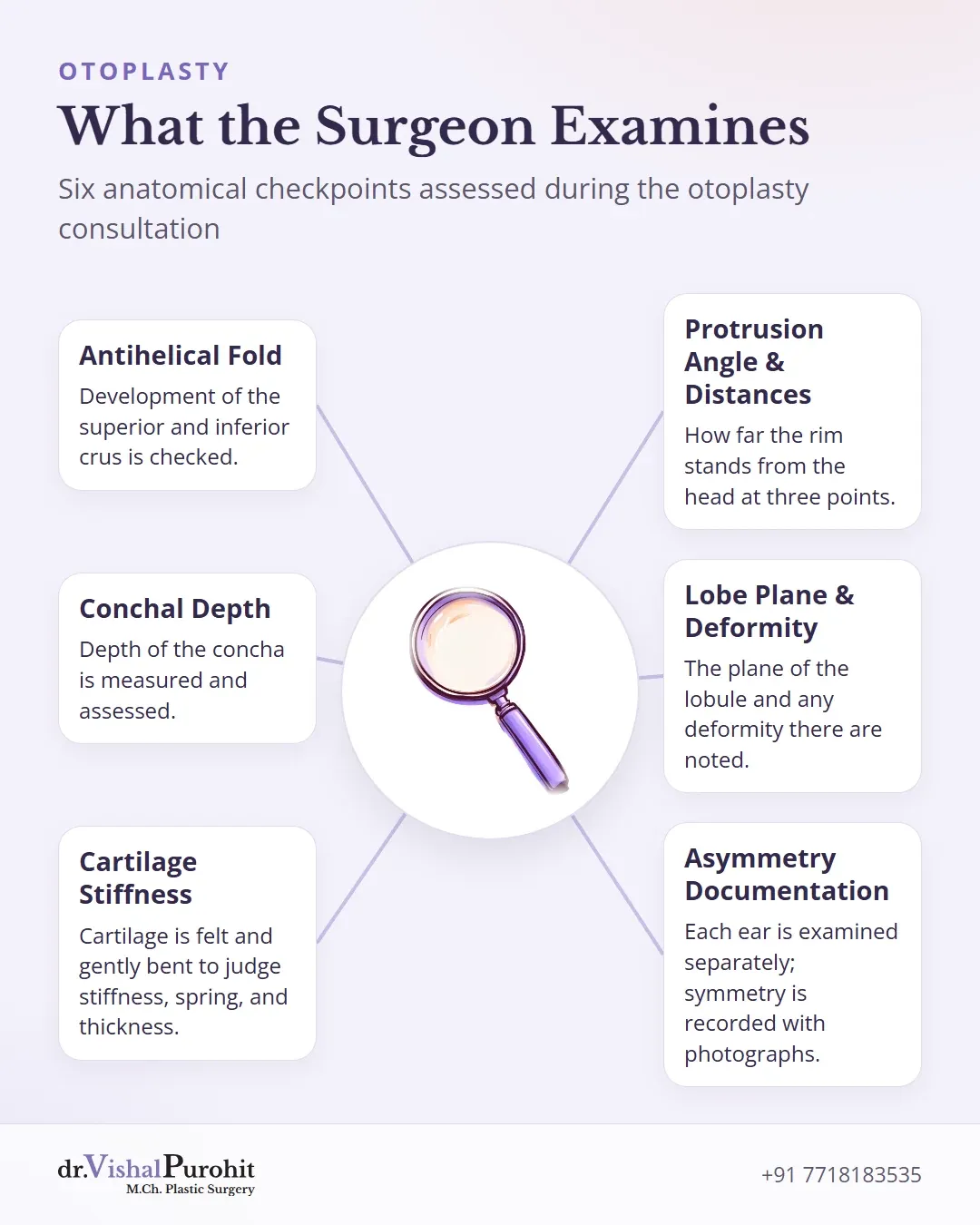
Each ear is examined separately, because the deformity may be very different between the two1. A different combination of features on each side is common, even when both are equally severe5. Symmetry is recorded and documented with photographs7.
Dr. Purohit’s note: In his Jaipur practice, Dr. Purohit explains that the two ears are never exactly alike, before or after surgery, and that exact symmetry cannot be achieved; this is acceptable because nobody sees both ears fully at the same time.
Health Questions Before Surgery
General health and bleeding
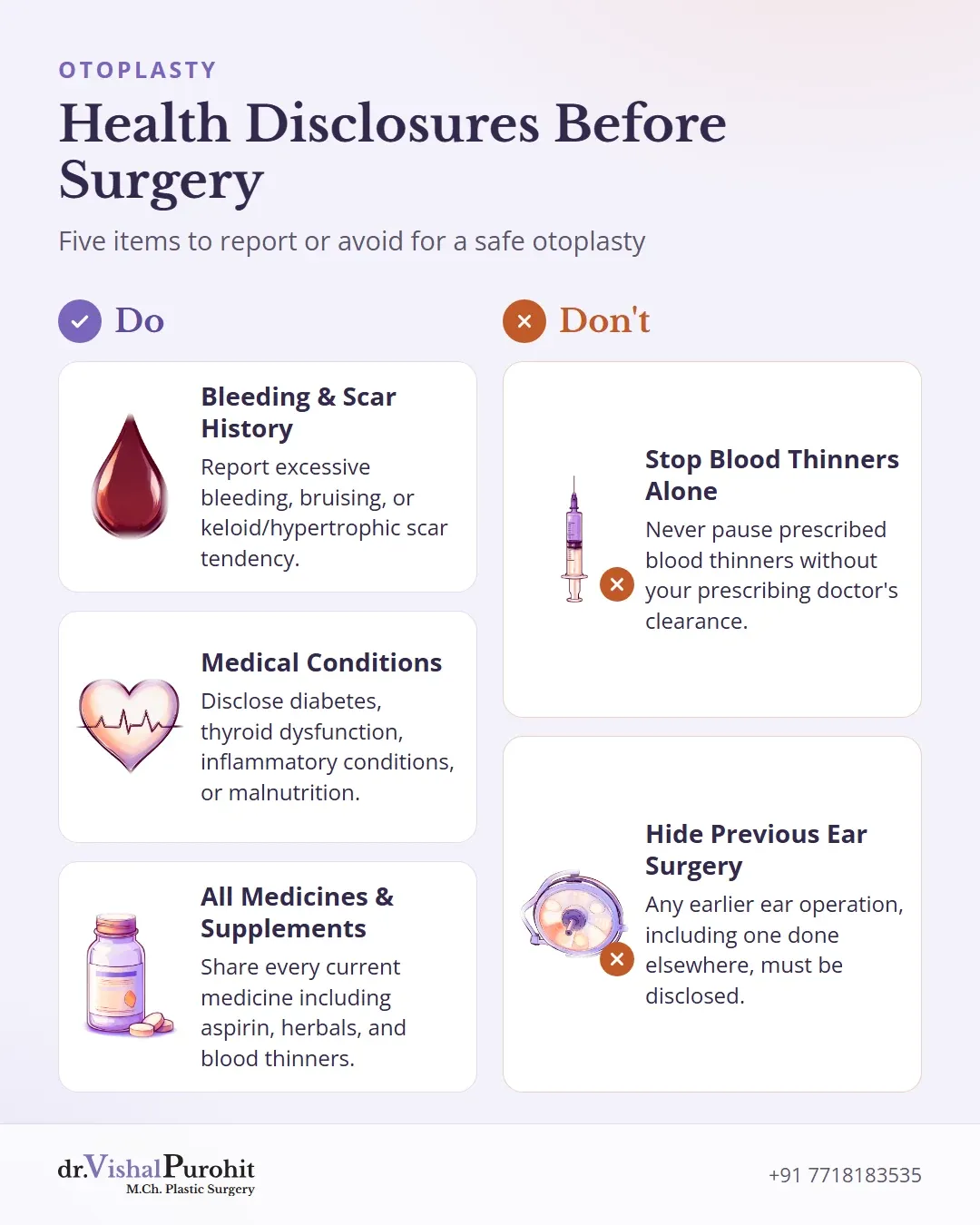
Before otoplasty, the health history covers general health and any tendency to bleed or bruise. A preoperative history should include excessive bleeding or bruising and any tendency to thick or raised scars (hypertrophic or keloid scarring) after earlier operations8.
Key points
- A thorough preoperative health history reviews bleeding tendencies, scarring history, and systemic conditions that could affect healing.
- All current medications and supplements are reviewed, and blood thinners are only adjusted in consultation with the patient’s prescribing doctor.
- Previous ear surgeries and any history of keloid or thick scars are evaluated.
Some medical conditions may adversely affect the outcome of surgery: diabetes (especially in older patients), systemic inflammatory conditions, malabsorption and poor nutrition can affect wound healing, and thyroid dysfunction may lead to postoperative complications9.
Medicines
All current medicines are discussed, including over-the-counter and herbal products8. Aspirin, NSAIDs and anticoagulants can increase the risk of postoperative bleeding8. A prescribed medicine is not stopped by the patient alone. Whether a blood thinner can be paused before and after surgery is checked with the patient’s own doctor9.
Smoking
Dr. Purohit asks smokers to stop ideally 1 month before surgery, and at least 7 days before, because smoking slows wound healing.
Previous ear surgery and scars
Any earlier ear operation, including one done elsewhere, is part of the history. Keloid after otoplasty performed elsewhere has been reported10.
In otoplasty, keloid formation was reported in 2.3% of cases in a large series11. Keloid or hypertrophic scars are presumably a result of closure under skin tension, and now that skin excision is no longer performed, keloids after otoplasty have been extremely rare10.
Questions to Ask About the Plan
Which parts of each ear will change
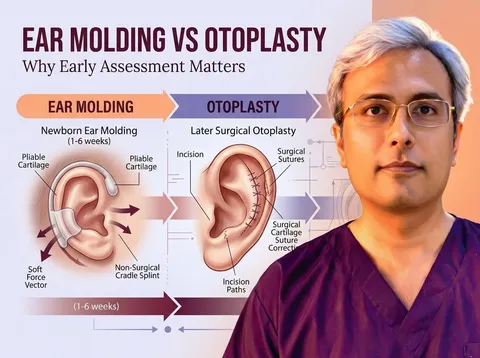
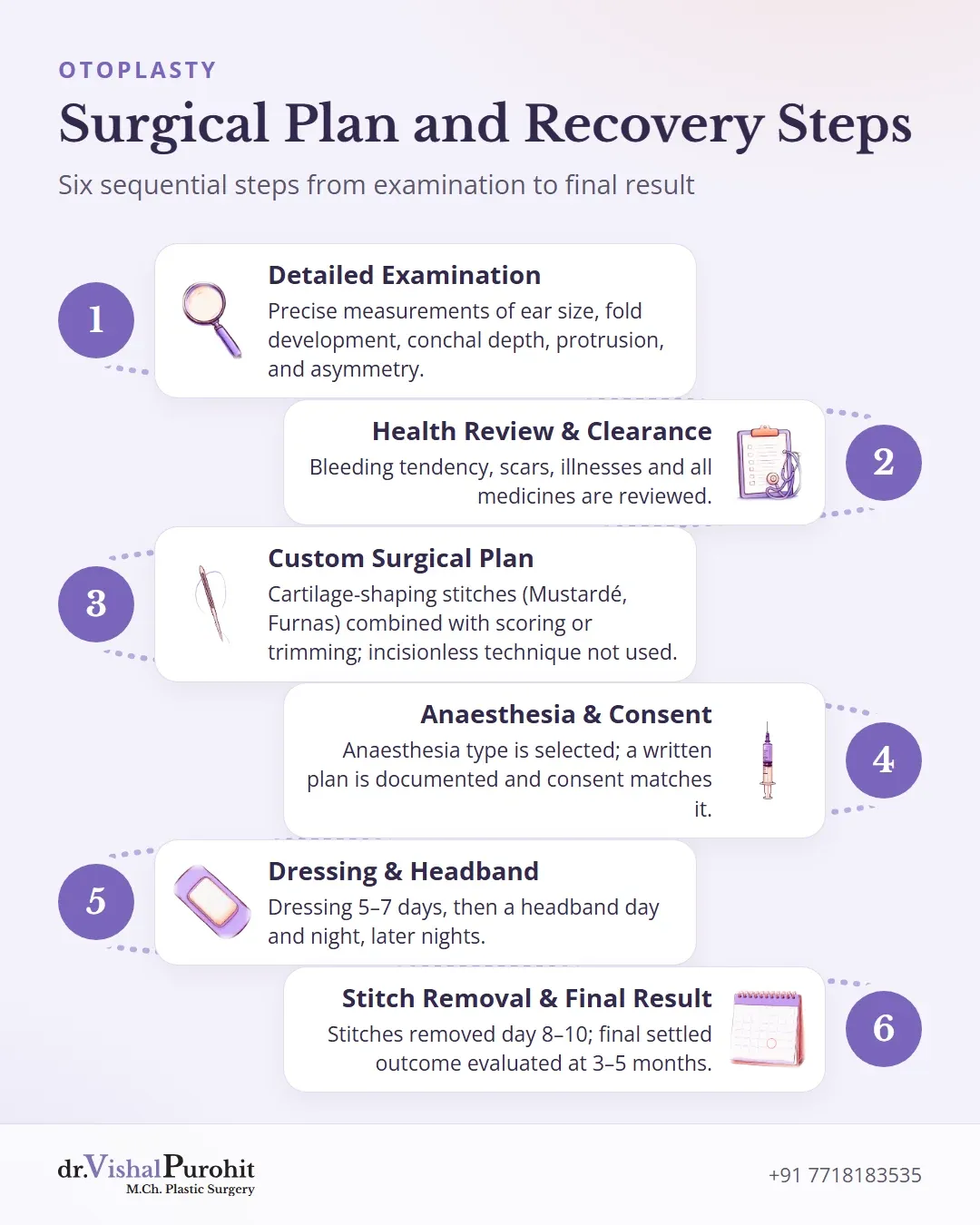
Ask which folds will be reshaped and whether both ears need the same work. At his practice in Jaipur, the plan is a mix of cartilage-shaping stitches (Mustardé and Furnas type) and cartilage scoring or trimming, chosen for each ear; incisionless, stitch-only otoplasty is not done. The incision is mostly placed behind the ear. Symmetry and the flexibility of the cartilage are assessed beforehand12, and previous ear surgery is asked about, because scarring can change planning and outcome13.
The cut, the anaesthesia and the days after
Ask which anaesthesia will be used. A written plan is documented at the preoperative visit, and the consent should match it14. A head dressing stays for 5 to 7 days and is first changed at the day-5 review, kept dry throughout. A soft headband is then worn day and night for 1 to 2 weeks, and at night for a further 3 to 4 weeks.
What result is realistic
Symmetry is not the goal, which is acceptable because nobody sees both ears fully at the same time. The final result is judged at 3 to 5 months. An unsatisfactory cosmetic result is among the risks discussed before surgery13, and the consent records that no guarantee of the result has been given15.
Photographs and Realistic Goals
A standard set for planning and review
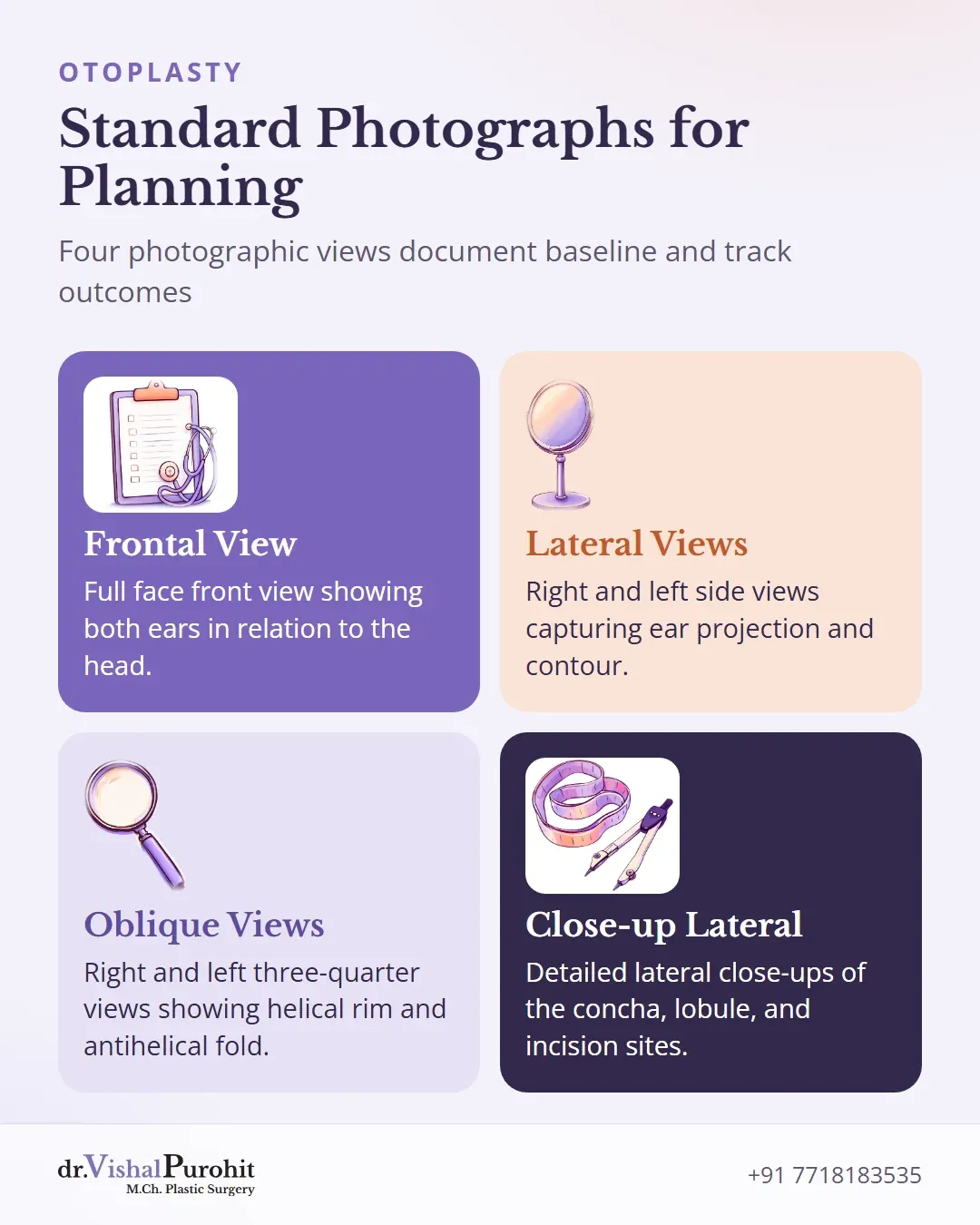
Standard photographs are part of planning and review71617. A usual set covers:
Key points
- Standard photographs taken before and after surgery document ear symmetry and guide surgical planning.
- The aim is natural, aesthetically pleasing contours rather than identical ears.
- Consultation clarifies what surgery can realistically achieve to set appropriate expectations.
- frontal view
- right and left lateral views
- right and left oblique or three-quarter views
- close-up lateral views716
The findings and the degree of asymmetry between the ears are also documented in writing7. Photographs are taken before surgery and at postoperative review71617.
Natural and balanced, never exactly alike
The aim is normal-appearing, aesthetically pleasing ears that are not recognisable as having been surgically corrected16. The surgical goals include a smooth, anatomical contour and avoiding overcorrection18. Dr. Purohit considers mild asymmetry acceptable because nobody sees both ears fully at the same time.
Realistic goals
The consultation should explain what surgery can and cannot achieve, so that expectations are appropriate7. The results post shows outcomes separately and is not a guarantee of a particular result15.
Children at the Consultation
The child takes part
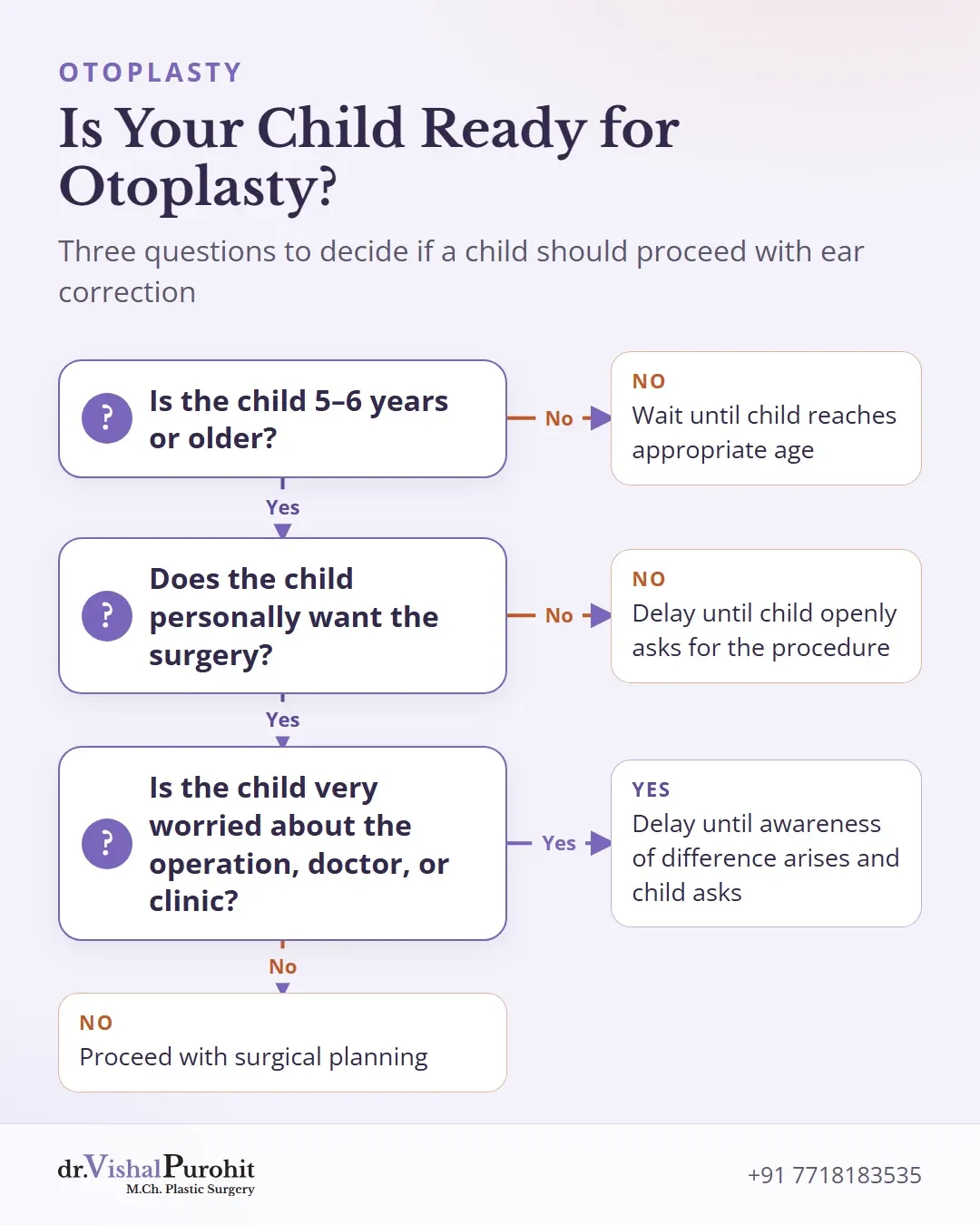
At the consultation, the child takes part and the parents are present. Dr. Purohit asks the child’s own wish in front of the parents. This follows the view that the indication for otoplasty should be discussed with the parents and the child together, so that later problems or misunderstandings are avoided13. Parents are usually the decision-makers, but they may not be the ones who sought the consultation; the surgeon must be sure that the operation is what the child wants, not only the parents’ wish12.
A worried child
Some children are eager, particularly when there has been ridicule from peers or siblings12. A child who is very worried about the operation, the doctor or the clinic may be better served by delay until awareness of the difference arises and the child openly asks for the procedure19.
The legal consent step for a minor is covered in the section on age.
Arranging an Ear Correction Consultation in Jaipur
Planning ear reshaping requires a clear understanding of surgical cartilage techniques, health evaluation, and recovery steps. To explore personalized planning for otoplasty in Jaipur, schedule a detailed consultation to examine ear anatomy and review realistic milestones. You can also read through otoplasty FAQs to learn more about procedural safety, dressings, and scheduled postoperative reviews.
This is educational information, not medical advice.