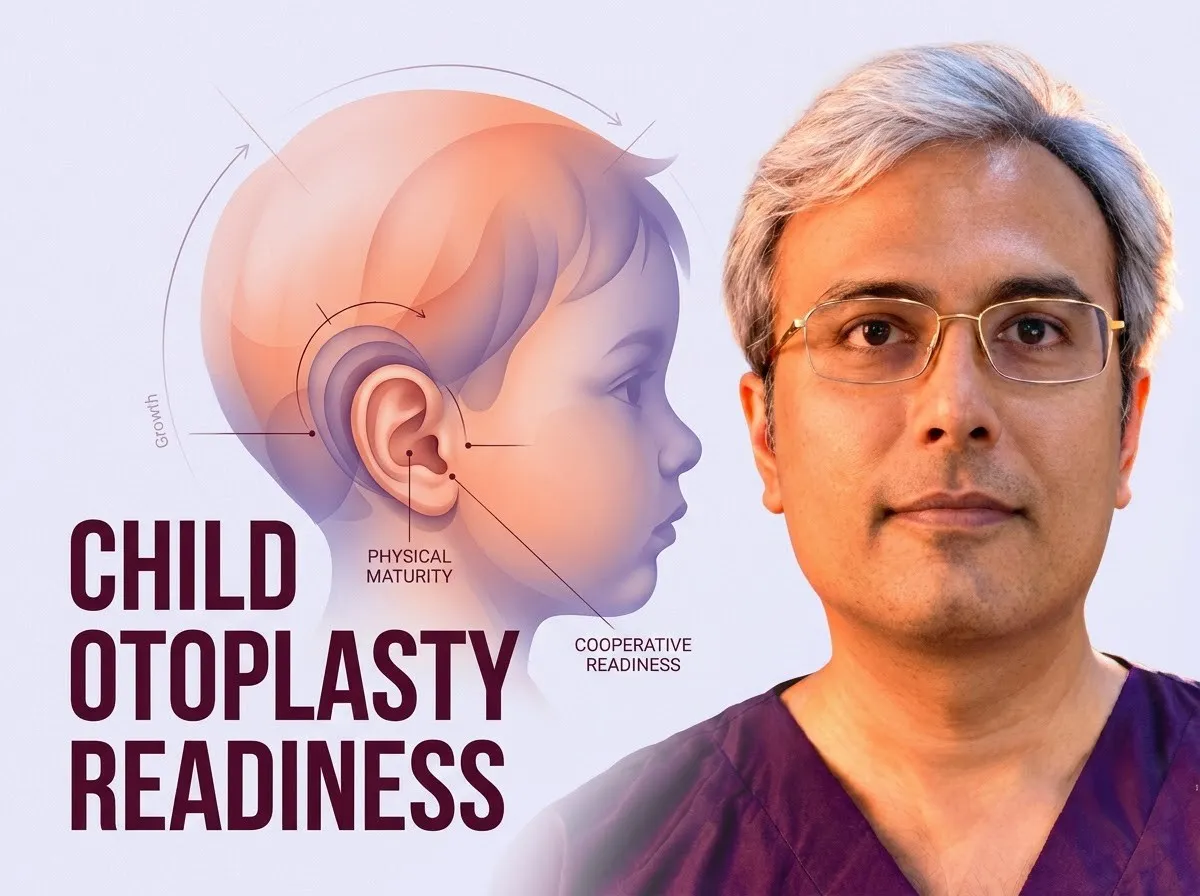
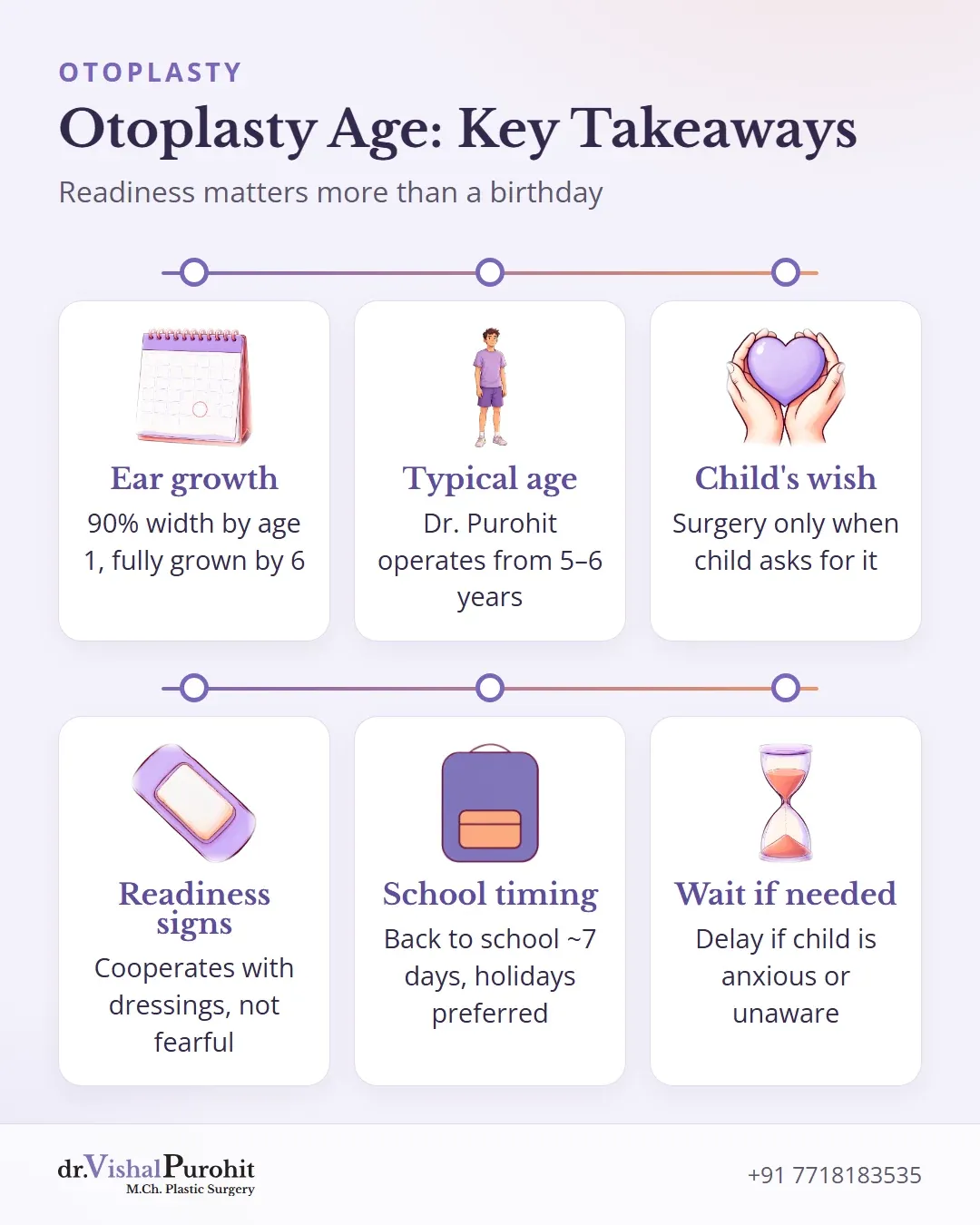
Prominent ears can affect how a child feels among classmates, but a birthday alone does not decide when surgery should happen. Most ear growth happens in the early years, and both published guidance and clinical practice point to a similar window.
During initial evaluations for otoplasty in Jaipur, Dr. Vishal Purohit assesses both ear cartilage maturity and emotional readiness before recommending corrective surgery.
This post explains how the ear grows, what signs show a child is ready, and how the decision is made with the child and parents together. Families also plan around term dates and sport, as covered in School, Work, Swimming and Sport After Otoplasty: Planning Your Return.
How Ears Grow in Childhood
Most of the growth happens early
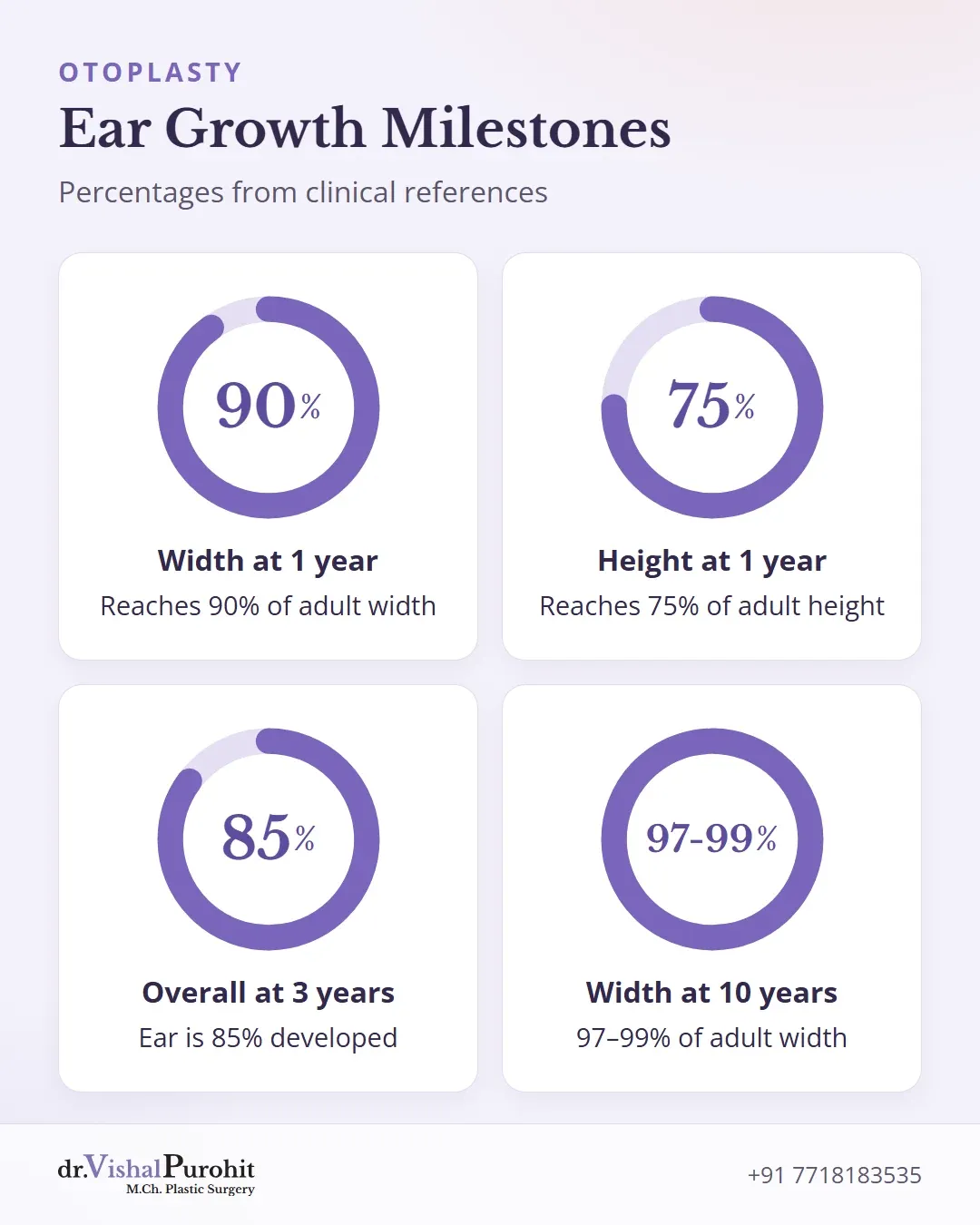
The external ear grows quickly in the first years of life. By 1 year of age, it has reached about 90% of adult width and 75% of adult height12. By 3 years of age, the ear is about 85% developed234, and by 10 years it reaches 97–99% of adult width and 93% of adult height125.
What finishes early, and what takes longer
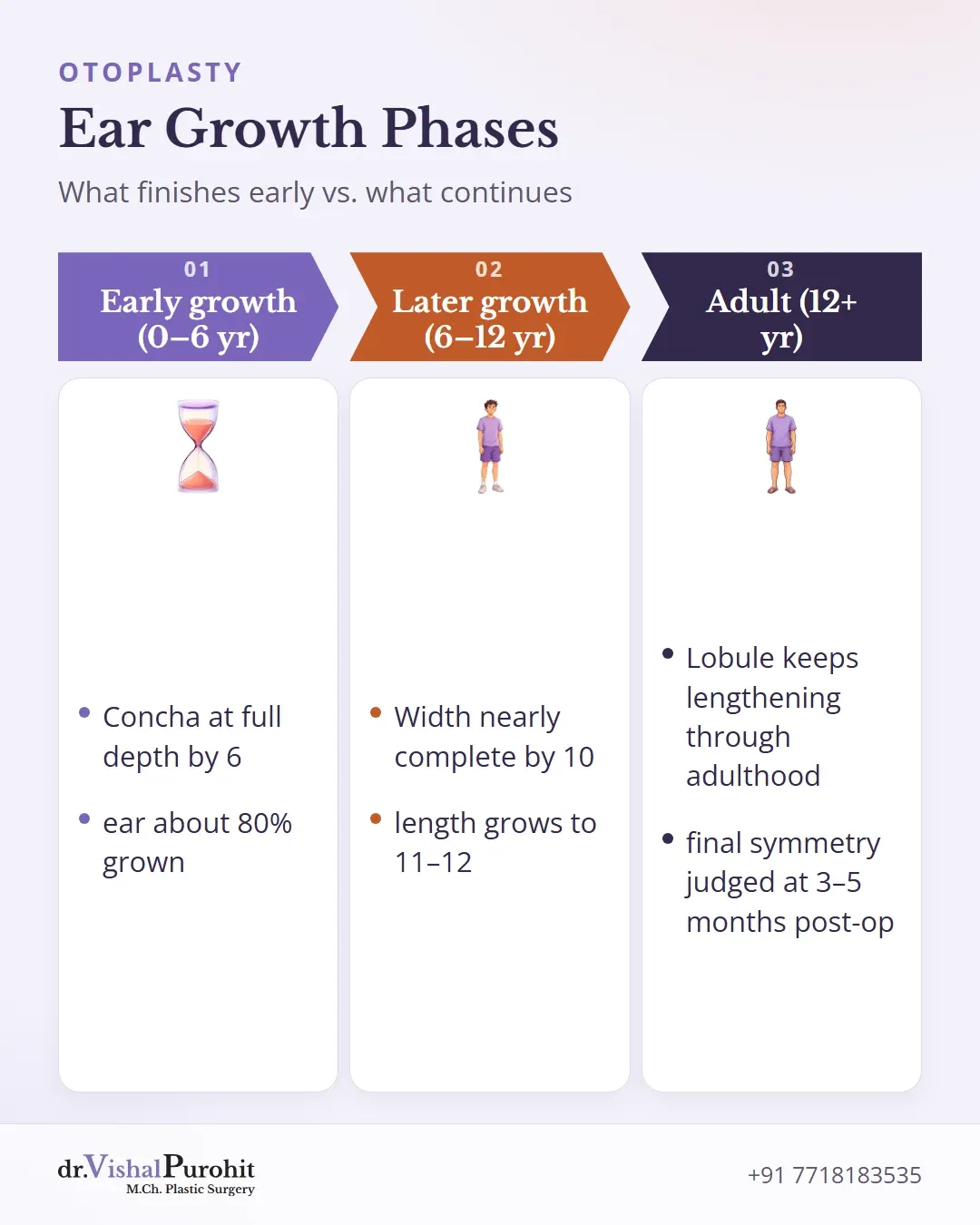
- Width and conchal depth are fully grown by about age 6, independent of gender6.
- Length takes longer: auricular length growth continues until about 11 to 12 years6, and another reference gives adult length at about age 12 in girls and 13 in boys7.
- Overall size is about 80% of adult size by age 6 and 90% or more by age 107.
- The lobule keeps lengthening through adulthood5.
Because most of the ear’s width and conchal depth are already grown in early childhood,
Dr. Purohit’s note: Dr. Purohit, who practises in Jaipur, operates on children from about 5 to 6 years of age, depending on the child’s development. He asks the child’s own wish in front of the parents, and parents give consent for a minor, as Indian law requires.
Dr. Purohit’s Age Guide
The clinic’s approach
At his practice in Jaipur, Dr. Vishal Purohit operates once this stage is reached. The child’s own wish is asked in front of the parents, and the parents give consent for a minor, as Indian law requires.
What published guidance says
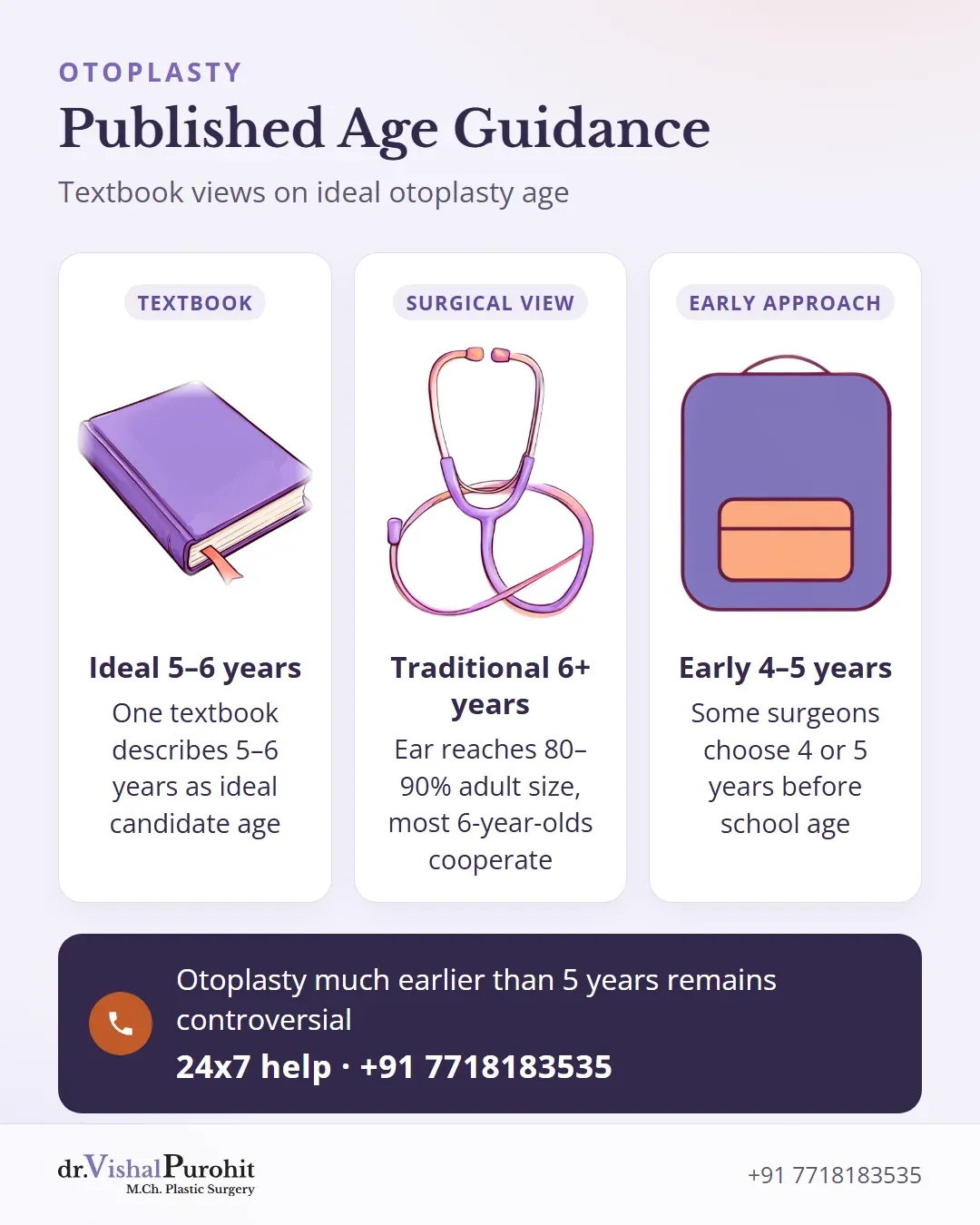
Published sources point to a similar window, though opinions vary:
- One textbook describes 5–6 years as the ideal candidate age8, and another reports that surgery is mostly performed after 5 years of age9.
- The traditional surgical view holds that otoplasty should not be done before age 6, because the ear reaches 80% to 90% of adult size by then and most 6-year-olds cooperate with dressings and headbands10.
- Some surgeons choose 4 or 5 years, before school age11, and one source treats age 4 as a minimum for most procedures12.
- Otoplasty much earlier than 5 years of age remains controversial13.
Is Your Child Ready?
Dressing and headband care
There is a head dressing for 5 to 7 days, kept dry at all times, then a soft headband day and night for 1 to 2 weeks and at night for a further 3 to 4 weeks.
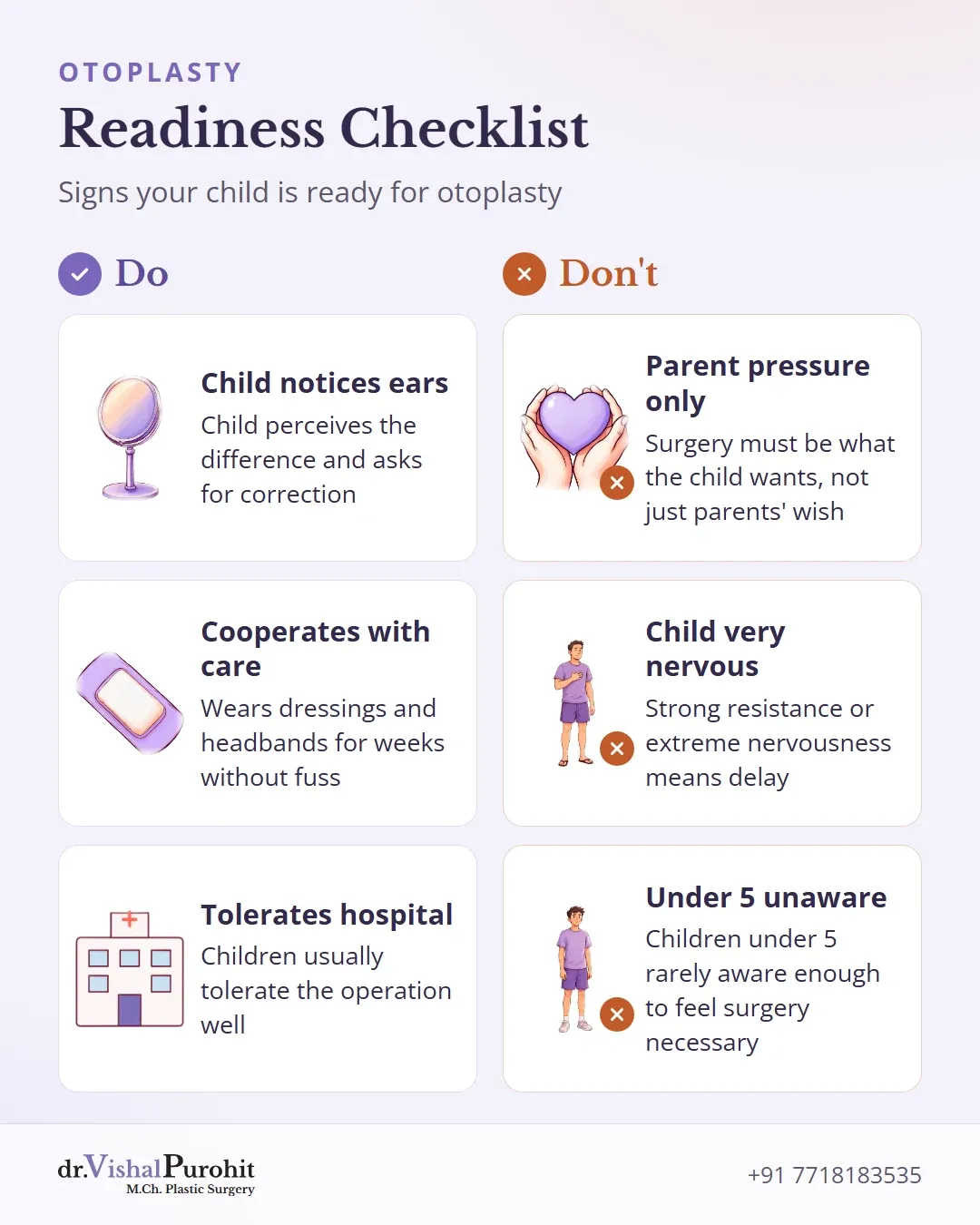
Most 6-year-olds cooperate with postoperative care and wear dressings and headbands for weeks without much fuss10.
Children under 5 are rarely aware enough of their appearance to feel surgery is necessary, and this may make postoperative care harder14.
Saying what bothers them
A child who perceives the ear difference and asks for correction is a common reason for consultation15.
Some children are very worried about the operation; it is better to wait until they are aware of the difference and ask for it themselves16.
Myth: Parents alone can decide on ear correction surgery for their young child.
Fact: The surgeon must be sure it is what the child wants and not just the parents’ wish8.
Coping with the hospital stay
The operation involves an overnight stay in hospital.
Children usually tolerate the operation well16.
Strong resistance to surgery or extreme nervousness about going to the doctor or hospital is a reason to delay14.
How Dr. Purohit decides
He asks the child’s own wish in front of the parents, and the parents give consent for a minor as Indian law requires.
Timing Around School
Plan around holidays and exams
Timing is discussed with the parents and the child together17. Published guidance recommends otoplasty between 5 and 6 years of age, before schooling starts1819, and one surgical text notes that no definitive studies settle the proper timing of the operation10. Around this age a child can also say whether the ears bother them18. Parents sometimes ask for the operation while the child reports no problem, which is why the discussion is held with both present18. Families often choose a school holiday, because the head dressing, the day-5 and day-10 reviews and headband wear all fall inside the first weeks after surgery.
Key points
- Otoplasty is often planned around age 5 to 6 or during school holidays when the child is ready.
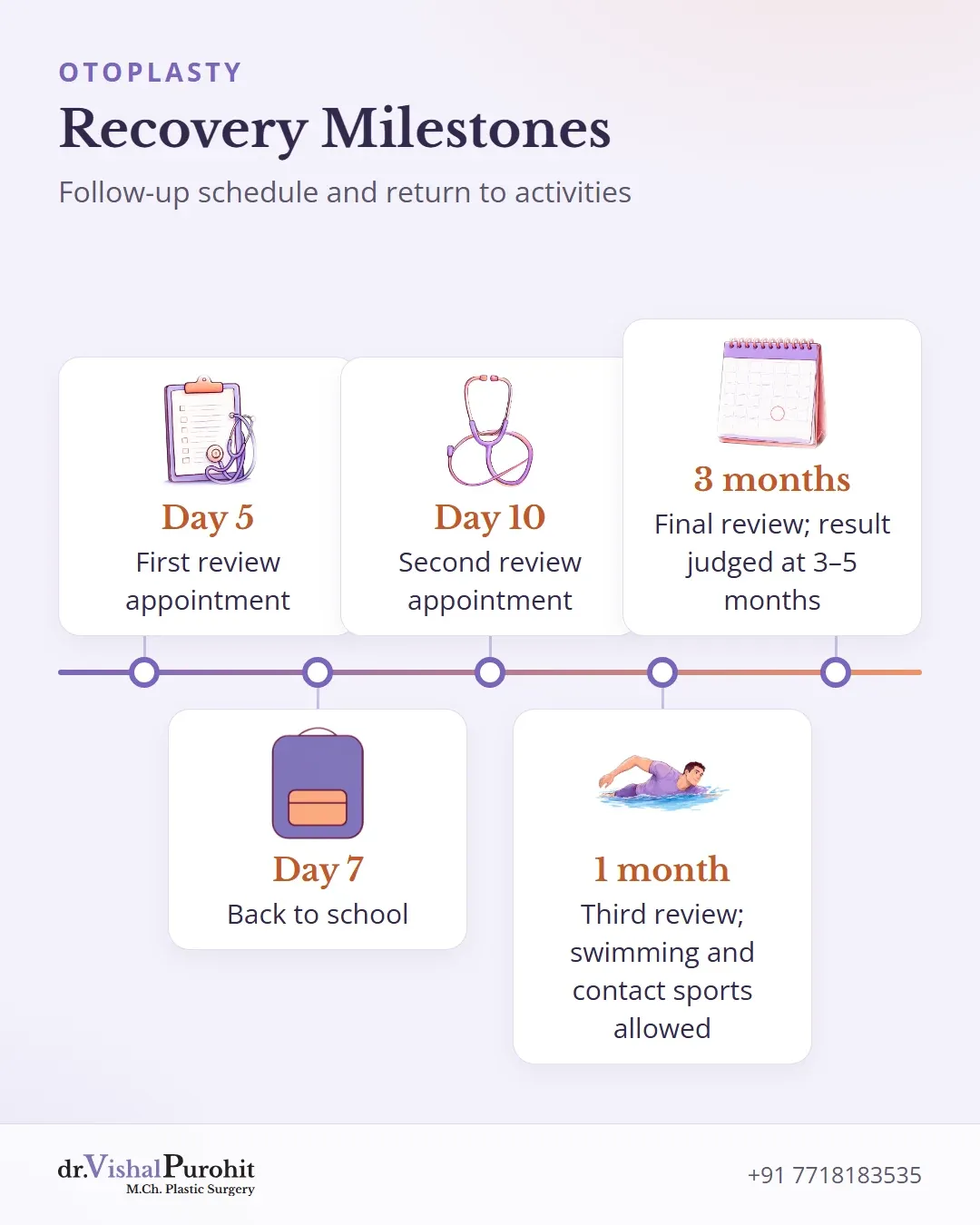
- Children typically return to school around 7 days after surgery, with scheduled follow-up reviews.
- Sports and swimming should wait until 1 month following the procedure.
Back to school at about 7 days
In Dr. Purohit’s practice in Jaipur, a child is back to school at about 7 days. Reviews fall on day 5, day 10, then at 1 month and 3 months, so term dates and exams can be planned around them. Swimming and contact sports wait until 1 month. Dressing, headband and sport rules are covered in the separate post on school and sport after otoplasty.
When Waiting Makes Sense
When the child is not ready
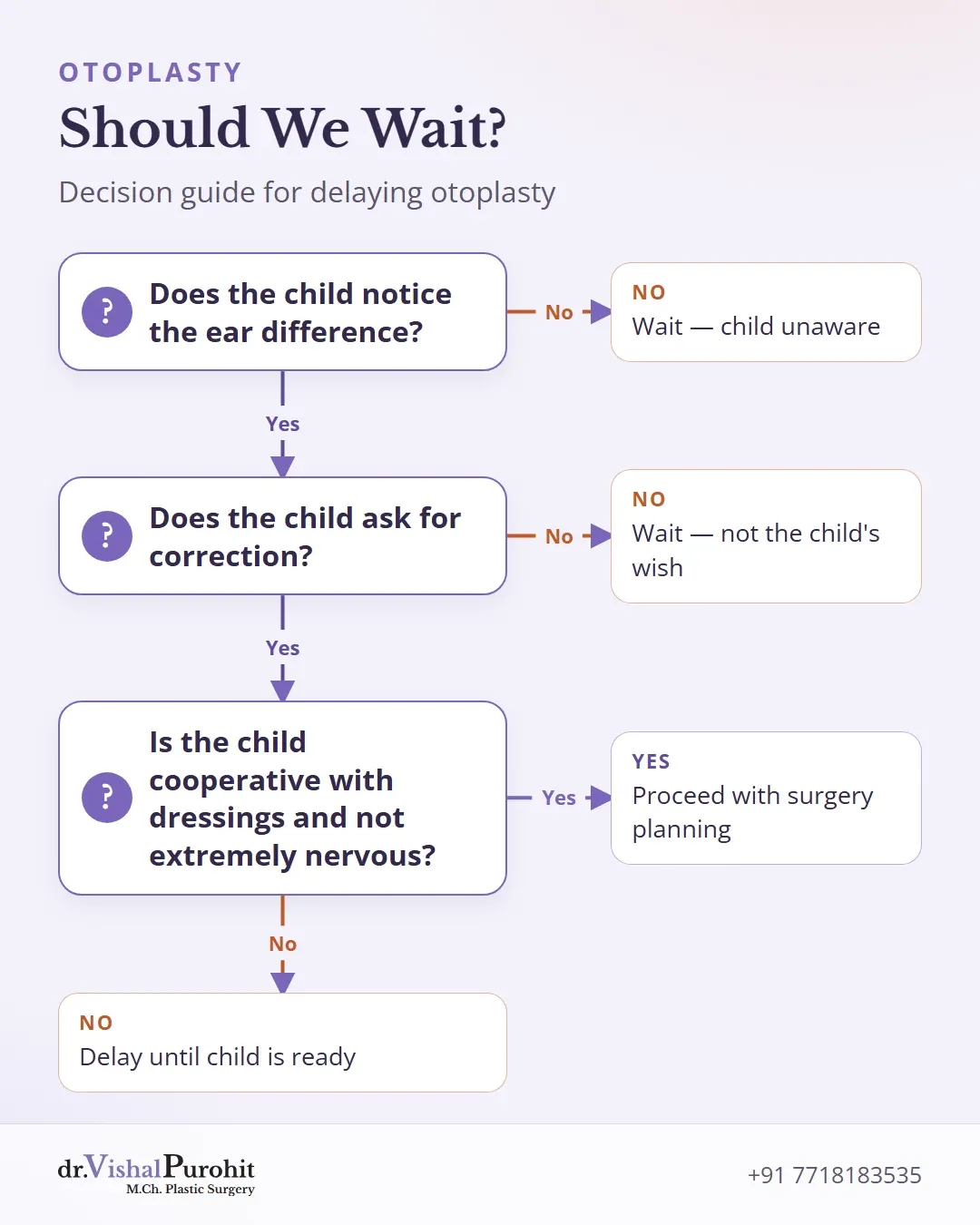
Some children are particularly worried about the operation, about seeing the doctor and about entering a clinic. In that situation, it is better to wait until the child’s own awareness of the difference arises and the child openly asks for the procedure16. The decision should be based on the needs of the child, not on pressure from the parents20. If the child is not bothered, deferring is reasonable1620. There have been no definitive studies to determine the proper timing of otoplasty10.
When teenagers decide for themselves
Adolescents and adults are more capable than young children of describing the ear features that concern them and their wish for correction11, and it is often the young adult who presents for evaluation independently10. At his practice in Jaipur, Dr. Vishal Purohit asks for the child’s own wish in front of the parents, while parental consent remains required for a minor under Indian law. Points specific to teenagers and to adults are covered on their own pages.
Planning Ahead in Jaipur
Every child develops at a different pace, so the calendar date alone never settles the question. How much the ear has grown and how the child is likely to cope with dressings both matter when a date is discussed. Parents who would like to discuss timing can book otoplasty in Jaipur, and the otoplasty FAQs answer common questions about dressings, school and follow-up reviews. No single number fits every child.
This is educational information, not medical advice.