
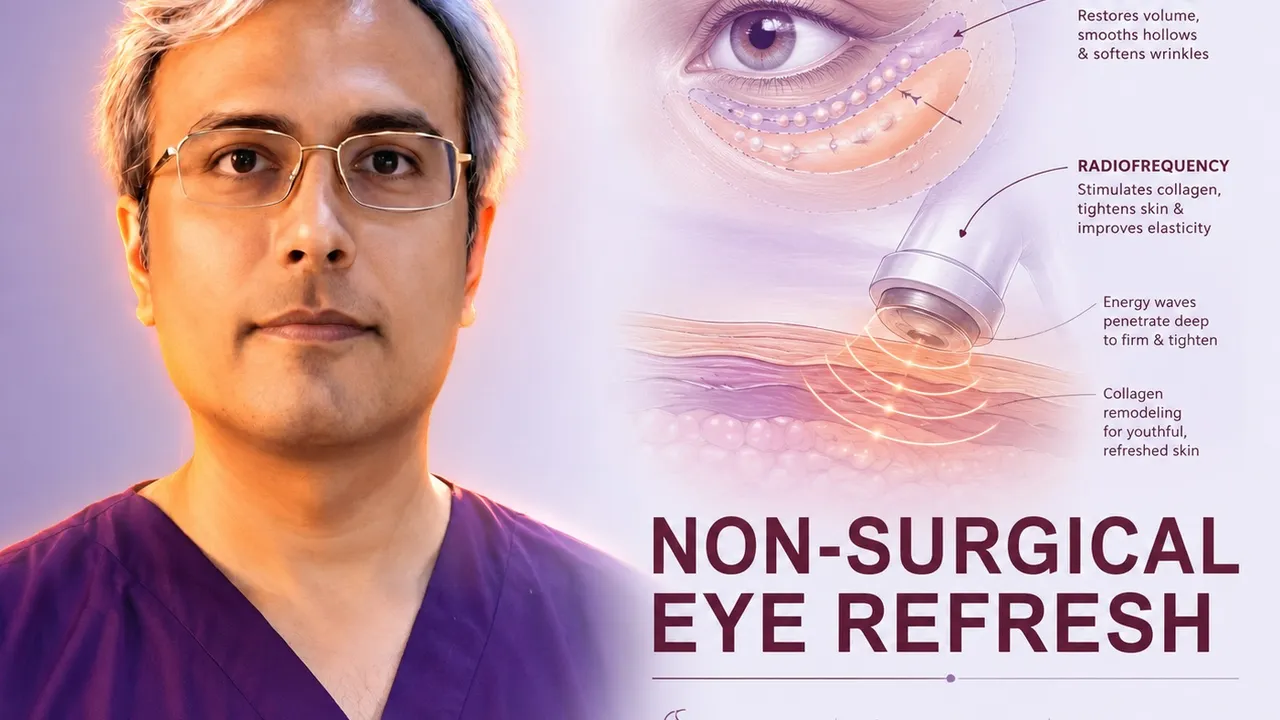
As we age, the area around the eyes is usually the first place to show it — fine lines, hollowing under the eye, crepey texture, a heavier-looking upper lid. Many people assume eyelid surgery is the only answer.
For a meaningful number of patients, it isn’t. Where the problem is skin quality, dynamic lines, or volume loss rather than genuinely excess skin, non-surgical treatment can do a great deal. Where there is excess skin or fat, no injection or laser will substitute for surgery, and you should be told that plainly.
This page explains what each non-surgical option actually does, how much downtime it really involves, and where its limits are.
At Kalpana Aesthetics, treatment is planned around your anatomy rather than around a menu. Dr. Vishal Purohit offers the full range of cosmetic surgery solutions, which means the recommendation you get is based on what will work — not on what happens to be on offer.
For the complete picture of the surgical option, read our full guide to blepharoplasty.
First: What Is Actually Causing the Problem?
This step matters more than the choice of device, and it is the step most often skipped.
Several different problems produce a “tired eye” appearance, and they respond to completely different treatments:
-
Dynamic lines — creases that appear only on smiling or squinting. Muscle activity. Responds to botulinum toxin.
-
Static lines and crepey texture — visible at rest. Skin quality. Responds to resurfacing and collagen-stimulating treatment.
-
Tear trough hollowing — a groove between the lower lid and cheek that casts a shadow. Volume loss and ligamentous attachment. Responds to filler, if the tissue is suitable.
-
True dermatochalasis — genuinely redundant upper eyelid skin, sometimes overhanging the lash line. Surgical.
-
Fat herniation — the “bag” under the eye that doesn’t change with hydration or sleep. Surgical.
-
Brow ptosis — a descended brow. This is important: a large proportion of upper-lid heaviness comes from the brow sitting low, not from lid skin. Treating the lid in these patients gives a poor result, and aggressive skin removal can make it worse. It needs a brow assessment.
-
Pigmentation — genuine melanin-based dark circles, common in Indian skin. Filler does not treat this.
-
Fluid-related puffiness — varies through the day, worse in the morning, worse with salt and poor sleep. Often not a candidate for anything procedural.
A consultation should distinguish between these before anything is recommended. If it doesn’t, ask.
Botulinum Toxin Injections

Botulinum toxin works at the junction between nerve and muscle. It temporarily reduces the contraction of the small muscles of facial expression — around the eyes, chiefly the orbicularis oculi — so the skin overlying them creases less. It does not act on the skin itself, and it does not tighten anything.
That makes it effective for dynamic wrinkles — lines that appear when you smile or squint — and specifically for crow’s feet at the outer corner of the eye. Carefully placed injections can also give a small lift to the lateral brow.
What to expect: onset over 3–7 days, full effect at around two weeks. Results last roughly 3–4 months, sometimes a little longer with repeated treatment. No downtime beyond the possibility of small injection-site marks or a bruise for a few days.
Limits and risks: lines that are already etched in at rest will soften but not disappear — those need resurfacing as well. Uncommon, temporary side effects include eyelid or brow droop and asymmetry, which resolve as the effect wears off. Placement around the eye is technique-dependent, which is the main argument for who does it rather than what brand is used.
Dermal Fillers for Volume Restoration
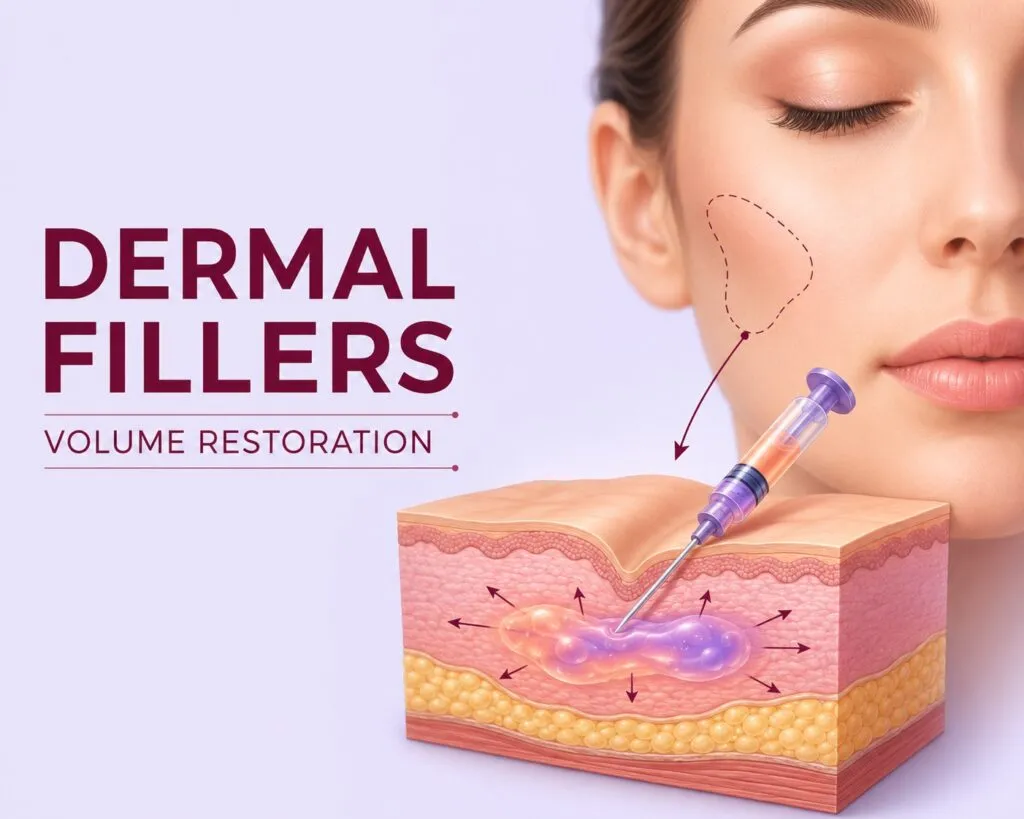
Hyaluronic acid fillers replace lost volume. In the periorbital area the usual target is the tear trough — the hollow at the junction of the lower lid and cheek — where a small, precisely placed quantity can soften the shadow and smooth the transition to the cheek.
Correcting a hollow often improves the shadow that reads as a dark circle. It is worth being clear that this is different from treating under-eye pigmentation, which is melanin in the skin and needs topical or laser management instead. Some patients have both. Some have neither, and their darkness is thin skin over underlying vessels, where filler can help a little and can also make things look worse.
What to expect: immediate visible change, settling over 2–4 weeks. Bruising and swelling for several days is common in this area — plan around social commitments. Longevity in the tear trough is variable, commonly 9–12 months, and occasionally much longer.
Limits and risks — please read this part:
-
Filler adds volume. It does not tighten skin, remove skin, or remove fat.
-
The lower lid is a genuinely unforgiving area. Overfilling, or filling too superficially, causes long-lasting puffiness (malar oedema) or a bluish-grey discolouration through the skin (Tyndall effect).
-
Patients with poor lower-lid tone, significant fat herniation, or a tendency to fluid retention are usually better served by surgery or by nothing at all.
-
Rarely, filler injected into or compressing a blood vessel can cause skin necrosis or, very rarely, visual loss. The periorbital region is one of the higher-risk sites for this because of its vascular anatomy. It is uncommon, it is the reason this treatment belongs with someone who knows the anatomy and manages the complication, and it is the reason we discuss it with you rather than around you.
-
Hyaluronic acid fillers are dissolvable with hyaluronidase. This is a real advantage over permanent materials, and a reason we don’t use permanent fillers around the eye.
Skin Resurfacing and Tightening
These treatments address the skin itself — texture, fine static lines, tone. They are performed on the periorbital skin, and treatment on the eyelid skin proper is either avoided or done at markedly reduced settings, because it is the thinnest skin on the body.
A few points worth correcting, because they’re commonly misstated online:
-
Fractional ablative CO₂ is not a lunchtime procedure. It gives the strongest non-surgical improvement in skin quality available, and it costs you a genuine recovery: several days of oozing and crusting while the skin re-epithelialises, then redness that fades over weeks and can be covered with makeup once healed. Anyone telling you otherwise is describing a different laser.
-
Er:YAG is not simply “gentler” than CO₂. It ablates with less spread of heat into surrounding tissue, which usually means faster healing at a comparable depth. Used in multiple passes it can be aggressive. The choice between the two is about your skin, your pigmentation risk, and how much downtime you can accept.
-
Q-switched Nd:YAG is a pigment device. It is genuinely useful for dark spots and for some patterns of pigmented dark circles. It is not a collagen-remodelling treatment, and claims that it tightens skin should be treated sceptically.
-
In Indian and other deeper skin types, any ablative or aggressive resurfacing carries a real risk of post-inflammatory hyperpigmentation. This is manageable with priming, sun protection and appropriate device settings, but it changes which device is the right choice.
Regenerative Treatments
Microneedling creates controlled micro-injuries that trigger a healing response and new collagen formation — collagen induction therapy. Applied to the periocular region over a course of 3–4 sessions spaced about a month apart, it improves fine lines and skin texture, and gives a modest firming effect. It is one of the safer options around the eye and combines well with topicals.
Platelet-rich plasma (PRP), prepared from your own blood, is often added to microneedling in this area. Evidence for periorbital PRP is promising but still modest, and it is best understood as an enhancement to collagen-stimulating treatment rather than a treatment in its own right. We’ll tell you honestly what the data supports.
A caution on marketed devices. Plasma or “fibroblast” pens and similar devices are heavily advertised for eyelid tightening. The evidence base is thin, they are frequently used by untrained operators, and the eyelid is the wrong place to accept an uncertain outcome. We don’t offer them.
Medical-Grade Topicals and Daily Maintenance
None of the above lasts without daily care. Topicals won’t remove a fold, but they meaningfully affect skin quality and they protect whatever result you’ve paid for. This is the foundation of long-term eye health.
-
Sun protection. The single most effective anti-ageing measure for the periorbital area, and the one most often neglected. Daily, year-round, plus sunglasses.
-
Retinoids. The best-evidenced topical for fine lines and skin quality. Around the eye they must be introduced slowly and at low strength — irritation here is common.
-
Hydration and barrier support. Thin eyelid skin loses water readily. A well-formulated moisturiser reduces the appearance of fine lines immediately and supports the barrier over time.
-
Pigment management. Where genuine pigmentation contributes to dark circles, targeted topicals are the appropriate first step, not filler.
-
Sleep, salt and allergy control. Unglamorous, and they make a visible difference to puffiness.
Who Is Not a Good Candidate for Non-Surgical Treatment?
Being told “no” is part of good care. Non-surgical options are unlikely to satisfy you if you have:
-
Significant redundant upper-lid skin, particularly if it touches the lashes or affects your field of vision
-
Prominent fat herniation producing a fixed lower-lid bag
-
Poor lower-lid tone on examination
-
Significant brow descent as the main driver of upper-lid heaviness
-
Puffiness that is fluid-related and fluctuating
Injectables and lasers are also postponed or avoided in pregnancy and breastfeeding, with active infection or inflammation in the area, with certain autoimmune and bleeding conditions, on anticoagulants without planning, and where expectations don’t match what the treatment can deliver.
Frequently Asked Questions
Can non-surgical treatments like Botox, fillers, or lasers replace surgical blepharoplasty?
Non-surgical treatments can soften dynamic crow’s feet wrinkles (Botox) or camouflage mild under-eye hollows (tear-trough fillers), but cannot excise redundant, heavy skin folds or remove herniated fat bags, as clinically clarified by Dr. Vishal Purohit in Jaipur. For moderate-to-severe hooded lids or prominent lower bags, blepharoplasty is the only definitive cure. As a board-certified plastic surgeon, Dr. Purohit provides unbiased anatomical assessments.
What can plasma pen (fibroblast) treatments achieve compared to eyelid surgery?
Plasma pen treatments produce superficial dermal micro-burns that cause temporary skin contraction (10% to 15%), but carry high risks of prolonged hyperpigmentation and scarring in Indian skin without removing fat, warns Dr. Vishal Purohit in Jaipur. Surgical blepharoplasty removes redundant tissue cleanly with zero skin discoloration. Dr. Purohit advises against unregulated energy devices around the delicate ocular globes.
How does a surgical blepharoplasty compare in cost and longevity to repeated non-surgical treatments?
Repeated non-surgical fillers and Botox cost ₹30,000 to ₹60,000 annually and require continuous maintenance, whereas a definitive blepharoplasty with Dr. Vishal Purohit in Jaipur costs ₹45,000 to ₹85,000 with results lasting 10 to 15 years. Surgical correction solves the root anatomical issue in a single 60-minute procedure. Dr. Purohit offers flexible 0% interest EMI options at Kalpana Aesthetics.
Can non-surgical treatments be combined with eyelid surgery for superior results?
Yes, combining surgical blepharoplasty with light chemical peels, fractional CO2 laser, or neuromodulators 2 to 3 months post-operatively refines skin texture and smooths fine smile lines around the eyes, recommended by Dr. Vishal Purohit in Jaipur. Combining modalities maximizes total periorbital rejuvenation. As an M.Ch. plastic surgeon, Dr. Purohit customizes comprehensive anti-aging roadmaps.
Book a Consultation
If you would like an assessment of what’s actually causing your concern and an honest account of your options — surgical and non-surgical — contact Dr. Vishal Purohit in Jaipur on +91 77181 83535, or book a consultation online.
Non-Surgical Rejuvenation vs. Surgical Blepharoplasty
| Treatment Modality | Mechanism of Action | Longevity of Result | Downtime Required | Best Clinical Indication |
|---|---|---|---|---|
| Surgical Blepharoplasty | Direct excision of excess skin & fat | 10 – 15+ Years (Permanent) | 7 – 10 Days | Moderate-to-severe hooding and lower lid bags |
| Hyaluronic Acid Filler | Deep volume replacement in tear trough | 9 – 14 Months | 2 – 4 Days | Isolated tear trough hollows with good skin tone |
| Fractional CO2 Laser | Thermal micro-ablation stimulating collagen | 1 – 2 Years | 5 – 10 Days | Fine periorbital crepey skin and surface wrinkles |
| RF Microneedling | Subdermal radiofrequency coagulation | 12 – 18 Months | 2 – 3 Days | Mild lower lid laxity and texture refinement |
| Botulinum Toxin (Botox) | Temporary relaxation of orbicularis oculi | 3 – 4 Months | Zero downtime | Dynamic crow’s feet and active smile wrinkles |
References
-
Botulinum toxin for periorbital rhytides — https://doi.org/10.1007/s00266-024-04613-x
-
Tear trough anatomy and correction — https://doi.org/10.3389/fsurg.2023.1112402
-
Management of infraorbital hollows and dark circles — https://doi.org/10.1097/DSS.0000000000002484
-
Periorbital fine line reduction — https://doi.org/10.4081/dr.2026.10428
Medically reviewed by Dr. Vishal Purohit, MBBS, MS, MCh (Plastic Surgery), on 26 July 2026. This page is general information about treatment options and is not a substitute for individual medical assessment.
Expert Blepharoplasty & Eyelid Rejuvenation in Jaipur
Are heavy, drooping upper eyelids or prominent under-eye bags making you look tired, aged, or obstructing your visual field? Schedule a detailed periorbital examination with Dr. Vishal Purohit, board-certified M.Ch plastic surgeon in Jaipur.
- Comprehensive Master Guide: Explore our foundational clinical overview on What is Blepharoplasty? Eyelid Surgery Explained.
- Surgical Procedures & Consultations: Visit our specialized Blepharoplasty Surgery in Jaipur suite to review surgical approaches, recovery milestones, and book your clinical evaluation.