
Planning injectable treatments requires assessing the entire face rather than focusing on an isolated fold or line. Understanding structural balance helps restore facial harmony while preserving personal identity.
Because gel interacts directly with soft tissues, individual tissue properties guide every step. In preparing for treatment, reviewing Your First Filler Consultation: What Happens and What to Ask helps clarify personal goals and expectations.
Whole-Face Assessment and Structural Balance
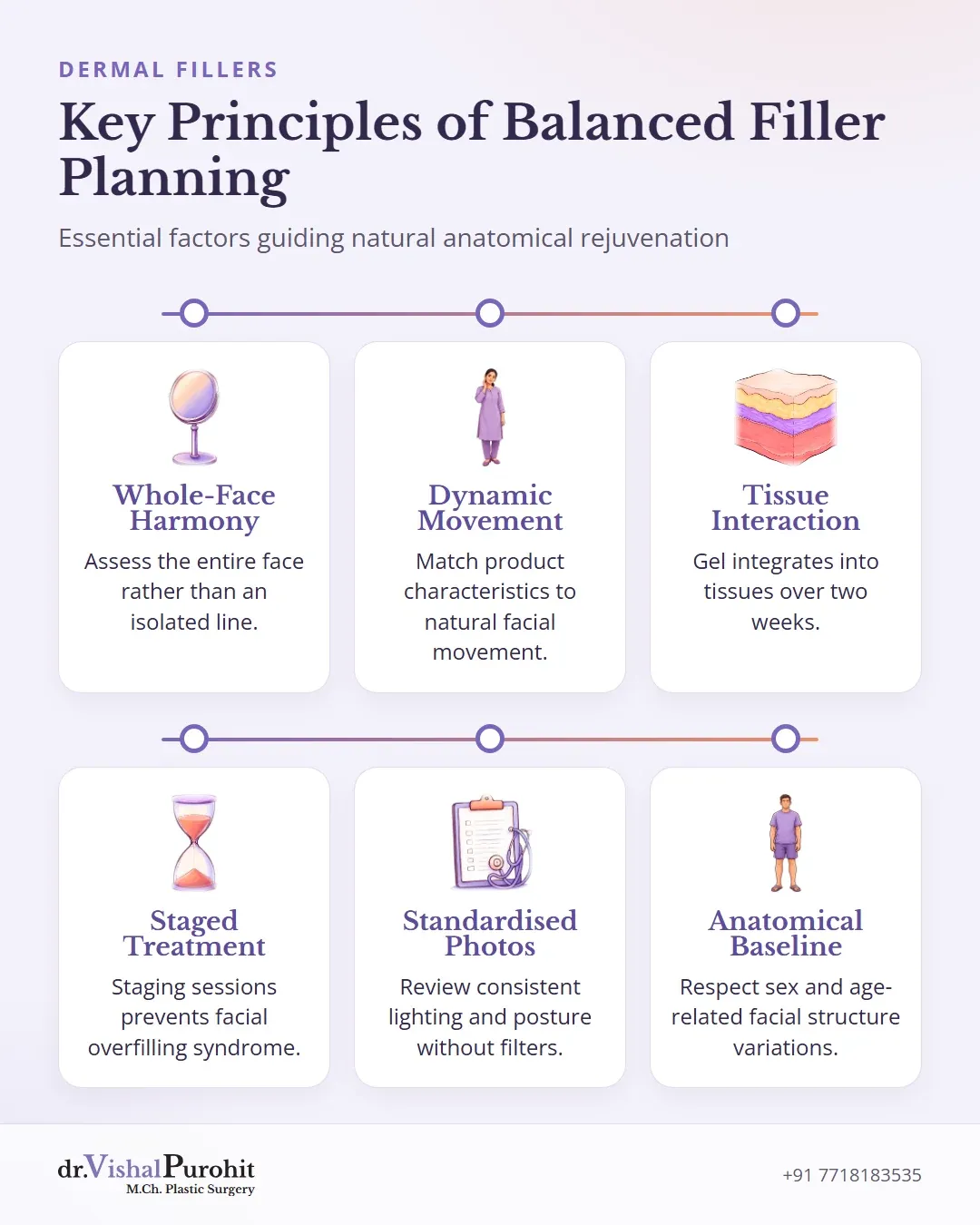
Natural cosmetic outcomes depend on evaluating the entire face as an interconnected unit rather than addressing isolated folds or lines in isolation1. When planning facial contouring with injectables, assessing overall facial proportions provides a foundation for balanced rejuvenation1.
Facial features influence one another, meaning a prominent anatomical feature can alter the perceived balance of neighboring structures2. Understanding the proportional relationship between these adjacent areas allows treatment to restore balance without distorting natural appearance2.
Dynamic Expression and Proportion
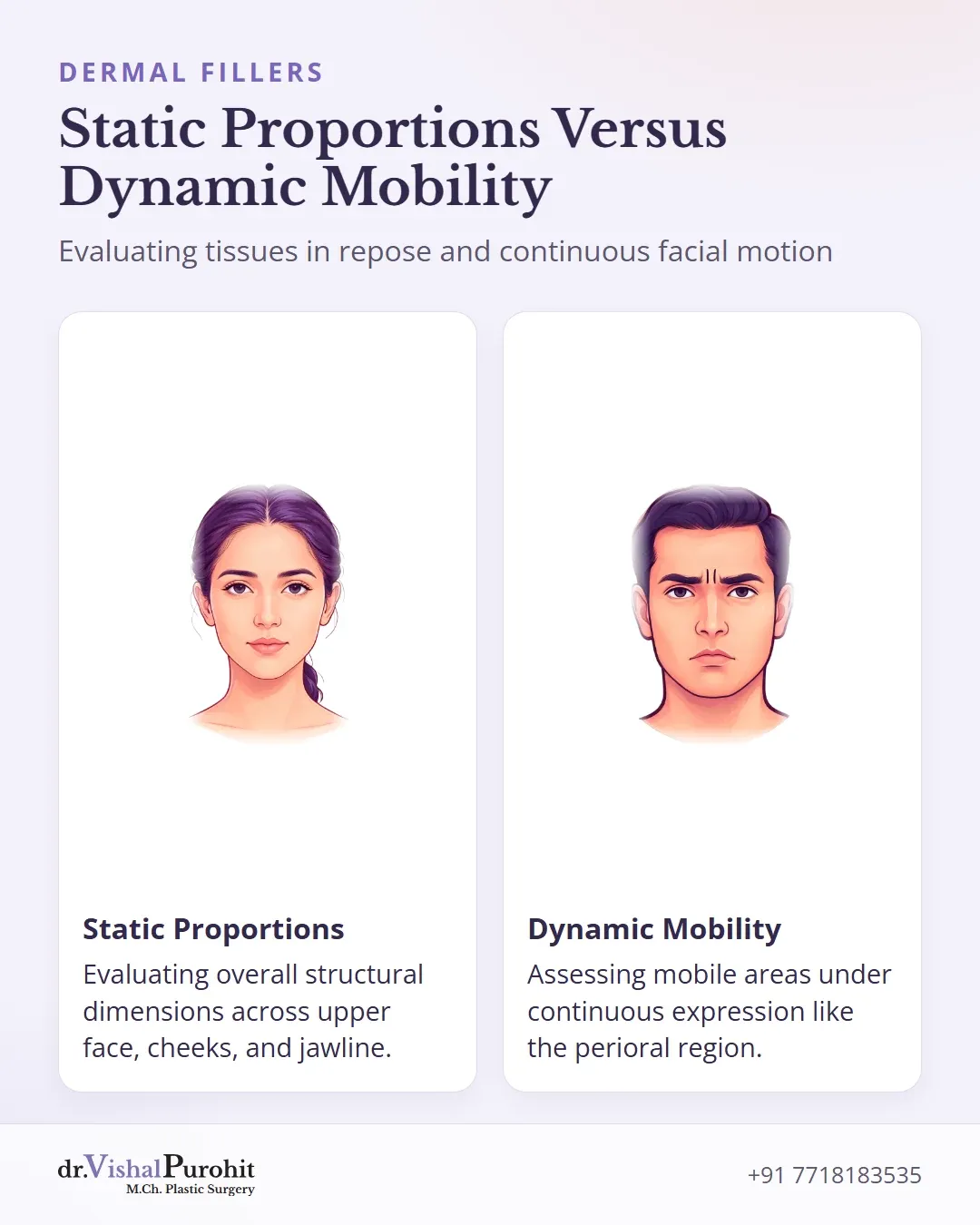
Assessment requires examining facial tissues both in static repose and during active movement:
- Static proportions: The clinician evaluates overall dimensions and structural relationships, such as how the upper face, cheeks, and jawline relate to one another12.
- Dynamic mobility: Highly mobile areas like the perioral region undergo continuous movement from facial expression, which affects how soft tissue behaves3.
Dr. Purohit’s note: Dr. Vishal Purohit assesses whole-face proportions and structural balance during the initial consultation to preserve personal identity while planning filler placement.
Matching product characteristics to tissue mobility helps maintain natural facial movement and prevents unnatural contour changes3.
Product Amount Versus Visible Change
The relationship between the injected material and visible aesthetic change is not a simple one-to-one addition. Dermal fillers provide soft tissue augmentation primarily through physical volume expansion4, but the final visual correction depends on how the gel interacts with the surrounding anatomy.
Tissue Characteristics and Placement
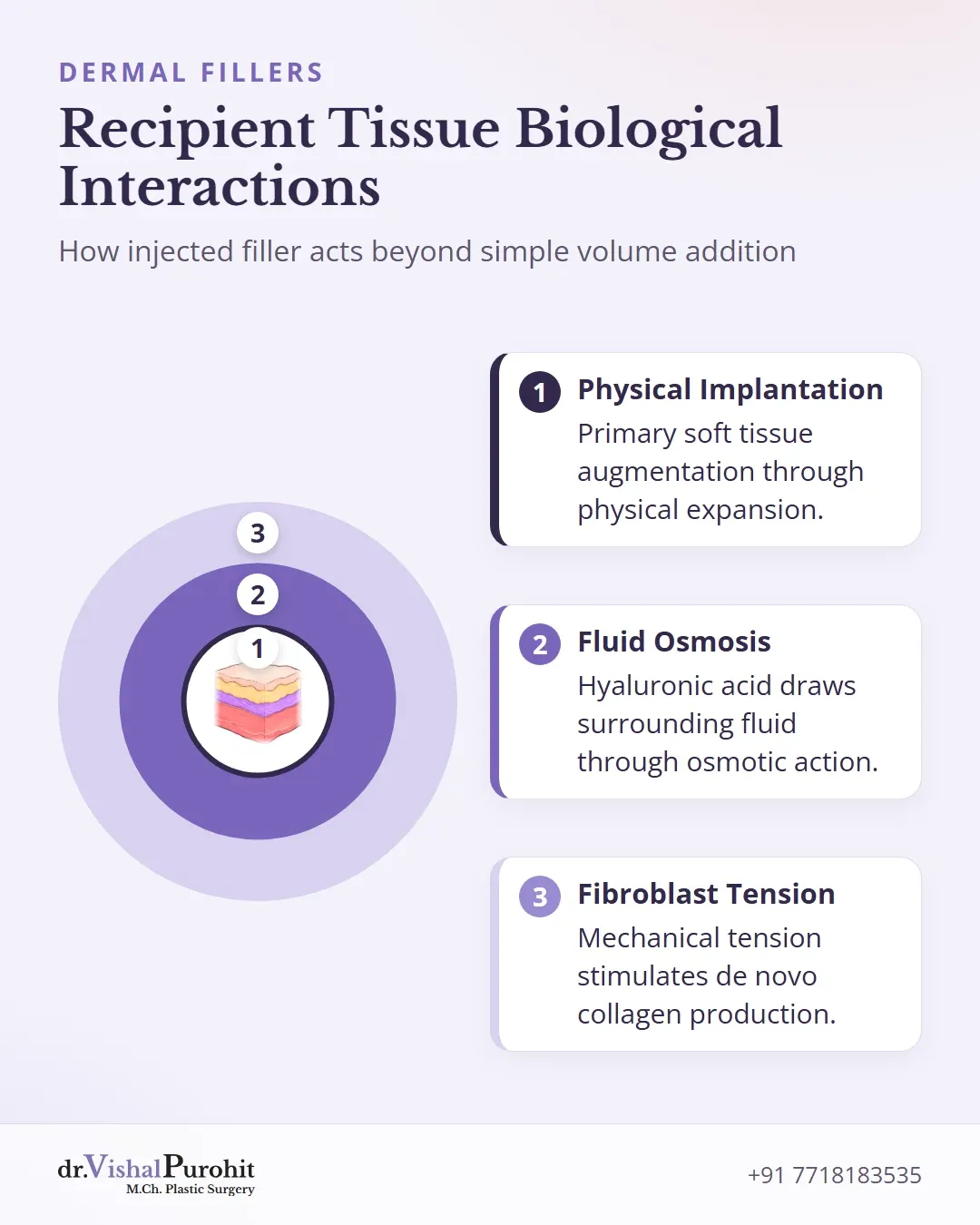
The outward appearance of an injected filler depends on several recipient tissue factors:
Mechanical properties
- The integration of injected gel starts within a few hours and continues for up to 2 weeks5.
- Integration is influenced by gel cohesivity and the physicomechanical properties of the recipient tissue.
Tissue response
- Hyaluronic acid exerts its primary effect through physical implantation while also drawing fluid through osmosis6.
- Furthermore, its clinical action is not limited to passive volume expansion, offering mechanical support and stimulating de novo collagen production through mechanical tension on local fibroblasts7.
Because these physical interactions and tissue resistance vary across facial regions, injection planning is tailored during individual consultation rather than calculated by product volume alone.
Staged Treatment and Avoiding Overfilling

Excessive, poorly sequenced, or anatomically insensitive filler placement can distort surface contours and cause facial overfilled syndrome7. Large volumes of product can clump, migrate under repeated muscle contractions, or draw excess water into the tissues, resulting in unnatural fullness8. Treating in planned stages helps maintain tissue integrity and prevents cumulative disharmony78.
Most acute swelling after injections is temporary and resolves on its own9. Pausing between sessions rather than rushing into early touch-ups allows the soft tissues to settle, showing the true contour before any further gel is introduced. At consultation in Jaipur, Dr. Purohit evaluates individual facial dynamics to plan conservative adjustments.
Choosing no treatment remains an entirely valid choice. Aesthetic care should never stem from social pressure, and leaving facial features unchanged is always an acceptable decision.
How to Evaluate Before-and-After Photos

When reviewing clinical photographs from any practice, assessing the consistency of image capture helps separate genuine tissue changes from photographic artefacts. Standardised medical photography is essential to align patient expectations with realistic treatment outcomes10.
Key points
- Consistent, standardised clinical photography separates genuine anatomical changes from lighting and photographic artefacts.
- Reliable comparisons require identical lighting, positioning, camera angles, and unretouched images.
- Before-and-after photographs serve as references but cannot predict individual healing or personal results.
Reliable before-and-after images generally share several key technical features:
- Standardised, symmetrical overhead lighting without camera-mounted flash, which can artificially wash out facial lines and contours11.
- Consistent patient positioning, typically seated fully upright looking straight ahead to account for gravitational effects1213.
- Identical angles, such as frontal and oblique views1213.
- Neutral facial expressions at rest, or matching dynamic views such as smiling in both images13.
- Unaltered images free of digital filtering, retouching, or magnification13.
Standardised photographs serve as a clinical reference but cannot predict how an individual will heal or respond to treatment. Each face presents unique anatomical proportions, meaning outcomes vary from person to person.
Age and Sex Considerations in Planning
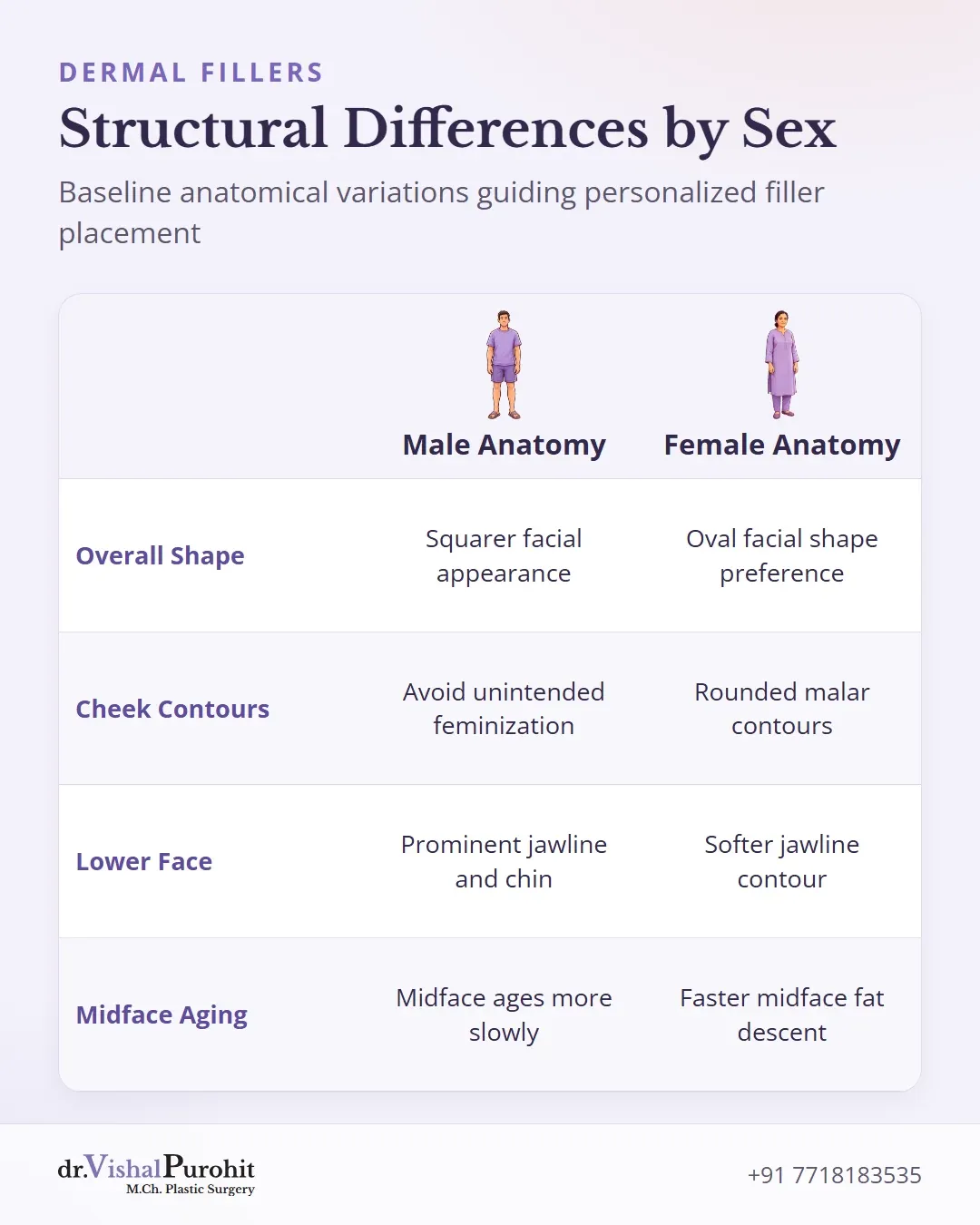
Facial structure and tissue characteristics differ naturally across sexes and change over time. In men, testosterone influences the development of a squarer facial appearance, thicker eyebrows, a prominent jawline, and thinner lips1415. Women typically present with more voluminous superficial fat pads, rounded malar contours, and softer jawlines1415. Men generally do not seek the oval facial shape often pursued by women14.
Aging brings gradual thinning of the skin, reduced elasticity, bone resorption, and descent of facial fat pads16. These changes shift facial contours from high cheeks to a heavier lower face16. Because the male facial skeleton retains its shape longer with age, the midface tends to age more slowly in men than in women14.
Planning dermal filler treatments requires respecting these baseline anatomical variations rather than imposing rigid, uniform templates:
- Structural goals: Treatment in men often focuses on restoring support along the jawline or chin while avoiding unintended feminization of the cheeks14.
- Tissue characteristics: Age-related volume reduction and skin laxity vary across facial compartments1617.
Dr. Vishal Purohit evaluates these individual anatomical traits directly, and treatment planning is decided at the consultation.
Planning Balanced Facial Care in Jaipur
Achieving natural cosmetic outcomes depends on understanding structural proportions and treating facial anatomy with care. Learn more about regional treatment planning through Dermal Fillers in Jaipur or review common patient questions in the Dermal Fillers FAQs. An in-person consultation provides an objective, individual assessment to determine appropriate care.
This is educational information, not medical advice.