
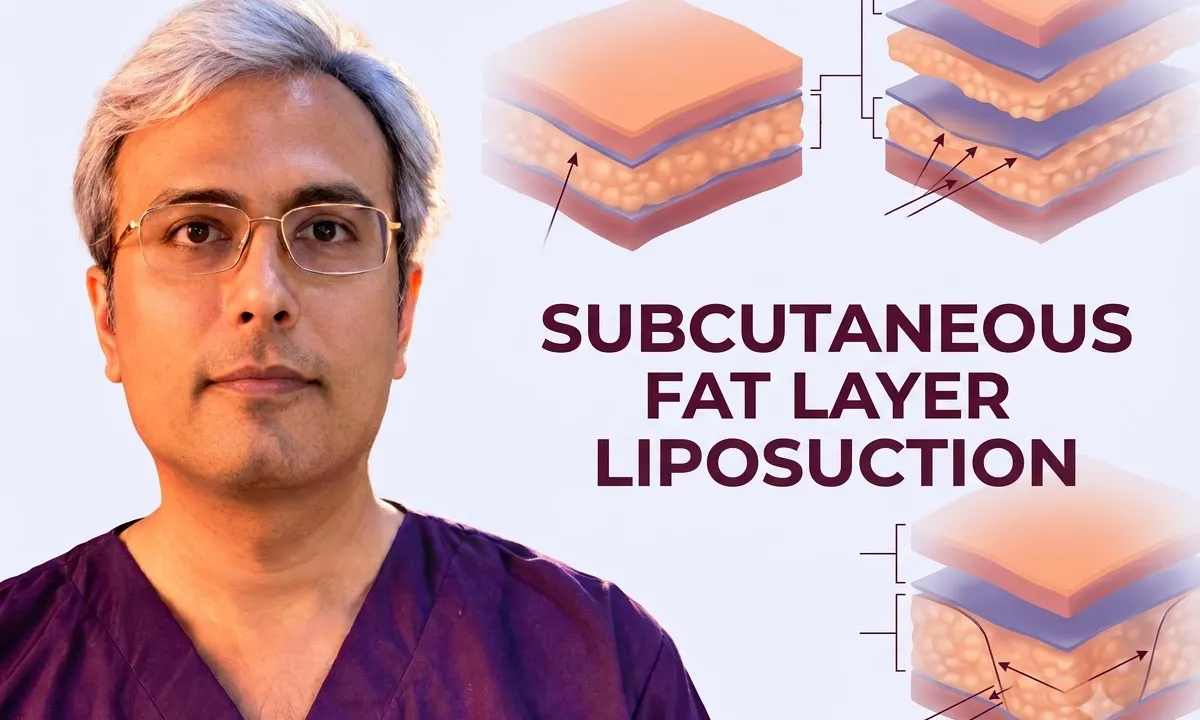
Subcutaneous Fat Layer Anatomy: Understanding the Structural Planes of Liposuction
Achieving smooth, athletic, and natural-looking body contouring requires far more than simply removing fat; it demands an intimate surgical mastery of anatomical tissue planes.
As an M.Ch. Plastic Surgeon at Kalpana Aesthetics in Jaipur, Dr. Vishal Purohit operates with microscopic anatomical precision. Understanding the distinct architectural layers of human adipose tissue—the superficial fat layer, the deep fat layer, and the dividing fibrous barrier known as Scarpa’s fascia—is the secret to preventing contour irregularities, preserving blood supply, and stimulating smooth skin retraction.
This clinical anatomical guide explains how human fat is structured beneath the skin, how surgical planes dictate liposuction safety, and how different techniques target specific depths.
For personalized anatomical evaluations and surgical planning in Jaipur, explore our surgical suite for liposuction in Jaipur with Dr. Vishal Purohit or review our complete guide to liposuction in Jaipur.
Fat Layer Anatomy Answer Capsule
Anatomy Answer Capsule: Human adipose tissue consists of three distinct layers: superficial subcutaneous fat (compact, metabolically stable, responsible for smooth skin draping), Scarpa’s fascia (a dense fibrous connective barrier), and deep subcutaneous fat (loose, metabolically active, responsible for bulk volume deposits). Safe liposuction primarily debulks the deep fat layer while carefully preserving a uniform layer of superficial fat to prevent skin indentations and necrosis.
| Anatomical Layer | Depth & Position | Tissue Characteristics | Surgical Role in Liposuction |
|---|---|---|---|
| Dermis / Epidermis | Outer surface (1–3 mm) | Sensory nerves, hair follicles, vascular capillary plexus | Must be protected from direct friction and cannula burn |
| Superficial Fat Layer | Directly beneath dermis (above Scarpa’s fascia) | Small, tightly packed adipocytes in vertical fibrous septae | Preservation Zone: Leave 1–1.5 cm intact to ensure smooth skin contour |
| Scarpa’s Fascia | Mid-subcutaneous boundary | Dense, membranous fibro-elastic connective sheet | Serves as the primary surgical landmark and support plane |
| Deep Fat Layer | Beneath Scarpa’s fascia (above deep muscle fascia) | Large, loosely organized adipocytes, abundant vascularity | Target Zone: Primary area for volume extraction and debulking |
| Deep Muscle Fascia | Covering rectus abdominis / skeletal muscles | Tough fibrous aponeurosis protecting internal organs | Anatomical floor; must never be penetrated by surgical cannulas |
1. The Superficial Fat Layer: Protecting Skin Smoothness
The superficial fat layer lies directly beneath the dermal skin envelope. Adipocytes in this layer are small, compact, and encased within dense, vertically oriented fibrous columns called the retinacula cutis.
Why Must Superficial Fat Be Preserved?
- Dermal Vascular Perfusion: The sub-dermal capillary network supplying oxygen and nutrients to your skin travels through this superficial layer. Over-aggressive suctioning in this plane can compromise skin blood flow, leading to blistering, hyperpigmentation, or localized skin necrosis.
- Preventing Contour Deformities: If superficial fat is completely removed, the skin adheres directly to underlying muscle or scar tissue, resulting in visible ripples, hollow depressions, and uneven waviness. Dr. Vishal Purohit always preserves a continuous 1.0 to 1.5 cm protective cushion of superficial fat to guarantee smooth skin draping. Learn about complication prevention in common risks of liposuction: from bruising to contour irregularities.
2. Scarpa’s Fascia: The Critical Structural Divider
In the lower abdomen and flanks, subcutaneous tissue is divided by Scarpa’s fascia—a tough, membranous sheet of collagen and elastin fibers.
- In thin individuals, Scarpa’s fascia is thin and flexible.
- In individuals with localized fullness, Scarpa’s fascia acts as a physical ceiling, trapping deep adipose tissue underneath.
During liposuction, an experienced plastic surgeon uses tactile feedback to feel the cannula pass beneath Scarpa’s fascia into the deep compartment, ensuring safe, uniform fat evacuation without entering the superficial danger zone.
3. The Deep Fat Layer: The Target for Volume Extraction
The deep subcutaneous fat layer sits between Scarpa’s fascia and the muscular wall (the deep muscle fascia covering your abdominal core, obliques, or latissimus dorsi).
Characteristics of Deep Fat:
- Fat cells are larger, softer, and arranged in loose, horizontal clusters.
- This layer responds readily to weight fluctuations and hormonal signals, making it the primary site of stubborn fat accumulation (love handles, lower belly pouches, and saddlebags).
- Safe Extraction Plane: Because major blood vessels run beneath the muscle fascia and dermal capillaries run superficially, the deep fat layer can be safely and generously debulked to flatten the silhouette without compromising skin health.
Review detailed target zones across the body in common target areas for liposuction: from double chins to thighs and liposuction body areas unveiled.
4. Subcutaneous Fat vs. Visceral Fat: What Can Liposuction Treat?
Patients frequently confuse subcutaneous fat with visceral fat:
- Subcutaneous Fat (Pinchable): Sitting outside the muscular wall, this is the only layer that liposuction can safely remove.
- Visceral Fat (Intra-Abdominal): Located deep inside the abdominal cavity, wrapped around the stomach, liver, and intestines behind the muscular wall. Visceral fat cannot be removed surgically; penetrating the muscle wall would cause life-threatening internal organ damage. Visceral fat can only be reduced through caloric restriction and cardiovascular exercise.
Learn why BMI and visceral fat dictate candidacy in the role of BMI and weight status in liposuction success and liposuction vs weight loss: why lipo is not for obesity.
5. How Energy Technologies Interact with Anatomical Layers
Modern energy devices specifically target these anatomical planes:
- VASER Ultrasound: Emulsifies deep fat effortlessly while sparing the delicate fibrous septae of the superficial layer, promoting superior skin retraction. Learn more in the difference between VASER and traditional suction-assisted liposuction.
- High-Definition (HD) Etching: Requires micro-cannula passes along the superficial boundary of muscular inscriptions (linea alba and semilunaris) while debulking the deep layer. Read understanding high-definition liposuction for muscle etching.
Frequently Asked Questions
What is the difference between superficial and deep fat layers in liposuction?
Subcutaneous fat consists of a deep fat layer (thick, metabolically stable reserves beneath Scarpa’s fascia) and a superficial fat layer (compact structural fat directly beneath the dermis), both precisely navigated by Dr. Vishal Purohit in Jaipur. Liposuction primarily targets the deep layer to remove volume, while conservative superficial contouring sculpts muscle shadows. As a board-certified plastic surgeon, Dr. Purohit avoids excessive superficial suction to prevent skin irregularities.
Why can’t liposuction remove visceral belly fat around internal organs?
Visceral fat is located deep inside the abdominal cavity surrounding the intestines and liver beneath the muscular wall, where surgical liposuction cannulas cannot safely enter, explains Dr. Vishal Purohit in Jaipur. Liposuction exclusively targets subcutaneous fat located outside the abdominal muscles. Dr. Purohit advises dietary adjustment and aerobic exercise to reduce internal visceral fat reserves.
What role does Scarpa’s fascia play in safe abdominal contouring?
Scarpa’s fascia is a dense connective tissue plane dividing the superficial and deep fat compartments of the lower abdomen, utilized as an anatomical safety barrier by Dr. Vishal Purohit in Jaipur. Preserving the fascial architecture maintains lymphatics and cutaneous sensory nerves, significantly reducing post-operative seroma and swelling. As an M.Ch. plastic surgeon, Dr. Purohit navigates fascial layers with surgical loupe precision.
How does fat layer anatomy influence the permanence of liposuction results?
Because adult humans possess a fixed number of fat cells, permanent removal of deep-layer adipocytes through liposuction by Dr. Vishal Purohit in Jaipur permanently reduces localized fat-storing capacity. Even if the patient gains moderate weight later, fat deposits more evenly across the body rather than re-accumulating in treated zones. Dr. Purohit emphasizes healthy nutrition to maintain optimal long-term results.
Book Your Anatomical Assessment in Jaipur
Understanding your tissue anatomy is the first step toward safe, natural, and transformative body contouring.
- Clinic Location: Kalpana Aesthetics, Jaipur Hospital, Tonk Road, Jaipur, Rajasthan, India
- Phone / WhatsApp: +91-7718183535
- Surgeon: Dr. Vishal Purohit, M.Ch. Plastic & Reconstructive Surgery
- Commercial Landing Page & Hospital Booking: Liposuction in Jaipur at Kalpana Aesthetics
- Master Educational Hub: Explore the Complete Guide to Liposuction in Jaipur