
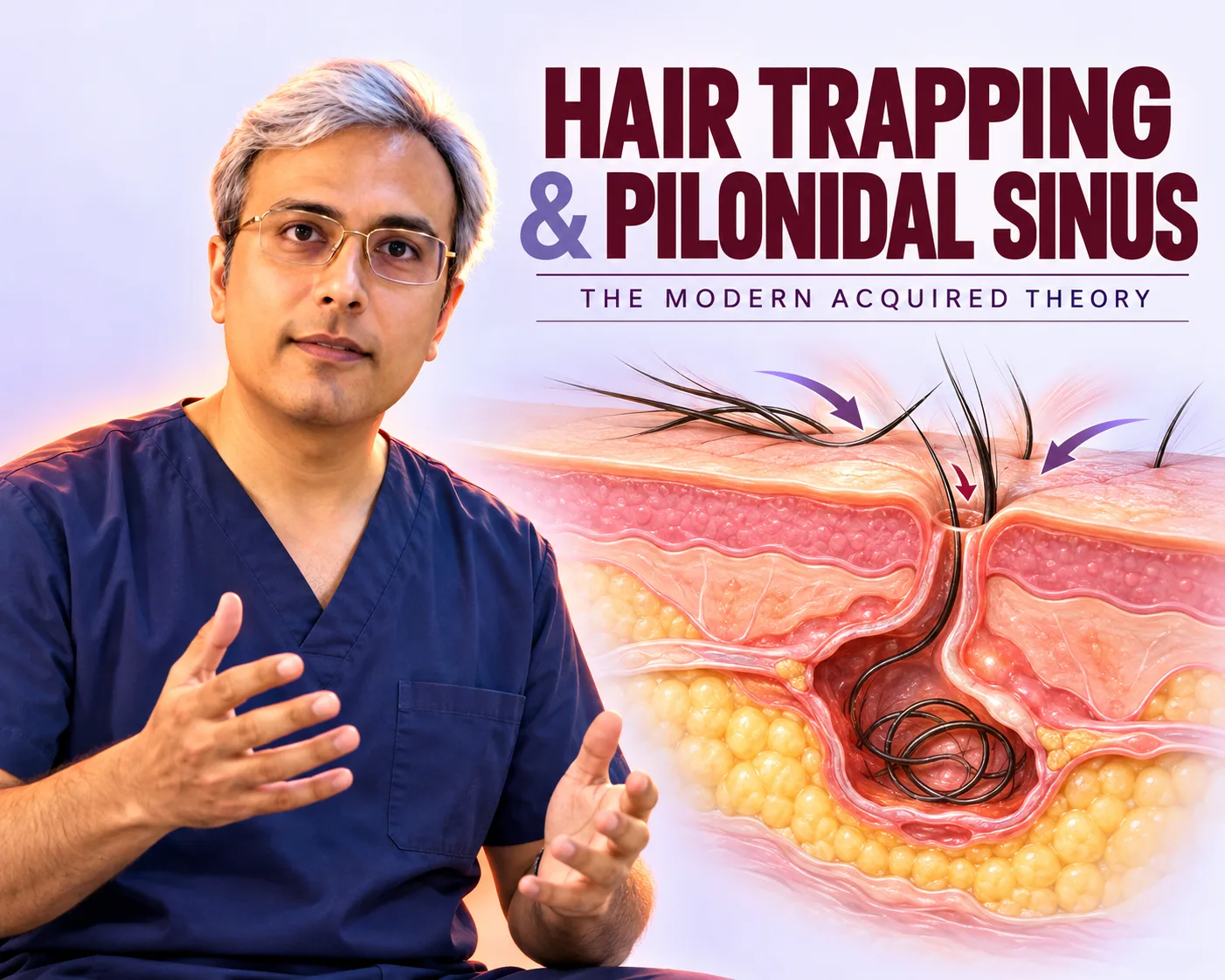
In short
- Three things must meet: loose hair, a driving force, and vulnerable cleft skin.
- Buttock motion pumps loose hairs into midline pits like a suction pump.
- Most culprit hairs are shed scalp and body hairs — not local ingrown hairs.
Who this page is for
Pilonidal sinus is a frequently observed disease in young adult males. Old books called it congenital. Modern surgery calls it acquired.
This page is for anyone asking “why me?” — students, drivers, desk workers, and athletes with cleft discharge. It explains the hair-trapping theory step by step. Start with what pilonidal sinus disease is for the anatomy first.
The three parts that must meet
Surgeon Karydakis named the trio behind the disease. All three must meet. Remove any one and the chain breaks.
- Loose hair — shed, short, coarse hair shafts lying on the skin.
- Driving force — motion, friction, and suction pushing hairs inward.
- Vulnerable skin — soft, moist, stretched pores in the deep cleft.
Each part alone is harmless. Shed hair falls off most bodies daily. Sitting moves every cleft. Moist skin covers every fold. Together in one deep cleft, they drill tunnels.
Hair shape matters. Short, stiff shafts pierce best. Fresh-cut hair ends are sharp like tiny spears. This is why barbers — with loose customer hair down their necks — develop similar tunnels between fingers. Their classic occupational cases back the theory.
Puberty starts the clock. Coarser hair, active sweat glands, and deeper folds arrive together. That is why disease is rare before the teens and peaks in young adults. Hormones do not cause tunnels directly — they build the trap.
Skin vulnerability grows with sweat and friction. A deep, tight cleft stretches its pores wide. Macerated skin grips hair instead of shedding it. Weight, heat, and long sitting all deepen the trap.
Full risk context sits in disease risk factors — who gets it and why.
The suction pump in the cleft
Walking moves the buttocks. Each step opens the cleft slightly, then presses it shut. This cycle pumps air — and loose hairs — inward. Doctors call it the vacuum suction effect.
Sitting adds friction. Standing, bending, and cycling repeat the pump thousands of times daily. Hairs lined up root-first slide deeper with each cycle. Barbed hair scales stop them sliding back out.
Once inside, the body reacts. It cannot dissolve keratin. White cells wall the hair off instead. Pus gathers. A tunnel lines itself with granulation tissue.
The tunnel seeks an exit. It bursts through weaker side skin. That side opening drains, rests, then blocks again. Each flare digs the tunnel deeper and grows side branches.
Pain follows the pressure cycle. Pus builds, throbs, then bursts and eases. The relief feels like healing. It is not — the tunnel lining stays and the next cycle starts with new trapped hair.
Lighten the trapping load
- Stand and walk briefly every hour — long unbroken sitting deepens the pump
- Keep the cleft clean and dry; change out of sweaty wear promptly
- Trim nearby hair short — never shave raw or inflamed skin
Whose hair builds the sinus
Surprise finding: the trapped hairs are rarely local. Studies of extracted nests show shed scalp and back hairs. They travel down, gather in the cleft, and drill in root-first.
Local cleft follicles play a smaller role. Their hairs are fine and sparse. The heavy load comes from above — head, back, and neck shedding. Long hair sheds more shafts per day.
This fact reshapes prevention. Shaving the cleft alone misses the source. Control must cover the supply zone:
- Daily rinse — shower the back and cleft so shed hairs wash away.
- Trim, do not razor-burn — short surrounds trap fewer shafts than stubbly regrowth.
- Laser after healing — clinic-based laser hair removal after healing cuts regrowth at the root.
Surgery follows the same logic. Removing the tunnel is half the job. Flattening the cleft is the other half. Off-midline flaps lift the scar out of the moist depth and shallow the fold. A shallower cleft pumps less and traps less.
That is why the Karydakis triad still guides modern plans. Kill the loose hair, kill the driving force, toughen the skin zone. Miss one leg and disease returns.
Key figures from published series
- Pilonidal sinus is a frequently observed disease in young adult male patients — the group where coarse hair, sweat, and long sitting overlap most.
- Nest analyses in surgical literature find shed scalp and body hairs as the usual invaders, not local follicle inversion.
- The ESCP 2024 guideline carries cause-and-prevention statements built on this acquired hair-insertion model.
What Dr. Vishal Purohit does in Jaipur
Dr. Vishal Purohit treats pilonidal sinus disease in Jaipur. Consultations trace each patient’s chain — hair load, sitting hours, cleft depth, and pit map — before any surgery is planned.
Treatment at the clinic is definitive Limberg and Karydakis off-midline flap surgery, which both clears the tunnels and flattens the cleft that caused them. Abscess drainage covers acute infection. Phenol, laser, endoscopic, and pit-picking methods are not offered.
After sealing, patients get a hair-control plan — trimming plus skin-clinic laser once the surgeon confirms closure. For the full starting picture, see the causes and symptoms guide. This is educational information, not medical advice.