
Dermal fillers provide temporary volume and structure, but their visible cosmetic enhancement does not disappear overnight. Over time, injected gels break down progressively as the body metabolises the material through enzymatic action and local free radicals.
Understanding the science of facial mobility and gel properties helps patients set realistic expectations. For a comprehensive overview of product categories, explore the Types of Dermal Fillers: HA, Stimulators and Permanent Fillers to see how structural differences influence persistence within dynamic tissues.
Visible Aesthetic Duration Versus Tissue Persistence
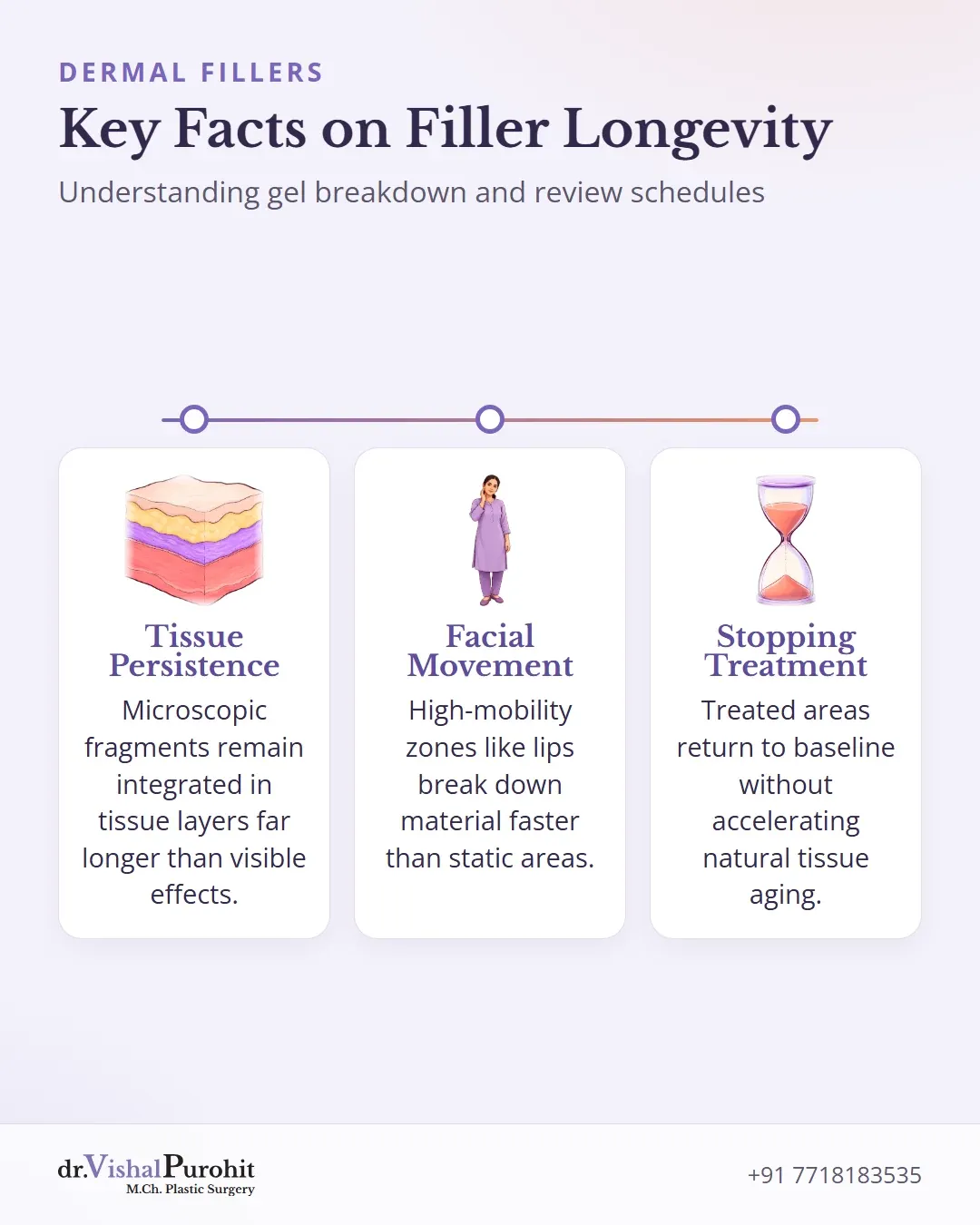
A clear clinical distinction exists between how long visible cosmetic enhancement lasts and how long filler material persists within facial tissue. Although visible aesthetic effects often diminish over months1, microscopic filler material or residual gel fragments may remain integrated within facial layers for far longer12.
Metabolic degradation of dermal fillers happens progressively rather than vanishing abruptly134. The clinical duration of an injectable and its smoothing effect depend on several factors, including the injected amount, tissue depth, the material used, and the anatomical area treated13. For example, material placed beneath actively moving facial folds tends to be absorbed faster than static deposits1.
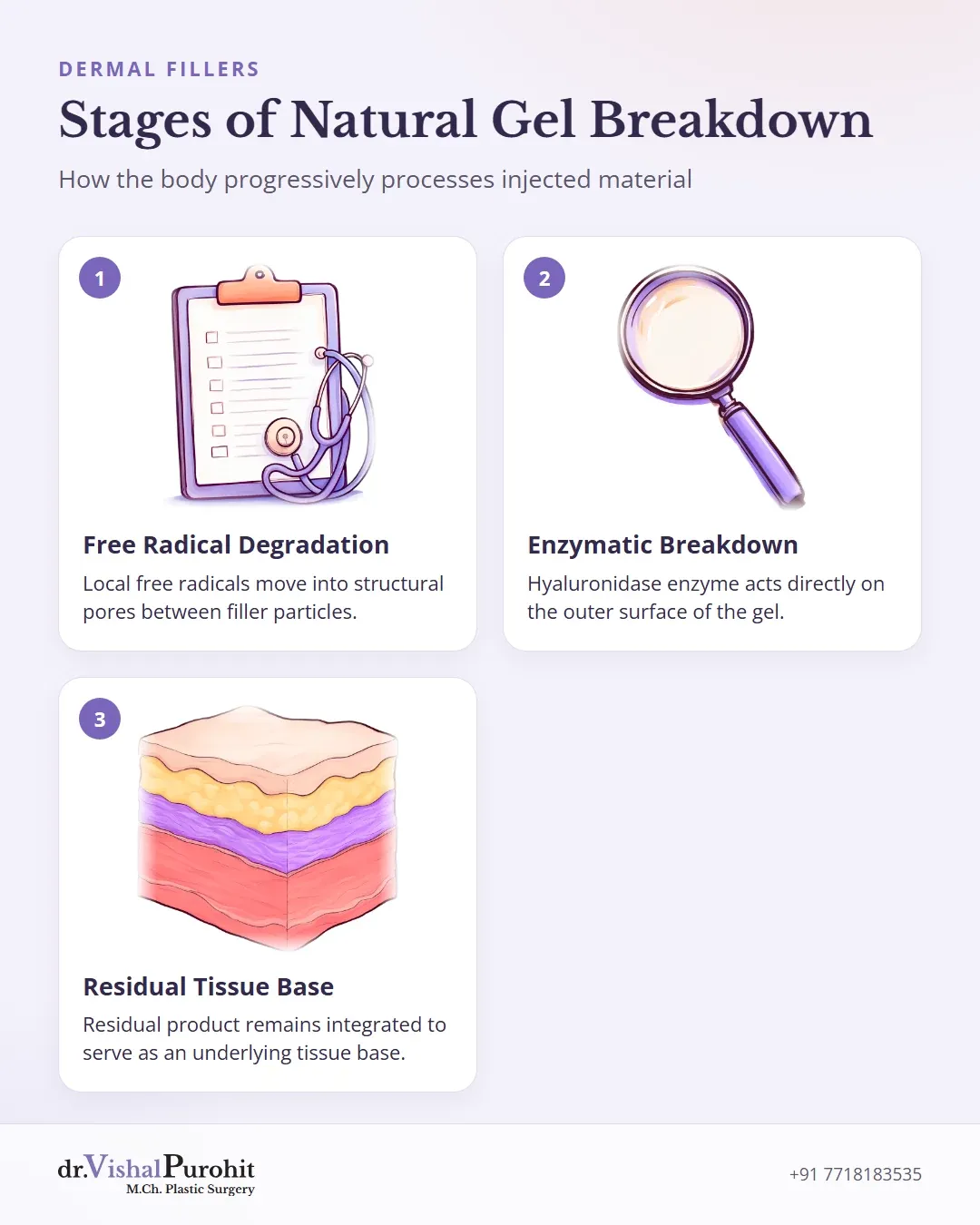
Natural breakdown involves multiple stages:
Initial Stage
- Local free radicals move into structural pores between filler particles5
Secondary Stage
- Enzymatic breakdown occurs through hyaluronidase acting on the outer surface of the gel5
Even after apparent visual correction softens, residual product may serve as an underlying base in the tissue24. Because dermal fillers are gradually absorbed over time, repeat procedures are often assessed to maintain desired results36.
Material Characteristics, Mobility and Metabolic Rates
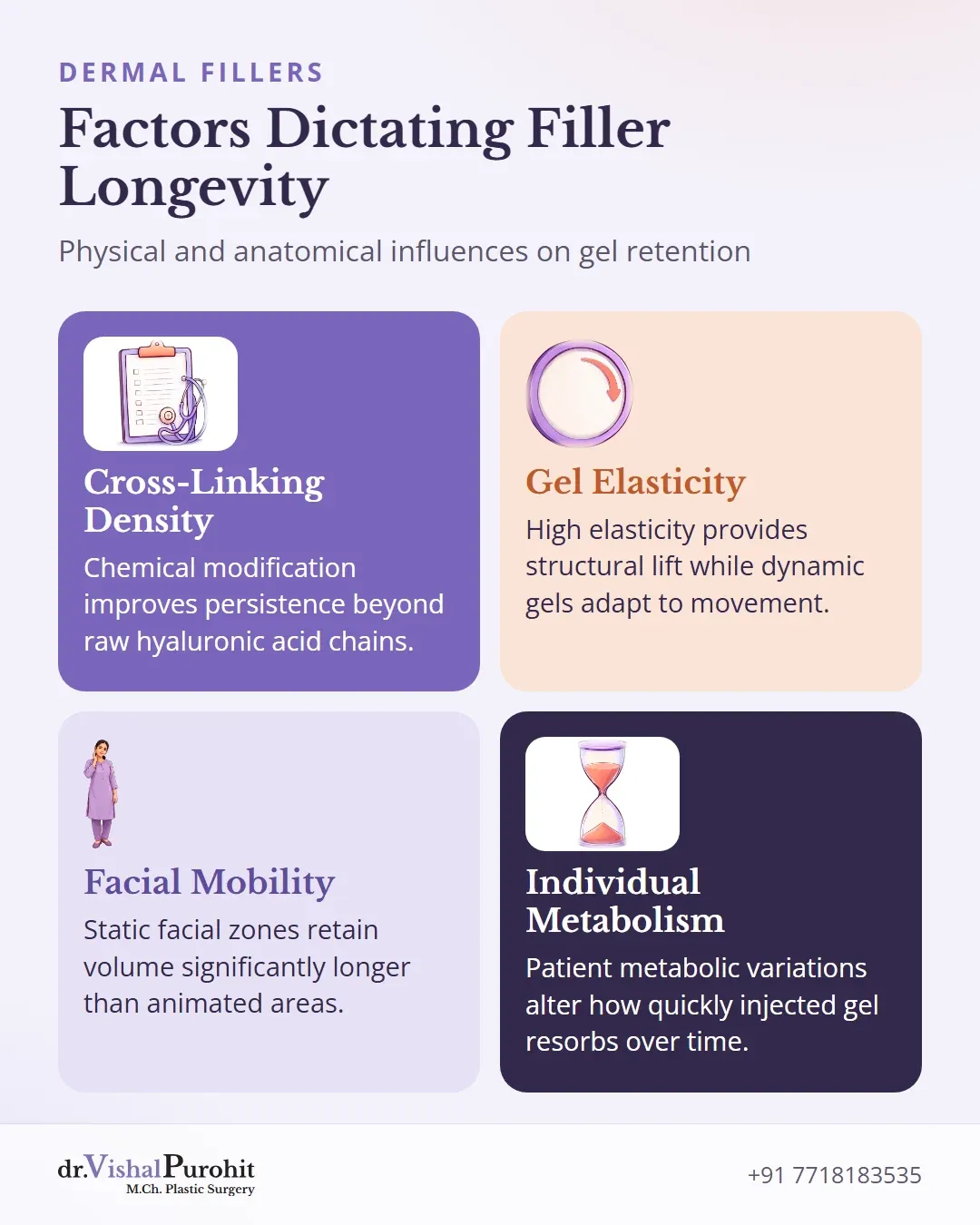
The duration of an injectable gel depends on several physical properties, the mechanical activity of the treatment site, and biological factors.
Key points
- Filler longevity depends on gel formulation, facial movement, and individual metabolism.
- Cross-linked, high-elasticity gels resist breakdown longer than softer unbound hyaluronic acid.
- Areas with constant muscular motion resorb filler faster than static zones.
Gel Characteristics
A filler gel formulation is characterized by cross-linking density and elasticity78. Unbound hyaluronic acid forms liquid polymer chains that break down within 24 to 48 hours8. Cross-linking modifies these chains to improve persistence8. High-elasticity gels provide structural support and lift capacity7, whereas softer, dynamic gels adapt to tissue movement7.
Facial Mobility
Mechanical motion strongly affects how long dermal fillers persist:
- High-mobility zones: Areas subject to continuous muscular activity and animation, such as the lips, break down materials faster89.
- Low-mobility zones: Static areas with less animation, such as the zygoma or chin, retain filler volume for a longer duration789.
Metabolic Factors
Individual variations also dictate duration9. Filler longevity is not uniform because a patient’s metabolism alters how quickly the material is processed and resorbed over time9. How long results last in specific individuals is assessed during consultation.
Professional Review Versus Rigid Top-Up Schedules

Aesthetic treatment relies on ongoing clinical re-evaluation rather than arbitrary, calendar-based repeat appointments. Scheduling automatic top-ups risks product accumulation and unnatural facial distortion over time.
In clinical literature, indiscriminate volumization without reassessing underlying anatomy can contribute to overfilled syndrome10. Repeatedly placing filler on a fixed timetable without assessing remaining product can distort facial contours and compromise natural tissue dynamics10. Instead, modern aesthetic approaches emphasize structural support guided by individual anatomy, tissue quality, and prior procedures rather than standardized dosing intervals10. Overcorrection or misplaced product from prior sessions may require clinical evaluation and corrective management rather than additional volume11.
Dr. Purohit’s note: Dr. Vishal Purohit approaches filler maintenance through individualized clinical assessment. His review visit timing and touch-up policy are not fixed schedules; each step is decided at the consultation based on anatomical needs and how prior treatment settles.
Patients are evaluated during follow-up to check facial balance before any further intervention is considered.
What Happens When You Discontinue Fillers
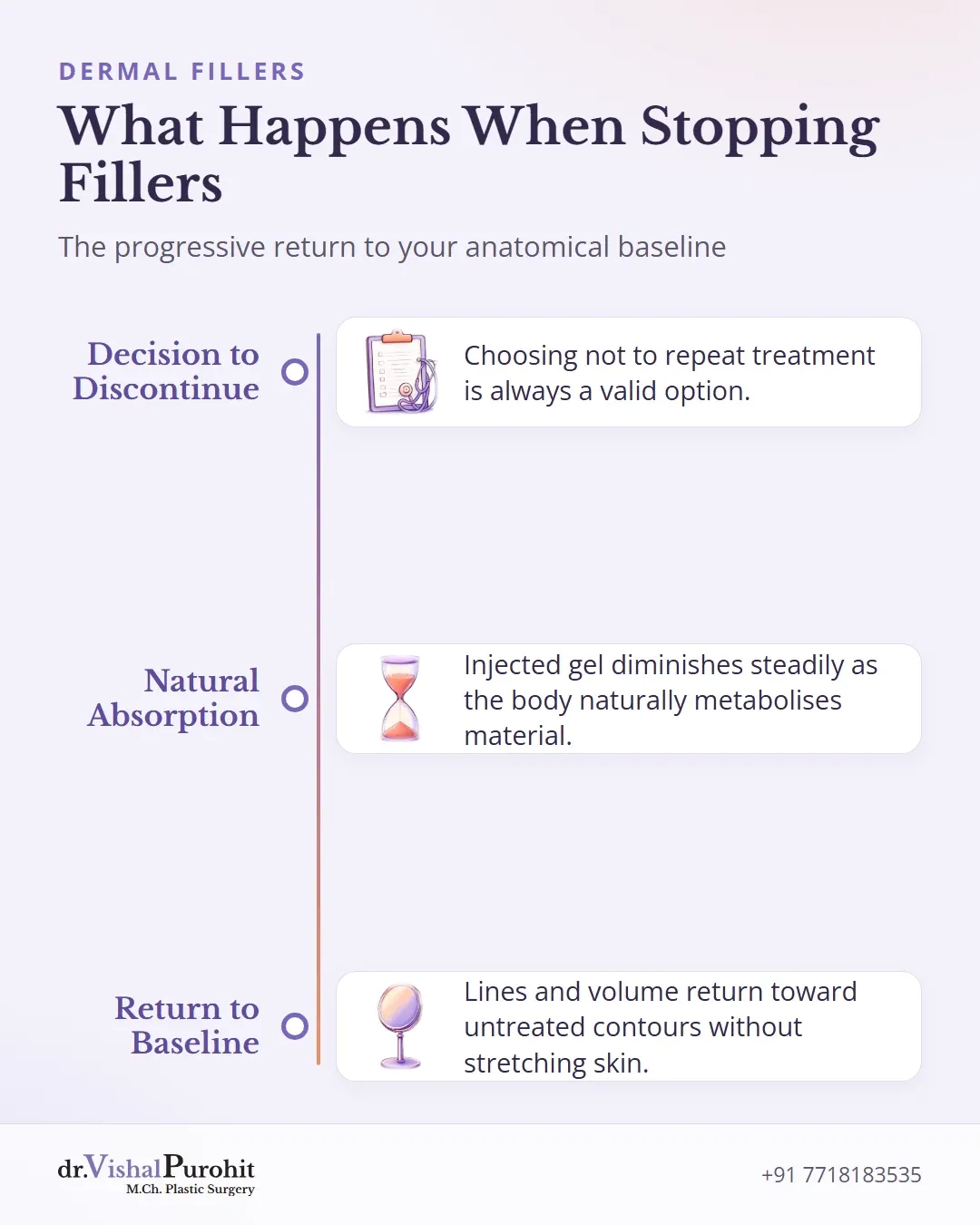
Choosing to stop receiving dermal filler injections at any point is a completely valid clinical decision. A common worry is that discontinuing treatments causes facial skin to stretch, collapse, or sag rapidly.
Dermal filler products gradually break down and are naturally absorbed by the body over time3. As this absorption occurs, the treated areas simply return progressively toward their pre-treatment appearance and anatomical baseline31213. The process does not accelerate the underlying biological aging of facial tissues.
When a patient decides not to schedule further appointments, the effects gradually soften:
- The injected gel diminishes steadily as the body metabolises the material312.
- Visible volume decreases and lines return to their original, untreated contours1213.
- Normal tissue changes continue only at an individual’s natural, chronological pace.
Dr. Vishal Purohit views choosing no treatment or ending ongoing maintenance as an entirely safe option.
Radiologic Visibility on MRI and Dental Scans
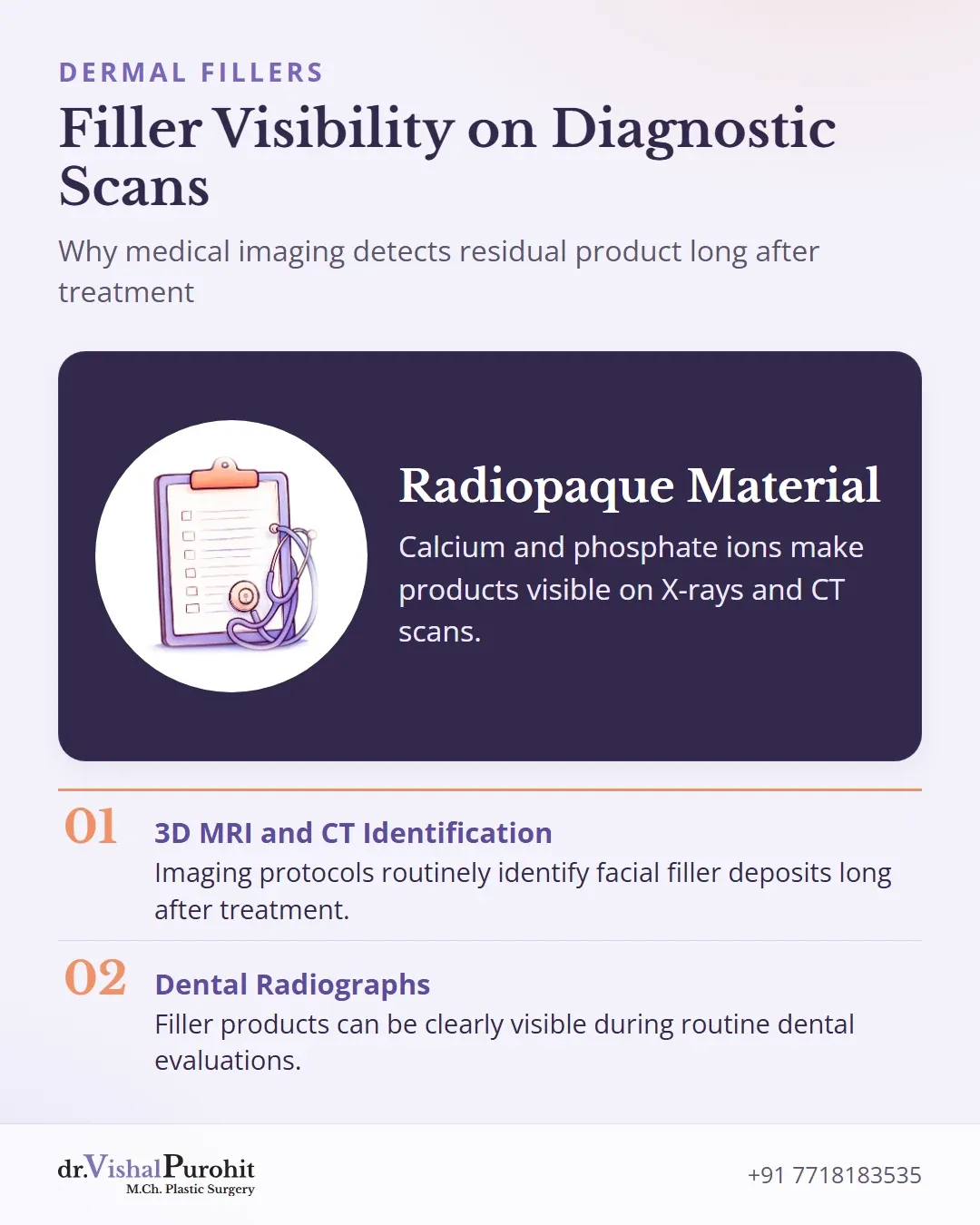
Dermal fillers may remain visible on diagnostic scans long after treatment. Three-dimensional MRI and CT imaging protocols can identify facial filler deposits during evaluation14. Injected materials such as calcium hydroxylapatite contain calcium and phosphate ions structurally identical to the inorganic matrix of human bone7. As a result, these deposits are radiopaque and show up on diagnostic X-rays and computed tomography (CT) scans, where they may obscure underlying structures7. In dental practice, products such as Radiesse can be clearly visible on routine dental radiographs15.
Clinical Filler Evaluation in Jaipur
Planning facial treatments requires a careful balance between tissue anatomy, facial mobility, and prior aesthetic interventions. Rather than following rigid touch-up schedules, personalized care ensures facial balance is respected at every stage. To understand treatment options or evaluate previous work, explore Dermal Fillers in Jaipur or read through common clinical questions in the Dermal Fillers FAQs.
This is educational information, not medical advice.