
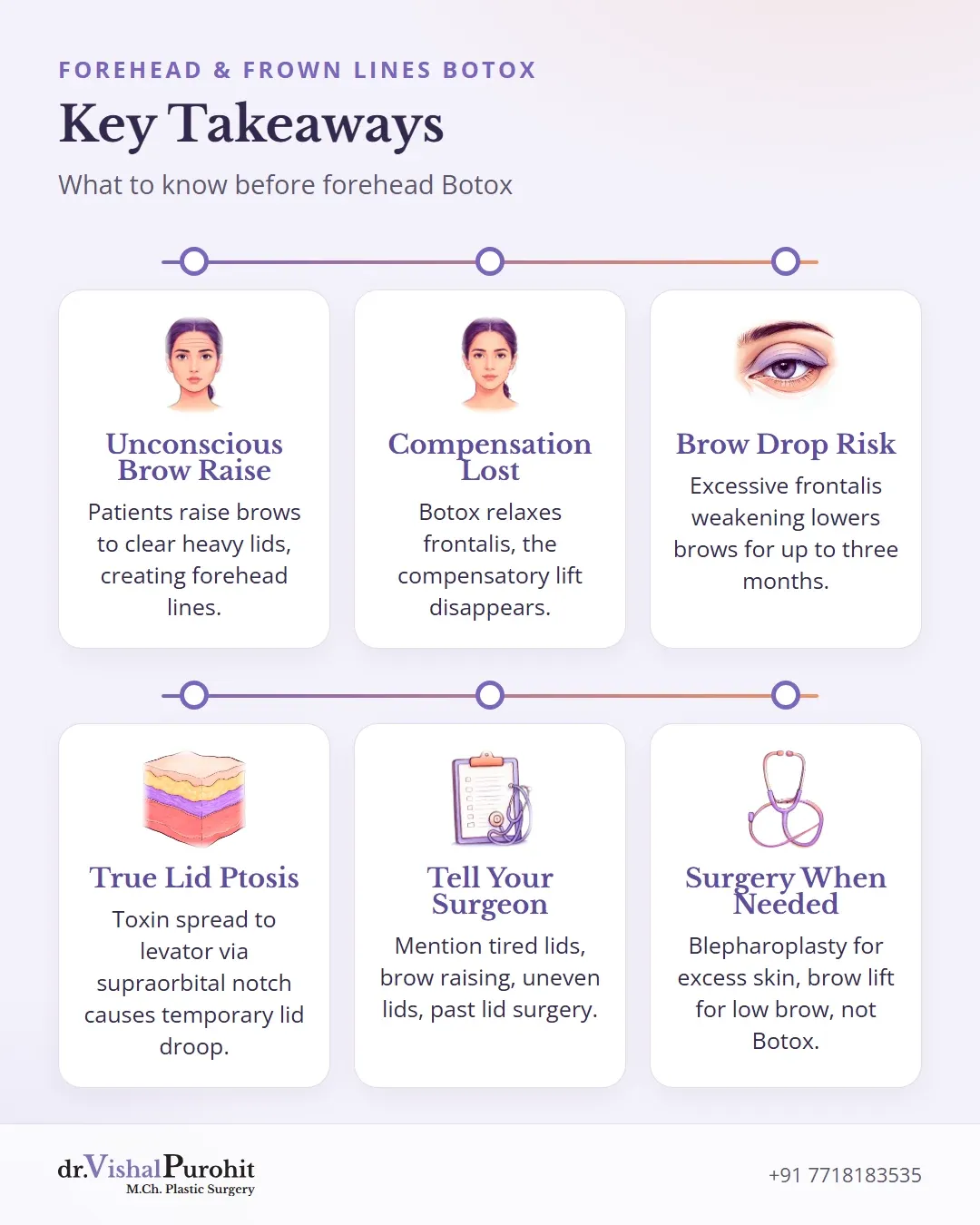
Many people hold their eyebrows up throughout the day without noticing the continuous muscular effort. This habit often develops to lift heavy upper eyelid skin or clear the upper visual field, creating deep horizontal lines across the forehead.
When botulinum toxin relaxes these forehead muscles, that compensatory lift disappears. Understanding forehead lines and 11 lines: why they are assessed together helps clarify how treating horizontal creases can reveal an underlying lid droop or cause the brows to rest lower.
When the Forehead Is Holding Up the Brows
The Habit Patients Do Not Notice
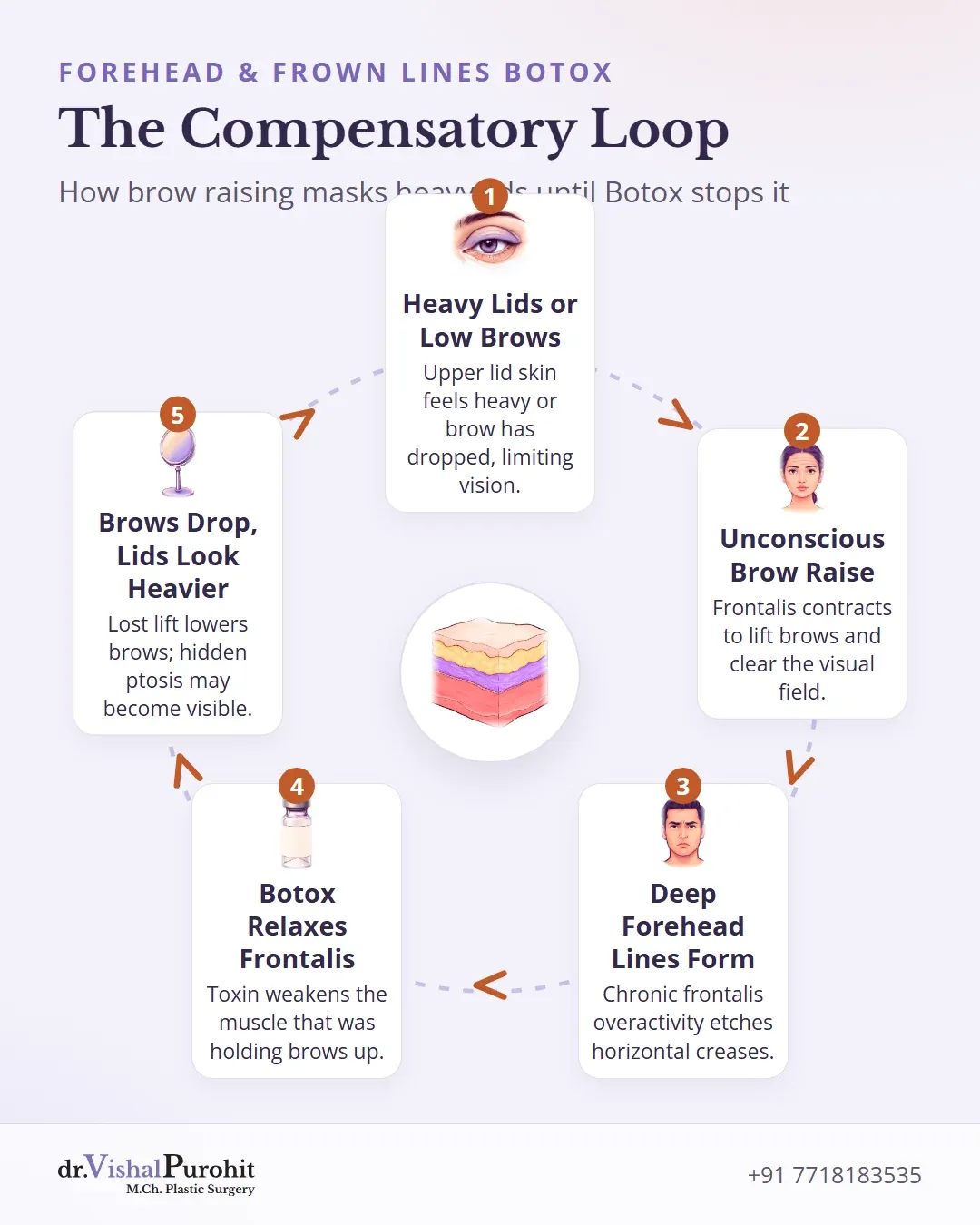
Some people raise their brows without realising it, and it may become a habitual gesture1. They may be trying to clear the upper field of vision when the brow has dropped or the upper lid skin feels heavy12.
Key points
- Forehead muscles often work unconsciously to lift heavy eyelids or drooping brows.
- Static forehead lines can be a compensatory sign masking underlying eyelid ptosis.
- Treating these lines with Botox alone can worsen brow drop and eyelid heaviness.
In older patients with brow ptosis or excess upper-eyelid skin, this can be an unconscious gesture to improve the visual field and look younger1.
Women with excess lid skin may also know they have to raise the brows to apply eye makeup1. Static lateral forehead lines above the outer brow may be a sign of this activity, which can mask a mild or compensated eyelid ptosis3.
Why It Matters Before Botox
The forehead wrinkles most likely result from this compensatory frontalis effort4. When a significantly low brow is the main concern, unrecognised compensatory activity can make brow position worse if the wrinkles are treated with Botox alone4. Assessment therefore includes brow position at rest and on animation2.
In patients with pre-existing brow descent or limited brow-elevation reserve, excessive weakening may cause brow ptosis, eyelid heaviness or an unnatural expression5. The aim is an individual balance between reducing lines and preserving brow function, not maximal muscle suppression5.
What Can Happen When That Effort Is Relaxed
When the brows sit lower
Brow ptosis generally follows excessive weakening of the frontalis, which removes the muscle’s brow-elevating support6. It may occur with aggressive treatment or excessive weakening of the lateral fibres6. Diffusion from treatment of the brow depressors may also contribute to medial brow descent6. The drop may persist for up to three months7. Some patients do not recognize the lower brow and instead report an angrier or more depressed look7.
When an eyelid droop becomes visible
When the brow settles lower, the upper lids can look heavier, and a droop that was already there can become visible8. Some patients already have eyelid ptosis that the frontalis has been compensating for, and they often have marked horizontal forehead lines8. Once those lines are relaxed, the eyebrow sits lower and eyelid ptosis may be unmasked in mild cases or worsened in severe cases8. This is not direct spread of toxin to the levator muscle; it exposes ptosis that was not evident before8. Pre-existing eyelid or eyebrow ptosis carries a risk of worsening or unmasking a compensated eyelid ptosis during glabellar treatment3. Most such events are transient and resolve spontaneously, though some last several weeks or need treatment3.
Brow Droop and Eyelid Droop Are Different
Two muscles, two problems

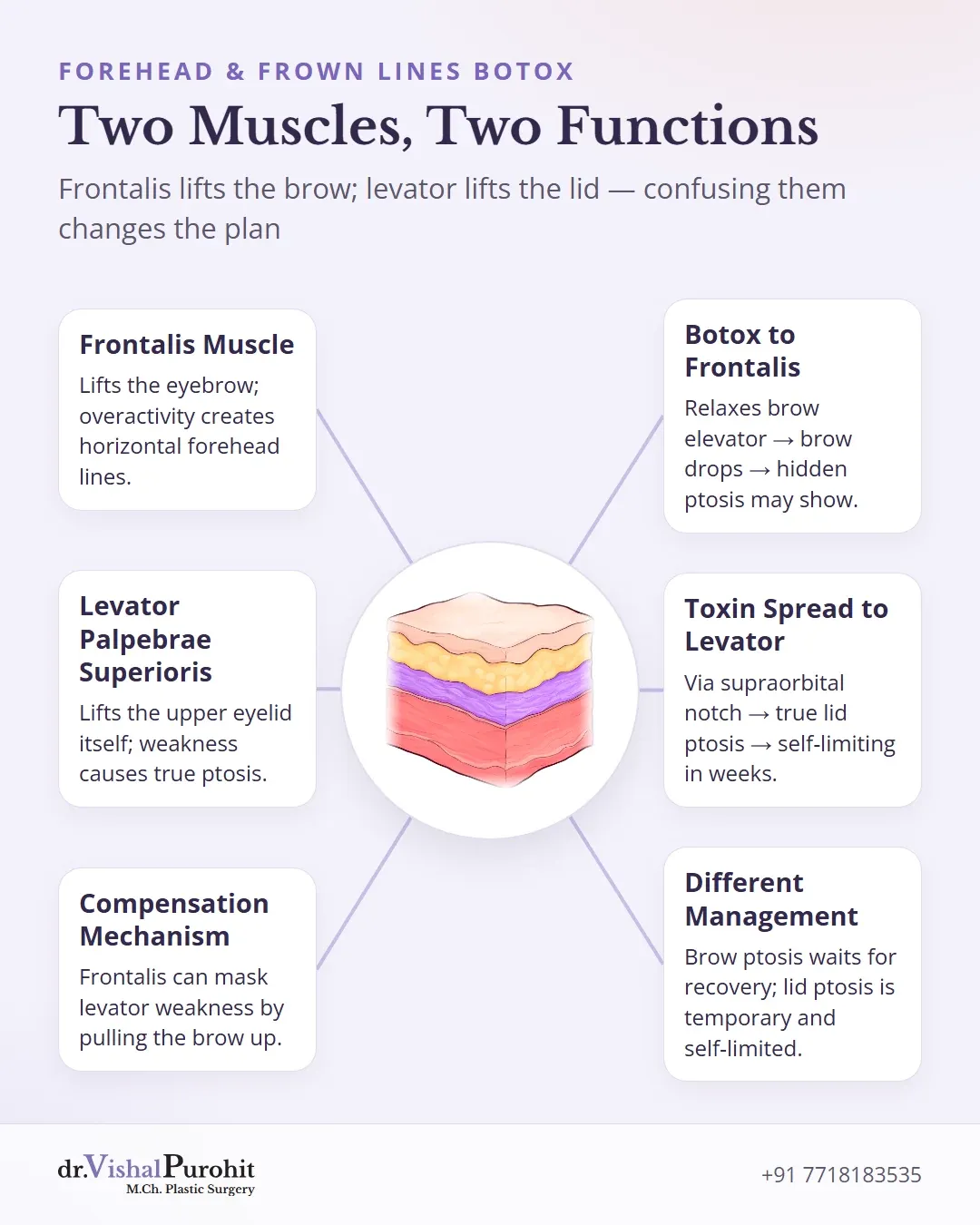
The frontalis lifts the eyebrow; the levator palpebrae superioris lifts the eyelid itself9. Relaxing the frontalis for horizontal forehead lines can therefore lower the brow. Where the forehead muscle has been helping to lift a weak eyelid, the same treatment can reveal a ptosis that was not obvious before, without the toxin acting on the levator38. Weakening the lower part of the frontalis, just above the brow, is what most often drops the brow or reveals a hidden eyelid droop3.
Key points
- The frontalis lifts the eyebrow, while the levator palpebrae superioris raises the eyelid.
- Forehead injections can lower the brow or unmask a preexisting, compensated eyelid droop.
- Eyelid ptosis from toxin spread is temporary, whereas eyebrow ptosis cannot be medically treated.
Cause and course
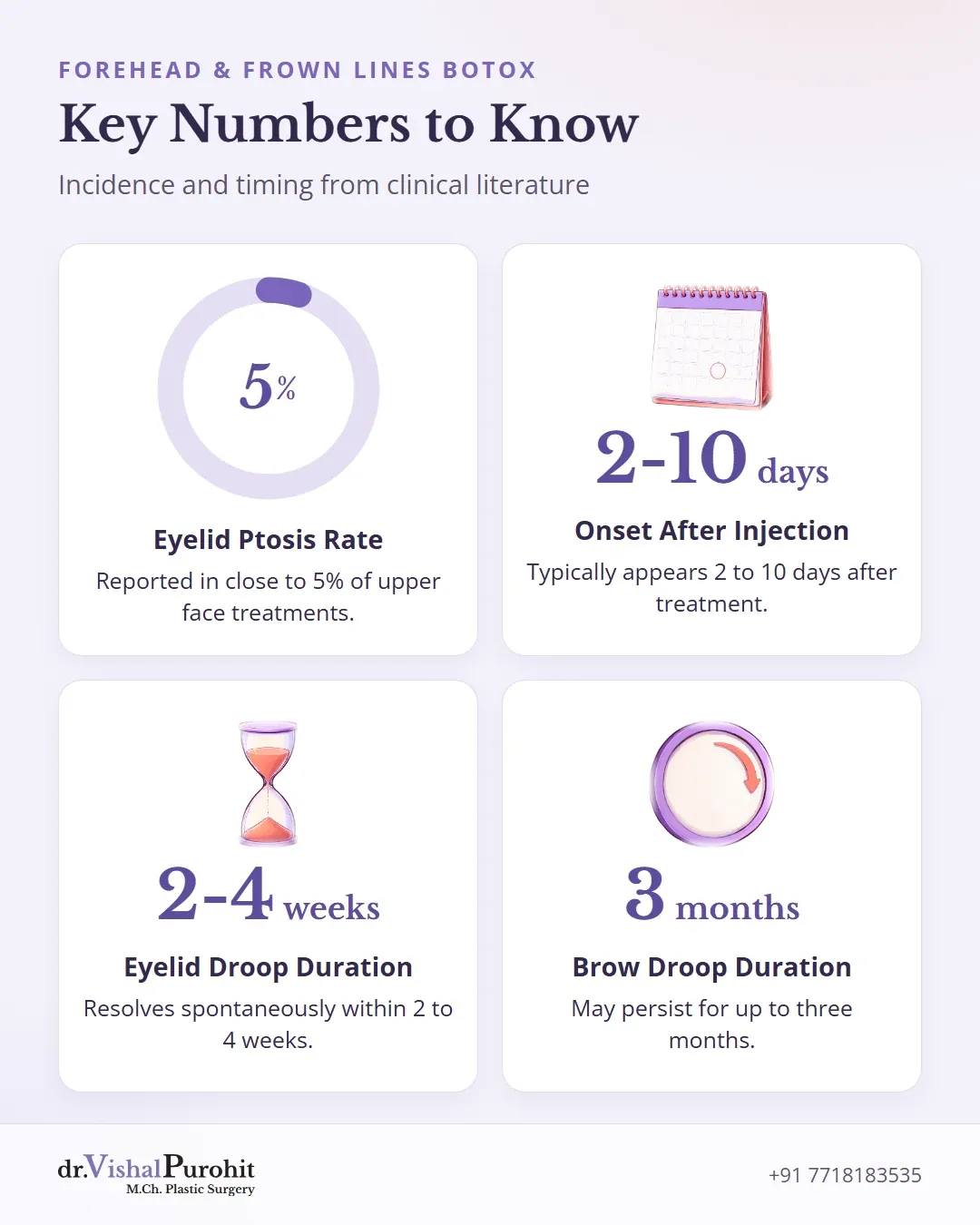
Eyelid ptosis after botulinum toxin treatment of the upper face is described as toxin spreading to the levator palpebrae superioris through the supraorbital notch6. It is reported in close to 5% of people treated in the upper face, appears 2 to 10 days after injection and can persist for 2 to 4 weeks; it is self-limiting6. Another text reports an incidence as high as 5%, usually within two weeks, and presumes migration of toxin under the orbital septum10.
These are different problems with different handling. Eyelid ptosis from toxin is temporary and self-limiting6. Eyebrow ptosis, by contrast, cannot be medically treated8. Careful examination before treatment is therefore emphasised, so that a compensated eyelid ptosis is recognised beforehand8.
Signs Worth Mentioning at the Consultation
What a Patient May Notice

- Eyelids that look tired by evening.
- Raising the brows to see more clearly.
- One upper lid resting lower than the other.
- Any earlier eyelid surgery.
Why These Details Matter
These observations are worth raising before treatment. Pre-existing eyelid or brow ptosis can be worsened or unmasked by glabellar treatment3. Patients with eyelid ptosis often have significant horizontal forehead lines because the frontalis lifts the brow to compensate8. Symmetry and any underlying eyelid or brow ptosis should be assessed before treatment3, and brow or upper eyelid asymmetry should be recorded and discussed11. A history of previous procedures, including earlier eyelid surgery, should be known at initial assessment12.
No Home Tests
There is no need to test or measure the lids at home. A patient should mention these points at the consultation so the lids and brow can be examined and the plan decided there.
When Another Option Fits Better
When the eyelid or brow is the main issue
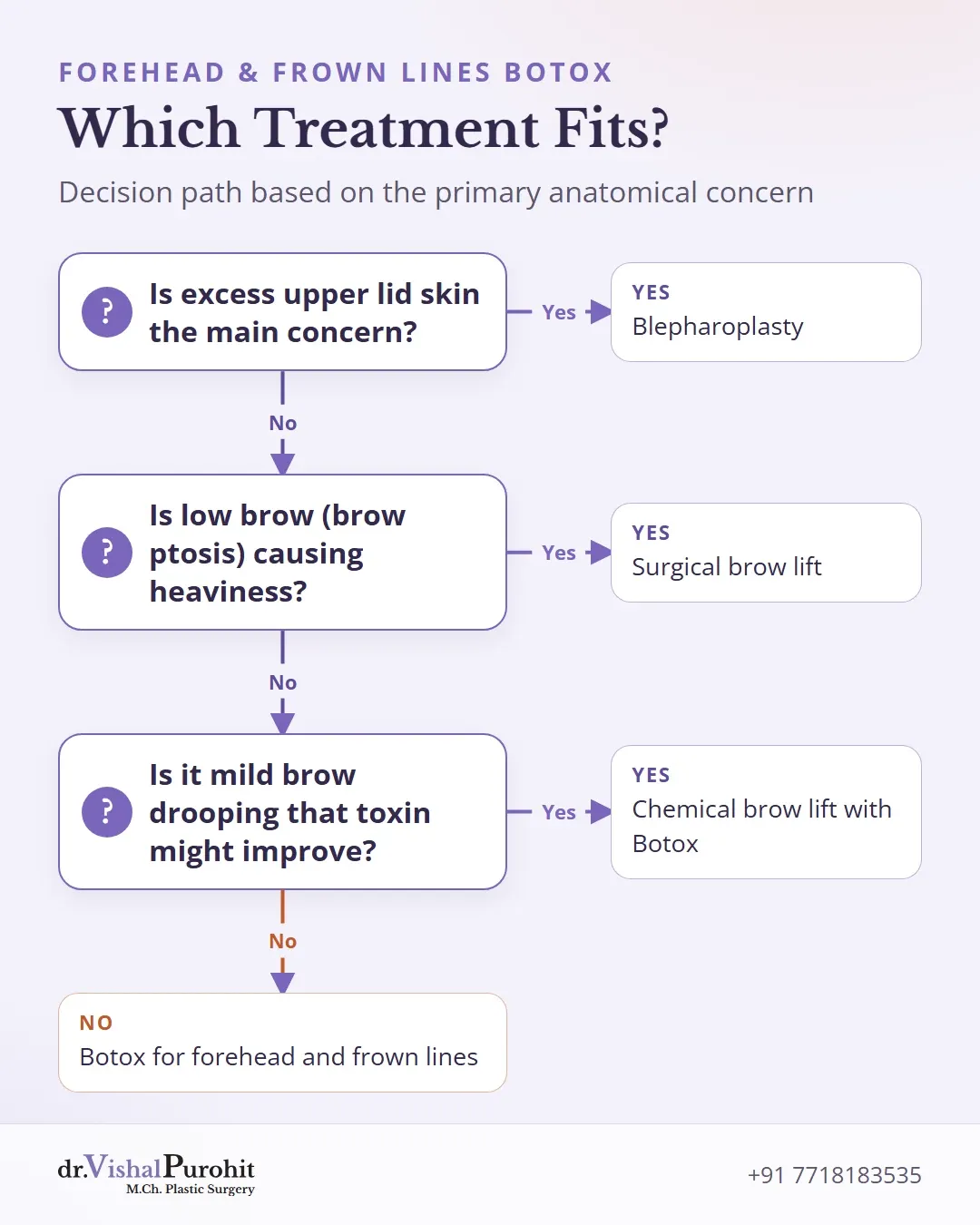
When extra upper eyelid skin is the main concern, blepharoplasty may be a better fit; when a low brow (brow ptosis) is causing the heaviness, a brow lift, direct or coronal, should be discussed13. Brow lifts are often performed with upper eyelid surgery for a more complete result14. The surgical choice depends on the severity of drooping, the person’s anatomy and their goals14.
A separate Botox goal
A chemical brow lift is a separate Botox goal: it uses botulinum toxin to change brow position1516. In some cases, mild brow drooping can be improved without surgery using botulinum toxin14. The result can vary; the brow may over-elevate or may not lift as intended15. Surgery directly excises excess eyelid skin or lifts the brow13. The blepharoplasty page, the eyebrow lift page and the Botox brow lift page explain these options.
The decision
Whether blepharoplasty, a surgical brow lift, a chemical brow lift or Botox for forehead and frown lines is appropriate is decided at the consultation.
Consultations for Brow and Forehead Concerns in Jaipur
Horizontal forehead lines frequently reflect an unconscious effort to keep heavy eyelids or descending brows out of the visual field. Relaxing these muscles without assessing underlying eyelid function can lead to brow descent or expose an unmasked ptosis. For individuals considering forehead and frown lines Botox in Jaipur, an in-person clinical assessment determines whether non-surgical injections or surgical procedures are appropriate. For answers to common procedural questions, review the forehead Botox FAQs.
This is educational information, not medical advice.