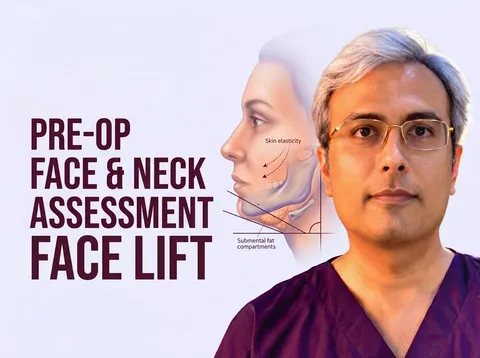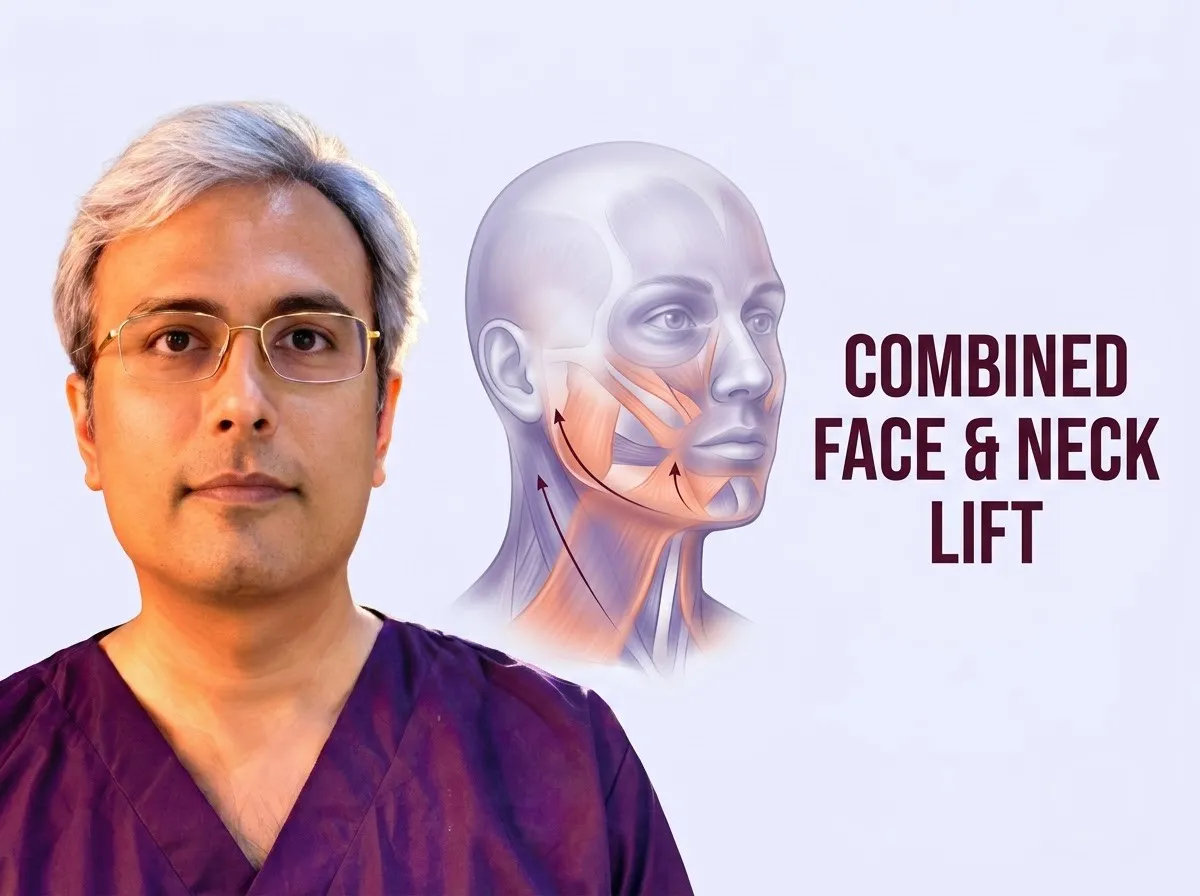
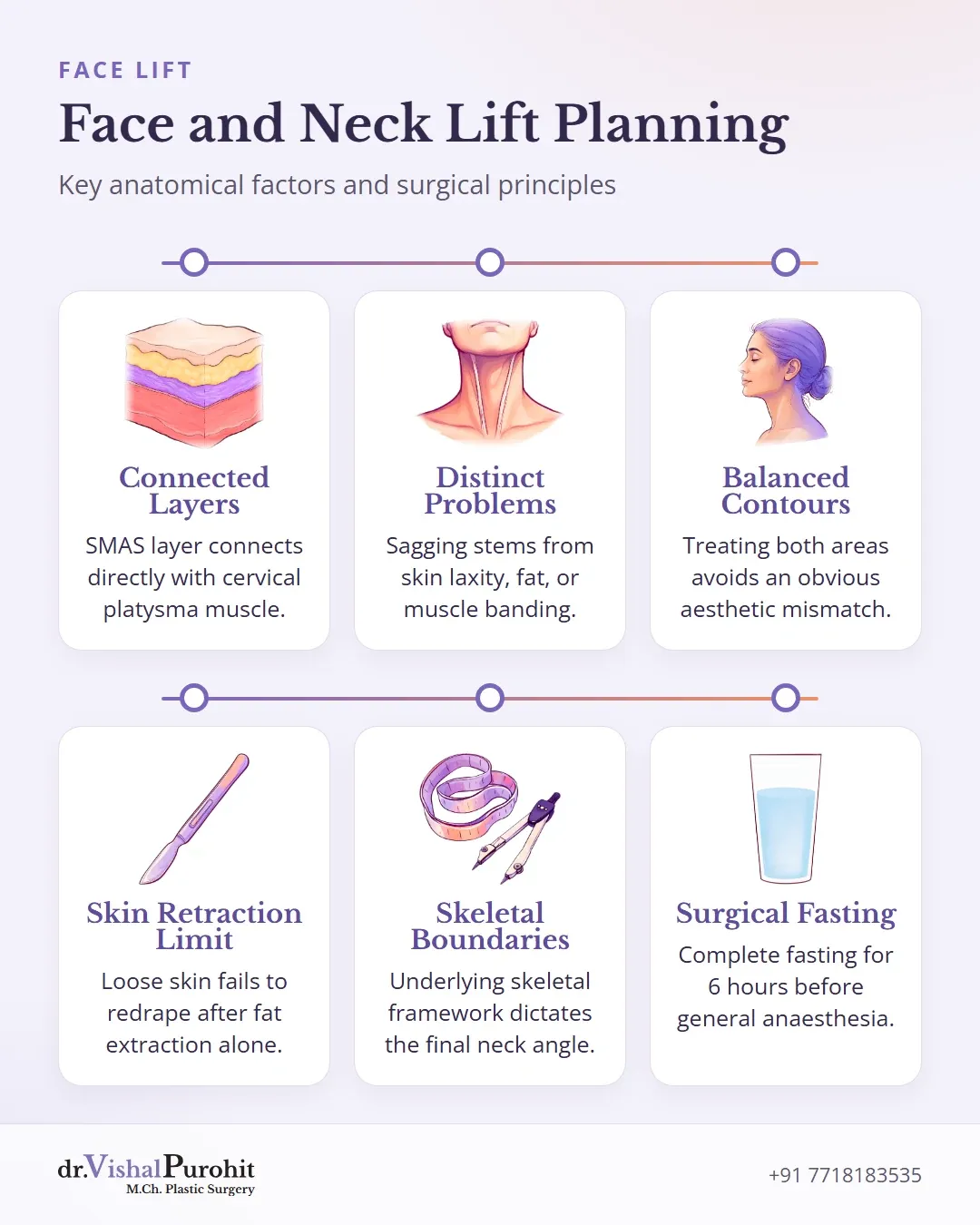
Lower facial ageing rarely stops at the jawline. Because the superficial muscular aponeurotic system directly connects with the platysma muscle in the cervical region, changes along the lower face and neck frequently develop together.
Evaluating both areas helps identify whether sagging stems from skin laxity, muscle banding, or deeper fat deposits. Understanding what is assessed before a face and neck lift guides appropriate surgical planning for balanced contouring.
Why the Jowls and Neck Are Assessed Together
The lower face and the upper neck share continuous anatomical layers. Jowl formation occurs when laxity develops along the superficial fascia, retinaculum cutis, and the superficial musculoaponeurotic system (SMAS)1. In the neck, this superficial layer connects directly with the platysma muscle12. Because these tissues function together, changes along the lower jawline typically occur alongside changes in the neck3.
Treating only one region can leave an obvious aesthetic mismatch45. For instance, performing an isolated neck lift in a patient who also has significant jowling can lead to an unnatural, unbalanced appearance and fails to restore jawline definition45. Similarly, attempting to lift the neck skin upward without addressing the lower face can displace cervicofacial folds over the jawline6. Combining a facelift with neck rejuvenation allows for a balanced correction and more comprehensive removal of excess neck skin47.
When a Combined Plan Is Discussed
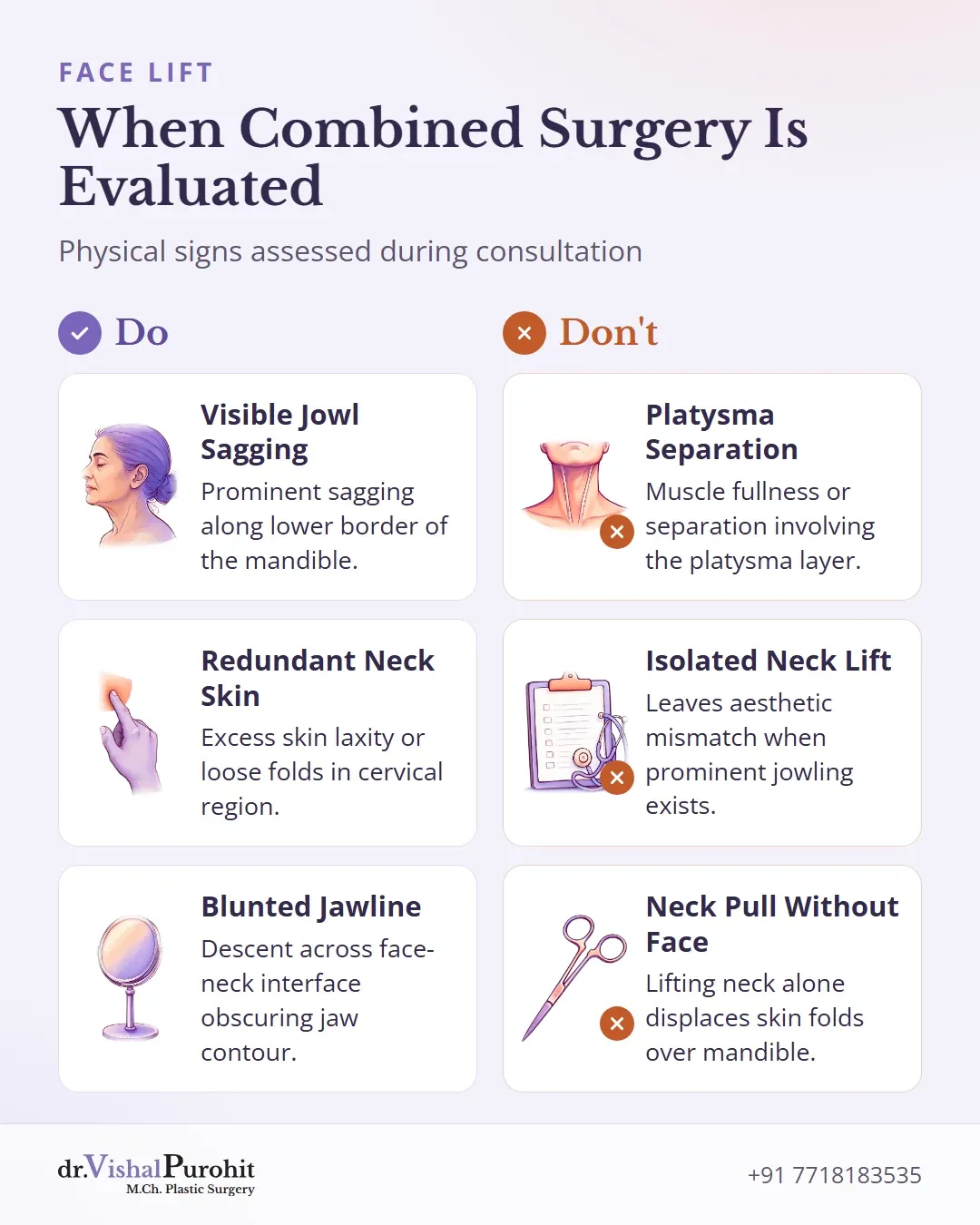
A combined surgical plan is evaluated during consultation when specific physical findings coexist:
- Visible jowl sagging along the lower border of the mandible12
- Redundant skin, excess laxity, or loose folds in the neck48
- Descent across the face-neck interface that blunts the jawline5
- Muscle separation or fullness involving the platysma8
Dr. Purohit’s note: In his practice in Jaipur, Dr. Vishal Purohit performs SMAS plication and suspension facelift surgery, incorporating cervicofacial platysmaplasty for the neck when indicated.
This approach addresses the underlying SMAS and platysma layers together, providing harmonious contours from the lower cheeks across the jawline and into the cervical region14.
Loose Skin, Fat and Muscle Bands Are Different Problems
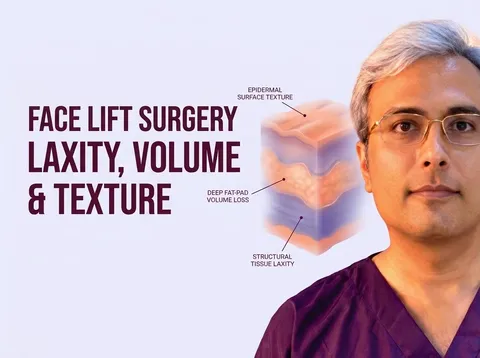
Ageing in the neck affects several anatomic layers. Accurate assessment identifies whether changes stem from the skin, adipose tissue, or the underlying platysma muscle9.
Distinct Anatomical Layers
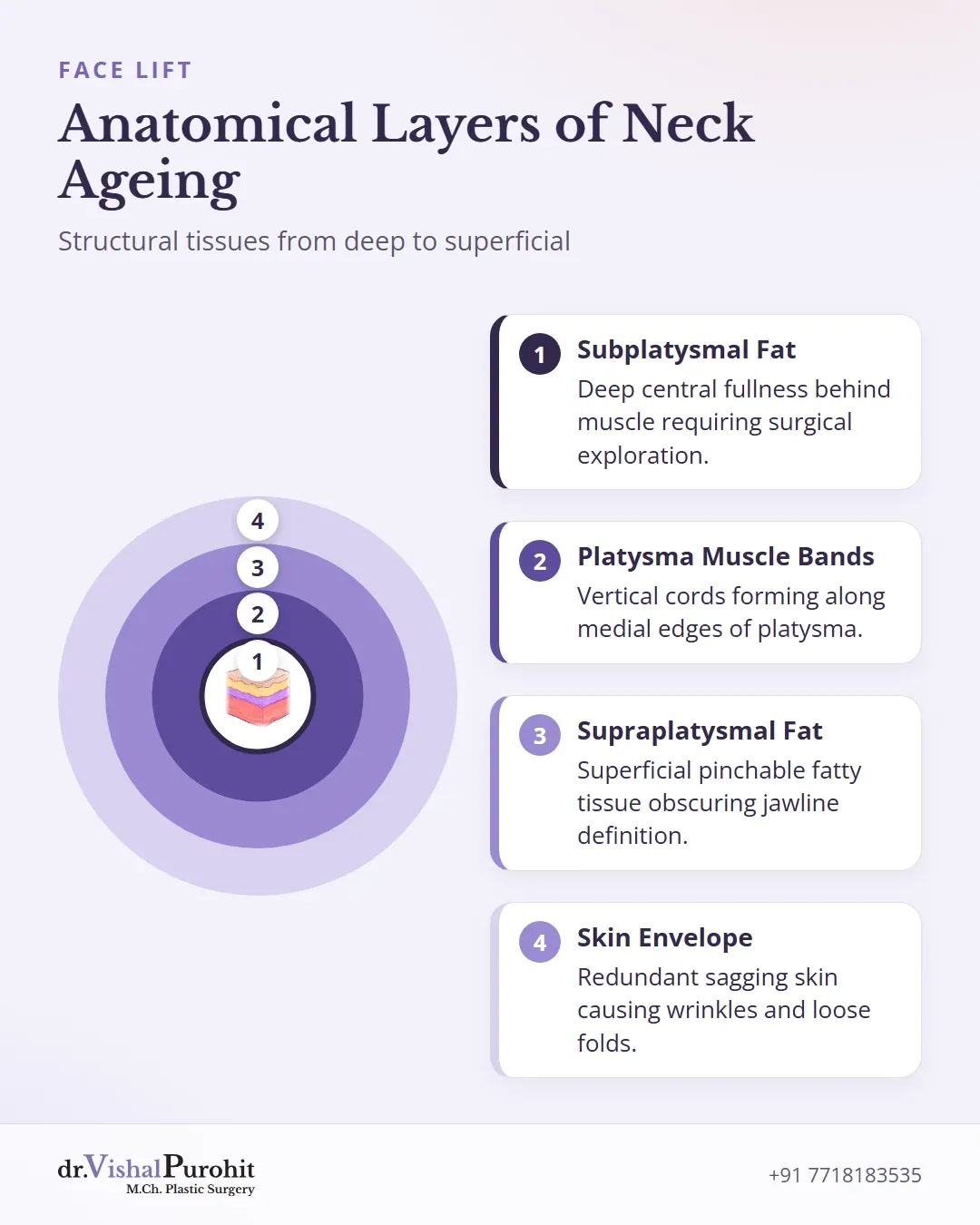
Neck changes typically involve three separate anatomical issues:
- Loose skin: Redundant, sagging skin contributes to wrinkles and loss of definition9. Patients with minimal to no laxity may be managed differently from those with moderate or marked excess who require skin redraping or excision1011.
- Fat above and below the platysma: Adipose tissue is divided by the platysma muscle into supraplatysmal (superficial) and subplatysmal (deep) compartments1012. Identifying subplatysmal fat purely through physical examination can be difficult, often requiring surgical exploration of the platysma layer1011.
- Vertical platysma bands: These vertical cords occur along the medial edges of the paired platysma muscles1213. Bands may be soft and adynamic, reflecting loose skin or horizontal muscle laxity, or hard and dynamic, caused by muscle hyperfunction during contraction1214.
Comparison of Neck Ageing Problems
| Problem | What it looks like | What may treat it |
|---|---|---|
| Loose skin | Sagging skin, horizontal wrinkles, and loss of jawline definition915 | Surgical skin undermining and redraping through facelift approaches91011 |
| Fat above the platysma | Superficial fullness or pinchable fatty tissue obscuring the jaw913 | Tumescent liposuction or direct surgical lipectomy101617 |
| Fat below the platysma | Deep central fullness that remains behind the muscle layer1013 | Opening the platysma with direct subplatysmal fat reduction101118 |
| Vertical platysma bands | Vertical cords in the front of the neck, visible at rest or on muscle contraction1213 | Medial platysmaplasty, muscle re-approximation, or transection161819 |
What a Combined Face and Neck Plan May Include
When surgical planning addresses both the face and neck, treatment targets structural support layers alongside contour adjustments. In Jaipur, Dr. Vishal Purohit plans treatment to address both areas when indicated.
Key points
- A combined face and neck plan addresses structural support layers and contour adjustments.
- Studies describe deep tissue tightening, neck access through a small incision under the chin, and fat removal as possible parts of a combined plan.
- Fat removal is typically performed after deep neck maneuvers to avoid contour irregularities.
Structural Support and Neck Contouring
A comprehensive surgical plan generally balances deep tissue tightening with careful fat management:
- Midface and jawline repositioning through deep-layer tightening and suspension.
- Direct neck access via a submental incision to address underlying tissues, including midline platysmal bands2021.
- Tumescent liposuction or targeted defatting to recontour excess fullness along the jawline and under the chin222324.
Literature on Platysmaplasty with Facelift
Open approaches using a submental incision allow direct exposure of anatomical structures such as the platysma, digastric muscles, and subplatysmal fat20. While closed approaches often feature shorter operative times, less scarring, and faster recoveries, debate continues regarding whether they achieve the same comprehensive correction as open techniques in patients with prominent platysma banding or significant skin laxity20.
Complications associated with open platysmaplasty in facelift and necklift cohorts are generally uncommon and mild, typically resolving spontaneously or with minimal treatment25.
Fat Removal and Recontouring
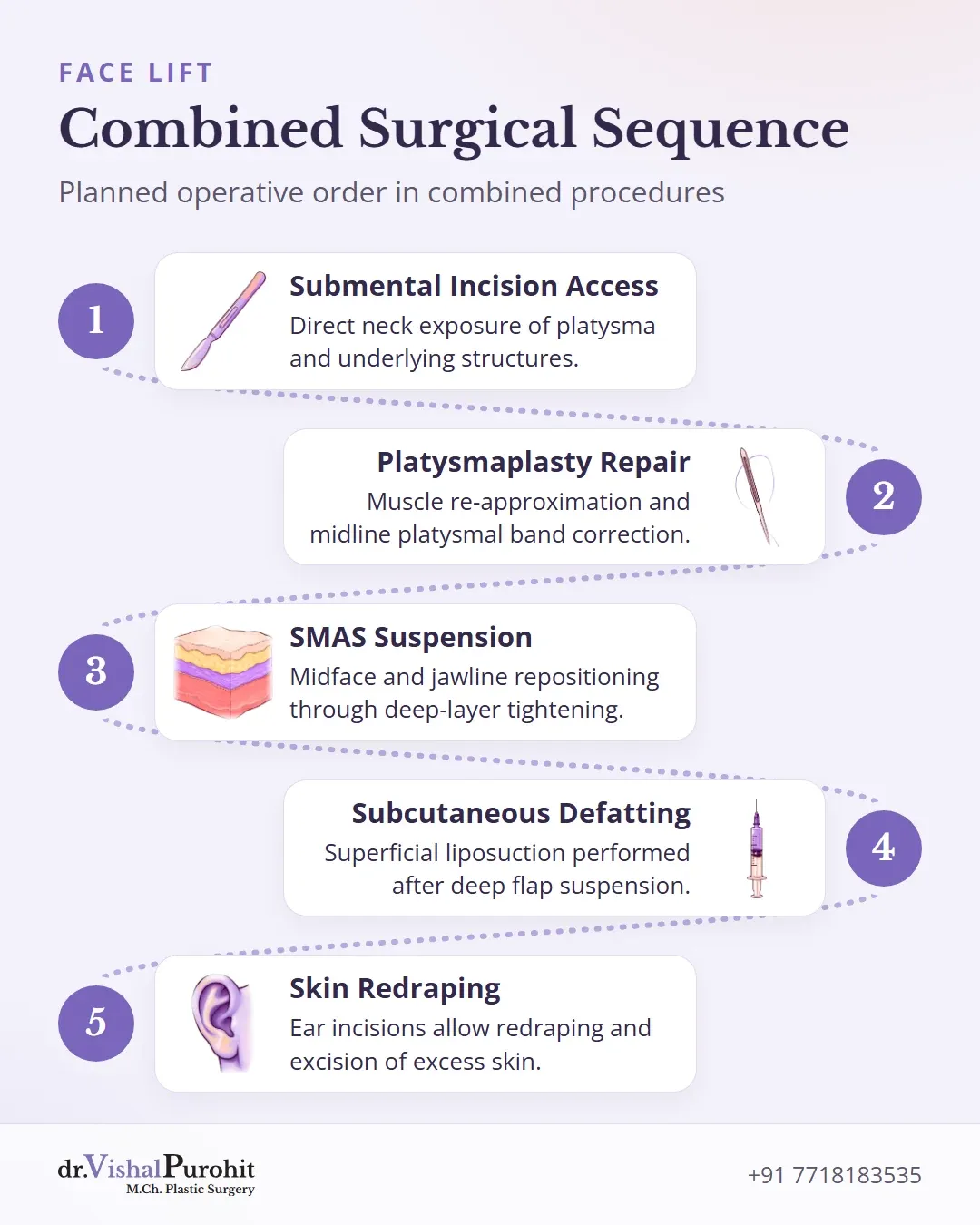
Submental liposuction can be performed alone or as an adjunct to a formal neck lift with platysmaplasty or facelift to improve submental and lower facial contour23. When tumescent liposuction is used, it may target the anterior neck, lateral neck, and inferior mandibular border24. The presence of platysmal banding and subplatysmal fat is inadequately addressed by submental liposuction alone23.
In combined procedures, cervical subcutaneous lipectomy or liposuction is typically performed after deep neck maneuvers and suspension of the SMAS and platysma26. Removing subcutaneous fat beforehand risks excising tissue that shifts upward during flap suspension, potentially creating irregular mandibular contours26.
The Limits of Removing Fat When the Skin Is Loose
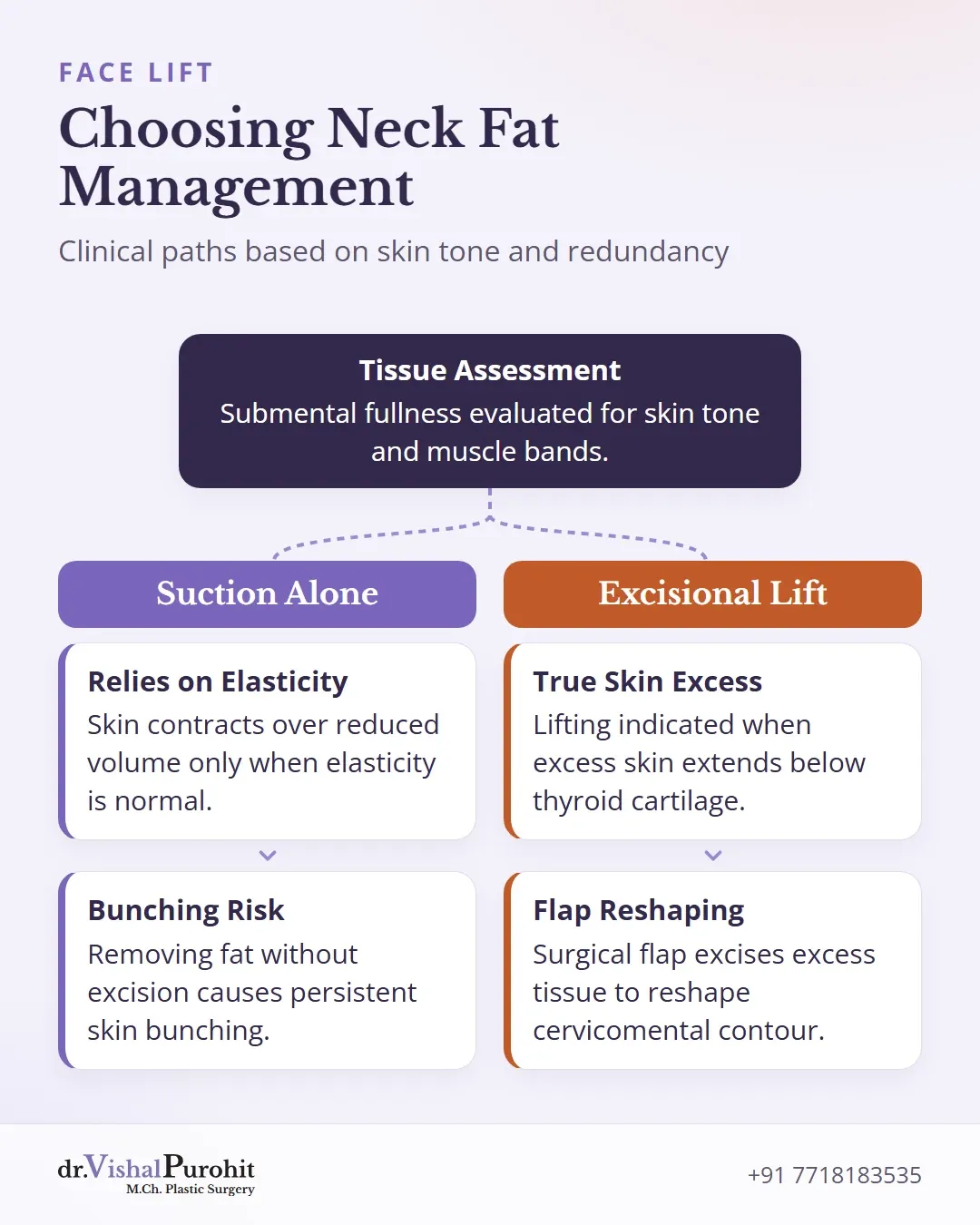
Removing excess submental fat improves neck definition only when overlying tissues can adapt to the smaller contour. In isolated suction-assisted liposuction, fat is extracted through small punctures, relying entirely on the skin’s inherent elasticity to retract over the deeper anatomy27.
Key points
- Neck liposuction only works when skin can retract over the reduced volume.
- Loose or inelastic skin often fails to redrape after fat removal, leading to folds or pleating.
- Surgical lifting with platysmaplasty is needed when skin excess extends below the thyroid cartilage.
When elasticity is normal, skin can contract and redrape over the reduced volume272829. However, this response diminishes when tissues lack firmness or when excess skin is already present:
- Inelastic or redundant skin often fails to redrape after removing moderate to large fat deposits30.
- Taking away volume without skin resection can cause persistent skinfolds, bunching, or pleating, most commonly in the submental area29.
- Inappropriate candidates for neck liposuction alone include individuals with prominent wrinkling, muscular sling laxity, or platysmal banding30.
- Failure of skin retraction after liposuction typically stems from patient selection rather than technical error, leaving loose hanging skin that often requires excisional surgery31.
When true skin excess extends below the thyroid cartilage or skin tone is compromised, lifting is indicated32. Rather than relying on simple fat removal, addressing redundant skin requires incisions around the ears and elevation of a surgical flap to excise redundant tissue and reshape the cervicomental contour2932. In Jaipur, Dr. Vishal Purohit performs surgical lifting, with platysmaplasty when the neck needs it.
Why a Perfect Neck Angle Cannot Be Promised
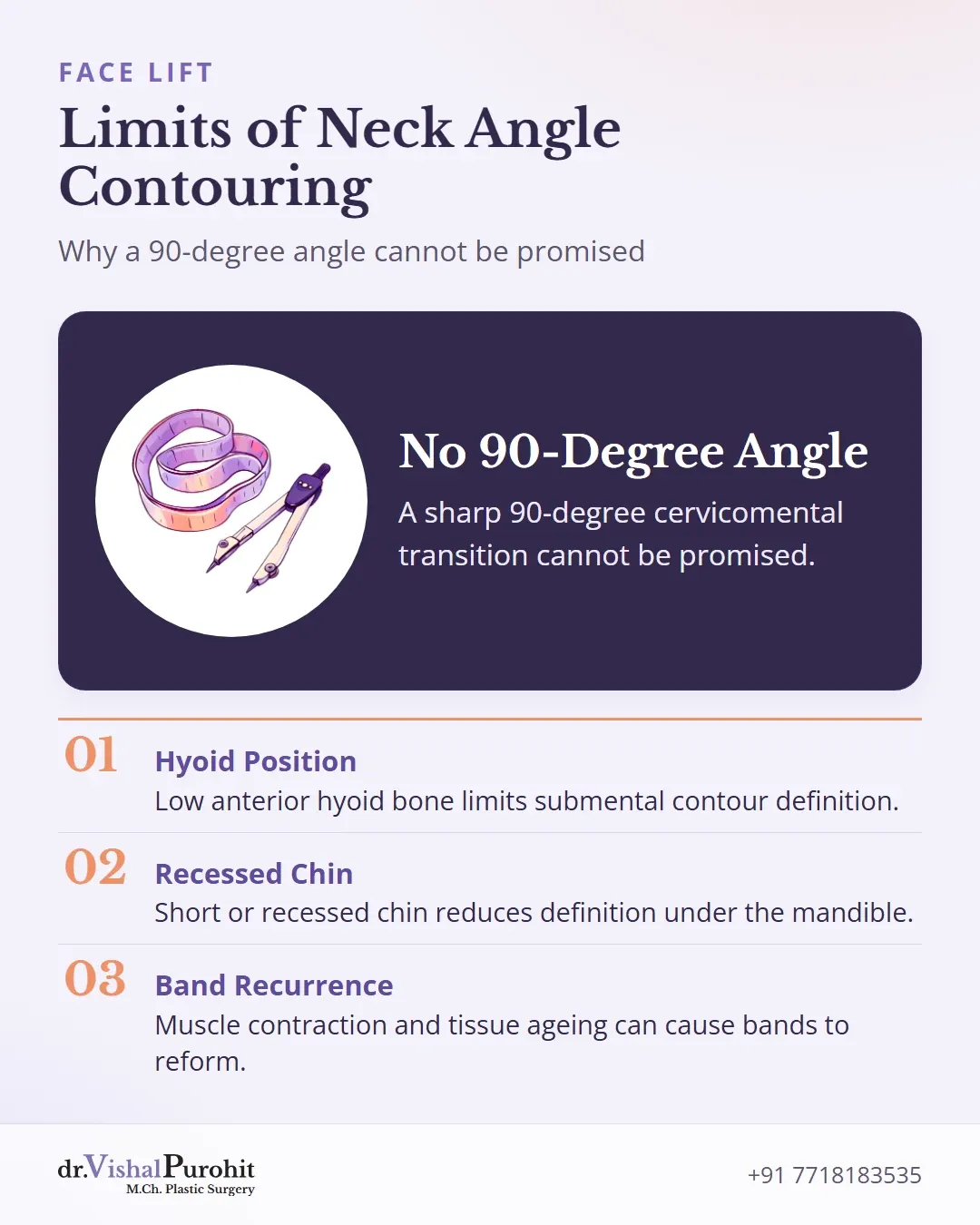
In face and neck lift planning, underlying anatomy sets strict boundaries on the final profile. A sharp, right-angled transition between the chin and the neck cannot be guaranteed, and Dr. Vishal Purohit never promises a 90-degree neck angle to patients.
Anatomical Limits: Chin and Hyoid Position
The cervicomental angle depends directly on the bony and cartilaginous framework beneath the skin33:
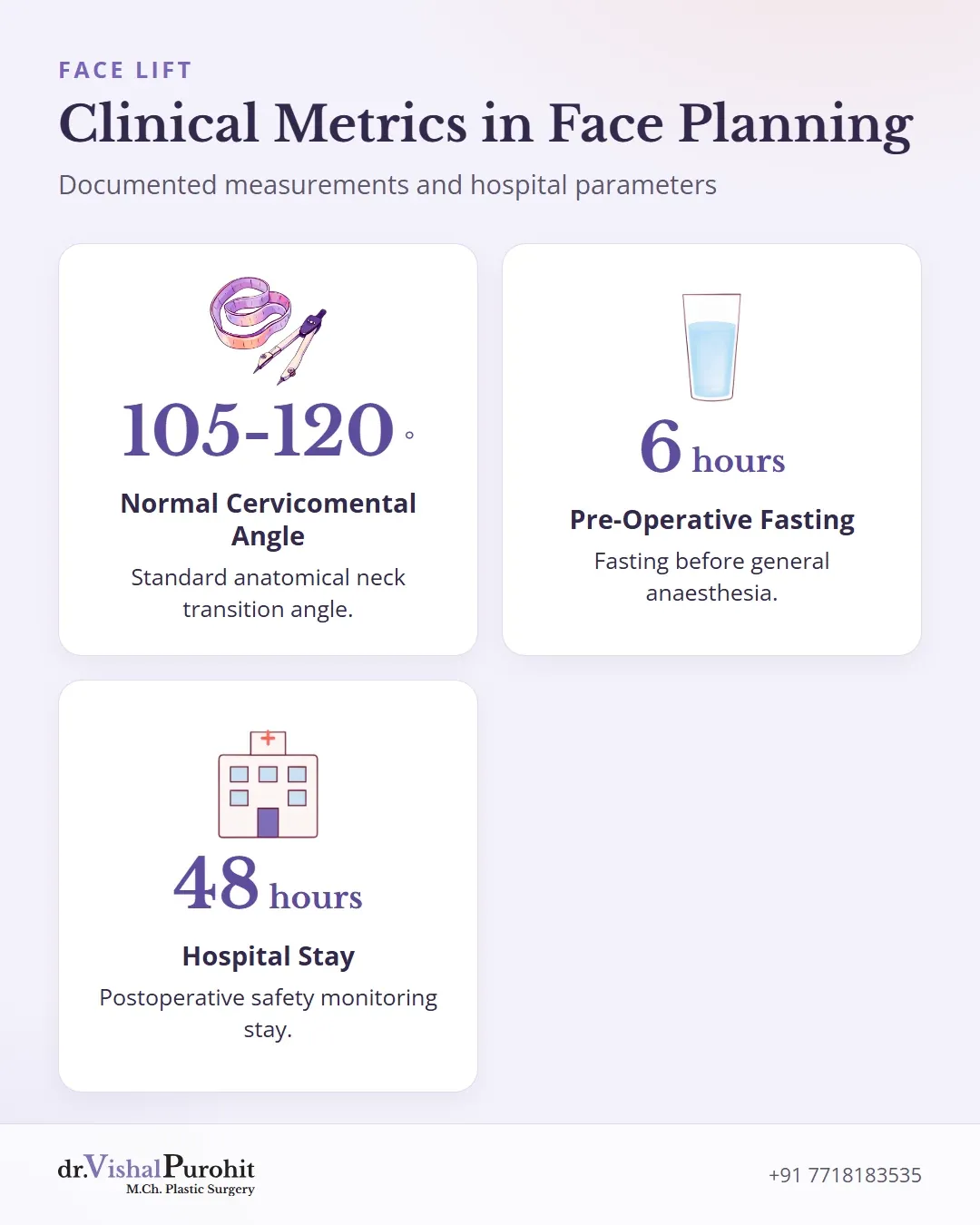
- Hyoid bone position: A normal cervicomental angle measures between 105° and 120°34. When the hyoid bone sits low and anteriorly, it creates an obtuse angle that soft-tissue surgery alone cannot fully sharpen3334353637.
- Chin projection: A short or recessed chin (microgenia or retrognathia) reduces submental definition, limiting how dramatic the neck contour will appear333536.
Platysma Bands and Non-Surgical Options
Platysma bands may also recur over time3839. Vertical muscle contraction and age-related tissue degeneration can cause banding to reform even after surgical repair38. Furthermore, uninterrupted lateral muscle retains the potential to form new bands40.
Dynamic neck bands become prominent upon muscle activation due to platysma hyperfunction41. For dynamic bands caused by muscle movement, Dr. Vishal Purohit offers Botox as a non-surgical option in Jaipur. However, Botox addresses muscle hyperactivity rather than loose skin; it cannot lift sagging cervical tissues or replace surgical tightening.
Consulting for Face and Neck Rejuvenation in Jaipur
Surgical planning for the lower face and neck requires evaluating skin elasticity, muscle laxity, and structural anatomy. For patients considering facelift surgery in Jaipur, an in-person assessment determines whether addressing both areas together will produce balanced results. Reviewing common facelift FAQs can provide further clarity regarding surgical options and structural corrections.
This is educational information, not medical advice.