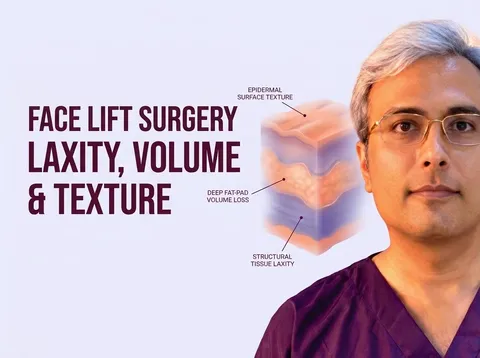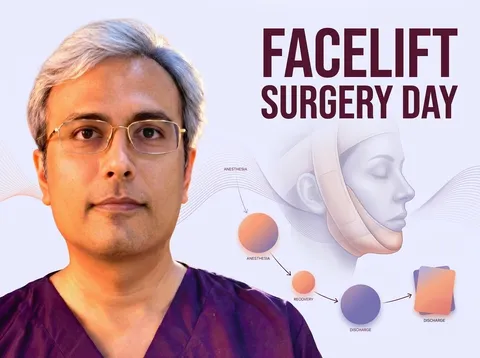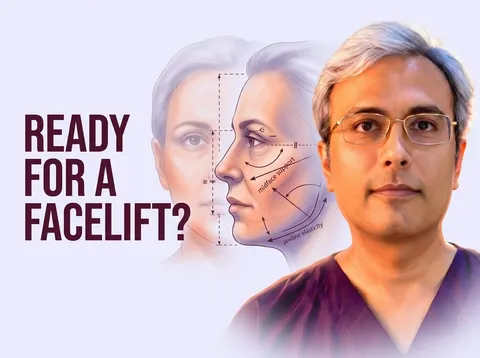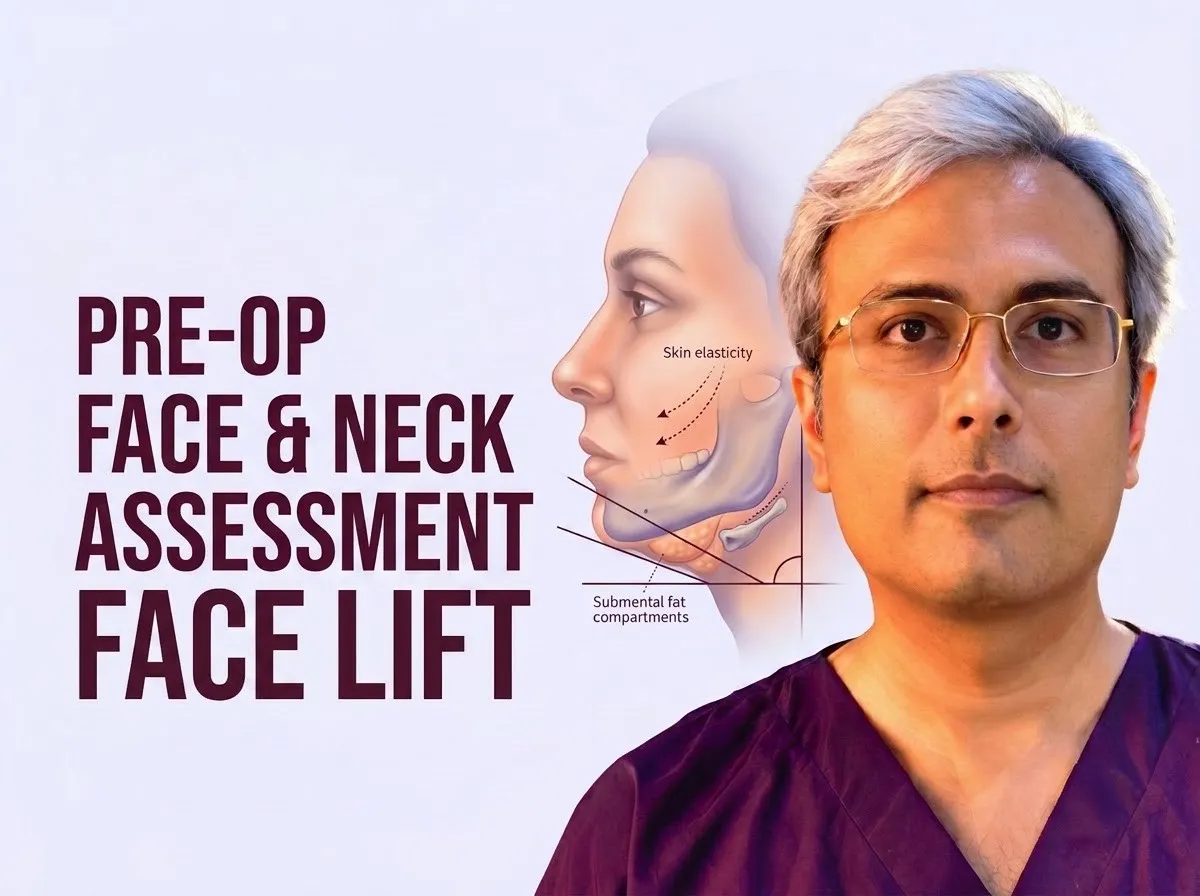
Ageing alters facial layers at different depths, creating skin laxity, descending muscle layers, and diminished volume. Distinguishing between these factors helps determine whether structural repositioning or non-surgical options are appropriate.
During consultation for facelift surgery in Jaipur, Dr. Vishal Purohit carefully evaluates these underlying anatomical changes to determine whether surgical repositioning is indicated.
Evaluating the lower face and neck requires examining the jawline, platysma muscle, and natural asymmetry before agreeing on realistic surgical expectations. Patients can explore Am I Ready for a Facelift? Health, Age and Realistic Goals to understand foundational considerations before an operative evaluation.
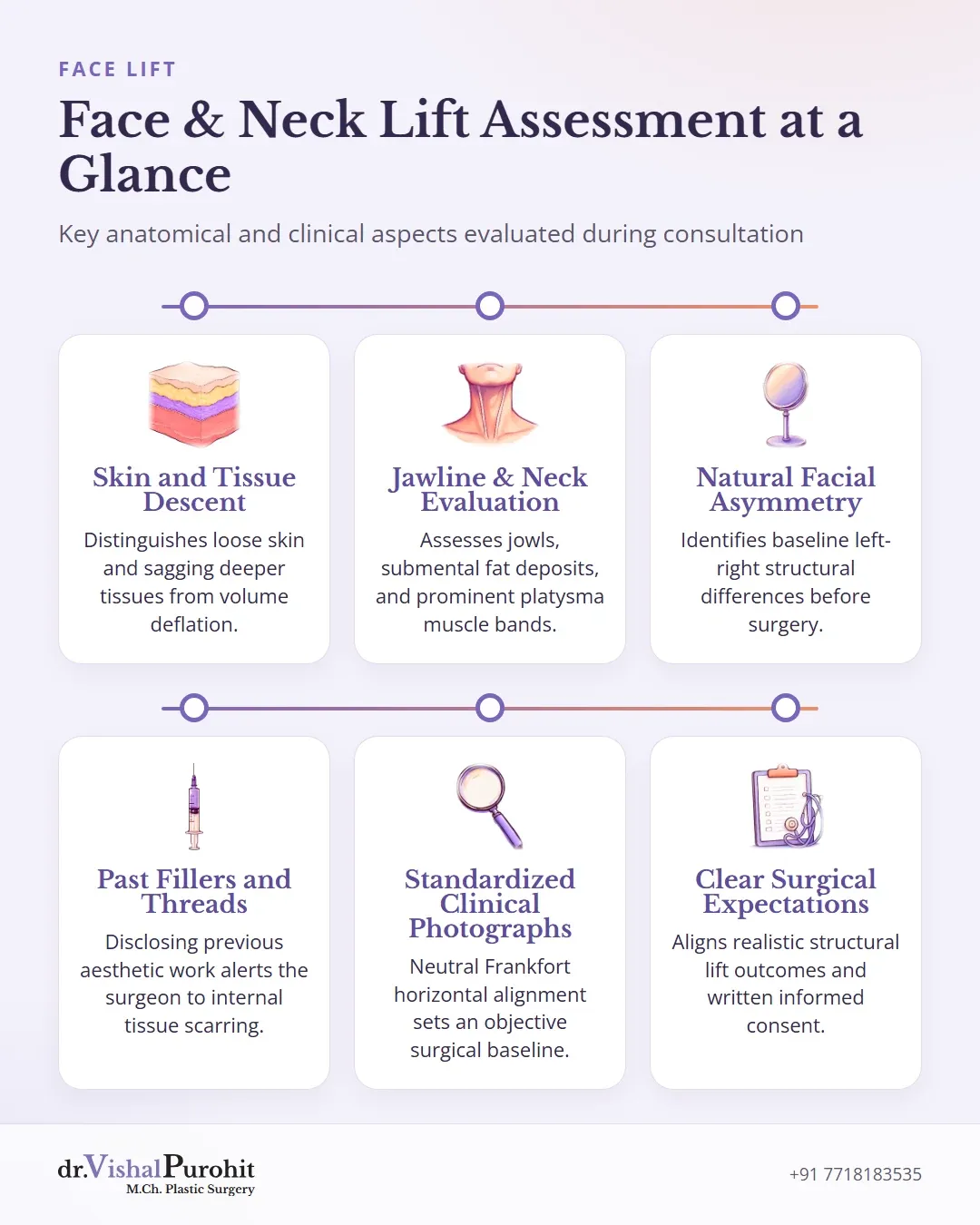
Loose Skin, Descended Tissue or Lost Volume
Facial ageing involves a combination of skin surface changes, soft tissue sagging, and volume loss1. During a consultation, a plastic surgeon must distinguish between these three factors because each requires a distinct surgical or non-surgical solution.
Distinguishing the Three Components
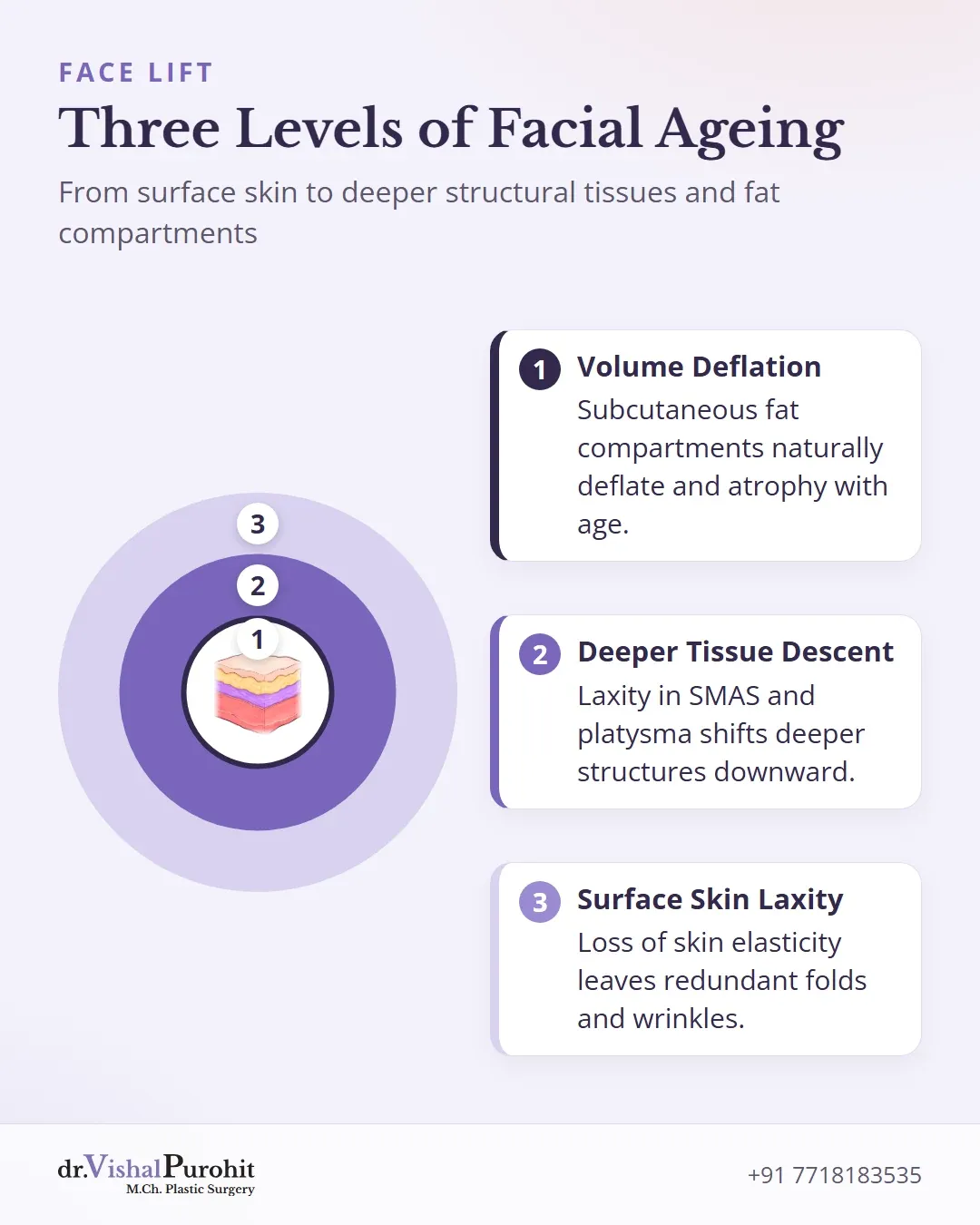
Each element of facial ageing manifests through distinct physical changes:
Skin laxity
Ageing and sun damage cause the skin to lose elasticity and recoil12. While trimming redundant skin addresses loose tissue, residual elasticity limits how smooth it remains over time1. Facelift surgery cannot pull out fine surface wrinkles3.
Why the Plan Depends on What Is Present
The surgical plan directly reflects which structural change dominates:
- Addressing descent and laxity: When sagging of the deeper structures and redundant skin are the primary findings, surgical repositioning is needed3.
- Addressing volume loss: Simply tightening skin over an area of deflated tissue does not restore lost fullness56. When volume deficit is identified, soft tissue fillers provide a non-surgical option.
Dr. Purohit’s note: In Jaipur, Dr. Vishal Purohit performs SMAS plication and suspension facelift surgery to elevate descended deeper tissues, with cervicofacial platysmaplasty when the neck requires support. If structural fat grafting is needed, Dr. Vishal Purohit performs it as a separate procedure a few months later rather than combining it with the face lift.
Jawline, Neck and Facial Asymmetry
Evaluating the lower face and neck is essential before planning a face lift78. Dr. Vishal Purohit assesses each anatomical layer to determine how the underlying structures contribute to age-related changes and what surgical adjustments are needed.
Key points
- Evaluating each anatomical layer of the lower face and neck determines the necessary surgical adjustments before a face lift.
- Clinical examination methodically checks jowl laxity, fat distribution, platysma muscle bands, and skin quality.
- Identifying pre-existing natural facial asymmetry during consultation helps set realistic expectations, as underlying structural differences remain after surgery.
Clinical Examination of the Jawline and Neck
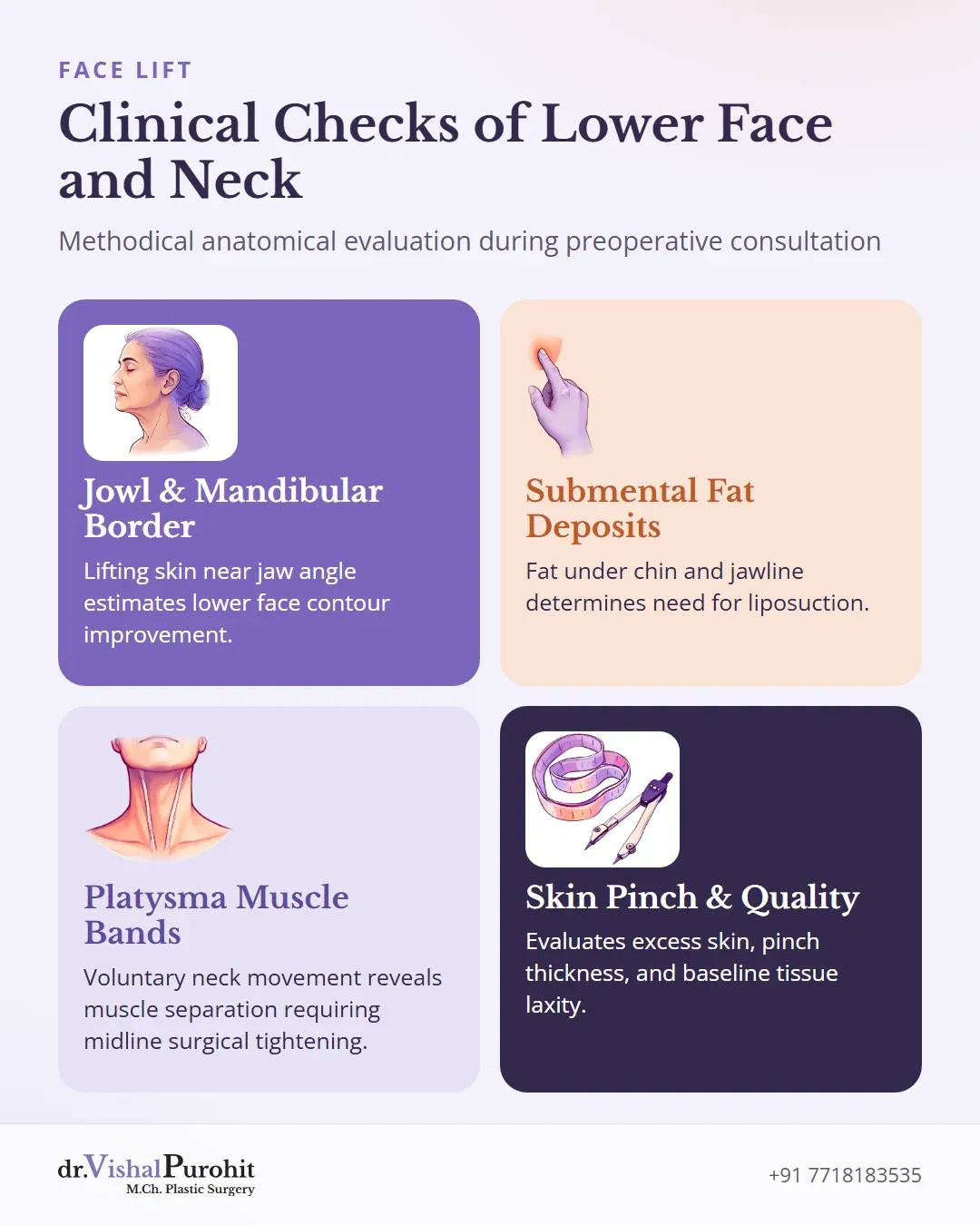
During the preoperative assessment, the lower face and neck are checked methodically9:
- Jowl area and mandibular border: The jawline is inspected for tissue laxity, contour, and fullness9. Gently lifting the skin near the angle of the mandible provides a guide to potential improvement in the lower third of the face9.
- Fat distribution: Deposits under the chin (submental fat) and along the lower border (submandibular and jowl fat) are evaluated to see whether fat resection or liposuction is indicated89.
- Platysma muscle and bands: Voluntary movement helps show platysma bands, muscle separation, and subplatysmal fat9. Prominent, divergent muscle edges along the neck may need surgical approximation through a submental incision10.
- Skin quality: The degree of excess skin, pinch thickness, and skin laxity are noted79.
Identifying Pre-existing Facial Asymmetry
Natural differences between the left and right sides of the face exist in every person1112. These differences involve uneven bone structure, eyelid position, and muscle movement12.
Patients often do not notice their natural asymmetry before surgery1113. During the preoperative consultation, Surgeons commonly point out these variations before surgery, for example in front of a mirror111415. This discussion prevents misunderstandings later, as pre-existing structural asymmetry remains present after surgery1112.
Previous Fillers, Threads and Earlier Surgery
During the initial consultation in Jaipur, disclosing all prior aesthetic treatments helps plan a safe face lift. Previous dermal fillers, thread lifts, or surgical procedures can alter underlying tissue layers and change natural surgical planes.
Anatomical Changes and Scarring
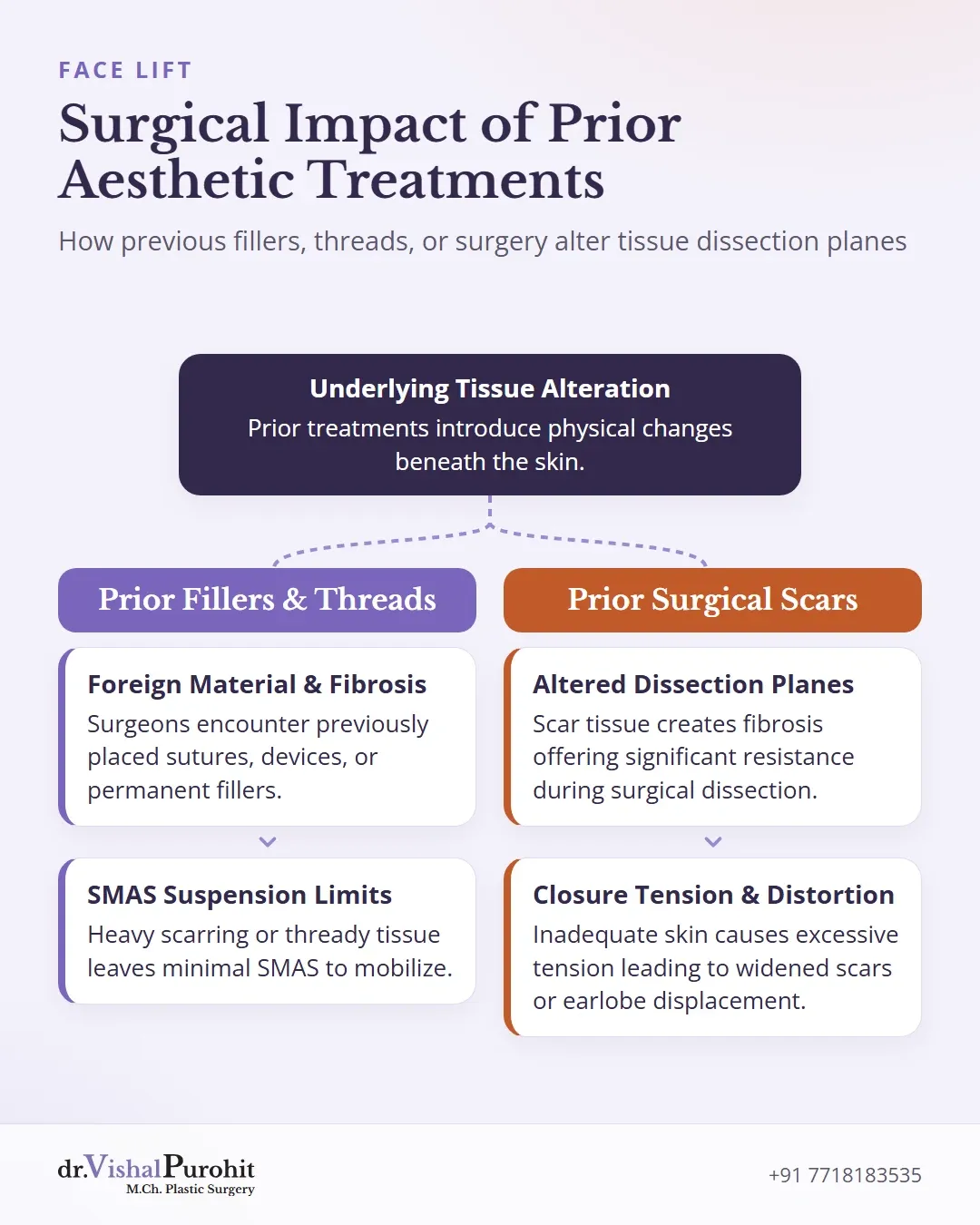
Prior interventions introduce physical changes beneath the skin:
- In revision surgery, scar tissue can alter tissue planes; it may form a glide plane that dissects simply, or extensive fibrosis that offers significant resistance during surgical dissection16.
- Heavy scarring or thready tissue may leave minimal superficial musculoaponeurotic system (SMAS) to mobilize or suspend1617.
- Scarring from subcutaneous and SMAS dissection can produce false skin excess or restrict skin available for resection18.
- Surgeons may encounter previously placed sutures, devices, or facial implants16.
- Previous surgery can cause deformities, hypertrophic scars, lobular changes, or altered hair patterns1618.
- Permanent facial fillers represent a recognized surgical challenge during facelift procedures19.
Re-incising past scars carries specific risks, including hair-bearing changes, tragal distortion, or earlobe displacement1618. Simple scar excision combined with aggressive undermining can leave inadequate skin, causing excessive closure tension that may lead to scar widening or hypertrophy20.
At consultation, the surgical team explains how previous aesthetic history is incorporated into individualized operative planning.
Photographs and Agreeing Realistic Targets
Standardized clinical photography forms a permanent baseline record before a face and neck lift2122. Images are captured in standard views—including frontal, left and right oblique, and left and right lateral angles2123. For accurate comparison, these photographs require a consistent head position along the Frankfort horizontal plane, with hair secured away from the face, jewelry removed, and the ears clearly displayed2223. In facial rejuvenation, maintaining this neutral alignment prevents patients from lifting their chin, which can falsely mask jowls or loose neck tissues24.
Setting Clear Expectations
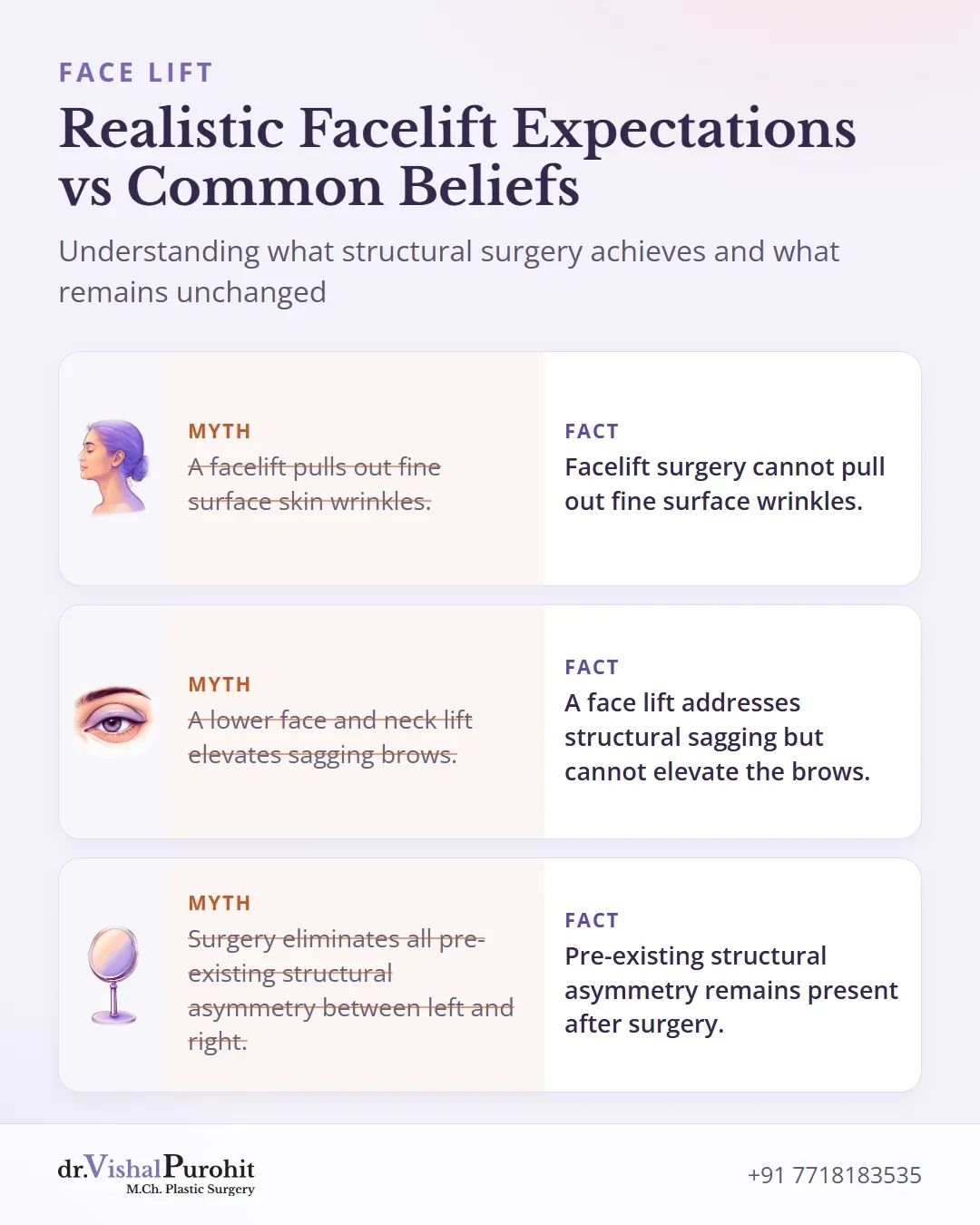
A primary goal of the preoperative evaluation is establishing realistic targets25. Dr. Vishal Purohit tells patients that facelift results last about a decade, while natural facial ageing continues. A face lift addresses structural sagging, such as jowling and neck laxity, but it cannot alter fine surface wrinkles or elevate the brows2326. Transparent discussions ensure that the patient understands what surgical repositioning can realistically achieve and what remains unchanged2526.
Written Informed Consent
The consultation concludes with a formal written consent process2527. Detailed documents explain the planned technique, expected recovery limitations, and potential surgical risks2527. In aesthetic surgery, no surgical outcome is guaranteed2627. The patient reviews these materials thoroughly and initials each section, confirming that all questions have been answered and realistic surgical goals are understood before proceeding27.
Questions to Ask at Your Consultation
A consultation is an opportunity to clarify surgical details, understand limitations, and ensure expectations are aligned with what an operation can achieve252829.
Checklist of Questions to Discuss
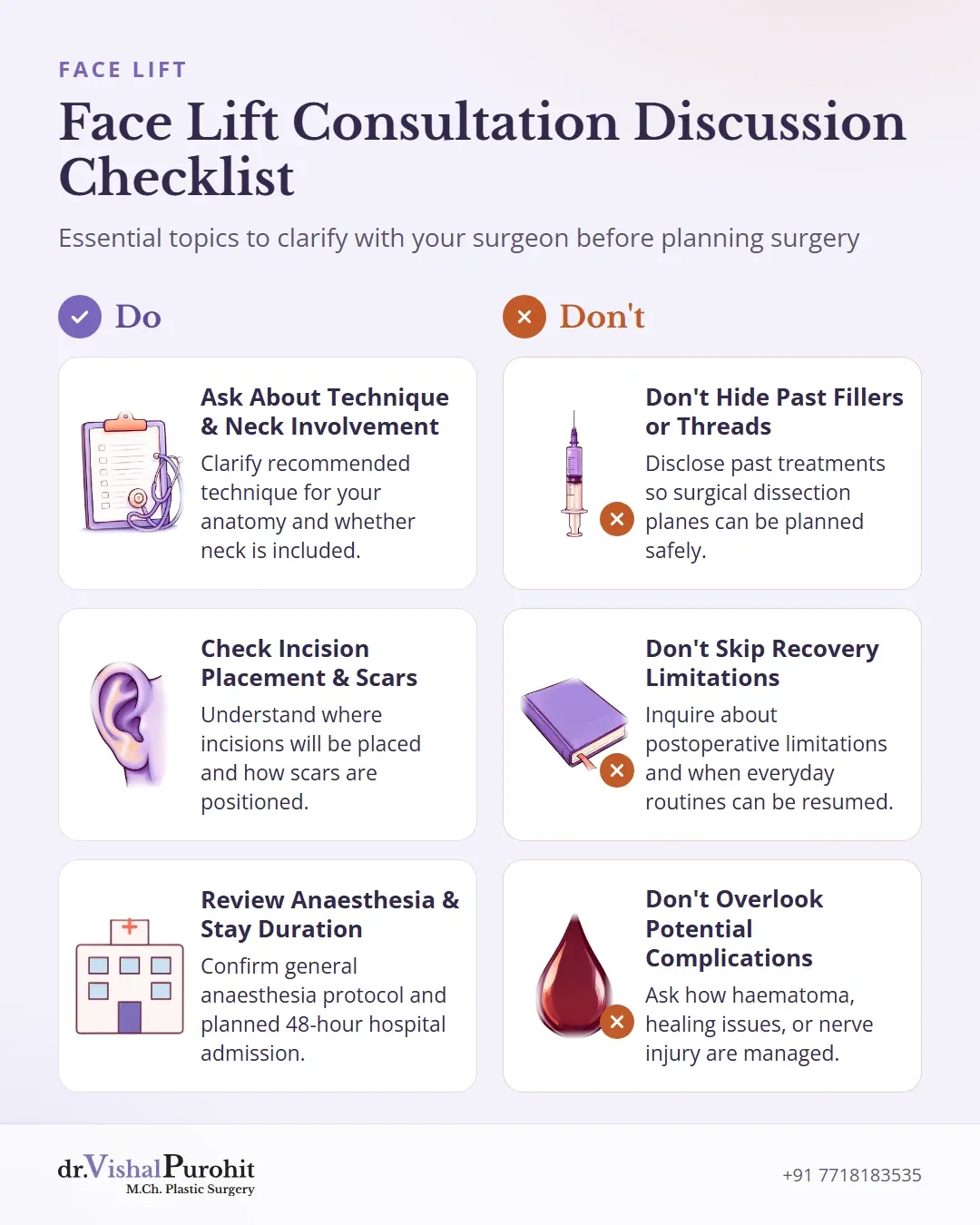
- Extent of the lift and neck involvement: Ask what technique is recommended for your facial anatomy, why it is chosen, and whether a neck lift is included2930.
- Incision placement and scars: Ask where incisions will be placed and how surgical scars are positioned3132. Inconspicuous placement is planned, but scarring remains an inevitable part of surgery32.
- Anaesthesia and hospital stay: In Dr. Purohit’s practice in Jaipur, a face and neck lift is performed under general anaesthesia with a 48-hour hospital stay.
- Recovery and daily life: Inquire about postoperative limitations and when everyday routines can be resumed25. Swelling, bruising, and numbness are probable sequelae that take time to settle3233.
- Risks and complications: Ask about potential complications, such as haematoma, healing issues, or nerve injury, and how they are managed if they arise32333435.
- Revisions: Discuss how potential touch-ups or revision procedures are approached if healing requires adjustment3436.
Scheduling a Face and Neck Lift Consultation in Jaipur
A comprehensive clinical evaluation ensures your surgical plan matches your unique facial anatomy and aesthetic goals. To explore operative techniques, surgical preparation, and common recovery questions, review our detailed guide to facelift surgery in Jaipur alongside our comprehensive facelift FAQs. Contact the surgical team to arrange your personalized assessment.
This is educational information, not medical advice.