
In short
- The Dufourmentel flap is a rhomboid flap variant that adapts its angles to wide or odd-shaped gaps.
- Its broad base keeps blood flow robust, guarding the far edge of the flap.
- This Jaipur clinic does not perform it — the page is literature context; Limberg and Karydakis flaps are offered.
Who this page is for
Pilonidal sinus is a frequently observed disease in young adult males. Wide or repeat tracts leave wide gaps after removal. Standard closures may not fit those gaps.
This page explains the Dufourmentel modification of the rhomboid flap. It is written for patients with extensive or repeat disease researching their options. It also helps families compare flap designs before a consult.
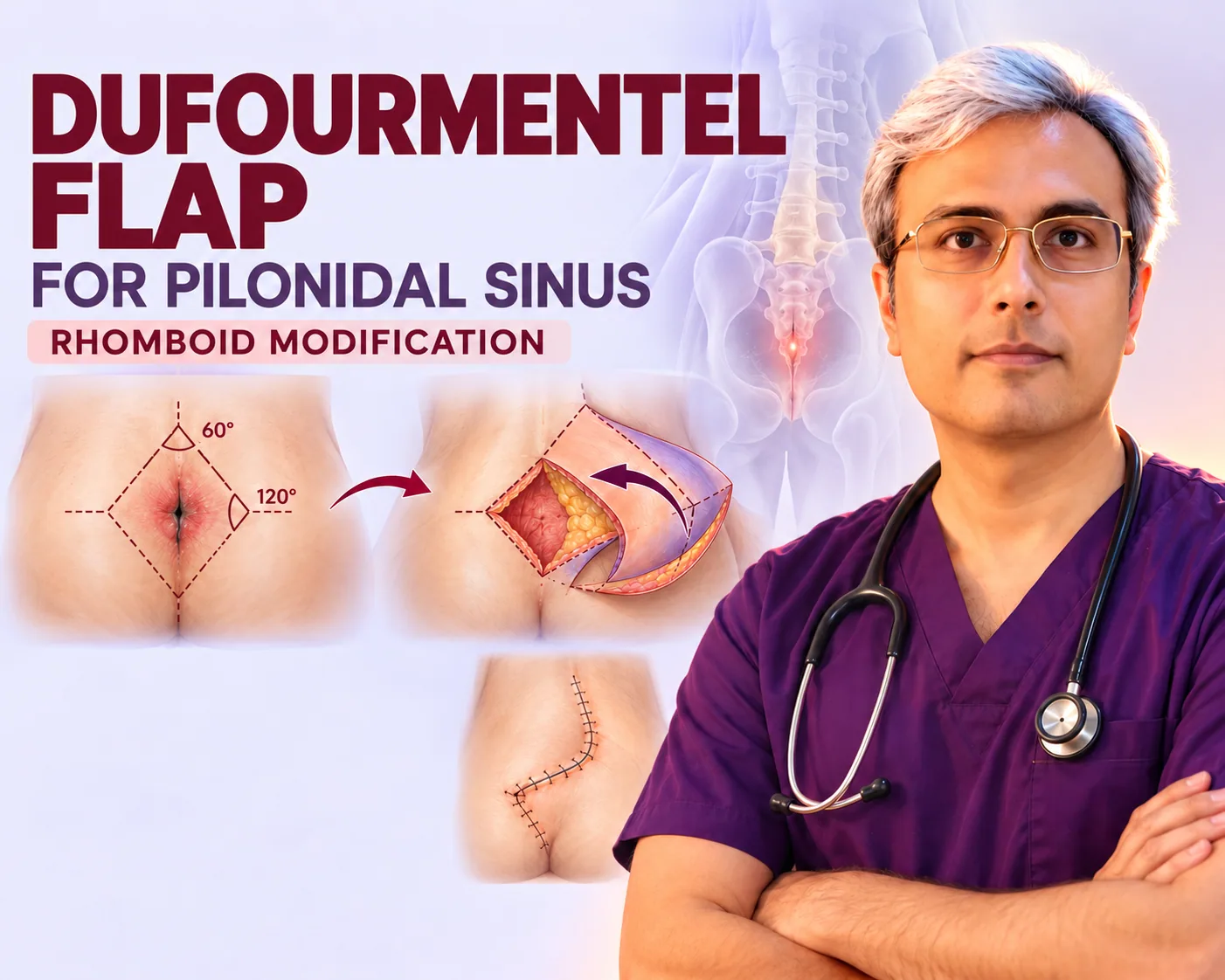
One fact matters first. The Dufourmentel modification of the Limberg flap is a variant of the rhomboid flap. Published series describe its use for extensive sacrococcygeal pilonidal disease. The Jaipur clinic describes it here as literature only.
How the shape adapts
The classic Limberg flap uses fixed 60-degree angles. That diamond fits neat, even defects well. Wide or lopsided gaps strain that fixed plan.
The Dufourmentel design frees the angles. It adapts the rhomboid internal angles for wider, non-60-degree defects. Each corner is drawn to match the actual gap, not a template.
Surgeons praise three traits in published reports:
- Simplicity of reconstruction — one-stage closure with local tissue.
- Flexibility — the shape bends to fit stiff or scarred edges.
- Good outcomes in recurrence rate — as reported in published series.
Drawing happens before anaesthesia. The patient stands so skin tension shows truly. Lines follow loose skin where possible. The scar then hides better and pulls less.
Size still matters. The cut must clear all diseased tissue with a small margin. Missed side branches seed repeat disease. Mapping with probe and, when needed, scans keeps the margin tight.
Marking follows a set order on the day. First the defect edge is drawn after full excision planning. Then the flap limbs are drawn to mirror that edge. Then the surgeon pinches the skin to test laxity. If the pinch feels tight, the angles open wider.
Wide defects often follow old failed surgery. Scar pulls skin in odd vectors. The Dufourmentel plan routes its limbs through the loosest nearby skin. This keeps the final join slack even in a scarred field.
Stiff tissue resists rotation. Gluteal skin near old scars barely stretches. The design answers by widening the flap base and shortening the rotation arc. Less twist means less pull on the far corner.
The modified Limberg type trims the lower tip near the anal verge. Dufourmentel planning uses the same care at its lower corner. Clean placement there keeps hygiene simple after healing.
For the design the clinic does use, patients can read about the Limberg flap rhomboid closure performed in Jaipur.
Why blood supply stays safe
Any flap lives or dies by blood flow. The far edge sits farthest from supply. Narrow-based flaps risk edge death there.
The Dufourmentel flap keeps a broad base. That broad flap base carries a robust pedicle. Blood reaches the far edge with margin to spare.
Three build steps guard the supply:
- Wide base — the flap stays broadly joined to its source tissue.
- No-twist transfer — the flap rotates into the gap without kinking its vessels.
- Tension-free join — edges meet loosely so tiny vessels stay open.
Deep stitches add safety. They anchor the flap base to firm tissue below. Dead space closes, so blood and fluid cannot pool and press on vessels.
A short-term drain backs this up. It draws fluid from under the flap for 24 to 72 hours. Less fluid means less pressure on the healing edge.
Smoking and diabetes threaten all flaps. Both narrow small vessels. Surgeons ask about both before any rhomboid plan. Control before surgery pays off after it.
Pressure is the silent threat. Sitting straight on a fresh flap squeezes its vessels flat. Side-lying and brief sits guard flow in week one. Short flat walks beat long chair hours.
Fluid is the second threat. A pocket of serum lifts the flap off its bed. New vessels cannot bridge a fluid gap. The drain plus light compression closes that gap until the flap sticks.
Week-by-week healing runs a known course. Week one brings drain removal and edge checks. Weeks two to three bring sealing and stitch softening. Months three to six bring the red phase, then slow fading to month eighteen.
Never ignore these after any flap
- Dusky, dark, or cold flap edges in the first days — possible blood-flow trouble
- Fast swelling under the flap, fever, or foul discharge
- Wound edges parting in the first two weeks
When surgeons choose it
Standard flaps cover most cases. The Dufourmentel variant enters for harder gaps. Published indications cluster in three groups:
| Situation | Why Dufourmentel fits | Usual alternative |
|---|---|---|
| Large defects | Angles adapt to wide, non-standard gaps | Limberg flap |
| Rigid nearby tissue | Flexible shape bends to stiff edges | Karydakis advancement |
| Multi-recurrent cases | Fresh geometry routes around old scars | Repeat Limberg or Karydakis |
Repeat disease needs extra care. Old scars distort the field. Tracts may run in new paths. A full probe map plus selective scans draws the true extent.
Patients comparing curved versus diamond scars can read about Karydakis flap surgery and its single off-midline curve. The contrast helps at the consult table.
Z-plasty is a different scar-redirection tool described in literature for pilonidal disease. It is not offered at this clinic. It appears here only so readers can place it — see the Z-plasty literature summary.
Choice always rests on anatomy. Pit rows, side spread, scar stock, and skin laxity steer the pick. No single flap fits all — that is exactly the gap Dufourmentel was drawn to fill.
Hair control follows every rhomboid closure. Trimming near — never on — the fresh line stops loose shafts bedding on raw skin. Once sealing is confirmed, often near week four, clinic-based laser cuts regrowth at the root.
Follow-up visits track edges, fluid, and redness while fixes stay small. Early redness gets wound care and review, not waiting. This watchful month decides whether the scar line stays thin or spreads.
Key figures from published series
- A published series of the modified Dufourmentel rhomboid flap in extensive sacrococcygeal pilonidal disease studied 42 patients (Acta Chirurgica Belgica).
- The same series reports rates of 7.1%, 2.4%, and 4.7% (reported rate for each endpoint as published).
- Figures come from one series — they describe that cohort, not a promise for any individual case.
What Dr. Vishal Purohit does in Jaipur
Dr. Vishal Purohit is an M.Ch plastic surgeon treating pilonidal sinus disease in Jaipur. He performs definitive Limberg and Karydakis off-midline flap surgery. If an acute infection needs urgent care, abscess drainage is available.
The clinic does not offer the Dufourmentel flap, phenol, SiLaC laser, endoscopic (EPSiT) clearance, pit-picking, Bascom lift, or Z-plasty. Dufourmentel appears on this page only as published-literature context for extensive disease.
Wide defects mapped at consultation are matched to the patient’s anatomy — most often a Limberg or Karydakis flap with layered closure, hidden skin stitch, short-term drain, and off-midline scar. Broader context sits in plastic reconstructive flap surgery for pilonidal disease. This is educational information, not medical advice.