
In short
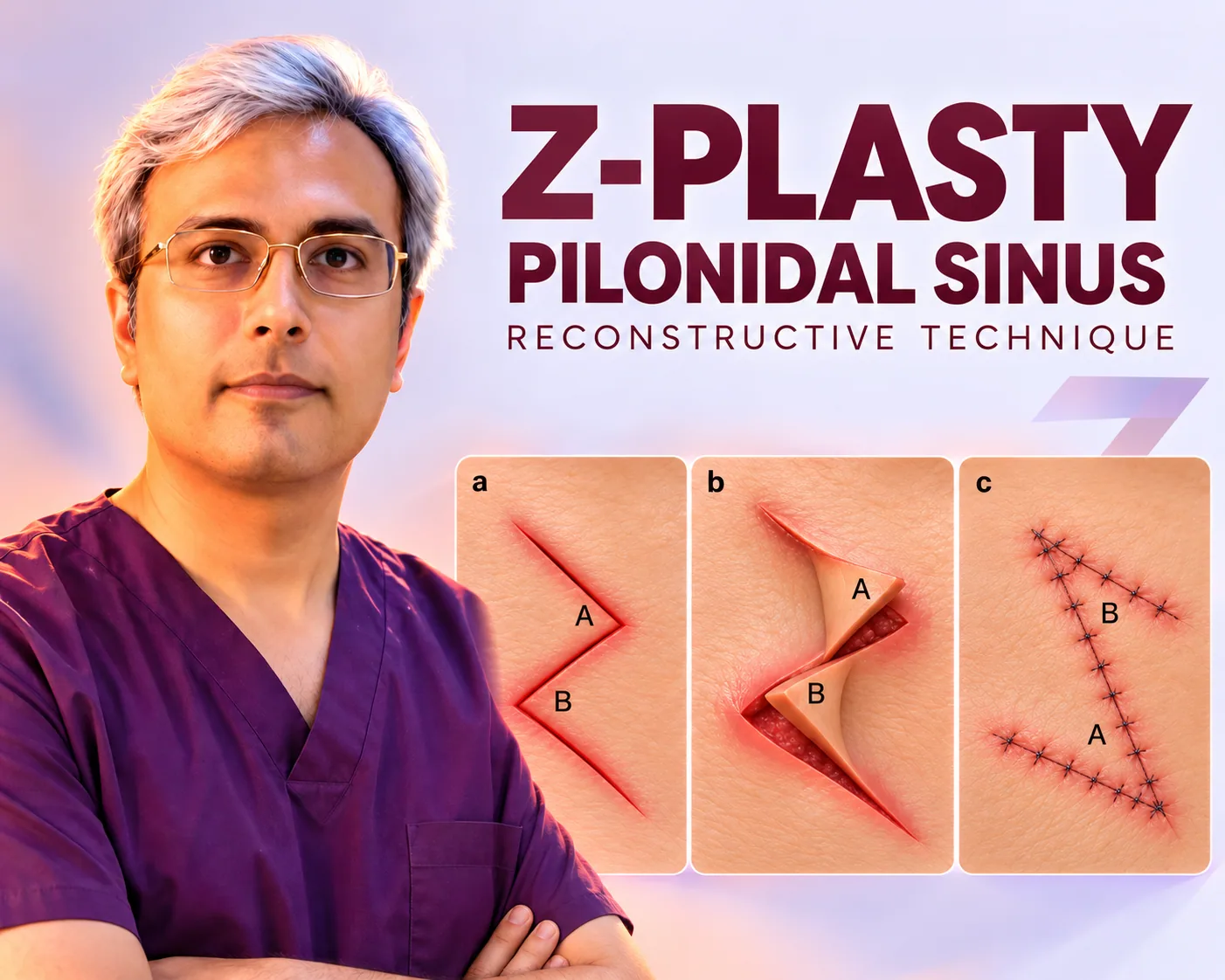
- Z-plasty swaps two 60-degree triangular skin flaps. The swap breaks scar pull, turns the scar off the midline, and shallows the cleft.
- Published series use it for mild to moderate disease and report low return rates, but the groups are small and single-centre.
- This clinic does not offer Z-plasty. Patients in Jaipur are matched to Limberg or Karydakis flap surgery instead.
Who this page is for
A pilonidal sinus is a tunnel infection near the tailbone. It mostly affects young adult men. Z-plasty is one closure method reported in the published pilonidal literature. The surgeon cuts a Z shape, lifts two small triangular flaps, and swaps their places.
This page is for patients who met the term Z-plasty while researching flap options. It explains the mechanics in plain words, the reported results, and where the method sits among rival flap shapes. It serves both first-time patients and return-disease patients reading about salvage options.
Surgeons outside pilonidal care know the Z-plasty well. It is a classic plastic surgery tool for releasing tight burn scars, opening contracted neck bands, and redirecting scar lines across joints. Its use in pilonidal disease borrows the same logic: a straight scar in a high-movement zone fails, while an angled scar sharing load across two flaps survives. Knowing this history helps patients judge the method as one proven tool among several, not a new experiment.
One fact runs the whole page. Dr. Vishal Purohit performs definitive Limberg flap and Karydakis flap surgery in Jaipur, plus urgent abscess drainage. Z-plasty, phenol, laser, endoscopic, pit-picking, Bascom, and Dufourmentel methods are described here only as published background. Patients in Jaipur are assessed for Limberg or Karydakis repair linked to cleft depth, disease map, and scar history.
How the 60-degree swap works
The design starts with a drawing on skin. After the sinus block is cut out, the surgeon marks a central limb across the gap. Two side limbs of equal length leave it at 60 degrees. The three lines form the letter Z.
Cutting along these lines lifts two triangles of skin with fat below. Each triangle keeps its base, and blood reaches it through that base. The surgeon lifts both flaps, turns each into the other bed, and stitches them in swapped places. Because both triangles match in size, they exactly fill each other gaps. The straight wound becomes an angled scar that no longer runs along the old line.
The 60-degree angle is the taught standard in plastic surgery. Its effects are measured, not guessed:
- Length gain. The swap at 60 degrees lengthens the central line by about three-quarters of the limb length. This releases the tight band and lets stiff scar stretch.
- Borrowed slack. Tissue comes into the gap from the side direction. A wound that would not close without pull gains slack taken from soft side skin.
- Shared pull. Strain spreads across two broad flaps instead of cutting at thin wound edges.
Reports credit this sharing for why Z-plasty closure sits under less pull than a straight midline stitch of the same gap. The operation itself runs in a fixed order:
- Map the pits and side tracts, then cut the disease block down to the tailbone layer.
- Mark the Z limbs on proven healthy nearby skin.
- Lift both triangles full-thickness with fat, keeping the blood vessels feeding each base.
- Swap the flaps into each other beds without crushing forceps grip or dragging.
- Stop all bleeding, join the deep layer below to cut dead space, and close skin in layers with a suction drain.
Angle choice is a trade-off the surgeon makes on the skin. Smaller angles such as 30 degrees are safer for weak blood flow but gain little length. Larger angles near 90 degrees gain more length but risk starving the sharp flap tips. Sixty degrees sits between the two and is the angle most surgeons are taught first. This is why nearly every published pilonidal Z-plasty series uses the 60-degree design rather than inventing its own geometry.
Blood care decides success. Thin, stretched flap tips starve at the edges. Rough handling kills the rim. A blood pocket under the swapped flap lifts it off its bed. These are the same vessel rules that run every local pilonidal flap. Z-plasty simply applies them on a smaller twin design.
Three jobs of the swap
The transfer does three jobs at once in the cleft. Each one fights a known cause of return:
- It breaks the straight scar. A straight midline scar centres the pull of every step and sit-to-stand on one line. Reviews report such lines suffer stitch cut-through, softening, and splitting. An angled scar shares load across angled parts, so no single segment takes the full force and the classic tight band cannot form.
- It turns the scar off the midline. After the swap, the main scar limb lies angled on quieter, drier skin off the cleft floor. Cleft depth mixes peak moisture, friction, and germs — the setting where scars soften and shed hairs enter. Moving the scar out of that gutter answers the entry problem directly, though on a smaller scale than Limberg or Karydakis surgery.
- It shallows the fold. The swap pulls side fullness toward the midline floor and takes cleft depth with shifted tissue. A shallow valley holds less sweat, shows less weak skin to friction, and is easier to keep hair-free. One comparative study called Z-plasty cosmetically superior to the rhomboid flap in its own group — a finding that matches the smaller angled scar and kept hip shape.
Scale sets the limit of all three jobs. Two small triangles can ease a shallow fold but cannot rebuild a deep, rigid valley the way a full Limberg or Karydakis advancement can. This is why the literature keeps Z-plasty in the small-defect lane while assigning wide or scarred fields to larger builds. Patients should read the low return rates beside the small case sizes: the method succeeds where it is asked to do modest work.
The table below compares the three flap shapes discussed across this flap surgery options series:
| Feature | Z-plasty | Limberg flap | Karydakis flap |
|---|---|---|---|
| Suits | Small to medium gaps | Medium to large gaps | Medium to large gaps |
| Cleft flattening | Mild lift | Strong flattening | Strong flattening |
| Scar line | Small angled scar | Off-midline rhomboid lines | Off-midline curved line |
| Evidence base | Small single-centre series | Large pooled reviews | Large pooled reviews |
Seek early review after any flap closure if
- Fever starts, or the wound area turns hot and more painful.
- Redness spreads outward from the scar line.
- The drain fills with fast bright blood, or discharge turns foul-smelling.
When published series use it
Reports apply Z-plasty to mild to moderate primary disease. That means a local midline pit cluster with little side spread, a fairly shallow cleft that lifting can raise, and enough healthy nearby skin to build two living triangles. Wide side branches, broad old scars from past open surgery, or a very deep rigid cleft exceed what two small flaps can cover without pull. The literature sends such cases toward larger transfer or advancement builds.
The reported Z-plasty pilonidal series holds 18 studied patients. It carries a top reported rate of 90% (endpoint as published) plus low single-digit companion rates of 3.9% and 0.7% (endpoints as published). The report authors link the method with lower return rates and faster healing than comparators in their own studies. A comparative study of rhomboid flap versus Z-plasty treats both as local-flap options set for these size differences.
Read these numbers as single-hospital results, not pooled proof. The groups are small, follow-up periods differ, and no large multi-centre trial pits Z-plasty against Limberg or Karydakis flaps. One pooled review names Limberg and Karydakis repair as the two most used off-midline closure methods in pilonidal surgery. For office-level context only: the 2025 comparison of crystallized versus liquid phenol in 80 patients by Demir and colleagues sits on a separate level in the literature and is not performed at this clinic.
When a Z-plasty itself fails, salvage follows the same off-midline ladder upward. The small angled scar and its bed are removed with any remaining tracts, and a larger Limberg or Karydakis build takes over the closure. Revision after a small flap is usually straightforward because surrounding tissue remains largely unscarred. This fallback matters for consent: choosing a smaller operation first stays safe only when the larger rescue remains available and the surgeon can perform it.
Reported healing matches other closed off-midline repairs, not open excision. Patients often walk the same day and manage pain with standard tablets. Desk work returns in two to three weeks. The drain comes out in the first week once output falls. Full sport waits until six to eight weeks after wound review. The angled scar needs the same hair care during the healing months as any pilonidal closure, because the swap eases the cleft setting without erasing it. Notes on healing and scar looks across flap shapes sit in the companion guide.
Key figures from published series
- Z-plasty pilonidal series in the evidence index: 18 patients studied.
- Same Z-plasty series: top reported rate 90% (endpoint as published).
- Same series: low single-digit companion rates of 3.9% and 0.7% (endpoints as published).
- Report series link Z-plasty with lower return rates and faster healing than their study comparators; one analysis calls it cosmetically superior to the rhomboid flap in its own group.
Care in Jaipur: what the clinic offers
Dr. Vishal Purohit is an M.Ch plastic surgeon treating pilonidal sinus disease in Jaipur, performing definitive Limberg and Karydakis off-midline flap surgery. No phenol, laser, or endoscopic shortcuts; matched to your anatomy. Z-plasty is not among the offered procedures. Patients whose maps would suit a small transfer in the literature are instead assessed for a Limberg or Karydakis shape — the two most used off-midline methods in pooled evidence — chosen on cleft depth, gap width, side spread, and old scar lines.
At consultation the surgeon maps all pits, tracts, and scars, shows which offered flap shape moves closure off the midline most durably for that body, and gives a written plan covering anaesthesia, drain, dressings, and hair-care teaching. Sudden abscesses are drained first, with staged flap repair after swelling settles. Travelling patients get a plain timeline: marking at the mapping visit, day-care or short-stay surgery, drain removal in the first week, and reviews at one, three, and six weeks.
Mapping also rules out look-alike conditions before any flap is drawn. A low pit near the anal verge may prove to be a fistula-in-ano rather than pilonidal disease, and a hairless midline cyst may need a different plan entirely. Sorting these at the first visit spares patients the wrong operation. Only maps that confirm true pilonidal tracts move forward to Limberg or Karydakis scheduling with a written preparation list.
This is educational information, not medical advice.